REVIEW 2 major objections 5 minor 94 references
Quantum Internet in a Nutshell -- Advancing Quantum Communication with Ion Traps
T0 review · 2 major / 5 minor · reviewed 2026-08-06 · deepseek-v4-flash
Pith's one-line read An ion-trap quantum processor can emulate quantum key distribution protocols, complete with eavesdropping attacks, and use error-correcting codes to fingerprint the noise of the channel.
desk verdict A credible NISQ testbed paper with a genuinely new framework, but the headline QEC privacy-authentication claim outruns the evidence. read the letter →
The pith
A machine-rendered reading of the paper's core claim, the machinery that carries it, and where it could break.
The reading
What carries the argument
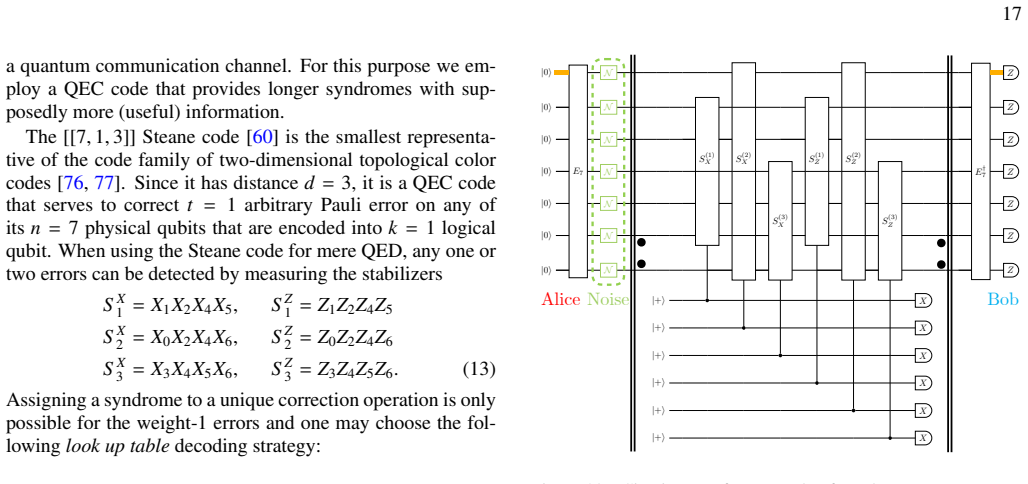
The load-bearing object is the QI-Nutshell mapping: a quantum communication scenario is translated into a circuit whose operations are executed by different parties at different times in a linear segmented ion trap with a single laser interaction zone, so that transfer of a qubit from Alice to Bob is represented by physical ion shuttling rather than by photon transmission. The second mechanism is the syndrome fingerprint: after encoding logical qubits with a stabilizer code, the measured distribution of non-trivial syndromes from repeated stabilizer measurements encodes the error channel's structure, and post-selecting on the trivial syndrome suppresses the logical error rate. The [[4,2,2]] code provides the post-selection example, while the [[7,1,3]] Steane code, which encodes one logical qubit in seven physical qubits and corrects one error, provides the six-bit syndrome statistics used to distinguish noise concentrated on one qubit from noise biased toward X errors.
What would settle it
Take a deployed fiber quantum key distribution link with characterized loss and detector efficiency, run the [[7,1,3]] syndrome-monitoring protocol on it, and compare the measured syndrome histogram with the one QI-Nutshell predicts from its injected-noise model; if the peak structure differs qualitatively, with wrong syndrome locations or a reversed ordering of the dominant syndromes, the noise-profile monitoring claim would fail for real channels. A simpler laboratory test would be to inject photon-loss-like noise via probabilistic shelving on the ion-trap hardware and check whether the measured Alice-Bob and Alice-Eve correlation curves still follow the no-cloning circle predicted by the emulation; a systematic departure beyond gate-error estimates would show that the mapping breaks down under realistic loss.
Extended reading notes
Core claim
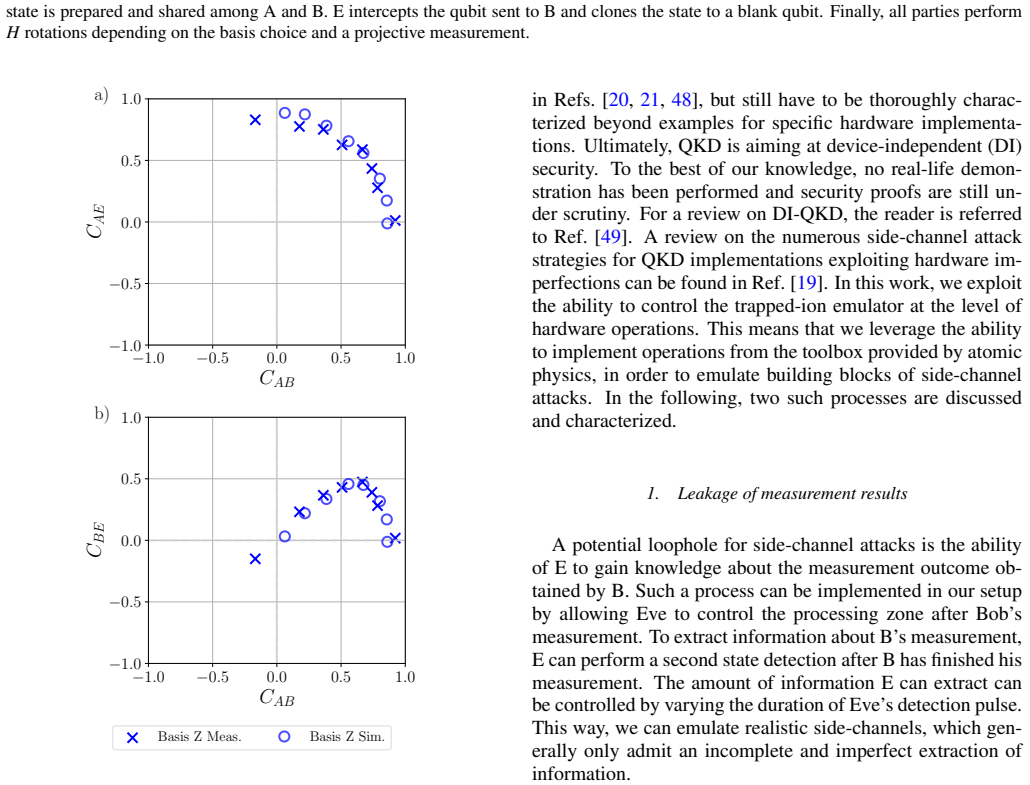
On its own terms, the paper claims that quantum communication protocols can be emulated on current trapped-ion hardware through the QI-Nutshell mapping, and that this emulation is good enough to reproduce known results about attacks on BB84 and BBM92: the measured correlations between Alice, Bob, and Eve follow the analytical curves for the phase-covariant cloning machine, with deviations of at most 12.9 percent attributed mainly to two-qubit gate errors, and numerical simulations with circuit-level depolarizing noise match the data. It further claims, from classical simulation, that small quantum error correction codes serve two purposes in a quantum key distribution pipeline: the [[4,2,2]] code suppresses the flip rate from linear to quadratic in the physical error rate through syndrome post-selection, and the [[7,1,3]] Steane code's syndrome distribution preserves the signature of the channel noise, such as single-qubit hotspots or Pauli-X bias, even with additional circuit-level noise, enabling channel noise monitoring. The paper concludes from this that quantum error correction may provide privacy authentication for quantum communication without modifying the transmitted quantum information.
Load-bearing premise
The whole approach rests on the assumption that executing a protocol as a circuit on trapped ions, with injected noise and no spacelike separation, behaves like the real photonic quantum key distribution deployment it is meant to represent; the paper itself states that it is an open question whether quantitative findings about actual physical realizations can be deduced from the emulations.
Editorial extensions
If this is right
- Quantum key distribution protocols that are usually implemented with photons can be executed and attacked on currently available trapped-ion NISQ hardware, giving experimental access to attack scenarios that formal security proofs do not cover.
- Errors deliberately injected at the quantum level make it possible to study how channel noise changes the correlations between Alice, Bob, and Eve, including regimes where an imbalanced cloner outperforms the phase-covariant cloning machine.
- Adding the [[4,2,2]] error detection code to the transmission pipeline lowers the qubit flip rate from linear to quadratic scaling in the physical error rate, at the cost of discarding runs with non-trivial syndromes.
- The syndrome distribution of the [[7,1,3]] code can serve as a monitoring signal: a channel whose noise profile deviates from the expected one would show up as a changed syndrome fingerprint, which is the basis for using quantum error correction as privacy authentication.
Reading between the lines
- If syndrome fingerprints are robust under realistic circuit noise, they could be turned into a quantitative security metric: two parties could compare syndrome histograms over an authenticated classical channel and set alarm thresholds for deviation, an extension the paper suggests but does not implement.
- The same QI-Nutshell mapping could run protocols beyond quantum key distribution, such as quantum secure direct communication or entanglement distribution over simulated repeater chains, since only the circuit representing the protocol changes.
- A multi-zone trap with spacelike separation between processing zones would allow emulating timing-based side channels and locality assumptions that the single-zone setup cannot capture.
- The claim that quantum error correction monitors eavesdropping will only be tested when the emulated noise models are validated against real fiber-based quantum key distribution implementations, since the paper's noise channels are ion-native and injected rather than photon-loss and detector-efficiency channels.
Editorial analysis
A structured set of objections, weighed in public.
Referee Report
Summary. The paper proposes and demonstrates "Quantum Internet in a Nutshell" (QI-Nutshell), a framework for emulating quantum communication protocols on a shuttling-based trapped-ion quantum computer. Hardware results include BB84 and BBM92 under phase-covariant and imbalanced-cloner attacks, injected Pauli noise, a quantum-circuit-learning optimization of an attack parameter, and hardware-level emulations of side-channel building blocks such as measurement-result leakage and biasing of Bob's detection. In numerical simulation, the authors study the [[4,2,2]] code for post-selected error detection and the [[7,1,3]] Steane code for syndrome-based channel-noise monitoring, and suggest that QEC could detect eavesdropping by revealing deviations from expected noise statistics.
Significance. If the claims are borne out, QI-Nutshell would be a useful NISQ-era testbed for prototyping QKD protocols, including attacks that are difficult to model analytically, and the syndrome-monitoring idea would give QEC a new cryptographic role. The hardware experiments are concrete, and the side-channel emulations via electron shelving, quench pulses, and optical pumping are original and parameterizable. The paper is appropriately cautious in places, explicitly flagging the transferability question in Sec. VI B, but the central eavesdropping-detection claim needs an adversarial test, and the emulation-fidelity validation needs quantitative strengthening.
major comments (2)
- [Sec. V.C and Abstract] The abstract and Sec. VI A claim that QEC can detect suspicious deviations from expected noise characteristics as a result of potential eavesdropping, but Sec. V.C contains no adversary. The evidence is a comparison of two fixed, non-adversarial noise maps (Fig. 24) and an AD-PD-Loss map (Fig. 25), presented as syndrome histograms. An eavesdropper is never included in the simulation, so it is possible that an Eve who tailors her attack to the expected syndrome distribution would be indistinguishable from ambient noise; no detection threshold, false-alarm rate, or statistical distance is computed. The text itself concedes that an appropriate metric would be desirable and that it would be interesting to further investigate the behavior of logical qubits in an attack scenario. The load-bearing privacy-authentication claim is therefore unsupported and should either be replaced by a noise-profile-monitoring claim or be tested against an explicit adversary with a decision-theoretic criterion.
- [Sec. IV A, Figs. 5, 6, 8] The quantitative basis for calling the emulation faithful is not established. In Fig. 5 the measured correlations deviate from the ideal values by up to 12.9% (7.3% average), and no error bars are shown. The numerical simulations use an asserted circuit-level depolarizing noise of strength p_d=0.01 (Eqs. (11)-(12)) rather than a noise model measured on the device. Fig. 8's caption states that for the imbalanced cloner most measured points lie closer to the ideal values than the p_d=0.01 simulations do, so the single chosen noise model is not even consistently conservative across the experiments. Given that the framework's value proposition is realistic emulation, a calibrated noise model or at minimum a much more cautious characterization of quantitative fidelity is required; the cautious wording in Sec. VI B should be reflected in the abstract.
minor comments (5)
- [Sec. I] There is a typo: "commericial" should be "commercial."
- [Figs. 5-8] The statistical uncertainty is described in the text as 0.022 in the worst case, but error bars are omitted for clarity; since the 12.9% deviation is used as a quantitative statement, confidence intervals or error bars should be displayed.
- [Sec. V.C, Fig. 24] The long syndrome labels on the horizontal axis are difficult to read; a compact notation or rotated labels would improve the figure.
- [Sec. V.C] The loss channel is invoked via stim's HERALDED_ERASE functionality without specifying its Kraus operators; a short definition or an explicit reference would make the simulation reproducible.
- [Code Availability] The statement that code is available from the corresponding authors upon reasonable request prevents independent reproduction; a public repository for the simulation scripts and data would strengthen the paper.
Circularity Check
No significant circularity; the central claims are independently benchmarked, with only a minor self-citation dependency in the reproduction of the imbalanced-cloner attack.
full rationale
The core derivations do not reduce to their inputs. The QEC-monitoring study (Sec. V) uses standard stabilizer codes ([[4,2,2]] and [[7,1,3]]), external simulators (stim, PECOS), and analytic error-counting checks (e.g., the acceptance floor 0.705 and the p_L ~ O(p^2) scaling), so the syndrome distributions are simulation outputs compared with known code properties rather than fitted parameters renamed as predictions. The experimental BB84/BBM92 correlation curves are checked against the independent PCCM formulas of Bruß et al. (Ref. [42]) and against numerical simulations. The main self-citation of note is Ref. [41] ('QKD as a Quantum Machine Learning task'), whose author list overlaps with the present paper (Ginter, Wormsbecher); Sec. IV states 'We verify known results from simulations found in Ref. [41]' and imports Eq. (5) ('From the calculation given in Ref. [41], we obtain the optimal tuning angle') for the imbalanced cloner. This is a reproduction of prior self-authored theory rather than a derivation that forecloses alternatives, and the paper's own hardware data in Fig. 8 provides independent confirmation of the predicted correlations. That dependency is not load-bearing for the paper's central QI-Nutshell/QEC-monitoring claims. The body also flags its own limits: Sec. VI B calls it 'an open question ... whether novel quantitative findings about actual physical realizations ... can be deduced from QI-Nutshell emulations,' and Sec. V.C ends with 'It would be interesting to further investigate the behavior of logical qubits in an attack scenario,' acknowledging that no eavesdropper was included in the QEC-monitoring simulations. The abstract's privacy-authentication language is therefore an extrapolation beyond the presented simulations, but that is a scope/overclaim issue, not a circular reduction.
Assumptions & free parameters
free parameters (3)
- Channel noise rate p =
0.1 (for bitflip and depolarizing channels in QEC simulations)
- Circuit-level depolarizing noise strength p_d =
0.01
- AD-PD-Loss channel parameters gamma, p_pd, p_l =
0.2 each
assumptions (5)
- domain assumption Standard QKD model assumptions: authenticated public classical channel, perfect random number generators, errors only in the quantum channel.
- standard math Stabilizer formalism and code properties of the [[4,2,2]] and [[7,1,3]] codes (distance, detectable errors, logical operators).
- domain assumption Pauli twirling transforms the amplitude damping channel into a non-uniform depolarizing channel (Eq. 16).
- ad hoc to paper A small circuit-level depolarizing noise of strength p_d=0.01 adequately captures the ion-trap hardware behavior.
- ad hoc to paper The syndrome distribution of a stabilizer code encodes enough information to distinguish an eavesdropper-induced disturbance from ambient channel noise.
Cite this review
Pith. "Pith review of Quantum Internet in a Nutshell -- Advancing Quantum Communication with Ion Traps." pith.science (2026). https://pith.science/paper/STOWIQYO
@misc{pith2026250714383,
  author       = {Pith},
  title        = {Pith review of: Quantum Internet in a Nutshell -- Advancing Quantum Communication with Ion Traps},
  year         = {2026},
  howpublished = {\url{https://pith.science/paper/STOWIQYO}},
  note         = {Machine review of arXiv:2507.14383}
}
read the original abstract
Quantum Internet in a Nutshell (QI-Nutshell) connects the fields of quantum communication and quantum computing by emulating quantum communication protocols on currently available ion-trap quantum computers. We demonstrate emulations of QKD protocols where the individual steps are mapped to physical operations within our hardware platform. This allows us to not only practically execute established protocols such as BB84 or BBM92, but also include cloning attacks by an eavesdropping party, noise sources and side-channel attacks that are generally hard to include in theoretical QKD security proofs. We deliberately inject noise and investigate its effect on quantum communication protocols. We employ numerical simulations in order to study the incorporation of small quantum error correction (QEC) codes into QKD protocols. We find that these codes can help to suppress the noise level and to monitor the noise profile of the channel. This may enable the communicating parties to detect suspicious deviations from expected noise characteristics as a result of potential eavesdropping. This suggests that QEC may serve as a means of privacy authentication for quantum communication without altering the transmitted quantum information.
Figures


Figures from the paper (19 more)






Reference graph
Works this paper leans on
-
[41]
QKD protected fiber-based infrastructure for time dissemina- tion,
A. Meda, A. Mura, S. Virzì, A. Avella, F. Levi, I. P. Degio- vanni, A. Geraldi, M. Valeri, S. D. Bartolo, T. Catuogno et al., “QKD protected fiber-based infrastructure for time dissemina- tion,” Scientific Reports15, 13419 (2025)
work page 2025
-
[1]
Such a process can be implemented in our setup by allowing Eve to control the processing zone after Bob’s measurement
Leakage of measurement results A potential loophole for side-channel attacks is the ability of E to gain knowledge about the measurement outcome ob- tained by B. Such a process can be implemented in our setup by allowing Eve to control the processing zone after Bob’s measurement. To extract information about B’s measurement, E can perform a second state d...
-
[2]
It can also be extended to investigate new approaches such as quantum machine learn- ing (QML)
Quantum circuit learning The QI-Nutshell framework does not only suit as a testbed for existing QKD attack protocols. It can also be extended to investigate new approaches such as quantum machine learn- ing (QML). It has been shown in Ref. [41] that quantum cir- cuit learning (QCL), a subdiscipline of QML, can be used to find optimal attacks on the BB84 p...
-
[3]
BBM92 In this section, we show the extension of the emulation of QKD protocols using the QI-Nutshell approach to the BBM92 protocol described in Sec. III B 2. The emulation is based on three trapped-ion qubits. The emulation circuit is shown in Fig. 10. A prepares an entangled Bell state and attempts to route one of the qubits to B. However, C intercepts ...
-
[4]
Within a QI-Nutshell emulation, by gaining control over the quantum processing zone before B’s measurement, E can bias the out- comes that B obtains
Biasing measurement outcomes Apart from gaining information about B’s measurement, E could also actively affect B’s measurement outcome. Within a QI-Nutshell emulation, by gaining control over the quantum processing zone before B’s measurement, E can bias the out- comes that B obtains. If E illuminates the ion with a laser pulse at 854 nm, referred to as ...
-
[5]
+zuaKKVQC6RWjaMbKVXKAIF+wO8=
We do not use these measurement results further in our analysis here. depolarizing noise E(ρ)=(1−p)ρ+ p 3 (XρX+YρY+ZρZ ),(11) with probabilitypand leaves the state unchanged with proba- bility 1−p, i.e., the chance to apply anX-,Y- orZ-flip isp/3 each. Since the application of stabilizer measurements gen- erally tends to decohere noise [71, 72], we deem t...
-
[6]
Simulating physics with computers,
R. P. Feynman, “Simulating physics with computers,” Int. J. Theor. Phys.21, 467 (1982)
1982
-
[7]
Polynomial-Time Algorithms for Prime Factorization and Discrete Logarithms on a Quantum Computer,
P. Shor, “Polynomial-Time Algorithms for Prime Factorization and Discrete Logarithms on a Quantum Computer,” SIAM Jour- nal on Computing26, 1484 (1997)
1997
Show all 94 references
-
[8]
Quantum Computing in the NISQ era and beyond,
J. Preskill, “Quantum Computing in the NISQ era and beyond,” Quantum2, 79 (2018)
2018
-
[9]
Quantum algorithms: A survey of applica- tions and end-to-end complexities,
A. M. Dalzell, S. McArdle, M. Berta, P. Bienias, C.-F. Chen, A. Gilyén, C. T. Hann, M. J. Kastoryano, E. T. Khabiboulline, A. Kubica et al., “Quantum algorithms: A survey of applica- tions and end-to-end complexities,” arXiv:2310.03011 (2023)
2023 arXiv
-
[10]
Polynomial-Time Algorithms for Prime Factoriza- tion and Discrete Logarithms on a Quantum Computer,
P. W. Shor, “Polynomial-Time Algorithms for Prime Factoriza- tion and Discrete Logarithms on a Quantum Computer,” SIAM Review41, 303 (1999). 21
1999
-
[11]
Noisy intermediate-scale quantum algo- rithms,
K. Bharti, A. Cervera-Lierta, T. H. Kyaw, T. Haug, S. Alperin- Lea, A. Anand, M. Degroote, H. Heimonen, J. S. Kottmann, T. Menke et al., “Noisy intermediate-scale quantum algo- rithms,” Reviews of Modern Physics94, 015004 (2022)
2022
-
[12]
Status of quantum computer developement,
F. Wilhelm, R. Steinwandt, D. Zeuch, P. Lageyre and S. Kirch- hoff, “Status of quantum computer developement,”www.bsi. bund.de/dok/study_status_quantum_computer(2024)
2024
-
[13]
Physical Layer Aspects of Quantum Commu- nications: A Survey,
S. Koudia, L. Oleynik, M. Bayraktar, J. u. Rehman and S. Chatzinotas, “Physical Layer Aspects of Quantum Commu- nications: A Survey,” arXiv:2407.09244 (2024)
2024 arXiv
-
[14]
A consolidated and accessible security proof for finite-size decoy-state quantum key distribution,
J. Wiesemann, J. Krause, D. Tupkary, N. Lütkenhaus, D. Rusca and N. Walenta, “A consolidated and accessible security proof for finite-size decoy-state quantum key distribution,” arXiv:2405.16578 (2024)
2024
-
[15]
Quantum Cryptography: an overview of Quantum Key Distribution,
D. Rusca and N. Gisin, “Quantum Cryptography: an overview of Quantum Key Distribution,” arXiv:2411.04044 (2024)
2024 arXiv
-
[16]
Quantum Key Distribution over Complex Networks,
L. Mariani, R. Yehia, C. Pascual-García, F. Centrone, J. van der Kolk, M. Á. Serrano and A. Acín, “Quantum Key Distribution over Complex Networks,” arXiv:2504.02372 (2025)
2025 arXiv
-
[17]
DemoQuanDT: A Carrier-Grade QKD Network,
P. Horoschenkoff, J. Henrich, R. Böhn, I. Khan, J. Rödiger, M. Gunkel, M. Bauch, J. Benda, P. Bläcker, E. Eichham- mer et al., “DemoQuanDT: A Carrier-Grade QKD Network,” arXiv:2503.21186 (2025)
2025 arXiv
-
[18]
Long-distance coherent quantum communications in de- ployed telecom networks,
M. Pittaluga, Y . S. Lo, A. Brzosko, R. I. Woodward, D. Scal- con, M. S. Winnel, T. Roger, J. F. Dynes, K. A. Owen, S. Juárez et al., “Long-distance coherent quantum communications in de- ployed telecom networks,” Nature640, 911 (2025)
2025
-
[19]
Quantum internet: A vision for the road ahead,
S. Wehner, D. Elkouss and R. Hanson, “Quantum internet: A vision for the road ahead,” Science362, eaam9288 (2018)
2018
-
[20]
Quantum Internet: Technologies, Protocols, and Research Challenges,
V . Kumar, C. Cicconetti, M. Conti and A. Passarella, “Quantum Internet: Technologies, Protocols, and Research Challenges,” arXiv:2502.01653 (2025)
2025 arXiv
-
[21]
Posi- tion Paper on Quantum Key Distribution,
French Cybersecurity Agency, Federal Office for Infoma- tion Security, Netherands National Communication Agency, Swedish National Communications Security Authority, “Posi- tion Paper on Quantum Key Distribution,”www.bsi.bund.d e/SharedDocs/Downloads/EN/BSI/Crypto/Quantum_Pos i...
2024
-
[22]
Quantum Key Distribution (QKD) and Quantum Cryp- tography (QC),
NSA, “Quantum Key Distribution (QKD) and Quantum Cryp- tography (QC),”www.nsa.gov/Cybersecurity/Quantum-K ey-Distribution-QKD-and-Quantum-Cryptography-Q C/, accessed: 2025-05-09
2025
-
[23]
QKD security proofs for decoy-state BB84: pro- tocol variations, proof techniques, gaps and limitations,
D. Tupkary, E. Y . Z. Tan, S. Nahar, L. Kamin and N. Lütken- haus, “QKD security proofs for decoy-state BB84: pro- tocol variations, proof techniques, gaps and limitations,” arXiv:2502.10340 (2025)
2025 arXiv
-
[24]
Implementation Attacks against QKD systems,
C. Marquardt, U. Seyfarth, S. Bettendorf, M. Bohmann, A. Buchner, M. Curty, D. Elser, S. Eul, T. Gehring, N. Jain et al., “Implementation Attacks against QKD systems,”www. bsi.bund.de/EN/Service-Navi/Publikationen/Stud ien/QKD-Systems/Implementation_Attacks_QKD_Syst ems_node.h...
2023
-
[25]
Imperfect detectors for adver- sarial tasks with applications to quantum key distribution,
S. Nahar and N. Lütkenhaus, “Imperfect detectors for adver- sarial tasks with applications to quantum key distribution,” arXiv:2503.06328 (2025)
2025
-
[26]
Intensity correlations in decoy-state BB84 quan- tum key distribution systems,
D. Trefilov, X. Sixto, V . Zapatero, A. Huang, M. Curty and V . Makarov, “Intensity correlations in decoy-state BB84 quan- tum key distribution systems,” arXiv:2411.00709 (2024)
2024 arXiv
-
[27]
International Organization for Standardization,Information se- curity — Security requirements, test and evaluation methods for quantum key distribution — Part 1: Requirements, ISO/IEC 23837-1:2023 (International Organization for Standardization, 2023)
2023
-
[28]
International Organization for Standardization,Information se- curity — Security requirements, test and evaluation methods for quantum key distribution — Part 2: Evaluation and testing methods, ISO/IEC 23837-2:2023 (International Organization for Standardization, 2023)
2023
-
[29]
Compact Ion-Trap Quantum Computing Demonstrator,
I. Pogorelov, T. Feldker, C. D. Marciniak, L. Postler, G. Ja- cob, O. Krieglsteiner, V . Podlesnic, M. Meth, V . Negnevit- sky, M. Stadler et al., “Compact Ion-Trap Quantum Computing Demonstrator,” PRX Quantum2, 020343 (2021)
2021
-
[30]
Architecture for a large-scale ion-trap quantum computer,
D. Kielpinski, C. Monroe and D. J. Wineland, “Architecture for a large-scale ion-trap quantum computer,” Nature417, 709 (2002)
2002
-
[31]
Shuttling-based trapped-ion quantum in- formation processing,
V . Kaushal, B. Lekitsch, A. Stahl, J. Hilder, D. Pijn, C. Schmiegelow, A. Bermudez, M. Müller, F. Schmidt-Kaler and U. Poschinger, “Shuttling-based trapped-ion quantum in- formation processing,” A VS Quantum Science2, 014101 (2020)
2020
-
[32]
A Race-Track Trapped-Ion Quantum Processor,
S. Moses, C. Baldwin, M. Allman, R. Ancona, L. Ascarrunz, C. Barnes, J. Bartolotta, B. Bjork, P. Blanchard, M. Bohn et al., “A Race-Track Trapped-Ion Quantum Processor,” Physical Re- view X13, 041052 (2023)
2023
-
[33]
The computational power of random quantum circuits in arbitrary geometries,
M. DeCross, R. Haghshenas, M. Liu, E. Rinaldi, J. Gray, Y . Alexeev, C. H. Baldwin, J. P. Bartolotta, M. Bohn, E. Chertkov et al., “The computational power of random quantum circuits in arbitrary geometries,” arXiv:2406.02501 (2024)
2024 arXiv
-
[34]
Certified randomness using a trapped-ion quantum processor,
M. Liu, R. Shaydulin, P. Niroula, M. DeCross, S.-H. Hung, W. Y . Kon, E. Cervero-Martín, K. Chakraborty, O. Amer, S. Aaronson et al., “Certified randomness using a trapped-ion quantum processor,” Nature640, 343 (2025)
2025
-
[35]
Fault-Tolerant Parity Readout on a Shuttling- Based Trapped-Ion Quantum Computer,
J. Hilder, D. Pijn, O. Onishchenko, A. Stahl, M. Orth, B. Lek- itsch, A. Rodriguez-Blanco, M. Müller, F. Schmidt-Kaler and U. Poschinger, “Fault-Tolerant Parity Readout on a Shuttling- Based Trapped-Ion Quantum Computer,” Physical Review X 12, 011032 (2022)
2022
-
[36]
Open Quantum Assembly Language,
A. W. Cross, L. S. Bishop, J. A. Smolin and J. M. Gambetta, “Open Quantum Assembly Language,” arXiv:1707.03429 (2017)
2017 arXiv
-
[37]
Quantum Circuit Compiler for a Shuttling-Based Trapped-Ion Quantum Computer,
F. Kreppel, C. Melzer, D. Olvera Millán, J. Wagner, J. Hilder, U. Poschinger, F. Schmidt-Kaler and A. Brinkmann, “Quantum Circuit Compiler for a Shuttling-Based Trapped-Ion Quantum Computer,” Quantum7, 1176 (2023)
2023
-
[38]
Automated Generation of Shuttling Sequences for a Linear Segmented Ion Trap Quantum Computer,
J. Durandau, J. Wagner, F. Mailhot, C.-A. Brunet, F. Schmidt- Kaler, U. Poschinger and Y . Bérubé-Lauzière, “Automated Generation of Shuttling Sequences for a Linear Segmented Ion Trap Quantum Computer,” Quantum7, 1175 (2023)
2023
-
[39]
Quantum cryptography: Public key distribution and coin tossing,
C. H. Bennett and G. Brassard, “Quantum cryptography: Public key distribution and coin tossing,” Theoretical Computer Sci- ence560, 7 (2014)
2014
-
[40]
Quantum cryp- tography without Bell’s theorem,
C. H. Bennett, G. Brassard and N. D. Mermin, “Quantum cryp- tography without Bell’s theorem,” Physical Review Letters68, 557 (1992)
1992
-
[42]
Niedersachsen quantum communications testbed,
J. E. Kadum, A.-K. Kniggendorf, A. Kuhl, A. Hreibi, S. Mukherjee, J. Kronjäger and S. Kück, “Niedersachsen quantum communications testbed,” Measurement: Sensors38, 101774 (2025)
2025
-
[43]
Renner,Security of quantum key distribution, Ph.D
R. Renner,Security of quantum key distribution, Ph.D. thesis, ETH Zurich (2005)
2005
-
[44]
Security of quantum key distribution with entangled photons against individual attacks,
E. Waks, A. Zeevi and Y . Yamamoto, “Security of quantum key distribution with entangled photons against individual attacks,” 22 Phys. Rev. A65, 052310 (2002)
2002
-
[45]
Security against individual attacks for realistic quantum key distribution,
N. Lütkenhaus, “Security against individual attacks for realistic quantum key distribution,” Phys. Rev. A61, 052304 (2000)
2000
-
[46]
QKD as a Quantum Machine Learning task,
T. Decker, M. Gallezot, S. F. Kerstan, A. Paesano, A. Ginter and W. Wormsbecher, “QKD as a Quantum Machine Learning task,” arXiv:2410.01904 (2024)
2024 arXiv
-
[47]
Phase-covariant quantum cloning,
D. Bruß, M. Cinchetti, G. Mauro D’Ariano and C. Macchi- avello, “Phase-covariant quantum cloning,” Physical Review A 62, 012302 (2000)
2000
-
[48]
Quantum cryptography based on Bell’s theorem,
A. K. Ekert, “Quantum cryptography based on Bell’s theorem,” Physical Review Letters67, 661 (1991)
1991
-
[49]
Entanglement as a Precondition for Secure Quantum Key Distribution,
M. Curty, M. Lewenstein and N. Lütkenhaus, “Entanglement as a Precondition for Secure Quantum Key Distribution,” Physical Review Letters92, 217903 (2004)
2004
-
[50]
Superconducting nanowire single-photon detec- tors with 98efficiency at 1550 nm,
D. V . Reddy, R. R. Nerem, S. W. Nam, R. P. Mirin and V . B. Verma, “Superconducting nanowire single-photon detec- tors with 98efficiency at 1550 nm,” Optica7, 1649 (2020)
2020
-
[51]
A direct search optimization method that models the objective and constraint functions by linear interpo- lation,
M. J. D. Powell, “A direct search optimization method that models the objective and constraint functions by linear interpo- lation,” inAdvances in Optimization and Numerical Analysis, edited by S. Gomez and J.-P. Hennart (Springer, 1994)
1994
-
[52]
Information-theoretic se- curity proof for quantum-key-distribution protocols,
R. Renner, N. Gisin and B. Kraus, “Information-theoretic se- curity proof for quantum-key-distribution protocols,” Physical Review A72, 012332 (2005)
2005
-
[53]
Quantum key distribution with im- perfectly isolated devices,
X. Sixto, Á. Navarrete, M. Pereira, G. Currás-Lorenzo, K. Tamaki and M. Curty, “Quantum key distribution with im- perfectly isolated devices,” arXiv:2411.13948 (2024)
2024 arXiv
-
[54]
The future of secure commu- nications: device independence in quantum key distribution,
S. A. Ghoreishi, G. Scala, R. Renner, L. L. Tacca, J. Bouda, S. P. Walborn and M. Pawłowski, “The future of secure commu- nications: device independence in quantum key distribution,” arXiv:2504.06350 (2025)
2025
-
[55]
Coherent manipulation of a 40Ca+spin qubit in a micro ion trap,
U. G. Poschinger, G. Huber, F. Ziesel, M. Deiß, M. Hettrich, S. A. Schulz, K. Singer, G. Poulsen, M. Drewsen, R. J. Hen- dricks et al., “Coherent manipulation of a 40Ca+spin qubit in a micro ion trap,” Journal of Physics B: Atomic, Molecular and Optical Physics42, 154013 (2009)
2009
-
[56]
Effects of detector effi- ciency mismatch on security of quantum cryptosystems,
V . Makarov, A. Anisimov and J. Skaar, “Effects of detector effi- ciency mismatch on security of quantum cryptosystems,” Phys- ical Review A74, 022313 (2006)
2006
-
[57]
The quantum internet,
H. J. Kimble, “The quantum internet,” Nature453, 1023 (2008)
2008
-
[58]
Van Meter,Quantum Networking(Wiley, 2014)
R. Van Meter,Quantum Networking(Wiley, 2014)
2014
-
[59]
Quantum in- ternet: from communication to distributed computing!
M. Caleffi, A. S. Cacciapuoti and G. Bianchi, “Quantum in- ternet: from communication to distributed computing!” in Proceedings of the 5th ACM International Conference on Nanoscale Computing and Communication, NANOCOM ’18 (ACM, 2018)
2018
-
[60]
Quantum channel correction outperforming direct transmission,
S. Slussarenko, M. M. Weston, L. K. Shalm, V . B. Verma, S.- W. Nam, S. Kocsis, T. C. Ralph and G. J. Pryde, “Quantum channel correction outperforming direct transmission,” Nature Communications13, 1832 (2022)
2022
-
[61]
Quantum repeaters: From quantum networks to the quantum internet,
K. Azuma, S. E. Economou, D. Elkouss, P. Hilaire, L. Jiang, H.-K. Lo and I. Tzitrin, “Quantum repeaters: From quantum networks to the quantum internet,” Reviews of Modern Physics 95, 045006 (2023)
2023
-
[62]
Quantum Routing for Emerging Quan- tum Networks,
W. Shi and R. Malaney, “Quantum Routing for Emerging Quan- tum Networks,” IEEE Network38, 140 (2024)
2024
-
[63]
Quantum Network Routing Based on Surface Code Error Correction,
T. Hu, J. Wu and Q. Li, “Quantum Network Routing Based on Surface Code Error Correction,” in44th International Confer- ence on Distributed Computing Systems (ICDCS)(IEEE, 2024)
2024
-
[64]
Error preven- tion scheme with four particles,
L. Vaidman, L. Goldenberg and S. Wiesner, “Error preven- tion scheme with four particles,” Physical Review A54, R1745 (1996)
1996
-
[65]
Multiple-particle interference and quantum error correction,
A. Steane, “Multiple-particle interference and quantum error correction,” Proceedings of the Royal Society of London. Se- ries A: Mathematical, Physical and Engineering Sciences452, 2551 (1996)
1996
-
[66]
Stim: a fast stabilizer circuit simulator,
C. Gidney, “Stim: a fast stabilizer circuit simulator,” Quantum 5, 497 (2021)
2021
-
[67]
PECOS: Performance estimator of codes on surfaces,
C. Ryan-Anderson, “PECOS: Performance estimator of codes on surfaces,”https://github.com/PECOS-packages/PE COS(2019)
2019
-
[68]
M. A. Nielsen and I. L. Chuang,Quantum Computation and Quantum Information: 10th Anniversary Edition(Cambridge University Press, 2012)
2012
-
[69]
Quantum error correction for beginners,
S. J. Devitt, W. J. Munro and K. Nemoto, “Quantum error correction for beginners,” Reports on Progress in Physics76, 076001 (2013)
2013
-
[70]
Gottesman,Stabilizer codes and quantum error correction, Ph.D
D. Gottesman,Stabilizer codes and quantum error correction, Ph.D. thesis, California Institute of Technology (1997)
1997
-
[71]
Theory of quantum error-correcting codes,
E. Knill and R. Laflamme, “Theory of quantum error-correcting codes,” Physical Review A55, 900 (1997)
1997
-
[72]
Fault-tolerant quantum er- ror detection,
N. M. Linke, M. Gutierrez, K. A. Landsman, C. Figgatt, S. Deb- nath, K. R. Brown and C. Monroe, “Fault-tolerant quantum er- ror detection,” Science Advances3, e1701074 (2017)
2017
-
[73]
Experimental Demonstration of Fault-Tolerant State Preparation with Superconducting Qubits,
M. Takita, A. W. Cross, A. Córcoles, J. M. Chow and J. M. Gambetta, “Experimental Demonstration of Fault-Tolerant State Preparation with Superconducting Qubits,” Physical Re- view Letters119, 180501 (2017)
2017
-
[74]
Entangling logical qubits with lattice surgery,
A. Erhard, H. Poulsen Nautrup, M. Meth, L. Postler, R. Stricker, M. Stadler, V . Negnevitsky, M. Ringbauer, P. Schindler, H. J. Briegel et al., “Entangling logical qubits with lattice surgery,” Nature589, 220 (2021)
2021
-
[75]
Logical computation demonstrated with a neutral atom quantum processor,
B. W. Reichardt, A. Paetznick, D. Aasen, I. Basov, J. M. Bello- Rivas, P. Bonderson, R. Chao, W. van Dam, M. B. Hastings, A. Paz et al., “Logical computation demonstrated with a neutral atom quantum processor,” arXiv:2411.11822 (2024)
2024 arXiv
-
[76]
Quantum Error Correction Decoheres Noise,
S. J. Beale, J. J. Wallman, M. Gutiérrez, K. R. Brown and R. Laflamme, “Quantum Error Correction Decoheres Noise,” Physical Review Letters121, 190501 (2018)
2018
-
[77]
Coherence in logical quantum channels,
J. K. Iverson and J. Preskill, “Coherence in logical quantum channels,” New Journal of Physics22, 073066 (2020)
2020
-
[78]
Demonstration of fault-tolerant universal quantum gate operations,
L. Postler, S. Heußen, I. Pogorelov, M. Rispler, T. Feldker, M. Meth, C. D. Marciniak, R. Stricker, M. Ringbauer, R. Blatt et al., “Demonstration of fault-tolerant universal quantum gate operations,” Nature605, 675 (2022)
2022
-
[79]
Demonstration of Fault-Tolerant Steane Quantum Error Cor- rection,
L. Postler, F. Butt, I. Pogorelov, C. D. Marciniak, S. Heußen, R. Blatt, P. Schindler, M. Rispler, M. Müller and T. Monz, “Demonstration of Fault-Tolerant Steane Quantum Error Cor- rection,” PRX Quantum5, 030326 (2024)
2024
-
[80]
Experimental fault-tolerant code switching,
I. Pogorelov, F. Butt, L. Postler, C. D. Marciniak, P. Schindler, M. Müller and T. Monz, “Experimental fault-tolerant code switching,” Nature Physics21, 298 (2025)
2025
-
[81]
Topological Quantum Distillation,
H. Bombin and M. A. Martin-Delgado, “Topological Quantum Distillation,” Physical Review Letters97, 180501 (2006)
2006
-
[82]
Topological quantum error correction with optimal encoding rate,
H. Bombin and M. A. Martin-Delgado, “Topological quantum error correction with optimal encoding rate,” Physical Review A73, 062303 (2006)
2006
-
[83]
Quantum com- putations on a topologically encoded qubit,
D. Nigg, M. Müller, E. A. Martinez, P. Schindler, M. Hennrich, T. Monz, M. A. Martin-Delgado and R. Blatt, “Quantum com- putations on a topologically encoded qubit,” Science345, 302 (2014)
2014
-
[84]
Realization of Real-Time Fault-Tolerant Quantum Error Correction,
C. Ryan-Anderson, J. Bohnet, K. Lee, D. Gresh, A. Han- kin, J. Gaebler, D. Francois, A. Chernoguzov, D. Lucchetti, N. Brown et al., “Realization of Real-Time Fault-Tolerant Quantum Error Correction,” Physical Review X11, 041058 (2021)
2021
-
[85]
A quantum processor based on coherent transport of entangled atom arrays,
D. Bluvstein, H. Levine, G. Semeghini, T. T. Wang, S. Ebadi, M. Kalinowski, A. Keesling, N. Maskara, H. Pich- 23 ler, M. Greiner et al., “A quantum processor based on coherent transport of entangled atom arrays,” Nature604, 451 (2022)
2022
-
[86]
Logical quantum processor based on reconfigurable atom arrays,
D. Bluvstein, S. J. Evered, A. A. Geim, S. H. Li, H. Zhou, T. Manovitz, S. Ebadi, M. Cain, M. Kalinowski, D. Hangleiter et al., “Logical quantum processor based on reconfigurable atom arrays,” Nature626, 58 (2024)
2024
-
[87]
Scaling and logic in the color code on a superconducting quan- tum processor,
N. Lacroix, A. Bourassa, F. J. H. Heras, L. M. Zhang, J. Bausch, A. W. Senior, T. Edlich, N. Shutty, V . Sivak, A. Bengtsson et al., “Scaling and logic in the color code on a superconducting quan- tum processor,” arXiv:2412.14256 (2024)
2024
-
[88]
A dynamical interpretation of the Pauli Twirling Approximation and Quantum Error Correction,
A. Katabarwa, “A dynamical interpretation of the Pauli Twirling Approximation and Quantum Error Correction,” arXiv:1701.03708 (2017)
2017 arXiv
-
[89]
Quantum error correc- tion of a qubit loss in an addressable atomic system,
J. Vala, K. B. Whaley and D. S. Weiss, “Quantum error correc- tion of a qubit loss in an addressable atomic system,” Physical Review A72, 052318 (2005)
2005
-
[90]
A theory of single-shot error correction for adversarial noise,
E. T. Campbell, “A theory of single-shot error correction for adversarial noise,” Quantum Science and Technology4, 025006 (2019)
2019
-
[91]
Quantum secure direct communi- cation: whispering with photons,
M. Wang and G.-L. Long, “Quantum secure direct communi- cation: whispering with photons,” National Science Review12, nwaf096 (2025)
2025
-
[92]
Uncloneable Encryption from Decoupling,
A. Bhattacharyya and E. Culf, “Uncloneable Encryption from Decoupling,” arXiv:2503.19125 (2025)
2025 arXiv
-
[93]
Encrypted Qubits can be Cloned,
K. Yamaguchi and A. Kempf, “Encrypted Qubits can be Cloned,” arXiv:2501.02757 (2025)
2025
-
[94]
Hybrid Au- thentication Protocols for Advanced Quantum Networks,
S. Goswami, M. Doosti and E. Kashefi, “Hybrid Au- thentication Protocols for Advanced Quantum Networks,” arXiv:2504.11552 (2025)
2025
Reviewed August 6, 2026 · model on record in the stance chip above.
Discussion (0). Sign in to comment.