REVIEW 3 major objections 6 minor 1 cited by
IRGPT: Understanding Real-world Infrared Image with Bi-cross-modal Curriculum on Large-scale Benchmark
T0 review · 3 major / 6 minor · reviewed 2026-08-06 · deepseek-v4-flash
Pith's one-line read IRGPT builds a vision-language model on real infrared images and claims state-of-the-art scores on nine infrared tasks, outperforming larger models.
desk verdict A genuinely new real-infrared-text dataset and a sensible curriculum idea, but the headline SOTA claim is only demonstrated in-distribution and needs external validation. read the letter →
The pith
A machine-rendered reading of the paper's core claim, the machinery that carries it, and where it could break.
The reading
What carries the argument
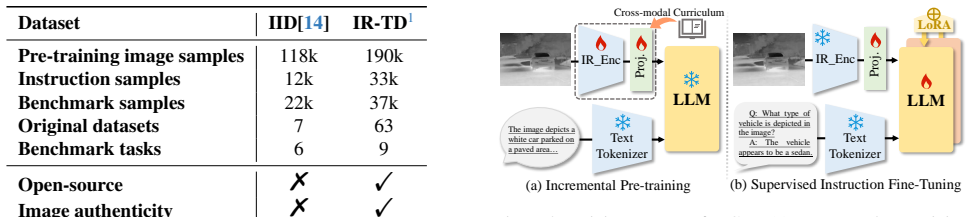
The central mechanism is the bi-cross-modal curriculum transfer learning strategy. It generates two complementary difficulty scores for every infrared-text pair: one based on infrared-to-visible domain distance (computed via intra-domain projection onto the inter-domain direction plus an MMD term), and one based on infrared-to-text semantic alignment (computed with a pre-warmed CLIP model and a dynamic loss-variation rate). The two scores are integrated into a difficulty ranking, the training data is split into ascending-difficulty tiers, and pre-training draws samples randomly within each tier; the loss-variation rate also acts as an adaptive per-sample weight. The curriculum is applied during incremental pre-training of the vision encoder and projector, before a LoRA-based instruction fine-tuning stage.
What would settle it
Have human experts independently annotate a held-out set of real infrared images, with captions, recognition, grounding, and counting labels, using no LLM-generated descriptions or rule-based templates drawn from IR-TD, then compare IRGPT and InternVL2-26B on that set; the central claim holds only if IRGPT's positive-sum advantage persists on such out-of-pipeline data.
Extended reading notes
Core claim
IRGPT's central claim is that real-world infrared understanding can be transferred from a pre-trained visible-domain vision-language model by sequencing training samples according to a two-component difficulty score. Lesson 1 assigns each infrared image a geometric domain-projection distance: the sample's vector is projected onto the inter-domain direction between infrared and visible centers in a Reproducing Kernel Hilbert Space, with an MMD term added, so samples closer to the visible domain are treated as easier. Lesson 2 measures infrared-text alignment with a pre-warmed CLIP model and augments the static loss with a dynamic loss-variation rate that down-weights misaligned pairs and up-weights hard ones. The model, initialized from InternVL2-8B, is pre-trained on difficulty tiers in ascending order with stratified random sampling and adaptive sample weights, then instruction-tuned. The paper reports state-of-the-art results on all nine benchmark tasks, with a fine-tuned positive-score total of 485.79 versus 473.78 for InternVL2-26B and a negative-score total of 4.39 versus 19.57, and shows that reversing the curriculum order sharply degrades performance.
Load-bearing premise
The benchmark that establishes the state-of-the-art claim is built from the same IR-TD image pool and the same LLM-generated and rule-based annotation pipeline used for training, so the test samples are in-distribution; the margins over models that have never seen infrared images may reflect adaptation to this pipeline rather than general infrared understanding.
Editorial extensions
If this is right
- Real infrared-text pairs, rather than synthetic style-transferred pairs, can serve as a sufficient training signal for visible-to-infrared transfer in vision-language models.
- The two-score curriculum, domain distance plus alignment difficulty, provides a sample ordering that outperforms random and anti-curriculum schedules on infrared tasks.
- The model's largest gains appear in identity and reasoning-heavy tasks such as ReID, where raw perception alone is insufficient.
- The released IR-TD dataset and nine-task benchmark give the community a common reference for comparing infrared vision-language models on authentic data.
Reading between the lines
- Because the benchmark is carved from the same IR-TD pool and the same annotation pipeline that trained IRGPT, the reported 12-point positive-sum advantage over InternVL2-26B partly reflects in-distribution adaptation; a fair test would use independently annotated infrared data to see how much generalizes.
- The same bi-cross-modal curriculum idea could be applied to other under-resourced sensing modalities, such as night-vision, radar, or multispectral imaging, where paired visible imagery and sparse text exist but large aligned corpora do not.
- A testable extension is to use the loss-variation-rate weighting alone, without the tiered ordering, to isolate whether the gains come from curriculum sequencing or from sample reweighting.
- The paper's approximation of cross-modal distance via intra-domain projection is explicitly imprecise; a sensitivity analysis on the distance metric would clarify how robust the difficulty ranking is.
Editorial analysis
A structured set of objections, weighed in public.
Referee Report
Summary. The paper introduces IRGPT, a multimodal large language model for real-world infrared images, together with a new large-scale infrared-text dataset (IR-TD) containing over 260K authentic image-text pairs. The dataset is constructed through LLM-based descriptions of paired visible images and rule-based annotations. The authors also propose a bi-cross-modal curriculum transfer learning strategy that orders pre-training samples by infrared-visible domain distance and infrared-text alignment difficulty. On a self-built 9-task benchmark, IRGPT reports state-of-the-art results in both zero-shot and fine-tuned settings, outperforming larger baselines such as InternVL2-26B.
Significance. If the claims are substantiated, the paper would provide a valuable open-source dataset and a practical training recipe for infrared vision-language understanding, a genuinely underexplored area. The bi-cross-modal curriculum idea is interesting, and the paper includes thorough ablations on curriculum components and sampling schedules. However, the evaluation is currently undermined by two load-bearing issues: the benchmark is generated from the same dataset and annotation pipeline as the training data, and the most relevant prior infrared-specific model, Infrared-LLaVA, is not compared. The reported 'state-of-the-art' performance therefore remains an in-distribution claim until those issues are addressed.
major comments (3)
- [Section 3.4 / Section 5.1, Table 2] The benchmark is built from the same IR-TD dataset and uses the same LLM-based and rule-based generation processes as the training data. Because the test questions and answers therefore share templates, vocabulary, and annotation statistics with the training set, the large gains in Table 2 (e.g., psum 485.79 vs 473.78 for InternVL2-26B) may be driven by adaptation to the generation pipeline rather than by generalizable infrared understanding. The paper should either add an external held-out benchmark (e.g., reusing existing infrared datasets with manually curated questions) or provide quantitative evidence that performance holds when the test distribution is varied (e.g., different question formats, unseen datasets, or human-written annotations).
- [Section 5.1, Table 2] The most relevant prior work, Infrared-LLaVA [14], is discussed in Section 2 but never experimentally compared. Since Infrared-LLaVA is also an infrared-specific vision-language model (though trained on synthetic infrared data), its omission makes it impossible to judge whether IRGPT actually surpasses the prior state of the art in this niche. The authors should include Infrared-LLaVA (and, if feasible, other infrared-specific MLLMs) in Table 2 under both zero-shot and fine-tuned settings.
- [Section 5.1, Table 2 footnote] The 'zero-shot' comparison is asymmetric: IRGPT is evaluated after incremental pre-training on 190k IR-TD pairs, while the baselines (InternVL2-8B, Qwen2-VL, etc.) have received no infrared training. Thus the reported zero-shot improvements (e.g., +76.35 psum over InternVL2-8B) conflate domain adaptation with zero-shot generalization. The authors should either report true zero-shot results (no IR pre-training) or pre-train the baselines on the same IR-TD pre-training subset with identical steps and then compare, so that the effect of the curriculum can be isolated.
minor comments (6)
- [Section 3.4 (title)] The subsection title 'Benchmark Defination' contains a typo; it should read 'Benchmark Definition'.
- [Table 2] The compared method listed as 'Pandagpt-7B' should be capitalized consistently as 'PandaGPT-7B'.
- [Section 5.2] The reported curriculum improvement of 14.47 in psum and the 'marginal decrease of merely 2.12' in nsum do not match the numbers in Table 2 (zero-shot CL vs Random: psum +21.47, nsum -3.62). Please reconcile the text with the table.
- [Section 5.1 / Section 4.2.3] The number of curriculum tiers M is not reported anywhere. Please provide the value used in the experiments and, ideally, a sensitivity analysis over M.
- [Section 4.2.1, Eq. (3)] The sign convention for the projection term in Eq. (3) is unclear; if d_i is intended as a distance it should be non-negative, but as written the projected term can be negative. Please clarify or use an absolute value.
- [Section 5.4] The claim that CLIP losses are 'normally distributed ... from the Central Limit Theorem' is not a valid justification, since the theorem applies to sums of independent random variables, not to model losses on a fixed dataset. Please rephrase this explanation.
Circularity Check
No circular derivation: IRGPT's claims rest on empirical evaluation and independently computed curriculum signals; the in-IR-TD benchmark raises generalization validity, not circularity.
full rationale
The paper's central contributions—a large infrared-text dataset, a bi-cross-modal curriculum, and the IRGPT model—are not derived from their evaluation targets by construction. The two difficulty signals used for curriculum ordering are computed externally: Lesson 1 uses MMD-based geometric projection on features from an existing retrained encoder, and Lesson 2 uses a pre-warmed CLIP's loss-variation rate. Neither signal is the model's own training loss, and the reported psum/nsum scores are measured on a held-out split rather than solved for. The only self-citation with overlapping authorship, reference [47], is used as general support for the benefit of stochasticity in curriculum sampling and is accompanied by external support [50]; the paper also directly ablatates the curriculum schedule in Tables 3 and 4, so the self-citation is not load-bearing. A genuine caveat is that the benchmark is constructed from the same IR-TD pipeline used to build the training data, making the evaluation in-distribution and limiting claims about general real-world infrared understanding. That is an external-validity concern, however, not a circularity: no benchmark number reduces by construction to a fitted parameter or to a training objective, and the train/test splits are disjoint. The paper's derivation chain is therefore not circular.
Assumptions & free parameters
free parameters (1)
- number of curriculum tiers M =
not reported
assumptions (4)
- domain assumption LLM-generated descriptions of visible images are valid semantic annotations for corresponding infrared images.
- domain assumption The sample-level distance di computed via intra-domain projection and MMD provides a meaningful difficulty ranking.
- domain assumption The CLIP loss variation rate alpha reflects sample alignment difficulty.
- domain assumption The nine benchmark tasks measure infrared image understanding.
Cite this review
Pith. "Pith review of IRGPT: Understanding Real-world Infrared Image with Bi-cross-modal Curriculum on Large-scale Benchmark." pith.science (2026). https://pith.science/paper/CLJOZZNH
@misc{pith2026250714449,
  author       = {Pith},
  title        = {Pith review of: IRGPT: Understanding Real-world Infrared Image with Bi-cross-modal Curriculum on Large-scale Benchmark},
  year         = {2026},
  howpublished = {\url{https://pith.science/paper/CLJOZZNH}},
  note         = {Machine review of arXiv:2507.14449}
}
read the original abstract
Real-world infrared imagery presents unique challenges for vision-language models due to the scarcity of aligned text data and domain-specific characteristics. Although existing methods have advanced the field, their reliance on synthetic infrared images generated through style transfer from visible images, which limits their ability to capture the unique characteristics of the infrared modality. To address this, we propose IRGPT, the first multi-modal large language model for real-world infrared images, built upon a large-scale InfraRed-Text Dataset (IR-TD) comprising over 260K authentic image-text pairs. The proposed IR-TD dataset contains real infrared images paired with meticulously handcrafted texts, where the initial drafts originated from two complementary processes: (1) LLM-generated descriptions of visible images, and (2) rule-based descriptions of annotations. Furthermore, we introduce a bi-cross-modal curriculum transfer learning strategy that systematically transfers knowledge from visible to infrared domains by considering the difficulty scores of both infrared-visible and infrared-text. Evaluated on a benchmark of 9 tasks (e.g., recognition, grounding), IRGPT achieves state-of-the-art performance even compared with larger-scale models.
Figures


Figures from the paper (4 more)


Forward citations
Cited by 1 Pith paper
-
Revealing Physical-World Semantic Vulnerabilities: Universal Adversarial Patch for Infrared Vision-Language Models
UCGP is a universal physical adversarial patch that compromises cross-modal semantic alignment in IR-VLMs through curved-grid parameterization and representation-space disruption.
Reference graph
Works this paper leans on
-
[14]
Infrared-llava: Enhancing understanding of infrared images in multi-modal large language models
Shixin Jiang, Zerui Chen, Jiafeng Liang, Yanyan Zhao, Ming Liu, and Bing Qin. Infrared-llava: Enhancing understanding of infrared images in multi-modal large language models. In Findings of the Association for Computational Linguistics: EMNLP 2024, pages 8573–8591, 2024. 1, 3, 4
work page 2024
-
[1]
Flamingo: a visual language model for few-shot learning
Jean-Baptiste Alayrac, Jeff Donahue, Pauline Luc, Antoine Miech, Iain Barr, Yana Hasson, Karel Lenc, Arthur Men- sch, Katherine Millican, Malcolm Reynolds, et al. Flamingo: a visual language model for few-shot learning. Advances in neural information processing systems, 35:23716–23736,
-
[2]
Yoshua Bengio, J ´erˆome Louradour, Ronan Collobert, and Ja- son Weston. Curriculum learning. In Proceedings of the 26th Annual International Conference on Machine Learn- ing, page 41–48, New York, NY , USA, 2009. Association for Computing Machinery. 3
work page 2009
-
[3]
In- formation maximizing curriculum: A curriculum-based ap- proach for learning versatile skills
Denis Blessing, Onur Celik, Xiaogang Jia, Moritz Reuss, Maximilian Li, Rudolf Lioutikov, and Gerhard Neumann. In- formation maximizing curriculum: A curriculum-based ap- proach for learning versatile skills. In Advances in Neural Information Processing Systems, pages 51536–51561. Cur- ran Associates, Inc., 2023. 3
work page 2023
-
[4]
The (r) evolution of multi- modal large language models: A survey
Davide Caffagni, Federico Cocchi, Luca Barsellotti, Nicholas Moratelli, Sara Sarto, Lorenzo Baraldi, Marcella Cornia, and Rita Cucchiara. The (r) evolution of multi- modal large language models: A survey. arXiv preprint arXiv:2402.12451, 2024. 3
arXiv 2024
-
[5]
Retinexformer: One-stage retinex- based transformer for low-light image enhancement
Yuanhao Cai, Hao Bian, Jing Lin, Haoqian Wang, Radu Tim- ofte, and Yulun Zhang. Retinexformer: One-stage retinex- based transformer for low-light image enhancement. In Pro- ceedings of the IEEE/CVF international conference on com- puter vision, pages 12504–12513, 2023. 3
work page 2023
-
[6]
Internvl: Scaling up vision foundation mod- els and aligning for generic visual-linguistic tasks
Zhe Chen, Jiannan Wu, Wenhai Wang, Weijie Su, Guo Chen, Sen Xing, Muyan Zhong, Qinglong Zhang, Xizhou Zhu, Lewei Lu, et al. Internvl: Scaling up vision foundation mod- els and aligning for generic visual-linguistic tasks. In Pro- ceedings of the IEEE/CVF Conference on Computer Vision and Pattern Recognition, pages 24185–24198, 2024. 3, 7
work page 2024
-
[7]
Cross-lingual lan- guage model pretraining
Alexis Conneau and Guillaume Lample. Cross-lingual lan- guage model pretraining. Advances in neural information processing systems, 32, 2019. 6
work page 2019
Show all 55 references
-
[8]
An image is worth 16x16 words: Trans- formers for image recognition at scale
Alexey Dosovitskiy, Lucas Beyer, Alexander Kolesnikov, Dirk Weissenborn, Xiaohua Zhai, Thomas Unterthiner, Mostafa Dehghani, Matthias Minderer, Georg Heigold, Syl- vain Gelly, et al. An image is worth 16x16 words: Trans- formers for image recognition at scale. arXiv preprint a...
2010 arXiv
-
[9]
Cross-domain gradient discrepancy minimization for unsupervised domain adaptation
Zhekai Du, Jingjing Li, Hongzu Su, Lei Zhu, and Ke Lu. Cross-domain gradient discrepancy minimization for unsupervised domain adaptation. In Proceedings of the IEEE/CVF conference on computer vision and pattern recognition, pages 3937–3946, 2021. 5
2021
-
[10]
Unsupervised domain adaptation via deep conditional adap- tation network
Pengfei Ge, Chuan-Xian Ren, Xiao-Lin Xu, and Hong Yan. Unsupervised domain adaptation via deep conditional adap- tation network. Pattern Recognition, 134:109088, 2023. 5
2023
-
[11]
Imagebind: One embedding space to bind them all
Rohit Girdhar, Alaaeldin El-Nouby, Zhuang Liu, Mannat Singh, Kalyan Vasudev Alwala, Armand Joulin, and Ishan Misra. Imagebind: One embedding space to bind them all. In Proceedings of the IEEE/CVF Conference on Computer Vision and Pattern Recognition, pages 15180–15190, 2023. 1, 3
2023
-
[12]
Learning with noisy correspondence for cross-modal matching.Advances in Neu- ral Information Processing Systems, 34:29406–29419, 2021
Zhenyu Huang, Guocheng Niu, Xiao Liu, Wenbiao Ding, Xinyan Xiao, Hua Wu, and Xi Peng. Learning with noisy correspondence for cross-modal matching.Advances in Neu- ral Information Processing Systems, 34:29406–29419, 2021. 6
2021
-
[13]
Quilt-1m: One million image-text pairs for histopathology
Wisdom Ikezogwo, Saygin Seyfioglu, Fatemeh Ghezloo, Dylan Geva, Fatwir Sheikh Mohammed, Pavan Kumar Anand, Ranjay Krishna, and Linda Shapiro. Quilt-1m: One million image-text pairs for histopathology. Advances in neural information processing systems, 36:37995–38017,
-
[15]
C-sfda: A curriculum learning aided self- training framework for efficient source free domain adapta- tion
Nazmul Karim, Niluthpol Chowdhury Mithun, Abhinav Ra- jvanshi, Han-pang Chiu, Supun Samarasekera, and Nazanin Rahnavard. C-sfda: A curriculum learning aided self- training framework for efficient source free domain adapta- tion. In Proceedings of the IEEE/CVF conference on com...
-
[16]
Segment any- thing
Alexander Kirillov, Eric Mintun, Nikhila Ravi, Hanzi Mao, Chloe Rolland, Laura Gustafson, Tete Xiao, Spencer White- head, Alexander C Berg, Wan-Yen Lo, et al. Segment any- thing. In Proceedings of the IEEE/CVF international confer- ence on computer vision, pages 4015–4026, 2023. 1, 3
2023
-
[17]
What matters when building vision-language mod- els? Advances in Neural Information Processing Systems , 37:87874–87907, 2025
Hugo Laurenc ¸on, L´eo Tronchon, Matthieu Cord, and Victor Sanh. What matters when building vision-language mod- els? Advances in Neural Information Processing Systems , 37:87874–87907, 2025. 3
2025
-
[18]
Edge-guided multi-domain rgb-to-tir image translation for training vision tasks with challenging labels
Dong–Guw Lee, Myung–Hwan Jeon, Younggun Cho, and Ayoung Kim. Edge-guided multi-domain rgb-to-tir image translation for training vision tasks with challenging labels. In 2023 IEEE International Conference on Robotics and Au- tomation (ICRA), pages 8291–8298, 2023. 3
2023
-
[19]
Seed-bench: Bench- marking multimodal large language models
Bohao Li, Yuying Ge, Yixiao Ge, Guangzhi Wang, Rui Wang, Ruimao Zhang, and Ying Shan. Seed-bench: Bench- marking multimodal large language models. In Proceedings of the IEEE/CVF Conference on Computer Vision and Pat- tern Recognition, pages 13299–13308, 2024. 1
2024
-
[20]
The stability- efficiency dilemma: Investigating sequence length warmup for training gpt models
Conglong Li, Minjia Zhang, and Yuxiong He. The stability- efficiency dilemma: Investigating sequence length warmup for training gpt models. Advances in Neural Information Processing Systems, 35:26736–26750, 2022. 3
2022
-
[21]
Domain generalization with adversarial feature learning
Haoliang Li, Sinno Jialin Pan, Shiqi Wang, and Alex C Kot. Domain generalization with adversarial feature learning. In Proceedings of the IEEE conference on computer vision and pattern recognition, pages 5400–5409, 2018. 5
2018
-
[22]
Blip-2: Bootstrapping language-image pre-training with frozen image encoders and large language models
Junnan Li, Dongxu Li, Silvio Savarese, and Steven Hoi. Blip-2: Bootstrapping language-image pre-training with frozen image encoders and large language models. In In- ternational conference on machine learning , pages 19730– 19742. PMLR, 2023. 3
2023
-
[23]
Infmae: A foundation model in the infrared modality
Fangcen Liu, Chenqiang Gao, Yaming Zhang, Junjie Guo, Jinghao Wang, and Deyu Meng. Infmae: A foundation model in the infrared modality. In European Conference on Computer Vision, pages 420–437. Springer, 2025. 3, 5
2025
-
[24]
Visual instruction tuning
Haotian Liu, Chunyuan Li, Qingyang Wu, and Yong Jae Lee. Visual instruction tuning. InAdvances in Neural Information Processing Systems, pages 34892–34916. Curran Associates, Inc., 2023. 1, 3, 4, 7
2023
-
[25]
A survey on hallucination in large vision-language models
Hanchao Liu, Wenyuan Xue, Yifei Chen, Dapeng Chen, Xiu- tian Zhao, Ke Wang, Liping Hou, Rongjun Li, and Wei Peng. A survey on hallucination in large vision-language models. arXiv preprint arXiv:2402.00253, 2024. 3
2024 arXiv
-
[26]
Lsotb-tir: A large-scale high-diversity thermal infrared object tracking benchmark
Qiao Liu, Xin Li, Zhenyu He, Chenglong Li, Jun Li, Zikun Zhou, Di Yuan, Jing Li, Kai Yang, Nana Fan, et al. Lsotb-tir: A large-scale high-diversity thermal infrared object tracking benchmark. In Proceedings of the 28th ACM international conference on multimedia, pages 3847–385...
2020
-
[27]
Let’s learn step by step: Enhancing in-context learning ability with curriculum learning
Yinpeng Liu, Jiawei Liu, Xiang Shi, Qikai Cheng, Yong Huang, and Wei Lu. Let’s learn step by step: Enhancing in-context learning ability with curriculum learning. arXiv preprint arXiv:2402.10738, 2024. 3
2024 arXiv
-
[28]
Decoupled weight de- cay regularization
Ilya Loshchilov and Frank Hutter. Decoupled weight de- cay regularization. In International Conference on Learning Representations, 2019. 7
2019
-
[29]
What is being transferred in transfer learning? In Advances in Neural Information Processing Systems , pages 512–523
Behnam Neyshabur, Hanie Sedghi, and Chiyuan Zhang. What is being transferred in transfer learning? In Advances in Neural Information Processing Systems , pages 512–523. Curran Associates, Inc., 2020. 5
2020
-
[30]
Learning transferable visual models from natural language supervi- sion
Alec Radford, Jong Wook Kim, Chris Hallacy, Aditya Ramesh, Gabriel Goh, Sandhini Agarwal, Girish Sastry, Amanda Askell, Pamela Mishkin, Jack Clark, et al. Learning transferable visual models from natural language supervi- sion. In International conference on machine learning, ...
2021
-
[31]
Laion-5b: An open large-scale dataset for training next generation image-text models
Christoph Schuhmann, Romain Beaumont, Richard Vencu, Cade Gordon, Ross Wightman, Mehdi Cherti, Theo Coombes, Aarush Katta, Clayton Mullis, Mitchell Worts- man, et al. Laion-5b: An open large-scale dataset for training next generation image-text models. Advances in neural in- f...
2022
-
[32]
Curriculum learning: A survey
Petru Soviany, Radu Tudor Ionescu, Paolo Rota, and Nicu Sebe. Curriculum learning: A survey. International Journal of Computer Vision, 130(6):1526–1565, 2022. 3
2022
-
[33]
less is more
Valentin I Spitkovsky, Hiyan Alshawi, and Dan Jurafsky. From baby steps to leapfrog: How “less is more” in unsuper- vised dependency parsing. In Human Language Technolo- gies: The 2010 Annual Conference of the North American Chapter of the Association for Computational Linguis...
2010
-
[34]
Pandagpt: One model to instruction-follow them all
Yixuan Su, Tian Lan, Huayang Li, Jialu Xu, Yan Wang, and Deng Cai. Pandagpt: One model to instruction-follow them all. arXiv preprint arXiv:2305.16355, 2023. 3, 7
2023 arXiv
-
[35]
Alignment-free rgb-t salient object detection: A large-scale dataset and progressive correlation network
Kunpeng Wang, Keke Chen, Chenglong Li, Zhengzheng Tu, and Bin Luo. Alignment-free rgb-t salient object detection: A large-scale dataset and progressive correlation network. arXiv preprint arXiv:2412.14576, 2024. 4
2024 arXiv
-
[36]
Alignment-free rgbt salient object de- tection: Semantics-guided asymmetric correlation network and a unified benchmark
Kunpeng Wang, Danying Lin, Chenglong Li, Zhengzheng Tu, and Bin Luo. Alignment-free rgbt salient object de- tection: Semantics-guided asymmetric correlation network and a unified benchmark. IEEE Transactions on Multime- dia, 2024. 4
2024
-
[37]
Qwen2-vl: Enhancing vision-language model’s perception of the world at any resolution
Peng Wang, Shuai Bai, Sinan Tan, Shijie Wang, Zhihao Fan, Jinze Bai, Keqin Chen, Xuejing Liu, Jialin Wang, Wenbin Ge, et al. Qwen2-vl: Enhancing vision-language model’s perception of the world at any resolution. arXiv preprint arXiv:2409.12191, 2024. 3, 7
2024 arXiv
-
[38]
Learning a multi-domain cur- riculum for neural machine translation
Wei Wang, Ye Tian, Jiquan Ngiam, Yinfei Yang, Isaac Caswell, and Zarana Parekh. Learning a multi-domain cur- riculum for neural machine translation. InProceedings of the 58th Annual Meeting of the Association for Computational Linguistics, pages 7711–7723, 2020. 3
2020
-
[39]
Rethinking maxi- mum mean discrepancy for visual domain adaptation
Wei Wang, Haojie Li, Zhengming Ding, Feiping Nie, Jun- yang Chen, Xiao Dong, and Zhihui Wang. Rethinking maxi- mum mean discrepancy for visual domain adaptation. IEEE Transactions on Neural Networks and Learning Systems, 34 (1):264–277, 2023. 5
2023
-
[40]
A survey on curriculum learning
Xin Wang, Yudong Chen, and Wenwu Zhu. A survey on curriculum learning. IEEE transactions on pattern analysis and machine intelligence, 44(9):4555–4576, 2021. 3
2021
-
[41]
Efficienttrain: Exploring gener- alized curriculum learning for training visual backbones
Yulin Wang, Yang Yue, Rui Lu, Tianjiao Liu, Zhao Zhong, Shiji Song, and Gao Huang. Efficienttrain: Exploring gener- alized curriculum learning for training visual backbones. In Proceedings of the IEEE/CVF International Conference on Computer Vision, pages 5852–5864, 2023. 3
2023
-
[42]
Deepseek-vl2: Mixture-of- experts vision-language models for advanced multimodal understanding
Zhiyu Wu, Xiaokang Chen, Zizheng Pan, Xingchao Liu, Wen Liu, Damai Dai, Huazuo Gao, Yiyang Ma, Chengyue Wu, Bingxuan Wang, et al. Deepseek-vl2: Mixture-of- experts vision-language models for advanced multimodal understanding. arXiv preprint arXiv:2412.10302, 2024. 3
2024 arXiv
-
[43]
Training large language models for reasoning through reverse curriculum reinforcement learning
Zhiheng Xi, Wenxiang Chen, Boyang Hong, Senjie Jin, Rui Zheng, Wei He, Yiwen Ding, Shichun Liu, Xin Guo, Junzhe Wang, et al. Training large language models for reasoning through reverse curriculum reinforcement learning. In In- ternational Conference on Machine Learning, pages...
2024
-
[44]
Curriculum learning for natural language understanding
Benfeng Xu, Licheng Zhang, Zhendong Mao, Quan Wang, Hongtao Xie, and Yongdong Zhang. Curriculum learning for natural language understanding. In Proceedings of the 58th Annual Meeting of the Association for Computational Linguistics, pages 6095–6104, Online, 2020. Association f...
2020
-
[45]
An Yang, Baosong Yang, Beichen Zhang, Binyuan Hui, Bo Zheng, Bowen Yu, Chengyuan Li, Dayiheng Liu, Fei Huang, Haoran Wei, et al. Qwen2. 5 technical report. arXiv preprint arXiv:2412.15115, 2024. 1
2024 arXiv
-
[46]
Bicro: Noisy correspon- dence rectification for multi-modality data via bi-directional cross-modal similarity consistency
Shuo Yang, Zhaopan Xu, Kai Wang, Yang You, Hongxun Yao, Tongliang Liu, and Min Xu. Bicro: Noisy correspon- dence rectification for multi-modality data via bi-directional cross-modal similarity consistency. In Proceedings of the IEEE/CVF Conference on Computer Vision and Patter...
2023
-
[47]
Mind the boundary: Coreset selection via reconstructing the decision boundary
Shuo Yang, Zhe Cao, Sheng Guo, Ruiheng Zhang, Ping Luo, Shengping Zhang, and Liqiang Nie. Mind the boundary: Coreset selection via reconstructing the decision boundary. In Forty-first International Conference on Machine Learn- ing, 2024. 6
2024
-
[48]
Vision-language models for vision tasks: A survey
Jingyi Zhang, Jiaxing Huang, Sheng Jin, and Shijian Lu. Vision-language models for vision tasks: A survey. IEEE Transactions on Pattern Analysis and Machine Intelligence,
-
[49]
Irsam: Advancing segment anything model for infrared small target detection
Mingjin Zhang, Yuchun Wang, Jie Guo, Yunsong Li, Xinbo Gao, and Jing Zhang. Irsam: Advancing segment anything model for infrared small target detection. In European Con- ference on Computer Vision, pages 233–249. Springer, 2025. 3
2025
-
[50]
Coverage-centric coreset selection for high pruning rates
Haizhong Zheng, Rui Liu, Fan Lai, and Atul Prakash. Coverage-centric coreset selection for high pruning rates. In 11th International Conference on Learning Representations, ICLR 2023, 2023. 6
2023
-
[51]
Intra-and inter-modal curriculum for multi- modal learning
Yuwei Zhou, Xin Wang, Hong Chen, Xuguang Duan, and Wenwu Zhu. Intra-and inter-modal curriculum for multi- modal learning. In Proceedings of the 31st ACM Interna- tional Conference on Multimedia , pages 3724–3735, 2023. 3
2023
-
[52]
Languagebind: Extending video-language pretraining to n-modality by language-based semantic align- ment
Bin Zhu, Bin Lin, Munan Ning, Yang Yan, Jiaxi Cui, W ANG HongFa, Yatian Pang, Wenhao Jiang, Junwu Zhang, Zong- wei Li, et al. Languagebind: Extending video-language pretraining to n-modality by language-based semantic align- ment. In The Twelfth International Conference on Lea...
2024
-
[53]
Minigpt-4: Enhancing vision-language understanding with advanced large language models
Deyao Zhu, Jun Chen, Xiaoqian Shen, Xiang Li, and Mo- hamed Elhoseiny. Minigpt-4: Enhancing vision-language understanding with advanced large language models. In 12th International Conference on Learning Representations, ICLR 2024, 2024. 3
2024
-
[54]
Task- customized mixture of adapters for general image fusion
Pengfei Zhu, Yang Sun, Bing Cao, and Qinghua Hu. Task- customized mixture of adapters for general image fusion. In Proceedings of the IEEE/CVF Conference on Computer Vi- sion and Pattern Recognition, pages 7099–7108, 2024. 3
2024
-
[55]
A comprehensive survey on transfer learning
Fuzhen Zhuang, Zhiyuan Qi, Keyu Duan, Dongbo Xi, Yongchun Zhu, Hengshu Zhu, Hui Xiong, and Qing He. A comprehensive survey on transfer learning. Proceedings of the IEEE, 109(1):43–76, 2021. 5
2021
Reviewed August 6, 2026 · model on record in the stance chip above.
Discussion (0). Sign in to comment.