REVIEW 5 major objections 5 minor 11 references
Amico: An Event-Driven Modular Framework for Persistent and Embedded Autonomy
T0 review · 5 major / 5 minor · reviewed 2026-08-06 · deepseek-v4-flash
Pith's one-line read Amico, an event-driven agent framework written in Rust and deployable via WebAssembly, claims to make LLM agents persistently autonomous on embedded devices and reports a WebShop reward of 0.61 versus 0.47 for a DeepSeek-V3 baseline.
desk verdict A plausible embedded-agent framework with a coherent design, but the WebShop experiment is confounded and the manuscript is unfinished; the empirical claims do not hold up. read the letter →
The pith
A machine-rendered reading of the paper's core claim, the machinery that carries it, and where it could break.
The reading
What carries the argument
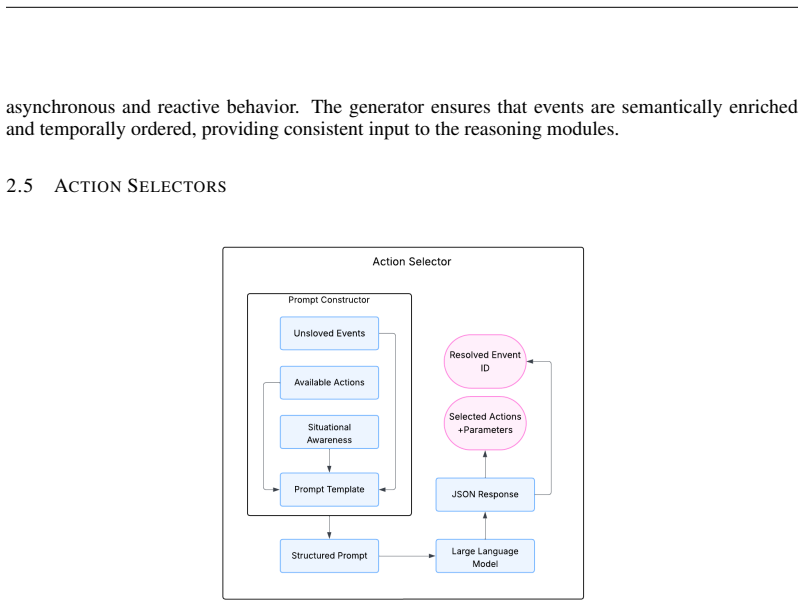
The load-bearing mechanism is the event-driven runtime loop. An Event Generator ingests sensor, timer, and user/client inputs and normalizes them into structured Event objects carrying timestamp, task intent, observations, and a machine-readable list of available actions; events enter a temporally ordered queue. An Action Selector then runs a two-stage model-based decision: an Action Generator proposes several plausible actions under a constraint-aware system prompt, and a Dispatcher evaluates semantic alignment with the task goal and outputs one valid action or a no-op. The agent keeps a persistent set of Tasks—short- and long-running goals—and an optional RAG module refreshes a model description after each event and action, closing a feedback loop through effectors. This decomposition is what the paper credits for state consistency, fewer invalid interface operations, and low-latency reactivity.
What would settle it
Re-run the WebShop comparison with DeepSeek-V3 using Amico's Event-Generator/Action-Generator/Dispatcher prompts inside a plain sequential loop; if the 0.61 score persists, the event-driven loop is not the cause.
Extended reading notes
Core claim
The paper's central claim is that decoupling an LLM-driven agent into asynchronous components—an Event Generator that converts raw observations into timestamped structured events, an Action Generator that proposes up to five candidate actions under format constraints, and a Dispatcher that filters candidates to one executable action—produces more reliable goal-directed behavior than giving the model the whole task in a single chain-of-thought prompt. On the 200-task WebShop subset it reports 0.61 average reward for Amico and 0.53 for Amico with Honcho RAG memory, versus 0.47 for the DeepSeek-V3 baseline. The authors further claim that this modular, Rust-based, WebAssembly-deployable design supports persistent autonomy—long-running tasks, incremental state, and autonomous event triggering—at sub-100ms reactivity on edge devices, although no latency measurement is reported.
Load-bearing premise
The claim rests on the assumption that the higher WebShop score comes from the event-driven architecture itself, rather than from Amico's more structured two-stage prompting and candidate filtering.
Editorial extensions
If this is right
- Structured event-driven prompting can outperform single-pass chain-of-thought prompting on goal-directed web navigation, even without a retrieval memory.
- Adding RAG memory is not automatically beneficial: on a tightly scoped task like WebShop it can add latency or irrelevant context and reduce reward (0.53 vs 0.61).
- Persistent task and state abstractions may reduce redundant or invalid interface actions, improving autonomy over multi-step interactions.
- A Rust/WASM agent runtime makes the same framework deployable on embedded hardware and in browsers, which suits environments with limited compute or connectivity.
- The modular split of event generation, action proposal, and dispatch can be extended to multi-agent collaboration and adaptive scheduling in future work.
Reading between the lines
- Editorial inference: the reported gain is not isolated to the event-driven loop; Amico also differs from the baseline in prompt structure, candidate generation, and filtering, so the 0.61 vs 0.47 comparison cannot by itself prove that asynchronous event processing caused the improvement.
- Editorial inference: if the gain comes mainly from the two-stage constraint-aware prompting, a simpler sequential loop with the same prompts should reproduce most of the result, which would be a cheap testable extension.
- Editorial inference: the sub-100ms edge-reactivity claim is stated as a differentiator but never measured; a latency benchmark on a representative edge device would separate the architectural claim from the performance claim.
- Editorial inference: the RAG slowdown suggests retrieval quality and timing matter more than memory presence; adaptive memory pruning or intent-aware retrieval could reverse that result in follow-up work.
Editorial analysis
A structured set of objections, weighed in public.
Referee Report
Summary. The paper introduces Amico, a Rust-based event-driven framework for building LLM-powered autonomous agents, with deployment targets including embedded systems and browsers via WebAssembly. It describes a layered architecture (Environment, Interaction, AI Agent, Engine), an event queue with an Event Generator, an Action Selector with two-stage candidate generation and filtering, and a RAG integration option. To validate the framework, the paper reports a WebShop (AgentBench) evaluation with three configurations: a DeepSeek-V3 baseline, Amico, and Amico+RAG, achieving average rewards of 0.47, 0.61, and 0.53, respectively. The paper also claims sub-100ms reactivity on edge devices and states that the framework is open-sourced.
Significance. The paper is a plausible engineering proposal for a modular, embedded-oriented agent framework; the Rust/WASM choice and the four-layer decomposition are sensible, and the intention to support event-driven, persistent behavior addresses a real gap in LLM-agent deployments. However, the current evidence does not support the central quantitative claims. The WebShop experiment is confounded, lacks statistical inference, and does not exercise the event-driven and real-time properties that distinguish Amico. The unmeasured latency and resource claims further weaken the contribution. If the authors provide controlled ablations, variance estimates, and measurements on embedded targets, the framework could become a useful contribution; as written, the empirical validation is insufficient.
major comments (5)
- [§4.2, §4.3, Table 1] The headline result (0.61 vs 0.47) is presented without error bars, confidence intervals, repeated runs, or significance tests. The word 'significantly' in §4.3 is therefore unsupported. Please report the number of independent runs and random seeds used, provide bootstrap intervals or a significance test, and soften the claim accordingly if only a single run was performed.
- [§4.2, §4.3] The comparison between DeepSeek-V3 and Amico varies at least three factors at once: prompt style (vanilla chain-of-thought vs constraint-aware structured prompts), decision procedure (single action plan vs candidate generation with a filtering Dispatcher), and execution architecture (single forward pass vs event queue with stateful task management). The observed +29.5% reward difference cannot be attributed to the event-driven architecture without an ablation that isolates the event queue and scheduling. Please add control conditions, e.g., a baseline that uses the same structured prompting and candidate filtering but no event-driven loop, and an Amico variant that uses a sequential loop without structured event parsing.
- [§4.1, §4.3] WebShop is a turn-based, synchronous web-navigation environment; it does not include asynchronous events, interruptions, noise, or resource constraints. Thus the experiment does not test the framework's claimed advantages in reactive, persistent, or embedded settings. Please either add a task or environment that exercises asynchronous event handling and intermittent connectivity, or explicitly reframe the WebShop result as evidence only for structured decision-making, not for event-driven autonomy.
- [§3.1, feature list] The paper claims 'Sub-100ms reactivity on edge devices' but provides no latency, throughput, or memory measurements anywhere in the evaluation. Please report measurements on an actual edge target (e.g., a Raspberry Pi or a browser WASM environment), or remove and qualify the claim.
- [§4.1, §4.2] The reproducibility section is incomplete: the 200-task subset is not described, the exact prompts and model sampling parameters are not given, and the open-source repository is only mentioned as a URL without stating which files support the benchmark. Please provide a reproducibility appendix with the subset selection, full prompts, model parameters, and code paths; if the repository is not yet public, revise the open-source statement.
minor comments (5)
- [Figures] Figure 1 and Figure 2 lack captions, Figure 4's caption reads 'Enter Caption', and Figure 5 is not described in the text.
- [References] The Richards entry contains stray markdown artifacts '[3](@ref)' and '[2](@ref)'; the Leer et al. citation appears unrelated to the Honcho RAG system; the Zhang et al. citation title does not match its described content; and the Michelsen et al. latency-reduction claim has no citation.
- [§4.2, §4.3] There are several typographical issues: 'W ASM' should be 'WASM' in the abstract, 'an Dispatcher' in §4.2 should be 'a Dispatcher', and 'attributing to' in §4.3 should be 'attributed to'.
- [References] The 'Honcho' module is referenced as a paper (Leer et al.) but appears to be a software project; please cite the project's documentation or repository instead.
- [§4.3] The phrase 'significantly outperforms' is used without statistical support; it should be replaced with descriptive language unless significance tests are added (see major comment 1).
Circularity Check
No significant circularity; the paper is an empirical framework comparison with no derivation chain, fitted parameters, or load-bearing self-citation.
full rationale
The paper contains no derivation chain that reduces to its own inputs. Amico is presented as a software framework, and the central quantitative claim is an empirical comparison on the WebShop benchmark (DeepSeek-V3 0.47, Amico 0.61, Amico+RAG 0.53). No parameter is fitted to the reported result and then renamed as a prediction; the framework's design is described procedurally (event generator, event queue, action selector, dispatcher) rather than derived from the outcome. The related-work citations are external references to ReAct, Voyager, AutoGPT, AgentBench, and similar works; there is no load-bearing self-citation chain, and the authors do not invoke a uniqueness theorem or prior result of their own to force the architecture. The main weakness is experimental confound: the baseline uses single-pass chain-of-thought prompting while Amico uses structured event parsing, candidate generation, and a filtering dispatcher, so the +29.5% reward difference cannot be cleanly attributed to event-drivenness alone. That is a correctness or validity concern about causal attribution, not circularity, because the comparison is not equivalent to its inputs by construction. The 'Sub-100ms reactivity' claim is unsupported by reported measurements, but that is an evidence gap rather than a circular step. Accordingly, no circular steps are identified and the score is 0.
Assumptions & free parameters
assumptions (2)
- domain assumption The WebShop reward metric and the 200-task subset are representative of general agent autonomy performance.
- domain assumption The DeepSeek-V3 baseline is a valid comparison point; differences in prompting and action-format constraints do not explain the result.
Cite this review
Pith. "Pith review of Amico: An Event-Driven Modular Framework for Persistent and Embedded Autonomy." pith.science (2026). https://pith.science/paper/ERXXTIEG
@misc{pith2026250714513,
  author       = {Pith},
  title        = {Pith review of: Amico: An Event-Driven Modular Framework for Persistent and Embedded Autonomy},
  year         = {2026},
  howpublished = {\url{https://pith.science/paper/ERXXTIEG}},
  note         = {Machine review of arXiv:2507.14513}
}
read the original abstract
Recent advances in large language models (LLMs) and autonomous agents have enabled systems capable of performing complex tasks across domains such as human-computer interaction, planning, and web navigation. However, many existing frameworks struggle in real-world or resource-constrained environments due to their reliance on cloud-based computation, limited robustness in dynamic contexts, and lack of persistent autonomy and environmental awareness. We present Amico, a modular, event-driven framework for building autonomous agents optimized for embedded systems. Written in Rust for safety and performance, Amico supports reactive, persistent agents that operate efficiently across embedded platforms and browser environments via WebAssembly. It provides clean abstractions for event handling, state management, behavior execution, and integration with reasoning modules. Amico delivers a unified infrastructure for constructing resilient, interactive agents suitable for deployment in settings with limited compute and intermittent connectivity.
Figures


Figures from the paper (2 more)


Reference graph
Works this paper leans on
-
[3]
Webassembly for edge computing: A systematic review, 2021
Peter Ha, Michael Cheng, and Susan Park. Webassembly for edge computing: A systematic review, 2021. URL https://dl.acm.org/doi/10.1145/3453478
-
[1]
write newline
" write newline "" before.all 'output.state := FUNCTION n.dashify 't := "" t empty not t #1 #1 substring "-" = t #1 #2 substring "--" = not "--" * t #2 global.max substring 't := t #1 #1 substring "-" = "-" * t #2 global.max substring 't := while if t #1 #1 substring * t #2 global.max substring 't := if while FUNCTION format.date year duplicate empty "emp...
-
[2]
On Absolute Algebraic Geometry, the affine case
Jacob Andreas, Dan Klein, and Sergey Levine. Modular multitask reinforcement learning with policy sketches, 2020. URL https://arxiv.org/abs/1909.09796
work page Pith review arXiv 2020
-
[4]
Persistent autonomy for robotics: A review, 2022
David Kortenkamp, Matthias Scheutz, and Peter Stone. Persistent autonomy for robotics: A review, 2022. URL https://journals.sagepub.com/doi/10.1177/02783649221081401
-
[5]
Courtland Leer, Vincent Trost, and Vineeth Voruganti. Violation of expectation via metacognitive prompting reduces theory of mind prediction error in large language models, 2023. URL https://arxiv.org/abs/2310.06983
work page Pith review arXiv 2023
-
[6]
Agentbench: Evaluating llms as agents, 2023
Xiao Liu, Hao Yu, Hanchen Zhang, Yifan Xu, Xuanyu Lei, Hanyu Lai, Yu Gu, Hangliang Ding, Kaiwen Men, Kejuan Yang, Shudan Zhang, Xiang Deng, Aohan Zeng, Zhengxiao Du, Chenhui Zhang, Sheng Shen, Tianjun Zhang, Yu Su, Huan Sun, Minlie Huang, Yuxiao Dong, and Jie Tang. Agentbench: Evaluating llms as agents, 2023. URL https://arxiv.org/abs/2308.03688
arXiv 2023
-
[7]
AutoGPT: Autonomous Self-Improving Agents
John Richards. AutoGPT: Autonomous Self-Improving Agents. O'Reilly Media, 2023. ISBN 978-1-4920-8345-2. URL https://www.oreilly.com/library/view/autogpt-autonomous-self/9781492083452/. Includes case studies on e-commerce lead generation [3](@ref) and critiques of production readiness [2](@ref)
-
[8]
Voyager: An open-ended embodied agent with large language models, 2023
Guanzhi Wang, Yuqi Xie, Yunfan Jiang, Ajay Mandlekar, Chaowei Xiao, Yuke Zhu, Linxi Fan, and Anima Anandkumar. Voyager: An open-ended embodied agent with large language models, 2023. URL https://arxiv.org/abs/2305.16291
arXiv 2023
Show all 11 references
-
[9]
TinyML: Machine Learning with TensorFlow Lite on Arduino and Edge Devices
Pete Warden and Daniel Situnayake. TinyML: Machine Learning with TensorFlow Lite on Arduino and Edge Devices. O'Reilly, 1st edition, 2020. ISBN 978-1-4920-8341-4. URL https://tinymlbook.com. Covers WASM integration techniques referenced in Ha et al. (2021) [1](@ref)
2021
-
[10]
React: Synergizing reasoning and acting in language models, 2023
Shunyu Yao, Jeffrey Zhao, Dian Yu, Nan Du, Izhak Shafran, Karthik Narasimhan, and Yuan Cao. React: Synergizing reasoning and acting in language models, 2023. URL https://arxiv.org/abs/2210.03629
2023 arXiv
-
[11]
Robust autonomous agents via uncertainty-aware reinforcement learning, 2021
Lingxiao Zhang, Qiuyuan Huang, and Jianyu Chen. Robust autonomous agents via uncertainty-aware reinforcement learning, 2021. URL https://proceedings.mlr.press/v139/zhang21a.html
2021
Reviewed August 6, 2026 · model on record in the stance chip above.
Discussion (0). Sign in to comment.