REVIEW 3 major objections 4 minor 43 references
Symmetry-breaking strain drives significant reduction in lattice thermal conductivity: A case study of boron arsenide
T0 review · 3 major / 4 minor · reviewed 2026-08-06 · deepseek-v4-flash
Pith's one-line read Applying uniaxial tensile strain along [100] makes the lattice thermal conductivity of cubic boron arsenide fall monotonically, by nearly 80 percent at room temperature under large strain, because the strain lifts TA/TO phonon…
desk verdict A solid, mechanistically careful prediction that uniaxial strain suppresses κL in BAs by up to 80%, but the strained structures' dynamical stability is asserted, not checked, and that gap needs closing before the result can be taken as quantitative. read the letter →
The pith
A machine-rendered reading of the paper's core claim, the machinery that carries it, and where it could break.
The reading
What carries the argument
The load-bearing mechanism is the strain-induced lifting of symmetry-protected phonon degeneracies. In unstrained BAs, two TA branches and two TO branches are degenerate along paths such as $\Gamma$-$X$ and $\Gamma$-$L$, protected by the threefold-rotation and mirror symmetries of the cubic lattice. Uniaxial [100] tension breaks those symmetries, splitting the degenerate branches and shifting the acoustic and optical mode frequencies downward. Because phonon-phonon scattering rates are governed by energy and momentum conservation selection rules, the split branches open new scattering channels, especially AAA and AOO processes, and the softened spectrum raises phonon populations, which also enlarges four-phonon phase space. The argument is carried by mode-resolved weighted phase space, a count of available scattering channels satisfying energy and momentum conservation, together with scattering matrix elements that separate the phase-space effect from the change in anharmonic force constants.
What would settle it
Compute the full phonon dispersion of BAs at 6, 10, 14, and 18 percent uniaxial [100] strain and search the whole Brillouin zone for imaginary frequencies; any soft mode in that range would invalidate the anharmonic force constants and scattering rates that produce the 80 percent suppression.
Extended reading notes
Core claim
The paper's central claim is that symmetry-breaking uniaxial strain is a distinct and effective control knob for lattice thermal conductivity in cubic boron arsenide. In first-principles phonon Boltzmann transport calculations that include fourth-order anharmonicity, tensile strain applied along the [100] direction makes $\kappa_{\rm L}$ decrease monotonically with strain, reaching a nearly 80 percent reduction at 18 percent strain at room temperature along the direction perpendicular to the load. The strain lifts the degeneracy of the two transverse acoustic branches and the two transverse optical branches, which are protected by crystal symmetries, and softens the overall phonon spectrum. These changes enlarge the three- and four-phonon scattering phase space and increase third-order anharmonicity, so both three- and four-phonon scattering rates rise together, in contrast to the competing responses seen under isotropic pressure. The paper also reports that the suppression is markedly anisotropic: heat conduction perpendicular to the strain direction falls far more than along the stretching direction, an effect traced mainly to strain-mediated three-phonon scattering and TA degeneracy lifting.
Load-bearing premise
The calculations assume BAs stays dynamically stable, elastically deformed, and semiconducting up to 18 percent strain, but no imaginary-frequency check of the strained phonon dispersions is reported.
Editorial extensions
If this is right
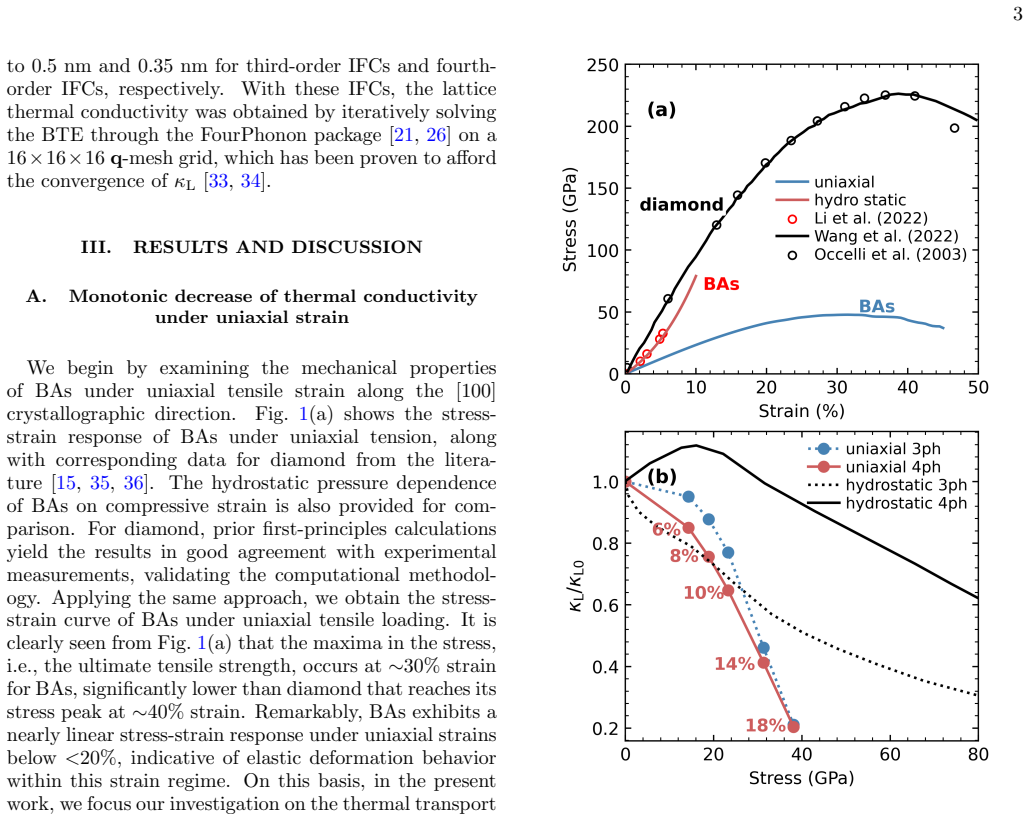
- At 18 percent uniaxial tensile strain, the room-temperature lattice thermal conductivity of BAs along the perpendicular direction falls from 1244 to 254 W/mK when four-phonon scattering is included, a reduction of about 80 percent.
- The strain response is directional: the perpendicular axis loses far more heat-carrying capacity than the stretching axis, so a single strained sample should display a measurable thermal anisotropy.
- Both three- and four-phonon scattering rates grow monotonically with strain, meaning the usual competition between these channels under isotropic pressure is replaced by cooperation under symmetry-breaking strain.
- Changes in group velocities and heat capacity contribute at most about a quarter of the drop, so the reduction is primarily an anharmonic-scattering effect rather than a harmonic one.
Reading between the lines
- If the degeneracy-lifting picture is right, other cubic semiconductors with degenerate TA/TO branches and a large acoustic-optical gap should show similar strain-driven suppression; screening zinc-blende compounds computationally would reveal which respond most.
- Because the strain axis also narrows the electronic band gap, the mechanism offers a way to couple heat-flow suppression with electronic property changes in one device, though the paper stops before metallization.
- A membrane or film experiment that measures in-plane and cross-plane thermal conductivity under uniaxial strain could directly test the predicted anisotropy: the perpendicular direction should show the larger drop.
- If a phonon instability appears below 18 percent strain, the monotonic suppression would break down; checking the strained phonon dispersion for imaginary modes would settle the practical strain limit.
Editorial analysis
A structured set of objections, weighed in public.
Referee Report
Summary. The manuscript reports first-principles DFT+BTE calculations of lattice thermal conductivity (κL) of cubic BAs under uniaxial tensile strain along [100], including both three- and four-phonon scattering. It finds that strain lifts the TA and TO degeneracies and softens the phonon spectrum, increasing scattering phase space and rates, leading to a monotonic reduction of κL with strain and an approximately 80% drop at 18% strain at room temperature. The suppression is stronger perpendicular to the strain direction than along it. The authors attribute this effect to symmetry-breaking that opens new scattering channels, and they support the mechanism with weighted-phase-space decomposition, matrix-element analysis, and small-grain-limit κSG estimates.
Significance. If the predictions hold, this is a useful contribution: it extends strain engineering of κL to anisotropic uniaxial strain, includes four-phonon scattering (important in BAs), identifies a concrete symmetry-based mechanism (degeneracy lifting) with a quantitative decomposition into phase-space and matrix-element contributions, and makes a falsifiable prediction of strong anisotropic suppression. The calculations are parameter-free with respect to the target κL, use an iterative BTE solver with standard DFT settings, and benchmark the stress-strain behavior against diamond. The main caveat is that lattice stability under large strain is asserted rather than directly verified, which affects the reliability of the headline 80% reduction.
major comments (3)
- [III.A and III.B (Fig. 2c)] The central ~80% reduction claim presumes that all strained structures up to 18% are dynamically stable. The only stability evidence is the linear stress-strain response below 20% (Fig. 1a) and phonon dispersions along high-symmetry paths at 14% (Fig. 2c). Elastic linearity does not rule out imaginary phonon modes at generic q-points, and high-symmetry-path sampling can miss soft-mode instabilities. Please compute full-Brillouin-zone phonon dispersions (or report the lowest phonon frequency on a dense q-grid) for every strained geometry, including 18%, and state explicitly whether any imaginary modes exist. If a soft mode appears, the strained reference is not the equilibrium structure and the predicted κL suppression would need to be reconsidered.
- [II (computational parameters)] The convergence of the IFC truncation radii and the q-mesh is argued from prior BAs studies at zero strain. Uniaxial strain changes the symmetry to tetragonal and can alter both the range of anharmonic interactions and the required Brillouin-zone sampling. Please report at least one convergence test for a strained cell (e.g., κL versus q-mesh and versus third- and fourth-order interaction radius at ε=14% or 18%) so that the quantitative uncertainty of the ~80% reduction is known.
- [III.C] The manuscript states that metallization occurs only at larger strain, but it does not report the electronic band gap at the strained geometries. Because the headline number is at ε=18%, please give the band gap at each studied strain and confirm that the 18% structure is still semiconducting; otherwise phonon-electron scattering should be included in the BTE.
minor comments (4)
- [III.D (inset of Fig. 5e)] The sentence 'suggesting that the increased TA scattering rates at this strain level arise from the weakened third-order anharmonicity' is logically inconsistent with the observed decrease in |V(3)|^2; the increased scattering must instead come from the enlarged phase space. Please rephrase.
- [References] References 19 and 36 are the same publication (B. Wang et al., Phys. Rev. B 106, 184303 (2022)); consolidate them into a single reference.
- [Fig. 1(a)] Please specify whether the strain is engineering strain and whether the stress is the Cauchy stress, since this matters for comparison with experimental loading conditions.
- [Eqs. (2)-(5)] The notation for the ± and ±± channel labels is defined only after the equations; consider defining these labels more explicitly at first use to improve readability.
Circularity Check
No significant circularity: the central uniaxial-strain thermal conductivity calculation is parameter-free and does not reduce to any fitted input or self-cited result.
full rationale
The paper's central claim, that [100] uniaxial tensile strain monotonically suppresses the lattice thermal conductivity of boron arsenide by up to about 80%, is obtained by an ab initio Boltzmann transport calculation in which the harmonic, third-order, and fourth-order interatomic force constants are computed by density functional theory and then used to solve for the thermal conductivity. No thermal conductivity value is fitted to experiment, and the strained structures are treated with the same first-principles framework as the unstrained reference. The explanatory quantities, such as weighted phase space, scattering rates, and scattering matrix elements, are derived from the same phonon eigenmodes and force constants, but this is a post hoc decomposition of a calculated result rather than an input fitted to the target prediction. The paper does cite prior work by overlapping authors, including refs. 20, 23, and 24, but those citations support methodology, motivational background, and analysis conventions rather than supplying the central numerical result. The claim does not depend on an unverified uniqueness theorem or on an ansatz imported solely through self-citation. The comparison with hydrostatic-pressure results and diamond stress-strain data provides external anchoring. The absence of an explicit imaginary-mode check at high strain is a physical validity concern, not a circularity: it questions whether the strained reference state is dynamically stable, but it does not make the derivation self-referential. Therefore no circular step can be identified.
Assumptions & free parameters
free parameters (2)
- Third-order IFC interaction radius =
0.5 nm
- Fourth-order IFC interaction radius =
0.35 nm
assumptions (5)
- standard math Phonon BTE and Fermi-golden-rule scattering rates (Eqs. 1-5) correctly describe thermal transport in this system.
- domain assumption GGA-PBE exchange-correlation functional is accurate for strained BAs.
- domain assumption Strained BAs remains dynamically stable and elastic for epsilon < 20%.
- domain assumption Fourth-order IFCs truncated at 0.35 nm are sufficient at all strains.
- domain assumption Phonon-only transport applies, with no electron-phonon scattering in the strain range studied.
Cite this review
Pith. "Pith review of Symmetry-breaking strain drives significant reduction in lattice thermal conductivity: A case study of boron arsenide." pith.science (2026). https://pith.science/paper/TOA3RMQQ
@misc{pith2026250714532,
  author       = {Pith},
  title        = {Pith review of: Symmetry-breaking strain drives significant reduction in lattice thermal conductivity: A case study of boron arsenide},
  year         = {2026},
  howpublished = {\url{https://pith.science/paper/TOA3RMQQ}},
  note         = {Machine review of arXiv:2507.14532}
}
abstract
Recent research has revealed that cubic boron arsenide (BAs) exhibits a non-monotonic pressure dependence of lattice thermal conductivity ($\kappa_{\rm L}$) under isotropic strain. Here, through rigorous first-principles calculations, we unveil that uniaxial tensile strain induces a monotonic reduction in the $\kappa_{\rm L}$ of BAs -- a striking contrast to the isotropic scenario. The results show that applying uniaxial (100) strain leads to the lifting of phonon band degeneracy, accompanied by an overall softening of the phonon spectrum. These modifications significantly increase phonon-phonon scattering channels by facilitating the fulfillment of selection rules, resulting in a concurrent increase in both three- and four-phonon scattering rates. Consequently, $\kappa_{\rm L}$ exhibits a dramatic suppression of nearly 80\% under large tension at room temperature. Meanwhile, we unexpectedly observe that the uniaxial strain suppresses $\kappa_{\rm L}$ much more strongly in the direction perpendicular to the strain than along the stretching direction. This work establishes the fundamental understanding of the thermal conductivity behavior of BAs under uniaxial strain and opens a promising avenue for manipulating solid-state heat transport by tuning crystal symmetry.
Figures


Figures from the paper (2 more)


Reference graph
Works this paper leans on
-
[1]
G. J. Snyder and E. S. Toberer, Nature materials7, 105 (2008)
work page 2008
-
[2]
Lindsay, C
L. Lindsay, C. Hua, X. Ruan, and S. Lee, Materials Today Physics7, 106 (2018)
2018
-
[3]
X. Qian, J. Zhou, and G. Chen, Nature Materials20, 1188 (2021)
work page 2021
-
[4]
Ziman, Electrons and phonons, oxford university press (1960)
J. Ziman, Electrons and phonons, oxford university press (1960)
work page 1960
-
[5]
N. K. Ravichandran and D. Broido, Nature Communica- tions12, 3473 (2021)
work page 2021
-
[6]
N. K. Ravichandran and D. Broido, Physical Review X 10, 021063 (2020)
work page 2020
-
[7]
X. Tang and J. Dong, Proceedings of the National Academy of Sciences107, 4539 (2010)
work page 2010
-
[8]
A. Chernatynskiy and S. R. Phillpot, Journal of Applied Physics114, 064902 (2013)
work page 2013
Show all 43 references
-
[9]
D. A. Broido, L. Lindsay, and A. Ward, Physical Review B86, 115203 (2012)
2012
-
[10]
Mukhopadhyay and D
S. Mukhopadhyay and D. A. Stewart, Physical Review Letters113, 025901 (2014)
2014
-
[11]
K. D. Parrish, A. Jain, J. M. Larkin, W. A. Saidi, and A. J. McGaughey, Physical Review B90, 235201 (2014)
2014
-
[12]
Lindsay, D
L. Lindsay, D. A. Broido, J. Carrete, N. Mingo, and T. L. Reinecke, Physical Review B91, 121202 (2015)
2015
-
[13]
X. Meng, T. Pandey, J. Jeong, S. Fu, J. Yang, K. Chen, A. Singh, F. He, X. Xu, J. Zhou, W.-P. Hsieh, A. K. Singh, J.-F. Lin, and Y. Wang, Physical Review Letters 122, 155901 (2019)
2019
-
[14]
N. K. Ravichandran and D. Broido, Nature Communica- tions10, 827 (2019)
2019
-
[15]
S. Li, Z. Qin, H. Wu, M. Li, M. Kunz, A. Alatas, A. Kavner, and Y. Hu, Nature612, 459 (2022)
2022
-
[16]
Kundu, Y
A. Kundu, Y. Chen, X. Yang, F. Meng, J. Carrete, M. Kabir, G. K. Madsen, and W. Li, Physical Review Letters132, 116301 (2024)
2024
-
[17]
P. W. Bridgman, Reviews of Modern Physics7, 1 (1935)
1935
-
[18]
Kundu, X
A. Kundu, X. Yang, J. Ma, T. Feng, J. Carrete, X. Ruan, G. K. Madsen, and W. Li, Physical Review Letters126, 115901 (2021)
2021
-
[19]
B. Wang, J. Zhao, Y. Hu, Y. He, N. Rodionov, J. Han, and J. Zhu, Physical Review B106, 184303 (2022). 8
2022
-
[20]
Jin, D.-s
X. Jin, D.-s. Ma, P. Yu, X. Ding, R. Wang, X. Lv, and X. Yang, Cell Reports Physical Science5, 101895 (2024)
2024
-
[21]
W. Li, J. Carrete, N. A. Katcho, and N. Mingo, Com- puter Physics Communications185, 1747 (2014)
2014
-
[22]
Li, Physical Review B92, 075405 (2015)
W. Li, Physical Review B92, 075405 (2015)
2015
-
[24]
X. Ding, X. Jin, Z. Chang, D. Li, X. Zhou, X. Yang, and R. Wang, Physical Review B110, 054304 (2024)
2024
-
[25]
Feng and X
T. Feng and X. Ruan, Physical Review B97, 045202 (2018)
2018
-
[26]
Z. Han, X. Yang, W. Li, T. Feng, and X. Ruan, Computer Physics Communications270, 108179 (2022)
2022
-
[27]
P. E. Bl¨ ochl, Physical Review B50, 17953 (1994)
1994
-
[28]
Kresse and J
G. Kresse and J. Hafner, Physical Review B48, 13115 (1993)
1993
-
[29]
Kresse and J
G. Kresse and J. Furthm¨ uller, Physical review B54, 11169 (1996)
1996
-
[30]
J. P. Perdew, A. Ruzsinszky, G. I. Csonka, O. A. Vydrov, G. E. Scuseria, L. A. Constantin, X. Zhou, and K. Burke, Physical review letters100, 136406 (2008)
2008
-
[31]
D. Le, A. Kara, E. Schr¨ oder, P. Hyldgaard, and T. S. Rahman, Journal of Physics: Condensed Matter24, 424210 (2012)
2012
-
[32]
Togo and I
A. Togo and I. Tanaka, Scripta Materialia108, 1 (2015)
2015
-
[33]
T. Feng, L. Lindsay, and X. Ruan, Physical Review B 96, 161201 (2017)
2017
-
[34]
X. Yang, T. Feng, J. Li, and X. Ruan, Physical Review B100, 245203 (2019)
2019
-
[35]
R. H. Telling, C. J. Pickard, M. C. Payne, and J. E. Field, Physical Review Letters84, 5160 (2000), pub- lisher: American Physical Society
2000
-
[36]
B. Wang, J. Zhao, Y. Hu, Y. He, N. Rodionov, J. Han, and J. Zhu, Physical Review B106, 184303 (2022)
2022
-
[37]
J. S. Kang, M. Li, H. Wu, H. Nguyen, and Y. Hu, Science 361, 575 (2018)
2018
-
[38]
S. Li, Q. Zheng, Y. Lv, X. Liu, X. Wang, P. Y. Huang, D. G. Cahill, and B. Lv, Science361, 579 (2018)
2018
-
[39]
F. Tian, B. Song, X. Chen, N. K. Ravichandran, Y. Lv, K. Chen, S. Sullivan, J. Kim, Y. Zhou, T.-H. Liu, M. Goni, Z. Ding, J. Sun, G. A. G. Udalamatta Gamage, H. Sun, H. Ziyaee, S. Huyan, L. Deng, J. Zhou, A. J. Schmidt, S. Chen, C.-W. Chu, P. Y. Huang, D. Broido, L. Shi, G. Ch...
2018
-
[40]
Lindsay, D
L. Lindsay, D. A. Broido, and T. L. Reinecke, Physical Review Letters111, 025901 (2013)
2013
-
[41]
See Supplemental Material for phonon dispersion, subprocess-contributed scattering rates, phonon group velocities, electronic band structure, and gr¨ uneisen pa- rameters for different strains
-
[42]
H. Wang, Y. Cheng, M. Nomura, S. Volz, D. Donadio, X. Zhang, and S. Xiong, Physical Review B103, 085414 (2021)
2021
-
[43]
X. Yang, J. Tiwari, and T. Feng, Materials Today Physics 24, 100689 (2022)
2022
-
[44]
L. Wei, X. Jin, Z. Zhou, X. Yang, G. Wang, and X. Zhou, Physical Review B110, 045406 (2024)
2024
Reviewed August 6, 2026 · model on record in the stance chip above.
Discussion (0). Continue with ORCID to comment.