REVIEW 3 major objections 5 minor 3 cited by
Agentic Satellite-Augmented Low-Altitude Economy and Terrestrial Networks: A Survey on Generative Approaches
T0 review · 3 major / 5 minor · reviewed 2026-08-06 · deepseek-v4-flash
Pith's one-line read Generative AI and LLMs are cast as the cognitive core of agentic space-air-ground networks.
desk verdict A well-organized survey whose model-to-task mapping is useful; fix the contradictory LLM-autonomy example and it's a solid reference. read the letter →
The pith
A machine-rendered reading of the paper's core claim, the machinery that carries it, and where it could break.
The reading
What carries the argument
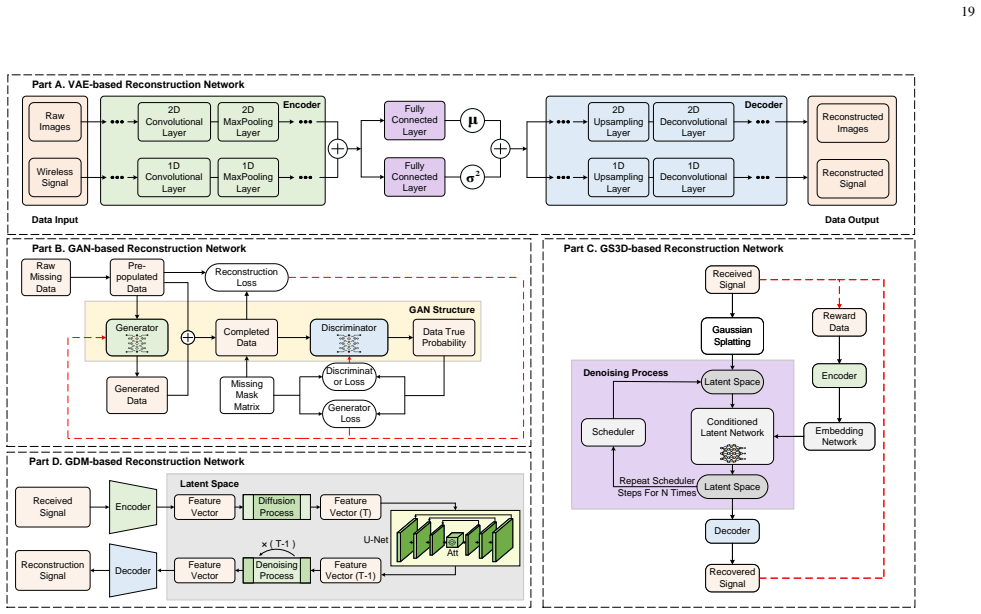
The central object is the agentic AI loop — perceive, reason, act — instantiated through five generative families: VAEs for uncertainty-aware reconstruction, GANs for high-fidelity synthesis and adversarial samples, diffusion models for noise-robust generation and sequential decision sampling, transformers for spatiotemporal pattern extraction, and LLMs for semantic reasoning and policy abstraction. The survey uses per-task tables to bind each family's mechanism to a specific SLAETN problem, and its comparative analysis positions the families as complementary modules in a hybrid cognitive engine.
What would settle it
Re-run the DMAPPO vertical-handover experiment and the DDPM-DRL carrier-aggregation experiment on an independent SAGIN simulator; if the handover failure reduction and the 42%–63% load-factor reduction do not appear outside the original setups, the paper's central mapping claim is undermined.
Extended reading notes
Core claim
The paper claims that GAI and LLMs together form the cognitive and generative core of agentic AI, enabling a shift from reactive decision-making to predictive and autonomous behavior in SLAETNs. It systematically reviews five classes of generative models and maps them onto agentic capabilities — perception generation, scenario construction, and policy synthesis — across three domains: communication enhancement, security and privacy protection, and intelligent satellite tasks. The survey reports quantitative gains from the papers it summarizes, including a handover failure reduction of up to 58%, load-factor reductions of 42%–63%, 95.68% radio-frequency fingerprint identification accuracy, and normalized MSE values as low as 0.01442, and treats these as evidence that the model-to-task mappings are actionable.
Load-bearing premise
The survey's model-to-task mappings rest on the accuracy and transferability of the simulation results reported by the papers it cites; if those numbers are scenario-specific or non-reproducible, the recommended mappings lose their evidentiary support.
Editorial extensions
If this is right
- Generative models become deployable building blocks for real-time channel estimation, CSI prediction, and spectrum map construction in space-air-ground links.
- Security functions — secrecy optimization, spoofing detection, intrusion detection, and signal recovery — can be implemented by choosing among VAE, GAN, diffusion, transformer, and LLM components rather than by bespoke rule engines.
- Satellite operations such as orbit prediction, collision avoidance, intent recognition, and remote sensing enhancement can be driven by lightweight transformers and LLM-based reasoning.
- The survey's lesson-learned sections imply that training overhead and data dependence currently gate deployment, pointing future work toward lightweight and transferable generative agents.
Reading between the lines
- If the claimed transferability holds, the same five-model taxonomy could organize agentic AI for other integrated network settings, such as maritime or vehicular space-air-ground systems, where the paper only sketches connections.
- The reported gains are mostly simulation-relative; a direct implication the authors leave implicit is that the mappings depend on scenario-matched training data and may degrade where channel statistics or attack patterns differ.
- A testable extension would be a benchmark comparing hybrid GAI-LLM agents against rule-based baselines under identical SLAETN topologies, quantifying how much of the reported gains comes from generative components versus RL infrastructure.
Editorial analysis
A structured set of objections, weighed in public.
Referee Report
Summary. This manuscript is a survey of generative AI (GAI) and large language model (LLM) techniques for satellite-augmented low-altitude economy and terrestrial networks (SLAETNs). After introducing the SLAETN architecture and its challenges, it organizes five model families—VAEs, GANs, GDMs, transformer-based models, and LLMs—into a comparative framework, and then maps these models onto three application domains: communication enhancement, security and privacy, and intelligent satellite operations. The paper's distinctive thesis, stated in Section II.B, is that GAI and LLMs form the 'cognitive and generative core' of agentic AI, enabling a shift from reactive decision-making to predictive and autonomous behavior. It includes per-topic 'Lesson Learned' paragraphs that candidly acknowledge training overhead, data dependence, and lack of real-world validation, as well as large comparative tables. No new algorithms, derivations, or experiments are presented; the contribution is organizational and interpretive, built on more than 100 cited papers.
Significance. If taken at face value, the survey fills a real gap between the existing GAI/LLM networking surveys and the emerging agentic-AI literature, and it offers a useful taxonomy of model families mapped to SLAETN tasks. The lesson-learned sections and the 'Cons' columns in the tables are genuine strengths: they prevent the survey from being a purely promotional summary and give the reader a realistic sense of deployment barriers. However, the paper's central claim—that these models enable autonomous, predictive decision-making in SLAETNs—is currently supported by at least one internally inconsistent flagship example, and the quantitative evidence is mostly simulation-specific without explicit scope caveats. The survey is therefore promising but not yet fully reliable as the 'actionable reference' it claims to be.
major comments (3)
- [Section V.A and Table X] The text describing [67] states that the LLM-based spacecraft operator 'achieved 0% failure rate using CoT' and 'highlights the potential of LLMs in autonomous spacecraft operational decision-making.' Table X for the same reference lists 'Dependence on manual responses to correct the LLM's actions' as a con. These two statements are never reconciled. A system that requires manual corrections of its actions is not autonomous in the paper's own sense (Section II.B), and this contradiction sits on the paper's flagship example of GAI/LLM-enabled autonomy. Please revise Section V.A to state explicitly that the 0% failure rate was obtained in the KSPDG simulation with human-in-the-loop corrections and substantial prompt engineering, and adjust the 'autonomous' language accordingly. The corresponding 'Pros' cell should also be qualified so that the table and the text agree.
- [Sections III.B.1, III.B.2, IV.A.2, IV.C.2] Several quantitative results are reported as general capabilities without flagging their origin as single simulation studies. Examples include the 58% handover-failure reduction (DMAPPO), the 42%–63% load-factor reduction (DDPM-DRL), the 95.68% radio-frequency fingerprint identification accuracy, and the normalized MSE of 0.01442. These numbers are presumably faithful transcripts of the cited papers, but presenting them without scenario context (dataset, SNR, topology, or error bars) is risky, because these numbers anchor the model-to-task mappings that the paper calls 'actionable.' Please add a caveat or a dedicated indication that each quantitative result is 'as reported in [ref] under specific simulation conditions,' or state explicitly in the lesson-learned paragraphs which results have not been independently validated.
- [Section II.B and passim] The term 'agentic' is applied very liberally: nearly every GAI- or LLM-enabled component, including single-shot GAN–DRL hybrids and pure channel-modeling modules, is described as demonstrating 'agentic capabilities' (e.g., Sections III.A.1, IV.A.1, IV.C.1). If the survey's contribution is specifically about agentic AI, it should state a minimal operational definition of 'agentic' (closed-loop perception–reasoning–action, multi-step goal-directed planning, tool invocation, or similar) and apply that definition consistently when classifying cited works. Without this, the survey's central distinction from ordinary GAI/LLM networking is eroded and the reader cannot tell which of the surveyed systems actually exhibits autonomous behavior.
minor comments (5)
- [Abstract / Index Terms] The index term 'Satellite-augemented' is misspelled, and the abstract uses 'V AEs' with a space; please use consistent 'VAEs' throughout.
- [Fig. 1 and Section I] The figure label 'perceiption-reasoning-action' should read 'perception-reasoning-action,' and there are subject-verb agreement slips in the text (e.g., 'These generative techniques helps' in Section I).
- [Table I] The caption refers to red/green circles and green checkmarkers, but the rendered table in the text version does not show these markers; ensure the typeset version includes them or revise the caption.
- [Section IV.C.1] The comparison 'uses only 0.44% of ChatGPT-4's parameters' is not meaningful because GPT-4's parameter count is not publicly documented; rephrase in terms of the model's own parameter count rather than a ratio to an undisclosed number.
- [Section VI] The future-research items are general and not explicitly connected to the survey's own lesson-learned limitations; adding one sentence per direction linking back to the specific bottlenecks identified in Sections III–V would strengthen the actionability.
Circularity Check
No significant circularity: the survey is a literature mapping with no derivation chain or fitted parameters, and its self-citations are not load-bearing.
full rationale
This paper is a survey, not a derivation. It introduces no equations, fits no parameters, and makes no new quantitative prediction; instead, it maps existing GAI/LLM results onto SLAETN tasks. The claim that GAI and LLMs form the cognitive and generative core of agentic AI (Section II.B) is a conceptual framing, not a result derived from data, and the model-to-task mappings in Sections III–V are literature attributions. Quantitative figures such as the DMAPPO handover-failure reduction, the 95.68% RFFI accuracy, or the 0.01442 normalized MSE are quoted from cited simulations and are not constructed from the survey's own definitions, so there is no fitted-input-called-prediction or self-definitional reduction. Some cited works share authors with the survey (e.g., references [33] and [43]), but these are external peer-reviewed publications with their own simulations and benchmarks; they support individual examples without being the unique basis for the survey's taxonomy or central claim. The internal inconsistency between Section V.A's 0% failure-rate description of reference [67] and Table X's note that the LLM depends on manual corrections is a correctness and consistency risk, not a circular step. The lesson-learned paragraphs further acknowledge training overhead and data dependence, which the survey treats as open limitations rather than hiding as predictions. No uniqueness theorem is imported from the authors' prior work, and no ansatz is smuggled in by citation. Within the requested circularity criteria, the derivation chain is self-contained.
Assumptions & free parameters
assumptions (4)
- domain assumption Conventional rule-based and static ML approaches cannot handle SLAETN dynamics and data sparsity.
- domain assumption Generative models' capabilities (latent-distribution learning, data synthesis, semantic reasoning) transfer to network control and security tasks as described.
- domain assumption The quantitative results of the summarized studies accurately reflect real SLAETN conditions.
- standard math Standard formulations of VAEs, GANs, GDMs, transformers, and LLMs are accepted background.
Cite this review
Pith. "Pith review of Agentic Satellite-Augmented Low-Altitude Economy and Terrestrial Networks: A Survey on Generative Approaches." pith.science (2026). https://pith.science/paper/AJ2AFMF6
@misc{pith2026250714633,
  author       = {Pith},
  title        = {Pith review of: Agentic Satellite-Augmented Low-Altitude Economy and Terrestrial Networks: A Survey on Generative Approaches},
  year         = {2026},
  howpublished = {\url{https://pith.science/paper/AJ2AFMF6}},
  note         = {Machine review of arXiv:2507.14633}
}
read the original abstract
The development of satellite-augmented low-altitude economy and terrestrial networks (SLAETNs) demands intelligent and autonomous systems that can operate reliably across heterogeneous, dynamic, and mission-critical environments. To address these challenges, this survey focuses on enabling agentic artificial intelligence (AI), that is, artificial agents capable of perceiving, reasoning, and acting, through generative AI (GAI) and large language models (LLMs). We begin by introducing the architecture and characteristics of SLAETNs, and analyzing the challenges that arise in integrating satellite, aerial, and terrestrial components. Then, we present a model-driven foundation by systematically reviewing five major categories of generative models: variational autoencoders (VAEs), generative adversarial networks (GANs), generative diffusion models (GDMs), transformer-based models (TBMs), and LLMs. Moreover, we provide a comparative analysis to highlight their generative mechanisms, capabilities, and deployment trade-offs within SLAETNs. Building on this foundation, we examine how these models empower agentic functions across three domains: communication enhancement, security and privacy protection, and intelligent satellite tasks. Finally, we outline key future directions for building scalable, adaptive, and trustworthy generative agents in SLAETNs. This survey aims to provide a unified understanding and actionable reference for advancing agentic AI in next-generation integrated networks.
Figures


Figures from the paper (5 more)



Forward citations
Cited by 3 Pith papers
-
SkyChain Intelligence: A Blockchain-Secured Multi-Agent DRL Framework for Low-Altitude Embodied Artificial Intelligence
SkyChain Intelligence integrates blockchain reputation scores into a MADDPG reward function to jointly optimize offloading, allocation, and 3D trajectories while addressing trust in decentralized low-altitude networks.
-
Large Language Models for Next-Generation Wireless Network Management: A Survey and Tutorial
A survey and tutorial that organizes LLM-enabled wireless network optimization into formulation, solution, and verification stages, with case studies drawn from the authors' own prior papers.
-
Low-Altitude Wireless Networks: A Comprehensive Survey
A comprehensive survey on low-altitude wireless network (LAWN) systems covering fundamentals, evolution of designs, performance metrics, privacy and security concerns, and airspace structuring for practical deployment.
Reference graph
Works this paper leans on
-
[67]
Language models are spacecraft operators,
V . Rodriguez-Fernandez, A. Carrasco, J. Cheng, E. Scharf, P. M. Siew, and R. Linares, “Language models are spacecraft operators,” arXiv:2404.00413, 2024
arXiv 2024
-
[1]
Unauthorized UA V countermeasure for low-altitude economy: Joint communications and jamming based on MIMO cellular systems,
Z. Li, Z. Gao, K. Wang, Y . Mei, C. Zhu, L. Chen, X. Wu, and D. Niyato, “Unauthorized UA V countermeasure for low-altitude economy: Joint communications and jamming based on MIMO cellular systems,”IEEE Internet of Things Journal, vol. 12, no. 6, pp. 6659–6672, Mar. 2025
2025
-
[2]
LEO-satellite-assisted UA V: Joint trajectory and data collection for Internet of remote things in 6G aerial access networks,
Z. Jia, M. Sheng, J. Li, D. Niyato, and Z. Han, “LEO-satellite-assisted UA V: Joint trajectory and data collection for Internet of remote things in 6G aerial access networks,”IEEE Internet of Things Journal, vol. 8, no. 12, pp. 9814–9826, Jun. 2021
2021
-
[3]
The state of urban air mobility research: An assessment of challenges and opportunities,
S. Shahriar Ahmed, G. Fountas, V . Lurkin, P. C. Anastasopoulos, Y . Zhang, M. Bierlaire, and F. Mannering, “The state of urban air mobility research: An assessment of challenges and opportunities,” IEEE Transactions on Intelligent Transportation Systems, vol. 26, no. 2, pp. 1375–1394, Feb. 2025
2025
-
[4]
Transfer optimization for heterogeneous drone delivery and pickup problem,
X. Wen, G. Wu, J. Liu, and Y .-S. Ong, “Transfer optimization for heterogeneous drone delivery and pickup problem,”IEEE Transactions on Emerging Topics in Computational Intelligence, vol. 9, no. 1, pp. 347–364, Feb. 2025
2025
-
[5]
The potential of low-altitude airspace: The future of urban air transportation,
H. Huang, J. Su, and F.-Y . Wang, “The potential of low-altitude airspace: The future of urban air transportation,”IEEE Transactions on Intelligent Vehicles, vol. 9, no. 8, pp. 5250–5254, Aug. 2024
2024
-
[6]
Low-earth orbit satellite constellations for global communication network connectivity,
E. Lagunas, S. Chatzinotas, and B. Ottersten, “Low-earth orbit satellite constellations for global communication network connectivity,”Nature Reviews Electrical Engineering, vol. 1, pp. 656–665, Sep. 2024
2024
-
[7]
Reliable and low- overhead clustering in LEO small satellite networks,
J. Liu, X. Zhang, R. Zhang, T. Huang, and F. R. Yu, “Reliable and low- overhead clustering in LEO small satellite networks,”IEEE Internet of Things Journal, vol. 9, no. 16, pp. 14 844–14 856, Aug. 2022
2022
Show all 255 references
-
[8]
Near-space communications: The last piece of 6G space–air–ground–sea integrated network puzzle,
H. Liu, T. Qin, null, T. Mao, K. Ying, Z. Wan, L. Qiao, R. Na, Z. Li, C. Hu, Y . Mei, T. Li, G. Wen, L. Chen, Z. Wu, R. Liu, G. Chen, S. Wang, and D. Zheng, “Near-space communications: The last piece of 6G space–air–ground–sea integrated network puzzle,”Space: Science & Techno...
2024
-
[9]
Secure physical layer communications for low-altitude economy networking: A survey,
L. Cai, J. Wang, R. Zhang, Y . Zhang, T. Jiang, D. Niyato, X. Wang, A. Jamalipour, and X. Shen, “Secure physical layer communications for low-altitude economy networking: A survey,” arXiv:2504.09153, 2025
2025 arXiv
-
[10]
A survey of wireless networks for future aerial communications (FACOM),
A. Baltaci, E. Dinc, M. Ozger, A. Alabbasi, C. Cavdar, and D. Schupke, “A survey of wireless networks for future aerial communications (FACOM),”IEEE Communications Surveys & Tutorials, vol. 23, no. 4, pp. 2833–2884, 4th. Quart. 2021
2021
-
[11]
A survey on technologies, standards and open challenges in satellite IoT,
M. Centenaro, C. E. Costa, F. Granelli, C. Sacchi, and L. Vangelista, “A survey on technologies, standards and open challenges in satellite IoT,”IEEE Communications Surveys & Tutorials, vol. 23, no. 3, pp. 1693–1720, 3rd. Quart. 2021
2021
-
[12]
Performance evaluation for latency-stability tradeoff in satellite-terrestrial integrated networks,
Z. Wang, Q. Meng, S. Zhang, and H. Luo, “Performance evaluation for latency-stability tradeoff in satellite-terrestrial integrated networks,” IEEE Transactions on Networking, early access, Jun. 27, 2025. [Online]. Available: https://doi.org/10.1109/TON.2025.3578240
2025
-
[13]
A survey on random access protocols in direct-access LEO satellite-based IoT communication,
T. T. T. Le, N. U. Hassan, X. Chen, M.-S. Alouini, Z. Han, and C. Yuen, “A survey on random access protocols in direct-access LEO satellite-based IoT communication,”IEEE Communications Surveys & Tutorials, vol. 27, no. 1, pp. 426–462, Feb. 2025
2025
-
[14]
Accessed: Jun
China moves to boost low-altitude economy through legislation. Accessed: Jun. 27, 2025. [Online]. Available: https://www.chinadaily. com.cn/a/202506/27/WS685e58ffa31000e9a573905a.html
2025
-
[15]
A novel graph-based multi-layer framework for managing drone BVLoS operations,
F. Betti Sorbelli, P. Chatterjee, F. Cor `o, S. Ghobadi, L. Palazzetti, and C. M. Pinotti, “A novel graph-based multi-layer framework for managing drone BVLoS operations,”IEEE Transactions on Network and Service Management, vol. 21, no. 5, pp. 5091–5105, Oct. 2024
2024
-
[16]
Towards a heuristic optimizer for a target time management system in air traffic flow management,
S. Gruber, P. Feichtenschlager, C. Fabianek, E. Gringinger, and C. G. Schuetz, “Towards a heuristic optimizer for a target time management system in air traffic flow management,” in2024 AIAA DATC/IEEE 43rd Digital Avionics Systems Conference (DASC), 2024, pp. 1–10
2024
-
[17]
Dynamic SFC em- bedding algorithm assisted by federated learning in space-air-ground- integrated network resource allocation scenario,
P. Zhang, Y . Zhang, N. Kumar, and M. Guizani, “Dynamic SFC em- bedding algorithm assisted by federated learning in space-air-ground- integrated network resource allocation scenario,”IEEE Internet of Things Journal, vol. 10, no. 11, pp. 9308–9318, Jun. 2023
2023
-
[18]
Hierarchical domain-based multicontroller deployment strategy in SDN-enabled space-air-ground integrated network,
C. Chen, Z. Liao, Y . Ju, C. He, K. Yu, and S. Wan, “Hierarchical domain-based multicontroller deployment strategy in SDN-enabled space-air-ground integrated network,”IEEE Transactions on Aerospace and Electronic Systems, vol. 58, no. 6, pp. 4864–4879, Dec. 2022
2022
-
[19]
Deep generative models in the industrial Internet of things: A survey,
S. De, M. Bermudez-Edo, H. Xu, and Z. Cai, “Deep generative models in the industrial Internet of things: A survey,”IEEE Transactions on Industrial Informatics, vol. 18, no. 9, pp. 5728–5737, Sep. 2022
2022
-
[20]
Internet of agents: Fundamentals, applications, and challenges,
Y . Wang, S. Guo, Y . Pan, Z. Su, F. Chen, T. H. Luan, P. Li, J. Kang, and D. Niyato, “Internet of agents: Fundamentals, applications, and challenges,” arXiv:2505.07176, 2025
2025
-
[21]
From predictive and generative to agentic AI: Shaping the future of marketing operations and strategies,
N. Kshetri, “From predictive and generative to agentic AI: Shaping the future of marketing operations and strategies,”Computer, vol. 58, no. 4, pp. 121–129, Apr. 2025
2025
-
[22]
Parallel emergency management of incidents by integrating OODA and PREA loops: The C2 mechanism and modes,
D. Yang, Q. Li, F. Zhu, H. Cui, W. Yi, and J. Qin, “Parallel emergency management of incidents by integrating OODA and PREA loops: The C2 mechanism and modes,”IEEE Transactions on Systems, Man, and Cybernetics: Systems, vol. 53, no. 4, pp. 2160–2172, Apr. 2023
2023
-
[23]
Agentic AI: Autonomous intelligence for complex goals—A comprehensive survey,
D. B. Acharya, K. Kuppan, and B. Divya, “Agentic AI: Autonomous intelligence for complex goals—A comprehensive survey,”IEEE Ac- cess, vol. 13, pp. 18 912–18 936, 2025
2025
-
[24]
Generative AI for unmanned vehicle swarms: Challenges, applications and opportunities,
G. Liu, N. V . Huynh, H. Du, D. T. Hoang, D. Niyato, K. Zhu, J. Kang, Z. Xiong, A. Jamalipour, and D. I. Kim, “Generative AI for unmanned vehicle swarms: Challenges, applications and opportunities,” arXiv:2402.18062, 2024
2024 arXiv
-
[25]
Large language model agents for radio map generation and wireless network planning,
H. Quan, W. Ni, T. Zhang, X. Ye, Z. Xie, S. Wang, Y . Liu, and H. Song, “Large language model agents for radio map generation and wireless network planning,”IEEE Networking Letters, early access, Feb. 07,
-
[26]
An enhanced AI-based network intrusion detection system using generative adversarial networks,
C. Park, J. Lee, Y . Kim, J.-G. Park, H. Kim, and D. Hong, “An enhanced AI-based network intrusion detection system using generative adversarial networks,”IEEE Internet of Things Journal, vol. 10, no. 3, pp. 2330–2345, Feb. 2023
2023
-
[27]
Generative AI-driven multi-agent DRL for task allocation in UA V- assisted EMPD within 6G-enabled SAGIN networks,
M. L. Betalo, I. Ullah, F. B. Tesema, Z. Wu, J. Li, and X. Bai, “Generative AI-driven multi-agent DRL for task allocation in UA V- assisted EMPD within 6G-enabled SAGIN networks,”IEEE Internet of Things Journal, early access, Jun. 16, 2025. [Online]. Available: https://doi.org...
2025
-
[28]
Integration of LLM and human-AI coordination for power dispatching with connected electric vehicles under SAGVNs,
X. Chen, X. Lu, Q. Li, D. Li, and F. Zhu, “Integration of LLM and human-AI coordination for power dispatching with connected electric vehicles under SAGVNs,”IEEE Transactions on Vehicular Technology, vol. 74, no. 2, pp. 1992–2002, Feb. 2025
1992
-
[29]
At the dawn of generative AI era: A tutorial-cum-survey on new frontiers in 6G wireless intelligence,
A. Celik and A. M. Eltawil, “At the dawn of generative AI era: A tutorial-cum-survey on new frontiers in 6G wireless intelligence,”IEEE Open Journal of the Communications Society, vol. 5, pp. 2433–2489, 2024
2024
-
[30]
Constructing 4D radio map in LEO satellite networks with limited samples,
H. Yuan, Z. Chen, Z. Lin, J. Peng, Y . Zhong, X. Hu, S. Xue, W. Li, and Y . Gao, “Constructing 4D radio map in LEO satellite networks with limited samples,” arXiv:2501.02775, 2025
2025 arXiv
-
[31]
High-altitude-UA V-relayed satellite D2D communications for 6G IoT network,
J. Wang, T. Hong, F. Qi, L. Liu, and X. He, “High-altitude-UA V-relayed satellite D2D communications for 6G IoT network,”Drones, vol. 8, no. 10, 2024
2024
-
[32]
CWGAN-based channel modeling of convolutional autoencoder-aided SCMA for satellite- terrestrial communication,
D. Li, X. Liu, Z. Yin, N. Cheng, and J. Liu, “CWGAN-based channel modeling of convolutional autoencoder-aided SCMA for satellite- terrestrial communication,”IEEE Internet of Things Journal, vol. 11, no. 22, pp. 36 775–36 785, Nov. 2024
2024
-
[33]
Generative AI for space-air-ground integrated networks,
R. Zhang, H. Du, D. Niyato, J. Kang, Z. Xiong, A. Jamalipour, P. Zhang, and D. I. Kim, “Generative AI for space-air-ground integrated networks,”IEEE Wireless Communications, vol. 31, no. 6, pp. 10–20, Dec. 2024
2024
-
[34]
Toward a fully-observable Markov decision process with generative models for integrated 6G- non-terrestrial networks,
A. Machumilane, P. Cassara, and A. Gotta, “Toward a fully-observable Markov decision process with generative models for integrated 6G- non-terrestrial networks,”IEEE Open Journal of the Communications Society, vol. 4, pp. 1913–1930, Aug. 2023
1913
-
[35]
Transformer neural network for throughput improvement in non-terrestrial networks,
R. Giuliano, E. Innocenti, F. Mazzenga, A. Vizzarri, L. Di Nunzio, P. B. Divakarachari, and I. Habib, “Transformer neural network for throughput improvement in non-terrestrial networks,” in2023 Interna- tional Conference on Network, Multimedia and Information Technology (NMITC...
2023
-
[36]
Space-based electromagnetic spectrum sensing and situation awareness,
Y . Huang, H. Cui, Y . Hou, C. Hao, W. Wang, Q. Zhu, J. Li, Q. Wu, and J. Wang, “Space-based electromagnetic spectrum sensing and situation awareness,”Space: Science & Technology, vol. 4, p. 0109, Feb. 2024
2024
-
[37]
SC- GAN: A spectrum cartography with satellite Internet based on Pix2Pix generative adversarial network,
Z. Pan, Z. Bangning, W. Heng, M. Wenfeng, and G. Daoxing, “SC- GAN: A spectrum cartography with satellite Internet based on Pix2Pix generative adversarial network,”China Communications, vol. 22, no. 2, pp. 47–61, Feb. 2025
2025
-
[38]
Routing for space-air-ground inte- grated network with GAN-powered deep reinforcement learning,
Q. Guo, F. Tang, and N. Kato, “Routing for space-air-ground inte- grated network with GAN-powered deep reinforcement learning,”IEEE Transactions on Cognitive Communications and Networking, vol. 11, no. 2, pp. 914–922, Apr. 2025
2025
-
[39]
Generative AI-aided vertical handover decision in SAGIN for IoT with integrated sensing and communication,
S. Tao, M. Yuan, Q. Wu, R. Wang, and J. Hao, “Generative AI-aided vertical handover decision in SAGIN for IoT with integrated sensing and communication,”IEEE Internet of Things Journal, vol. 12, no. 10, pp. 13 297–13 310, May 2025
2025
-
[40]
Carrier aggregation, load balanc- ing, and backhauling in non-terrestrial networks: Generative diffusion model-based optimization,
F. Khoramnejad and E. Hossain, “Carrier aggregation, load balanc- ing, and backhauling in non-terrestrial networks: Generative diffusion model-based optimization,”IEEE Transactions on Wireless Communi- cations, vol. 24, no. 5, pp. 4483–4499, May 2025
2025
-
[41]
Diffusion-enabled digital twin synchronization for AIGC services in space-air-ground-integrated networks,
Y . Li, K. Jin, J. Tang, Y . Zhang, and Y . Feng, “Diffusion-enabled digital twin synchronization for AIGC services in space-air-ground-integrated networks,”IEEE Internet of Things Journal, vol. 12, no. 9, pp. 12 989– 13 004, May 2025
2025
-
[42]
Generative adversarial imitation learning assisted virtual network em- bedding algorithm for space-air-ground integrated network,
P. Zhang, Z. Xu, N. Kumar, J. Wang, L. Tan, and A. Almogren, “Generative adversarial imitation learning assisted virtual network em- bedding algorithm for space-air-ground integrated network,”Computer Communications, vol. 228, p. 107936, Sep. 2024
2024
-
[43]
Generative AI agents with large language model for satellite networks via a mixture of experts transmission,
R. Zhang, H. Du, Y . Liu, D. Niyato, J. Kang, Z. Xiong, A. Jamalipour, and D. In Kim, “Generative AI agents with large language model for satellite networks via a mixture of experts transmission,”IEEE Journal on Selected Areas in Communications, vol. 42, no. 12, pp. 3581–3596,...
2024
-
[44]
An autonomous network orchestration framework integrating large language models with continual reinforce- ment learning,
M. Shokrnezhad and T. Taleb, “An autonomous network orchestration framework integrating large language models with continual reinforce- ment learning,” arXiv:2502.16198, 2025
2025 arXiv
-
[45]
Space-air-ground integrated networks with task-driven connected intelligence,
H. Gao, R. Cao, W. Xu, C. Yuan, and H.-H. Chen, “Space-air-ground integrated networks with task-driven connected intelligence,”IEEE Wireless Communications, vol. 32, no. 2, pp. 254–261, Apr. 2025
2025
-
[46]
Multi- objective aerial collaborative secure communication optimization via generative diffusion model-enabled deep reinforcement learning,
C. Zhang, G. Sun, J. Li, Q. Wu, J. Wang, D. Niyato, and Y . Liu, “Multi- objective aerial collaborative secure communication optimization via generative diffusion model-enabled deep reinforcement learning,”IEEE Transactions on Mobile Computing, vol. 24, no. 4, pp. 3041–3058, Apr. 2025
2025
-
[47]
Generative adversarial network based resource optimization for UA V jamming assisted cog- nitive covert communication,
X. Liao, C. Lin, S. Nie, H. Wang, and C. Zhao, “Generative adversarial network based resource optimization for UA V jamming assisted cog- nitive covert communication,”Journal of Physics: Conference Series, vol. 2717, no. 1, p. 012013, Mar. 2024
2024
-
[48]
Decentralized detection of GPS spoofing in vehicular Ad Hoc networks,
F. A. Milaat and H. Liu, “Decentralized detection of GPS spoofing in vehicular Ad Hoc networks,”IEEE Communications Letters, vol. 22, no. 6, pp. 1256–1259, Jun. 2018
2018
-
[49]
Distributed network intrusion detection system in satellite-terrestrial integrated networks using federated learning,
K. Li, H. Zhou, Z. Tu, W. Wang, and H. Zhang, “Distributed network intrusion detection system in satellite-terrestrial integrated networks using federated learning,”IEEE Access, vol. 8, pp. 214 852–214 865, Dec. 2020
2020
-
[50]
Large language models for telecom: Forthcoming impact on the industry,
A. Maatouk, N. Piovesan, F. Ayed, A. De Domenico, and M. Debbah, “Large language models for telecom: Forthcoming impact on the industry,”IEEE Communications Magazine, vol. 63, no. 1, pp. 62–68, Jan. 2025
2025
-
[51]
Toward proactive, secure and efficient space-air- ground communications: Generative AI-based DRL framework,
A. Kakati, G. Li, E. Moustapha Diallo, L. Chiru Kawala, N. Hussain, and A. B. M. Adam, “Toward proactive, secure and efficient space-air- ground communications: Generative AI-based DRL framework,”IEEE Open Journal of the Communications Society, vol. 6, pp. 1284–1298, 2025
2025
-
[52]
Low-altitude friendly-jamming for satellite-maritime com- munications via generative AI-enabled deep reinforcement learning,
J. Huang, A. Wang, G. Sun, J. Li, J. Wang, D. Niyato, and V . C. M. Leung, “Low-altitude friendly-jamming for satellite-maritime com- munications via generative AI-enabled deep reinforcement learning,” arXiv:2501.15468, 2025
2025
-
[53]
Radio frequency fingerprint identification based on variational autoencoder for GNSS,
Q. Jiang and J. Sha, “Radio frequency fingerprint identification based on variational autoencoder for GNSS,”IEEE Geoscience and Remote Sensing Letters, vol. 21, pp. 1–4, 2024
2024
-
[54]
Covert LEO satellite communication aided by generative adversarial network based cooperative UA V jamming,
S. Jia, L. Xiaomeng, L. Xiaomin, T. Zhuangzhuang, and H. Junfan, “Covert LEO satellite communication aided by generative adversarial network based cooperative UA V jamming,”China Communications, vol. 21, no. 9, pp. 27–39, Sep. 2024
2024
-
[55]
Res- GAN for behavioral modeling and pre-distortion of power amplifiers in OFDM-based satellite communication system,
M. Wang, H. Jia, S. Wu, X. Hu, C. Jiang, and W. Zhang, “Res- GAN for behavioral modeling and pre-distortion of power amplifiers in OFDM-based satellite communication system,”IEEE Transactions on Vehicular Technology, vol. 73, no. 2, pp. 2132–2141, Feb. 2024
2024
-
[56]
GNSS spoofing jamming detection based on generative adversarial network,
J. Li, X. Zhu, M. Ouyang, W. Li, Z. Chen, and Q. Fu, “GNSS spoofing jamming detection based on generative adversarial network,”IEEE Sensors Journal, vol. 21, no. 20, pp. 22 823–22 832, Oct. 2021
2021
-
[57]
Machine and representation learning-based GNSS spoofing detectors utilizing feature set from generic GNSS receivers,
A. Iqbal, M. N. Aman, and B. Sikdar, “Machine and representation learning-based GNSS spoofing detectors utilizing feature set from generic GNSS receivers,”IEEE Transactions on Consumer Electronics, vol. 70, no. 1, pp. 574–583, Feb. 2024
2024
-
[58]
A deep learning based induced GNSS spoof detection frame- work,
——, “A deep learning based induced GNSS spoof detection frame- work,”IEEE Transactions on Machine Learning in Communications and Networking, vol. 2, pp. 457–478, Apr. 2024
2024
-
[59]
A synthetic data-assisted satellite terrestrial integrated network intrusion detection framework,
J. He, X. Li, X. Zhang, W. Niu, and F. Li, “A synthetic data-assisted satellite terrestrial integrated network intrusion detection framework,” IEEE Transactions on Information Forensics and Security, vol. 20, pp. 1739–1754, Jan. 2025
2025
-
[60]
PLLM-CS: Pre-trained large language model (LLM) for cyber threat detection in satellite networks,
M. Hassanin, M. Keshk, S. Salim, M. Alsubaie, and D. Sharma, “PLLM-CS: Pre-trained large language model (LLM) for cyber threat detection in satellite networks,” arXiv:2405.05469, 2024
2024 arXiv
-
[61]
Exploring LLM-based multi-agent situation awareness for zero-trust space-air-ground integrated network,
X. Cao, G. Nan, H. Guo, H. Mu, L. Wang, Y . Lin, Q. Zhou, J. Li, B. Qin, Q. Cui, X. Tao, H. Fang, H. Du, and T. Q. Quek, “Exploring LLM-based multi-agent situation awareness for zero-trust space-air-ground integrated network,”IEEE Journal on Selected Areas in Communications, v...
2025
-
[62]
An LLM-based self-evolving security framework for 6G space-air-ground integrated networks,
Q. Qin, X. Cao, G. Nan, S. Chen, R. Li, L. Su, H. Du, Q. Cui, P. Mao, X. Tao, and T. Q. S. Quek, “An LLM-based self-evolving security framework for 6G space-air-ground integrated networks,” arXiv:2505.03161, 2025
2025 arXiv
-
[63]
Efficient fusion and reconstruction for communication and sensing signals in green IoT networks,
Z. Jing, J. Mu, X. Li, Q. Zhou, and Q. Tian, “Efficient fusion and reconstruction for communication and sensing signals in green IoT networks,”IEEE Internet of Things Journal, vol. 10, no. 11, pp. 9319– 9328, Jun. 2023
2023
-
[64]
High-precision reconstruction method based on MTS-GAN for electromagnetic environment data in SAGIoT,
L. Guo, Y . Liu, Y . Li, and K. Yang, “High-precision reconstruction method based on MTS-GAN for electromagnetic environment data in SAGIoT,”EURASIP Journal on Advances in Signal Processing, vol. 2023, no. 1, p. 125, Dec. 2023
2023
-
[65]
Diffusion model-based signal recovery in coexisting satellite and terrestrial networks,
A. B. M. Adam, M. Samy, C. E. Garc ´ıa, E. Lagunas, and S. Chatzino- tas, “Diffusion model-based signal recovery in coexisting satellite and terrestrial networks,” in2024 IEEE Wireless Communications and Networking Conference (WCNC), Apr. 2024, pp. 1–5
2024
-
[66]
GS3D: Signal recovery in 3D wireless networks with Gaussian splatting-synergized stable diffusion,
A. B. M. Adam, E. Lagunas, M. Samy, and S. Chatzinotas, “GS3D: Signal recovery in 3D wireless networks with Gaussian splatting-synergized stable diffusion,”IEEE Wireless Communications Letters, early access, Apr. 16, 2025. [Online]. Available: https: //doi.org/10.1109/LWC.2025.3561522
2025
-
[68]
LTE: Lightweight transformer encoder for orbit prediction,
S. Jeong and Y . Shin, “LTE: Lightweight transformer encoder for orbit prediction,”Electronics, vol. 13, no. 22, Nov. 2024
2024
-
[69]
Intention recognition of space noncooperative targets using large language models,
H. Jing, Q. Sun, Z. Dang, and H. Wang, “Intention recognition of space noncooperative targets using large language models,”Space: Science & Technology, vol. 5, p. 0271, 2025
2025
-
[70]
Enhanced GANs for satellite behavior discovery,
D. Shen, C. Sheaff, M. Guo, E. Blasch, K. Pham, and G. Chen, “Enhanced GANs for satellite behavior discovery,” inSensors and Systems for Space Applications XIII, vol. 11422. SPIE, 2020, pp. 110–121
2020
-
[71]
On-air deep learning integrated semantic inference models for enhanced Earth observation satellite networks,
H. fu Chou, V . N. Ha, P. Thiruvasagam, T.-D. Le, G. Eappen, T. T. Nguyen, L. M. Garces-Socarras, J. L. Gonzalez-Rios, J. C. Merlano- Duncan, and S. Chatzinotas, “On-air deep learning integrated semantic inference models for enhanced Earth observation satellite networks,” arXi...
2024 arXiv
-
[72]
A lightweight transformer-based collision detection and load estimation scheme for massive random access in 6G satellite-ground integrated vehicular networks,
L. Zhen, M. Li, C. Chakraborty, J. Jiang, A. Polavarapu, and F. Alqahtani, “A lightweight transformer-based collision detection and load estimation scheme for massive random access in 6G satellite-ground integrated vehicular networks,”IEEE Transactions on Intelligent Transport...
2025
-
[73]
PrecipGAN: Merging microwave and infrared data for satellite precipitation estimation using generative adversarial network,
C. Wang, G. Tang, and P. Gentine, “PrecipGAN: Merging microwave and infrared data for satellite precipitation estimation using generative adversarial network,”Geophysical Research Letters, vol. 48, no. 5, p. e2020GL092032, Feb. 2021
2021
-
[74]
T-SPP: Im- proving GNSS single-point positioning performance using transformer- based correction,
F. Wu, L. Wei, H. Luo, F. Zhao, X. Ma, and B. Ning, “T-SPP: Im- proving GNSS single-point positioning performance using transformer- based correction,”International Journal of Intelligent Systems, vol. 2024, no. 1, p. 6643723, Feb. 2024. 27
2024
-
[75]
MBGPIN: Multi-branch generative prior integra- tion network for super-resolution satellite imagery,
F. Safarov, U. Khojamuratova, M. Komoliddin, F. Bolikulov, S. Muksi- mova, and Y .-I. Cho, “MBGPIN: Multi-branch generative prior integra- tion network for super-resolution satellite imagery,”Remote Sensing, vol. 17, no. 5, Feb. 2025
2025
-
[76]
Super-resolved 3-D satellite lidar imaging of Earth via generative diffusion models,
A. Ramirez-Jaime, N. Porras-Diaz, G. R. Arce, and M. Stephen, “Super-resolved 3-D satellite lidar imaging of Earth via generative diffusion models,”IEEE Transactions on Geoscience and Remote Sensing, vol. 63, pp. 1–19, Feb. 2025
2025
-
[77]
Free space optical semantic communication for satellite remote sensing image transmission,
W. Chen, C. Ju, T. Yuan, Y . Zhan, M. Zhang, and D. Wang, “Free space optical semantic communication for satellite remote sensing image transmission,”IEEE Transactions on Communications, early access, Apr. 18, 2025. [Online]. Available: https://doi.org/10.1109/ TCOMM.2025.3562356
2025
-
[78]
Machine learning-aided operations and communications of unmanned aerial vehicles: A contemporary survey,
H. Kurunathan, H. Huang, K. Li, W. Ni, and E. Hossain, “Machine learning-aided operations and communications of unmanned aerial vehicles: A contemporary survey,”IEEE Communications Surveys & Tutorials, vol. 26, no. 1, pp. 496–533, 1st. Quart. 2024
2024
-
[79]
A compre- hensive survey on artificial intelligence for unmanned aerial vehicles,
S. Sai, A. Garg, K. Jhawar, V . Chamola, and B. Sikdar, “A compre- hensive survey on artificial intelligence for unmanned aerial vehicles,” IEEE Open Journal of Vehicular Technology, vol. 4, pp. 713–738, 2023
2023
-
[80]
Artificial intelligence for satellite communication: A survey,
G. Fontanesi, F. Ort ´ız, E. Lagunas, L. M. Garc ´es-Socarr´as, V . M. Baeza, M. ´A. V ´azquez, J. A. V ´asquez-Peralvo, M. Minardi, H. N. Vu, P. J. Honnaiah, C. Lacoste, Y . Drif, L. M. Marrero, S. Daoud, T. S. Abdu, G. Eappen, J. u. Rehman, W. A. Martins, P. Henarejos, H. Al...
2025
-
[81]
Revolutionizing future connectivity: A contemporary survey on AI-empowered satellite-based non-terrestrial networks in 6G,
S. Mahboob and L. Liu, “Revolutionizing future connectivity: A contemporary survey on AI-empowered satellite-based non-terrestrial networks in 6G,”IEEE Communications Surveys & Tutorials, vol. 26, no. 2, pp. 1279–1321, 2nd. Quart. 2024
2024
-
[82]
On the interplay of artificial intelligence and space-air-ground integrated networks: A survey,
A. Bakambekova, N. Kouzayha, and T. Al-Naffouri, “On the interplay of artificial intelligence and space-air-ground integrated networks: A survey,”IEEE Open Journal of the Communications Society, vol. 5, pp. 4613–4673, 2024
2024
-
[83]
Resource allocation for space-air-ground integrated networks: A comprehensive review,
H. Liang, Z. Yang, G. Zhang, and H. Hou, “Resource allocation for space-air-ground integrated networks: A comprehensive review,” Journal of Communications and Information Networks, vol. 9, no. 1, pp. 1–23, Mar. 2024
2024
-
[84]
UA V-assisted space-air-ground integrated networks: A technical review of recent learning algorithms,
A. H. Arani, P. Hu, and Y . Zhu, “UA V-assisted space-air-ground integrated networks: A technical review of recent learning algorithms,” IEEE Open Journal of Vehicular Technology, vol. 5, pp. 1004–1023, 2024
2024
-
[85]
Generative diffusion-based contract design for efficient AI twin migration in vehicular embodied AI networks,
Y . Zhong, J. Kang, J. Wen, D. Ye, J. Nie, D. Niyato, X. Gao, and S. Xie, “Generative diffusion-based contract design for efficient AI twin migration in vehicular embodied AI networks,”IEEE Transactions on Mobile Computing, vol. 24, no. 5, pp. 4573–4588, May 2025
2025
-
[86]
Applications of generative AI (GAI) for mobile and wireless networking: A survey,
T.-H. Vu, S. Kumar Jagatheesaperumal, M.-D. Nguyen, N. Van Huynh, S. Kim, and Q.-V . Pham, “Applications of generative AI (GAI) for mobile and wireless networking: A survey,”IEEE Internet of Things Journal, vol. 12, no. 2, pp. 1266–1290, Jan. 2025
2025
-
[87]
Deep generative model and its applications in efficient wireless network management: A tutorial and case study,
Y . Liu, H. Du, D. Niyato, J. Kang, Z. Xiong, D. I. Kim, and A. Jamalipour, “Deep generative model and its applications in efficient wireless network management: A tutorial and case study,”IEEE Wireless Communications, vol. 31, no. 4, pp. 199–207, Aug. 2024
2024
-
[88]
Generative AI in mobile networks: A survey,
A. Karapantelakis, P. Alizadeh, A. Alabassi, K. Dey, and A. Nikou, “Generative AI in mobile networks: A survey,”Annals of Telecommu- nications, vol. 79, no. 1, pp. 15–33, Feb. 2024
2024
-
[89]
Generative AI for the optimization of next-generation wireless networks: Basics, state-of-the-art, and open challenges,
F. Khoramnejad and E. Hossain, “Generative AI for the optimization of next-generation wireless networks: Basics, state-of-the-art, and open challenges,”IEEE Communications Surveys & Tutorials, early access, Jan. 28, 2025. [Online]. Available: https://doi.org/10.1109/ COMST.202...
2025
-
[90]
Enhancing deep reinforcement learning: A tutorial on generative diffusion models in network optimization,
H. Du, R. Zhang, Y . Liu, J. Wang, Y . Lin, Z. Li, D. Niyato, J. Kang, Z. Xiong, S. Cui, B. Ai, H. Zhou, and D. I. Kim, “Enhancing deep reinforcement learning: A tutorial on generative diffusion models in network optimization,”IEEE Communications Surveys & Tutorials, vol. 26, ...
2024
-
[91]
Generative AI for physical layer communications: A survey,
N. Van Huynh, J. Wang, H. Du, D. T. Hoang, D. Niyato, D. N. Nguyen, D. I. Kim, and K. B. Letaief, “Generative AI for physical layer communications: A survey,”IEEE Transactions on Cognitive Communications and Networking, vol. 10, no. 3, pp. 706–728, Jun. 2024
2024
-
[92]
Generative AI for secure physical layer communi- cations: A survey,
C. Zhao, H. Du, D. Niyato, J. Kang, Z. Xiong, D. I. Kim, X. Shen, and K. B. Letaief, “Generative AI for secure physical layer communi- cations: A survey,”IEEE Transactions on Cognitive Communications and Networking, vol. 11, no. 1, pp. 3–26, Feb. 2025
2025
-
[93]
Generative AI-driven semantic communication networks: Architec- ture, technologies, and applications,
C. Liang, H. Du, Y . Sun, D. Niyato, J. Kang, D. Zhao, and M. A. Imran, “Generative AI-driven semantic communication networks: Architec- ture, technologies, and applications,”IEEE Transactions on Cognitive Communications and Networking, vol. 11, no. 1, pp. 27–47, Feb. 2025
2025
-
[94]
UA Vs meet LLMs: Overviews and perspectives towards agentic low-altitude mobility,
Y . Tian, F. Lin, Y . Li, T. Zhang, Q. Zhang, X. Fu, J. Huang, X. Dai, Y . Wang, C. Tian, B. Li, Y . Lv, L. Kov ´acs, and F.-Y . Wang, “UA Vs meet LLMs: Overviews and perspectives towards agentic low-altitude mobility,”Information Fusion, vol. 122, p. 103158, Oct. 2025
2025
-
[95]
Generative AI-powered aerial access networks: Recent studies and future outlook,
T.-H. Nguyen, T. K. Nguyen, V . N. Quoc Bao, H. Park, and L. Park, “Generative AI-powered aerial access networks: Recent studies and future outlook,” in2024 15th International Conference on Information and Communication Technology Convergence (ICTC), 2024, pp. 529– 533
2024
-
[96]
Lever- aging large language models for integrated satellite-aerial-terrestrial networks: Recent advances and future directions,
S. Javaid, R. A. Khalil, N. Saeed, B. He, and M.-S. Alouini, “Lever- aging large language models for integrated satellite-aerial-terrestrial networks: Recent advances and future directions,”IEEE Open Journal of the Communications Society, vol. 6, pp. 399–432, 2025
2025
-
[97]
Unleashing the power of edge-cloud generative AI in mobile networks: A survey of AIGC services,
M. Xu, H. Du, D. Niyato, J. Kang, Z. Xiong, S. Mao, Z. Han, A. Jamalipour, D. I. Kim, X. Shen, V . C. M. Leung, and H. V . Poor, “Unleashing the power of edge-cloud generative AI in mobile networks: A survey of AIGC services,”IEEE Communications Surveys & Tutorials, vol. 26, n...
2024
-
[98]
Optimizing aigc services using learning-based stackelberg game in vehicular metaverses,
B. Lai, X. Luo, J. Kang, X. Gao, Z. Yang, D. Niyato, and S. Mao, “Optimizing aigc services using learning-based stackelberg game in vehicular metaverses,”IEEE Transactions on Vehicular Technology, early access, Feb. 21, 2025. [Online]. Available: https://doi.org/10.1109/TVT.20...
2025
-
[99]
The role of agentic AI in shaping a smart future: A systematic review,
S. Hosseini and H. Seilani, “The role of agentic AI in shaping a smart future: A systematic review,”Array, vol. 26, p. 100399, Jul. 2025
2025
-
[100]
Toward agentic AI: Generative information retrieval inspired intelligent communications and networking,
R. Zhang, S. Tang, Y . Liu, D. Niyato, Z. Xiong, S. Sun, S. Mao, and Z. Han, “Toward agentic AI: Generative information retrieval inspired intelligent communications and networking,” arXiv:2502.16866, 2025
2025 arXiv
-
[101]
Industrial agentic AI and generative modeling in complex systems,
M. R. Boskabadi, Y . Cao, B. Khadem, W. Clements, Z. Nevin Gerek, E. Reuthe, A. Sivaram, C. J. Savoie, and S. S. Mansouri, “Industrial agentic AI and generative modeling in complex systems,”Current Opinion in Chemical Engineering, vol. 48, p. 101150, Jun. 2025
2025
-
[102]
From large AI models to agentic AI: A tutorial on future intelligent communications,
F. Jiang, C. Pan, L. Dong, K. Wang, O. A. Dobre, and M. Debbah, “From large AI models to agentic AI: A tutorial on future intelligent communications,” arXiv:2505.22311, 2025
2025 arXiv
-
[103]
AI agents vs. agentic AI: A conceptual taxonomy, applications and challenges,
R. Sapkota, K. I. Roumeliotis, and M. Karkee, “AI agents vs. agentic AI: A conceptual taxonomy, applications and challenges,” arXiv:2505.10468, 2025
2025
-
[104]
Enhancing generative AI reliability via agentic AI in 6G-enabled edge computing,
A. Laha, S. A. King, N. Zhang, H. Xing, and H. Seilani, “Enhancing generative AI reliability via agentic AI in 6G-enabled edge computing,” Nature Reviews Electrical Engineering, Apr. 2025
2025
-
[105]
TRiSM for agentic AI: A review of trust, risk, and security management in LLM- based agentic multi-agent systems,
S. Raza, R. Sapkota, M. Karkee, and C. Emmanouilidis, “TRiSM for agentic AI: A review of trust, risk, and security management in LLM- based agentic multi-agent systems,” arXiv:2506.04133, 2025
2025
-
[106]
Agentic AI for cloud troubleshooting: A review of multi agent system for automated cloud support,
K. A. Patel, E. C. Pandey, I. Misra, and D. Surve, “Agentic AI for cloud troubleshooting: A review of multi agent system for automated cloud support,” in2025 International Conference on Inventive Computation Technologies (ICICT), 2025, pp. 422–428
2025
-
[107]
Generative AI-enabled wireless communications for robust low-altitude economy networking,
C. Zhao, J. Wang, R. Zhang, D. Niyato, G. Sun, H. Du, D. I. Kim, and A. Jamalipour, “Generative AI-enabled wireless communications for robust low-altitude economy networking,” arXiv:2502.18118, 2025
2025 arXiv
-
[108]
Networked ISAC for low-altitude economy: Coordinated transmit beamforming and UA V trajectory design,
G. Cheng, X. Song, Z. Lyu, and J. Xu, “Networked ISAC for low-altitude economy: Coordinated transmit beamforming and UA V trajectory design,”IEEE Transactions on Communications, early access, Feb. 11, 2025. [Online]. Available: https://doi.org/10.1109/ TCOMM.2025.3541027
2025
-
[109]
Communications in space–air–ground integrated networks: An overview,
K. Yang, Y . Wang, X. Gao, C. Shi, Y . Huang, H. Yuan, and M. Shi, “Communications in space–air–ground integrated networks: An overview,”Space: Science & Technology, vol. 5, p. 0199, Feb. 2025
2025
-
[110]
From nodes to roads: Surveying DRL applications in MEC- enhanced terrestrial wireless networks,
S. A. Ullah, M. Bibi, S. A. Hassan, H. Abou-Zeid, H. K. Qureshi, H. Jung, A. Mahmood, M. Gidlund, and E. Hossain, “From nodes to roads: Surveying DRL applications in MEC- enhanced terrestrial wireless networks,”IEEE Communications Surveys & Tutorials, early access, May 9, 2025...
2025
-
[111]
Machine learn- ing for resource management in cellular and IoT networks: Potentials, current solutions, and open challenges,
F. Hussain, S. A. Hassan, R. Hussain, and E. Hossain, “Machine learn- ing for resource management in cellular and IoT networks: Potentials, current solutions, and open challenges,”IEEE Communications Surveys & Tutorials, vol. 22, no. 2, pp. 1251–1275, 2nd. Quart. 2020. 28
2020
-
[112]
Resource allocation for ultra-reliable and enhanced mobile broadband IoT applications in Fog network,
S. F. Abedin, M. G. R. Alam, S. M. A. Kazmi, N. H. Tran, D. Niyato, and C. S. Hong, “Resource allocation for ultra-reliable and enhanced mobile broadband IoT applications in Fog network,”IEEE Transactions on Communications, vol. 67, no. 1, pp. 489–502, Jan. 2019
2019
-
[113]
Survey of inter-satellite com- munication for small satellite systems: Physical layer to network layer view,
R. Radhakrishnan, W. W. Edmonson, F. Afghah, R. M. Rodriguez- Osorio, F. Pinto, and S. C. Burleigh, “Survey of inter-satellite com- munication for small satellite systems: Physical layer to network layer view,”IEEE Communications Surveys & Tutorials, vol. 18, no. 4, pp. 2442–2...
2016
-
[114]
Efficient onboard signaling processing for satellite-terrestrial integrated core networks,
Y . Liu, L. Wang, A. Liu, Z. Lu, G. Shou, and A. Ksentini, “Efficient onboard signaling processing for satellite-terrestrial integrated core networks,”IEEE Internet of Things Journal, vol. 11, no. 24, pp. 39 865– 39 879, Dec. 2024
2024
-
[115]
Multi-satellite MIMO systems for direct satellite-to-device communi- cations: A survey,
Z. M. Bakhsh, Y . Omid, G. Chen, F. Kayhan, Y . Ma, and R. Tafazolli, “Multi-satellite MIMO systems for direct satellite-to-device communi- cations: A survey,”IEEE Communications Surveys & Tutorials, vol. 27, no. 3, pp. 1536–1564, Jun. 2025
2025
-
[116]
Large language models and artificial intelligence generated content technologies meet communication networks,
J. Guo, M. Wang, H. Yin, B. Song, Y . Chi, F. R. Yu, and C. Yuen, “Large language models and artificial intelligence generated content technologies meet communication networks,”IEEE Internet of Things Journal, vol. 12, no. 2, pp. 1529–1553, Jan. 2025
2025
-
[117]
Emerging trends in UA Vs: From placement, semantic communications to generative AI for mission-critical networks,
Z. Kaleem, F. A. Orakzai, W. Ishaq, K. Latif, J. Zhao, and A. Jamalipour, “Emerging trends in UA Vs: From placement, semantic communications to generative AI for mission-critical networks,”IEEE Transactions on Consumer Electronics, early access, Jul. 29, 2024. [Online]. Availa...
2024
-
[118]
Recurrent variational autoencoders for learning nonlinear generative models in the presence of outliers,
Y . Wang, B. Dai, G. Hua, J. Aston, and D. Wipf, “Recurrent variational autoencoders for learning nonlinear generative models in the presence of outliers,”IEEE Journal of Selected Topics in Signal Processing, vol. 12, no. 6, pp. 1615–1627, Dec. 2018
2018
-
[119]
How genera- tive models improve LoS estimation in 6G non-terrestrial networks,
S. Bano, A. Machumilane, P. Cassar `a, and A. Gotta, “How genera- tive models improve LoS estimation in 6G non-terrestrial networks,” arXiv:2305.18845, 2023
2023 arXiv
-
[120]
Physical-layer authentication based on hierarchical variational autoen- coder for industrial Internet of things,
R. Meng, X. Xu, B. Wang, H. Sun, S. Xia, S. Han, and P. Zhang, “Physical-layer authentication based on hierarchical variational autoen- coder for industrial Internet of things,”IEEE Internet of Things Journal, vol. 10, no. 3, pp. 2528–2544, Feb. 2023
2023
-
[121]
Dual spoof disentangle- ment generation for face anti-spoofing with depth uncertainty learning,
H. Wu, D. Zeng, Y . Hu, H. Shi, and T. Mei, “Dual spoof disentangle- ment generation for face anti-spoofing with depth uncertainty learning,” IEEE Transactions on Circuits and Systems for Video Technology, vol. 32, no. 7, pp. 4626–4638, Jul. 2022
2022
-
[122]
Cross-modal information recovery and enhancement using multiple-input-multiple-output variational autoencoder,
J. E. Liang, “Cross-modal information recovery and enhancement using multiple-input-multiple-output variational autoencoder,”IEEE Internet of Things Journal, vol. 11, no. 15, pp. 26 470–26 480, Aug. 2024
2024
-
[123]
eV AE: Evolutionary variational autoen- coder,
Z. Wu, L. Cao, and L. Qi, “eV AE: Evolutionary variational autoen- coder,”IEEE Transactions on Neural Networks and Learning Systems, vol. 36, no. 2, pp. 3288–3299, Feb. 2025
2025
-
[124]
Physical layer authentication via conditional variational auto-encoder for AIS,
Q. Jiang and J. Sha, “Physical layer authentication via conditional variational auto-encoder for AIS,”IEEE Transactions on Green Com- munications and Networking, vol. 9, no. 2, pp. 513–521, Jun. 2025
2025
-
[125]
A tabular variational auto encoder-based hybrid model for imbalanced data classification with feature selection,
A. Abraham, H. S. Mohideen, and R. Kayalvizhi, “A tabular variational auto encoder-based hybrid model for imbalanced data classification with feature selection,”IEEE Access, vol. 11, pp. 122 760–122 771, 2023
2023
-
[126]
Recent progress on generative adversarial networks (GANs): A survey,
Z. Pan, W. Yu, X. Yi, A. Khan, F. Yuan, and Y . Zheng, “Recent progress on generative adversarial networks (GANs): A survey,”IEEE Access, vol. 7, pp. 36 322–36 333, 2019
2019
-
[127]
Time-variant radio map reconstruction with optimized distributed sensors in dynamic spectrum environments,
Q. Gao, Q. Zhu, Z. Lin, P. T. Mathiopoulos, Y . Zhao, Y . Huang, J. Wang, and Q. Wu, “Time-variant radio map reconstruction with optimized distributed sensors in dynamic spectrum environments,” IEEE Internet of Things Journal, vol. 12, no. 12, pp. 20 927–20 941, Jun. 2025
2025
-
[128]
RME-GAN: A learning framework for radio map estimation based on conditional generative adversarial network,
S. Zhang, A. Wijesinghe, and Z. Ding, “RME-GAN: A learning framework for radio map estimation based on conditional generative adversarial network,”IEEE Internet of Things Journal, vol. 10, no. 20, pp. 18 016–18 027, Oct. 2023
2023
-
[129]
Experi- enced deep reinforcement learning with generative adversarial networks (GANs) for model-free ultra reliable low latency communication,
A. T. Z. Kasgari, W. Saad, M. Mozaffari, and H. V . Poor, “Experi- enced deep reinforcement learning with generative adversarial networks (GANs) for model-free ultra reliable low latency communication,” IEEE Transactions on Communications, vol. 69, no. 2, pp. 884–899, Feb. 2021
2021
-
[130]
Robust attacks detection model for Internet of flying things based on generative adversarial network (GAN) and adversarial training,
T. Gaber, T. Ali, M. Nicho, and M. Torky, “Robust attacks detection model for Internet of flying things based on generative adversarial network (GAN) and adversarial training,”IEEE Internet of Things Journal, vol. 12, no. 13, pp. 23 961–23 974, Jul. 2025
2025
-
[131]
Jamming waveform generation method based on generative adversarial network model,
Y . Jiang, L. Guan, W. Liu, and Y . Yu, “Jamming waveform generation method based on generative adversarial network model,”IEEE Signal Processing Letters, vol. 31, pp. 1114–1118, 2024
2024
-
[132]
ESR-GAN: Environmental signal reconstruction learning with generative adversarial network,
X. Kang, L. Liu, and H. Ma, “ESR-GAN: Environmental signal reconstruction learning with generative adversarial network,”IEEE Internet of Things Journal, vol. 8, no. 1, pp. 636–646, Jan. 2021
2021
-
[133]
A VO inversion based on closed-loop multitask conditional Wasserstein generative adversarial network,
Z. Wang, S. Wang, C. Zhou, and W. Cheng, “A VO inversion based on closed-loop multitask conditional Wasserstein generative adversarial network,”IEEE Transactions on Geoscience and Remote Sensing, vol. 61, pp. 1–13, 2023
2023
-
[134]
Combining residual attention mechanisms and generative adversarial networks for hippocampus segmentation,
H. Deng, Y . Zhang, R. Li, C. Hu, Z. Feng, and H. Li, “Combining residual attention mechanisms and generative adversarial networks for hippocampus segmentation,”Tsinghua Science and Technology, vol. 27, no. 1, pp. 68–78, Feb. 2022
2022
-
[135]
Urban vehicle trajectory generation based on generative adversarial imitation learning,
M. Wang, J. Cui, Y . W. Wong, Y . Chang, L. Wu, and J. Jin, “Urban vehicle trajectory generation based on generative adversarial imitation learning,”IEEE Transactions on Vehicular Technology, vol. 73, no. 12, pp. 18 237–18 249, Dec. 2024
2024
-
[136]
Diffusion models meet remote sensing: Principles, methods, and perspectives,
Y . Liu, J. Yue, S. Xia, P. Ghamisi, W. Xie, and L. Fang, “Diffusion models meet remote sensing: Principles, methods, and perspectives,” IEEE Transactions on Geoscience and Remote Sensing, vol. 62, pp. 1–22, 2024
2024
-
[137]
Digital twin of channel: Diffusion model for sensing-assisted statistical channel state information generation,
X. Gong, X. Liu, A.-A. Lu, X. Gao, X.-G. Xia, C.-X. Wang, and X. You, “Digital twin of channel: Diffusion model for sensing-assisted statistical channel state information generation,”IEEE Transactions on Wireless Communications, vol. 24, no. 5, pp. 3805–3821, May 2025
2025
-
[138]
Diffusion- based reinforcement learning for cooperative offloading and resource allocation in multi-UA V assisted edge-enabled metaverse,
Z. Zhang, J. Wang, J. Chen, H. Fu, Z. Tong, and C. Jiang, “Diffusion- based reinforcement learning for cooperative offloading and resource allocation in multi-UA V assisted edge-enabled metaverse,”IEEE Transactions on Vehicular Technology, early access, Feb. 24, 2025. [Online]...
2025
-
[139]
Intention-aware denoising diffusion model for trajectory prediction,
C. Liu, S. He, H. Liu, and J. Chen, “Intention-aware denoising diffusion model for trajectory prediction,”IEEE Transactions on Intelligent Transportation Systems, vol. 26, no. 5, pp. 5915–5930, May 2025
2025
-
[140]
Radio anomaly detection based on improved denoising diffusion probabilistic models,
J. Zeng, X. Liu, and Z. Li, “Radio anomaly detection based on improved denoising diffusion probabilistic models,”IEEE Communi- cations Letters, vol. 27, no. 8, pp. 1979–1983, Aug. 2023
1979
-
[141]
CDDM: Channel denoising diffusion models for wireless semantic communications,
T. Wu, Z. Chen, D. He, L. Qian, Y . Xu, M. Tao, and W. Zhang, “CDDM: Channel denoising diffusion models for wireless semantic communications,”IEEE Transactions on Wireless Communications, vol. 23, no. 9, pp. 11 168–11 183, Sep. 2024
2024
-
[142]
Rate-adaptive generative semantic communication using conditional diffusion models,
P. Yang, G. Zhang, and Y . Cai, “Rate-adaptive generative semantic communication using conditional diffusion models,”IEEE Wireless Communications Letters, vol. 14, no. 2, pp. 539–543, Feb. 2025
2025
-
[143]
Attention is all you need,
A. Vaswani, N. Shazeer, N. Parmar, J. Uszkoreit, L. Jones, A. N. Gomez, Ł. Kaiser, and I. Polosukhin, “Attention is all you need,” Advances in Neural Information Processing Systems, vol. 30, 2017
2017
-
[144]
A survey on time-series pre-trained models,
Q. Ma, Z. Liu, Z. Zheng, Z. Huang, S. Zhu, Z. Yu, and J. T. Kwok, “A survey on time-series pre-trained models,”IEEE Transactions on Knowledge and Data Engineering, vol. 36, no. 12, pp. 7536–7555, Dec. 2024
2024
-
[145]
Transformer-based channel prediction for rate-splitting multiple access-enabled vehicle-to-everything communication,
S. Zhang, S. Zhang, Y . Mao, L. K. Yeung, B. Clerckx, and T. Q. S. Quek, “Transformer-based channel prediction for rate-splitting multiple access-enabled vehicle-to-everything communication,”IEEE Transac- tions on Wireless Communications, vol. 23, no. 10, pp. 12 717–12 730, Oct. 2024
2024
-
[146]
Transformer- based distributed task offloading and resource management in cloud-edge computing networks,
M. Han, X. Sun, X. Wang, W. Zhan, and X. Chen, “Transformer- based distributed task offloading and resource management in cloud-edge computing networks,”IEEE Journal on Selected Areas in Communications, early access, May 28, 2025. [Online]. Available: https://doi.org/10.1109/J...
2025
-
[147]
GenAI-based models for NGSO satellites interference detection,
A. Saifaldawla, F. Ortiz, E. Lagunas, A. B. M. Adam, and S. Chatzino- tas, “GenAI-based models for NGSO satellites interference detection,” IEEE Transactions on Machine Learning in Communications and Networking, vol. 2, pp. 904–924, 2024
2024
-
[148]
A novel transformer- based multiscale siamese framework for high-resolution remote sensing change detection,
L. Wang, W. Chen, H. Wang, and Z. Chen, “A novel transformer- based multiscale siamese framework for high-resolution remote sensing change detection,”IEEE Journal of Selected Topics in Applied Earth Observations and Remote Sensing, vol. 18, pp. 13 087–13 099, 2025
2025
-
[149]
A survey of knowledge enhanced pre-trained language models,
L. Hu, Z. Liu, Z. Zhao, L. Hou, L. Nie, and J. Li, “A survey of knowledge enhanced pre-trained language models,”IEEE Transactions on Knowledge and Data Engineering, vol. 36, no. 4, pp. 1413–1430, Apr. 2024
2024
-
[150]
Survey on large language model-enhanced reinforce- ment learning: Concept, taxonomy, and methods,
Y . Cao, H. Zhao, Y . Cheng, T. Shu, Y . Chen, G. Liu, G. Liang, J. Zhao, J. Yan, and Y . Li, “Survey on large language model-enhanced reinforce- ment learning: Concept, taxonomy, and methods,”IEEE Transactions 29 on Neural Networks and Learning Systems, vol. 36, no. 6, pp. 97...
2025
-
[151]
When software security meets large language models: A survey,
X. Zhu, W. Zhou, Q.-L. Han, W. Ma, S. Wen, and Y . Xiang, “When software security meets large language models: A survey,”IEEE/CAA Journal of Automatica Sinica, vol. 12, no. 2, pp. 317–334, Feb. 2025
2025
-
[152]
Unleashing the potential of LLMs in space-based IoT networks: Opportunities, challenges, and outlooks,
Z. Ni, Y . Tao, X. Yang, S. Wang, G. Pan, and J. An, “Unleashing the potential of LLMs in space-based IoT networks: Opportunities, challenges, and outlooks,”IEEE Internet of Things Magazine, early access, Jun. 25, 2025. [Online]. Available: https: //doi.org/10.1109/MIOT.2025.3583128
2025
-
[153]
AgentsCoMerge: Large language model empowered collaborative decision making for ramp merging,
S. Hu, Z. Fang, Z. Fang, Y . Deng, X. Chen, Y . Fang, and S. T. W. Kwong, “AgentsCoMerge: Large language model empowered collaborative decision making for ramp merging,”IEEE Transactions on Mobile Computing, early access, Apr. 24, 2025. [Online]. Available: https://doi.org/10....
2025
-
[154]
Generative AI in intrusion detection systems for Internet of things: A systematic literature review,
Z. Deng, A. Torim, S. Ben Yahia, and H. Bahsi, “Generative AI in intrusion detection systems for Internet of things: A systematic literature review,”IEEE Open Journal of the Communications Society, vol. 6, pp. 4689–4717, May 2025
2025
-
[155]
Generative adversarial networks: An overview,
A. Creswell, T. White, V . Dumoulin, K. Arulkumaran, B. Sengupta, and A. A. Bharath, “Generative adversarial networks: An overview,” IEEE Signal Processing Magazine, vol. 35, no. 1, pp. 53–65, Jan. 2018
2018
-
[156]
A survey on generative diffusion models,
H. Cao, C. Tan, Z. Gao, Y . Xu, G. Chen, P.-A. Heng, and S. Z. Li, “A survey on generative diffusion models,”IEEE Transactions on Knowledge and Data Engineering, vol. 36, no. 7, pp. 2814–2830, Jul. 2024
2024
-
[157]
A transformer-based fea- ture segmentation and region alignment method for UA V-view GEO- localization,
M. Dai, J. Hu, J. Zhuang, and E. Zheng, “A transformer-based fea- ture segmentation and region alignment method for UA V-view GEO- localization,”IEEE Transactions on Circuits and Systems for Video Technology, vol. 32, no. 7, pp. 4376–4389, Jul. 2022
2022
-
[158]
Recent advances in generative AI and large language models: Current status, challenges, and perspectives,
D. H. Hagos, R. Battle, and D. B. Rawat, “Recent advances in generative AI and large language models: Current status, challenges, and perspectives,”IEEE Transactions on Artificial Intelligence, vol. 5, no. 12, pp. 5873–5893, Dec. 2024
2024
-
[159]
Generative neural network channel modeling for millimeter-wave UA V communication,
W. Xia, S. Rangan, M. Mezzavilla, A. Lozano, G. Geraci, V . Semkin, and G. Loianno, “Generative neural network channel modeling for millimeter-wave UA V communication,”IEEE Transactions on Wireless Communications, vol. 21, no. 11, pp. 9417–9431, Nov. 2022
2022
-
[160]
Ultra-wideband nonstationary channel modeling for UA V-to- ground communications,
B. Hua, L. Han, Q. Zhu, C.-X. Wang, K. Mao, J. Bao, H. Chang, and Z. Tang, “Ultra-wideband nonstationary channel modeling for UA V-to- ground communications,”IEEE Transactions on Wireless Communica- tions, vol. 24, no. 5, pp. 4190–4204, May 2025
2025
-
[161]
Machine-learning-based 3-D channel modeling for U2V mmwave communications,
K. Mao, Q. Zhu, M. Song, H. Li, B. Ning, G. F. Pedersen, and W. Fan, “Machine-learning-based 3-D channel modeling for U2V mmwave communications,”IEEE Internet of Things Journal, vol. 9, no. 18, pp. 17 592–17 607, Sep. 2022
2022
-
[162]
Spatially consistent air-to-ground channel modeling via generative neural networks,
A. Giuliani, R. Nikbakht, G. Geraci, S. Kang, A. Lozano, and S. Rangan, “Spatially consistent air-to-ground channel modeling via generative neural networks,”IEEE Wireless Communications Letters, vol. 13, no. 4, pp. 1158–1162, Apr. 2024
2024
-
[163]
LSTM-based distributed conditional generative adversarial network for data-driven 5G-enabled maritime UA V communications,
I. Rasheed, M. Asif, A. Ihsan, W. U. Khan, M. Ahmed, and K. M. Rabie, “LSTM-based distributed conditional generative adversarial network for data-driven 5G-enabled maritime UA V communications,” IEEE Transactions on Intelligent Transportation Systems, vol. 24, no. 2, pp. 2431–...
2023
-
[164]
Distributed con- ditional generative adversarial networks (GANs) for data-driven mil- limeter wave communications in UA V networks,
Q. Zhang, A. Ferdowsi, W. Saad, and M. Bennis, “Distributed con- ditional generative adversarial networks (GANs) for data-driven mil- limeter wave communications in UA V networks,”IEEE Transactions on Wireless Communications, vol. 21, no. 3, pp. 1438–1452, Mar. 2022
2022
-
[165]
3D radio map recon- struction based on generative adversarial networks under constrained aircraft trajectories,
T. Hu, Y . Huang, J. Chen, Q. Wu, and Z. Gong, “3D radio map recon- struction based on generative adversarial networks under constrained aircraft trajectories,”IEEE Transactions on Vehicular Technology, vol. 72, no. 6, pp. 8250–8255, Jun. 2023
2023
-
[166]
Generative adversarial nets,
I. J. Goodfellow, J. Pouget-Abadie, M. Mirza, B. Xu, D. Warde-Farley, S. Ozair, A. Courville, and Y . Bengio, “Generative adversarial nets,” Advances in Neural Information Processing Systems, vol. 27, 2014
2014
-
[167]
A VO inversion based on closed-loop multitask conditional wasserstein generative adversarial network,
Z. Wang, S. Wang, C. Zhou, and W. Cheng, “A VO inversion based on closed-loop multitask conditional wasserstein generative adversarial network,”IEEE Transactions on Geoscience and Remote Sensing, vol. 61, pp. 1–13, Mar. 2023
2023
-
[168]
A distributed conditional Wasserstein deep convolutional relativistic loss generative adversarial network with improved convergence,
A. Roy and D. Dasgupta, “A distributed conditional Wasserstein deep convolutional relativistic loss generative adversarial network with improved convergence,”IEEE Transactions on Artificial Intelligence, vol. 5, no. 9, pp. 4344–4353, Sep. 2024
2024
-
[169]
Exploring collaborative distributed diffusion-based AI-generated content (AIGC) in wireless networks,
H. Du, R. Zhang, D. Niyato, J. Kang, Z. Xiong, D. I. Kim, X. Shen, and H. V . Poor, “Exploring collaborative distributed diffusion-based AI-generated content (AIGC) in wireless networks,”IEEE Network, vol. 38, no. 3, pp. 178–186, May 2024
2024
-
[170]
Three-dimensional trajec- tory optimization for energy-constrained UA V-enabled IoT system in probabilistic LoS channel,
A. Meng, X. Gao, Y . Zhao, and Z. Yang, “Three-dimensional trajec- tory optimization for energy-constrained UA V-enabled IoT system in probabilistic LoS channel,”IEEE Internet of Things Journal, vol. 9, no. 2, pp. 1109–1121, Jan. 2022
2022
-
[171]
Learning-based traffic scheduling in non-stationary multipath 5G non- terrestrial networks,
A. Machumilane, A. Gotta, P. Cassar ´a, G. Amato, and C. Gennaro, “Learning-based traffic scheduling in non-stationary multipath 5G non- terrestrial networks,”Remote Sensing, vol. 15, no. 7, Mar. 2023
2023
-
[172]
Partially observable Markov decision processes for spoken dialog systems,
J. D. Williams and S. Young, “Partially observable Markov decision processes for spoken dialog systems,”Computer Speech & Language, vol. 21, no. 2, pp. 393–422, Apr. 2007
2007
-
[173]
Channel estimation enhancement with generative adversarial networks,
T. Hu, Y . Huang, Q. Zhu, and Q. Wu, “Channel estimation enhancement with generative adversarial networks,”IEEE Transactions on Cognitive Communications and Networking, vol. 7, no. 1, pp. 145–156, Mar. 2021
2021
-
[174]
Spec- trumChain: A disruptive dynamic spectrum-sharing framework for 6G,
Q. Wu, W. Wang, Z. Li, B. Zhou, Y . Huang, and X. Wang, “Spec- trumChain: A disruptive dynamic spectrum-sharing framework for 6G,” Science China Information Sciences, vol. 66, no. 3, p. 130302, Feb. 2023
2023
-
[175]
Interference geolocation in satellite communications systems: An overview,
C. Hao, D. Feng, Q. Zhang, and X.-G. Xia, “Interference geolocation in satellite communications systems: An overview,”IEEE Vehicular Technology Magazine, vol. 16, no. 1, pp. 66–74, Mar. 2021
2021
-
[176]
Spatiotemporal dilated con- volution with uncertain matching for video-based crowd estimation,
Y .-J. Ma, H.-H. Shuai, and W.-H. Cheng, “Spatiotemporal dilated con- volution with uncertain matching for video-based crowd estimation,” IEEE Transactions on Multimedia, vol. 24, pp. 261–273, Jan. 2022
2022
-
[177]
A residual learning-aided convolutional autoencoder for SCMA,
F. Jiang, D.-W. Chang, S. Ma, Y .-J. Hu, and Y .-H. Xu, “A residual learning-aided convolutional autoencoder for SCMA,”IEEE Commu- nications Letters, vol. 27, no. 5, pp. 1337–1341, May 2023
2023
-
[178]
Space-air-ground inte- grated network: A survey,
J. Liu, Y . Shi, Z. M. Fadlullah, and N. Kato, “Space-air-ground inte- grated network: A survey,”IEEE Communications Surveys & Tutorials, vol. 20, no. 4, pp. 2714–2741, May 2018
2018
-
[179]
Deep reinforce- ment learning-based resource allocation for RSMA in LEO satellite- terrestrial networks,
J. Huang, Y . Yang, J. Lee, D. He, and Y . Li, “Deep reinforce- ment learning-based resource allocation for RSMA in LEO satellite- terrestrial networks,”IEEE Transactions on Communications, vol. 72, no. 3, pp. 1341–1354, Mar. 2024
2024
-
[180]
Generative diffusion model-based deep reinforcement learning for uplink rate-splitting multiple access in LEO satellite networks,
X. Wang, K. Wang, D. Zhang, J. Li, M. Zhou, and T. H ¨am¨al¨ainen, “Generative diffusion model-based deep reinforcement learning for uplink rate-splitting multiple access in LEO satellite networks,” in2024 IEEE Symposium on Computers and Communications (ISCC), 2024, pp. 1–8
2024
-
[181]
Generative artifi- cial intelligence-empowered multidomain Internet of vehicles systems: Scalability, efficiency, and suitability,
Z. Song, Y . Tao, Z. Hua, S. Wang, G. Pan, and J. An, “Generative artifi- cial intelligence-empowered multidomain Internet of vehicles systems: Scalability, efficiency, and suitability,”IEEE Vehicular Technology Magazine, vol. 20, no. 2, pp. 2–11, Jun. 2025
2025
-
[182]
Dynamic resource allocation in integrated terrestrial-satellite networks: An elastic decision transformer approach,
J. Li, L. Ying, C. Ni, J. Zhang, T. Ma, and G. Chen, “Dynamic resource allocation in integrated terrestrial-satellite networks: An elastic decision transformer approach,” in2024 16th International Conference on Wireless Communications and Signal Processing (WCSP), 2024, pp. 931–936
2024
-
[183]
Enhancing spectrum efficiency in 6G satellite networks: A GAIL-powered policy learning via asynchronous federated inverse reinforcement learning,
S. S. Hassan, Y . M. Park, Y . K. Tun, W. Saad, Z. Han, and C. S. Hong, “Enhancing spectrum efficiency in 6G satellite networks: A GAIL-powered policy learning via asynchronous federated inverse reinforcement learning,” arXiv:2409.18718, 2024
2024 arXiv
-
[184]
Utilizing large language models for advanced optimization and intelligent management in space-air-ground integrated networks,
J. Tang, F. Tang, S. Long, M. Zhao, and N. Kato, “Utilizing large language models for advanced optimization and intelligent management in space-air-ground integrated networks,”IEEE Network, early access, Dec. 18, 2024. [Online]. Available: https://doi.org/10. 1109/MNET.2024.3519664
2024
-
[185]
Survey on machine learning for intelligent end-to-end communication toward 6G: From network access, routing to traffic control and streaming adaption,
F. Tang, B. Mao, Y . Kawamoto, and N. Kato, “Survey on machine learning for intelligent end-to-end communication toward 6G: From network access, routing to traffic control and streaming adaption,”IEEE Communications Surveys & Tutorials, vol. 23, no. 3, pp. 1578–1598, 3rd. Quart. 2021
2021
-
[186]
Diffusion-based reinforcement learning for edge-enabled AI-generated content services,
H. Du, Z. Li, D. Niyato, J. Kang, Z. Xiong, H. Huang, and S. Mao, “Diffusion-based reinforcement learning for edge-enabled AI-generated content services,”IEEE Transactions on Mobile Computing, vol. 23, no. 9, pp. 8902–8918, Sep. 2024
2024
-
[187]
Dependency-elimination MADRL: Scalable on- board resource allocation for feeder- and user-link integrated satellite communications,
Q. Ouyang, N. Ye, W. Shin, X. Gao, D. Niyato, and K. Yang, “Dependency-elimination MADRL: Scalable on- board resource allocation for feeder- and user-link integrated satellite communications,”IEEE Transactions on Communications, 2025, early access, Jan. 13, 2025. [Online]. Ava...
2025
-
[188]
Delay-aware and energy-efficient carrier aggregation in 5G using double deep Q-Networks,
F. Khoramnejad, R. Joda, A. B. Sediq, H. Abou-Zeid, R. Atawia, G. Boudreau, and M. Erol-Kantarci, “Delay-aware and energy-efficient carrier aggregation in 5G using double deep Q-Networks,”IEEE 30 Transactions on Communications, vol. 70, no. 10, pp. 6615–6629, Oct. 2022
2022
-
[189]
Improved UCB-based energy-efficient channel selection in hybrid-band wireless communication,
S. Hashima, M. M. Fouda, Z. M. Fadlullah, E. M. Mohamed, and K. Hatano, “Improved UCB-based energy-efficient channel selection in hybrid-band wireless communication,” in2021 IEEE Global Com- munications Conference (GLOBECOM), 2021, pp. 1–6
2021
-
[190]
Conditional denoising diffusion probabilistic models for data reconstruction enhancement in wireless communications,
M. Letafati, S. Ali, and M. Latva-Aho, “Conditional denoising diffusion probabilistic models for data reconstruction enhancement in wireless communications,”IEEE Transactions on Machine Learning in Com- munications and Networking, vol. 3, pp. 133–146, Dec. 2025
2025
-
[191]
Novel node-ranking approach and multiple topology attributes-based embedding algorithm for single- domain virtual network embedding,
H. Cao, L. Yang, and H. Zhu, “Novel node-ranking approach and multiple topology attributes-based embedding algorithm for single- domain virtual network embedding,”IEEE Internet of Things Journal, vol. 5, no. 1, pp. 108–120, Feb. 2018
2018
-
[192]
Large language model-based wireless network design,
K. Qiu, S. Bakirtzis, I. Wassell, H. Song, J. Zhang, and K. Wang, “Large language model-based wireless network design,”IEEE Wireless Communications Letters, vol. 13, no. 12, pp. 3340–3344, Dec. 2024
2024
-
[193]
Interactive AI with retrieval-augmented generation for next generation networking,
R. Zhang, H. Du, Y . Liu, D. Niyato, J. Kang, S. Sun, X. Shen, and H. V . Poor, “Interactive AI with retrieval-augmented generation for next generation networking,”IEEE Network, vol. 38, no. 6, pp. 414–424, Nov. 2024
2024
-
[194]
Mitigation of hallucinations in language models in education: A new approach of comparative and cross-verification,
W. de Almeida da Silva, L. C. Costa Fonseca, S. Labidi, and J. C. Lima Pacheco, “Mitigation of hallucinations in language models in education: A new approach of comparative and cross-verification,” in 2024 IEEE International Conference on Advanced Learning Technolo- gies (ICAL...
2024
-
[195]
Over- the-air edge inference for low-altitude airspace: Generative AI-aided multi-task batching and beamforming design,
Y . Fu, P. Qin, Y . Wang, L. Chen, M. Li, and X. Zhao, “Over- the-air edge inference for low-altitude airspace: Generative AI-aided multi-task batching and beamforming design,”IEEE Transactions on Communications, early access, Apr. 23, 2025. [Online]. Available: https://doi.or...
2025
-
[196]
Joint UA V deployment, power allocation, and coalition formation for physical layer security in heterogeneous networks,
Y . Zhang, X. Gao, N. Ye, D. Niyato, Z. Han, and K. Yang, “Joint UA V deployment, power allocation, and coalition formation for physical layer security in heterogeneous networks,”IEEE Transactions on Vehicular Technology, early access, Mar. 07, 2025. [Online]. Available: https...
2025
-
[197]
Privacy-preserving federated learning for space-air-ground integrated networks: A bi-level reinforcement learn- ing and adaptive transfer learning optimization framework,
L. Li, L. Zhu, and W. Li, “Privacy-preserving federated learning for space-air-ground integrated networks: A bi-level reinforcement learn- ing and adaptive transfer learning optimization framework,”Sensors, vol. 25, no. 9, Apr. 2025
2025
-
[198]
Secrecy energy efficiency maximization in space-air-ground networks with an aerial eavesdropper,
X. Gao, Y . Mei, Y . Wang, M. Shi, J. Kang, and K. Yang, “Secrecy energy efficiency maximization in space-air-ground networks with an aerial eavesdropper,”IEEE Transactions on Vehicular Technology, early access, Jun. 06, 2025. [Online]. Available: https://doi.org/10.1109/TVT.2...
2025
-
[199]
Hash-chain-based cross-regional safety authentication for space-air-ground integrated V ANETs,
G. Luo, M. Shi, C. Zhao, and Z. Shi, “Hash-chain-based cross-regional safety authentication for space-air-ground integrated V ANETs,”Ap- plied Sciences, vol. 10, no. 12, Jun. 2020
2020
-
[200]
Joint UA V deployment and power allocation for secure space-air-ground communications,
C. Han, L. Bai, T. Bai, and J. Choi, “Joint UA V deployment and power allocation for secure space-air-ground communications,”IEEE Transactions on Communications, vol. 70, no. 10, pp. 6804–6818, Oct. 2022
2022
-
[201]
Broadcast secrecy rate maxi- mization in UA V-empowered IRS backscatter communications,
S. Han, J. Wang, L. Xiao, and C. Li, “Broadcast secrecy rate maxi- mization in UA V-empowered IRS backscatter communications,”IEEE Transactions on Wireless Communications, vol. 22, no. 10, pp. 6445– 6458, Oct. 2023
2023
-
[202]
Robust secure UA V communications with the aid of jamming beamforming,
Y . Zhang, X. Gao, M. Shi, H. Yuan, J. Kang, D. Niyato, and K. Yang, “Robust secure UA V communications with the aid of jamming beamforming,”IEEE Transactions on Communications, early access, May 05, 2025. [Online]. Available: https://doi.org/10.1109/TCOMM. 2025.3566977
2025
-
[203]
Deep reinforcement learning-based energy efficiency optimization for RIS-aided integrated satellite-aerial-terrestrial relay networks,
M. Wu, K. Guo, X. Li, Z. Lin, Y . Wu, T. A. Tsiftsis, and H. Song, “Deep reinforcement learning-based energy efficiency optimization for RIS-aided integrated satellite-aerial-terrestrial relay networks,”IEEE Transactions on Communications, vol. 72, no. 7, pp. 4163–4178, Jul. 2024
2024
-
[204]
Dynamic weighted energy minimization for aerial edge computing networks,
Y . Li, X. Gao, M. Shi, J. Kang, D. Niyato, and K. Yang, “Dynamic weighted energy minimization for aerial edge computing networks,” IEEE Internet of Things Journal, vol. 12, no. 1, pp. 683–697, Jan. 2025
2025
-
[205]
Generative AI for deep reinforcement learning: Framework, analysis, and use cases,
G. Sun, W. Xie, D. Niyato, F. Mei, J. Kang, H. Du, and S. Mao, “Generative AI for deep reinforcement learning: Framework, analysis, and use cases,”IEEE Wireless Communications, vol. 32, no. 3, pp. 186–195, Jun. 2025
2025
-
[206]
A review of radio frequency fingerprinting techniques,
N. Soltanieh, Y . Norouzi, Y . Yang, and N. C. Karmakar, “A review of radio frequency fingerprinting techniques,”IEEE Journal of Radio Frequency Identification, vol. 4, no. 3, pp. 222–233, Sep. 2020
2020
-
[207]
A survey of spoofer detection techniques via radio frequency fingerprinting with focus on the GNSS pre-correlation sampled data,
W. Wang, I. Aguilar Sanchez, G. Caparra, A. McKeown, T. Whitworth, and E. S. Lohan, “A survey of spoofer detection techniques via radio frequency fingerprinting with focus on the GNSS pre-correlation sampled data,”Sensors, vol. 21, no. 9, Apr. 2021
2021
-
[208]
Efficient PMU data compression using enhanced graph filtering enabled principal component analysis,
M. Pandit and R. Sodhi, “Efficient PMU data compression using enhanced graph filtering enabled principal component analysis,”IEEE Transactions on Knowledge and Data Engineering, vol. 37, no. 5, pp. 2488–2500, May 2025
2025
-
[209]
Secrecy and covert communications against UA V surveillance via multi-hop networks,
H.-M. Wang, Y . Zhang, X. Zhang, and Z. Li, “Secrecy and covert communications against UA V surveillance via multi-hop networks,” IEEE Transactions on Communications, vol. 68, no. 1, pp. 389–401, Jan. 2020
2020
-
[210]
Variational autoencoder-based radio frequency fingerprinting for GPS anti-spoofing,
Y . Zhang, J. Wang, Z. Zheng, Y . Shen, Y . Jiang, and M. Yang, “Variational autoencoder-based radio frequency fingerprinting for GPS anti-spoofing,” in2024 International Conference on Networking and Network Applications (NaNA), 2024, pp. 172–178
2024
-
[211]
Intrusion detection with federated learning and conditional generative adversarial network in satellite-terrestrial integrated networks,
W. Jiang, H. Han, Y . Zhang, J. Mu, and A. Shankar, “Intrusion detection with federated learning and conditional generative adversarial network in satellite-terrestrial integrated networks,”Mobile Networks and Applications, pp. 1–14, Apr. 2024
2024
-
[212]
GPS spoofer countermeasure effectiveness based on signal strength, noise power, and C/N0 measurements
A. J. Jahromi, A. Broumandan, J. Nielsen, and G. Lachapelle, “GPS spoofer countermeasure effectiveness based on signal strength, noise power, and C/N0 measurements.”Int. J. Satell. Commun. Netw., vol. 30, no. 4, pp. 181–191, Jun. 2012
2012
-
[213]
Low-complexity GNSS anti-spoofing technique based on Doppler frequency difference monitoring,
J. Tu, X. Zhan, X. Zhang, Z. Zhang, and S. Jing, “Low-complexity GNSS anti-spoofing technique based on Doppler frequency difference monitoring,”IET Radar, Sonar & Navigation, vol. 12, no. 9, pp. 1058– 1065, Aug. 2018
2018
-
[214]
GNSS signal authentication via power and distortion monitoring,
K. D. Wesson, J. N. Gross, T. E. Humphreys, and B. L. Evans, “GNSS signal authentication via power and distortion monitoring,” IEEE Transactions on Aerospace and Electronic Systems, vol. 54, no. 2, pp. 739–754, Apr. 2018
2018
-
[215]
Unsupervised algorithms to detect zero-day attacks: Strategy and application,
T. Zoppi, A. Ceccarelli, and A. Bondavalli, “Unsupervised algorithms to detect zero-day attacks: Strategy and application,”IEEE Access, vol. 9, pp. 90 603–90 615, Jun. 2021
2021
-
[216]
Attack of the tails: Yes, you really can backdoor federated learning,
H. Wang, K. Sreenivasan, S. Rajput, H. Vishwakarma, S. Agarwal, J.-y. Sohn, K. Lee, and D. Papailiopoulos, “Attack of the tails: Yes, you really can backdoor federated learning,” inAdvances in Neural Information Processing Systems, vol. 33. Curran Associates, Inc., 2020, pp. 1...
2020
-
[217]
Federated learning on non-IID data: A survey,
H. Zhu, J. Xu, S. Liu, and Y . Jin, “Federated learning on non-IID data: A survey,”Neurocomputing, vol. 465, pp. 371–390, Sep. 2021
2021
-
[218]
ICARUS: Attacking low earth orbit satellite networks,
G. Giuliari, T. Ciussani, A. Perrig, and A. Singla, “ICARUS: Attacking low earth orbit satellite networks,” in2021 USENIX Annual Technical Conference (USENIX ATC 21), 2021, pp. 317–331
2021
-
[219]
TFL-DT: A trust evaluation scheme for federated learning in digital twin for mobile networks,
J. Guo, Z. Liu, S. Tian, F. Huang, J. Li, X. Li, K. K. Igorevich, and J. Ma, “TFL-DT: A trust evaluation scheme for federated learning in digital twin for mobile networks,”IEEE Journal on Selected Areas in Communications, vol. 41, no. 11, pp. 3548–3560, Nov. 2023
2023
-
[220]
A security awareness and protection system for 5G smart healthcare based on zero-trust architecture,
B. Chen, S. Qiao, J. Zhao, D. Liu, X. Shi, M. Lyu, H. Chen, H. Lu, and Y . Zhai, “A security awareness and protection system for 5G smart healthcare based on zero-trust architecture,”IEEE Internet of Things Journal, vol. 8, no. 13, pp. 10 248–10 263, Jul. 2021
2021
-
[221]
Image reconstruction by domain-transform manifold learning,
B. Zhu, J. Z. Liu, S. F. Cauley, B. R. Rosen, and M. S. Rosen, “Image reconstruction by domain-transform manifold learning,”Nature, vol. 555, no. 7697, pp. 487–492, Mar. 2018
2018
-
[222]
Transformer-based anomaly detection in P-LEO constellations: A dynamic graph approach,
M. Indaco and D. Guzzetti, “Transformer-based anomaly detection in P-LEO constellations: A dynamic graph approach,”Acta Astronautica, vol. 218, pp. 177–194, May 2024
2024
-
[223]
SatGuard: Satellite networks penetration testing and vulnerability risk assessment methods,
J. Xiao, B. Wang, R. Dong, Z. Zhao, and B. Zhao, “SatGuard: Satellite networks penetration testing and vulnerability risk assessment methods,”Aerospace, vol. 12, no. 5, May 2025
2025
-
[224]
Conditional dif- fusion model for anti-interference in train satellite navigation receiver signals,
Z. Zhang, Y . Wen, J. Zhang, D. Zhang, and J. Ren, “Conditional dif- fusion model for anti-interference in train satellite navigation receiver signals,” in2024 8th International Conference on Communication and Information Systems (ICCIS), 2024, pp. 102–106
2024
-
[225]
A network security situation assessment method based on adversarial deep learning,
H. Yang, R. Zeng, G. Xu, and L. Zhang, “A network security situation assessment method based on adversarial deep learning,”Applied Soft Computing, vol. 102, p. 107096, Jan. 2021
2021
-
[226]
Network security situation assessment with network attack behavior classification,
H. Yang, Z. Zhang, L. Xie, and L. Zhang, “Network security situation assessment with network attack behavior classification,”International Journal of Intelligent Systems, vol. 37, no. 10, pp. 6909–6927, Mar. 2022
2022
-
[227]
Visual data completion via local sensitive low rank tensor learning,
Q.-Y . Liu, L. Zhu, D.-S. Huang, G. Wang, X.-P. Zhang, L. Shang, and Z.-K. Huang, “Visual data completion via local sensitive low rank tensor learning,” in2016 International Joint Conference on Neural Networks (IJCNN), Jul. 2016, pp. 2693–2698. 31
2016
-
[228]
Learning guided convolutional network for depth completion,
J. Tang, F.-P. Tian, W. Feng, J. Li, and P. Tan, “Learning guided convolutional network for depth completion,”IEEE Transactions on Image Processing, vol. 30, pp. 1116–1129, Dec. 2021
2021
-
[229]
Tensorf: Tensorial radiance fields,
A. Chen, Z. Xu, A. Geiger, J. Yu, and H. Su, “Tensorf: Tensorial radiance fields,” inEuropean conference on computer vision. Springer, 2022, pp. 333–350
2022
-
[230]
Satellite orbit prediction using big data and soft computing techniques to avoid space collisions,
C. Puente, M. A. S ´aenz-Nu˜no, A. Villa-Monte, and J. A. Olivas, “Satellite orbit prediction using big data and soft computing techniques to avoid space collisions,”Mathematics, vol. 9, no. 17, Aug. 2021
2021
-
[231]
Self-induced collision risk of the Starlink constellation based on long-term orbital evolution analysis,
X. W. Wei Zhang, Z. Z. Wen Cui, and S. Chen, “Self-induced collision risk of the Starlink constellation based on long-term orbital evolution analysis,”Astrodynamics, vol. 7, no. 4, pp. 445–453, Dec. 2023
2023
-
[232]
Robust information bottleneck for task-oriented communication with digital modulation,
S. Xie, S. Ma, M. Ding, Y . Shi, M. Tang, and Y . Wu, “Robust information bottleneck for task-oriented communication with digital modulation,”IEEE Journal on Selected Areas in Communications, vol. 41, no. 8, pp. 2577–2591, Aug. 2023
2023
-
[233]
Semantics-empowered communications: A tutorial-cum-survey,
Z. Lu, R. Li, K. Lu, X. Chen, E. Hossain, Z. Zhao, and H. Zhang, “Semantics-empowered communications: A tutorial-cum-survey,”IEEE Communications Surveys & Tutorials, vol. 26, no. 1, pp. 41–79, Nov. 2023
2023
-
[234]
NOMA-based grant-free massive access for latency-critical Internet of things: A scalable and reliable framework,
C. G. Kang, A. T. Abebe, and J. Choi, “NOMA-based grant-free massive access for latency-critical Internet of things: A scalable and reliable framework,”IEEE Internet of Things Magazine, vol. 6, no. 3, pp. 12–18, Sep. 2023
2023
-
[235]
Evaporation correction methods for microwave retrievals of surface precipitation rate,
C. Surussavadee and D. H. Staelin, “Evaporation correction methods for microwave retrievals of surface precipitation rate,”IEEE Transac- tions on Geoscience and Remote Sensing, vol. 49, no. 12, pp. 4763– 4770, Dec. 2011
2011
-
[236]
GNSS integrity monitoring schemes for terrestrial applications in harsh signal environ- ments,
N. Zhu, D. Betaille, J. Marais, and M. Berbineau, “GNSS integrity monitoring schemes for terrestrial applications in harsh signal environ- ments,”IEEE Intelligent Transportation Systems Magazine, vol. 12, no. 3, pp. 81–91, Jun. 2020
2020
-
[237]
Hyperheight lidar compressive sampling and machine learning reconstruction of forested landscapes,
A. Ramirez-Jaime, K. Pena-Pena, G. R. Arce, D. Harding, M. Stephen, and J. MacKinnon, “Hyperheight lidar compressive sampling and machine learning reconstruction of forested landscapes,”IEEE Trans- actions on Geoscience and Remote Sensing, vol. 62, pp. 1–16, Jan. 2024
2024
-
[238]
Diffusion posterior sampling for general noisy inverse problems,
H. Chung, J. Kim, M. T. Mccann, M. L. Klasky, and J. C. Ye, “Diffusion posterior sampling for general noisy inverse problems,” arXiv:2209.14687, 2024
2024 arXiv
-
[239]
Joint UA V trajectory and power allocation with hybrid FSO/RF for secure space-air-ground communications,
Y . Zhang, X. Gao, H. Yuan, K. Yang, J. Kang, P. Wang, and D. Niyato, “Joint UA V trajectory and power allocation with hybrid FSO/RF for secure space-air-ground communications,”IEEE Internet of Things Journal, vol. 11, no. 19, pp. 31 407–31 421, Oct. 2024
2024
-
[240]
AI-based cloud-edge-device collaboration in 6G space-air-ground integrated power IoT,
Z. Wang, Z. Zhou, H. Zhang, G. Zhang, H. Ding, and A. Farouk, “AI-based cloud-edge-device collaboration in 6G space-air-ground integrated power IoT,”IEEE Wireless Communications, vol. 29, no. 1, pp. 16–23, Feb. 2022
2022
-
[241]
Edge-cloud resource scheduling in space-air-ground-integrated networks for Internet of vehicles,
B. Cao, J. Zhang, X. Liu, Z. Sun, W. Cao, R. M. Nowak, and Z. Lv, “Edge-cloud resource scheduling in space-air-ground-integrated networks for Internet of vehicles,”IEEE Internet of Things Journal, vol. 9, no. 8, pp. 5765–5772, Apr. 2022
2022
-
[242]
Resource-efficient generative mobile edge networks in 6G era: Funda- mentals, framework and case study,
B. Lai, J. Wen, J. Kang, H. Du, J. Nie, C. Yi, D. I. Kim, and S. Xie, “Resource-efficient generative mobile edge networks in 6G era: Funda- mentals, framework and case study,”IEEE Wireless Communications, vol. 31, no. 4, pp. 66–74, Aug. 2024
2024
-
[243]
Efficient learning of generative models via finite-difference score matching,
T. Pang, K. Xu, C. LI, Y . Song, S. Ermon, and J. Zhu, “Efficient learning of generative models via finite-difference score matching,” in Advances in Neural Information Processing Systems, vol. 33. Curran Associates, Inc., 2020, pp. 19 175–19 188
2020
-
[244]
QIS-GAN: A lightweight adversarial network with quadtree implicit sampling for multispectral and hyperspectral image fusion,
C. Zhu, S. Deng, Y . Zhou, L.-J. Deng, and Q. Wu, “QIS-GAN: A lightweight adversarial network with quadtree implicit sampling for multispectral and hyperspectral image fusion,”IEEE Transactions on Geoscience and Remote Sensing, vol. 61, pp. 1–15, Nov. 2023
2023
-
[245]
Cooperative generative AI for UA V-based scenarios: An intelligent cooperative framework,
L. Zhou, W. Feng, Z. Chen, T. Ruan, S. Leng, H. H. Yang, Y . Fu, and T. Q. S. Quek, “Cooperative generative AI for UA V-based scenarios: An intelligent cooperative framework,”IEEE Vehicular Technology Magazine, vol. 20, no. 2, pp. 44–52, Jun. 2025
2025
-
[246]
When geoscience meets generative AI and large language models: Foundations, trends, and future challenges,
A. Hadid, T. Chakraborty, and D. Busby, “When geoscience meets generative AI and large language models: Foundations, trends, and future challenges,”Expert Systems, vol. 41, no. 10, p. e13654, Jun. 2024
2024
-
[247]
Digital twin development for the airspace of the future,
T. Souanef, S. Al-Rubaye, A. Tsourdos, S. Ayo, and D. Panagio- takopoulos, “Digital twin development for the airspace of the future,” Drones, vol. 7, no. 7, Jul. 2023
2023
-
[248]
La- tentformer: Multi-agent transformer-based interaction modeling and trajectory prediction,
E. Amirloo, A. Rasouli, P. Lakner, M. Rohani, and J. Luo, “La- tentformer: Multi-agent transformer-based interaction modeling and trajectory prediction,” arXiv:2203.01880, 2022
2022 arXiv
-
[249]
Combining GCN structural learning with LLM chemical knowledge for enhanced virtual screening,
R. Berreziga, M. Brahimi, K. Kraim, and H. Azzoune, “Combining GCN structural learning with LLM chemical knowledge for enhanced virtual screening,” arXiv:2504.17497, 2025
2025 arXiv
-
[250]
Augmenting orbital de- bris identification with Neo4j-enabled graph-based retrieval-augmented generation for multimodal large language models,
D. S. Roll, Z. Kurt, Y . Li, and W. L. Woo, “Augmenting orbital de- bris identification with Neo4j-enabled graph-based retrieval-augmented generation for multimodal large language models,”Sensors, vol. 25, no. 11, May 2025
2025
-
[251]
Artificial intelligence techniques for next-generation massive satellite networks,
B. Al Homssi, K. Dakic, K. Wang, T. Alpcan, B. Allen, R. Boyce, S. Kandeepan, A. Al-Hourani, and W. Saad, “Artificial intelligence techniques for next-generation massive satellite networks,”IEEE Com- munications Magazine, vol. 62, no. 4, pp. 66–72, Apr. 2024
2024
-
[252]
Explainable AI (XAI): Core ideas, techniques, and solutions,
R. Dwivedi, D. Dave, H. Naik, S. Singhal, R. Omer, P. Patel, B. Qian, Z. Wen, T. Shah, G. Morgan, and R. Ranjan, “Explainable AI (XAI): Core ideas, techniques, and solutions,”ACM Comput. Surv., vol. 55, no. 9, pp. 1–33, Jan. 2023
2023
-
[253]
Resilient path planning for UA Vs in data collection under adversarial attacks,
X. Wang and M. C. Gursoy, “Resilient path planning for UA Vs in data collection under adversarial attacks,”IEEE Transactions on Information Forensics and Security, vol. 18, pp. 2766–2779, Apr. 2023
2023
-
[254]
An overview of trustworthy AI: Advances in IP protection, privacy- preserving federated learning, security verification, and GAI safety alignment,
Y . Zheng, C.-H. Chang, S.-H. Huang, P.-Y . Chen, and S. Picek, “An overview of trustworthy AI: Advances in IP protection, privacy- preserving federated learning, security verification, and GAI safety alignment,”IEEE Journal on Emerging and Selected Topics in Circuits and Syst...
2024
-
[2025]
Available: https://doi.org/10.1109/LNET.2025.3539829
[Online]. Available: https://doi.org/10.1109/LNET.2025.3539829
2025
Reviewed August 6, 2026 · model on record in the stance chip above.
Discussion (0). Sign in to comment.