Determination of Fragmentation Functions from Charge Asymmetries in Hadron Production
Pith reviewed 2026-05-19 04:02 UTC · model grok-4.3
The pith
Charge asymmetries in SIA and SIDIS isolate non-singlet fragmentation functions for pions and kaons at NNLO.
A machine-rendered reading of the paper's core claim, the machinery that carries it, and where it could break.
Core claim
We propose a novel method for extracting non-singlet (NS) fragmentation functions (FFs) of light charged hadrons from charge asymmetries measured in hadron fragmentation, using data from both single-inclusive electron-positron annihilation and semi-inclusive deep-inelastic scattering processes. We determine the NS FFs for pions and kaons at next-to-next-to-leading order in Quantum Chromodynamics, including a comprehensive uncertainty analysis. The extracted FFs reveal a scaling index of about 0.7 at large momentum fractions and low energy scales, a strangeness suppression factor of about 0.5, and universality in fragmentation of light mesons. Our findings provide a valuable benchmark for non
What carries the argument
Charge asymmetry measured simultaneously in SIA and SIDIS, which cancels singlet contributions to isolate the non-singlet fragmentation functions.
If this is right
- The extracted non-singlet FFs provide a benchmark for testing non-perturbative QCD models and Monte Carlo event generators.
- They serve as crucial input for future electron-ion collider analyses.
- The scaling index of about 0.7 guides model building for fragmentation at large momentum fractions.
- The strangeness suppression of about 0.5 and observed universality support simplified assumptions in light-meson hadronization studies.
Where Pith is reading between the lines
- If the isolation holds, certain global fits of parton distributions and fragmentation functions could be simplified by treating non-singlet channels separately.
- Repeating the charge-asymmetry extraction with higher-precision data from future facilities would tighten the uncertainty bands on the scaling index.
- The universality result suggests the same method could be applied to additional light mesons to check consistency of the suppression factor.
Load-bearing premise
Charge asymmetries in the measured SIA and SIDIS data directly isolate the non-singlet fragmentation functions with negligible contamination from singlet contributions, higher-twist effects, or process-specific corrections beyond the NNLO framework.
What would settle it
A high-precision measurement of charge asymmetries at large momentum fractions that deviates from the predictions of these extracted non-singlet FFs outside the reported uncertainty bands would indicate significant contamination or incorrect scaling.
Figures
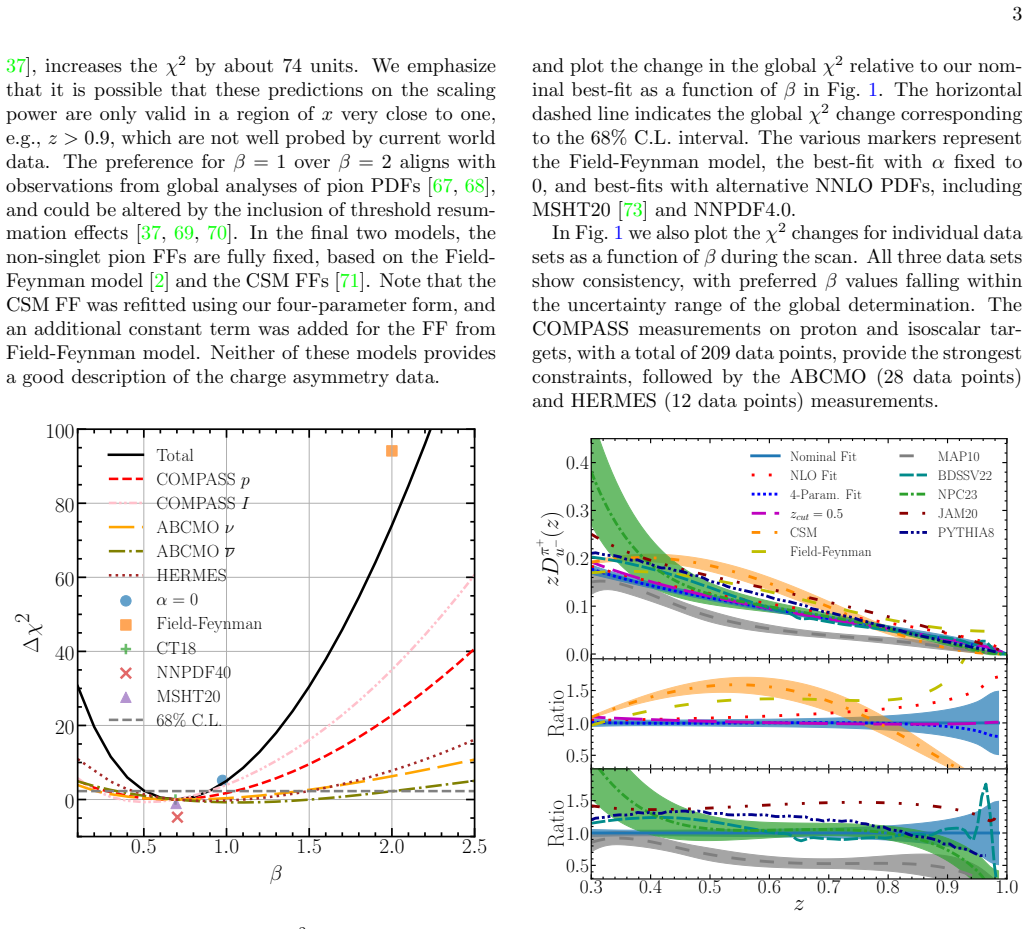


read the original abstract
We propose a novel method for extracting non-singlet (NS) fragmentation functions (FFs) of light charged hadrons from charge asymmetries measured in hadron fragmentation, using data from both single-inclusive electron-positron annihilation and semi-inclusive deep-inelastic scattering processes. We determine the NS FFs for pions and kaons at next-to-next-to-leading order in Quantum Chromodynamics, including a comprehensive uncertainty analysis. The extracted FFs reveal a scaling index of about 0.7 at large momentum fractions and low energy scales, a strangeness suppression factor of about 0.5, and universality in fragmentation of light mesons. Our findings provide a valuable benchmark for testing non-perturbative QCD models and Monte Carlo event generators, and serve as crucial input for future electron-ion colliders.
Editorial analysis
A structured set of objections, weighed in public.
Referee Report
Summary. The manuscript proposes extracting non-singlet fragmentation functions for pions and kaons from charge asymmetries in SIA and SIDIS data at NNLO in QCD. It performs a fit with comprehensive uncertainty analysis and reports a scaling index of approximately 0.7 at large z and low scales, a strangeness suppression factor of about 0.5, and evidence for universality in light-meson fragmentation. The results are positioned as benchmarks for non-perturbative QCD models and input for future electron-ion colliders.
Significance. If the central isolation of NS FFs holds, the work supplies useful NNLO constraints on fragmentation at low scales and could serve as a benchmark for Monte Carlo generators. The inclusion of NNLO coefficient functions and uncertainty quantification strengthens the potential utility for EIC phenomenology.
major comments (2)
- [§3 (charge-asymmetry definition and isolation)] The extraction rests on the claim that charge asymmetries isolate the non-singlet combination with negligible singlet mixing or higher-twist contamination. At the low scales and large z where the scaling index ~0.7 is reported, this isolation is least secure because SIDIS asymmetries can receive target-fragmentation or power-suppressed contributions that do not cancel symmetrically; NNLO evolution alone does not suppress them. A quantitative estimate or dedicated test of these residuals is required to support both the functional form and the universality conclusion.
- [§4.2 (fit results and parameter extraction)] The strangeness suppression factor of ~0.5 and the scaling index are obtained from the global fit to the chosen SIA+SIDIS data sets. The sensitivity of these parameters to data selection, kinematic cuts, and the precise form of the input parameterization at the initial scale must be shown explicitly; without this, the quoted values remain tied to the specific choices even though the two processes are formally independent.
minor comments (2)
- [Abstract and §4] The abstract states that a comprehensive uncertainty analysis is performed; the main text should explicitly list the sources (data, parameterization, higher-order truncation) and show how they are propagated into the final bands on the scaling index and suppression factor.
- [§5 (discussion)] A short comparison table placing the new NS FFs against existing global fits (e.g., DSS, NNPDF) at a common scale would help readers assess the numerical impact of the charge-asymmetry method.
Simulated Author's Rebuttal
We thank the referee for the detailed and constructive report. We address the major comments below, providing clarifications and indicating where revisions will be made to strengthen the manuscript.
read point-by-point responses
-
Referee: [§3 (charge-asymmetry definition and isolation)] The extraction rests on the claim that charge asymmetries isolate the non-singlet combination with negligible singlet mixing or higher-twist contamination. At the low scales and large z where the scaling index ~0.7 is reported, this isolation is least secure because SIDIS asymmetries can receive target-fragmentation or power-suppressed contributions that do not cancel symmetrically; NNLO evolution alone does not suppress them. A quantitative estimate or dedicated test of these residuals is required to support both the functional form and the universality conclusion.
Authors: We acknowledge the importance of verifying the isolation of the non-singlet combination, particularly at low scales and large z. While the charge asymmetry is designed to suppress singlet contributions and symmetric higher-twist effects, we agree that a more explicit test is valuable. In the revised manuscript, we will add a dedicated subsection presenting a quantitative assessment by varying the kinematic cuts (e.g., minimum Q²) and examining the impact on the extracted scaling index and universality. This will help quantify any residual power-suppressed contributions. revision: yes
-
Referee: [§4.2 (fit results and parameter extraction)] The strangeness suppression factor of ~0.5 and the scaling index are obtained from the global fit to the chosen SIA+SIDIS data sets. The sensitivity of these parameters to data selection, kinematic cuts, and the precise form of the input parameterization at the initial scale must be shown explicitly; without this, the quoted values remain tied to the specific choices even though the two processes are formally independent.
Authors: We thank the referee for highlighting the need for explicit sensitivity studies. The manuscript includes an uncertainty analysis that accounts for variations in the parameterization, but we agree that additional explicit demonstrations would enhance clarity. In the revision, we will include supplementary material or figures showing the dependence of the strangeness suppression factor and scaling index on different data selections, kinematic cuts, and alternative input forms at the initial scale. revision: yes
Circularity Check
No significant circularity; extraction is data-driven and self-contained
full rationale
The paper proposes extracting non-singlet fragmentation functions directly from measured charge asymmetries in SIA and SIDIS data at NNLO, with results such as the scaling index ~0.7 and strangeness suppression ~0.5 obtained via fit to experimental datasets plus uncertainty analysis. No load-bearing step reduces by construction to the inputs: the isolation of NS combinations is an assumption justified by the processes' kinematics and coefficient functions rather than a self-definition or renamed fit; there are no self-citations invoked as uniqueness theorems, no ansatze smuggled via prior work, and no predictions presented as independent of the fitted data. The central claims remain independent of any circular reduction and rest on external experimental inputs.
Axiom & Free-Parameter Ledger
free parameters (2)
- scaling index =
0.7
- strangeness suppression factor =
0.5
axioms (2)
- domain assumption Perturbative QCD calculations at NNLO accurately describe the hard scattering and evolution for the relevant processes
- domain assumption Charge asymmetries in SIA and SIDIS are dominated by non-singlet fragmentation functions
Lean theorems connected to this paper
-
IndisputableMonolith/Cost/FunctionalEquation.leanwashburn_uniqueness_aczel unclear?
unclearRelation between the paper passage and the cited Recognition theorem.
We determine the NS FFs for pions and kaons at next-to-next-to-leading order in Quantum Chromodynamics... scaling index of about 0.7 at large momentum fractions... functional form zD h i−(z,Q0)=z^α(1−z)^β exp(a0)
-
IndisputableMonolith/Foundation/DimensionForcing.leanalexander_duality_circle_linking unclear?
unclearRelation between the paper passage and the cited Recognition theorem.
The extracted FFs reveal a scaling index of about 0.7... strangeness suppression factor of about 0.5, and universality in fragmentation of light mesons.
What do these tags mean?
- matches
- The paper's claim is directly supported by a theorem in the formal canon.
- supports
- The theorem supports part of the paper's argument, but the paper may add assumptions or extra steps.
- extends
- The paper goes beyond the formal theorem; the theorem is a base layer rather than the whole result.
- uses
- The paper appears to rely on the theorem as machinery.
- contradicts
- The paper's claim conflicts with a theorem or certificate in the canon.
- unclear
- Pith found a possible connection, but the passage is too broad, indirect, or ambiguous to say the theorem truly supports the claim.
Reference graph
Works this paper leans on
-
[1]
S. M. Berman, J. D. Bjorken, and J. B. Kogut, Phys. Rev. D 4, 3388 (1971)
work page 1971
-
[2]
R. D. Field and R. P. Feynman, Nucl. Phys. B 136, 1 (1978)
work page 1978
-
[3]
R. P. Feynman, R. D. Field, and G. C. Fox, Phys. Rev. D 18, 3320 (1978)
work page 1978
-
[4]
J. C. Collins, D. E. Soper, and G. F. Sterman, Adv. Ser. Direct. High Energy Phys. 5, 1 (1989), hep-ph/0409313
work page internal anchor Pith review Pith/arXiv arXiv 1989
-
[5]
Parton Fragmentation Functions
A. Metz and A. Vossen, Prog. Part. Nucl. Phys. 91, 136 (2016), 1607.02521
work page internal anchor Pith review Pith/arXiv arXiv 2016
- [6]
-
[7]
J. Cruz-Martinez, T. Hasenack, F. Hekhorn, G. Magni, E. R. Nocera, T. R. Rabemananjara, J. Rojo, T. Sharma, and G. van Seeventer (2025), 2503.11814
-
[8]
R. Abdul Khalek, J. J. Ethier, J. Rojo, and G. van Weelden, JHEP 09, 183 (2020), 2006.14629
- [9]
- [10]
-
[11]
I. Helenius, M. Walt, and W. Vogelsang, Phys. Rev. D 105, 094031 (2022), 2112.11904
-
[12]
Electron Ion Collider: The Next QCD Frontier - Understanding the glue that binds us all
A. Accardi et al., Eur. Phys. J. A 52, 268 (2016), 1212.1701
work page internal anchor Pith review Pith/arXiv arXiv 2016
- [13]
-
[14]
Global Analysis of Fragmentation Functions for Protons and Charged Hadrons
D. de Florian, R. Sassot, and M. Stratmann, Phys. Rev. D 76, 074033 (2007), 0707.1506
work page internal anchor Pith review Pith/arXiv arXiv 2007
-
[15]
Determination of fragmentation functions and their uncertainties
M. Hirai, S. Kumano, T. H. Nagai, and K. Sudoh, Phys. Rev. D 75, 094009 (2007), hep-ph/0702250
work page internal anchor Pith review Pith/arXiv arXiv 2007
-
[16]
AKK Update: Improvements from New Theoretical Input and Experimental Data
S. Albino, B. A. Kniehl, and G. Kramer, Nucl. Phys. B 803, 42 (2008), 0803.2768
work page internal anchor Pith review Pith/arXiv arXiv 2008
-
[17]
Charged hadron fragmentation functions from collider data
V. Bertone, N. P. Hartland, E. R. Nocera, J. Rojo, and L. Rottoli (NNPDF), Eur. Phys. J. C 78, 651 (2018), [Erratum: Eur.Phys.J.C 84, 155 (2024)], 1807.03310
work page internal anchor Pith review Pith/arXiv arXiv 2018
- [18]
- [19]
- [20]
- [21]
- [22]
-
[23]
V. Bertone, S. Carrazza, N. P. Hartland, E. R. Nocera, and J. Rojo (NNPDF), Eur. Phys. J. C 77, 516 (2017), 1706.07049
work page internal anchor Pith review Pith/arXiv arXiv 2017
-
[24]
M. Soleymaninia, M. Goharipour, and H. Khanpour, Phys. Rev. D 98, 074002 (2018), 1805.04847
work page internal anchor Pith review Pith/arXiv arXiv 2018
- [25]
-
[26]
R. Abdul Khalek, V. Bertone, A. Khoudli, and E. R. Nocera (MAP (Multi-dimensional Analyses of Partonic distributions)), Phys. Lett. B 834, 137456 (2022), 2204.10331
- [27]
-
[28]
R. J. Holt and C. D. Roberts, Rev. Mod. Phys. 82, 2991 (2010), 1002.4666
work page internal anchor Pith review Pith/arXiv arXiv 2010
-
[29]
T. Ito, W. Bentz, I. C. Cloet, A. W. Thomas, and K. Yazaki, Phys. Rev. D 80, 074008 (2009), 0906.5362
work page internal anchor Pith review Pith/arXiv arXiv 2009
- [30]
-
[31]
Pion Structure Function in the Nambu and Jona-Lasinio model
T. Shigetani, K. Suzuki, and H. Toki, Phys. Lett. B 308, 383 (1993), hep-ph/9402286
work page internal anchor Pith review Pith/arXiv arXiv 1993
-
[32]
J. F. Gunion, 11th International Symposium on Multi- particle Dynamics (1980), SLAC-PUB-2607
work page 1980
-
[33]
S. J. Brodsky, M. Burkardt, and I. Schmidt, Nucl. Phys. B 441, 197 (1995), hep-ph/9401328
work page internal anchor Pith review Pith/arXiv arXiv 1995
- [34]
-
[35]
Factorization of Large-x Quark Distributions in a Hadron
X.-d. Ji, J.-P. Ma, and F. Yuan, Phys. Lett. B 610, 247 (2005), hep-ph/0411382
work page internal anchor Pith review Pith/arXiv arXiv 2005
-
[36]
C. Shi, C. Mezrag, and H.-s. Zong, Phys. Rev. D 98, 054029 (2018), 1806.10232
work page internal anchor Pith review Pith/arXiv arXiv 2018
- [37]
-
[38]
S. Goyal, S.-O. Moch, V. Pathak, N. Rana, and V. Ravin- dran, Phys. Rev. Lett. 132, 251902 (2024), 2312.17711
- [39]
- [40]
- [41]
-
[42]
P. J. Rijken and W. L. van Neerven, Phys. Lett. B 386, 422 (1996), hep-ph/9604436
work page internal anchor Pith review Pith/arXiv arXiv 1996
-
[43]
P. J. Rijken and W. L. van Neerven, Phys. Lett. B 392, 207 (1997), hep-ph/9609379
work page internal anchor Pith review Pith/arXiv arXiv 1997
-
[44]
P. J. Rijken and W. L. van Neerven, Nucl. Phys. B 487, 233 (1997), hep-ph/9609377
work page internal anchor Pith review Pith/arXiv arXiv 1997
-
[45]
QCD Corrections to Semi-Inclusive Hadron Production in Electron-Positron Annihilation at Two Loops
A. Mitov and S.-O. Moch, Nucl. Phys. B 751, 18 (2006), hep-ph/0604160
work page internal anchor Pith review Pith/arXiv arXiv 2006
-
[46]
G. Soar, S. Moch, J. A. M. Vermaseren, and A. Vogt, Nucl. Phys. B 832, 152 (2010), 0912.0369
work page internal anchor Pith review Pith/arXiv arXiv 2010
-
[47]
A. A. Almasy, S. Moch, and A. Vogt, Nucl. Phys. B 854, 133 (2012), 1107.2263
work page internal anchor Pith review Pith/arXiv arXiv 2012
- [48]
- [49]
-
[50]
A. Airapetian et al. (HERMES), Phys. Rev. D87, 074029 (2013), 1212.5407
work page internal anchor Pith review Pith/arXiv arXiv 2013
-
[51]
C. Adolph et al. (COMPASS), Phys. Lett. B 764, 1 (2017), 1604.02695
work page internal anchor Pith review Pith/arXiv arXiv 2017
-
[52]
Multiplicities of charged kaons from deep-inelastic muon scattering off an isoscalar target
C. Adolph et al. (COMPASS), Phys. Lett. B 767, 133 (2017), 1608.06760
work page internal anchor Pith review Pith/arXiv arXiv 2017
- [53]
-
[54]
P. Allen et al. (Aachen-Bonn-CERN-Munich-Oxford), Nucl. Phys. B 214, 369 (1983)
work page 1983
-
[55]
Production of pi+, pi-, K+, K-, p and p-bar in Light (uds), c and b Jets from Z0 Decays
K. Abe et al. (SLD), Phys. Rev. D 69, 072003 (2004), hep-ex/0310017
work page internal anchor Pith review Pith/arXiv arXiv 2004
-
[56]
Production of pi+, K+, K0, K*0, phi, p and Lambda-0 in Hadronic Z0 Decays
K. Abe et al. (SLD), Phys. Rev. D 59, 052001 (1999), hep-ex/9805029
work page internal anchor Pith review Pith/arXiv arXiv 1999
- [57]
-
[58]
Fully differential VBF Higgs production at NNLO
M. Cacciari, F. A. Dreyer, A. Karlberg, G. P. Salam, and G. Zanderighi, Phys. Rev. Lett. 115, 082002 (2015), [Er- ratum: Phys.Rev.Lett. 120, 139901 (2018)], 1506.02660
work page internal anchor Pith review Pith/arXiv arXiv 2015
-
[59]
Next-to-Next-to-Leading Order Evolution of Non-Singlet Fragmentation Functions
A. Mitov, S. Moch, and A. Vogt, Phys. Lett. B 638, 61 (2006), hep-ph/0604053
work page internal anchor Pith review Pith/arXiv arXiv 2006
-
[60]
On Third-Order Timelike Splitting Functions and Top-Mediated Higgs Decay into Hadrons
S. Moch and A. Vogt, Phys. Lett. B 659, 290 (2008), 0709.3899
work page internal anchor Pith review Pith/arXiv arXiv 2008
-
[61]
H. Chen, T.-Z. Yang, H. X. Zhu, and Y. J. Zhu, Chin. Phys. C 45, 043101 (2021), 2006.10534
-
[62]
G. P. Salam and J. Rojo, Comput. Phys. Commun. 180, 120 (2009), 0804.3755
work page internal anchor Pith review Pith/arXiv arXiv 2009
- [63]
- [64]
-
[65]
T.-J. Hou et al., Phys. Rev. D 103, 014013 (2021), 1912.10053
-
[66]
See Supplemental Material for detaild comparisions of the theory to data
-
[67]
I. Novikov et al., Phys. Rev. D 102, 014040 (2020), 2002.02902
- [68]
-
[69]
Soft-Gluon Resummation and the Valence Parton Distribution Function of the Pion
M. Aicher, A. Schafer, and W. Vogelsang, Phys. Rev. Lett. 105, 252003 (2010), 1009.2481
work page internal anchor Pith review Pith/arXiv arXiv 2010
- [70]
-
[71]
H.-Y. Xing, W.-H. Bian, Z.-F. Cui, and C. D. Roberts (2025), 2504.08142
- [72]
- [73]
-
[74]
A comprehensive guide to the physics and usage of PYTHIA 8.3
C. Bierlich et al., SciPost Phys. Codeb. 2022, 8 (2022), 2203.11601
work page internal anchor Pith review Pith/arXiv arXiv 2022
-
[75]
T. Sjostrand, Comput. Phys. Commun. 82, 74 (1994). 7 Supplemental Material Comparison between Theory and Experimental Data This analysis incorporates charged hadron multiplicity data from several key experiments. The COMPASS collab- oration provides measurements on multiplicities of charged pions and kaons in kinematic bins of Bjorken-x from 0.004 to 0.4 ...
work page 1994
discussion (0)
Sign in with ORCID, Apple, or X to comment. Anyone can read and Pith papers without signing in.