REVIEW 4 major objections 4 minor 21 references
Linear Relational Decoding of Morphology in Language Models
T0 review · 4 major / 4 minor · reviewed 2026-08-06 · deepseek-v4-flash
Pith's one-line read A single bias-free matrix multiplication reproduces how GPT-J and Llama-7b inflect words, at 90 percent top-1 faithfulness.
desk verdict Useful extension of the LRE line, but the 90% faithfulness headline is an in-sample maximum and should not be quoted as a generalization estimate. read the letter →
The pith
A machine-rendered reading of the paper's core claim, the machinery that carries it, and where it could break.
The reading
What carries the argument
The load-bearing object is the mean Jacobian $W_r = \mathbb{E}_{s_i}\left[\partial F_r / \partial s|_{s_i}\right]$, a $d \times d$ matrix of derivatives from the subject token's middle-layer hidden state to the final object hidden state, averaged over eight in-context examples of the same relation. The linear LRE applies $o \approx W_r s$ with no bias, while the affine LRE adds a bias vector $b_r$ and a scale factor $\beta = 7$; the paper isolates the components by also testing $s + b_r$ and $s + \mathbb{E}(o - s)$ as additive operators. The mean Jacobian carries the argument because it is taken from the model's own derivatives rather than fit to outputs, so its success on held-out subjects is evidence that the subject-to-object map is genuinely linear in that layer range for morphology.
What would settle it
Replace the eight in-context examples with eight different subjects of the same morphological relation and re-measure top-1 faithfulness on the same held-out pairs; if faithfulness collapses, the mean Jacobian is a prompt artifact rather than a general linear map.
Extended reading notes
Core claim
On its own terms, the paper's discovery is that a true linear relational embedding, with no bias and no scaling, suffices for morphology. For each relation in the adapted Bigger Analogy Test Set, the authors compute the mean Jacobian $W_r = \mathbb{E}_{s_i}\left[\partial F_r / \partial s|_{s_i}\right]$ between a middle-layer subject state and the final object state, then decode by $o \approx W_r s$. On GPT-J this linear LRE reaches 90% faithfulness across 14 morphology relations, against 95% for the affine LRE; non-morphological relations score 40% versus 61%. Llama-7b shows the same pattern, and plural marking is linearly recoverable in eight languages. The conclusion is that morphological relations are encoded multiplicatively in the residual stream, and the bias term of the affine approximation is not carrying the morphological signal.
Load-bearing premise
The load-bearing premise is that the eight in-context examples make the model implement each relation as one stable function of the subject's middle-layer state, so the averaged Jacobian represents the relation rather than the prompt's surface pattern.
Editorial extensions
If this is right
- On the paper's evidence, morphological relations in GPT-J are recovered at 90% top-1 faithfulness by the linear LRE, within five points of the affine LRE's 95%, so the bias term is not the main carrier of morphological information.
- The same linear encoding of plural marking appears in eight languages, including agglutinative Turkish and Hungarian, which suggests the result is not limited to English or to fusional-analytic morphology.
- Because the linear LRE fails on semantic and encyclopedic relations (40% versus 61% for affine), the paper's dichotomy predicts that additive operators, not multiplicative ones, carry those relations.
- The adapted Bigger Analogy Test Set prompting procedure provides a reusable protocol for turning analogical datasets into relational probes for transformer approximators.
- The Jacobian-based $W$ is necessary, not merely sufficient: additive Bias and TRANSLATION approximators cannot reproduce morphology, so the multiplicative term is doing the relational work.
Reading between the lines
- If morphology is genuinely linear in the residual stream, a morphological rule could in principle be edited by updating a single matrix $W_r$, and the same matrix might transfer across languages with similar inflectional systems; the paper does not test editing or transfer, so this is an editorial extension.
- The near-parity of linear and affine LRE on morphology suggests the decoder head applies an approximately linear readout to these object states, so a linear probe on middle-layer states may recover inflections without running the full model, a testable consequence not pursued in the paper.
- Because the relation is elicited by eight in-context examples, a natural stress test is to vary the number and lexical content of those examples and see whether linearity is a stable property of the relation or emerges only at a particular prompt length.
Editorial analysis
A structured set of objections, weighed in public.
Referee Report
Summary. The paper extends linear relational embeddings (LRE) to morphological relations in transformer language models. It adapts BATS into a relational prompt setting, estimates the relation operator W_r as the mean Jacobian of the final object state with respect to middle-layer subject states over eight in-context examples, and compares the pure linear approximator W_r s to the affine approximator βW_r s + b_r and to additive baselines. On GPT-J and Llama-7b, the authors report 90% and 95% top-1 faithfulness for the linear and affine approximators averaged over 14 English morphology relations, and they report similar cross-linguistic results for plural marking. The paper concludes that morphological relations are sparsely encoded by cross-layer linear transformations.
Significance. If the headline numbers survive unbiased evaluation, this is a useful empirical contribution: it extends LRE to a new relation family, provides code and data, tests two architectures and eight languages, and includes additive baselines that help establish the role of the Jacobian. The use of held-out BATS pairs for estimating W_r is a genuine strength. However, the central quantitative claim is currently computed after selecting the best subject layer on the same evaluation set, so the reported 90% is an in-sample maximum rather than a prediction estimate. The paper's significance therefore depends on re-analysis with honest layer selection and per-relation reporting.
major comments (4)
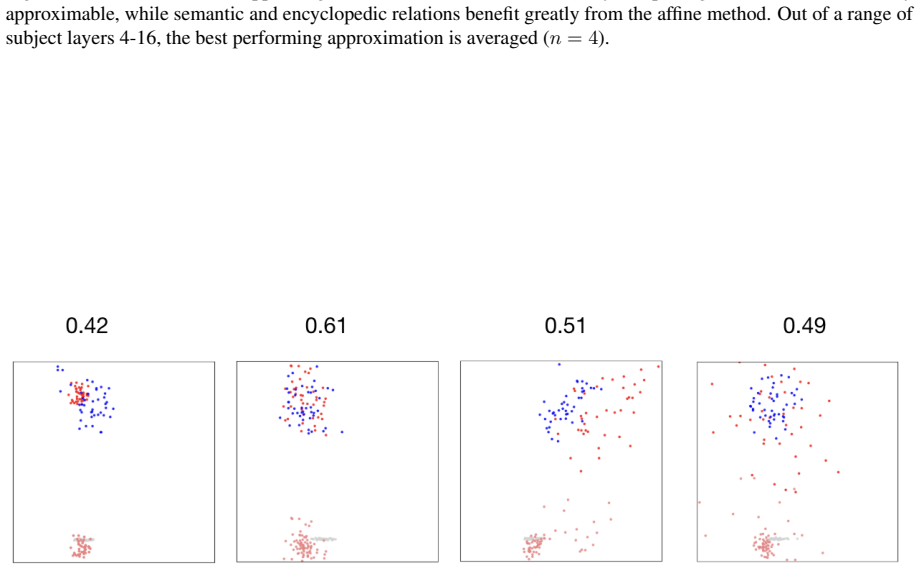
- [§5.1, Figure 3 caption] The caption states that for subject layers 3–9 "the best performing approximation is averaged (n=4)". Because the best layer is chosen after scoring every candidate layer on the same held-out BATS pairs, the reported 90% faithfulness is the maximum over seven layers and four repetitions, not an unbiased estimate of what any fixed layer achieves. With seven candidates, the expected maximum systematically exceeds the per-layer faithfulness. Please report the faithfulness of a single layer selected without access to the test objects (for example, a fixed middle layer or a layer selected on the construction subjects), and present the per-layer curves so the headline number corresponds to a genuine generalization estimate.
- [§5.1, footnote 5] The affine LRE uses β = 7, which is said to be "found to be optimal for BATS." Since BATS is also the evaluation set, the affine 95% figure is tuned in-sample on the test relations. This does not affect the pure linear result, but it affects the comparison "affine 95% versus linear 90%." Please select β on a held-out portion of BATS or report accuracy over a range of β values; otherwise the affine result should be described as a fitted upper bound, not a predictive accuracy.
- [§4.3] The paper restricts evaluation to pairs for which the LM computation successfully reproduces the object, and it chooses the 8-ICL template because it is "most likely to exhibit the desired linear encoding." The reported faithfulness is therefore conditional on the model already solving the pair under that exact template. Please report how many BATS pairs per relation survive the filter and give results on the full set (or a random held-out subset) as a secondary analysis; additionally, it would be informative to vary the number of ICL examples (0, 4, 8, 16) to test whether W_r is stable or is partly a prompt artifact. Without these checks, the abstract's claim about "morphological relations" is broader than the evaluated setting.
- [Appendix B, Table 3] Table 3 reports fixed-layer counts of 42 correct / 0 stemmed / 0 incorrect for [noun_plural], but 23 / 11 / 9 for [verb+tion] and 7 / 35 / 6 for [adj+ness]. This large per-relation variation is difficult to reconcile with a blanket "90% faithfulness across 14 morphology relations" if the same layer were used. Please report per-relation means and standard deviations over layers, and identify which relations drive the average; the current average may be carried by a small number of high-accuracy relations.
minor comments (4)
- [§3.2] The phrase "strongly casual on predictions" should read "strongly causal on predictions."
- [Appendix C] The TRANSLATION operator is written as "˜o = Bias(s) = s + br", which is confusing because TRANSLATION should use the mean of (o − s), whereas the Bias term is defined as b_r = E(o − W_r s). Please use distinct notation for the two additive operators.
- [Appendix B, Table 3] Table 3 appears to list row values without explicit row labels; please add relation names to each row so the counts are unambiguous.
- [§4.3] The paper says that for GPT-J and Llama-7b "nearly all examples fit this criteria," but it does not give exact counts or a per-relation breakdown; please report the number of excluded pairs per relation.
Circularity Check
Headline faithfulness is an in-sample best-layer (and beta) maximum; the core held-out W estimate keeps the paper from being fully circular.
-
fitted input called prediction
[Section 5.1 and Footnote 5; also Appendix Figure 7 for Llama layers 4-16]
"We then evaluate the approximators four times for each relation, and average the best cross-layer approximation."
The 90% (linear) and 95% (affine) faithfulness headlines are produced by scoring every candidate subject layer (3-9 for GPT-J, 4-16 for Llama) on the same held-out BATS pairs and retaining each relation's best layer before averaging, with the affine beta=7 selected as 'optimal for BATS.' Choosing the layer after seeing the target top-one matches makes the reported number an in-sample maximum over seven (or thirteen) configurations rather than the faithfulness of a single linear map fixed a priori. The W matrix itself is still estimated from eight disjoint ICL subjects, so the linear map is not fitted to the test objects; but the summary statistic 'achieves 90%' is by construction a best-of-layers result, so it overstates the generalization of any fixed linear decoder.
full rationale
The central derivation is largely self-contained: W is estimated as the mean Jacobian over eight ICL subject-object pairs and tested on disjoint BATS pairs, with construction pairs explicitly omitted. No load-bearing self-citations appear; the LRE framework is prior external work, and the held-out split is genuine. The principal circularity-adjacent flaw is the evaluation protocol, which takes a per-relation best over subject layers after evaluating those layers on the test set (and tunes beta on the same BATS suite); this is in-sample model selection, not a fit of W to test objects, so it reduces the evidentiary strength of the 90% claim but does not make the linear-encoding result true by definition. Appendix Table 3's fixed-layer counts (e.g., 7 correct vs. 35 stemmed for [adj+ness]) corroborate that the headline average is carried by selected best layers. The Limitations section candidly acknowledges the unproven mechanistic link between the observed linear maps and actual prediction, which is a validity caveat rather than a circular step.
Assumptions & free parameters
free parameters (2)
- beta scaling for affine LRE =
7
- subject layer selection =
per-relation best among layers 3-9 (GPT-J) and 4-16 (Llama-7b)
assumptions (5)
- domain assumption The subject-object function Fr is approximately differentiable and affine over the chosen subject states, so a mean Jacobian approximates it.
- domain assumption A fixed prompt with 8 ICL examples induces the same relation as the BATS word pair.
- domain assumption Middle-layer subject state and final-layer object state are the causally relevant representations.
- ad hoc to paper Layer-normalization scale mismatch justifies the beta correction in affine LRE.
- domain assumption Top-1 token match after the decoder head is a valid measure of relational faithfulness.
Cite this review
Pith. "Pith review of Linear Relational Decoding of Morphology in Language Models." pith.science (2026). https://pith.science/paper/GNC2HQ55
@misc{pith2026250714640,
  author       = {Pith},
  title        = {Pith review of: Linear Relational Decoding of Morphology in Language Models},
  year         = {2026},
  howpublished = {\url{https://pith.science/paper/GNC2HQ55}},
  note         = {Machine review of arXiv:2507.14640}
}
read the original abstract
A two-part affine approximation has been found to be a good approximation for transformer computations over certain subject object relations. Adapting the Bigger Analogy Test Set, we show that the linear transformation Ws, where s is a middle layer representation of a subject token and W is derived from model derivatives, is also able to accurately reproduce final object states for many relations. This linear technique is able to achieve 90% faithfulness on morphological relations, and we show similar findings multi-lingually and across models. Our findings indicate that some conceptual relationships in language models, such as morphology, are readily interpretable from latent space, and are sparsely encoded by cross-layer linear transformations.
Figures


Figures from the paper (5 more)


Reference graph
Works this paper leans on
-
[1]
Tom Brown, Benjamin Mann, Nick Ryder, Melanie Subbiah, Jared D Kaplan, Prafulla Dhariwal, Arvind Neelakantan, Pranav Shyam, Girish Sastry, Amanda Askell, et al. 2020. Language models are few-shot learners. Advances in neural information processing systems, 33:1877--1901
2020
-
[2]
Bob Coecke, Mehrnoosh Sadrzadeh, and Stephen Clark. 2010. Mathematical foundations for a compositional distributional model of meaning. arXiv preprint arXiv:1003.4394
arXiv 2010
-
[3]
Dedre Gentner. 1983. Structure-mapping: A theoretical framework for analogy. Cognitive science, 7(2):155--170
work page 1983
-
[4]
Mor Geva, Jasmijn Bastings, Katja Filippova, and Amir Globerson. 2023. http://arxiv.org/abs/2304.14767 Dissecting Recall of Factual Associations in Auto - Regressive Language Models . arXiv preprint. ArXiv:2304.14767 [cs]
arXiv 2023
-
[5]
Mor Geva, Roei Schuster, Jonathan Berant, and Omer Levy. 2021. Transformer feed-forward layers are key-value memories. In Proceedings of the 2021 Conference on Empirical Methods in Natural Language Processing, pages 5484--5495
2021
-
[6]
Anna Gladkova, Aleksandr Drozd, and Satoshi Matsuoka. 2016. https://doi.org/10.18653/v1/N16-2002 Analogy-based detection of morphological and semantic relations with word embeddings: what works and what doesn ' t. In Proceedings of the NAACL Student Research Workshop , pages 8--15, San Diego, California. Association for Computational Linguistics
-
[7]
Evan Hernandez, Arnab Sen Sharma, Tal Haklay, Kevin Meng, Martin Wattenberg, Jacob Andreas, Yonatan Belinkov, and David Bau. 2023. Linearity of relation decoding in transformer language models. arXiv preprint arXiv:2308.09124
arXiv 2023
-
[8]
Geoffrey E Hinton. 1986. Learning distributed representations of concepts. In Proceedings of the Eighth Annual Conference of the Cognitive Science Society, volume 1, page 12. Amherst, MA
work page 1986
Show all 21 references
-
[9]
Keith J Holyoak. 2012. Analogy and relational reasoning. The Oxford handbook of thinking and reasoning, pages 234--259
2012
-
[10]
Kevin Meng, David Bau, Alex Andonian, and Yonatan Belinkov. 2022 a . Locating and editing factual associations in gpt. Advances in Neural Information Processing Systems, 35:17359--17372
2022
-
[11]
Kevin Meng, Arnab Sen Sharma, Alex J Andonian, Yonatan Belinkov, and David Bau. 2022 b . Mass-editing memory in a transformer. In The Eleventh International Conference on Learning Representations
2022
-
[12]
Jack Merullo, Carsten Eickhoff, and Ellie Pavlick. 2023. Language models implement simple word2vec-style vector arithmetic. arXiv preprint arXiv:2305.16130
2023 arXiv
-
[13]
Tomas Mikolov, Kai Chen, Greg Corrado, and Jeffrey Dean. 2013. Efficient estimation of word representations in vector space. arXiv preprint arXiv:1301.3781
2013 arXiv
-
[14]
Alberto Paccanaro and Geoffrey E. Hinton. 2001. Learning distributed representations of concepts using linear relational embedding. IEEE Transactions on Knowledge and Data Engineering, 13(2):232--244
2001
-
[15]
Robert J Sternberg and Bathsheva Rifkin. 1979. The development of analogical reasoning processes. Journal of experimental child psychology, 27(2):195--232
1979
-
[16]
Hugo Touvron, Louis Martin, Kevin Stone, Peter Albert, Amjad Almahairi, Yasmine Babaei, Nikolay Bashlykov, Soumya Batra, Prajjwal Bhargava, Shruti Bhosale, et al. 2023. Llama 2: Open foundation and fine-tuned chat models. arXiv preprint arXiv:2307.09288
2023 arXiv
-
[17]
Ashish Vaswani, Noam Shazeer, Niki Parmar, Jakob Uszkoreit, Llion Jones, Aidan N Gomez, Ł ukasz Kaiser, and Illia Polosukhin. 2017. https://proceedings.neurips.cc/paper/2017/hash/3f5ee243547dee91fbd053c1c4a845aa-Abstract.html Attention is All you Need . In Advances in Neural I...
2017
-
[18]
Ekaterina Vylomova, Laura Rimell, Trevor Cohn, and Timothy Baldwin. 2016. Take and took, gaggle and goose, book and read: Evaluating the utility of vector differences for lexical relation learning. In Proceedings of the 54th Annual Meeting of the Association for Computational ...
2016
-
[19]
Ben Wang and Aran Komatsuzaki. 2021. GPT-J-6B: A 6 Billion Parameter Autoregressive Language Model . https://github.com/kingoflolz/mesh-transformer-jax
2021
-
[20]
online" 'onlinestring :=
ENTRY address archivePrefix author booktitle chapter edition editor eid eprint eprinttype howpublished institution journal key month note number organization pages publisher school series title type volume year doi pubmed url lastchecked label extra.label sort.label short.list...
-
[21]
write newline
" write newline "" before.all 'output.state := FUNCTION n.dashify 't := "" t empty not t #1 #1 substring "-" = t #1 #2 substring "--" = not "--" * t #2 global.max substring 't := t #1 #1 substring "-" = "-" * t #2 global.max substring 't := while if t #1 #1 substring * t #2 gl...
Reviewed August 6, 2026 · model on record in the stance chip above.
Discussion (0). Sign in to comment.