REVIEW 5 major objections 5 minor 13 references
Pruning Increases Orderedness in Recurrent Computation
T0 review · 5 major / 5 minor · reviewed 2026-08-06 · deepseek-v4-flash
Pith's one-line read Pruning by weight magnitude alone pushes a fully connected recurrent layer toward one-way information flow, with no explicit directional bias in the pruning rule, and training performance is preserved on the paper's tasks.
desk verdict A small, genuinely new observation about pruning inducing orderedness in weight-tied RNNs, undercut by weak quantitative support and an unvalidated metric. read the letter →
The pith
A machine-rendered reading of the paper's core claim, the machinery that carries it, and where it could break.
The reading
What carries the argument
The complete perceptron layer is a single all-to-all weight matrix $W$ reused over $T$ iterations — a weight-tied recurrent network with clamped inputs — so temporal depth substitutes for spatial depth. The orderedness metric $O(W) = 1 - \min_{\pi\in\Pi} L(\pi(|W|))/S(\pi(|W|))$ drives the analysis: it finds the relabeling of hidden units that minimizes the lower-triangular absolute weight fraction, with $O=1$ for perfect topological ordering. The pruning mechanism is Top-K masking by absolute magnitude, applied statically or with a dynamic schedule; because the mask never looks at a weight's position relative to the diagonal, the observed increase in $O$ after training is the paper's evidence that gradient descent itself prefers acyclic routes once competing low-magnitude edges are removed.
What would settle it
Take the trained complete perceptron layers from the XOR/Sine runs and compare the effect on the output of zeroing an upper-triangular edge versus a lower-triangular edge of comparable magnitude. If removing lower-triangular (feed-back) edges changes the output as much as removing upper-triangular (feed-forward) edges, then the increase in $O(W)$ under Top-K pruning does not reflect one-way information flow.
Extended reading notes
Core claim
On the paper's own terms, the discovery is that directionality in recurrent computation can be induced, not imposed: starting from dense all-to-all weights, Top-K pruning (static, and especially dynamic) selects edges by magnitude alone, and after gradient descent the surviving high-magnitude connections concentrate in one triangle of the weight matrix. The orderedness metric $O(W)=1-\min_{\pi\in\Pi}L(\pi(|W|))/S(\pi(|W|))$ quantifies this as the largest possible fraction of forward-flowing absolute weight under permutation of hidden units. Reported increases are $+0.116$ (XOR) and $+0.086$ (Sine) for Top-K, with dynamic Top-K reaching $+0.149$ on XOR; these exceed the untrained control, indicating that the ordering develops during learning. The paper also finds that random pruning raises $O$ even untrained, which it attributes to the metric's definition, and that two-iteration layers are structurally directional because hidden-to-hidden feedback cannot reach the output.
Load-bearing premise
The whole argument rests on the assumption that the orderedness metric — the smallest lower-triangular weight fraction reachable by relabeling hidden units — really measures whether information flows one way, rather than merely describing the layout of large weights; if the metric tracks the wrong triangle or the permutation search is unreliable, the observed orderedness gains would not show induced directionality.
Editorial extensions
If this is right
- If the claim holds, a dense weight-tied recurrent layer can be trained to a state where relabeling its hidden units exposes a nearly triangular weight matrix: most connection strength feeds forward, with no layer-wise architecture imposed in advance.
- The observed $\Delta O$ for dynamic Top-K ($+0.149$ on XOR, $+0.086$ on Sine) exceeds the untrained control, so the orderedness is a product of learning under pruning, not an artifact of sparsification alone.
- Because Top-K pruning selects by absolute magnitude and never looks at the diagonal position, the triangular organization must arise from gradient descent choosing acyclic routes, which suggests sparsification as a route to more interpretable recurrent computation.
- The two-iteration spike in orderedness follows directly from the authors' structural argument: with only two updates, hidden-to-hidden feedback cannot influence the output, so the learned network is directionally constrained regardless of pruning.
Reading between the lines
- An implication the paper leaves implicit: if Top-K pruning reliably induces triangular structure, the same recipe could be used to compress an already-trained weight-tied RNN into an approximately feedforward network, reducing inference-time recurrence depth — but the paper's experiments train from scratch on toy tasks rather than converting pretrained models.
- The authors' two-iteration argument suggests a diagnostic that they do not run: comparing orderedness across iteration counts separates structurally forced directionality (where recurrence depth is too small for feedback to matter) from directionality that learning chooses when feedback is actually usable.
- A testable extension would apply the same pruning schedule to a real sequence task and check whether increases in $O(W)$ track test performance; the synthetic XOR/Sine setup leaves the relation between orderedness and generalization open.
Editorial analysis
A structured set of objections, weighed in public.
Referee Report
Summary. The paper studies whether directionality—defined as topologically ordered information flow—can emerge, rather than be hard-wired, in an all-to-all connected perceptron layer that is mathematically equivalent to a weight-tied recurrent network. It introduces the ``complete perceptron layer'' (Sec. 3.1), an orderedness metric O(W) defined as 1 minus the minimal lower-triangular weight fraction under neuron permutations (Eq. 3), and evaluates several initialisation and pruning schemes on XOR and Sine tasks. The central empirical claim is that magnitude-based Top-K pruning, which is agnostic to the orderedness metric, increases orderedness relative to untrained controls, and that this happens ``without compromising performance.'' The paper also reports exploratory results on the number of hidden units, evolution iterations, and sparsity level.
Significance. If the central claim is established, the paper would contribute a concrete and potentially useful phenomenon: gradient descent combined with simple magnitude pruning can organize a recurrent weight matrix into a nearly topologically ordered structure, suggesting that directionality is an emerging rather than a hard-wired inductive bias. Strengths of the paper include public code, multi-seed experiments, untrained controls, and the explicit acknowledgment that the Tril-Damp methods inject an expected inductive bias. However, the evidence as presented is incomplete: the orderedness metric is not validated against known feedforward/feedback structures, the direction convention is internally inconsistent, performance preservation is not quantified, and the central effect sizes are small relative to the reported variance. The significance of the result therefore depends on additional validation rather than on the current tables alone.
major comments (5)
- [Secs. 3.1, 3.2 and Eq. (3)] The direction convention is inconsistent. Section 3.1 defines W_ij as the strength of the connection from neuron j to neuron i, and Algorithm 1 computes s <- sigma(h W^T + b), so neuron i receives sum_j h_j W_ij. Under this convention a feedforward edge from an earlier-indexed neuron to a later-indexed neuron lies in the lower triangle (row i > column j), not ``above the main diagonal'' as stated in Section 3.2. Because Eq. (3) minimizes the lower-triangular fraction, the text's claim that a feedforward network corresponds to an upper-triangular W is wrong under the stated convention, or the convention in Eq. (1) is misstated. A reverse ordering of neuron indices can reconcile the two descriptions, but that reconciliation is never stated. The central conclusion that Top-K pruning induces directionality depends on O(W) actually measuring topological information flow under the implemented convention. The authors must fix this convention, specify exactly which rows/columns are permuted (output units, hidden units, inputs) in the min over pi, and validate Eq. (3) on synthetic matrices with known feedforward and feedback structure.
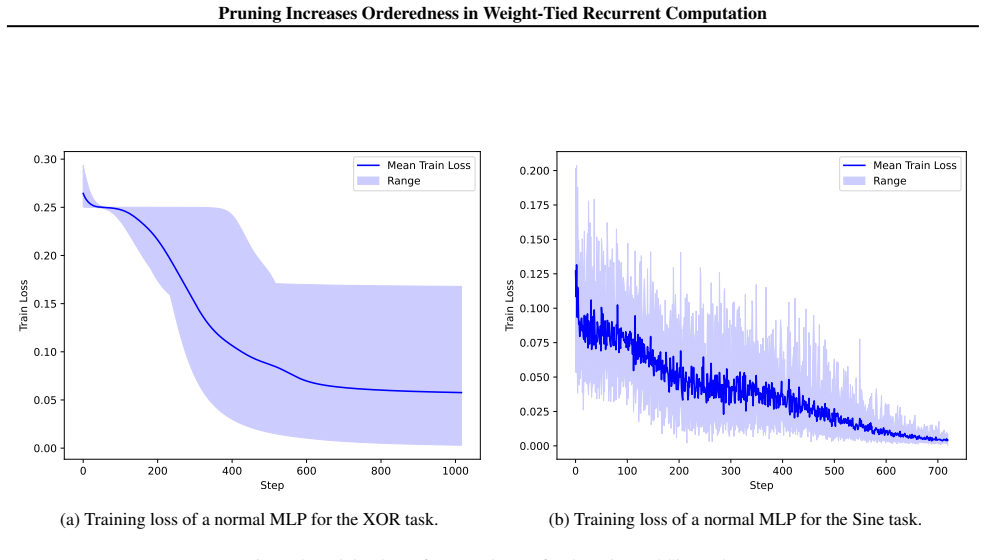
- [Abstract, Sec. 5, Table 1] The claim that pruning increases orderedness ``without compromising performance'' is not supported by any quantitative performance result. Table 1 reports only changes in orderedness; Appendix D shows training-loss curves only for Dynamic Top-K (k=0.5) and does not report final losses or accuracies for the other methods or for the unpruned baseline. The paper should include a table of final training (and, where applicable, test) loss or accuracy for every configuration in Table 1, with standard deviations, and should demonstrate that the orderedness increases are not achieved at the cost of task performance.
- [Table 1(b), Sec. 5] The statistical evidence for the key Top-K claim is weak as presented. On XOR, trained Top-K gives Delta O = 0.116 +/- 0.060 versus 0.039 +/- 0.032 for untrained Top-K; on Sine the values are 0.086 +/- 0.037 versus 0.039 +/- 0.032. The standard deviations overlap substantially and no significance test or confidence interval is reported. The authors should report paired or independent t-tests/bootstrap intervals across their 10 seeds and effect sizes. In addition, Random pruning produces a larger Delta O (0.243 +/- 0.082 on XOR) than Top-K, so the specific claim that Top-K pruning induces orderedness should be supported by a matched-sparsity comparison showing that Top-K's gain over its untrained control is not simply a sparsity artifact.
- [Sec. 3.3, Eq. (3)] The orderedness metric is never validated as a measure of information-flow directionality. O(W) is purely algebraic and does not account for activation dynamics, input clamping, or the fact that a small lower-triangular weight can dominate the recurrent trajectory. The paper should include synthetic probes: (i) matrices with known feedforward block structure, after random neuron relabeling, should yield O close to 1; (ii) random Gaussian matrices should yield a baseline O; (iii) matrices with known feedback cycles should yield lower O; and (iv) ablating the lower-triangular entries of a trained network and measuring the resulting change in network output would directly test whether O tracks functional directionality. Without such validation, the interpretation of Table 1 as evidence of ``induced directionality'' remains an unverified semantic claim.
- [Appendix B, Appendix C, Sec. 3.4] Several implementation details that affect reproducibility are missing or contradictory. The paper does not specify how often the pruning/damping operations in Appendix B are applied during training, whether the pruning mask is updated every step, or how the min over permutations in Eq. (3) is computed (exact enumeration, heuristic, number of samples). In addition, Table 1 states that the default initialisation is random normal, while Appendix C states that ``random uniform distribution was applied on the weights matrix and values vector.'' These inconsistencies must be resolved before the reported Delta O values can be reproduced.
minor comments (5)
- [Fig. 3] The legend labels for the Top-K methods use ``Top-K (1-k)'' and ``Dyn. Top-K (1-k)'', while the text and Table 1 use k as the retained fraction; please clarify whether the horizontal axis is sparsity or retention for each method.
- [Sec. 3.2] The phrase ``W would consist of rectangular blocks above the main diagonal'' should be reconciled with the W_ij convention defined in Section 3.1; see Major Comment 1.
- [Sec. 5] The sentence explaining the ``spike'' at two iterations is speculative and not tested; consider adding a control experiment that removes hidden-to-hidden connections and shows that performance does not degrade.
- [Sec. 3.3] Eq. (3) should handle the degenerate case S(pi(W_abs)) = 0, and the statement that O is ``1 in the limit'' should be clarified because the min over permutations may not attain exactly 1 even for a feedforward matrix if diagonal entries are allowed and the permutation set is restricted.
- [App. C] The paper says ``random uniform distribution was applied on the weights matrix and values vector'' while Table 1 says random normal; harmonize these statements.
Circularity Check
No significant circularity: the main effect is a measured outcome of magnitude-based pruning, not an input to the metric.
full rationale
The paper is an empirical study, not a derivation, and I find no load-bearing circular step. The dependent variable O(W) in Eq. (3) is the paper's own definition of topological orderedness, and the observed ΔO values in Table 1 and Figures 2–3 are direct measurements of that metric before and after training, not predictions computed from fitted parameters. Top-K and Dynamic Top-K pruning select weights by absolute magnitude (Appendix B) and never use O(W) or the triangle structure, so the reported increase in orderedness after training is not constructed by the pruning rule. Tril-Damp and Dynamic Tril-Damp explicitly damp the lower triangle, and the paper itself flags this increase as expected, so that result is also not circular. Random pruning's untrained increase is acknowledged as an artifact of the metric's permutation-minimization, and untrained controls are reported for the Top-K variants, providing a baseline against the definitional effect of sparsification. The convention ambiguity between the W_ij statement in Section 3.1 and the 'upper triangular' description in Section 3.3 is a genuine interpretability and validity risk for what O measures, but it is a correctness concern rather than a case of an output being equivalent to an input by construction. There are no load-bearing self-citations, no imported uniqueness theorems, and no renamed known results; the paper is self-contained and its central observation is not forced by the way it defines or fits its quantities.
Assumptions & free parameters
free parameters (2)
- Top-K sparsity fraction k =
0.5
- Tril-Damp damping factor f =
0.8
assumptions (2)
- domain assumption The orderedness metric O(W) measures the directionality of actual information flow in the recurrent computation.
- domain assumption The permutation minimum in Eq. (3) is computed correctly for all reported configurations.
Cite this review
Pith. "Pith review of Pruning Increases Orderedness in Recurrent Computation." pith.science (2026). https://pith.science/paper/67T4Q7N6
@misc{pith2026250714747,
  author       = {Pith},
  title        = {Pith review of: Pruning Increases Orderedness in Recurrent Computation},
  year         = {2026},
  howpublished = {\url{https://pith.science/paper/67T4Q7N6}},
  note         = {Machine review of arXiv:2507.14747}
}
read the original abstract
Inspired by the prevalence of recurrent circuits in biological brains, we investigate the degree to which directionality is a helpful inductive bias for artificial neural networks. Taking directionality as topologically-ordered information flow between neurons, we formalise a perceptron layer with all-to-all connections (mathematically equivalent to a weight-tied recurrent neural network) and demonstrate that directionality, a hallmark of modern feed-forward networks, can be induced rather than hard-wired by applying appropriate pruning techniques. Across different random seeds our pruning schemes successfully induce greater topological ordering in information flow between neurons without compromising performance, suggesting that directionality is not a prerequisite for learning, but may be an advantageous inductive bias discoverable by gradient descent and sparsification.
Figures


Figures from the paper (2 more)

Reference graph
Works this paper leans on
-
[1]
write newline
" write newline "" before.all 'output.state := FUNCTION n.dashify 't := "" t empty not t #1 #1 substring "-" = t #1 #2 substring "--" = not "--" * t #2 global.max substring 't := t #1 #1 substring "-" = "-" * t #2 global.max substring 't := while if t #1 #1 substring * t #2 global.max substring 't := if while FUNCTION format.date year duplicate empty "emp...
-
[2]
H., Hinton, G
Ackley, D. H., Hinton, G. E., and Sejnowski, T. J. A learning algorithm for boltzmann machines. Cognitive science, 9 0 (1): 0 147--169, 1985
1985
-
[3]
Frankle, J. and Carbin, M. The lottery ticket hypothesis: Finding sparse, trainable neural networks. arXiv preprint arXiv:1803.03635, 2018
arXiv 2018
-
[4]
Hopfield, J. J. Neural networks and physical systems with emergent collective computational abilities. Proceedings of the national academy of sciences, 79 0 (8): 0 2554--2558, 1982
work page 1982
-
[5]
Kingma, D. P. Adam: A method for stochastic optimization. arXiv preprint arXiv:1412.6980, 2014
arXiv 2014
-
[6]
Kolk, S. M. and Rakic, P. Development of prefrontal cortex. Neuropsychopharmacology, 47 0 (1): 0 41--57, 2022
work page 2022
-
[7]
Li, Y., Zhao, P., Yuan, G., Lin, X., Wang, Y., and Chen, X. Pruning-as-search: Efficient neural architecture search via channel pruning and structural reparameterization. arXiv preprint arXiv:2206.01198, 2022
work page Pith review arXiv 2022
-
[8]
Seeing is believing: Brain-inspired modular training for mechanistic interpretability
Liu, Z., Gan, E., and Tegmark, M. Seeing is believing: Brain-inspired modular training for mechanistic interpretability. Entropy, 26 0 (1): 0 41, 2023
work page 2023
Show all 13 references
-
[9]
Proving the lottery ticket hypothesis: Pruning is all you need
Malach, E., Yehudai, G., Shalev-Schwartz, S., and Shamir, O. Proving the lottery ticket hypothesis: Pruning is all you need. In International Conference on Machine Learning, pp.\ 6682--6691. PMLR, 2020
2020
-
[10]
V., and Newsome, W
Mante, V., Sussillo, D., Shenoy, K. V., and Newsome, W. T. Context-dependent computation by recurrent dynamics in prefrontal cortex. nature, 503 0 (7474): 0 78--84, 2013
2013
-
[11]
The evolutionary origins of hierarchy
Mengistu, H., Huizinga, J., Mouret, J.-B., and Clune, J. The evolutionary origins of hierarchy. PLoS computational biology, 12 0 (6): 0 e1004829, 2016
2016
-
[12]
Stothers, D. B. Turing's child machine: A deep learning model of neural development. 2019
2019
-
[13]
van Bergen, R. S. and Kriegeskorte, N. Going in circles is the way forward: the role of recurrence in visual inference. Current Opinion in Neurobiology, 65: 0 176--193, 2020
2020
Reviewed August 6, 2026 · model on record in the stance chip above.
Discussion (0). Continue with ORCID to comment.