Analysis of Hopf solitons as generalized fold maps
Pith reviewed 2026-05-19 04:54 UTC · model grok-4.3
The pith
Hopf solitons with high Hopf index are analyzed as generalized fold maps to classify their fiber configurations.
A machine-rendered reading of the paper's core claim, the machinery that carries it, and where it could break.
Core claim
At the core of our approach is the notion of a generalized Hopf map of order n, whose structure is captured via fold maps and their Stein factorizations. We demonstrate that this theoretical construction not only aligns closely with recent experimental observations of high-Hopf-index hopfions, but also offers a precise classification of the possible configurations of fiber pairs associated to distinct points.
What carries the argument
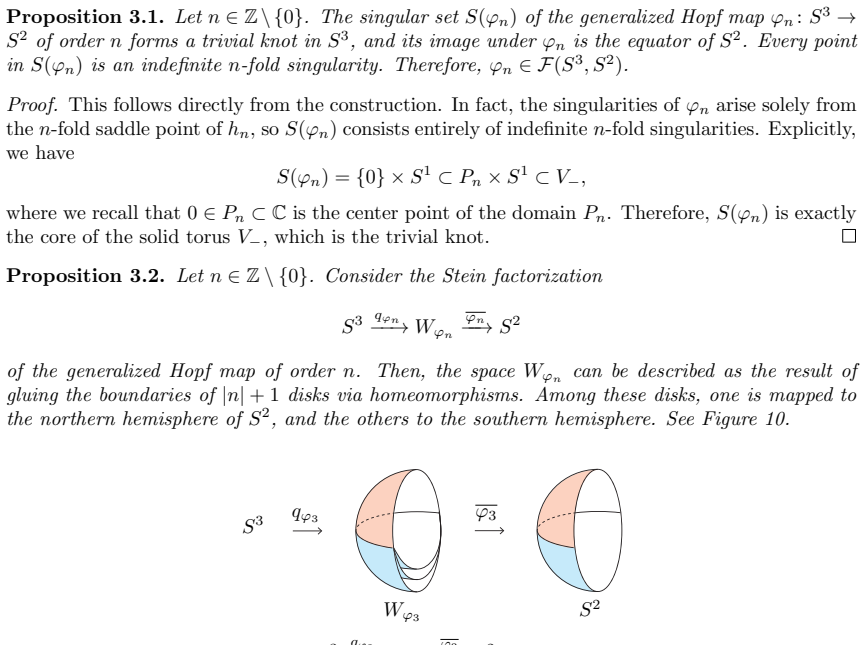
Generalized Hopf map of order n captured via fold maps and their Stein factorizations, which models the linking of preimage fibers in hopfions.
If this is right
- High-Hopf-index hopfions can be precisely classified based on their fiber pair configurations using this map framework.
- The geometry of fold maps provides a bridge between singular map theory and the topology observed in hopfion experiments.
- This approach enables modeling of complex field configurations in materials and other physical systems.
Where Pith is reading between the lines
- If the framework holds, it may suggest new experimental designs to realize specific Hopf indices by manipulating fold geometries in materials.
- Connections could be drawn to other topological solitons where singularity theory applies, such as skyrmions.
- Further work might derive explicit formulas for Hopf index in terms of fold map invariants.
Load-bearing premise
That physical hopfion configurations in materials can be faithfully represented as generalized Hopf maps of order n whose fiber linking is captured by the geometry of fold maps and their Stein factorizations.
What would settle it
Finding an experimental hopfion with a high Hopf index whose preimage fiber linking cannot be described by the Stein factorization of any generalized Hopf map of order n.
Figures






read the original abstract
The Hopf index, a topological invariant that quantifies the linking of preimage fibers, is fundamental to the structure and stability of hopfions. In this work, we propose a new mathematical framework for modeling hopfions with high Hopf index, drawing on the language of singularity theory and the topology of differentiable maps. At the core of our approach is the notion of a generalized Hopf map of order $n$, whose structure is captured via fold maps and their Stein factorizations. We demonstrate that this theoretical construction not only aligns closely with recent experimental observations of high-Hopf-index hopfions, but also offers a precise classification of the possible configurations of fiber pairs associated to distinct points. Our results thus establish a robust bridge between the geometry of singular maps and the experimentally observed topology of complex field configurations of hopfions in materials and other physical systems.
Editorial analysis
A structured set of objections, weighed in public.
Referee Report
Summary. The paper proposes a new mathematical framework for modeling hopfions with high Hopf index, centered on the notion of a generalized Hopf map of order n whose structure is captured via fold maps and their Stein factorizations from singularity theory. It asserts that this construction aligns closely with recent experimental observations of high-Hopf-index hopfions and offers a precise classification of the possible configurations of fiber pairs associated to distinct points.
Significance. If the proposed identification between physical hopfion configurations and generalized Hopf maps can be made rigorous with explicit constructions, the work could provide a useful topological classification tool bridging singularity theory and soft-matter field configurations. However, the manuscript introduces the new object and asserts the correspondence without derivations, explicit embeddings, or comparisons to measured linking numbers, so the potential impact remains unrealized in the current form.
major comments (2)
- [Abstract and main construction section] The central claim that physical hopfion configurations (director or magnetization fields) can be faithfully represented as generalized Hopf maps of order n such that preimage fibers and linking are exactly captured by fold singularities and Stein factorization is asserted in the abstract and main construction but is not supported by an explicit embedding, pull-back, or example that recovers a known physical order-parameter field and its measured Hopf index. This is load-bearing for both the experimental alignment and the classification claims.
- [Demonstration and results sections] No explicit maps, derivations of the Hopf index from the generalized construction, or direct comparisons to experimental data (e.g., observed linking numbers for high-index hopfions) are provided. The alignment with experiments is stated without supporting calculations or controls.
minor comments (2)
- [Definition section] Clarify the precise definition of the generalized Hopf map of order n, including how the order n relates to the standard Hopf index.
- [Introduction] Add references to prior work on Hopf solitons in soft matter and on fold maps in singularity theory to better situate the contribution.
Simulated Author's Rebuttal
We thank the referee for their thoughtful review and constructive suggestions. We address each major comment below and commit to revisions that will strengthen the explicit support for our framework while preserving the core contribution of the generalized Hopf map construction.
read point-by-point responses
-
Referee: [Abstract and main construction section] The central claim that physical hopfion configurations (director or magnetization fields) can be faithfully represented as generalized Hopf maps of order n such that preimage fibers and linking are exactly captured by fold singularities and Stein factorization is asserted in the abstract and main construction but is not supported by an explicit embedding, pull-back, or example that recovers a known physical order-parameter field and its measured Hopf index. This is load-bearing for both the experimental alignment and the classification claims.
Authors: We agree that an explicit example would make the central identification more concrete. In the revised manuscript we will add a dedicated subsection providing an explicit embedding of a standard low-order hopfion director field into the generalized Hopf map of order n. This will include the pull-back construction, the resulting Stein factorization, recovery of the Hopf index, and the associated fiber-pair classification, thereby directly supporting the claims in the abstract and main construction. revision: yes
-
Referee: [Demonstration and results sections] No explicit maps, derivations of the Hopf index from the generalized construction, or direct comparisons to experimental data (e.g., observed linking numbers for high-index hopfions) are provided. The alignment with experiments is stated without supporting calculations or controls.
Authors: We accept that the current presentation would benefit from additional explicit content. The revised version will incorporate explicit maps for representative high-index cases, step-by-step derivations of the Hopf index directly from the fold-map and Stein-factorization structure, and side-by-side comparisons with published experimental linking numbers for high-Hopf-index hopfions, including discussion of controls where relevant. revision: yes
Circularity Check
No significant circularity detected; construction is self-contained
full rationale
The paper introduces a new mathematical framework defining generalized Hopf maps of order n via fold maps and Stein factorizations as a modeling tool for high-Hopf-index hopfions. This is presented as a proposal drawing on singularity theory rather than a derivation that reduces to fitted inputs, self-citations, or tautological redefinitions. The stated alignment with experiments and classification of fiber-pair configurations follows from applying the defined objects, without evidence in the provided text of any load-bearing step where a prediction equals an input by construction or where uniqueness is imported solely via overlapping-author citations. The derivation chain remains independent and self-contained against external topological benchmarks.
Axiom & Free-Parameter Ledger
axioms (1)
- domain assumption Hopfions in physical systems admit a description as generalized Hopf maps whose structure is captured by fold maps and Stein factorizations.
invented entities (1)
-
generalized Hopf map of order n
no independent evidence
Lean theorems connected to this paper
-
IndisputableMonolith/Foundation/AlexanderDuality.leanalexander_duality_circle_linking unclear?
unclearRelation between the paper passage and the cited Recognition theorem.
At the core of our approach is the notion of a generalized Hopf map of order n, whose structure is captured via fold maps and their Stein factorizations.
What do these tags mean?
- matches
- The paper's claim is directly supported by a theorem in the formal canon.
- supports
- The theorem supports part of the paper's argument, but the paper may add assumptions or extra steps.
- extends
- The paper goes beyond the formal theorem; the theorem is a base layer rather than the whole result.
- uses
- The paper appears to rely on the theorem as machinery.
- contradicts
- The paper's claim conflicts with a theorem or certificate in the canon.
- unclear
- Pith found a possible connection, but the passage is too broad, indirect, or ambiguous to say the theorem truly supports the claim.
Reference graph
Works this paper leans on
-
[1]
P. J. Ackerman and I. I. Smalyukh. Diversity of knot solitons in liquid crystals manifested by linking of preimages in torons and hopfions. Phys. Rev. X , 7:011006, Jan 2017
work page 2017
-
[2]
P. J. Ackerman and I. I. Smalyukh. Static three-dimensional topological solitons in fluid chiral ferromagnets and colloids. Nature Materials, 16(4):426–432, 2017
work page 2017
-
[3]
F. Costantino and D. Thurston. 3-manifolds efficiently bound 4-manifolds. J. Topol., 1(3):703– 745, 2008
work page 2008
-
[4]
L. Faddeev and A. J. Niemi. Stable knot-like structures in classical field theory. Nature, 387(6628):58–61, 1997
work page 1997
-
[5]
M. Golubitsky and V. Guillemin. Stable mappings and their singularities , volume Vol. 14 of Graduate Texts in Mathematics . Springer-Verlag, New York-Heidelberg, 1973
work page 1973
-
[6]
D. Hall, J.-S. B. Tai, Y. Koda, Y. Nozaki, and I. I. Smalyukh. Structure, stability and inter-transformations of heliknotons with high hopf index. in preparation
-
[7]
J. H. Han. Skyrmions in Condensed Matter . Springer Tracts in Modern Physics. Springer Cham, 2017
work page 2017
-
[8]
M. Ishikawa and Y. Koda. Stable maps and branched shadows of 3-manifolds. Math. Ann., 367(3-4):1819–1863, 2017
work page 2017
-
[9]
N. Manton and P. Sutcliffe. Topological solitons. Cambridge Monographs on Mathematical Physics. Cambridge University Press, Cambridge, 2004
work page 2004
-
[10]
O. Saeki. Simple stable maps of 3-manifolds into surfaces. Topology, 35(3):671–698, 1996
work page 1996
-
[11]
O. Saeki. Topology of singular fibers of differentiable maps , volume 1854 of Lecture Notes in Mathematics. Springer-Verlag, Berlin, 2004
work page 2004
-
[12]
Y. M. Shnir. Topological and non-topological solitons in scalar field theories . Cambridge Monographs on Mathematical Physics. Cambridge University Press, Cambridge, 2018
work page 2018
-
[13]
N. E. Steenrod. Cohomology invariants of mappings. Ann. of Math. (2) , 50:954–988, 1949
work page 1949
-
[14]
J.-S. B. Tai, P. J. Ackerman, and I. I. Smalyukh. Topological transformations of hopf solitons in chiral ferromagnets and liquid crystals. Proceedings of the National Academy of Sciences , 115(5):921–926, 2018
work page 2018
-
[15]
J.-S. B. Tai and I. I. Smalyukh. Static hopf solitons and knotted emergent fields in solid-state noncentrosymmetric magnetic nanostructures. Phys. Rev. Lett., 121:187201, Oct 2018
work page 2018
-
[16]
J.-S. B. Tai and I. I. Smalyukh. Three-dimensional crystals of adaptive knots. Science, 365(6460):1449–1453, 2019
work page 2019
-
[17]
J.-S. B. Tai, J.-S. Wu, and I. I. Smalyukh. Geometric transformation and three-dimensional hopping of hopf solitons. Nature Communications, 13(1):2986, 2022
work page 2022
-
[18]
R. Voinescu, J.-S. B. Tai, and I. I. Smalyukh. Hopf solitons in helical and conical backgrounds of chiral magnetic solids. Phys. Rev. Lett., 125:057201, Jul 2020. 14
work page 2020
discussion (0)
Sign in with ORCID, Apple, or X to comment. Anyone can read and Pith papers without signing in.