REVIEW 4 major objections 4 minor 46 references
Progressive Sentences: Combining the Benefits of Word and Sentence Learning
T0 review · 4 major / 4 minor · reviewed 2026-08-06 · deepseek-v4-flash
Pith's one-line read A progressive sentence-reveal format with timed pauses improves recall in mobile AR language learning.
desk verdict The gap effect during walking is real and worth reporting, but the abstract's claim that progressive beats word and full-sentence learning is not backed by any formal comparison. read the letter →
The pith
A machine-rendered reading of the paper's core claim, the machinery that carries it, and where it could break.
The reading
What carries the argument
The central mechanism is progressive disclosure applied to sentence structure: a sentence is segmented into subject, verb, and object components that appear sequentially, earlier components remain visible, and the newest component is signaled by a transparency cue, followed by a final full-sentence display. This follows the multimedia-learning principles of segmenting, breaking content into small progressive units, and signaling, highlighting new elements, which are meant to manage cognitive load. All modalities (L2 text, L1 text, images, synchronized audio) were time-matched across conditions so that total exposure time was equal, isolating the format and the word-gap timing as the manipulated variables.
What would settle it
A preregistered, adequately powered study (for example, $N \geq 60$) comparing progressive, full-sentence, and word-only formats during walking with equal total exposure time would settle the claim: if the progressive format does not produce significantly higher free recall than both alternatives, the headline claim fails. A second check is to remove the final full-sentence display from the progressive sequence; if recall then drops to word-only levels, the benefit would come from the appended sentence rather than from stepwise disclosure.
Extended reading notes
Core claim
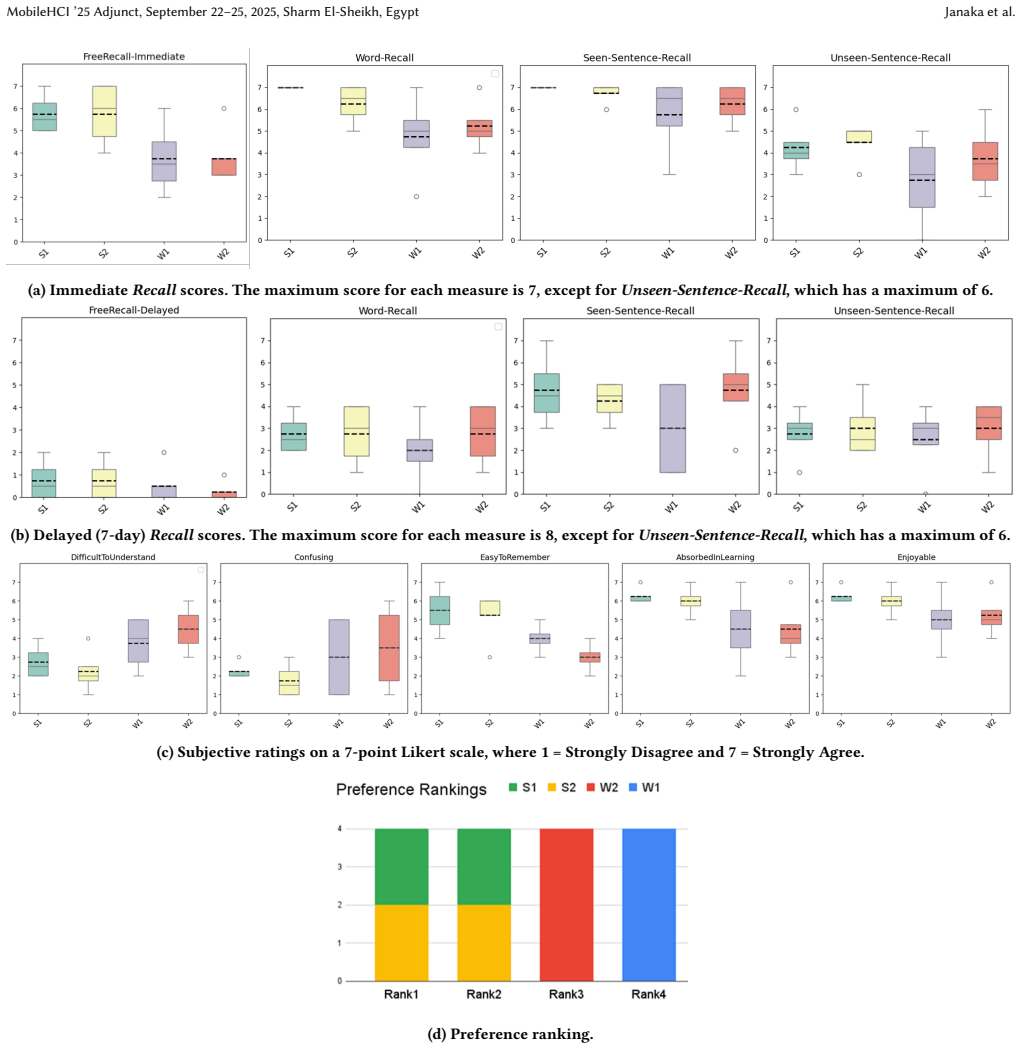
Progressive presentation combines the advantages of word and sentence learning: it gives novice learners the one-to-one word mapping of isolated vocabulary while preserving the grammatical context of a full sentence. In the 2×2 formal study, walking participants who saw sentence components separated by a 4-second gap recalled more L2–L1 word pairs freely ($M = 4.7$, $SD = 2.2$) than those without a gap ($M = 3.1$, $SD = 1.8$; $p_{\mathrm{bonf}} < 0.05$, $d = 0.44$); sitting participants showed no gap benefit. The authors interpret the gap as giving learners time to consolidate each word before the next appears, which matters most when attention is divided between walking and learning. Most participants also preferred progressive over full-sentence and random-word formats, reporting that preserving sentence context helped them connect L2 words to their L1 meanings.
Load-bearing premise
The headline claim that progressive presentation beats full-sentence and word-only learning rests on a six-person pilot with no significant differences plus self-reported preference, because the formal experiment only varied mobility and word-gap within the progressive format itself.
Editorial extensions
If this is right
- Designers of AR language apps can expect that inserting short pauses between sentence components will improve immediate recall specifically for learners who are mobile, such as walking.
- The progressive format is best positioned as a scaffolding technique: it should be offered to novice learners and gradually replaced by full-sentence presentation as word familiarity grows.
- Pacing should be treated as adaptive rather than fixed, since participants reported that the ideal gap duration depends on how demanding the concurrent task is.
- Because the 7-day delayed-recall measures showed no significant effects, the demonstrated advantage is in short-term retention rather than long-term memory.
- Time-matched multimodal presentation with text, image, and audio together was preferred and performed at least as well as text-only, supporting the multimedia principle on see-through glasses.
Reading between the lines
- A direct powered comparison of progressive, full-sentence, and word-only formats, matched for exposure and with the progressive condition's final full-sentence display removed, would test whether the benefit comes from stepwise disclosure itself or from the appended sentence replay.
- The gap effect predicts a testable interaction with task load: making the walking task harder should shift the optimal gap duration, suggesting an adaptive-pacing design space beyond the fixed 4 seconds used here.
- The same progressive-disclosure pattern could be applied to other sequential learning content such as step-by-step instructions or short narratives, and a similar walking-versus-sitting comparison would show whether the effect is general or specific to subject-verb-object sentences.
Editorial analysis
A structured set of objections, weighed in public.
Referee Report
Summary. The paper proposes a 'progressive presentation' method for second-language vocabulary learning on augmented-reality smart glasses, in which a sentence is revealed component-by-component (subject, verb, object) while prior context is retained, and reports a sequence of pilots and one formal study. Study 1 (N=12) uses a 2x2 within-subject design (Mobility x Word-Gap) inside the Progressive format and finds a significant immediate free-recall benefit of a 4-second word gap in the Walking condition, along with overall higher recall when Sitting. The manuscript claims in the Abstract and Introduction that progressive presentation enhances recall over full-sentence and word-only formats, but that claim rests on Pilot 2 (N=6), whose format differences were not statistically significant. Pilot 4 (N=4) provides no format baseline.
Significance. The topic is timely and the apparatus is appropriate for studying AR microlearning. The authors use Wuggy pseudowords to control prior knowledge, standard recall measures with partial-credit scoring, a within-subject Latin-square design, and a 7-day delayed recall; these are strengths. However, the central comparative claim about progressive versus full-sentence and word-only learning is not supported by the data as reported: the only formal study that is statistically analyzed (Study 1) does not include those formats, and the only format comparison (Pilot 2) is underpowered and non-significant. The narrower finding that a 4-second gap improves immediate free recall during walking is plausible but depends on a gap duration chosen in a two-participant pilot. As submitted, the paper's headline overclaims its evidence.
major comments (4)
- [Abstract; Section 8; Section 6] The headline claim that progressive presentation enhances recall relative to full-sentence and word-only formats is not tested by Study 1. Study 1's 2x2 design varies only Mobility (Sitting/Walking) and Word-Gap (NoGap/Gap) while all conditions use the Progressive format; there is no Full or Word condition. The only formal comparison across formats is Pilot 2 (Section 6), N=6, which reports that 'differences were not statistically significant.' The abstract's statement that 'Pilot and formal studies revealed that progressive presentation enhances recall' therefore overstates the evidence, and the preference and qualitative feedback in Section 8 do not constitute recall evidence. This is a load-bearing mismatch between claim and design.
- [Section 4.4.5; Section 6] Section 4.4.5 asserts that 'all modalities and gaps were time-matched across conditions,' but no exposure durations are reported for the Full and Word conditions in Pilot 2. If the Full or Word condition presented the same sentence components for more or less total time, the descriptive advantage for Progressive could be an artifact of exposure time rather than format. The manuscript should report the actual per-item and per-condition durations for each format and, ideally, verify that the Word condition presented the same number of words for the same total duration before treating the Pilot 2 trend as meaningful.
- [Section 7; Section 8] The 4-second gap that is central to the significant interaction in Study 1 was itself selected from Pilot 3 (N=2) and then tested in the same research program, so Study 1 is a confirmation of that pilot's choice rather than an independent test of gap duration. In addition, the significant gap benefit appears only in immediate free recall during Walking (p_bonf < .05, d = 0.44); no gap effect is reported for delayed recall, and the gap had no effect in Sitting. The abstract's claim that 'incorporating timed gaps between word presentations further improved learning effectiveness' should be qualified to immediate recall under multitasking and treated as exploratory given the parameter-selection dependence.
- [Section 9; Section 10] Pilot 4 (N=4) repeats the same within-Progressive design with Norwegian materials and, like Study 1, does not include Full or Word conditions. It therefore cannot provide the format baseline needed to support the central claim. Moreover, Section 10's discussion of 'why progressive presentation is effective' relies heavily on subjective preference and interview responses, which are not measures of learning outcome. The manuscript should either confine its conclusions to the within-format gap and mobility effects or collect a powered, time-matched format comparison.
minor comments (4)
- [Section 4.1] The participant count is inconsistent: Section 4.1 says 'Participants (total of 27),' but the individual studies sum to 5+6+2+12+4=29, and Section 4.1 also states that no participant took part in more than one study. Please reconcile the total.
- [Figure 4 caption] The caption of Figure 4(b) says the maximum score for each measure is 8 for most measures, but Pilot 4 has 7 new words per condition, so the maximum for Free-Recall and Word-Recall should be 7; the caption in Figure 3 is correct for Study 1 but not for Pilot 4.
- [Section 4.4.5] The presentation schedule is described only qualitatively ('at least 6 seconds,' '8 seconds,' '12 seconds,' 'shown twice'); a concrete per-condition timing table for the NoGap and Gap variants of Progressive, and for Full and Word, would make the time-matching claim verifiable.
- [Section 8] The main effect of Mobility is reported only as p < 0.05 without test statistics for most recall measures; please report exact F values, degrees of freedom, and effect sizes for all significant main effects and interactions.
Circularity Check
No circularity: Study 1's comparisons are new empirical data, and the broader format claim is under-supported rather than derived from its inputs.
full rationale
The paper's formal quantitative result comes from Study 1's 2x2 within-subject ANOVA (Section 8), in which Mobility and Word-Gap are manipulated before recall is measured; the significant Gap-vs-NoGap contrast during Walking is an empirical difference in new data, not an identity with any fitted parameter or earlier result. The 4-second gap was selected in Pilot 3 (N=2, Section 7) and then tested in Study 1, but that is a design choice made before the formal study, not a fitted coefficient that algebraically determines the outcome, so no 'prediction reduces by construction' pattern is present. The abstract's broader claim that progressive presentation enhances recall relative to Full and Word formats rests on Pilot 2's descriptive non-significant trend (Section 6: 'differences were not statistically significant') rather than a formal comparison, and Study 1 contains no Full/Word baseline; this is an evidentiary gap, not circularity. The manuscript itself flags related limitations in Section 10.1 ('the small sample size and controlled lab settings limit ecological validity'), and I weigh those as validity concerns rather than circular ones. Self-citations such as [22] and [34] are used only as supporting alignment in the discussion and do not supply a load-bearing premise, so they do not raise the circularity score.
Assumptions & free parameters
free parameters (2)
- word gap duration =
4 seconds
- presentation durations =
6 s word, 8 s phrase, 12 s sentence, +8 s between sentences, +3 s final sentence
assumptions (2)
- domain assumption Cognitive Theory of Multimedia Learning principles (Segmenting, Signaling, Multimedia) apply to optical see-through head-mounted displays with novice learners
- domain assumption Recall of Wuggy pseudoword-L1 pairs is a valid proxy for second-language vocabulary learning
Cite this review
Pith. "Pith review of Progressive Sentences: Combining the Benefits of Word and Sentence Learning." pith.science (2026). https://pith.science/paper/EW22PCZS
@misc{pith2026250714846,
  author       = {Pith},
  title        = {Pith review of: Progressive Sentences: Combining the Benefits of Word and Sentence Learning},
  year         = {2026},
  howpublished = {\url{https://pith.science/paper/EW22PCZS}},
  note         = {Machine review of arXiv:2507.14846}
}
read the original abstract
The rapid evolution of lightweight consumer augmented reality (AR) smart glasses (a.k.a. optical see-through head-mounted displays) offers novel opportunities for learning, particularly through their unique capability to deliver multimodal information in just-in-time, micro-learning scenarios. This research investigates how such devices can support mobile second-language acquisition by presenting progressive sentence structures in multimodal formats. In contrast to the commonly used vocabulary (i.e., word) learning approach for novice learners, we present a "progressive presentation" method that combines both word and sentence learning by sequentially displaying sentence components (subject, verb, object) while retaining prior context. Pilot and formal studies revealed that progressive presentation enhances recall, particularly in mobile scenarios such as walking. Additionally, incorporating timed gaps between word presentations further improved learning effectiveness under multitasking conditions. Our findings demonstrate the utility of progressive presentation and provide usage guidelines for educational applications-even during brief, on-the-go learning moments.
Figures


Figures from the paper (1 more)
Reference graph
Works this paper leans on
-
[1]
1998. The Role of Illustrations in Text Comprehension: What, When, for Whom, and Why? In The Construction of Mental Representations During Reading , Susan R. Goldman and Herre van Oostendorp (Eds.). Psychology Press. https://psycnet. apa.org/record/1998-06740-008
work page 1998
-
[2]
Introducing Duolingo Max, a learning experience powered by GPT-4
2023. Introducing Duolingo Max, a learning experience powered by GPT-4. https://blog.duolingo.com/duolingo-max/
work page 2023
-
[3]
CEFR descriptors search - Common European Framework of Reference for Languages (CEFR) - www.coe.int
2024. CEFR descriptors search - Common European Framework of Reference for Languages (CEFR) - www.coe.int. https://www.coe.int/en/web/common- european-framework-reference-languages/cefr-descriptors-search
work page 2024
-
[4]
Attygalle, Matjaž Kljun, Aaron Quigley, Klen Čopič Pucihar, Jens Gru- bert, Verena Biener, Luis A
Nuwan T. Attygalle, Matjaž Kljun, Aaron Quigley, Klen Čopič Pucihar, Jens Gru- bert, Verena Biener, Luis A. Leiva, Juri Yoneyama, Alice Toniolo, Angela Miguel, Hirokazu Kato, and Maheshya Weerasinghe. 2025. Text-to-Image Generation for Vocabulary Learning Using the Keyword Method. In Proceedings of the 30th Inter- national Conference on Intelligent User I...
arXiv 2025
-
[5]
Ronald T. Azuma. 2019. The road to ubiquitous consumer augmented reality systems. 1, 1 (2019), 26–32. doi:10.1002/hbe2.113
-
[6]
Virginia Braun and Victoria Clarke. 2006. Using thematic analysis in psychol- ogy. Qualitative Research in Psychology 3, 2 (Jan. 2006), 77–101. doi:10.1191/ 1478088706qp063oa
work page 2006
-
[7]
Carrie J. Cai, Anji Ren, and Robert C. Miller. 2017. WaitSuite: Productive Use of Diverse Waiting Moments. ACM Transactions on Computer-Human Interaction 24, 1 (March 2017), 7:1–7:41. doi:10.1145/3044534
-
[8]
Ronald Carter. 1998. Vocabulary: Applied Linguistic Perspectives . Psychology Press. Google-Books-ID: G_Rdpfzfy8kC
work page 1998
Show all 46 references
-
[9]
Qiaoyi Chen, Siyu Liu, Kaihui Huang, Xingbo Wang, Xiaojuan Ma, Junkai Zhu, and Zhenhui Peng. 2024. RetAssist: Facilitating Vocabulary Learners with Genera- tive Images in Story Retelling Practices. InProceedings of the 2024 ACM Designing Interactive Systems Conference (DIS ’24...
2024
-
[10]
Xu Chen and Di Wu. 2024. Automatic Generation of Multimedia Teaching Materials Based on Generative AI: Taking Tang Poetry as an Example. IEEE Transactions on Learning Technologies 17 (2024), 1353–1366. doi:10.1109/TLT. 2024.3378279 Conference Name: IEEE Transactions on Learnin...
2024
-
[11]
Kai-Yi Chin, Huai-Ling Chang, and Ching-Sheng Wang. 2024. Applying a wearable MR-based mobile learning system on museum learning activities for university students. Interactive Learning Environments 32, 9 (Oct. 2024), 5744–5765. doi:10.1080/10494820.2023.2228843 Publisher: Rou...
2024
-
[12]
Brita Curum and Kavi Kumar Khedo. 2021. Cognitive load management in mobile learning systems: principles and theories. Journal of Computers in Education 8, 1 (March 2021), 109–136. doi:10.1007/s40692-020-00173-6
2021 doi
-
[13]
Tilman Dingler, Dominik Weber, Martin Pielot, Jennifer Cooper, Chung-Cheng Chang, and Niels Henze. 2017. Language learning on-the-go: opportune moments and design of mobile microlearning sessions. In Proceedings of the 19th International Conference on Human-Computer Interactio...
2017
-
[14]
Darren Edge, Stephen Fitchett, Michael Whitney, and James Landay. 2012. Mem- Reflex: adaptive flashcards for mobile microlearning. In Proceedings of the 14th international conference on Human-computer interaction with mobile devices and services (MobileHCI ’12) . Association f...
2012
-
[15]
Darren Edge, Elly Searle, Kevin Chiu, Jing Zhao, and James A. Landay. 2011. MicroMandarin: mobile language learning in context. InProceedings of the SIGCHI Conference on Human Factors in Computing Systems. ACM, Vancouver BC Canada, 3169–3178. doi:10.1145/1978942.1979413
2011
-
[16]
Eng, Karrie E
Cassondra M. Eng, Karrie E. Godwin, and Anna V. Fisher. 2020. Keep it simple: streamlining book illustrations improves attention and comprehension in begin- ning readers. npj Science of Learning 5, 1 (Sept. 2020), 1–10. doi:10.1038/s41539- 020-00073-5 Number: 1 Publisher: Natu...
2020 doi
-
[17]
Alix Goguey, Carl Gutwin, Zhe Chen, Pang Suwanaposee, and Andy Cockburn
-
[18]
Yongqi Gu and Robert Keith Johnson. 1996. Vocabulary Learning Strategies and Language Learning Outcomes. Language Learning 46, 4 (Dec. 1996), 643–679. doi:10.1111/j.1467-1770.1996.tb01355.x 00000
1996
-
[19]
Adam Ibrahim, Brandon Huynh, Jonathan Downey, Tobias Hollerer, Dorothy Chun, and John O’Donovan. 2018. ARbis Pictus: A Study of Vocabulary Learn- ing with Augmented Reality. IEEE Transactions on Visualization and Computer Graphics 24, 11 (Nov. 2018), 2867–2874. doi:10.1109/TVC...
2018
-
[20]
Yuta Itoh, Tobias Langlotz, Jonathan Sutton, and Alexander Plopski. 2021. To- wards Indistinguishable Augmented Reality: A Survey on Optical See-through Head-mounted Displays. Comput. Surveys 54, 6 (July 2021), 120:1–120:36. doi:10.1145/3453157
2021 doi
-
[21]
Nuwan Janaka, Xinke Wu, Shan Zhang, Shengdong Zhao, and Petr Slovak. 2022. Visual Behaviors and Mobile Information Acquisition. doi:10.48550/arXiv.2202. 02748
2022 doi
-
[22]
Nuwan Janaka, Shengdong Zhao, and Samantha Chan. 2023. NotiFade: Mini- mizing OHMD Notification Distractions Using Fading. In Extended Abstracts of the 2023 CHI Conference on Human Factors in Computing Systems (CHI EA ’23) . Association for Computing Machinery, New York, NY, U...
2023
-
[23]
Nuwan Janaka, Shengdong Zhao, and Shardul Sapkota. 2023. Can Icons Outper- form Text? Understanding the Role of Pictograms in OHMD Notifications. In Proceedings of the 2023 CHI Conference on Human Factors in Computing Systems (Hamburg, Germany) (CHI ’23). Association for Compu...
2023
-
[24]
Emmanuel Keuleers and Marc Brysbaert. 2010. Wuggy: A multilingual pseu- doword generator. Behavior Research Methods 42, 3 (Aug. 2010), 627–633. doi:10.3758/BRM.42.3.627
2010 doi
-
[25]
Krathwohl
David R. Krathwohl. 2002. A Revision of Bloom’s Taxonomy: An Overview. Theory Into Practice 41, 4 (Nov. 2002), 212–218. doi:10.1207/s15430421tip4104_2 06999
2002 doi
-
[26]
de Fockert, and Essi Viding
Nilli Lavie, Aleksandra Hirst, Jan W. de Fockert, and Essi Viding. 2004. Load Theory of Selective Attention and Cognitive Control. Journal of Experimental Psychology: General 133, 3 (2004), 339–354. doi:10.1037/0096-3445.133.3.339 Place: US Publisher: American Psychological As...
2004 doi
-
[27]
Joanne Leong, Pat Pataranutaporn, Valdemar Danry, Florian Perteneder, Yaoli Mao, and Pattie Maes. 2024. Putting Things into Context: Generative AI-Enabled Context Personalization for Vocabulary Learning Improves Learning Motivation. In Proceedings of the CHI Conference on Huma...
2024
-
[28]
Jimmie Leppink, Fred Paas, Cees P. M. Van der Vleuten, Tamara Van Gog, and Jeroen J. G. Van Merriënboer. 2013. Development of an instrument for measuring different types of cognitive load. Behavior Research Methods 45, 4 (Dec. 2013), 1058–1072. doi:10.3758/s13428-013-0334-1
2013 doi
-
[29]
Manuela Macedonia and Thomas R. Knösche. 2011. Body in Mind: How Gestures Empower Foreign Language Learning. Mind, Brain, and Education 5, 4 (2011), 196–211. doi:10.1111/j.1751-228X.2011.01129.x
2011 arXiv
-
[30]
Richard E. Mayer. 2002. Multimedia learning. In Psychology of Learning and Motivation. Vol. 41. Academic Press, 85–139. doi:10.1016/S0079-7421(02)80005-6
2002 doi
-
[31]
Richard E. Mayer. 2014. Cognitive Theory of Multimedia Learning. In The Cambridge Handbook of Multimedia Learning (2 ed.), Richard E. Mayer (Ed.). Cambridge University Press, Cambridge, 43–71. doi:10.1017/CBO9781139547369. 005
2014 doi
-
[32]
del Pobil
Eunil Park, Jinyoung Han, Ki Joon Kim, Yongwoo Cho, and Angel P. del Pobil
-
[33]
Angela Ralli. 1991. Review of Vocabulary: Applied Linguistic Perspectives. Ma- chine Translation 6, 1 (1991), 51–54. https://www.jstor.org/stable/40006901 Pub- lisher: Springer
1991
-
[34]
Ashwin Ram and Shengdong Zhao. 2021. LSVP: Towards Effective On-the-go Video Learning Using Optical Head-Mounted Displays. Proc. ACM Interact. Mob. Wearable Ubiquitous Technol. 5, 1 (March 2021), 30:1–30:27. doi:10.1145/3448118 MobileHCI ’25 Adjunct, September 22–25, 2025, Sha...
2021 doi
-
[35]
Rauschnabel, Reto Felix, Chris Hinsch, Hamza Shahab, and Florian Alt
Philipp A. Rauschnabel, Reto Felix, Chris Hinsch, Hamza Shahab, and Florian Alt. 2022. What is XR? Towards a Framework for Augmented and Virtual Reality. Computers in Human Behavior 133 (Aug. 2022). doi:10.1016/j.chb.2022.107289
2022
-
[36]
Mrigank S Shail. 2019. Using Micro-learning on Mobile Applications to Increase Knowledge Retention and Work Performance: A Review of Literature. Cureus 11, 8 (2019), e5307. doi:10.7759/cureus.5307
2019 doi
-
[37]
Smitha Sheshadri, Shengdong Zhao, Yang Chen, and Morten Fjeld. 2020. Learn with Haptics: Improving Vocabulary Recall with Free-form Digital Annotation on Touchscreen Mobiles. In Proceedings of the 2020 CHI Conference on Human Factors in Computing Systems (CHI ’20) . Associatio...
2020
-
[38]
Felicia Fang-Yi Tan, Peisen Xu, Ashwin Ram, Wei Zhen Suen, Shengdong Zhao, Yun Huang, and Christophe Hurter. 2024. AudioXtend: Assisted Reality Visual Accompaniments for Audiobook Storytelling During Everyday Routine Tasks. In Proceedings of the 2024 CHI Conference on Human Fa...
2024
-
[39]
Mark Feng Teng. 2023. The effectiveness of multimedia input on vocabulary learning and retention. Innovation in Language Learning and Teaching 17, 3 (May 2023), 738–754. doi:10.1080/17501229.2022.2131791
2023
-
[40]
Susannah Torcasio and John Sweller. 2010. The use of illustrations when learning to read: A cognitive load theory approach. Applied Cognitive Psychology 24, 5 (2010), 659–672. doi:10.1002/acp.1577
2010 doi
-
[41]
Maheshya Weerasinghe, Verena Biener, Jens Grubert, Aaron Quigley, Alice Toniolo, Klen Copic Pucihar, and Matjaz Kljun. 2022. VocabulARy: Learn- ing Vocabulary in AR Supported by Keyword Visualisations. IEEE Transac- tions on Visualization and Computer Graphics 28, 11 (Nov. 202...
2022
-
[42]
Wobbrock, Leah Findlater, Darren Gergle, and James J
Jacob O. Wobbrock, Leah Findlater, Darren Gergle, and James J. Higgins. 2011. The aligned rank transform for nonparametric factorial analyses using only anova procedures. In Proceedings of the SIGCHI Conference on Human Factors in Computing Systems (CHI ’11) . Association for ...
2011
-
[43]
Yue Zhao, Tarmo Robal, Christoph Lofi, and Claudia Hauff. 2018. Stationary vs. Non-stationary Mobile Learning in MOOCs. In Adjunct Publication of the 26th Conference on User Modeling, Adaptation and Personalization - UMAP ’18 . ACM Press, Singapore, Singapore, 299–303. doi:10....
2018
-
[44]
book” vs L2: “bok
Chen Zhou, Katherine Fennedy, Felicia Fang-Yi Tan, Shengdong Zhao, and Yurui Shao. 2023. Not All Spacings are Created Equal: The Effect of Text Spacings in On-the-go Reading Using Optical See-Through Head-Mounted Displays. In Proceedings of the 2023 CHI Conference on Human Fac...
2023
-
[2018]
In Proceedings of the 12th International Conference on Ubiquitous Information Management and Communication (IMCOM ’18)
Effects of Screen Size in Mobile Learning Over Time. In Proceedings of the 12th International Conference on Ubiquitous Information Management and Communication (IMCOM ’18). Association for Computing Machinery, New York, NY, USA, 1–5. doi:10.1145/3164541.3164625
-
[2021]
In Proceedings of the 2021 CHI Conference on Human Factors in Computing Systems (CHI ’21)
Interaction Pace and User Preferences. In Proceedings of the 2021 CHI Conference on Human Factors in Computing Systems (CHI ’21) . Association for Computing Machinery, New York, NY, USA, 1–14. doi:10.1145/3411764.3445772
2021
Reviewed August 6, 2026 · model on record in the stance chip above.
Discussion (0). Sign in to comment.