REVIEW 4 major objections 6 minor 1 cited by
Feedback-Induced Performance Decline in LLM-Based Decision-Making
T0 review · 4 major / 6 minor · reviewed 2026-08-06 · deepseek-v4-flash
Pith's one-line read The paper shows that incrementally adding feedback—dynamics, reward, cumulative reward, and policy cues—to zero-shot LLM prompts degrades MiniGrid navigation performance, with policy feedback driving some models to 0% success.
desk verdict A useful but under-supported empirical scan: the feedback-confusion claim needs parse-failure counts and error bars before it lands. read the letter →
The pith
A machine-rendered reading of the paper's core claim, the machinery that carries it, and where it could break.
The reading
What carries the argument
The central object is a family of structured prompts incrementally extended from a human-written base prompt (HWBP): chain-of-thought (CoT), dynamics feedback (DF) describing the last action and state change, reward feedback (RF), cumulative reward feedback (CRF), and policy feedback (PF), where the model summarises and reuses its own previous strategy, optionally across episodes. The prompt composer appends these blocks to a fixed environment description and demands the action as JSON with 'action' and 'reason' fields—plus a 'policy' field when PF is included. The comparison runs on three MiniGrid layouts of increasing difficulty using LLaMA 3.1 8B and Qwen 2.5 1.5B, with random and PPO-trained policies serving as baselines.
What would settle it
Count the fraction of LLM responses that fail the required JSON schema for each prompt variant, and rerun the policy-feedback conditions with the extra 'policy' field removed from the output requirement while keeping the feedback text. If success rates return to the non-PF level, the decline is a format artifact; if they stay low, confusion is substantiated.
Extended reading notes
Core claim
On its own terms, this paper claims that LLM-based policies evaluated zero-shot cannot match a trained PPO baseline on MiniGrid MDPs, and more specifically that prompting strategies that pile up feedback signals consistently underperform the simplest human-written base prompt. The cleanest evidence is the policy-feedback conditions, where LLaMA 3.1 8B achieved 0% success in every configuration—below the random baseline—and the authors attribute this to feedback introducing confusion and misallocating the model's attention away from task-relevant signals. The paper further reports that one-shot reasoning models fail on the most complex configuration, and interprets the overall pattern as showing that LLMs struggle with planning and reasoning in complex scenarios without fine-tuning or additional guidance. The intended takeaway is that feedback mechanisms intended to improve decision-making instead diminish performance in intricate environments.
Load-bearing premise
The observed decline is attributed to the LLM becoming confused by feedback, but the paper never reports how often the LLM produced malformed or unparseable JSON output, so part of the drop—especially the 0% policy-feedback rows—could be a mechanical parsing failure rather than confusion.
Editorial extensions
If this is right
- If the claim is right, adding more feedback to zero-shot LLM prompts is not a viable way to improve agentic decision-making; richer prompts can actively hurt.
- LLM-based agents in sequential tasks should rely on fine-tuning, external planners or verifiers, or memory architectures rather than on prompt-level feedback alone.
- Prompt designers should treat feedback injection as a potential confounder in any evaluation of LLM agents, since context length and format demands can mask or reverse the intended benefit.
- The results strengthen the case for hybrid LLM-RL systems where the LLM contributes priors but a trained policy or verifier governs action selection.
Reading between the lines
- One unresolved alternative: the extra JSON 'policy' field in the policy-feedback prompts could mechanically cause parse failures; the paper's 0% rows make this worth testing before concluding the model was 'confused'.
- A testable extension of the paper's claim is that feedback delivered through a separate structured channel (e.g., metadata or tool calls) rather than appended to the narrative prompt would not show the same decline.
- If the feedback-dilution effect generalises beyond MiniGrid, the trend toward automated prompt optimisation must verify that optimisations improve action quality rather than just format compliance.
Editorial analysis
A structured set of objections, weighed in public.
Referee Report
Summary. The paper studies zero-shot LLM policies in MiniGrid MDPs, using hand-written base prompts (HWBP) extended with chain-of-thought, dynamics feedback, reward feedback, cumulative reward feedback, and policy feedback, compared against random and PPO baselines. Across three grid configurations and two small LLMs (Llama 3.1 8B and Qwen 2.5 1.5B), the authors report that LLM success rates tend to decline as feedback is added, that policy-feedback conditions can drop to 0% success, and that one-shot reasoning models (Deepseek R1 14B and QwQ 32B) produce incomplete or incorrect plans. The central claim is that feedback mechanisms intended to improve decision-making instead introduce confusion and degrade performance.
Significance. If the empirical pattern holds, this is a timely caution for prompt-based LLM agents: appending memory and reward signals does not automatically help and can harm. The paper's strengths are the transparent prompt-construction appendix, the use of external RL and random baselines, and the inclusion of multiple environment difficulties. However, the evidence is not yet sufficient: single runs without error bars, unreported parse-failure rates, and an anecdotal reasoning-model section all sit between the data and the central conclusion. With parse-failure statistics and multi-seed results, the paper would be a useful contribution; without them, the headline claim remains confounded.
major comments (4)
- [Section III-C and Tables II-IV] Each condition is evaluated over 100 episodes, but the paper reports no number of independent runs (seeds), no error bars, and no statistical tests. With stochastic LLM decoding, a 10-20 percentage point difference between conditions may be within run-to-run noise, so the monotonic-decline narrative is not established. Report mean and standard deviation over at least 3-5 seeds, and perform pairwise significance tests (e.g., bootstrap or Fisher's exact test on success counts) for the key comparisons.
- [Appendix A (compose_prompt) and Tables II-IV] Policy-feedback prompts switch the output requirement to output_requirements_with_policy_feedback, which adds a required 'policy' field to the JSON. The paper never reports the frequency of malformed JSON, missing 'action' keys, or invalid action strings, nor how the parser treated such outputs. If the parser rejected non-conforming outputs, the 0.000 success rows under HWBP+PF (e.g., llama3.1:8b in all three configurations) could be a format artifact rather than evidence of LLM confusion. Report per-condition parse-failure rates and, if possible, rerun with a parser that recovers the 'action' field from partial JSON; this is necessary to support the Section IV-E interpretation that feedback 'misallocates focus.'
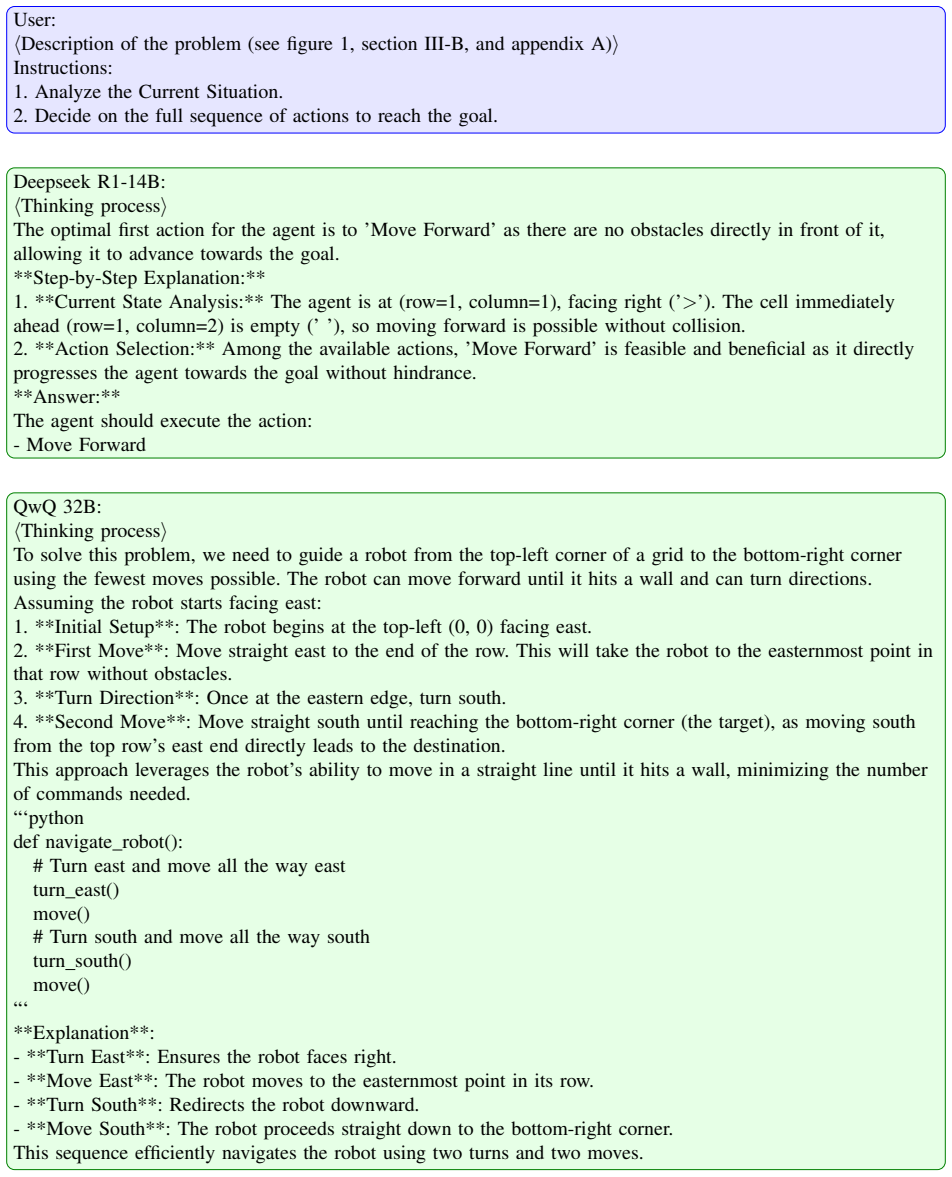
- [Section IV-D and Table V] The reasoning-model results are based on a single output per model per configuration, with qualitative labels ('Failed', 'Incomplete', 'Incorrect', 'Failed to generate') and no explicit scoring rubric. This does not support the quantitative claim that these models 'tend to fail on more complex instances.' Provide multiple runs, a defined evaluation criterion, and at least a simple count of success/failure across trials, or explicitly characterize this subsection as anecdotal.
- [Section IV-A and Tables II-IV] The claim that 'additional forms of feedback' produce 'noticeable performance decline' is not uniformly supported by the tables. For example, qwen2.5:1.5b in Configuration 1 goes from 92% success with HWBP+CoT to 0% with HWBP+CoT+DF, then recovers to 63% with HWBP+CoT+DF+RF; and qwen2.5:1.5b in Configuration 3 goes from 35% with HWBP+CoT to 0% with DF and then back to 20% with PF. These non-monotonic patterns, together with the absence of error bars, prevent a blanket conclusion. The paper should analyze each feedback type separately and discuss or explain the outliers; the Section IV-E statement that 'Policy feedback further degraded performance' is also contradicted by qwen2.5:1.5b in Configuration 1, where HWBP+PF (81% success) slightly outperforms HWBP (80%).
minor comments (6)
- [Section V] The phrase 'proximal policy persuit' is a typo; it should be 'proximal policy pursuit' or 'Proximal Policy Optimization.'
- [Appendix A] The identifier 'cummulative' appears throughout the code and comments; use 'cumulative' for consistency and readability.
- [Figure 1 and Section III-C] The Figure 1 caption refers to a 'red arrow,' while the text describes the agent as a 'red triangle'; align the descriptions.
- [Appendix C] The one-shot reasoning prompts are shown only with a placeholder ('Description of the problem'); include the exact prompt text used so the results are reproducible.
- [Section III-D] The method is called 'one-shot prompting,' but the Appendix C prompts contain no worked example; this appears to be zero-shot prompting with extended instructions, so the terminology should be corrected.
- [Sections I and V] Absolute statements such as 'LLMs cannot effectively plan or reason' go beyond the evidence from three MiniGrid tasks and two small open-weight models; recommend limiting the claim to the evaluated models and environments.
Circularity Check
No circularity: the paper reports direct empirical measurements against external baselines, with no fitted-input predictions, self-citation chains, or definitional reductions.
full rationale
The paper's central claims—LLM-based policies underperform PPO, and adding policy feedback lowers success rates—are empirical summaries of measured episode outcomes. The baselines (random policy and PPO) are external to the LLM prompting pipeline, and no model parameter is fitted to a subset of the data and then 'predicted' on a closely related quantity. The authors cite prior work by Kambhampati et al. and others to contextualize the finding that LLMs struggle to plan, but that prior work does not supply the measured numbers in Tables II-IV; the experiment is self-contained. There are no author self-citations that carry a load-bearing uniqueness or ansatz. One could question the internal validity of the policy-feedback comparisons, since Appendix A shows that including policy feedback also swaps output_requirements for output_requirements_with_policy_feedback (adding a required 'policy' JSON field), and the paper does not report parse-failure rates; however, that is a possible confound or alternative mechanism, not a circular derivation. The phrase 'introduce confusion' is an interpretive label for the observed decline rather than a quantity defined in terms of the result; no equation or cited theorem reduces the conclusion to its inputs. Accordingly, no specific circular step can be quoted, and the appropriate finding is no significant circularity (score 0).
Assumptions & free parameters
free parameters (2)
- Episode step limit =
100
- LLM decoding parameters (temperature, top_p, max tokens)
assumptions (4)
- domain assumption The text encoding of the MiniGrid state is a faithful and sufficient representation for an LLM to choose actions optimally.
- domain assumption LLM outputs in the required JSON format are parsed and executed without error; invalid outputs are not explicitly handled or measured.
- domain assumption PPO with the listed hyperparameters is a sound baseline for near-optimal behavior in these environments.
- ad hoc to paper The hand-written base prompt (HWBP) is a reasonable, unbiased zero-shot prompt.
Cite this review
Pith. "Pith review of Feedback-Induced Performance Decline in LLM-Based Decision-Making." pith.science (2026). https://pith.science/paper/7ODQGEMT
@misc{pith2026250714906,
  author       = {Pith},
  title        = {Pith review of: Feedback-Induced Performance Decline in LLM-Based Decision-Making},
  year         = {2026},
  howpublished = {\url{https://pith.science/paper/7ODQGEMT}},
  note         = {Machine review of arXiv:2507.14906}
}
read the original abstract
The ability of Large Language Models (LLMs) to extract context from natural language problem descriptions naturally raises questions about their suitability in autonomous decision-making settings. This paper studies the behaviour of these models within a Markov Decision Process (MDPs). While traditional reinforcement learning (RL) strategies commonly employed in this setting rely on iterative exploration, LLMs, pre-trained on diverse datasets, offer the capability to leverage prior knowledge for faster adaptation. We investigate online structured prompting strategies in sequential decision making tasks, comparing the zero-shot performance of LLM-based approaches to that of classical RL methods. Our findings reveal that although LLMs demonstrate improved initial performance in simpler environments, they struggle with planning and reasoning in complex scenarios without fine-tuning or additional guidance. Our results show that feedback mechanisms, intended to improve decision-making, often introduce confusion, leading to diminished performance in intricate environments. These insights underscore the need for further exploration into hybrid strategies, fine-tuning, and advanced memory integration to enhance LLM-based decision-making capabilities.
Figures


Figures from the paper (2 more)

Forward citations
Cited by 1 Pith paper
-
Why We Need World Models for AGI: Where LLMs Fail and How World Models May Outperform
In the Flux environment, RL agents with explicit latent state access achieve ~79% win rate versus ~11% for LLMs on long-horizon tasks, illustrating limitations of sequence prediction for dynamic reasoning.
Reference graph
Works this paper leans on
-
[1]
Alibaba: Qwen 2.5 (2024), https://ollama.com/library/qwen2.5, ac- cessed: 2025-05-22
work page 2024
-
[2]
Alibaba: qwq:32b (2025), https://ollama.com/library/qwq:32b, accessed: 2025-05-27
work page 2025
-
[3]
Advances in Neural Information Processing Systems 36, 73383–73394 (2023)
Chevalier-Boisvert, M., Dai, B., Towers, M., Perez-Vicente, R., Willems, L., Lahlou, S., Pal, S., Castro, P.S., Terry, J.: Minigrid & miniworld: Modular & customizable reinforcement learning environments for goal- oriented tasks. Advances in Neural Information Processing Systems 36, 73383–73394 (2023)
work page 2023
-
[4]
Darwiche, A.: Can llms really reason and plan? (2024), https:// cacm.acm.org/blogcacm/can-llms-really-reason-and-plan/, communica- tions of the ACM Blog, accessed June 22, 2025
work page 2024
-
[5]
Deepseek: deepseek-r1:14b (2025), https://ollama.com/library/ deepseek-r1:14b, accessed: 2025-05-27
work page 2025
-
[6]
arXiv preprint arXiv:2407.21783 (2024)
Grattafiori, A., Dubey, A., Jauhri, A., Pandey, A., Kadian, A., Al-Dahle, A., Letman, A., Mathur, A., Schelten, A., Vaughan, A., et al.: The llama 3 herd of models. arXiv preprint arXiv:2407.21783 (2024)
arXiv 2024
-
[7]
Advances in Neural Information Processing Systems 36, 79081–79094 (2023)
Guan, L., Valmeekam, K., Sreedharan, S., Kambhampati, S.: Leverag- ing pre-trained large language models to construct and utilize world models for model-based task planning. Advances in Neural Information Processing Systems 36, 79081–79094 (2023)
work page 2023
-
[8]
arXiv preprint arXiv:2501.12948 (2025)
Guo, D., Yang, D., Zhang, H., Song, J., Zhang, R., Xu, R., Zhu, Q., Ma, S., Wang, P., Bi, X., et al.: Deepseek-r1: Incentivizing reasoning capabil- ity in llms via reinforcement learning. arXiv preprint arXiv:2501.12948 (2025)
arXiv 2025
Show all 58 references
-
[9]
In: International conference on machine learning
Huang, W., Abbeel, P., Pathak, D., Mordatch, I.: Language models as zero-shot planners: Extracting actionable knowledge for embodied agents. In: International conference on machine learning. pp. 9118–9147. PMLR (2022)
2022
-
[10]
Huang, Z.: The ai revolution in distributed systems: How github copilot verified azure storage (2025), \url{https: //zfhuang99.github.io/github%20copilot/formal%20verification/tla+ /2025/05/24/ai-revolution-in-distributed-systems.html }, accessed: 2025-06-26
2025
-
[11]
arXiv preprint arXiv:2410.16456 (2024)
Ju, D., Jiang, S., Cohen, A., Foss, A., Mitts, S., Zharmagambetov, A., Amos, B., Li, X., Kao, J.T., Fazel-Zarandi, M., et al.: To the globe (ttg): Towards language-driven guaranteed travel planning. arXiv preprint arXiv:2410.16456 (2024)
2024 arXiv
-
[12]
Kambhampati, S., Stechly, K., Valmeekam, K., Saldyt, L., Bhambri, S., Palod, V ., Gundawar, A., Samineni, S.R., Kalwar, D., Biswas, U.: Stop anthropomorphizing intermediate tokens as reasoning/thinking traces! arXiv preprint arXiv:2504.09762 (2025)
2025 arXiv
-
[13]
In: Forty-first International Conference on Machine Learning (2024)
Kambhampati, S., Valmeekam, K., Guan, L., Verma, M., Stechly, K., Bhambri, S., Saldyt, L.P., Murthy, A.B.: Position: Llms can’t plan, but can help planning in llm-modulo frameworks. In: Forty-first International Conference on Machine Learning (2024)
2024
-
[14]
arXiv preprint arXiv:2310.03714 (2023)
Khattab, O., Singhvi, A., Maheshwari, P., Zhang, Z., Santhanam, K., Vardhamanan, S., Haq, S., Sharma, A., Joshi, T.T., Moazam, H., et al.: Dspy: Compiling declarative language model calls into self-improving pipelines. arXiv preprint arXiv:2310.03714 (2023)
2023 arXiv
-
[15]
Meta Platforms: Llama 3.1 (2024), https://ollama.com/library/llama3.1, accessed: 2024-10-10
2024
-
[16]
arXiv preprint arXiv:2311.05596 (2023)
Prakash, B., Oates, T., Mohsenin, T.: Llm augmented hierarchical agents. arXiv preprint arXiv:2311.05596 (2023)
2023 arXiv
-
[17]
https: //sebastianraschka.com/blog/2025/understanding-reasoning-llms.html (2025), accessed: 2025-06-18
Raschka, S.: Understanding reasoning in large language models. https: //sebastianraschka.com/blog/2025/understanding-reasoning-llms.html (2025), accessed: 2025-06-18
2025
-
[18]
arXiv preprint arXiv:1707.06347 (2017)
Schulman, J., Wolski, F., Dhariwal, P., Radford, A., Klimov, O.: Prox- imal policy optimization algorithms. arXiv preprint arXiv:1707.06347 (2017)
2017 arXiv
-
[19]
arXiv preprint arXiv:2412.12119 (2024)
Schultz, J., Adamek, J., Jusup, M., Lanctot, M., Kaisers, M., Perrin, S., Hennes, D., Shar, J., Lewis, C., Ruoss, A., et al.: Mastering board games by external and internal planning with language models. arXiv preprint arXiv:2412.12119 (2024)
2024 arXiv
-
[20]
arXiv preprint arXiv:2506.06941 (2025)
Shojaee, P., Mirzadeh, I., Alizadeh, K., Horton, M., Bengio, S., Fara- jtabar, M.: The illusion of thinking: Understanding the strengths and limitations of reasoning models via the lens of problem complexity. arXiv preprint arXiv:2506.06941 (2025)
2025 arXiv
-
[21]
arXiv preprint arXiv:2402.08115 (2024)
Stechly, K., Valmeekam, K., Kambhampati, S.: On the self-verification limitations of large language models on reasoning and planning tasks. arXiv preprint arXiv:2402.08115 (2024)
2024 arXiv
-
[22]
arXiv preprint arXiv:2412.01572 (2024)
Tang, X., Gao, Q., Li, J., Du, N., Li, Q., Xie, S.: Mba-rag: a bandit approach for adaptive retrieval-augmented generation through question complexity. arXiv preprint arXiv:2412.01572 (2024)
2024 arXiv
-
[23]
Advances in Neural Information Processing Systems 36, 38975–38987 (2023)
Valmeekam, K., Marquez, M., Olmo, A., Sreedharan, S., Kambhampati, S.: Planbench: An extensible benchmark for evaluating large language models on planning and reasoning about change. Advances in Neural Information Processing Systems 36, 38975–38987 (2023)
2023
-
[24]
Advances in Neural Information Processing Systems 36, 75993–76005 (2023)
Valmeekam, K., Marquez, M., Sreedharan, S., Kambhampati, S.: On the planning abilities of large language models-a critical investigation. Advances in Neural Information Processing Systems 36, 75993–76005 (2023)
2023
-
[25]
Advances in neural information processing systems 35, 24824–24837 (2022)
Wei, J., Wang, X., Schuurmans, D., Bosma, M., Xia, F., Chi, E., Le, Q.V ., Zhou, D., et al.: Chain-of-thought prompting elicits reasoning in large language models. Advances in neural information processing systems 35, 24824–24837 (2022)
2022
-
[26]
arXiv preprint arXiv:2505.09388 (2025)
Yang, A., Li, A., Yang, B., Zhang, B., Hui, B., Zheng, B., Yu, B., Gao, C., Huang, C., Lv, C., et al.: Qwen3 technical report. arXiv preprint arXiv:2505.09388 (2025)
2025 arXiv
-
[27]
In: International Conference on Learning Representations (ICLR) (2023)
Yao, S., Zhao, J., Yu, D., Du, N., Shafran, I., Narasimhan, K., Cao, Y .: React: Synergizing reasoning and acting in language models. In: International Conference on Learning Representations (ICLR) (2023)
2023
-
[28]
"" self.base_instructions =
Yuksekgonul, M., Bianchi, F., Boen, J., Liu, S., Huang, Z., Guestrin, C., Zou, J.: Textgrad: Automatic” differentiation” via text. arXiv preprint arXiv:2406.07496 (2024) APPENDIX A PROMPT DETAILS Listing 1: prompt composer.py import yaml class PromptComposer: def __init__(self...
2024 arXiv
-
[30]
"" self.base_instructions_complete =
Decide on the Best Action to progress toward the goal. """ self.base_instructions_complete = """\ Instructions:
-
[32]
"" self.cot_instructions =
Decide on the full sequence of actions to reach the goal. """ self.cot_instructions = """\ Chain-of-Thought (CoT) Instructions:
-
[34]
"" self.dynamics_feedback =
Decide on the Best Action: - Consider how each action affects the agent and the environment. - Choose the action that will optimally satisfy the task. - Consider whether it may be worth incurring risk to obtain a higher long term reward. """ self.dynamics_feedback = """\ Dynam...
-
[35]
Analyze the Current Situation: - Determine the agent’s state - Identify any immediate obstacles or challenges facing the agent
-
[36]
action": The chosen action as a string (e.g.,
Decide on the Best Action: - Consider how each action affects the agent and the environment. - Choose the action that will optimally satisfy the task. - Consider whether it may be worth incurring risk to obtain a higher long term reward. Output Requirement: Must provide the se...
-
[38]
Deepseek R1-14B: 〈Thinking process〉 The optimal path for the agent starts by turning right to face downwards and then moving directly towards the goal
Decide on the full sequence of actions to reach the goal. Deepseek R1-14B: 〈Thinking process〉 The optimal path for the agent starts by turning right to face downwards and then moving directly towards the goal. This approach efficiently navigates the grid with minimal steps. **...
-
[39]
**Initial Position:** The agent begins at position (1,1) facing upwards
-
[40]
**Turn Right:** The agent turns right, now facing downward (’v’)
-
[41]
**Move Down Twice:** The agent moves down from (1,1) to (2,1), then to (3,1)
-
[42]
**Turn Right Again:** Now at (3,1), the agent turns right to face right (’ >’)
-
[43]
**Move Right Twice:** From (3,1), the agent moves right to (3,2), then to (3,3), which is the goal
-
[44]
This sequence ensures the agent takes the shortest path by leveraging right turns and downward movements
**Done:** The agent reaches the goal. This sequence ensures the agent takes the shortest path by leveraging right turns and downward movements. **Answer:** The optimal actions for the agent are: RIGHT, DOWN, DOWN, RIGHT, RIGHT. These steps guide the agent from (1,1) to (3,3), ...
-
[45]
**Move East twice**: This takes 2 actions (FF)
-
[46]
**Turn Right** (south): Costs 1 action (R)
-
[47]
This results in the sequence FFRF, which is four actions
**Move South once**: Costs 1 action (F). This results in the sequence FFRF, which is four actions. Fig. 3: Configuration 1. User: 〈Description of the problem (see figure 1, section III-B, and appendix A) 〉 Instructions:
-
[49]
Decide on the full sequence of actions to reach the goal. Deepseek R1-14B: 〈Thinking process〉 The optimal first action for the agent is to ’Move Forward’ as there are no obstacles directly in front of it, allowing it to advance towards the goal. **Step-by-Step Explanation:**
-
[50]
The cell immediately ahead (row=1, column=2) is empty (’ ’), so moving forward is possible without collision
**Current State Analysis:** The agent is at (row=1, column=1), facing right (’ >’). The cell immediately ahead (row=1, column=2) is empty (’ ’), so moving forward is possible without collision
-
[51]
**Action Selection:** Among the available actions, ’Move Forward’ is feasible and beneficial as it directly progresses the agent towards the goal without hindrance. **Answer:** The agent should execute the action: - Move Forward QwQ 32B: 〈Thinking process〉 To solve this proble...
-
[52]
**Initial Setup**: The robot begins at the top-left (0, 0) facing east
-
[53]
This will take the robot to the easternmost point in that row without obstacles
**First Move**: Move straight east to the end of the row. This will take the robot to the easternmost point in that row without obstacles
-
[54]
**Turn Direction**: Once at the eastern edge, turn south
-
[55]
This approach leverages the robot’s ability to move in a straight line until it hits a wall, minimizing the number of commands needed
**Second Move**: Move straight south until reaching the bottom-right corner (the target), as moving south from the top row’s east end directly leads to the destination. This approach leverages the robot’s ability to move in a straight line until it hits a wall, minimizing the ...
-
[56]
Analyze the Current Situation
-
[57]
Decide on the full sequence of actions to reach the goal. Deepseek R1-14B: 〈Thinking process〉 To solve this problem, I would typically use a Breadth-First Search (BFS) algorithm to find the shortest path in a grid from the starting position to the goal. However, since the spec...
-
[58]
**Problem Analysis:** Understand the grid layout, identify start and goal positions, and note any obstacles or walls
-
[59]
**Algorithm Selection:** Use BFS for shortest path in unweighted grids due to its ability to explore all possible moves level by level
-
[60]
- Mark visited positions to avoid revisiting them
**Implementation Steps:** - Initialize a queue with the starting position. - Mark visited positions to avoid revisiting them. - For each position, explore all possible directions (up, down, left, right). - If the goal is reached, reconstruct the path. **Example Solution (Assum...
-
[61]
- Visited set contains (1, 1)
**Initialization:** - Queue starts with [(1, 1)]. - Visited set contains (1, 1)
-
[62]
- Explore neighbors: - Right to (2, 1) if not a wall and not visited
**BFS Execution:** - Dequeue (1, 1). - Explore neighbors: - Right to (2, 1) if not a wall and not visited. - Down to (1, 2) if valid. - Enqueue these positions and mark them as visited
-
[63]
- Eventually reach the goal by moving right across y=1 until x=7, then down to y=8
**Continue BFS:** - Process each position, exploring all possible moves while avoiding walls and revisits. - Eventually reach the goal by moving right across y=1 until x=7, then down to y=8. **Final Answer (Example Path):** The shortest path from (1, 1) to (7, 8) is: “‘ (1,1) ...
Reviewed August 6, 2026 · model on record in the stance chip above.
Discussion (0). Sign in to comment.