REVIEW 4 major objections 6 minor 1 cited by
OmniVTON: Training-Free Universal Virtual Try-On
T0 review · 4 major / 6 minor · reviewed 2026-08-06 · deepseek-v4-flash
Pith's one-line read The paper claims that virtual try-on can work with a single training-free pipeline, beating dedicated trained models on in-shop, in-the-wild, and multi-human benchmarks.
desk verdict A genuine training-free VTON pipeline with well-supported modules, but the headline SOTA claim is inflated by a cross-dataset evaluation protocol. read the letter →
The pith
A machine-rendered reading of the paper's core claim, the machinery that carries it, and where it could break.
The reading
What carries the argument
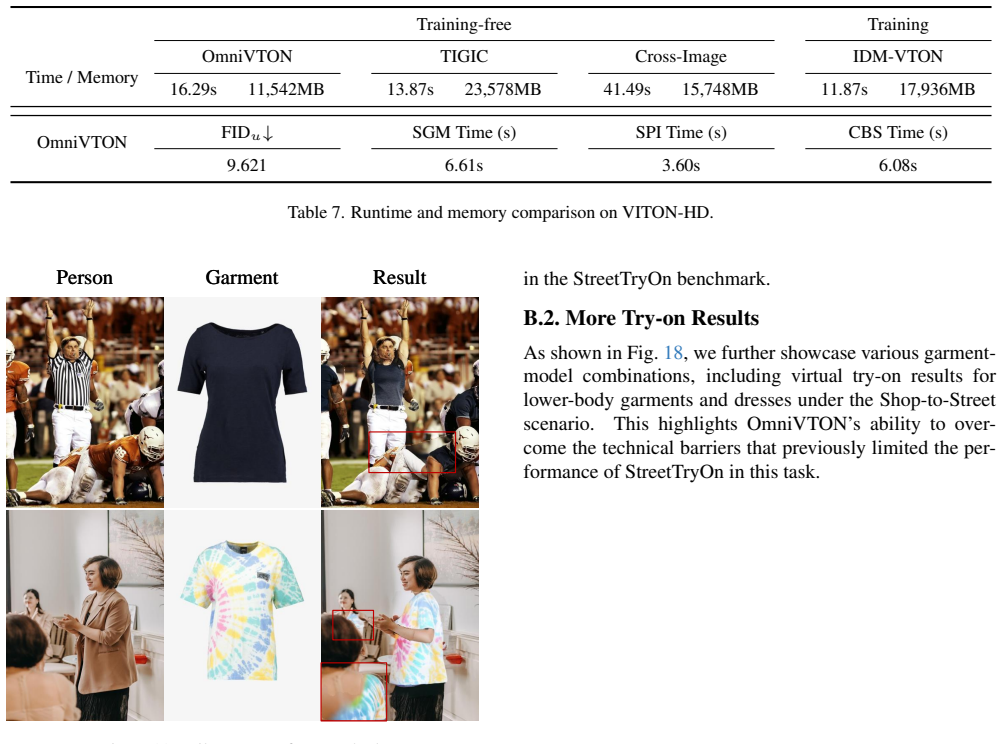
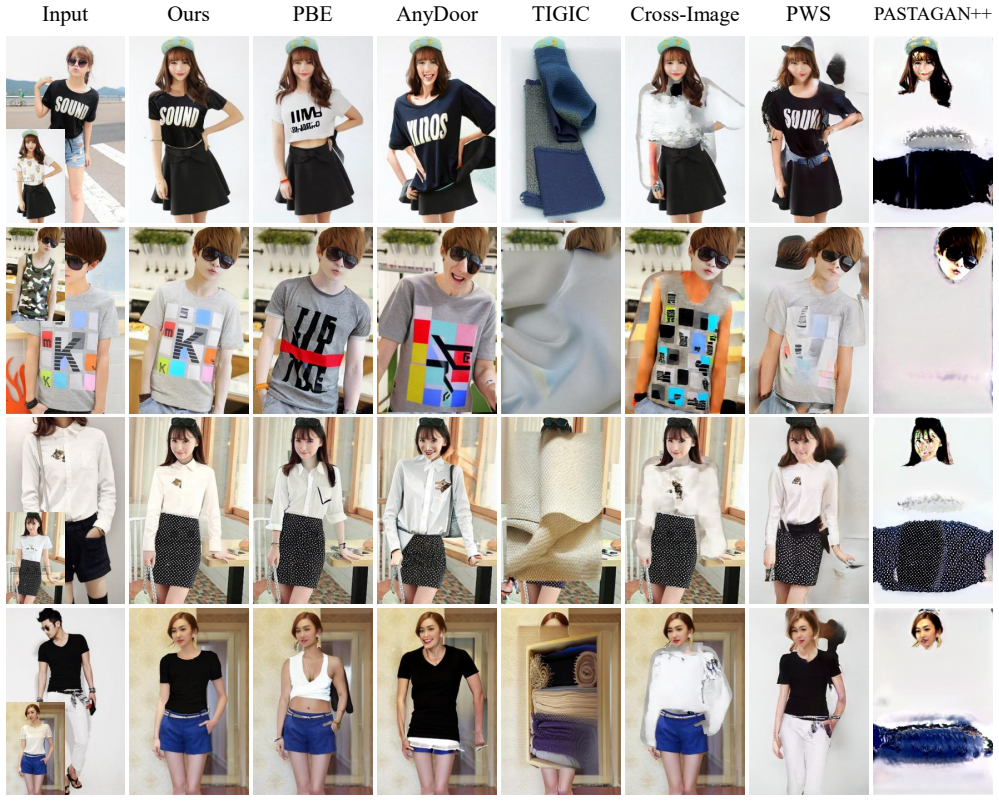
The framework is carried by three modules. Structured Garment Morphing (SGM) generates a pseudo-person wearing the target garment, fragments both the pseudo-person and the target into semantic parts using OpenPose keypoints and TAPPS part segmentation, and applies a piecewise perspective warp per part, each homography optimized by Levenberg-Marquardt. Spectral Pose Injection (SPI) takes the DDIM inversion noise of the target, decomposes it with the Fast Fourier Transform, preserves the low-frequency band that encodes body structure through a Gaussian mask with cutoff $ au = 0.1$, and mixes in random high-frequency noise so the target's original clothing texture does not contaminate the generated garment. Continuous Boundary Stitching (CBS) modifies self-attention so that the garment image path and the garment-infused image path exchange keys and values bidirectionally, smoothing the seams left by multi-region morphing during the inpainting stage. Each module contributes a measurable gain in the ablation study, and the full system reaches FID$_u$ 9.621 on VITON-HD.
What would settle it
Run the pipeline on a test set dominated by crowded group photos or targets with heavily occluded limbs, where OpenPose and TAPPS misdetect parts, and check whether garment misalignment appears exactly where the detectors err. A quantitative version is to compare SGM's warped-garment mask against manual parsing on such a corpus and observe whether FID and LPIPS collapse as the detector error rate rises.
Extended reading notes
Core claim
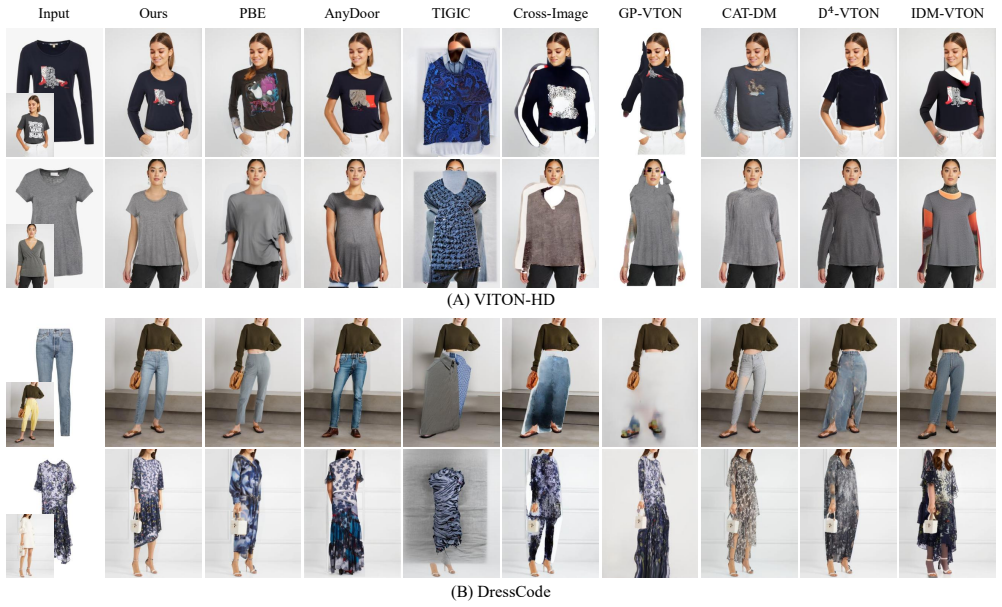
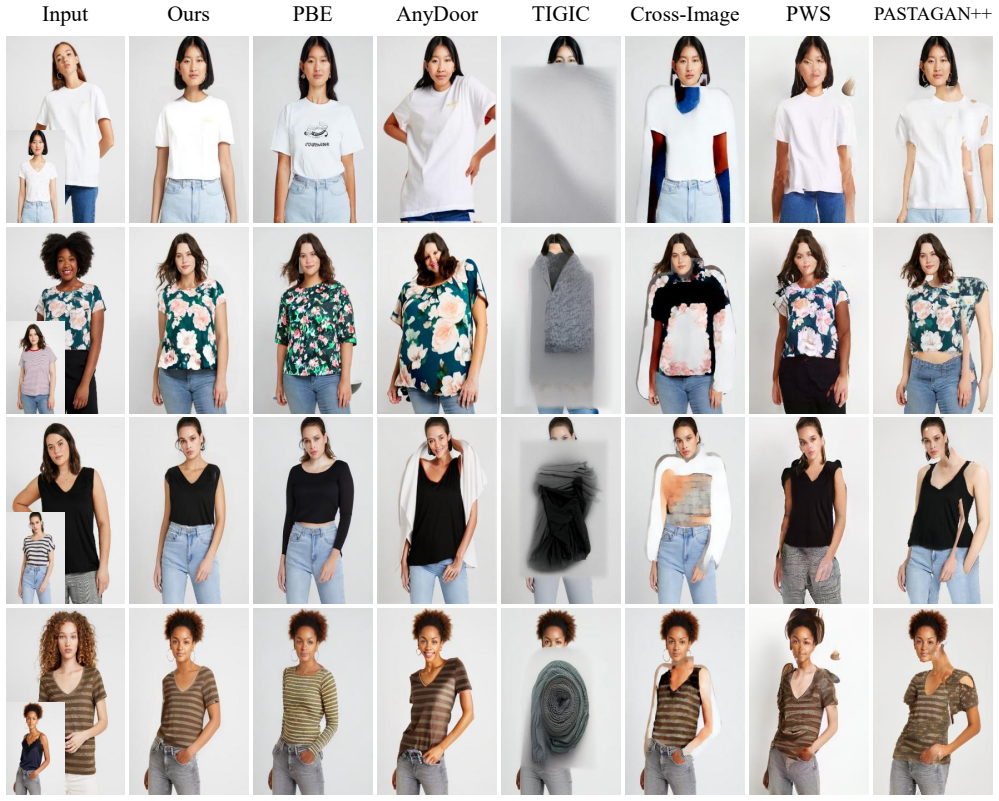
OmniVTON's central claim is that garment fidelity and pose fidelity are conflicting conditions for a diffusion model, and that decoupling them removes the bias that arises when a diffusion model must handle both simultaneously. Garment fidelity is achieved geometrically: a pseudo-person image is generated from the garment, then the pseudo-person and target are split into semantic regions using skeleton keypoints and part segmentation, and each region is warped with its own optimized homography. Pose fidelity is achieved spectrally: the target person is inverted into noise with DDIM inversion, the noise is split by frequency with the Fourier transform, and only the low-frequency band that carries pose is kept, while high-frequency texture is replaced with random noise. The paper reports that this combination outperforms both exemplar-based editing methods and scenario-trained try-on models across three benchmarks, and that the same mechanisms extend to multi-human scenes by concatenating garment images and generating several pseudo-persons at once.
Load-bearing premise
The method depends on OpenPose and TAPPS giving trustworthy skeleton keypoints and part segmentation for both the pseudo-person and the target, and when those fail, in crowded scenes or with barely visible bodies, the multi-part warping and pose injection break down, as the paper's own supplementary failure cases show.
Editorial extensions
If this is right
- A virtual try-on deployment can run with an off-the-shelf diffusion model plus pretrained keypoint and parsing models, with no domain-specific training data.
- The frequency-split inversion recipe is a general way to borrow pose or structure from a source image while letting texture be regenerated freely.
- Multi-human try-on becomes possible in one pass, enabling group outfits and coordinated garments in a single scene.
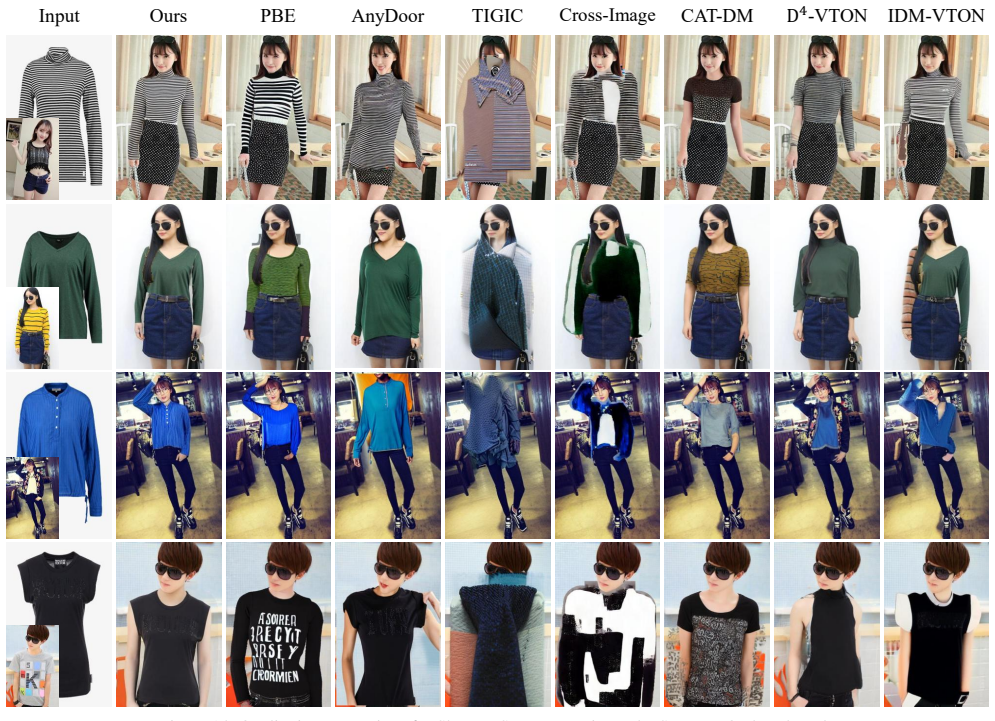
- The same pipeline handles Shop-to-Street, Model-to-Model, Model-to-Street, and Street-to-Street scenarios without retraining, which the paper verifies on the StreetTryOn benchmark.
- Each of the three modules is shown, by ablation, to improve fidelity or pose alignment separately, so the components can be adopted or replaced independently.
Reading between the lines
- The method's universal-scenario claim is bounded by the reliability of OpenPose and TAPPS: as those detectors improve, the same framework should scale without modification, which the paper's own failure cases support.
- The spectral pose-injection idea could generalize beyond try-on to any diffusion task where a structural cue must be transferred without carrying source texture, such as face reenactment or pose-guided generation.
- Because the mechanisms are defined at the attention and noise level rather than tied to a specific checkpoint, they could plausibly be ported to newer base diffusion models than Stable Diffusion v2.
- A direct stress test of the paper's reasoning would be to swap the fixed $ au = 0.1$ cutoff for an adaptive one estimated per image, which the sensitivity analysis suggests could trade a little FID for better SSIM.
Editorial analysis
A structured set of objections, weighed in public.
Referee Report
Summary. This paper introduces OmniVTON, a training-free virtual try-on framework that combines three modules: Structured Garment Morphing (pseudo-person image generation, multi-part semantic correspondence, and localized homographic warping), Spectral Pose Injection (frequency-domain fusion of DDIM inversion noise with random noise), and Continuous Boundary Stitching (cross-attention modulation between garment and inpainted image paths). The authors report state-of-the-art results on VITON-HD, DressCode, and StreetTryOn, and claim the first multi-human try-on capability. The paper includes module ablations, a user study, runtime measurements, and a supplementary sensitivity analysis.
Significance. The training-free design is a meaningful practical contribution: it removes the need for per-dataset retraining, and the ablations provide support for each module. The code release and the supplementary failure-case discussion are strengths. However, the headline SOTA claim rests on a cross-dataset baseline protocol, and the multi-human and quantitative-superiority claims are not yet fully supported; these issues are load-bearing for the paper's central claims.
major comments (4)
- [§4.2, Tables 1–3] The numerical comparisons in Tables 1–3 are run under a cross-dataset checkpoint protocol: VITON-HD baselines use DressCode-pretrained checkpoints, DressCode baselines use VITON-HD-pretrained checkpoints, and StreetTryOn baselines are either VITON-HD-trained or taken from the original paper. This measures zero-shot cross-domain generalization rather than in-domain state of the art. Because the abstract and contribution list claim unconditional state-of-the-art performance, the authors should either re-run the baselines with in-domain checkpoints or explicitly reframe the claims as cross-domain generalization results; otherwise the reported margins (e.g., IDM-VTON's FID_u of 23.035 on VITON-HD) may not reflect the methods' actual capabilities.
- [Supplementary §A.3, Table 6] The cutoff frequency τ of the Gaussian mask in Eq. (5) is selected by sweeping on VITON-HD, and the final VITON-HD numbers in Table 1 are reported with the same τ=0.1. Since the sweep and the final evaluation share the same test set, the reported FID_u 9.621 may reflect selection on the test set. Please use a validation split or fix τ a priori.
- [Tables 1–4] All quantitative results are reported as point estimates from a single evaluation run, with no error bars or significance testing. The claimed LPIPS advantage over IDM-VTON on VITON-HD is 0.145 versus 0.147, which is 0.002 and may be within run-to-run or split variation. The authors should provide multiple runs or bootstrap confidence intervals for the main comparisons.
- [§4.4, supplementary Fig. 11] The multi-human try-on capability is presented only as a qualitative demonstration with no quantitative metrics, baselines, or protocol. The supplementary failure cases simultaneously show that high-density crowds and small target body regions lead to garment misalignment. The claim of being 'the first framework capable of multi-human VTON' should be either supported by a dedicated evaluation or softened to a qualitative demonstration.
minor comments (6)
- [Table 4 caption] The word 'Spectual' in the caption should be 'Spectral'.
- [§3.1] The heading 'Pesudo-Person Image Generation' contains a typo and should read 'Pseudo-Person Image Generation'.
- [Eq. (3)] Equation (3) uses a fixed sum over five regions, whereas Section A.1 describes two-region processing for dresses and five-region processing for upper and lower garments; the notation should be generalized (e.g., to N regions).
- [Eq. (7)] The notation 'Vc·↓Mc' is ambiguous; please use an explicit element-wise product symbol such as ⊙ and define the downsampling operation.
- [Figure 2 caption] The caption contains garbled symbols such as 'σ × ×,'; this appears to be a typesetting error and should be fixed.
- [Table 3] The table should state in a footnote that the StreetTryOn numbers are copied from the original paper rather than re-evaluated in the same pipeline as the other baselines.
Circularity Check
No significant circularity: the pipeline is an engineered system validated against external benchmarks, and no predicted quantity reduces to a fitted input or self-cited theorem.
full rationale
OmniVTON is a training-free, modular pipeline whose components (SGM, CBS, SPI) are defined constructively in Section 3 and validated in Table 4 and the supplementary ablations against external metrics (FID_u, FID_p, SSIM, LPIPS) on VITON-HD, DressCode, and the StreetTryOn benchmark. The claimed state-of-the-art results are empirical comparisons, not derivations from the paper's own premises. The only tuning choice, the Gaussian cutoff frequency tau, is selected via sensitivity analysis in Table 6 on VITON-HD and then reused for the reported VITON-HD numbers; this is a model-selection or evaluation-leakage concern, not circularity, because the reported FID/SSIM/LPIPS values are measured on test pairs rather than being equivalent by construction to the selected parameter. The comparison protocols in Tables 1-3 use cross-dataset checkpoints for baselines, which may weaken the unconditional 'state-of-the-art' claim, but that is a benchmark-protocol concern rather than a circular-derivation concern. The paper also candidly states its limitations in Section 5 and the supplementary failure cases, acknowledging reliance on OpenPose and TAPPS, which further indicates that the method is evaluated rather than assumed. No load-bearing self-citation or imported uniqueness theorem appears: the D4-VTON baseline shares authors with this paper but is used only as a comparison method, and StreetTryOn results are taken from the original paper. Overall, the derivation chain is self-contained with respect to the external benchmarks, so no circular step is present.
Assumptions & free parameters
free parameters (2)
- Gaussian mask cutoff tau =
0.1
- Number of semantic regions in SGM =
5 for upper/lower, 2 for dresses
assumptions (5)
- domain assumption OpenPose 25-keypoint detection is reliable on pseudo-person and target person images.
- domain assumption TAPPS part segmentation accurately separates semantic regions (torso, arms, legs, etc.).
- domain assumption Low-frequency components of DDIM inversion noise encode pose while high-frequency components encode texture.
- domain assumption Piecewise homography transformations rather than dense flow are sufficient to align garment regions to the body.
- domain assumption Stable Diffusion v2 can perform garment-infused inpainting given concatenated conditions.
Cite this review
Pith. "Pith review of OmniVTON: Training-Free Universal Virtual Try-On." pith.science (2026). https://pith.science/paper/VLP4FGYW
@misc{pith2026250715037,
  author       = {Pith},
  title        = {Pith review of: OmniVTON: Training-Free Universal Virtual Try-On},
  year         = {2026},
  howpublished = {\url{https://pith.science/paper/VLP4FGYW}},
  note         = {Machine review of arXiv:2507.15037}
}
read the original abstract
Image-based Virtual Try-On (VTON) techniques rely on either supervised in-shop approaches, which ensure high fidelity but struggle with cross-domain generalization, or unsupervised in-the-wild methods, which improve adaptability but remain constrained by data biases and limited universality. A unified, training-free solution that works across both scenarios remains an open challenge. We propose OmniVTON, the first training-free universal VTON framework that decouples garment and pose conditioning to achieve both texture fidelity and pose consistency across diverse settings. To preserve garment details, we introduce a garment prior generation mechanism that aligns clothing with the body, followed by continuous boundary stitching technique to achieve fine-grained texture retention. For precise pose alignment, we utilize DDIM inversion to capture structural cues while suppressing texture interference, ensuring accurate body alignment independent of the original image textures. By disentangling garment and pose constraints, OmniVTON eliminates the bias inherent in diffusion models when handling multiple conditions simultaneously. Experimental results demonstrate that OmniVTON achieves superior performance across diverse datasets, garment types, and application scenarios. Notably, it is the first framework capable of multi-human VTON, enabling realistic garment transfer across multiple individuals in a single scene. Code is available at https://github.com/Jerome-Young/OmniVTON
Figures


Figures from the paper (14 more)






Forward citations
Cited by 1 Pith paper
-
Structure-Detail Decoupled Autoregressive Generation for Fast and High-Fidelity Virtual Try-On
STAR-VTON decouples latent VAR structure synthesis from pixel-space matching-based detail recovery, yielding faster high-fidelity virtual try-on than diffusion baselines.
Reference graph
Works this paper leans on
-
[1]
Cross-image attention for zero- shot appearance transfer
Yuval Alaluf, Daniel Garibi, Or Patashnik, Hadar Averbuch- Elor, and Daniel Cohen-Or. Cross-image attention for zero- shot appearance transfer. In ACM SIGGRAPH, pages 1–12,
-
[2]
Pose with style: Detail- preserving pose-guided image synthesis with conditional stylegan
Badour AlBahar, Jingwan Lu, Jimei Yang, Zhixin Shu, Eli Shechtman, and Jia-Bin Huang. Pose with style: Detail- preserving pose-guided image synthesis with conditional stylegan. ACM TOG, 40(6):1–11, 2021. 5, 6
work page 2021
-
[3]
Moab Arar, Rinon Gal, Yuval Atzmon, Gal Chechik, Daniel Cohen-Or, Ariel Shamir, and Amit H. Bermano. Domain- agnostic tuning-encoder for fast personalization of text-to- image models. In SIGGRAPH Asia, pages 1–10, 2023. 3
work page 2023
- [4]
-
[5]
Realtime multi-person 2d pose estimation using part affinity fields
Zhe Cao, Tomas Simon, Shih-En Wei, and Yaser Sheikh. Realtime multi-person 2d pose estimation using part affinity fields. In CVPR, pages 7291–7299, 2017. 2, 4
work page 2017
-
[6]
Wear-any-way: Manip- ulable virtual try-on via sparse correspondence alignment
Mengting Chen, Xi Chen, Zhonghua Zhai, Chen Ju, Xuewen Hong, Jinsong Lan, and Shuai Xiao. Wear-any-way: Manip- ulable virtual try-on via sparse correspondence alignment. In ECCV, pages 124–142. Springer, 2024. 3
work page 2024
-
[7]
Anydoor: Zero-shot object-level im- age customization
Xi Chen, Lianghua Huang, Yu Liu, Yujun Shen, Deli Zhao, and Hengshuang Zhao. Anydoor: Zero-shot object-level im- age customization. In CVPR, pages 6593–6602, 2024. 3, 5, 6
work page 2024
-
[8]
Viton-hd: High-resolution virtual try-on via misalignment-aware normalization
Seunghwan Choi, Sunghyun Park, Minsoo Lee, and Jaegul Choo. Viton-hd: High-resolution virtual try-on via misalignment-aware normalization. In CVPR, pages 14131– 14140, 2021. 2, 3, 5, 6, 7, 8, 12
work page 2021
Show all 48 references
-
[9]
Improving diffusion models for au- thentic virtual try-on in the wild
Yisol Choi, Sangkyung Kwak, Kyungmin Lee, Hyungwon Choi, and Jinwoo Shin. Improving diffusion models for au- thentic virtual try-on in the wild. In ECCV, pages 206–235. Springer, 2024. 3, 5, 6
2024
-
[10]
Learn- ing garment densepose for robust warping in virtual try-on
Aiyu Cui, Sen He, Tao Xiang, and Antoine Toisoul. Learn- ing garment densepose for robust warping in virtual try-on. arXiv preprint arXiv:2303.17688, 2023. 6
2023 arXiv
-
[11]
Street tryon: Learning in-the-wild virtual try-on from unpaired person images
Aiyu Cui, Jay Mahajan, Viraj Shah, Preeti Gomathinayagam, Chang Liu, and Svetlana Lazebnik. Street tryon: Learning in-the-wild virtual try-on from unpaired person images. In WACV, pages 8235–8239, 2025. 2, 5, 6, 7, 12
2025
-
[12]
Task-aligned part-aware panoptic segmentation through joint object-part representa- tions
Daan De Geus and Gijs Dubbelman. Task-aligned part-aware panoptic segmentation through joint object-part representa- tions. In CVPR, pages 3174–3183, 2024. 4
2024
-
[13]
An image is worth one word: Personalizing text-to- image generation using textual inversion
Rinon Gal, Yuval Alaluf, Yuval Atzmon, Or Patash- nik, Amit H Bermano, Gal Chechik, and Daniel Cohen- Or. An image is worth one word: Personalizing text-to- image generation using textual inversion. arXiv preprint arXiv:2208.01618, 2022. 3
2022 arXiv
-
[14]
The levenberg-marquardt algorithm for non- linear least squares curve-fitting problems
Henri P Gavin. The levenberg-marquardt algorithm for non- linear least squares curve-fitting problems. Department of Civil and Environmental Engineering Duke University Au- gust, 3:1–23, 2019. 4
2019
-
[15]
Deepfashion2: A versatile benchmark for de- tection, pose estimation, segmentation and re-identification of clothing images
Yuying Ge, Ruimao Zhang, Xiaogang Wang, Xiaoou Tang, and Ping Luo. Deepfashion2: A versatile benchmark for de- tection, pose estimation, segmentation and re-identification of clothing images. In CVPR, pages 5337–5345, 2019. 5
2019
-
[16]
Generative adversarial nets
Ian Goodfellow, Jean Pouget-Abadie, Mehdi Mirza, Bing Xu, David Warde-Farley, Sherjil Ozair, Aaron Courville, and Yoshua Bengio. Generative adversarial nets. In NeurIPS,
-
[17]
Taming the power of diffusion models for high-quality virtual try-on with appearance flow
Junhong Gou, Siyu Sun, Jianfu Zhang, Jianlou Si, Chen Qian, and Liqing Zhang. Taming the power of diffusion models for high-quality virtual try-on with appearance flow. In ACM MM, pages 7599–7607, 2023. 2
2023
-
[18]
Densepose: Dense human pose estimation in the wild
Rıza Alp G ¨uler, Natalia Neverova, and Iasonas Kokkinos. Densepose: Dense human pose estimation in the wild. In CVPR, pages 7297–7306, 2018. 2
2018
-
[19]
Viton: An image-based virtual try-on network
Xintong Han, Zuxuan Wu, Zhe Wu, Ruichi Yu, and Larry S Davis. Viton: An image-based virtual try-on network. In CVPR, pages 7543–7552, 2018. 2
2018
-
[20]
Clothflow: A flow-based model for clothed person generation
Xintong Han, Xiaojun Hu, Weilin Huang, and Matthew R Scott. Clothflow: A flow-based model for clothed person generation. In ICCV, pages 10471–10480, 2019. 2
2019
-
[21]
Emma: Your text-to-image diffusion model can secretly accept multi-modal prompts
Yucheng Han, Rui Wang, Chi Zhang, Juntao Hu, Pei Cheng, Bin Fu, and Hanwang Zhang. Emma: Your text-to-image diffusion model can secretly accept multi-modal prompts. arXiv preprint arXiv:2406.09162, 2024. 4
2024 arXiv
-
[22]
Style-based global appearance flow for virtual try-on
Sen He, Yi-Zhe Song, and Tao Xiang. Style-based global appearance flow for virtual try-on. In CVPR, pages 3470– 3479, 2022. 2
2022
-
[23]
Brushnet: A plug-and-play image inpainting model with decomposed dual-branch diffusion
Xuan Ju, Xian Liu, Xintao Wang, Yuxuan Bian, Ying Shan, and Qiang Xu. Brushnet: A plug-and-play image inpainting model with decomposed dual-branch diffusion. In ECCV, pages 150–168. Springer, 2024. 3
2024
-
[24]
Stableviton: Learning semantic corre- spondence with latent diffusion model for virtual try-on
Jeongho Kim, Guojung Gu, Minho Park, Sunghyun Park, and Jaegul Choo. Stableviton: Learning semantic corre- spondence with latent diffusion model for virtual try-on. In CVPR, pages 8176–8185, 2024. 3
2024
-
[25]
Segment any- thing
Alexander Kirillov, Eric Mintun, Nikhila Ravi, Hanzi Mao, Chloe Rolland, Laura Gustafson, Tete Xiao, Spencer White- head, Alexander C Berg, Wan-Yen Lo, et al. Segment any- thing. In ICCV, pages 4015–4026, 2023. 11
2023
-
[26]
High-resolution virtual try-on with misalignment and occlusion-handled conditions
Sangyun Lee, Gyojung Gu, Sunghyun Park, Seunghwan Choi, and Jaegul Choo. High-resolution virtual try-on with misalignment and occlusion-handled conditions. In ECCV, pages 204–219. Springer, 2022. 2
2022
-
[27]
Tuning-free image customization with image and text guidance
Pengzhi Li, Qiang Nie, Ying Chen, Xi Jiang, Kai Wu, Yuhuan Lin, Yong Liu, Jinlong Peng, Chengjie Wang, and Feng Zheng. Tuning-free image customization with image and text guidance. In ECCV, pages 233–250. Springer, 2024. 3, 5, 6
2024
-
[28]
Deepfashion: Powering robust clothes recognition and retrieval with rich annotations
Ziwei Liu, Ping Luo, Shi Qiu, Xiaogang Wang, and Xiaoou Tang. Deepfashion: Powering robust clothes recognition and retrieval with rich annotations. In CVPR, pages 1096–1104,
-
[29]
Dress code: High- resolution multi-category virtual try-on
Davide Morelli, Matteo Fincato, Marcella Cornia, Federico Landi, Fabio Cesari, and Rita Cucchiara. Dress code: High- resolution multi-category virtual try-on. In CVPR, pages 2231–2235, 2022. 5, 6, 7, 12
2022
-
[30]
Ladi-vton: Latent diffusion textual-inversion enhanced virtual try-on
Davide Morelli, Alberto Baldrati, Giuseppe Cartella, Mar- cella Cornia, Marco Bertini, and Rita Cucchiara. Ladi-vton: Latent diffusion textual-inversion enhanced virtual try-on. In ACM MM, pages 8580–8589, 2023. 3
2023
-
[31]
On aliased resizing and surprising subtleties in gan evaluation
Gaurav Parmar, Richard Zhang, and Jun-Yan Zhu. On aliased resizing and surprising subtleties in gan evaluation. In CVPR, pages 11410–11420, 2022. 6
2022
-
[32]
Clip-interrogator
pharmapsychotic. Clip-interrogator. https://github. com / pharmapsychotic / clip - interrogator ,
-
[33]
High-resolution image syn- thesis with latent diffusion models
Robin Rombach, Andreas Blattmann, Dominik Lorenz, Patrick Esser, and Bj¨orn Ommer. High-resolution image syn- thesis with latent diffusion models. In CVPR, pages 10684– 10695, 2022. 11
2022
-
[34]
U-net: Convolutional networks for biomedical image segmentation
Olaf Ronneberger, Philipp Fischer, and Thomas Brox. U-net: Convolutional networks for biomedical image segmentation. In MICCAI, pages 234–241. Springer, 2015. 3
2015
-
[35]
Denois- ing diffusion implicit models
Jiaming Song, Chenlin Meng, and Stefano Ermon. Denois- ing diffusion implicit models. ICLR, 2020. 2, 4
2020
-
[36]
Key-locked rank one editing for text-to-image personaliza- tion
Yoad Tewel, Rinon Gal, Gal Chechik, and Yuval Atzmon. Key-locked rank one editing for text-to-image personaliza- tion. In ACM SIGGRAPH, pages 1–11, 2023. 4
2023
-
[37]
Image quality assessment: from error visibility to structural similarity
Zhou Wang, Alan C Bovik, Hamid R Sheikh, and Eero P Simoncelli. Image quality assessment: from error visibility to structural similarity. IEEE TIP, 13(4):600–612, 2004. 6
2004
-
[38]
Towards scalable unpaired virtual try-on via patch-routed spatially- adaptive gan
Zhenyu Xie, Zaiyu Huang, Fuwei Zhao, Haoye Dong, Michael Kampffmeyer, and Xiaodan Liang. Towards scalable unpaired virtual try-on via patch-routed spatially- adaptive gan. NeurIPS, 34:2598–2610, 2021. 5, 6
2021
-
[39]
Pasta-gan++: A versatile framework for high-resolution unpaired virtual try-on
Zhenyu Xie, Zaiyu Huang, Fuwei Zhao, Haoye Dong, Michael Kampffmeyer, Xin Dong, Feida Zhu, and Xi- aodan Liang. Pasta-gan++: A versatile framework for high-resolution unpaired virtual try-on. arXiv preprint arXiv:2207.13475, 2022. 2, 5, 6
2022 arXiv
-
[40]
Gp- vton: Towards general purpose virtual try-on via collabo- rative local-flow global-parsing learning
Zhenyu Xie, Zaiyu Huang, Xin Dong, Fuwei Zhao, Haoye Dong, Xijin Zhang, Feida Zhu, and Xiaodan Liang. Gp- vton: Towards general purpose virtual try-on via collabo- rative local-flow global-parsing learning. In CVPR, pages 23550–23559, 2023. 2, 3, 5, 6
2023
-
[41]
Oot- diffusion: Outfitting fusion based latent diffusion for control- lable virtual try-on
Yuhao Xu, Tao Gu, Weifeng Chen, and Chengcai Chen. Oot- diffusion: Outfitting fusion based latent diffusion for control- lable virtual try-on. arXiv preprint arXiv:2403.01779, 2024. 2, 3
2024 arXiv
-
[42]
Paint by example: Exemplar-based image editing with diffusion mod- els
Binxin Yang, Shuyang Gu, Bo Zhang, Ting Zhang, Xuejin Chen, Xiaoyan Sun, Dong Chen, and Fang Wen. Paint by example: Exemplar-based image editing with diffusion mod- els. In CVPR, pages 18381–18391, 2023. 3, 5, 6
2023
-
[43]
D 4-vton: Dynamic semantics disentangling for differential diffusion based virtual try-on
Zhaotong Yang, Zicheng Jiang, Xinzhe Li, Huiyu Zhou, Junyu Dong, Huaidong Zhang, and Yong Du. D 4-vton: Dynamic semantics disentangling for differential diffusion based virtual try-on. In ECCV, pages 36–52. Springer, 2024. 2, 5, 6
2024
-
[44]
Cat-dm: Controllable acceler- ated virtual try-on with diffusion model
Jianhao Zeng, Dan Song, Weizhi Nie, Hongshuo Tian, Tong- tong Wang, and An-An Liu. Cat-dm: Controllable acceler- ated virtual try-on with diffusion model. In CVPR, pages 8372–8382, 2024. 3, 5, 6
2024
-
[45]
Adding conditional control to text-to-image diffusion models
Lvmin Zhang, Anyi Rao, and Maneesh Agrawala. Adding conditional control to text-to-image diffusion models. In ICCV, pages 3836–3847, 2023. 12
2023
-
[46]
The unreasonable effectiveness of deep features as a perceptual metric
Richard Zhang, Phillip Isola, Alexei A Efros, Eli Shechtman, and Oliver Wang. The unreasonable effectiveness of deep features as a perceptual metric. In CVPR, pages 586–595,
-
[47]
View synthesis by appearance flow
Tinghui Zhou, Shubham Tulsiani, Weilun Sun, Jitendra Ma- lik, and Alexei A Efros. View synthesis by appearance flow. In ECCV, pages 286–301. Springer, 2016. 2
2016
-
[48]
a person wearing an upper garment
Junhao Zhuang, Yanhong Zeng, Wenran Liu, Chun Yuan, and Kai Chen. A task is worth one word: Learning with task prompts for high-quality versatile image inpainting. In ECCV, pages 195–211. Springer, 2024. 3 OmniVTON: Training-Free Universal Virtual Try-On Supplementary Material...
2024
Reviewed August 6, 2026 · model on record in the stance chip above.
Discussion (0). Sign in to comment.