Reconfigurable Antenna Arrays With Tunable Loads: Expanding Solution Space via Coupling Control
Pith reviewed 2026-05-19 03:51 UTC · model grok-4.3
The pith
Tunable loads on reconfigurable antennas let elements sit at any spacing by exploiting or canceling mutual coupling, unlocking far more array configurations.
A machine-rendered reading of the paper's core claim, the machinery that carries it, and where it could break.
Core claim
The central claim is that placing tunable loads on passive reconfigurable antennas surrounding a limited number of active ones exploits mutual coupling to increase array gain, while tunable loads on every element in an all-active array eliminate coupling in the analog domain; both approaches permit arbitrary inter-element spacing and therefore the full solution space, which is searched efficiently by port selection algorithms so that loading values can be optimized to maximize sum rate under transmit power constraints in a multiple-input single-output broadcast channel.
What carries the argument
Tunable analog loads attached to reconfigurable antenna elements that either exploit or suppress mutual coupling to remove spacing constraints.
If this is right
- Fewer active elements suffice when surrounded by passive loaded antennas that still deliver array gain.
- Port selection algorithms scale to search spaces larger than 10 to the 20 configurations.
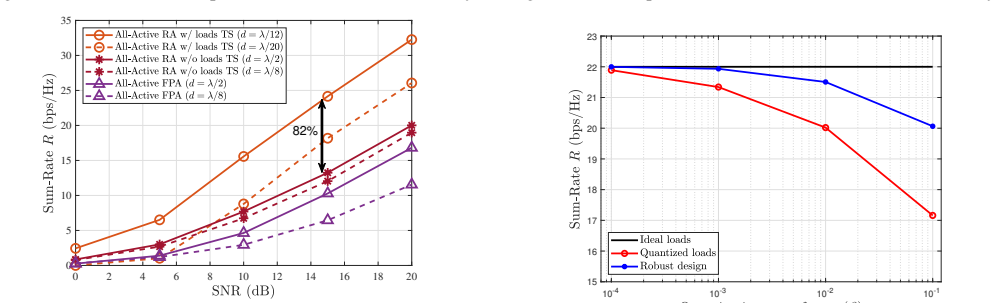
- Robust designs for quantized loads recover approximately 60 percent of the ideal sum-rate performance.
- Sum-rate improvements of 20 to 56 percent appear relative to conventional benchmarks that enforce half-wavelength spacing.
Where Pith is reading between the lines
- The coupling-control approach may extend directly to full MIMO settings or to metasurface-based surfaces where similar interaction effects occur.
- Practical hardware tests would need to check how tuning speed and power consumption of the loads affect overall system efficiency.
- The far-field assumption could be relaxed by incorporating near-field channel models common in high-frequency indoor deployments.
Load-bearing premise
The reported performance gains rest on optimizing loads under a heuristic linear precoder with perfect channel state information and a standard far-field propagation model.
What would settle it
Re-running the load and port optimization with an optimal precoder or with measured channels that include near-field effects would show whether the sum-rate gains hold.
Figures


read the original abstract
The emerging reconfigurable antenna (RA) array technology promises capacity enhancement through dynamic antenna positioning. Traditional approaches enforce half-wavelength or greater spacing among RA elements to avoid mutual coupling, limiting the solution space. Additionally, achieving sufficient spatial channel sampling requires numerous discrete RA positions (ports), while high-frequency scenarios with hybrid processing demand many physical RAs to maintain array gains. This leads to exponential growth in the solution space. In this work, we propose two techniques to address the former challenge: (1) surrounding a limited number of active RAs with passive ones terminated to tunable analog loads to \textit{exploit} mutual coupling and increase array gain, and (2) employing tunable loads on each RA in an all-active design to \textit{eliminate} mutual coupling in the analog domain. Both methods enable arbitrary RA spacing, unlocking the full solution space. Regarding the latter challenge, we develop greedy and meta-heuristic port selection algorithms, alongside low-complexity heuristic variants, that efficiently handle over $10^{20}$ array configurations. Furthermore, we optimize the loading values to maximize the sum-rate in a multiple-input single-output broadcast channel under transmission power constraints, assuming a heuristic linear precoder. In addition, we analyze performance degradation from quantized loads and propose corresponding robust designs. Numerical simulations reveal 20-56\% sum-rate gains over benchmarks and around 60\% performance recovery under quantization errors.
Editorial analysis
A structured set of objections, weighed in public.
Referee Report
Summary. The manuscript proposes two techniques for reconfigurable antenna (RA) arrays: surrounding limited active RAs with passive ones terminated in tunable loads to exploit mutual coupling, and using tunable loads on all-active RAs to eliminate coupling in the analog domain. Both approaches permit arbitrary element spacing. The work develops greedy and meta-heuristic port-selection algorithms (plus low-complexity variants) to navigate >10^20 configurations, optimizes load values to maximize sum-rate in a MISO broadcast channel under power constraints with a heuristic linear precoder, and analyzes performance under load quantization. Simulations report 20-56% sum-rate gains over benchmarks and ~60% recovery under quantization.
Significance. If the modeling assumptions hold, the contribution meaningfully enlarges the feasible design space for RA arrays by removing half-wavelength spacing constraints and supplying scalable algorithms for enormous configuration spaces. The numerical gains and quantization-robustness analysis indicate practical utility for high-frequency hybrid systems. Strengths include explicit handling of exponential search spaces and direct sum-rate optimization under realistic power constraints.
major comments (2)
- [Abstract and §IV] Abstract and §IV: the reported 20-56% sum-rate gains are obtained by jointly optimizing tunable loads and port selection to maximize sum-rate under a fixed heuristic linear precoder, with all benchmarks evaluated using the identical precoder. No comparison to stronger precoders (e.g., WMMSE or dirty-paper coding) is provided, so it remains unclear whether the gains are intrinsic to the coupling-control methods or artifacts of the chosen precoder’s sub-optimality surface.
- [Channel-model section] Channel-model section: the effective channel matrices are generated under a standard far-field plane-wave model. No verification or sensitivity study is included for near-field propagation or rich-scattering environments, both of which would modify the coupling matrix and the precoder’s behavior, potentially altering the claimed performance improvements.
minor comments (1)
- [Abstract] Abstract: the phrase “around 60% performance recovery under quantization errors” does not specify the quantization bit levels or the precise recovery metric (e.g., relative to unquantized sum-rate).
Simulated Author's Rebuttal
We thank the referee for the constructive comments and positive assessment of the significance of our work. We address each major comment point by point below, indicating the revisions we will incorporate.
read point-by-point responses
-
Referee: [Abstract and §IV] Abstract and §IV: the reported 20-56% sum-rate gains are obtained by jointly optimizing tunable loads and port selection to maximize sum-rate under a fixed heuristic linear precoder, with all benchmarks evaluated using the identical precoder. No comparison to stronger precoders (e.g., WMMSE or dirty-paper coding) is provided, so it remains unclear whether the gains are intrinsic to the coupling-control methods or artifacts of the chosen precoder’s sub-optimality surface.
Authors: We appreciate this observation. The manuscript deliberately fixes the same heuristic linear precoder for the proposed configurations and all benchmarks to isolate the sum-rate improvements attributable to the tunable-load coupling control and port-selection algorithms. This controlled setting ensures that reported relative gains (20-56%) reflect the expanded solution space rather than differences in precoding. We acknowledge that absolute rates could increase further under WMMSE or dirty-paper coding; however, because the precoder remains identical across comparisons, the relative advantage of the proposed methods is still meaningful. In the revision we will add explicit clarification of this rationale in Section IV together with a remark that optimal precoding constitutes a natural direction for future work. revision: partial
-
Referee: [Channel-model section] Channel-model section: the effective channel matrices are generated under a standard far-field plane-wave model. No verification or sensitivity study is included for near-field propagation or rich-scattering environments, both of which would modify the coupling matrix and the precoder’s behavior, potentially altering the claimed performance improvements.
Authors: We agree that the far-field plane-wave assumption is a modeling choice. The manuscript adopts this standard model, common in array-antenna studies, to focus on the impact of tunable loads on mutual coupling. We will revise the channel-model section to state the assumption explicitly and to note that near-field propagation or rich scattering could alter the coupling matrix and the observed gains. Extending the framework to these regimes is identified as future work. revision: yes
Circularity Check
No circularity: sum-rate gains are direct numerical outputs of optimization under stated heuristic precoder, not reductions by construction.
full rationale
The paper optimizes loading values and port selection to maximize sum-rate under a fixed heuristic linear precoder and far-field model, then reports gains relative to benchmarks evaluated with the identical precoder. No quoted equations, self-citations, or fitted parameters reduce the reported 20-56% gains to inputs by definition or statistical forcing. The derivation chain consists of standard constrained optimization followed by simulation; results remain independent of any self-referential loop or renamed ansatz. This matches the most common honest finding for simulation-driven papers with explicit modeling assumptions.
Axiom & Free-Parameter Ledger
free parameters (2)
- tunable load impedance values
- number of discrete RA positions
axioms (2)
- domain assumption Standard far-field propagation and mutual coupling matrix model
- domain assumption Heuristic linear precoder is sufficient for performance evaluation
Lean theorems connected to this paper
-
IndisputableMonolith/Cost/FunctionalEquation.leanwashburn_uniqueness_aczel unclear?
unclearRelation between the paper passage and the cited Recognition theorem.
We propose two techniques... (1) surrounding a limited number of active RAs with passive ones terminated to tunable analog loads to exploit mutual coupling... (2) employing tunable loads on each RA in an all-active design to eliminate mutual coupling in the analog domain.
-
IndisputableMonolith/Foundation/RealityFromDistinction.leanreality_from_one_distinction unclear?
unclearRelation between the paper passage and the cited Recognition theorem.
Numerical simulations reveal 20-56% sum-rate gains over benchmarks
What do these tags mean?
- matches
- The paper's claim is directly supported by a theorem in the formal canon.
- supports
- The theorem supports part of the paper's argument, but the paper may add assumptions or extra steps.
- extends
- The paper goes beyond the formal theorem; the theorem is a base layer rather than the whole result.
- uses
- The paper appears to rely on the theorem as machinery.
- contradicts
- The paper's claim conflicts with a theorem or certificate in the canon.
- unclear
- Pith found a possible connection, but the passage is too broad, indirect, or ambiguous to say the theorem truly supports the claim.
Reference graph
Works this paper leans on
-
[1]
A Survey on 5G Usage Scenarios and Traffic Models,
J. Navarro-Ortiz et al. , “A Survey on 5G Usage Scenarios and Traffic Models,” IEEE Commun. Surv. & Tut. , vol. 22, no. 2, pp. 905–929, Secondquarter 2020
work page 2020
-
[2]
5G Requirements and Key Performance Indicator s,
T. Norp, “5G Requirements and Key Performance Indicator s,” J of ICT Standardization, vol. 6, no. 1-2, pp. 15–30, 2018
work page 2018
-
[3]
Massive MI MO Networks: Spectral, Energy, and Hardware Efficiency,
E. Bj¨ ornson, J. Hoydis, and L. Sanguinetti, “Massive MI MO Networks: Spectral, Energy, and Hardware Efficiency,” F oundations and Trends in Signal Process. , vol. 11, no. 3–4, pp. 154–655, 2017
work page 2017
-
[4]
Millimeter-Wave Massive MIMO Communication for Future Wi reless Systems: A Survey,
S. A. Busari, K. M. S. Huq, S. Mumtaz, L. Dai, and J. Rodrigu ez, “Millimeter-Wave Massive MIMO Communication for Future Wi reless Systems: A Survey,” IEEE Commun. Surv. & Tut. , vol. 20, no. 2, pp. 836–869, Secondquarter 2018. Rm,m = η 2π {ln(u) + Ci(u) + 0. 5 sin(u) [Si(2u) − 2 Si(u)] + 0. 5 cos(u) [γ + ln(u/ 2) + Ci(2u) − 2 Ci(u)]} + γη 2π , (42a) Xm,m...
work page 2018
-
[5]
A Survey on Hybrid Beamforming Techniques in 5G: Architecture and System Model Perspectives,
I. Ahmed et al. , “A Survey on Hybrid Beamforming Techniques in 5G: Architecture and System Model Perspectives,” IEEE Commun. Surv. & Tut., vol. 20, no. 4, pp. 3060–3097, Fourthquarter 2018
work page 2018
- [6]
-
[7]
Beamforming with Hybrid Rec on- figurable Parasitic Antenna Arrays,
N. V . Deshpande, M. R. Castellanos, S. R. Khosravirad, J. Du, H. Viswanathan, and R. W. H. Jr, “Beamforming with Hybrid Rec on- figurable Parasitic Antenna Arrays,” arXiv: 2502.17864, 20 25
-
[8]
Beamspace-D omain Analysis of Single-RF Front-End MIMO Systems,
V . I. Barousis, A. G. Kanatas, and A. Kalis, “Beamspace-D omain Analysis of Single-RF Front-End MIMO Systems,” IEEE Trans. V eh. Technol., vol. 60, no. 3, pp. 1195–1199, Mar. 2011
work page 2011
-
[9]
Reconfigurable Orthonormal Basis Patterns Using ESPAR Ant ennas,
P . N. V asileiou, K. Maliatsos, E. D. Thomatos, and A. G. Ka natas, “Reconfigurable Orthonormal Basis Patterns Using ESPAR Ant ennas,” IEEE Antennas Wireless Propag. Lett. , vol. 12, pp. 448–451, 2013
work page 2013
-
[10]
V . I. Barousis and C. B. Papadias, “Arbitrary Precoding with Single- Fed Parasitic Arrays: Closed-Form Expressions and Design G uidelines,” IEEE Wireless Commun. Lett. , vol. 3, no. 2, pp. 229–232, April 2014
work page 2014
-
[11]
A chieving Arbitrary Signals Transmission Using a Single Radio Freque ncy Chain,
L. Zhou, F. A. Khan, T. Ratnarajah, and C. B. Papadias, “A chieving Arbitrary Signals Transmission Using a Single Radio Freque ncy Chain,” IEEE Trans. Commun. , vol. 63, no. 12, pp. 4865–4878, Dec. 2015
work page 2015
-
[12]
MIMO Transmissi on for Single-Fed ESPAR With Quantized Loads,
A. Li, C. Masouros, and C. B. Papadias, “MIMO Transmissi on for Single-Fed ESPAR With Quantized Loads,” IEEE Trans. Commun. , vol. 65, no. 7, pp. 2863–2876, July 2017
work page 2017
-
[13]
Analog–Digita l Beamforming in the MU-MISO Downlink by Use of Tunable Antenna Loads,
A. Li, C. Masouros, and M. Sellathurai, “Analog–Digita l Beamforming in the MU-MISO Downlink by Use of Tunable Antenna Loads,” IEEE Trans. V eh. Technol., vol. 67, no. 4, pp. 3114–3129, April 2018
work page 2018
-
[14]
Mutual coupling exploitation fo r point-to-point MIMO by constructive interference,
A. Li and C. Masouros, “Mutual coupling exploitation fo r point-to-point MIMO by constructive interference,” in IEEE Int. Conf. Commun. (ICC) , May 2017, pp. 1–6
work page 2017
-
[15]
The Ro ad Towards 6G: A Comprehensive Survey,
W. Jiang, B. Han, M. A. Habibi, and H. D. Schotten, “The Ro ad Towards 6G: A Comprehensive Survey,” IEEE Open J. Commun. Soc. , vol. 2, pp. 334–366, 2021
work page 2021
-
[16]
On the Road to 6G: Visions, Requirements, Key Technologies, and Testbeds,
C. Wang et al. , “On the Road to 6G: Visions, Requirements, Key Technologies, and Testbeds,” IEEE Commun. Surv. & Tut., vol. 25, no. 2, pp. 905–974, Secondquarter 2023
work page 2023
-
[17]
A Survey on Green 6G Network: Architecture and Technologies,
T. Huang et al. , “A Survey on Green 6G Network: Architecture and Technologies,” IEEE Access , vol. 7, pp. 175 758–175 768, 2019
work page 2019
-
[18]
A Tutorial on Extremely Large-Scale MIMO for 6G: Fundamentals, Signal Processing, and Applications,
Z. Wang et al. , “A Tutorial on Extremely Large-Scale MIMO for 6G: Fundamentals, Signal Processing, and Applications,” IEEE Commun. Surv. & Tut. , vol. 26, no. 3, pp. 1560–1605, Thirdquarter 2024
work page 2024
-
[19]
T. Gong et al., “Holographic MIMO Communications: Theoretical Foun- dations, Enabling Technologies, and Future Directions,” IEEE Commun. Surv. & Tut. , vol. 26, no. 1, pp. 196–257, Firstquarter 2024
work page 2024
-
[20]
Flexible-Position MIMO for Wireless Communications: Fundamentals, Challenges, and Future Directions,
J. Zheng et al., “Flexible-Position MIMO for Wireless Communications: Fundamentals, Challenges, and Future Directions,” IEEE Wireless Com- mun., vol. 31, no. 5, pp. 18–26, Oct. 2024
work page 2024
-
[21]
Antenna Selection for Improving Energy Efficiency in XL-MI MO Systems,
J. C. Marinello, T. Abr˜ ao, A. Amiri, E. de Carvalho, and P . Popovski, “Antenna Selection for Improving Energy Efficiency in XL-MI MO Systems,” IEEE Trans. V eh. Technol., vol. 69, no. 11, pp. 13 305–13 318, Nov 2020
work page 2020
-
[22]
MIMO Capacity Characteriza tion for Movable Antenna Systems,
W. Ma, L. Zhu, and R. Zhang, “MIMO Capacity Characteriza tion for Movable Antenna Systems,” IEEE Trans. Wireless Commun. , vol. 23, no. 4, pp. 3392–3407, Apr. 2024
work page 2024
-
[23]
Modeling and Performance An alysis for Movable Antenna Enabled Wireless Communications,
L. Zhu, W. Ma, and R. Zhang, “Modeling and Performance An alysis for Movable Antenna Enabled Wireless Communications,” IEEE Trans. Wireless Commun., vol. 23, no. 6, pp. 6234–6250, June 2024
work page 2024
-
[24]
Movable-Antenna En hanced Multiuser Communication via Antenna Position Optimizatio n,
L. Zhu, W. Ma, B. Ning, and R. Zhang, “Movable-Antenna En hanced Multiuser Communication via Antenna Position Optimizatio n,” IEEE Trans. Wireless Commun. , vol. 23, no. 7, pp. 7214–7229, July 2024
work page 2024
-
[25]
K.-K. Wong, A. Shojaeifard, K.-F. Tong, and Y . Zhang, “F luid Antenna Systems,” IEEE Trans. Wireless Commun., vol. 20, no. 3, pp. 1950–1962, Mar. 2021
work page 1950
-
[26]
Fluid Antenna System—Part I: Preliminaries,
K.-K. Wong, W. K. New, X. Hao, K.-F. Tong, and C.-B. Chae, “Fluid Antenna System—Part I: Preliminaries,” IEEE Commun. Lett. , vol. 27, no. 8, pp. 1919–1923, Aug 2023
work page 1919
-
[27]
Fluid Antenna S ystem—Part II: Research Opportunities,
K.-K. Wong, K.-F. Tong, and C.-B. Chae, “Fluid Antenna S ystem—Part II: Research Opportunities,” IEEE Commun. Lett. , vol. 27, no. 8, pp. 1924–1928, Aug 2023
work page 1924
-
[28]
Pe rformance Limits of Fluid Antenna Systems,
K. K. Wong, A. Shojaeifard, K.-F. Tong, and Y . Zhang, “Pe rformance Limits of Fluid Antenna Systems,” IEEE Commun. Lett. , vol. 24, no. 11, pp. 2469–2472, Nov 2020
work page 2020
-
[29]
Fluid Antenna Multiple Acce ss,
K.-K. Wong and K.-F. Tong, “Fluid Antenna Multiple Acce ss,” IEEE Trans. Wireless Commun. , vol. 21, no. 7, pp. 4801–4815, July 2022
work page 2022
-
[30]
G. Hu et al. , “Fluid Antennas-Enabled Multiuser Uplink: A Low- Complexity Gradient Descent for Total Transmit Power Minim ization,” IEEE Commun. Lett. , vol. 28, no. 3, pp. 602–606, March 2024
work page 2024
-
[31]
User-Centric Cell-Free Massiv e MIMO with Access Points Empowered by Fluid Antennas,
M. Olyaee and S. Buzzi, “User-Centric Cell-Free Massiv e MIMO with Access Points Empowered by Fluid Antennas,” in IEEE Int. W orkshop on Signal Process. Advances Wireless Commun. (SPAWC) , Sep. 2024, pp. 666–670
work page 2024
-
[32]
Capacity Maximization fo r Base Station With Hybrid Fixed and Movable Antennas,
X. Shi, X. Shao, and R. Zhang, “Capacity Maximization fo r Base Station With Hybrid Fixed and Movable Antennas,” IEEE Wireless Commun. Lett., vol. 13, no. 10, pp. 2877–2881, Oct 2024
work page 2024
-
[33]
C. N. Efrem and I. Krikidis, “Transmit and Receive Anten na Port Selection for Channel Capacity Maximization in Fluid-MIMO Systems,” IEEE Wireless Commun. Lett., vol. 13, no. 11, pp. 3202–3206, Nov 2024
work page 2024
-
[34]
Fluid Antenna-Assisted MIMO Transmission Exploiting Statistical CSI,
Y . Y e et al. , “Fluid Antenna-Assisted MIMO Transmission Exploiting Statistical CSI,” IEEE Commun. Lett. , vol. 28, no. 1, pp. 223–227, Jan 2024
work page 2024
-
[35]
X. Chen, B. Feng, Y . Wu, D. W. Kwan Ng, and R. Schober, “Joi nt Beamforming and Antenna Movement Design for Moveable Anten na Systems Based on Statistical CSI,” in IEEE Global Commun. Conf. (GLOBECOM), Dec 2023, pp. 4387–4392
work page 2023
-
[36]
H. Qin, W. Chen, Z. Li, Q. Wu, N. Cheng, and F. Chen, “Anten na Posi- tioning and Beamforming Design for Fluid Antenna-Assisted Multi-User Downlink Communications,” IEEE Wireless Commun. Lett. , vol. 13, no. 4, pp. 1073–1077, April 2024
work page 2024
-
[37]
Y . Wu, D. Xu, D. W. K. Ng, W. Gerstacker, and R. Schober, “M ovable Antenna-Enhanced Multiuser Communication: Jointly Optim al Discrete Antenna Positioning and Beamforming,” in IEEE Global Commun. Conf. (GLOBECOM), Kuala Lumpur, Malaysia, Dec. 2023, pp. 7508–7513
work page 2023
-
[38]
Flexible Precoding for Multi-User Movable Antenna Communications,
S. Y ang, W. Lyu, B. Ning, Z. Zhang, and C. Y uen, “Flexible Precoding for Multi-User Movable Antenna Communications,” IEEE Wireless Commun. Lett. , vol. 13, no. 5, pp. 1404–1408, May 2024
work page 2024
-
[39]
Weighted Sum-Rat e Max- imization for Movable Antenna-Enhanced Wireless Networks ,
B. Feng, Y . Wu, X.-G. Xia, and C. Xiao, “Weighted Sum-Rat e Max- imization for Movable Antenna-Enhanced Wireless Networks ,” IEEE Wireless Commun. Lett. , vol. 13, no. 6, pp. 1770–1774, June 2024
work page 2024
-
[40]
Sum-Rate Maximization for Fluid Antenna Enabled Multiuser Communications,
Z. Cheng et al. , “Sum-Rate Maximization for Fluid Antenna Enabled Multiuser Communications,” IEEE Commun. Lett. , vol. 28, no. 5, pp. 1206–1210, May 2024
work page 2024
-
[41]
Movable Antenna-Aided Hybrid Beamforming for Multi-User Communications,
Y . Zhang et al. , “Movable Antenna-Aided Hybrid Beamforming for Multi-User Communications,” arXiv: 2404.00953, 2024
-
[42]
B. Zhang et al. , “Sum-Rate Enhancement for RIS-assisted Movable Antenna Systems: Joint Transmit Beamforming, Reflecting De sign, and Antenna Positioning,” IEEE Trans. V eh. Technol., 2024, (Early Access)
work page 2024
-
[43]
Fiber-Like Radio Enabled by Fluid Antennas and Hybrid Sub-Connected Active/Passive RIS,
K. Ntougias and I. Krikidis, “Fiber-Like Radio Enabled by Fluid Antennas and Hybrid Sub-Connected Active/Passive RIS,” in Proc. IEEE Global Commun. Conf. (GLOBECOM) , Cape Town, South Africa, 2024, pp. 4104–4109
work page 2024
-
[44]
V aractor-Based Frequency-Reconfigurable Dual- Polarized mm-Wave Antenna Array for Mobile Devices,
Q. Chen et al. , “V aractor-Based Frequency-Reconfigurable Dual- Polarized mm-Wave Antenna Array for Mobile Devices,” IEEE Trans. Antennas Propag., vol. 71, no. 8, pp. 6628–6638, Aug 2023
work page 2023
-
[45]
Fluid Antenna With L inear MMSE Channel Estimation for Large-Scale Cellular Networks,
C. Skouroumounis and I. Krikidis, “Fluid Antenna With L inear MMSE Channel Estimation for Large-Scale Cellular Networks,” IEEE Trans. on Commun., vol. 71, no. 2, pp. 1112–1125, Feb 2023
work page 2023
-
[46]
Spatially Sparse Precoding in Millimeter Wave MIMO System s,
O. E. Ayach, S. Rajagopal, S. Abu-Surra, Z. Pi, and R. W. H eath, “Spatially Sparse Precoding in Millimeter Wave MIMO System s,” IEEE Trans. Wireless Commun. , vol. 13, no. 3, pp. 1499–1513, Mar. 2014
work page 2014
-
[47]
C. A. Balanis, Antenna Theory: Analysis and Design , 2nd ed. John Wiley & Sons, Inc., 1997
work page 1997
-
[48]
MIMO over ESPAR with 16-QAM Modulation,
B. Han, V . I. Barousis, C. B. Papadias, A. Kalis, and R. Pr asad, “MIMO over ESPAR with 16-QAM Modulation,” IEEE Wireless Commun. Lett. , vol. 2, no. 6, pp. 687–690, Dec. 2013
work page 2013
-
[49]
M. Grant and S. Boyd. (2020, Jan.) CVX: Matlab Software f or Disciplined Convex Programming. V ersion 2.2. [Online]. Av ailable: http://cvxr.com/cvx/
work page 2020
discussion (0)
Sign in with ORCID, Apple, or X to comment. Anyone can read and Pith papers without signing in.