REVIEW 4 major objections 6 minor 53 references
Few-Shot Object Detection via Spatial-Channel State Space Model
T0 review · 4 major / 6 minor · reviewed 2026-08-06 · deepseek-v4-flash
Pith's one-line read Modeling CNN channels as a 1-D sequence with a selective state space model improves few-shot object detection by highlighting informative channels and correcting misleading ones.
desk verdict Useful plug-in module for FSOD with consistent gains on VOC/COCO; the central mechanism claim about channel order is plausible but untested, and reporting details need tightening. read the letter →
The pith
A machine-rendered reading of the paper's core claim, the machinery that carries it, and where it could break.
The reading
What carries the argument
The load-bearing object is the Channel State Modeling (CSM) block, which reinterprets the channel dimension of a feature map as a 1-D sequence and applies Mamba's discrete state space update $h_t = A_d h_{t-1} + B_d x_t$, $y_t = C h_t$, with the HiPPO-initialized state matrix $A$ and zero-order-hold discretization. A spatial feature modeling (SFM) block using multi-head attention precedes it, so the sequence is built from spatially attended features. The residual design lets the module reweight and refine channels while leaving the backbone's spatial computation intact.
What would settle it
Take the trained CSM model and randomly permute the channel order before the CSM block at inference, or retrain with a fixed random permutation. If detection AP stays the same, the sequential ordering itself is not the mechanism; if AP drops substantially, ordering matters. A complementary control would replace the CSM block with a permutation-invariant channel mixer of similar parameter count.
Extended reading notes
Core claim
The central discovery is that modeling inter-channel correlation with a state space model, rather than with scalar channel attention, yields better feature channel selection in the low-data regime, and the paper argues the mechanism is the ordering of channels as a sequence. Channels are permuted into a sequence, downsampled in space, and fed into a Mamba block whose hidden state carries information from previous channels; the output is gated, upsampled, and added back as a residual. The paper supports the mechanism with an ablation in which CSM (channel state modeling) outperforms SFM (spatial feature modeling) and with a channel-pruning experiment: as high-weight channels are removed, the CSM model degrades less than a spatial-only model, suggesting it spreads useful information across channels.
Load-bearing premise
The argument assumes that the arbitrary ordering of channels in a feature map carries meaningful sequential structure for the state space model, even though permuting channels does not change the recognition problem.
Editorial extensions
If this is right
- Adding SCSM to a two-stage fine-tuning detector such as DeFRCN improves novel-class AP50 on VOC and COCO across 1-10 shot settings.
- The module also helps when combined with Swin Transformer backbones, not only ResNet, showing some generality across feature extractors.
- On base classes with abundant data, SCSM gives only a small gain, suggesting the benefit is concentrated in the few-shot regime where channels are more likely to be redundant or misleading.
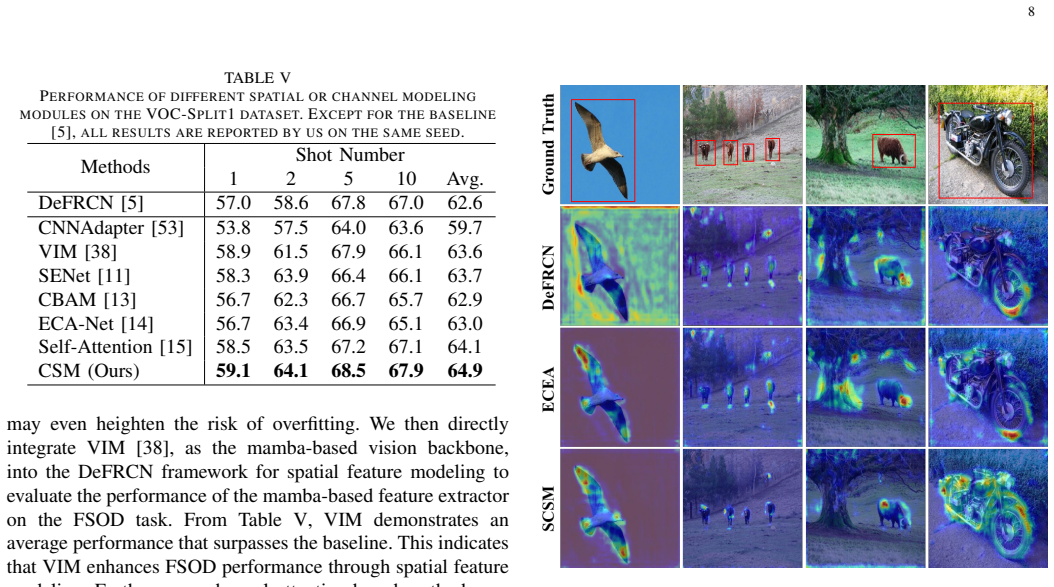
- CSM alone outperforms SFM alone in every shot setting, and the combination performs best, indicating that channel modeling contributes more than spatial modeling in this task.
- Removing high-weight channels causes less degradation with CSM than without, which the paper interprets as evidence that channel-state modeling maintains feature quality across channels.
Reading between the lines
- The paper leaves implicit a direct test of whether the sequential ordering of channels is the mechanism: training with a fixed random channel permutation and comparing to the natural order would isolate ordering effects from extra model capacity.
- A permutation-invariant channel mixer with comparable parameter count might match the reported gains, which would suggest the benefit comes from added capacity or gating rather than from state space sequencing.
- Because the COCO gains are smaller than the VOC gains, scaling behavior across dataset size, number of novel classes, and pretraining quality is not analyzed; understanding that could indicate where the method helps most.
- The same channel-as-sequence idea could transfer to other few-shot perception tasks such as few-shot segmentation or fine-grained classification, where channel redundancy is also a known difficulty.
Editorial analysis
A structured set of objections, weighed in public.
Referee Report
Summary. The paper proposes a Spatial-Channel State Space Modeling (SCSM) module for few-shot object detection (FSOD). The module is inserted after each backbone stage and contains two parts: a Spatial Feature Modeling (SFM) branch using multi-head attention over spatial patches, and a Channel State Modeling (CSM) branch that treats the channel dimension of a feature map as a 1-D sequence and applies a Mamba-style selective state space model to it. The authors claim that this channel-sequence modeling highlights effective channels and rectifies ineffective ones, improving feature quality for novel classes. Experiments on PASCAL VOC and COCO with ResNet and Swin backbones report consistent improvements over the DeFRCN baseline and several recent FSOD methods, with average nAP50 gains of about 2.6 points on VOC (ResNet101) and about 1.1 points on COCO (ResNet101, 10-shot). The paper also includes ablations of the two components and comparisons with channel-attention baselines.
Significance. If the mechanism is real, this is a useful and original application of state space models to the channel dimension rather than the spatial or temporal dimension, and the reported gains are consistent across two benchmarks and three backbones. The design is simple and could be readily adopted by other FSOD pipelines. However, the central mechanistic claim is not yet fully supported: the paper does not test whether the fixed ordering of channels is actually meaningful to the sequential model, and the ablation table omits the SFM-only condition that the text explicitly discusses. The lack of multiple seeds or error bars also makes the small reported margins difficult to evaluate. The paper does not provide code or trained models, so reproducibility currently rests on the textual description. Overall, the empirical direction is promising, but the evidence for the proposed mechanism and the reliability of the numerical claims need strengthening.
major comments (4)
- [Section III-D, Algorithm 1] The central mechanism claim is that treating channels as a 1-D sequence and applying a causal, order-sensitive selective SSM captures meaningful inter-channel correlation. However, the channel indices in a CNN feature map are arbitrary: a fixed random permutation of channels does not change the recognition problem if the downstream weights are permuted accordingly, yet the Mamba scan is order-sensitive. The paper provides no experiment testing whether the specific channel order matters. If results are largely unchanged under random fixed channel permutations, then the 'channel sequence' rationale is vacuous and the gains may come from added capacity; if results degrade sharply, the module is exploiting an arbitrary ordering rather than a principled feature property. Please report performance under several fixed random channel permutations, or alternatively show that the module is permutation-equivariant/invariant by design.
- [Section IV-C, Table IV] The text states that 'Using SFM alone outperforms the baseline under each shot setting too,' but Table IV contains only three rows: baseline, CSM, and CSM+SFM. The SFM-only row is absent, so the claimed individual contribution of SFM cannot be verified from the table. Since the paper's contribution is the combination of SFM and CSM, this missing condition is load-bearing for the ablation story. Please add the SFM-only row with the same experimental protocol.
- [Section IV-A/B, Tables I and II] All reported results appear to come from a single training run; Table V explicitly states that the compared results are on the same seed, and the main tables give no variance information. Several of the claimed improvements are small (e.g., 20.1 vs. 19.4 nAP on COCO 10-shot with Swin-B; 58.6 vs. 56.0 average on VOC with ResNet101), and FSOD training is known to be sensitive to seed and split. Without error bars or multiple seeds, these margins do not establish statistical significance. Please provide mean and standard deviation over at least three seeds for the main tables and the key ablations.
- [Section III-A, Eq. (1)] The paper describes the Mamba discretization with a fixed time-scale parameter ∆t computed from λmax, and Algorithm 1 uses Eq. (1) without an input-dependent ∆. In the actual Mamba model, selectivity comes from input-dependent ∆, B, and C; a fixed ∆ gives a linear time-invariant SSM without the selective-scan property that the paper invokes as motivation. If the implementation follows the description, the CSM is not a selective state space model; if it uses a standard Mamba block, the formal description is inaccurate. Please clarify the exact discretization and whether ∆, B, C are input-dependent, and justify the choice in either case.
minor comments (6)
- [Throughout] There are numerous typos and inconsistencies: 'whcih' in Section III-A, 'alnoe' in Section IV-C, 'Swin Transfromer' in the Table I caption, 'Channel Sate Modeling' in the Section III-D heading, and 'as shown in in Algorithm 1' in Section III-D. A careful proofread is needed.
- [Section III-C, Eq. (3)] The attention formula appears malformed: the expression 'ef ·W q(fqW k n)^T' mixes notation and does not clearly define the query, key, and value tensors. Please rewrite Eq. (3) with explicit indices for queries, keys, and values.
- [Table II caption] The caption says 'Swin-B is the backbone of Swin Transfromer with large size,' but the table reports both Swin-B and Swin-L results. The caption should refer to Swin-L for the large-size model and otherwise be consistent with the abbreviations used in the table.
- [Section IV-C, Table III] The sentence 'we observe enhancements from 81.0 to 81.2 of the average results on three VOC-base datasets (as shown in Table III) and from 56.0 to 58.6 of average results on the VOC dataset (refer to Table I)' is confusing because Table I reports novel-class nAP50 values while Table III reports base AP50 values. Please clarify which numbers correspond to which table and metric.
- [Section III-B/III-C] The tensor ordering is inconsistent: Section III-C describes the feature shape as (S, B, Ce), while Algorithm 1 and Figure 3 use (B, S, Ce) or (B, Ce, S) depending on the stage. Please standardize the notation so that permute and reshape operations are unambiguous.
- [Section IV-C and Fig. 1] The channel-weight analysis in Fig. 1 and Fig. 4 relies on SENet-derived channel weights, but the paper does not specify which model produces these weights (the baseline, SCSM, or an external SENet) or how the top/bottom channel subsets are selected. Please clarify the protocol.
Circularity Check
No significant circularity: SCSM's central claim is benchmarked on external VOC/COCO data and its components are independently ablated; self-citations are not load-bearing.
full rationale
The derivation chain is not circular. The central claim, that modeling channels as a 1D sequence with Mamba improves few-shot detection, is supported by external benchmark results in Tables I and II against DeFRCN, ECEA, and other methods, and by ablations in Tables IV-V and Fig. 4 whose metrics are downstream nAP on VOC/COCO. No equation defines the SCSM output in terms of the quantity it claims to predict: channel 'effectiveness' is assessed via SENet-derived weights only as a diagnostic in Fig. 1 and Fig. 4, while the module itself is trained with standard detection losses, so there is no fitted parameter renamed as a prediction. The self-citations ([7], [9], [16]) appear in related-work discussion and as a comparison baseline; they do not supply a uniqueness theorem or an assumption on which the SCSM design depends. One reporting gap exists in Section IV-C: the text states SFM alone outperforms the baseline, but Table IV shows no SFM-only row; this is omitted empirical support, not circularity. The untested channel-order assumption is a validity or robustness concern, not a circularity, because even if gains came from added capacity, the benchmark results are still external to the model's definitions.
Assumptions & free parameters
free parameters (4)
- State dimension D =
not reported
- Downsampled spatial size P =
not reported
- Compressed channel count Ce =
not reported
- Number of attention heads M =
not reported
assumptions (6)
- standard math Zero-order hold discretization of continuous state space parameters (Eq. 1) yields a correct Mamba SSM update.
- standard math The HiPPO matrix provides a valid initialization for the state matrix A.
- domain assumption Channel indices in a CNN feature map form a meaningful, fixed 1D sequence for state space modeling.
- domain assumption Modeling inter-channel correlations highlights effective channels and rectifies ineffective ones.
- domain assumption Multi-head self-attention over spatial patches balances spatial and channel learning and complements CSM.
- domain assumption DeFRCN's two-stage fine-tuning protocol is a representative baseline, and freezing the backbone in the novel phase isolates the effect of SCSM.
Cite this review
Pith. "Pith review of Few-Shot Object Detection via Spatial-Channel State Space Model." pith.science (2026). https://pith.science/paper/4CQOGF7R
@misc{pith2026250715308,
  author       = {Pith},
  title        = {Pith review of: Few-Shot Object Detection via Spatial-Channel State Space Model},
  year         = {2026},
  howpublished = {\url{https://pith.science/paper/4CQOGF7R}},
  note         = {Machine review of arXiv:2507.15308}
}
read the original abstract
Due to the limited training samples in few-shot object detection (FSOD), we observe that current methods may struggle to accurately extract effective features from each channel. Specifically, this issue manifests in two aspects: i) channels with high weights may not necessarily be effective, and ii) channels with low weights may still hold significant value. To handle this problem, we consider utilizing the inter-channel correlation to facilitate the novel model's adaptation process to novel conditions, ensuring the model can correctly highlight effective channels and rectify those incorrect ones. Since the channel sequence is also 1-dimensional, its similarity with the temporal sequence inspires us to take Mamba for modeling the correlation in the channel sequence. Based on this concept, we propose a Spatial-Channel State Space Modeling (SCSM) module for spatial-channel state modeling, which highlights the effective patterns and rectifies those ineffective ones in feature channels. In SCSM, we design the Spatial Feature Modeling (SFM) module to balance the learning of spatial relationships and channel relationships, and then introduce the Channel State Modeling (CSM) module based on Mamba to learn correlation in channels. Extensive experiments on the VOC and COCO datasets show that the SCSM module enables the novel detector to improve the quality of focused feature representation in channels and achieve state-of-the-art performance.
Figures


Figures from the paper (3 more)


Reference graph
Works this paper leans on
-
[1]
Binary similarity few- shot object detection with modeling of hard negative samples,
Y . Lu, X. Chen, Z. Wu, M. Tan, and J. Yu, “Binary similarity few- shot object detection with modeling of hard negative samples,” IEEE Transactions on Multimedia , vol. 26, pp. 4805–4818, 2023
work page 2023
-
[2]
Temporal speciation network for few-shot object detection,
X. Zhao, X. Liu, Y . Ma, S. Bai, Y . Shen, Z. Hao, and A. Liu, “Temporal speciation network for few-shot object detection,” IEEE Transactions on Multimedia, vol. 25, pp. 8267–8278, 2023
work page 2023
-
[3]
Dual-awareness attention for few-shot object detection,
T.-I. Chen, Y .-C. Liu, H.-T. Su, Y .-C. Chang, Y .-H. Lin, J.-F. Yeh, W.- C. Chen, and W. H. Hsu, “Dual-awareness attention for few-shot object detection,” IEEE Transactions on Multimedia , vol. 25, pp. 291–301, 2021
work page 2021
-
[4]
Smile: Leveraging submodular mutual information for robust few-shot object detection,
A. Majee, R. Sharp, and R. Iyer, “Smile: Leveraging submodular mutual information for robust few-shot object detection,” arXiv preprint arXiv:2407.02665, 2024
arXiv 2024
-
[5]
Defrcn: Decoupled faster r-cnn for few-shot object detection,
L. Qiao, Y . Zhao, Z. Li, X. Qiu, J. Wu, and C. Zhang, “Defrcn: Decoupled faster r-cnn for few-shot object detection,” in Proc. ICCV, Virtual, Online, Canada, 2021, pp. 8661–8670
work page 2021
-
[6]
Uncertainty-based forgetting mitigation for generalized few-shot object detection,
K. Guirguis, G. Eskandar, M. Wang, M. Kayser, E. Monari, B. Yang, and J. Beyerer, “Uncertainty-based forgetting mitigation for generalized few-shot object detection,” in Proc. CVPR, 2024, pp. 2586–2595
work page 2024
-
[7]
Ecea: Extensible co-existing attention for few-shot object detection,
Z. Xin, T. Wu, S. Chen, Y . Zou, L. Shao, and X. You, “Ecea: Extensible co-existing attention for few-shot object detection,” IEEE Transactions on Image Processing , 2024
work page 2024
-
[8]
Few-shot object detection with foundation models,
G. Han and S.-N. Lim, “Few-shot object detection with foundation models,” in Proc. CVPR, 2024, pp. 28 608–28 618
work page 2024
Show all 53 references
-
[9]
Adversarial feature training for few-shot object detection,
T. Wu, Z. Xin, S. Chen, Y . Zou, and X. You, “Adversarial feature training for few-shot object detection,” IEEE Transactions on Circuits and Systems for Video Technology , pp. 1–1, 2025
2025
-
[10]
Snida: Unlocking few-shot object detection with non-linear semantic decoupling augmen- tation,
Y . Wang, X. Zou, L. Yan, S. Zhong, and J. Zhou, “Snida: Unlocking few-shot object detection with non-linear semantic decoupling augmen- tation,” in Proc. CVPR, June 2024, pp. 12 544–12 553
2024
-
[11]
Squeeze-and-excitation networks,
J. Hu, L. Shen, and G. Sun, “Squeeze-and-excitation networks,” in Proc. CVPR, 2018, pp. 7132–7141
2018
-
[12]
Mamba: Linear-time sequence modeling with selective state spaces,
A. Gu and T. Dao, “Mamba: Linear-time sequence modeling with selective state spaces,” arXiv preprint arXiv:2312.00752 , 2023
2023 arXiv
-
[13]
Cbam: Convolutional block attention module,
S. Woo, J. Park, J.-Y . Lee, and I. S. Kweon, “Cbam: Convolutional block attention module,” in Proc. ECCV, 2018, pp. 3–19
2018
-
[14]
Eca-net: Efficient channel attention for deep convolutional neural networks,
Q. Wang, B. Wu, P. Zhu, P. Li, W. Zuo, and Q. Hu, “Eca-net: Efficient channel attention for deep convolutional neural networks,” in Proc. CVPR, 2020, pp. 11 534–11 542
2020
-
[15]
Attention is all you need,
A. Vaswani, N. Shazeer, N. Parmar, J. Uszkoreit, L. Jones, A. N. Gomez, Ł. Kaiser, and I. Polosukhin, “Attention is all you need,” Proc. NeurIPS, vol. 30, 2017
2017
-
[16]
Few-shot object detection: Research advances and challenges,
Z. Xin, S. Chen, T. Wu, Y . Shao, W. Ding, and X. You, “Few-shot object detection: Research advances and challenges,” Information Fusion , p. 102307, 2024
2024
-
[17]
Decoupling classifier for boosting few- shot object detection and instance segmentation,
B.-B. Gao, X. Chen, Z. Huang, C. Nie, J. Liu, J. Lai, G. JIANG, X. Wang, and C. Wang, “Decoupling classifier for boosting few- shot object detection and instance segmentation,” in Proc. NeurIPS , S. Koyejo, S. Mohamed, A. Agarwal, D. Belgrave, K. Cho, and A. Oh, Eds. Curran As...
2022
-
[18]
Explicit margin equilibrium for few-shot object detection,
C. Liu, B. Li, M. Shi, X. Chen, Q. Ye, and X. Ji, “Explicit margin equilibrium for few-shot object detection,” IEEE Transactions on Neural Networks and Learning Systems , pp. 1–13, 2024
2024
-
[19]
Proposal distribution calibration for few-shot object detection,
B. Li, C. Liu, M. Shi, X. Chen, X. Ji, and Q. Ye, “Proposal distribution calibration for few-shot object detection,” IEEE Transactions on Neural Networks and Learning Systems , vol. 36, no. 1, pp. 1911–1918, 2025
1911
-
[20]
Fsodv2: A deep calibrated few-shot object detection network,
Q. Fan, W. Zhuo, C.-K. Tang, and Y .-W. Tai, “Fsodv2: A deep calibrated few-shot object detection network,” International Journal of Computer Vision, pp. 1–20, 2024
2024
-
[21]
Meta faster r- cnn: Towards accurate few-shot object detection with attentive feature alignment. arxiv,
G. Han, S. Huang, J. Ma, Y . He, and S.-F. Chang, “Meta faster r- cnn: Towards accurate few-shot object detection with attentive feature alignment. arxiv,” 2021, arXiv preprint arXiv:2104.07719
2021 arXiv
-
[22]
Meta r-cnn: Towards general solver for instance-level low-shot learning,
X. Yan, Z. Chen, A. Xu, X. Wang, X. Liang, and L. Lin, “Meta r-cnn: Towards general solver for instance-level low-shot learning,” in Proc. ICCV, Los Alamitos, CA, USA, 2019, pp. 9576–9585
2019
-
[23]
Query adaptive few- shot object detection with heterogeneous graph convolutional networks,
G. Han, Y . He, S. Huang, J. Ma, and S.-F. Chang, “Query adaptive few- shot object detection with heterogeneous graph convolutional networks,” in Proc. ICCV, Virtual, Online, Canada, 2021, pp. 3243–3252
2021
-
[24]
Frustrat- ingly simple few-shot object detection,
X. Wang, T. E. Huang, T. Darrell, J. E. Gonzalez, and F. Yu, “Frustrat- ingly simple few-shot object detection,” in Proc. ICML, Virtual, Online, 2020, pp. 9861–9870
2020
-
[25]
Semantic relation reasoning for shot-stable few-shot object detection,
C. Zhu, F. Chen, U. Ahmed, Z. Shen, and M. Savvides, “Semantic relation reasoning for shot-stable few-shot object detection,” in Proc. CVPR, Piscataway, NJ, USA, 2021, pp. 8778–8787
2021
-
[26]
Niff: Alleviating forgetting in generalized few-shot object detection via neural instance feature forging,
K. Guirguis, J. Meier, G. Eskandar, M. Kayser, B. Yang, and J. Beyerer, “Niff: Alleviating forgetting in generalized few-shot object detection via neural instance feature forging,” in Proc. CVPR, June 2023, pp. 24 193– 24 202
2023
-
[27]
Fsce: Few-shot object detection via contrastive proposal encoding,
B. Sun, B. Li, S. Cai, Y . Yuan, and C. Zhang, “Fsce: Few-shot object detection via contrastive proposal encoding,” inProc. CVPR, Piscataway, NJ, USA, 2021, pp. 7348–7358
2021
-
[28]
Accurate few-shot object detection with support-query mutual guidance and hybrid loss,
L. Zhang, S. Zhou, J. Guan, and J. Zhang, “Accurate few-shot object detection with support-query mutual guidance and hybrid loss,” in Proc. CVPR, 2021, pp. 14 419–14 427
2021
-
[29]
Repmet: representative-based metric learning for classification and few-shot object detection,
L. Karlinsky, J. Shtok, S. Harary, E. Schwartz, A. Aides, R. Feris, R. Giryes, and A. Bronstein, “Repmet: representative-based metric learning for classification and few-shot object detection,” inProc. CVPR, Los Alamitos, CA, USA, 2019, pp. 5192–5201
2019
-
[30]
Feature reconstruction and metric based network for few-shot object detection,
Y . Li, W. Feng, S. Lyu, and Q. Zhao, “Feature reconstruction and metric based network for few-shot object detection,” Computer Vision and Image Understanding, pp. 103 600–103 610, 2023
2023
-
[31]
Few-shot object detection via variational feature aggregation. arxiv,
J. Han, Y . Ren, J. Ding, K. Yan, and G.-S. Xia, “Few-shot object detection via variational feature aggregation. arxiv,” 2023, arXiv preprint at arXiv.2301.13411
2023 arXiv
-
[32]
Generating features with increased crop- related diversity for few-shot object detection,
J. Xu, H. Le, and D. Samaras, “Generating features with increased crop- related diversity for few-shot object detection,” in Proc. CVPR, 2023, pp. 19 713–19 722
2023
-
[33]
Few-shot object detection with fully cross-transformer,
G. Han, J. Ma, S. Huang, L. Chen, and S.-F. Chang, “Few-shot object detection with fully cross-transformer,” in Proc. CVPR, Piscataway, NJ, USA, 2022, pp. 5311–5320
2022
-
[34]
Meta-detr: Image- level few-shot detection with inter-class correlation exploitation,
G. Zhang, Z. Luo, K. Cui, S. Lu, and E. P. Xing, “Meta-detr: Image- level few-shot detection with inter-class correlation exploitation,” IEEE Transactions on Pattern Analysis and Machine Intelligence , pp. 1–12, 2022
2022
-
[35]
Transformers are ssms: Generalized models and ef- ficient algorithms through structured state space duality,
T. Dao and A. Gu, “Transformers are ssms: Generalized models and ef- ficient algorithms through structured state space duality,” arXiv preprint arXiv:2405.21060, 2024
2024 arXiv
-
[36]
Videomamba: State space model for efficient video understanding,
K. Li, X. Li, Y . Wang, Y . He, Y . Wang, L. Wang, and Y . Qiao, “Videomamba: State space model for efficient video understanding,” arXiv preprint arXiv:2403.06977 , 2024
2024 arXiv
-
[37]
A survey on vision mamba: Models, applications and challenges,
R. Xu, S. Yang, Y . Wang, B. Du, and H. Chen, “A survey on vision mamba: Models, applications and challenges,” arXiv preprint arXiv:2404.18861, 2024
2024 arXiv
-
[38]
Vision mamba: Efficient visual representation learning with bidirectional state space model,
L. Zhu, B. Liao, Q. Zhang, X. Wang, W. Liu, and X. Wang, “Vision mamba: Efficient visual representation learning with bidirectional state space model,” arXiv preprint arXiv:2401.09417 , 2024
2024 arXiv
-
[39]
Vmamba: Visual state space model,
Y . Liu, Y . Tian, Y . Zhao, H. Yu, L. Xie, Y . Wang, Q. Ye, and Y . Liu, “Vmamba: Visual state space model,” arXiv preprint arXiv:2401.10166, 2024
2024 arXiv
-
[40]
Localmamba: Visual state space model with windowed selective scan,
T. Huang, X. Pei, S. You, F. Wang, C. Qian, and C. Xu, “Localmamba: Visual state space model with windowed selective scan,” arXiv preprint arXiv:2403.09338, 2024
2024 arXiv
-
[41]
Fcanet: Frequency channel attention networks,
Z. Qin, P. Zhang, F. Wu, and X. Li, “Fcanet: Frequency channel attention networks,” in Proc. ICCV, 2021, pp. 783–792
2021
-
[42]
Global context networks,
Y . Cao, J. Xu, S. Lin, F. Wei, and H. Hu, “Global context networks,” IEEE Transactions on Pattern Analysis and Machine Intelligence , vol. 45, no. 6, pp. 6881–6895, 2020
2020
-
[43]
Deep residual learning for image recognition,
K. He, X. Zhang, S. Ren, and J. Sun, “Deep residual learning for image recognition,” in Proc. CVPR, 2016, pp. 770–778
2016
-
[44]
Swin transformer: Hierarchical vision transformer using shifted windows,
Z. Liu, Y . Lin, Y . Cao, H. Hu, Y . Wei, Z. Zhang, S. Lin, and B. Guo, “Swin transformer: Hierarchical vision transformer using shifted windows,” in Proc. ICCV , Virtual, Online, Canada, 2021, pp. 9992– 10 002
2021
-
[45]
How to train your hippo: State space models with generalized orthogonal basis projections,
A. Gu, I. Johnson, A. Timalsina, A. Rudra, and C. R ´e, “How to train your hippo: State space models with generalized orthogonal basis projections,” arXiv preprint arXiv:2206.12037 , 2022
2022 arXiv
-
[46]
Meta-learning to detect rare objects,
Y .-X. Wang, D. Ramanan, and M. Hebert, “Meta-learning to detect rare objects,” in Proc. ICCV, Los Alamitos, CA, USA, 2019, pp. 9924–9933
2019
-
[47]
Fine-grained prototypes distillation for few-shot object detection,
Z. Wang, B. Yang, H. Yue, and Z. Ma, “Fine-grained prototypes distillation for few-shot object detection,” in Proc. AAAI, vol. 38, no. 6, 2024, pp. 5859–5866. 10
2024
-
[48]
Detect everything with few examples,
X. Zhang, Y . Liu, Y . Wang, and A. Boularias, “Detect everything with few examples,” arXiv preprint arXiv:2309.12969 , 2023
2023 arXiv
-
[49]
The pascal visual object classes (voc) challenge,
M. Everingham, L. Van Gool, C. Williams, J. Winn, and A. Zisserman, “The pascal visual object classes (voc) challenge,” International Journal of Computer Vision , pp. 303–308, 2010
2010
-
[50]
Microsoft coco: Common objects in context,
T.-Y . Lin, M. Maire, S. Belongie, J. Hays, P. Perona, D. Ramanan, P. Dollar, and C. Zitnick, “Microsoft coco: Common objects in context,” in Proc. ECCV, Cham, Switzerland, 2014, pp. 740–755
2014
-
[51]
Faster r-cnn: Towards real-time object detection with region proposal networks,
S. Ren, K. He, R. Girshick, and J. Sun, “Faster r-cnn: Towards real-time object detection with region proposal networks,” IEEE Transactions on Pattern Analysis and Machine Intelligence , vol. 39, no. 6, pp. 1137– 1149, 2017
2017
-
[52]
Imagenet large scale visual recognition challenge,
O. Russakovsky, J. Deng, H. Su, J. Krause, S. Satheesh, S. Ma, Z. Huang, A. Karpathy, A. Khosla, M. Bernstein, A. Berg, and L. Fei- Fei, “Imagenet large scale visual recognition challenge,” International Journal of Computer Vision , pp. 211–252, 2015
2015
-
[53]
Adapter- fusion: Non-destructive task composition for transfer learning,
J. Pfeiffer, A. Kamath, A. R ¨uckl´e, K. Cho, and I. Gurevych, “Adapter- fusion: Non-destructive task composition for transfer learning,” arXiv preprint arXiv:2005.00247, 2020
2005 arXiv
Reviewed August 6, 2026 · model on record in the stance chip above.
Discussion (0). Sign in to comment.