REVIEW 4 major objections 6 minor 41 references
Privacy-Preserving Multimodal News Recommendation through Federated Learning
T0 review · 4 major / 6 minor · reviewed 2026-08-06 · deepseek-v4-flash
Pith's one-line read Fed-MM-PNR: a federated, multimodal news recommender that matches centralized accuracy while keeping clicks on devices.
desk verdict Plausible integration of known components, but the federated training loop is underspecified and the evaluation is not trustworthy as written. read the letter →
The pith
A machine-rendered reading of the paper's core claim, the machinery that carries it, and where it could break.
The reading
What carries the argument
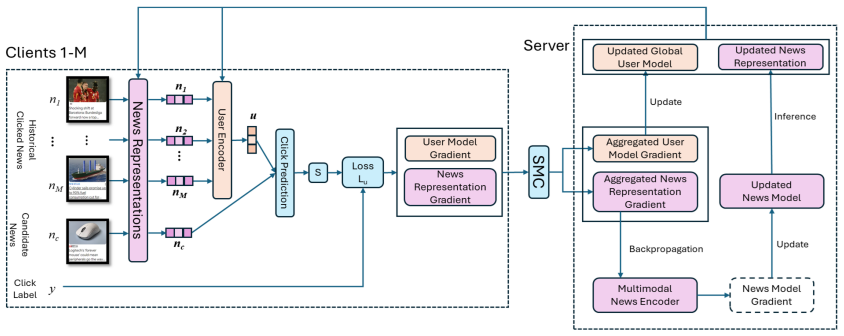
The central object is the split model: a server-side multimodal news encoder (BERT title encoder plus ViT image encoder, late-fusion additive attention) that produces news vectors, and a lightweight user encoder that applies multi-head self-attention to the clicked-news sequence to form long-term and short-term user vectors, fuses them with additive attention, and scores candidates by dot product. The federated loop has each selected client fetch only the news vectors for its own clicked items, compute local gradient updates from the cross-entropy loss over clicked and sampled non-clicked news, and submit those gradients through Shamir-secret-sharing secure aggregation; the server aggregates them to update the global user model and, according to the paper, relevant parts of the news model.
What would settle it
Instrument the federated training loop to record the norm of news-encoder parameter updates per round. If the news encoder's weights are identical before and after aggregation, the claimed joint update of the news model does not happen, and the architecture reduces to a federated user model over frozen multimodal embeddings.
Extended reading notes
Core claim
The paper introduces Fed-MM-PNR, a federated multimodal news recommendation system in which a server maintains a large multimodal news encoder while clients keep their click histories local. The authors claim that combining text and cover-image representations with both long- and short-term user interest modeling, trained through federated averaging with Shamir secret sharing, yields AUC 0.698, MRR 0.350, nDCG@5 0.384, and nDCG@10 0.442 on MIND. On those numbers Fed-MM-PNR outperforms every listed centralized and federated baseline except the centralized Hyper4NR, and it beats the multimodal centralized models NRMS-IM, FIM-IM, and VLSNR despite never collecting user browsing data on the server. The paper's conclusion is that privacy-preserving federated training, with careful architecture design, can match or exceed centralized recommendation quality.
Load-bearing premise
The central load-bearing premise is that clients can compute gradients that update the server-held news model even though the paper gives no equation for how news-model parameters receive those gradients; if the news encoder is actually frozen, the claimed 'updated news model' and the accuracy attributed to it are unsupported.
Editorial extensions
If this is right
- A deployed news platform could train a multimodal recommender without storing user click histories on a central server, since only aggregated gradients and group-level news-pool requests leave client devices.
- Multimodal content (title plus cover image) is necessary for the accuracy gain: the paper's own ablation shows text-only and image-only variants both lag behind the fused model.
- Modeling short-term interests on top of long-term history helps; the paper reports best results with the most recent 20 of 50 clicked news items used for the short-term branch.
- Federated training with secure aggregation is not inherently a quality tax: on MIND, Fed-MM-PNR beats the multimodal centralized baselines VLSNR, NRMS-IM, and FIM-IM.
- The practical sweet spot in this setup is roughly 200 participating users per round, balancing accuracy against the steep rise in training time at larger group sizes.
Reading between the lines
- Editorial extension: the news-model update is asserted but not demonstrated; no equation details how clients, who hold only news vectors, produce gradients for server-side news-encoder parameters. If the encoder is frozen, the accuracy gains should be attributed to the user model and the fixed multimodal representations, not to jointly trained news representations.
- Editorial extension: the comparison uses published baseline numbers rather than re-running baselines under the same federated protocol, so part of the reported margin may reflect differences in training schedule, negative sampling, or hardware rather than the architecture alone.
- Editorial extension: the privacy claim covers the training phase; serving-time behavior, where clients receive news vectors for candidates from the server, is outside the stated guarantee and could still leak group-level access patterns.
- Testable extension: if the news encoder is made genuinely trainable in this split architecture, one would expect news vectors to drift across rounds; measuring representation drift or gradient norms at the server would show whether the claimed joint update occurs.
Editorial analysis
A structured set of objections, weighed in public.
Referee Report
Summary. The paper proposes Fed-MM-PNR, a multimodal personalized news recommendation framework that combines textual and visual news representations with long- and short-term user interest modeling, and trains the model in a federated setting with secure aggregation based on Shamir's secret sharing. The authors evaluate the approach on the MIND-Large dataset and report that it outperforms most centralized and federated baselines on AUC, MRR, nDCG@5, and nDCG@10 while preserving user privacy. The high-level architecture is plausible, but the manuscript has two decisive technical deficiencies: the federated gradient flow for updating the news model is unspecified, so the training algorithm is not well-defined, and the baseline comparison is based on numbers copied from other papers rather than a common experimental protocol, invalidating the central empirical claim.
Significance. If the claims were supported, the paper would address a timely and important problem: combining multimodal news representation, long/short-term user modeling, and privacy-preserving federated training. The proposed architecture is a sensible extension of Efficient-FedRec to the multimodal setting, and the idea of using an aggregated news pool to hide individual click histories from the server is interesting. However, the current manuscript does not deliver valid evidence for these claims. The federated update rule for the news model is not formally defined, the evaluation uses non-standard baseline methodology, and the hyperparameters are selected in a way that is not clearly separated from test performance. No code or detailed protocol is provided, so the experiments are not reproducible from the text. These issues are load-bearing for the paper's central claim, and I cannot recommend publication in the current form.
major comments (4)
- [§4.1, Table 3] The federated update loop does not specify how the server updates the news model. The text says that clients 'compute the gradients of their local user model' and that the server 'updates the global user model and, if necessary, relevant parts of the news model,' but clients receive only news representation vectors and the lightweight user model, so they hold no parameters of the text encoder (BERT), image encoder (ViT), or fusion layer. Consequently, clients cannot compute ∂L/∂θ_news. For the news model to be trainable, clients would need to send upstream gradients ∂L/∂n_i for the requested news vectors, and the server would need to apply the chain rule ∂L/∂θ_news = Σ_i (∂L/∂n_i)(∂n_i/∂θ_news); this message is never described. If the news encoder is frozen, the abstract's claim of an 'updated news model' is unsupported; if it is trainable, the client-server protocol is incomplete. Either way, the reported results cannot be attributed to the algorithm as written.
- [§4.2, Figures 7 and 8] The baseline comparison is not a controlled experiment. The paper states, 'we relied on the performance metrics reported in their respective papers,' but those metrics are typically obtained on different dataset splits and hyperparameter settings. For example, DKN, NPA, and NRMS were originally evaluated on MIND-small, while the present paper uses MIND-Large; other baselines such as Hyper4NR may also use different splits. Without reimplementing the baselines under a common protocol, the performance gaps in Table 3 cannot be attributed to the proposed method rather than to dataset size, negative sampling, sequence length, or other settings. This invalidates the central empirical claim that Fed-MM-PNR 'outperforms most baseline models.'
- [§3.3, Eqs. (3)-(7)] The final configuration (M=20, group size=200) is selected based on the performance curves in Figures 7 and 8, but the paper does not state whether these curves are computed on the validation split or the test split. If they are computed on the test set, the final numbers in Table 3 are the result of test-set tuning and are optimistically biased. The paper also reports only averages over five runs without any variance or significance testing, so the apparent optimality of M=20 and group size=200 is not established statistically. The authors must specify the split used for hyperparameter selection and report standard deviations or confidence intervals.
- [4.2, Performance Evaluation] The secure aggregation protocol described is not Shamir's secret sharing as claimed. In Eqs. (3)-(7), each user splits each vector element into M random additive parts (hi,j = Σ_k h^k_i,j) and the server reconstructs h by summing all received column sums. This is additive secret sharing, not Shamir's polynomial-based secret sharing, which requires threshold interpolation and provides dropout resilience. The described protocol also assumes all M users complete the protocol and requires O(M^2) pairwise share distribution, and no mechanism for handling dropouts is given. Furthermore, the privacy claim that the server 'only knows the collective news accessed by a set of clients' is weak: the aggregated news pool reveals the union of the group's clicked news, and the paper provides no threat model or formal privacy analysis. These gaps directly affect the paper's stated privacy contribution.
minor comments (6)
- [§4.1, Table 1] The dataset is labeled 'MIND-Large' but the reported statistics (130,379 images) match IM-MIND or V-MIND; the paper should clarify which dataset variant was actually used and how the cover images were obtained, and the limitations section mentions 'MM-MIND,' which is never defined.
- [§3.1] The user model architecture is described only in prose; equations for the multi-head self-attention, the additive attention fusion of long- and short-term representations, and the final user representation are missing, making the model difficult to reproduce.
- [§3.2] The federated aggregation step is underspecified: the paper says the server 'aggregates the gradients' but does not provide the aggregation formula (e.g., FedAvg weighting), the number of communication rounds, local epochs, or the client sampling fraction.
- [§4.2, Figures 5 and 6] The text says these figures compare Fed-MM-PNR with single-modality and single-term variants, but the figures are not described in enough detail, and it is unclear whether they show validation or test results or include error bars.
- [Conclusion, §5] The claim that the framework 'can be adopted by major platforms such as Microsoft and Google News' is speculative and unsupported by the experiments.
- [References] Reference [17] for BERT is incomplete and does not cite the original Devlin et al. paper; the current citation appears to be a placeholder.
Circularity Check
No circular derivation: Fed-MM-PNR's federated training and evaluation do not reduce to their inputs; the flagged concerns concern evaluation comparability and an unspecified gradient path, not circularity.
full rationale
The manuscript contains no derivation chain that reduces to its own inputs. The core architecture (multimodal text/image news encoder, user encoder with long- and short-term self-attention, dot-product click score, cross-entropy loss) is a standard supervised pipeline trained and evaluated on MIND, and the federated decomposition is explicitly adopted from the external Efficient-FedRec work [29] with Shamir's secret sharing cited to [36]. There are no load-bearing self-citations by the present authors: the references to FedRec, Efficient-FedRec, MIND, BERT, ViT, and CLIP are all independent prior work, and none is relied upon as an unverified premise unique to this paper. The two concerns raised in the reader's take are not circularity under the definitions used here. First, hyperparameters M and group size are chosen from the performance curves in Figures 7 and 8 and then reported in Table 3; this is hyperparameter selection on the same benchmark, which may make the reported numbers optimistic if the tuning used the test split, but the reported metrics are still the outcome of a learned model rather than a quantity identical to the fitted input by construction. Second, Section 3.2 does not give an explicit equation for how news-model parameters receive gradients from clients that never hold the news encoder weights; this is an incompleteness in the algorithm specification, not a circular step. The paper also acknowledges its single-dataset limitation in Section 5. Because no step meets the quoted-evidence bar for self-definitional reasoning, fitted-input-as-prediction, self-citation dependence, or renaming, the appropriate finding is no significant circularity.
Assumptions & free parameters
free parameters (6)
- short-term sequence length M =
20
- user group size per FL round =
200
- long-term sequence length L =
50
- negative samples per positive =
20
- news representation dimension =
400
- learning rate =
6e-5
assumptions (4)
- domain assumption Pre-trained BERT and ViT provide useful representations of news titles and cover images.
- standard math Shamir secret sharing with M parties and threshold M prevents the server from seeing individual user data.
- domain assumption The MIND/V-MIND/IM-MIND image associations are correct and complete for all news items used.
- ad hoc to paper The aggregated news pool hides individual click histories from the server.
Cite this review
Pith. "Pith review of Privacy-Preserving Multimodal News Recommendation through Federated Learning." pith.science (2026). https://pith.science/paper/P63HB2CZ
@misc{pith2026250715460,
  author       = {Pith},
  title        = {Pith review of: Privacy-Preserving Multimodal News Recommendation through Federated Learning},
  year         = {2026},
  howpublished = {\url{https://pith.science/paper/P63HB2CZ}},
  note         = {Machine review of arXiv:2507.15460}
}
read the original abstract
Personalized News Recommendation systems (PNR) have emerged as a solution to information overload by predicting and suggesting news items tailored to individual user interests. However, traditional PNR systems face several challenges, including an overreliance on textual content, common neglect of short-term user interests, and significant privacy concerns due to centralized data storage. This paper addresses these issues by introducing a novel multimodal federated learning-based approach for news recommendation. First, it integrates both textual and visual features of news items using a multimodal model, enabling a more comprehensive representation of content. Second, it employs a time-aware model that balances users' long-term and short-term interests through multi-head self-attention networks, improving recommendation accuracy. Finally, to enhance privacy, a federated learning framework is implemented, enabling collaborative model training without sharing user data. The framework divides the recommendation model into a large server-maintained news model and a lightweight user model shared between the server and clients. The client requests news representations (vectors) and a user model from the central server, then computes gradients with user local data, and finally sends their locally computed gradients to the server for aggregation. The central server aggregates gradients to update the global user model and news model. The updated news model is further used to infer news representation by the server. To further safeguard user privacy, a secure aggregation algorithm based on Shamir's secret sharing is employed. Experiments on a real-world news dataset demonstrate strong performance compared to existing systems, representing a significant advancement in privacy-preserving personalized news recommendation.
Figures


Figures from the paper (5 more)


Reference graph
Works this paper leans on
-
[1]
G. Adomavicius and A. Tuzhilin, “Toward the next generation of recommender sys- tems: A survey of the state-of-the-art and possible extensions,” IEEE transactions on knowledge and data engineering , vol. 17, no. 6, pp. 734–749, 2005
work page 2005
-
[2]
News recommender systems – Survey and roads ahead, – Information Processing & Management,
M. Karimi, D. Jannach, and M. Jugovac, “News recommender systems – Survey and roads ahead, – Information Processing & Management,” vol. 54, no. 6, pp. 1203– 1227, Nov. 2018
work page 2018
-
[3]
Neural news recommendation with long-and short-term user representations,
M. An, F. Wu, C. Wu, K. Zhang, Z. Liu, and X. Xie, “Neural news recommendation with long-and short-term user representations,” in Proceedings of the 57th annual meeting of the association for computational linguistics , 2019, pp. 336–345
work page 2019
-
[4]
Neural news recommen- dation with attentive multi-view learning,
C. Wu, F. Wu, M. An, J. Huang, Y. Huang, and X. Xie, “Neural news recommen- dation with attentive multi-view learning,” arXiv preprint arXiv:1907.05576 , 2019
arXiv 1907
-
[5]
Hierec: Hierarchical user interest modeling for person- alized news recommendation,
T. Qi, F. Wu, C. Wu, et al., “Hierec: Hierarchical user interest modeling for person- alized news recommendation,” arXiv preprint arXiv:2106.04408 , 2021
arXiv 2021
-
[6]
Dkn: Deep knowledge-aware network for news recommendation,
H. Wang, F. Zhang, X. Xie, and M. Guo, “Dkn: Deep knowledge-aware network for news recommendation,” in Proceedings of the 2018 world wide web conference, 2018, pp. 1835–1844
work page 2018
-
[7]
Dan: Deep attention neural net- work for news recommendation,
Q. Zhu, X. Zhou, Z. Song, J. Tan, and L. Guo, “Dan: Deep attention neural net- work for news recommendation,” in Proceedings of the AAAI conference on artificial intelligence, vol. 33, 2019, pp. 5973–5980
work page 2019
-
[8]
Why do we click: Visual impression-aware news recommendation,
J. Xun, S. Zhang, Z. Zhao, et al. , “Why do we click: Visual impression-aware news recommendation,” in Proceedings of the 29th ACM international conference on mul- timedia, 2021, pp. 3881–3890
work page 2021
Show all 41 references
-
[9]
Modeling and broadening temporal user interest in personalized news recommendation,
L. Li, L. Zheng, F. Yang, and T. Li, “Modeling and broadening temporal user interest in personalized news recommendation,” Expert Systems with Applications , vol. 41, no. 7, pp. 3168–3177, 2014
2014
-
[10]
Privacy Enhanced Matrix Factorization for Recommendation with Local Differential Privacy,
H. Shin, S. Kim, J. Shin, and X. Xiao, “Privacy Enhanced Matrix Factorization for Recommendation with Local Differential Privacy,” en,IEEE Transactions on Knowl- edge and Data Engineering , vol. 30, no. 9, pp. 1770–1782, Sep. 2018, issn: 1041- 4347, 1558-2191, 2326-3865. doi: ...
2018
-
[11]
The eu general data protection regulation (gdpr),
P. Voigt and A. Von dem Bussche, “The eu general data protection regulation (gdpr),” A practical guide, 1st ed., Cham: Springer International Publishing , vol. 10, no. 3152676, pp. 10–5555, 2017
2017
-
[12]
How the gdpr will change the world,
J. P. Albrecht, “How the gdpr will change the world,” Eur. Data Prot. L. Rev. , vol. 2, p. 287, 2016
2016
-
[13]
Recommender systems: Issues, challenges, and re- search opportunities,
S. Khusro, Z. Ali, and I. Ullah, “Recommender systems: Issues, challenges, and re- search opportunities,” in Information science and applications (ICISA) 2016, Springer, 2016, pp. 1179–1189
2016
-
[14]
Npa: Neural news recom- mendation with personalized attention,
C. Wu, F. Wu, M. An, J. Huang, Y. Huang, and X. Xie, “Npa: Neural news recom- mendation with personalized attention,” in Proceedings of the 25th ACM SIGKDD international conference on knowledge discovery & data mining , 2019, pp. 2576– 2584
2019
-
[15]
Gradient-based learning applied to document recognition,
Y. Lecun, L. Bottou, Y. Bengio, and P. Haffner, “Gradient-based learning applied to document recognition,” Proceedings of the IEEE, vol. 86, no. 11, pp. 2278–2324, Nov. 1998, Conference Name: Proceedings of the IEEE, issn: 1558-2256. doi: 10. 1109/5.726791 . [Online]. Availabl...
1998
-
[16]
Attention is all you need,
V. Ashish, “Attention is all you need,” Advances in neural information processing systems, vol. 30, p. I, 2017
2017
-
[17]
Bert: Pre-training of deep bidirectional transformers for language under- standing,
J. Kim, “Bert: Pre-training of deep bidirectional transformers for language under- standing,” 2022
2022
-
[18]
Neural news recommendation with multi-head self-attention,
C. Wu, F. Wu, S. Ge, T. Qi, Y. Huang, and X. Xie, “Neural news recommendation with multi-head self-attention,” in Proceedings of the 2019 conference on empirical methods in natural language processing and the 9th international joint conference on natural language processing (E...
2019
-
[19]
Graph neural news recommenda- tion with long-term and short-term interest modeling,
L. Hu, C. Li, C. Shi, C. Yang, and C. Shao, “Graph neural news recommenda- tion with long-term and short-term interest modeling,” Information Processing & Management, vol. 57, no. 2, p. 102 142, 2020
2020
-
[20]
Vision-language recommendation via attribute augmented multimodal reinforcement learning,
T. Yu, Y. Shen, R. Zhang, X. Zeng, and H. Jin, “Vision-language recommendation via attribute augmented multimodal reinforcement learning,” in Proceedings of the 27th ACM International Conference on Multimedia , 2019, pp. 39–47
2019
-
[21]
Principle-to-program: Neural fashion recom- mendation with multi-modal input,
M. Chelliah, S. Biswas, and L. Dhakad, “Principle-to-program: Neural fashion recom- mendation with multi-modal input,” in Proceedings of the 27th ACM International Conference on Multimedia, 2019, pp. 2706–2708
2019
-
[22]
Vlsnr: Vision-linguistics coordination time sequence- aware news recommendation,
S. Han, W. Huang, and X. Luan, “Vlsnr: Vision-linguistics coordination time sequence- aware news recommendation,” arXiv preprint arXiv:2210.02946 , 2022
2022 arXiv
-
[23]
Learning transferable visual models from natural language supervision,
A. Radford, J. W. Kim, C. Hallacy, et al. , “Learning transferable visual models from natural language supervision,” inInternational conference on machine learning, PMLR, 2021, pp. 8748–8763
2021
-
[24]
SECRECSY: A Secure Frame- work for Enhanced Privacy-Preserving Location Recommendations in Cloud Envi- ronment,
L. Ravi, V. Subramaniyaswamy, M. Devarajan, et al., “SECRECSY: A Secure Frame- work for Enhanced Privacy-Preserving Location Recommendations in Cloud Envi- ronment,” en, Wireless Personal Communications , vol. 108, no. 3, pp. 1869–1907, Oct. 2019, issn: 1572-834X. doi: 10.1007...
1907 doi
-
[25]
Federated learning: Challenges, methods, and future directions,
T. Li, A. K. Sahu, A. Talwalkar, and V. Smith, “Federated learning: Challenges, methods, and future directions,” IEEE signal processing magazine , vol. 37, no. 3, pp. 50–60, 2020
2020
-
[26]
Communication- efficient learning of deep networks from decentralized data,
B. McMahan, E. Moore, D. Ramage, S. Hampson, and B. A. y Arcas, “Communication- efficient learning of deep networks from decentralized data,” in Artificial intelligence and statistics , PMLR, 2017, pp. 1273–1282
2017
-
[27]
Privacy-preserving news recommen- dation model learning,
T. Qi, F. Wu, C. Wu, Y. Huang, and X. Xie, “Privacy-preserving news recommen- dation model learning,” arXiv preprint arXiv:2003.09592 , 2020
2003 arXiv
-
[28]
Lopub: High-dimensional crowdsourced data pub- lication with local differential privacy,
X. Ren, C.-M. Yu, W. Yu, et al., “Lopub: High-dimensional crowdsourced data pub- lication with local differential privacy,”IEEE Transactions on Information Forensics and Security, vol. 13, no. 9, pp. 2151–2166, 2018
2018
-
[29]
Efficient-fedrec: Efficient federated learning framework for privacy-preserving news recommendation,
J. Yi, F. Wu, C. Wu, R. Liu, G. Sun, and X. Xie, “Efficient-fedrec: Efficient federated learning framework for privacy-preserving news recommendation,” arXiv preprint arXiv:2109.05446, 2021
2021 arXiv
-
[30]
Crypten: Secure multi-party computation meets machine learning,
B. Knott, S. Venkataraman, A. Hannun, S. Sengupta, M. Ibrahim, and L. van der Maaten, “Crypten: Secure multi-party computation meets machine learning,” Ad- vances in Neural Information Processing Systems , vol. 34, pp. 4961–4973, 2021
2021
-
[31]
Privacy-Preserving Deep Learning via Additively Homomorphic Encryption,
L. T. Phong, Y. Aono, T. Hayashi, L. Wang, and S. Moriai, “Privacy-Preserving Deep Learning via Additively Homomorphic Encryption,” en, IEEE Transactions on Information Forensics and Security , vol. 13, no. 5, pp. 1333–1345, May 2018, issn: 1556-6013, 1556-6021. doi: 10.1109/T...
2018
-
[32]
LoPub : High-Dimensional Crowdsourced Data Publication With Local Differential Privacy,
X. Ren, C.-M. Yu, W. Yu, et al. , “LoPub : High-Dimensional Crowdsourced Data Publication With Local Differential Privacy,” IEEE Transactions on Information Forensics and Security, vol. 13, no. 9, pp. 2151–2166, Sep. 2018, Conference Name: IEEE Transactions on Information Fore...
2018
-
[33]
UCoin: An Efficient Privacy Preserving Scheme for Cryptocurrencies,
M. R. Nosouhi, S. Yu, K. Sood, et al. , “UCoin: An Efficient Privacy Preserving Scheme for Cryptocurrencies,” en, IEEE Transactions on Dependable and Secure Computing, vol. 20, no. 1, pp. 242–255, Jan. 2023, issn: 1545-5971, 1941-0018, 2160-9209. doi: 10 . 1109 / TDSC . 2021 ....
2023
-
[34]
Dosovitskiy, L
A. Dosovitskiy, L. Beyer, A. Kolesnikov, et al. , An Image is Worth 16x16 Words: Transformers for Image Recognition at Scale , en, arXiv:2010.11929 [cs], Jun. 2021. [Online]. Available: http://arxiv.org/abs/2010.11929 (visited on 05/18/2024)
2010 arXiv
-
[35]
An effective recommendation model based on deep representation learning,
J. Ni, Z. Huang, J. Cheng, and S. Gao, “An effective recommendation model based on deep representation learning,” Information Sciences, vol. 542, pp. 324–342, 2021
2021
-
[36]
How to share a secret,
A. Shamir, “How to share a secret,” Communications of the ACM , vol. 22, no. 11, pp. 612–613, 1979
1979
-
[37]
Mind: A large-scale dataset for news recommendation, in proceedings of the 58th annual meeting of the association for computational linguistics,
F. Wu et al., “Mind: A large-scale dataset for news recommendation, in proceedings of the 58th annual meeting of the association for computational linguistics,” Online: Association for Computational Linguistics, Jul. 2020, pp. 3597–3606. doi: , vol. 10. D. Jurafsky, J. Chai, N...
2020
-
[38]
Mm-rec: Multimodal news recommendation,
C. Wu, F. Wu, T. Qi, and Y. Huang, “Mm-rec: Multimodal news recommendation,” arXiv preprint arXiv:2104.07407 , 2021
2021 arXiv
-
[39]
Heterogeneous graph neural network with personalized and adaptive diversity for news recommendation,
G. Zhang, D. Li, H. Gu, T. Lu, and N. Gu, “Heterogeneous graph neural network with personalized and adaptive diversity for news recommendation,” ACM Trans- actions on the Web , vol. 18, no. 3, pp. 1–33, 2024
2024
-
[40]
News recommendation with word-related joint topic prediction,
X. Pu, J. Zhang, X. Chen, Y. Qian, and R. Zhang, “News recommendation with word-related joint topic prediction,” IEEE Access, 2024
2024
-
[41]
Dual-view hypergraph attention network for news recommendation,
W. Liu, Z. Zhang, and B. Wang, “Dual-view hypergraph attention network for news recommendation,” Engineering Applications of Artificial Intelligence , vol. 133, p. 108 256, 2024
2024
Reviewed August 6, 2026 · model on record in the stance chip above.
Discussion (0). Sign in to comment.