REVIEW 3 major objections 6 minor 2 cited by
We Need to Rethink Benchmarking in Anomaly Detection
T0 review · 3 major / 6 minor · reviewed 2026-08-06 · deepseek-v4-flash
Pith's one-line read A two-line quantile rule performs comparably to deep anomaly detection methods on the ADBench benchmark, and the paper argues this shows aggregate benchmarking hides the real differences that scenario-specific evaluation would reveal.
desk verdict A thoughtful, well-argued position paper on scenario-specific benchmarking, but its load-bearing claim that shared structural properties make within-scenario performance transferable is asserted, not validated. read the letter →
The pith
A machine-rendered reading of the paper's core claim, the machinery that carries it, and where it could break.
The reading
What carries the argument
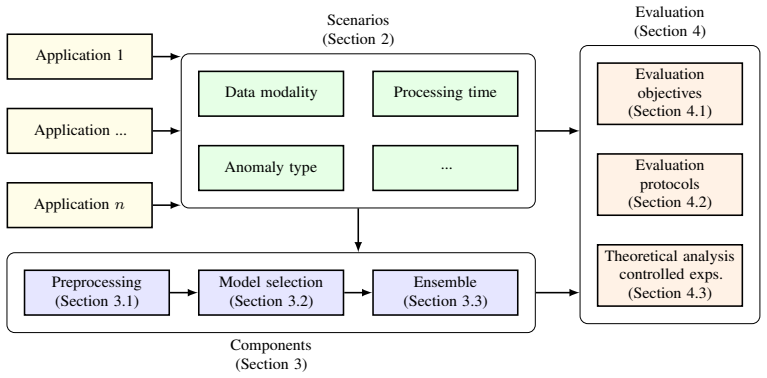
The machinery is the notion of a scenario, defined formally through structural properties $P_{\mathrm{str}}$ and contextual properties $P_{\mathrm{ctx}}$. Structural properties---anomaly type, anomaly ratio, data modality, dimensionality, supervision, processing time, evaluation priority, and operational constraints---directly constrain algorithm design; contextual properties describe the deployment setting and are used only to help experts identify the structural properties. A scenario is the set of applications sharing the same structural properties, and the paper argues this grouping supplies the inductive basis for transferring model-selection evidence across datasets, constrains admissible preprocessing and ensembles, and fixes which metrics and evaluation protocols fit. The companion instrument is the Quantiles algorithm, a deliberately trivial baseline that isolates the failure of aggregated evaluation.
What would settle it
A decisive check would be to take a scenario defined by the paper, for example real-time sequential anomaly detection, select several datasets that satisfy those structural properties, and compare algorithm rankings within the scenario against rankings across randomly chosen datasets. If within-scenario ranks are no more consistent across datasets than across-scenario ranks, the central premise that shared structural properties make performance transferable would fail. A second falsifier would be to find an application whose structural properties match a scenario but where the best algorithm is systematically different from the scenario's best, showing the taxonomy underspecifies requirements.
Extended reading notes
Core claim
The central claim is that current aggregated anomaly detection benchmarks are inadequate, and the field should move to scenario-specific benchmarking. The paper introduces a distinction between contextual properties and structural properties; a scenario groups applications that share structural properties regardless of application domain. It argues that within such a scenario, performance on one dataset provides evidence for performance on another, because shared structural properties determine the algorithmic requirements. It supports the diagnosis with a critical-difference experiment in which the two-line Quantiles algorithm ranks second among DTE, DeepSVDD, GoAD, and OCSVM on ADBench and is not statistically different from them, even though it cannot detect an anomaly inside an annulus of normal points. On this basis the paper claims that specialized algorithms will show real advantages when evaluated per scenario, and that scenario-specific choices for preprocessing, model selection, ensembles, metrics, and evaluation protocols will make progress measurable and guidance reliable.
Load-bearing premise
The load-bearing premise is that grouping applications by structural properties such as anomaly type and processing time makes performance on one dataset in a scenario predict performance on others; if real applications within a scenario still differ in ways those properties miss, the promised reliable guidance does not follow.
Editorial extensions
If this is right
- Overall leaderboards that average ranks across heterogeneous datasets should be supplemented or replaced by per-scenario leaderboards, because only within-scenario comparisons reveal which algorithm fits the application.
- A new algorithm should not need to beat baselines everywhere; a clear win inside one scenario is the transferable result.
- Benchmark dataset curation should record standardized structural-property metadata so datasets can be grouped, split, or merged into scenarios.
- Preprocessing, hyperparameter selection, and ensemble construction become scenario-constrained design problems, making individual pipeline components reusable.
- Practitioners can choose algorithms by looking up results for their scenario, such as real-time sequential detection, instead of extrapolating from a broad aggregate.
Reading between the lines
- A direct test the paper does not run: train a model-selection rule on datasets in one scenario and test it on held-out datasets in the same versus different scenarios; if within-scenario transfer is no better, the taxonomy needs refinement.
- The scenario logic also implies that when an application's structural properties change over time, the effective scenario changes, so drift in anomaly definitions is not just noise but a change in the problem instance.
- Scenario-specific metrics like diversity, severity, and fairness could reshuffle current rankings, because ROC-AUC and PR-AUC reward detectors that repeatedly find easy anomalies rather than broad coverage.
- A quick empirical check of the paper's diagnosis is to select ADBench datasets matching one scenario and see whether algorithm rankings stabilize; this would test whether aggregation, not method weakness, causes the apparent tie.
Editorial analysis
A structured set of objections, weighed in public.
Referee Report
Summary. This position paper argues that current aggregated benchmarking practice in anomaly detection is fundamentally misleading. The authors support this by introducing a trivial feature-wise baseline called Quantiles, which scores observations by the fraction of features outside the 5th–95th percentile range of the training data, and claim it performs competitively with deep learning methods on the ADBench benchmark. From this observation, they argue that progress in the field appears stagnant only because evaluation aggregates over heterogeneous application contexts. The paper proposes a new evaluation paradigm based on 'scenarios,' defined as groups of applications sharing the same structural properties Pstr (e.g., anomaly type, data modality, processing time), and argues that benchmarking within such scenarios would enable meaningful model selection, preprocessing choices, and metric design. The paper discusses taxonomies, benchmark design, evaluation objectives and protocols, and includes a 'Call to Action' for the community, as well as a section of alternative views with responses.
Significance. If the scenario-based benchmarking proposal is correct, it would redirect how anomaly detection algorithms are compared, moving the field away from global leaderboards toward application-aware evaluations that could give practitioners actionable guidance. The paper's strengths are its clear articulation of a plausible weakness in current evaluation (supported by a concrete, albeit under-specified, demonstration), its careful separation of contextual and structural properties, and its constructive suggestions for preprocessing, model selection, ensembles, and metrics. The authors also honestly acknowledge the risk of fragmentation and discuss alternative viewpoints. However, the central inductive premise—that shared structural properties make algorithm performance transferable within a scenario—is not validated empirically, and the motivating experiment in Figure 1 lacks reproducibility details. The paper is a genuine position statement, not a derivation, and its value depends on whether the community finds the proposed taxonomy and the transferability assumption plausible enough to act upon.
major comments (3)
- [Section 1 (Figure 1)] The motivating experiment in Figure 1 is under-specified, and the entire argument rests on it. Please provide a complete protocol: the list of ADBench datasets used, the train/test split and contamination settings, the hyperparameters chosen for each of the five methods, the number of random seeds, and the statistical test used to draw the critical difference diagram. The Quantiles algorithm also needs a precise description (e.g., how ties are handled, whether features are independently standardized, and what is done when a feature has zero variance). As written, the result is not reproducible. In addition, the annulus failure is asserted but never measured; if this is an illustrative example, say so explicitly, and if it is an empirical claim, include the measurement. The claim that Quantiles is 'trivial' (2 lines of code) is a rhetorical device and should be separated from the empirical comparison.
- [Section 3.2 (and Section 2.2)] The proposal's practical value depends on the premise that shared structural properties Pstr make algorithm performance transferable within a scenario. The paper states this premise in Section 3.2, but provides no empirical evidence that ranking consistency is higher within the scenarios of Table 1 than across them. The ADBench anomaly-type breakdown cited in Section 2.1.2 varies only a single property and does not validate multi-property scenarios. This is a load-bearing assumption for the call to action in Section 5: 'providing practitioners with reliable guidance' requires that within-scenario transfer holds. Please either add a pilot study using existing benchmarks (e.g., ADBench or Macrodata [38]) with scenario labels based on Table 1, or explicitly frame the premise as a hypothesis to be tested and soften the corresponding claims in Sections 3.2 and 5.
- [Section 2.2 (Table 1)] The list of structural properties in Table 1 is presented as the starting point, which is appropriate for a position paper, but the paper also claims that these properties 'determine the algorithmic requirements for all datasets in that scenario.' That strong claim is not supported by the cited work on taxonomy development [39] or by the examples in Section 2.3. At minimum, the paper should distinguish between properties that are known to affect algorithm choice (e.g., anomaly type) and those that are hypothesized to do so (e.g., processing time), and it should acknowledge that the set Pstr itself is part of the proposal to be validated rather than a settled list.
minor comments (6)
- [Section 1 (Figure 1)] The number of lines of code in Figure 1 is an unusual metric and is not defined; if it is meant to emphasize simplicity, define it or drop it.
- [Section 2.3 (Example 2.1)] The statement that failure patterns are 'often known' and therefore 'best suited to semi-supervised methods' is a strong generalization; consider softening or citing evidence.
- [Section 3.1] The discussion of normalization is useful but should acknowledge that z-score standardization is also a standard part of many deep anomaly detection pipelines and may not always be harmful; the recommendation should be nuanced.
- [Section 4.1] The claim that ROC-AUC is 'preferable when missing anomalies is the primary risk' conflates rank-based metrics with threshold-based operating points; ROC-AUC does not specify a decision threshold, so the sentence needs rewriting.
- [Section 6.3] The response to the 'many objectives' concern is reasonable, but the sentence 'the community only needs to reach an agreement within each scenario' underestimates the coordination cost; suggest acknowledging that even within scenarios, metric choice can be contentious.
- [References] Some references are incomplete (e.g., [37] lacks page numbers for the BDTA proceedings), and the citation [38] appears to be a future-dated preprint; please verify bibliographic details.
Circularity Check
No circularity: the paper is a position paper; its Quantiles demonstration is an external-benchmark measurement and the scenario framework is an explicitly inductive proposal, not a derivation from its own definitions.
full rationale
The paper contains no hidden fitted-parameter prediction or definitional equivalence. The Quantiles result in Section 1 and Figure 1 is an empirical ranking on the external ADBench benchmark using standard hyperparameters; it is used only to motivate the argument, and it does not construct or entail the paper's scenario proposal. The scenario framework in Section 2.2 is explicitly a proposal with iterative refinement, and the transferability claim in Section 3.2 is stated as an inductive basis while conceding that 'similar performance cannot be guaranteed'; therefore, it is not a self-definitional reduction. The self-citations ([3], [38], [66], [79]) appear only as example contexts, a critique of an existing benchmark, or supporting empirical illustrations, and none is load-bearing for the central claim that anomaly detection should be benchmarked within scenarios. The paper also explicitly acknowledges open challenges and alternative views in Sections 4.2 and 6, rather than suppressing them. Any weakness in the transfer premise is an empirical validation gap, not a circularity. No specific reduction of a result to its inputs by construction can be exhibited.
Assumptions & free parameters
free parameters (1)
- Quantiles thresholds (5th and 95th percentiles per feature) =
0.05 and 0.95 quantiles, chosen by hand
assumptions (4)
- domain assumption Anomalies are rare and different from normal data (Hawkins definition)
- domain assumption Current aggregated benchmarks, exemplified by ADBench, fairly represent the field's evaluation practice
- ad hoc to paper Shared structural properties P_str imply transferability of algorithm performance within a scenario
- domain assumption The no-free-lunch perspective applies to anomaly detection
invented entities (1)
-
Scenario (grouping of applications sharing structural properties P_str)
Cite this review
Pith. "Pith review of We Need to Rethink Benchmarking in Anomaly Detection." pith.science (2026). https://pith.science/paper/DAZZRDN5
@misc{pith2026250715584,
  author       = {Pith},
  title        = {Pith review of: We Need to Rethink Benchmarking in Anomaly Detection},
  year         = {2026},
  howpublished = {\url{https://pith.science/paper/DAZZRDN5}},
  note         = {Machine review of arXiv:2507.15584}
}
read the original abstract
Despite the continuous proposal of new anomaly detection algorithms and extensive benchmarking efforts, progress seems to stagnate, with only minor performance differences between established baselines and new algorithms. In this position paper, we argue that this stagnation is due to limitations in how we evaluate anomaly detection algorithms. In current benchmarks, a trivial algorithm that only checks for extreme values in individual features performs competitively with state-of-the-art deep learning methods, despite failing on simple cases such as anomalies within an annulus of normal points. Moreover, existing benchmarks do not adequately reflect the diversity of anomaly detection applications, making it difficult for practitioners to reliably select algorithms for their applications. Consequently, we need to rethink benchmarking in anomaly detection. In our opinion, anomaly detection should be studied using scenarios that group applications sharing relevant characteristics, defined through a common taxonomy. Benchmarking within scenarios enables scenario-specific choices for preprocessing, metrics, and model selection, clarifying which advances transfer across similar applications and providing practitioners with reliable guidance for their specific contexts.
Figures

Forward citations
Cited by 2 Pith papers
-
MacrOData: New Benchmarks of Thousands of Datasets for Tabular Outlier Detection
MacrOData supplies three large, curated benchmark suites totaling 2,446 datasets for tabular outlier detection, complete with standardized splits, metadata, and a public leaderboard.
-
Evaluating Tabular Representation Learning for Network Intrusion Detection
Tabular representation learning for network intrusion detection exhibits strong dataset-model dependency, with supervised methods outperforming unsupervised anomaly detection and limited but possible cross-dataset gen...
Reference graph
Works this paper leans on
-
[38]
MacrOData: New Benchmarks of Thousands of Datasets for Tabular Outlier Detection
Xueying Ding, Simon Klüttermann, Haomin Wen, Yilong Chen, and Leman Akoglu. Macrodata: New benchmarks of thousands of datasets for tabular outlier detection, 2026. URL https: //arxiv.org/abs/2602.09329
work page Pith review arXiv 2026
-
[39]
Nickerson, Upkar Varshney, and Jan Muntermann
Robert C. Nickerson, Upkar Varshney, and Jan Muntermann. A method for taxonomy develop- ment and its application in information systems.Eur. J. Inf. Syst., 22(3):336–359, 2013. doi: 10.1057/EJIS.2012.26. URLhttps://doi.org/10.1057/ejis.2012.26
-
[1]
Meta-survey on outlier and anomaly detection.Neurocomputing, 555:126634, 2023
Madalina Olteanu, Fabrice Rossi, and Florian Yger. Meta-survey on outlier and anomaly detection.Neurocomputing, 555:126634, 2023. ISSN 0925-2312. doi: https://doi.org/10.1016/j. neucom.2023.126634. URL https://www.sciencedirect.com/science/article/pii/ S0925231223007579
arXiv 2023
-
[2]
A comparative study of anomaly detection schemes in network intrusion detection
Aleksandar Lazarevic, Levent Ertöz, Vipin Kumar, Aysel Ozgur, and Jaideep Srivastava. A comparative study of anomaly detection schemes in network intrusion detection. InSDM, pages 25–36. SIAM, 2003
2003
-
[3]
Unsupervised anomaly detection of implausible elec- tronic health records: a real-world evaluation in cancer registries.BMC Medical Research Methodology, 23(1):125, 2023
Philipp Röchner and Franz Rothlauf. Unsupervised anomaly detection of implausible elec- tronic health records: a real-world evaluation in cancer registries.BMC Medical Research Methodology, 23(1):125, 2023
2023
-
[4]
Andrew Gadsden, and John Yawney
Waleed Hilal, S. Andrew Gadsden, and John Yawney. Financial fraud: A review of anomaly detection techniques and recent advances.Expert Syst. Appl., 193:116429, 2022
work page 2022
-
[5]
D. M. Hawkins.Identification of Outliers. Monographs on Applied Probability and Statistics. Springer, 1980
work page 1980
-
[6]
Guilherme Oliveira Campos, Arthur Zimek, Jörg Sander, Ricardo J. G. B. Campello, Barbora Micenková, Erich Schubert, Ira Assent, and Michael E. Houle. On the evaluation of unsupervised outlier detection: measures, datasets, and an empirical study.Data Min. Knowl. Discov., 30(4): 891–927, 2016
work page 2016
Show all 82 references
-
[7]
Adbench: Anomaly detection benchmark
Songqiao Han, Xiyang Hu, Hailiang Huang, Mingqi Jiang, and Yue Zhao. Adbench: Anomaly detection benchmark. InNeural Information Processing Systems (NeurIPS), 2022
2022
-
[8]
Learning multiple layers of features from tiny images
Alex Krizhevsky, Geoffrey Hinton, et al. Learning multiple layers of features from tiny images. Master’s thesis, University of Tront, 2009
2009
-
[9]
Imagenet: A large-scale hierarchical image database
Jia Deng, Wei Dong, Richard Socher, Li-Jia Li, Kai Li, and Li Fei-Fei. Imagenet: A large-scale hierarchical image database. InCVPR, pages 248–255. IEEE Computer Society, 2009
2009
-
[10]
Efficient algorithms for mining outliers from large data sets
Sridhar Ramaswamy, Rajeev Rastogi, and Kyuseok Shim. Efficient algorithms for mining outliers from large data sets. InSIGMOD Conference, pages 427–438. ACM, 2000
2000
-
[11]
An anomaly detection approach based on isolation forest algorithm for streaming data using sliding window
Zhiguo Ding and Minrui Fei. An anomaly detection approach based on isolation forest algorithm for streaming data using sliding window. InICONS, pages 12–17. International Federation of Automatic Control, 2013
2013
-
[12]
Unsupervised anomaly detection algorithms on real-world data: How many do we need?J
Roel Bouman, Zaharah Bukhsh, and Tom Heskes. Unsupervised anomaly detection algorithms on real-world data: How many do we need?J. Mach. Learn. Res., 25:105:1–105:34, 2024
2024
-
[13]
On diffusion modeling for anomaly detection
Victor Livernoche, Vineet Jain, Yashar Hezaveh, and Siamak Ravanbakhsh. On diffusion modeling for anomaly detection. InICLR. OpenReview.net, 2024
2024
-
[14]
Vandermeulen, Alexander Binder, Emmanuel Müller, and Marius Kloft
Lukas Ruff, Nico Görnitz, Lucas Deecke, Shoaib Ahmed Siddiqui, Robert A. Vandermeulen, Alexander Binder, Emmanuel Müller, and Marius Kloft. Deep one-class classification. InICML, volume 80 ofProceedings of Machine Learning Research, pages 4390–4399. PMLR, 2018
2018
-
[15]
Deep autoencoding gaussian mixture model for unsupervised anomaly detection
Bo Zong, Qi Song, Martin Renqiang Min, Wei Cheng, Cristian Lumezanu, Dae ki Cho, and Haifeng Chen. Deep autoencoding gaussian mixture model for unsupervised anomaly detection. InInternational Conference on Learning Representations, 2018. URL https: //api.semanticscholar.org/Co...
2018
-
[16]
Sahand Hariri, Matias Carrasco Kind, and Robert J. Brunner. Extended isolation forest.CoRR, abs/1811.02141, 2018
2018 arXiv
-
[17]
Classification-based anomaly detection for general data
Liron Bergman and Yedid Hoshen. Classification-based anomaly detection for general data. InICLR. OpenReview.net, 2020. URL http://dblp.uni-trier.de/db/conf/iclr/ iclr2020.html#BergmanH20
2020
-
[18]
One-class classifier networks for target recognition applications
Mr Moya. One-class classifier networks for target recognition applications. InProc. World Congress on Neural Networks, 1993, pages 797–801, 1993
1993
-
[19]
Anomaly detection: A survey.ACM Comput
Varun Chandola, Arindam Banerjee, and Vipin Kumar. Anomaly detection: A survey.ACM Comput. Surv., 41(3):15:1–15:58, July 2009. ISSN 0360-0300. doi: 10.1145/1541880.1541882. URLhttps://doi.org/10.1145/1541880.1541882
2009
-
[20]
Aggarwal.Outlier Analysis
Charu C. Aggarwal.Outlier Analysis. Springer, 2013. ISBN 978-1-4614-6396-2. URL http://dx.doi.org/10.1007/978-1-4614-6396-2
2013 doi
-
[21]
On the nature and types of anomalies: a review of deviations in data.Interna- tional Journal of Data Science and Analytics, 12(4):297–331, October 2021
Ralph Foorthuis. On the nature and types of anomalies: a review of deviations in data.Interna- tional Journal of Data Science and Analytics, 12(4):297–331, October 2021. ISSN 2364-415X, 2364-4168. doi: 10.1007/s41060-021-00265-1. URL https://link.springer.com/10. 1007/s41060-0...
2021 doi
-
[22]
No free lunch but a cheaper supper: A general framework for streaming anomaly detection.Expert Systems with Applications, 155:113453, October 2020
Ece Calikus, Sławomir Nowaczyk, Anita Sant’Anna, and Onur Dikmen. No free lunch but a cheaper supper: A general framework for streaming anomaly detection.Expert Systems with Applications, 155:113453, October 2020. ISSN 0957-4174. doi: 10.1016/j.eswa.2020.113453. URLhttps://www...
2020
-
[23]
E. H. Simpson. The Interpretation of Interaction in Contingency Tables.Journal of the Royal Statistical Society. Series B (Methodological), 13(2):238–241, 1951. ISSN 0035-9246. URL https://www.jstor.org/stable/2984065. Publisher: [Royal Statistical Society, Oxford University Press]
1951
-
[24]
Anomaly Detection in Computer Networks: A State-of-the-Art Review.J
Sherenaz Al-Haj Baddar, Alessio Merlo, and Mauro Migliardi. Anomaly Detection in Computer Networks: A State-of-the-Art Review.J. Wirel. Mob. Networks Ubiquitous Comput. Dependable Appl., 5(4):29–64, 2014
2014
-
[25]
Ruchi Makani and B. V . R. Reddy. Taxonomy of Machine Leaning Based Anomaly Detec- tion and its suitability.Procedia Computer Science, 132:1842–1849, January 2018. ISSN 1877-0509. doi: 10.1016/j.procs.2018.05.133. URL https://www.sciencedirect.com/ science/article/pii/S1877050...
2018 doi
-
[26]
A taxonomy and platform for anomaly detection
Gheorghe Sebestyen, Anca Hangan, Zoltan Czako, and Gyorgy Kovacs. A taxonomy and platform for anomaly detection. In2018 IEEE International Conference on Automation, Quality and Testing, Robotics (AQTR), pages 1–6, May 2018. doi: 10.1109/AQTR.2018.8402710. URL https://ieeexplor...
2018
-
[27]
Gilberto Fernandes, Joel J. P. C. Rodrigues, Luiz Fernando Carvalho, Jalal F. Al-Muhtadi, and Mario Lemes Proença. A comprehensive survey on network anomaly detection.Telecommunica- tion Systems, 70(3):447–489, March 2019. ISSN 1572-9451. doi: 10.1007/s11235-018-0475-8. URLhtt...
2019 doi
-
[28]
Deep Learning for Anomaly Detection: A Survey, January 2019
Raghavendra Chalapathy and Sanjay Chawla. Deep Learning for Anomaly Detection: A Survey, January 2019. URLhttp://arxiv.org/abs/1901.03407. arXiv:1901.03407 [cs]
2019 arXiv
-
[29]
A Taxonomy of Anomalies in Log Data, November 2021
Thorsten Wittkopp, Philipp Wiesner, Dominik Scheinert, and Odej Kao. A Taxonomy of Anomalies in Log Data, November 2021. URL http://arxiv.org/abs/2111.13462. arXiv:2111.13462 [cs]
2021 arXiv
-
[30]
Deep Learning for Anomaly Detection: A Review.ACM Computing Surveys, 54(2):1–38, March 2022
Guansong Pang, Chunhua Shen, Longbing Cao, and Anton van den Hengel. Deep Learning for Anomaly Detection: A Review.ACM Computing Surveys, 54(2):1–38, March 2022. ISSN 0360-0300, 1557-7341. doi: 10.1145/3439950. URL http://arxiv.org/abs/2007.02500. arXiv:2007.02500 [cs]. 11
2022 arXiv
-
[31]
Taxonomy of Anomaly Detection Techniques in Crowd Scenes.Sensors, 22(16):6080, January 2022
Amnah Aldayri and Waleed Albattah. Taxonomy of Anomaly Detection Techniques in Crowd Scenes.Sensors, 22(16):6080, January 2022. ISSN 1424-8220. doi: 10.3390/s22166080. URL https://www.mdpi.com/1424-8220/22/16/6080. Number: 16 Publisher: Multidis- ciplinary Digital Publishing Institute
2022 doi
-
[32]
Navigating the metric maze: a taxonomy of evaluation metrics for anomaly detection in time series.Data Mining and Knowledge Discovery, 38 (3):1027–1068, May 2024
Sondre Sørbø and Massimiliano Ruocco. Navigating the metric maze: a taxonomy of evaluation metrics for anomaly detection in time series.Data Mining and Knowledge Discovery, 38 (3):1027–1068, May 2024. ISSN 1573-756X. doi: 10.1007/s10618-023-00988-8. URL https://doi.org/10.1007...
2024 doi
-
[33]
Estevez-Tapiador, Pedro Garcia-Teodoro, and Jesus E
Juan M. Estevez-Tapiador, Pedro Garcia-Teodoro, and Jesus E. Diaz-Verdejo. Anomaly de- tection methods in wired networks: a survey and taxonomy.Computer Communications, 27 (16):1569–1584, October 2004. ISSN 0140-3664. doi: 10.1016/j.comcom.2004.07.002. URL https://www.scienced...
2004 doi
-
[34]
Taxonomy of Anomaly Based Intrusion Detection System: A Review.International Journal of Scientific and Research Publications, 2 (12), 2012
Manasi Gyanchandani, J L Rana, and R N Yadav. Taxonomy of Anomaly Based Intrusion Detection System: A Review.International Journal of Scientific and Research Publications, 2 (12), 2012
2012
-
[35]
The elephant in the room: Towards a reliable time-series anomaly detection benchmark.Advances in Neural Information Processing Systems, 37:108231– 108261, 2024
Qinghua Liu and John Paparrizos. The elephant in the room: Towards a reliable time-series anomaly detection benchmark.Advances in Neural Information Processing Systems, 37:108231– 108261, 2024
2024
-
[36]
Bmad: Benchmarks for medical anomaly detection
Jinan Bao, Hanshi Sun, Hanqiu Deng, Yinsheng He, Zhaoxiang Zhang, and Xingyu Li. Bmad: Benchmarks for medical anomaly detection. InProceedings of the IEEE/CVF Conference on Computer Vision and Pattern Recognition, pages 4042–4053, 2024
2024
-
[37]
Netflow datasets for machine learning-based network intrusion detection systems
Mohanad Sarhan, Siamak Layeghy, Nour Moustafa, and Marius Portmann. Netflow datasets for machine learning-based network intrusion detection systems. InBig data technologies and applications: 10th EAI international conference, BDTA 2020, and 13th EAI international conference on...
2020
-
[40]
Marius Zollner
Daniel Bogdoll, Maximilian Nitsche, and J. Marius Zollner. Anomaly detection in autonomous driving: A survey. In2022 IEEE/CVF Conference on Computer Vision and Pattern Recognition Workshops (CVPRW), page 4487–4498. IEEE, June 2022. doi: 10.1109/cvprw56347.2022. 00495. URLhttp:...
2022
-
[41]
A survey of anomaly detection methods for power grids.International Journal of Information Security, 22(6):1799–1832, Dec 2023
Srinidhi Madabhushi and Rinku Dewri. A survey of anomaly detection methods for power grids.International Journal of Information Security, 22(6):1799–1832, Dec 2023. ISSN 1615-5270. doi: 10.1007/s10207-023-00720-z. URL https://doi.org/10.1007/ s10207-023-00720-z
2023 doi
-
[42]
Lochner and B.A
M. Lochner and B.A. Bassett. Astronomaly: Personalised active anomaly detection in as- tronomical data.Astronomy and Computing, 36:100481, 2021. ISSN 2213-1337. doi: https://doi.org/10.1016/j.ascom.2021.100481. URL https://www.sciencedirect.com/ science/article/pii/S2213133721000354
2021
-
[43]
Financial fraud: a review of anomaly detection techniques and recent advances.Expert systems With applications, 193, 2022
Waleed Hilal, S Andrew Gadsden, and John Yawney. Financial fraud: a review of anomaly detection techniques and recent advances.Expert systems With applications, 193, 2022
2022
-
[44]
Sunil Kumar Singh and Pradeep Kumar Roy. Detecting malicious dns over https traffic us- ing machine learning.2020 International Conference on Innovation and Intelligence for Informatics, Computing and Technologies (3ICT), pages 1–6, 2020. URL https://api. semanticscholar.org/C...
2020
-
[45]
Anomaly detection for automated data quality monitoring in the cms detector, 2025
Andrew Brinkerhoff, Chosila Sutantawibul, Robert White, Caio Daumann, Chad Freer, Indara Suarez, Samuel May, Vivan Nguyen, Jonathan Guiang, Bennett Marsh, Darin Acosta, Alex Aubuchon, Emanuela Barberis, Aaron Bundock, Evan Collins, Preston Epps, Johannes Erdmann, Henning Flaec...
2025
-
[46]
Idrisov, Divine Okeke, Abdullatif Albaseer, Mohamed Abdallah, and Federico M
Ildar N. Idrisov, Divine Okeke, Abdullatif Albaseer, Mohamed Abdallah, and Federico M. Ibanez. Leveraging digital twin and machine learning techniques for anomaly detection in power electronics dominated grid, 2025. URLhttps://arxiv.org/abs/2501.13474
2025 arXiv
-
[47]
Anomaly detection in double-entry bookkeeping data by federated learning system with non- model sharing approach, 2025
Sota Mashiko, Yuji Kawamata, Tomoru Nakayama, Tetsuya Sakurai, and Yukihiko Okada. Anomaly detection in double-entry bookkeeping data by federated learning system with non- model sharing approach, 2025. URLhttps://arxiv.org/abs/2501.12723
2025 arXiv
-
[48]
ADGym: Design Choices for Deep Anomaly Detection, October
Minqi Jiang, Chaochuan Hou, Ao Zheng, Songqiao Han, Hailiang Huang, Qingsong Wen, Xiyang Hu, and Yue Zhao. ADGym: Design Choices for Deep Anomaly Detection, October
-
[49]
Muñoz, Rob J
Sevvandi Kandanaarachchi, Mario A. Muñoz, Rob J. Hyndman, and Kate Smith-Miles. On normalization and algorithm selection for unsupervised outlier detection.Data Min. Knowl. Discov., 34(2):309–354, 2020
2020
-
[50]
Breunig, Hans-Peter Kriegel, Raymond T
Markus M. Breunig, Hans-Peter Kriegel, Raymond T. Ng, and Jörg Sander. LOF: identifying density-based local outliers. In Weidong Chen, Jeffrey F. Naughton, and Philip A. Bernstein, editors,Proceedings of the 2000 ACM SIGMOD International Conference on Management of Data, May 1...
-
[51]
Zheng Li, Yue Zhao, Xiyang Hu, Nicola Botta, Cezar Ionescu, and George H. Chen. ECOD: unsupervised outlier detection using empirical cumulative distribution functions.IEEE Trans. Knowl. Data Eng., 35(12):12181–12193, 2023
2023
-
[52]
Remarks on Some Nonparametric Estimates of a Density Function.The Annals of Mathematical Statistics, 27(3):832 – 837, 1956
Murray Rosenblatt. Remarks on Some Nonparametric Estimates of a Density Function.The Annals of Mathematical Statistics, 27(3):832 – 837, 1956. doi: 10.1214/aoms/1177728190
1956
-
[53]
Anomaly detection using autoencoders with nonlinear dimensionality reduction
Mayu Sakurada and Takehisa Yairi. Anomaly detection using autoencoders with nonlinear dimensionality reduction. InProceedings of the MLSDA 2014 2nd Workshop on Machine Learning for Sensory Data Analysis, MLSDA’14, page 4–11, 2014. ISBN 9781450331593. doi: 10.1145/2689746.2689747
2014
-
[54]
Copod: Copula-based outlier detection
Zheng Li, Yue Zhao, Nicola Botta, Cezar Ionescu, and Xiyang Hu. Copod: Copula-based outlier detection. In2020 IEEE International Conference on Data Mining (ICDM), 2020. doi: 10.1109/ICDM50108.2020.00135
2020
-
[55]
Variational inference with normalizing flows
Danilo Jimenez Rezende and Shakir Mohamed. Variational inference with normalizing flows. InProceedings of the 32nd International Conference on International Conference on Machine Learning - Volume 37, ICML’15, page 1530–1538. JMLR.org, 2015
2015
-
[56]
A multivariate gaussian mixture model for anomaly detection in transient current signature of control element drive mechanism.Nuclear Engineer- ing and Design, 402:112098, 2023
Adebena Oluwasegun and Jae-Cheon Jung. A multivariate gaussian mixture model for anomaly detection in transient current signature of control element drive mechanism.Nuclear Engineer- ing and Design, 402:112098, 2023. ISSN 0029-5493
2023
-
[57]
A survey on gans for anomaly detection, 2021
Federico Di Mattia, Paolo Galeone, Michele De Simoni, and Emanuele Ghelfi. A survey on gans for anomaly detection, 2021
2021
-
[58]
Hyperparameter sensitivity in deep outlier detection: Analysis and a scalable hyper-ensemble solution.Advances in Neural Information Processing Systems, 35:9603–9616, 2022
Xueying Ding, Lingxiao Zhao, and Leman Akoglu. Hyperparameter sensitivity in deep outlier detection: Analysis and a scalable hyper-ensemble solution.Advances in Neural Information Processing Systems, 35:9603–9616, 2022. 13
2022
-
[59]
Automatic unsupervised outlier model selection
Yue Zhao, Ryan Rossi, and Leman Akoglu. Automatic unsupervised outlier model selection. In M. Ranzato, A. Beygelzimer, Y . Dauphin, P.S. Liang, and J. Wortman Vaughan, editors, Advances in Neural Information Processing Systems, volume 34, pages 4489–4502. Curran Associates, In...
2021
-
[60]
Rossi, and Leman Akoglu
Yue Zhao, Ryan A. Rossi, and Leman Akoglu. Automating outlier detection via meta-learning,
-
[61]
Hypex: Hyperparameter optimiza- tion in time series anomaly detection
Sebastian Schmidl, Phillip Wenig, and Thorsten Papenbrock. Hypex: Hyperparameter optimiza- tion in time series anomaly detection. InDatenbanksysteme für Business, Technologie und Web,
-
[62]
Flaml: A fast and lightweight automl library
Chi Wang, Qingyun Wu, Markus Weimer, and Erkang (Eric) Zhu. Flaml: A fast and lightweight automl library. InFourth Conference on Machine Learning and Systems (MLSys 2021), April 2021. URL https://www.microsoft.com/en-us/research/publication/ flaml-a-fast-and-lightweight-automl...
2021
-
[63]
Internal evaluation of unsupervised outlier detection.ACM Transactions on Knowledge Discovery from Data (TKDD), 14(4):1–42, 2020
Henrique O Marques, Ricardo JGB Campello, Jörg Sander, and Arthur Zimek. Internal evaluation of unsupervised outlier detection.ACM Transactions on Knowledge Discovery from Data (TKDD), 14(4):1–42, 2020
2020
-
[64]
URLhttps://api.semanticscholar.org/CorpusID:257104910
-
[65]
A study on anomaly detection ensembles.Journal of Applied Logic, 21, 12 2016
Alvin Chiang, Esther David, Yuh-Jye Lee, Guy Leshem, and Yi-Ren Yeh. A study on anomaly detection ensembles.Journal of Applied Logic, 21, 12 2016. doi: 10.1016/j.jal.2016.12.002
2016 doi
-
[66]
Evaluating and comparing heterogeneous ensemble methods for unsupervised anomaly detection
Simon Klüttermann and Emmanuel Müller. Evaluating and comparing heterogeneous ensemble methods for unsupervised anomaly detection. InIJCNN, 2023
2023
-
[67]
Ma, Yue Zhao, Xiaorong Zhang, and Leman Akoglu
Martin Q. Ma, Yue Zhao, Xiaorong Zhang, and Leman Akoglu. The need for unsupervised outlier model selection: A review and evaluation of internal evaluation strategies.SIGKDD Explor. Newsl., 25(1):19–35, July 2023. ISSN 1931-0145. doi: 10.1145/3606274.3606277. URLhttps://doi.or...
2023
-
[68]
Matthew B. A. McDermott, Haoran Zhang, Lasse Hyldig Hansen, Giovanni Angelotti, and Jack Gallifant. A closer look at auroc and auprc under class imbalance, 2025. URL https: //arxiv.org/abs/2401.06091
2025 arXiv
-
[69]
Diversity in recommender systems - A survey.Knowl
Matevz Kunaver and Tomaz Pozrl. Diversity in recommender systems - A survey.Knowl. Based Syst., 123:154–162, 2017
2017
-
[70]
Springer, 04 2017
Charu Aggarwal and Saket Sathe.Outlier Ensembles. Springer, 04 2017. ISBN 978-3-319- 54764-0. doi: 10.1007/978-3-319-54765-7
2017 doi
-
[71]
Y . Dai, M. Jayaratne, and B. Jayatilleke. Question-aware outlier answer detection for fairer ai scoring of interviews. In38th Annual Conference of the Society for Industrial & Organizational Psychology (SIOP), apr 2023
2023
-
[72]
Guoxiang Zhong, Fagui Liu, Jun Jiang, and C. L. Philip Chen. Causeformer: Interpretable anomaly detection with stepwise attention for cloud service.IEEE Transactions on Network and Service Management, 21(1):637–652, 2024. doi: 10.1109/TNSM.2023.3299846
2024
-
[73]
Subha and J
S. Subha and J. G. R. Sathiaseelan. Effective anomaly detection approach to classify noisy data using robust noise detection and removal technique in iot healthcare data.SN Computer Science, 4(5):522, Jul 2023. ISSN 2661-8907. doi: 10.1007/s42979-023-01890-2. URL https://doi.o...
2023 doi
-
[74]
On bootstrapping machine learning performance predictors via analytical models.CoRR, abs/1410.5102, 2014
Diego Didona and Paolo Romano. On bootstrapping machine learning performance predictors via analytical models.CoRR, abs/1410.5102, 2014
2014 arXiv
-
[75]
A bootstrap algorithm for fast supervised learning, 2023
Michael A Kouritzin, Stephen Styles, and Beatrice-Helen Vritsiou. A bootstrap algorithm for fast supervised learning, 2023. URLhttps://arxiv.org/abs/2305.03099. 14
2023 arXiv
-
[76]
Isolation-based anomaly detection.ACM Trans
Fei Tony Liu, Kai Ming Ting, and Zhi-Hua Zhou. Isolation-based anomaly detection.ACM Trans. Knowl. Discov. Data, 6(1):3:1–3:39, 2012
2012
-
[77]
Bootstrap methods: Another look at the jackknife.The Annals of Statistics, 7(1):1–26, 1979
B Efron. Bootstrap methods: Another look at the jackknife.The Annals of Statistics, 7(1):1–26, 1979
1979
-
[78]
Anomaly detection techniques for unsupervised machine learning, 2022
Albin Iivari. Anomaly detection techniques for unsupervised machine learning, 2022. URL https://www.diva-portal.org/smash/get/diva2:1674371/FULLTEXT01.pdf. 15 credits
2022
-
[79]
Area under the precision-recall curve: point estimates and confidence intervals
Kendrick Boyd, Kevin H Eng, and C David Page. Area under the precision-recall curve: point estimates and confidence intervals. InMachine Learning and Knowledge Discovery in Databases: European Conference, ECML PKDD 2013, Prague, Czech Republic, September 23-27, 2013, Proceedin...
2013
-
[82]
About test-time training for outlier detection, 2024
Simon Klüttermann and Emmanuel Müller. About test-time training for outlier detection, 2024. URLhttps://arxiv.org/abs/2404.03495. 15
2024 arXiv
-
[2021]
URLhttps://arxiv.org/abs/2009.10606
2009 arXiv
- [2023]
Reviewed August 6, 2026 · model on record in the stance chip above.
Discussion (0). Sign in to comment.