REVIEW 4 major objections 5 minor 1 cited by
Conflicting narratives and polarization on social media
T0 review · 4 major / 5 minor · reviewed 2026-08-06 · deepseek-v4-flash
Pith's one-line read Conflicting narratives in German tweets reveal the discursive fault lines behind political polarization.
desk verdict A useful qualitative typology of conflicting narratives, undermined only by thin LLM validation and a curated issue-alignment section; deserves peer review despite the soft spots. read the letter →
The pith
A machine-rendered reading of the paper's core claim, the machinery that carries it, and where it could break.
The reading
What carries the argument
The paper’s central object is the actantial network: nodes are actors (NATO, Russia, vaccine, Bill Gates, the collective “we”), and a directed edge from actor i to actor j records how often tweets express a relationship from i to j, with a weight equal to the retweet count and a score between −1 and +1 indicating conflictive, neutral, or supportive valence. To build these networks, the corpus is translated from German to English, parsed into Abstract Meaning Representation graphs, and the ARG0–ARG1 pairs are extracted as candidate relationships; an open-weight LLM (Phi-4) then labels each relationship using the original tweet as context, replacing an earlier context-free verb dictionary. Conflicting narratives are defined operationally as edges whose score has opposite sign in the left and right networks; keeping only the most central actors yields conflict networks that pinpoint the disputed links. The same networks, restricted to the node “we,” serve as identity narratives, and the comparison of recurring antagonists and cross-issue keyphrases provides the mechanism for studying narrative alignment.
What would settle it
Take a fresh sample of tweets that produced sign-opposite edges in the conflict networks, have annotators blind to the author’s camp label the valence by hand, and check whether the conflicts survive; a rate near chance, or a collapse of sign-opposite edges when ironic or sarcastic tweets are removed, would show the conflicts are artifacts of label noise rather than genuine narrative divergence.
Extended reading notes
Core claim
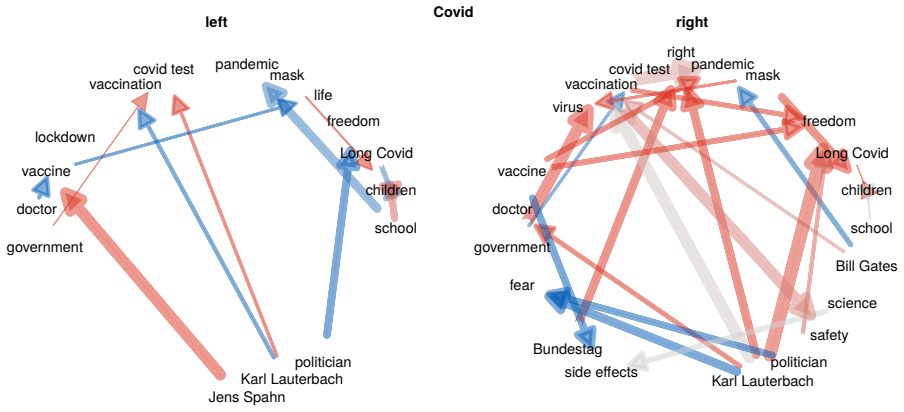
The central discovery is that conflicting narratives can be extracted and displayed as sign-opposite relationships in actantial networks, and that these networks surface the interpretive fault lines on which polarization is built. For the war in Ukraine, the left-leaning network attributes to NATO and the USA a supportive role in defending Ukraine and ending the war, while the right-leaning network attributes to them a conflictive role as instigators who profit from the war; the same event of Putin’s arrest warrant for deporting children is narrated as justice in one camp and as saving children from a war zone in the other. For Covid, the camps disagree on the vaccine’s effectiveness and side effects, and the right emplots Bill Gates and fear-mongering politicians where the left emplots solidarity and scientific guidance. For climate change, the left treats floods and extreme weather as consequences of emissions and defends the Last Generation protests, while the right relativizes CO2, condemns climate terrorists, and frames climate policy as a threat to freedom. Across all three issues the paper reports a recurring pattern: the right leans on a meta-narrative of individual freedom under attack by elites, the media, and the Green Party, while the left leans on solidarity and shared responsibility, and cross-issue phrases like “climate lockdown” suggest these narratives actively align opinions.
Load-bearing premise
The load-bearing premise is that the LLM’s supportive/conflictive/neutral labels reflect the narrative valence German speakers actually intended, after automatic translation and AMR parsing; the paper’s own validation reaches 86% agreement with human coding on 100 tweets and explicitly concedes that irony and sarcasm are mislabeled.
Editorial extensions
If this is right
- If the central claim is right, polarization is visible not only in who retweets whom but in the stories told: the same actors (NATO, vaccines, floods) can simultaneously play savior and culprit in the two camps.
- Sign-opposite links in actantial networks give a systematic way to locate the specific points of tension in a polarized debate, turning “discursive fault lines” into a searchable object.
- Narrative alignment through shared antagonists and analogies such as “climate lockdown” offers a discursive mechanism that could explain why polarization spreads across otherwise unrelated topics.
- The extraction method is reusable for any event covered on social media when translation and AMR parsing are available, making cross-country and cross-platform comparisons possible.
- Analyzing actantial networks over time could detect narrative shifts as links change sign or new actors enter the plot, connecting narratives to the dynamics of polarization.
Reading between the lines
- Beyond the paper: because the validation explicitly finds irony and sarcasm mislabeled, a sarcasm-aware labeler could change which edges appear as conflicts; the present conflict networks should be re-examined with such a model before the sign-opposite links are taken at face value.
- Beyond the paper: if “climate lockdown” is a genuine alignment device, then tracking the spread of such cross-issue keyphrases over time would predict which issues become ideologically bundled before structural alignment appears in retweet networks.
- Beyond the paper: the same actantial-network comparison could be applied to mainstream media coverage, testing whether the Twitter camps’ narratives are mirrored, amplified, or challenged by legacy outlets.
Editorial analysis
A structured set of objections, weighed in public.
Referee Report
Summary. The paper analyzes conflicting narratives in German Twitter discourse around the war in Ukraine, Covid, and climate change. Using a pipeline that combines AMR parsing, translation, and LLM-based labeling of actantial relations, it constructs actantial networks for left- and right-leaning camps and identifies edges whose supportive/conflictive/neutral sign disagrees between the camps. These sign-disagreement networks are interpreted as fault lines in polarized debates, revealing, for example, opposite characterizations of NATO's role in Ukraine and the emergence of Bill Gates in the right-leaning Covid narrative. The paper also presents qualitative evidence for cross-issue narrative alignment, such as recurring antagonism toward the media and the Green Party on the right and a solidarity meta-narrative on the left. The central methodological novelty is the LLM-assisted labeling of actantial links, validated in Appendix A.3 against 100 hand-coded examples.
Significance. If the central claims hold, the paper offers a systematic and interpretable way to surface narrative divergence in large-scale social media corpora, bridging computational text analysis and close reading. The strengths include a fully documented pipeline, the inclusion of many direct tweet quotations that ground the interpretation, a validation comparison against a dictionary-based baseline (46% versus 86% agreement), and an explicit discussion of limitations. The bookkeeping of sign-disagreement networks is a concrete operationalization of 'conflicting narratives' that could be reused by other researchers. However, the evidential weight of the sign-disagreement networks and the issue-alignment section depends on the reliability of the LLM labels and on the systematicity of the qualitative analysis, both of which need strengthening before the claims can be fully accepted.
major comments (4)
- [§A.3 and §3.2.2] The validation of the LLM-based relation labeling is too thin to support the central sign-disagreement evidence. The paper reports 86% agreement on 100 tweets, but gives no confidence intervals, no per-class breakdown (supportive/conflictive/neutral), and no breakdown by ideological camp. Because conflict edges in §3.2.2 require a sign disagreement between two independently labeled networks, a 14% raw error rate, if non-independent across camps, could generate a large share of spurious conflicts. The admitted irony/sarcasm failure is particularly worrying: the Appendix's own example of 'elect Armin Laschet now, because only he can build us an ark' is a mislabeled tweet of exactly the kind that could feed a conflict network. I request a stratified validation on left and right subcorpora, a per-class error matrix, and a sensitivity analysis showing how many edges in Figures 3, 5, and 7 remain conflicted when label noise is simulated or when a score-magnitude threshold (e.g., |σ| > 0.1) is imposed.
- [§4.4] The issue-alignment claim rests on a curated set of example tweets selected after the fact, with no systematic quantification. The paper introduces the notion that recurring actors and analogies bind issues together, but it does not measure, for instance, overlap in the sets of antagonized actors across the three issue-specific conflict networks, or the frequency of cross-issue keyphrases like 'climate lockdown' in the entire corpus. Without such a systematic component, the 'first evidence' language in the abstract and Section 4.4 overstates what is currently a qualitative observation. Please either add a quantitative analysis of narrative alignment (e.g., network overlap, co-occurrence of actors across issue corpora) or clearly rephrase the claim as a hypothesis-generating observation.
- [§3.2.2] The formal definition of a conflict edge uses sign(α_l(i,j)) ≠ sign(α_r(i,j)), but α is never explicitly defined; the text elsewhere defines a score σ ∈ [−1, 1]. This inconsistency matters because a threshold on the score magnitude is needed to avoid treating numerically negligible sign differences as narrative conflicts. A score of +0.01 in one camp and −0.01 in the other would count as a conflict edge, which is arguably noise. Please define α, clarify its relationship to σ, report the score distributions for the edges included in the conflict networks, and test robustness to the threshold used.
- [§4.2.2 and §3.2] The claim that certain actants (e.g., Bill Gates, vaccination side effects) are absent from one side's narrative is inferred from their absence in the filtered networks, but those networks are restricted to the top-100 central nodes in each camp and are further thresholded by retweet counts. Absence in the displayed network may reflect the centrality cutoff or the weight threshold rather than a genuine narrative omission. Please report the rank or unthresholded weight of the supposedly absent actors in the relevant networks, or verify by direct corpus search that these actors are effectively not discussed in the corresponding camp's tweets for the issue at hand.
minor comments (5)
- [Abstract and §1] There are several typographical issues, including 'warin Ukraine' in the abstract and 'recieved' in Section 3.1.2; a careful proofreading pass is needed.
- [§A.2] The prompt definition lists 'approves of' twice in the supportive relations definition; the duplicate should be removed.
- [§3.2.1 and §4.1.1] The notation alternates between σ and α for the edge score, and the relationship between 'score' and the qualitative sign used in the figures is not always explicit; unifying the notation would improve clarity.
- [Figure 2 caption] The caption states that the color bar is 'only plotted here for subsequent actantial networks,' which is confusing because Figure 2 itself uses the color scale; please rephrase the caption to describe the color encoding directly.
- [§5 Discussion] The discussion would benefit from a short paragraph on the representativeness of the selected three issues relative to the full issue list in Table A1; for example, the paper could state whether the conflict-network findings are likely to generalize to less-polarized topics.
Circularity Check
No significant circularity: prior work supplies data and methods, while the narrative evidence comes from close reading of quoted tweets.
full rationale
The paper's central claims are descriptive, not predictive. The conflict networks in §3.2.2 are constructed by an explicit, honest operationalization ("if sign(σl(i,j)) ≠ sign(σr(i,j)), we assume the underlying edge to correspond to a narrative trace that points to a fault line"); this is a measurement rule, and the paper does not claim to derive the existence of conflicts from anything outside that rule. The substantive evidence for conflicting narratives is the close reading of the underlying tweets in §4 and Appendix A.4, which quotes original texts showing, e.g., that the left sees NATO as supporting Ukraine while the right sees the US as wanting the war. These quotes are independent of the LLM's valence summary. The paper's reliance on Pournaki et al. (2025) and Pournaki and Willaert (2024) is provenance of the dataset and the AMR/actantial-network toolkit, not a self-citation chain that supplies the conclusion. The LLM validation (Appendix A.3) is limited (86% agreement on 100 tweets, admitted irony/sarcasm failures), but that is a measurement-validity limitation, not a circular reduction: no parameter is fitted and then renamed as a prediction. The paper itself flags its assumptions (internal coherence of camps, selection of only conflicting links), which further shows the analysis is not presenting a definitionally forced result as a discovery. No step in the paper's own equations makes the output equivalent to the input by construction.
Assumptions & free parameters
free parameters (5)
- Centrality top-N =
100
- Edge weight threshold =
500 (Ukraine/Covid), 250 (Climate)
- Conflict sign mismatch =
sign(alpha_l) != sign(alpha_r)
- Trend selection top-5 =
5 trends/day
- LLM model and prompt =
Phi-4 with guided JSON generation
assumptions (5)
- domain assumption Retweet network clusters correspond to opinion groups
- domain assumption AMR graphs preserve narrative roles after German-to-English translation
- domain assumption LLM relationship labels are accurate enough
- domain assumption 'we' refers to the collective in-group identity
- domain assumption Trending topic tweets are representative of public discourse
Cite this review
Pith. "Pith review of Conflicting narratives and polarization on social media." pith.science (2026). https://pith.science/paper/ROH53HDP
@misc{pith2026250715600,
  author       = {Pith},
  title        = {Pith review of: Conflicting narratives and polarization on social media},
  year         = {2026},
  howpublished = {\url{https://pith.science/paper/ROH53HDP}},
  note         = {Machine review of arXiv:2507.15600}
}
read the original abstract
Narratives are key interpretative devices by which humans make sense of political reality. In this work, we show how the analysis of conflicting narratives, i.e. conflicting interpretive lenses through which political reality is experienced and told, provides insight into the discursive mechanisms of polarization and issue alignment in the public sphere. Building upon previous work that has identified ideologically polarized issues in the German Twittersphere between 2021 and 2023, we analyze the discursive dimension of polarization by extracting textual signals of conflicting narratives from tweets of opposing opinion groups. Focusing on a selection of salient issues and events (the war in Ukraine, Covid, climate change), we show evidence for conflicting narratives along two dimensions: (i) different attributions of actantial roles to the same set of actants (e.g. diverging interpretations of the role of NATO in the war in Ukraine), and (ii) emplotment of different actants for the same event (e.g. Bill Gates in the right-leaning Covid narrative). Furthermore, we provide first evidence for patterns of narrative alignment, a discursive strategy that political actors employ to align opinions across issues. These findings demonstrate the use of narratives as an analytical lens into the discursive mechanisms of polarization.
Figures


Figures from the paper (4 more)



Forward citations
Cited by 1 Pith paper
-
An Experimental Method to Study Opinion Diffusion in Human-AI Hybrid Societies
Hybrid human-AI networks in 5x5 grids reached lower final polarization than human-only networks after eight rounds of opinion revision on polarizing topics.
Reference graph
Works this paper leans on
-
[1]
Abdin, M.,J. Aneja,H. Behl,S. Bubeck,R. Eldan,S. Gunasekar,M. Harrison,R. J. Hewett,M. Javaheripi, P. Kauffmann, J. R. Lee, Y. T. Lee, Y. Li, W. Liu, C. C. T. Mendes, A. Nguyen, E. Price, G. de Rosa, O. Saarikivi, A. Salim, S. Shah, X. Wang, R. Ward, Y. Wu, D. Yu, C. Zhang, and Y. Zhang (2024). Phi-4 Technical Report. doi: 10.48550/arXiv.2412.08905. arXiv...
-
[2]
On the contrary. What we should demand is the immediate repair & the restarting of the two pipelines. Right now. Everything else would be in the sense of the perpetrators & would harm us massively.” (2022-09-28, 762 retweets) The NATO and Europe are antagonized: “Zelensky: “The US will have to send their sons and daughters just as we send our sons and dau...
work page 2022
-
[3]
When the side effects rose, the PEI took the database from the network. Do you trust the government?” (2022-07-07, 3610 retweets) “Many acquaintances got the vaccine only for convenience. They were allowed to go to the restaurant. I wasn’t. They were allowed to travel. I wasn’t. They were allowed to go to Christmas market. I wasn’t. Now even BMG and ÖRR a...
work page 2022
-
[4]
A.4.1 War in Ukraine Identity network We see that the left-leaning camp is strongly supportive ofUkrainians, thedefense and support for Ukraine: 18 “On the way to #Ukraine. Today in Kiev and tomorrow in Moscow, I will continue our talks on the continuing very serious situation on the border of Ukraine. In Kiev, it is important for me to express our contin...
work page 2022
-
[9]
The European response can only be: it should. If, for good reasons, we are not prepared to intervene directly in the war, then at least we must be prepared to sacrifice part of our prosperity.” (2022-03-07, 658 retweets) “If Ukraine stops fighting, Ukraine ends. If Russia stops fighting, this war ends. And that is why we support Ukraine, because we want t...
work page 2022
-
[10]
48550/arXiv.2307.09702. arXiv: 2307.09702 [cs]. X/Twitter (2025).X Trends FAQ – Trending Hashtags and Topics. https://help.x.com/en/using-x/x- trending-faqs. Zhao, W., L. Walasek, and G. D. A. Brown (2023). The Evolution of Polarization in Online Conversation: Twitter Users’ Opinions about the COVID-19 Pandemic Become More Politicized over Time.Human Beha...
arXiv 2025
-
[11]
Twice vaccinated must not be tested because they are not contagious. Any court that accepts this nonsense would be a VOLKSGERICHTSHOF. Sue them! 1/2” (2021-08-12, 540 retweets) There is a fundamental distrust in thegovernment in the right-leaning camp, connected to safety of the vaccination: “Due to the fact that I am not vaccinated, I am 100% safe from s...
work page 2021
-
[12]
The Greens need pressure to put climate protection at the top of the agenda.” (2023-03-29, 13 retweets) “The Greens have simply sacrificed climate protection completely for the FDP. I could freak out, they are such losers... all they needed to do was to insist on existing laws, they can’t even do that.... #Coalition Committee” (2023-03-28, 11 retweets) On...
work page 2023
Show all 12 references
-
[17]
Antinyan, A., T
doi: 10.1007/s42001-024-00345-9. Antinyan, A., T. Bassetti, L. Corazzini, and F. Pavesi (2024). Narratives and Opinion Polarization: A Survey Experiment.Scientific Reports, 14(1), 19732. doi: 10.1038/s41598-024-70012-6. Banarescu, L., C. Bonial, S. Cai, M. Georgescu, K. Griffi...
2024
-
[53]
Bayesian Stochastic Blockmodeling
doi: 10.1140/epjds/s13688-021-00308-4. Lejano, R. P. and S. J. Nero (2020).The Power of Narrative: Climate Skepticism and the Deconstruction of Science(1). Oxford University Press. Lu, Y., B. Yao, S. Zhang, Y. Wang, P. Zhang, T. Lu, T. J.-J. Li, and D. Wang (2023).Human Still ...
-
[1973]
Narrative, Political
Grootendorst, M. (2022).BERTopic: Neural Topic Modeling with a Class-Based TF-IDF Procedure. doi: 10.48550/arXiv.2203.05794. arXiv: 2203.05794 [cs]. 15 Groth, S. (2019). Political Narratives / Narrations of the Political: An Introduction.Narrative Culture, 6(1), 1–18. doi: 10....
-
[2024]
{A1}" to
with the following prompt, where {A1} is replaced by the actor label of the agent, {A2} is replaced by the actor label of the patient, and {tweet} is replaced by the tweet to process: You are an expert political analyst. In the following tweet, the author expresses a relation ...
2024
Reviewed August 6, 2026 · model on record in the stance chip above.
Discussion (0). Sign in to comment.