REVIEW 5 major objections 5 minor 18 references
CylinderPlane: Nested Cylinder Representation for 3D-aware Image Generation
T0 review · 5 major / 5 minor · reviewed 2026-08-06 · deepseek-v4-flash
Pith's one-line read Cylindrical coordinates separate front and back features, removing the Janus face in 360-degree generation.
desk verdict A sensible cylindrical reparameterization of tri-planes that directly targets the Janus artifact, but the paper's evidence is too thin to support its main causal claim. read the letter →
The pith
A machine-rendered reading of the paper's core claim, the machinery that carries it, and where it could break.
The reading
What carries the argument
The machinery is the cylinder-plane field: a point with cylindrical coordinates $(\theta, r, y)$ samples the generator's feature maps by projection onto three planes $F_{\theta y}$, $F_{r\theta}$, and $F_{yr}$, and the interpolated features are summed and decoded to color and density, in the same spirit as a Tri-plane but with angular information isolated. The nested-cylinder structure generalizes the $\theta y$ plane to a stack of cylindrical surfaces $F_{\theta y}^{r_0}, F_{\theta y}^{r_1}, \dots, F_{\theta y}^{r_N}$ with $r_0 < r_1 < \dots < r_N$, forming what the paper calls a Swiss-Roll-like multi-scale surface. Seam regularization at $\theta = -\pi$ and $\theta = \pi$ handles the numerical discontinuity where the cylinder wraps around, and the whole field is renderer-agnostic, feeding either a volume renderer or a DMTet-based mesh rasterizer.
What would settle it
Train or evaluate CylinderPlane on a subject whose geometry is not captured by a single upright cylinder axis, such as an object with a protruding horizontal arm or a head with large pitch, and render a full 360-degree orbit; if the back view again shows duplicated front features, or if changing the number and radii of nested cylinders changes FID-back dramatically, the central claims of angular separation and nested coverage fail.
Extended reading notes
Core claim
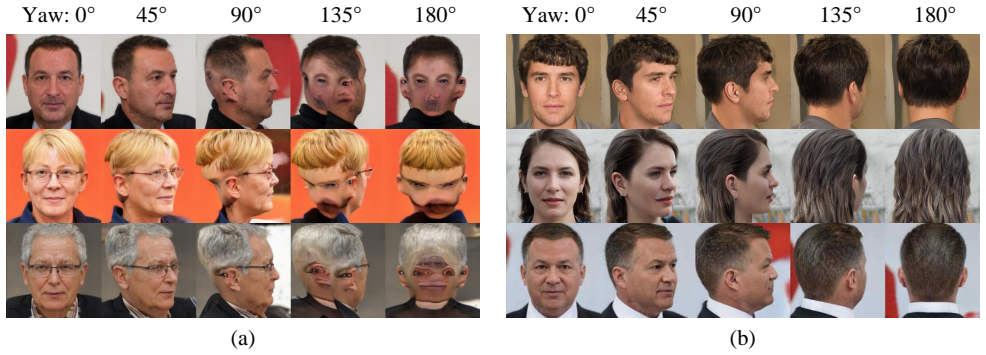
The central claim is that cylindrical coordinates explicitly separate features by azimuth, so front and back views no longer draw from identical feature locations the way they do on the XY-plane of a Tri-plane. The paper argues that this structural change, rather than extra data or pose balancing, is the main reason its renders stay consistent over a full 360-degree orbit. To handle geometry that one cylinder cannot capture, the nested-cylinder construction stacks multiple cylindrical surfaces with increasing radii, effectively giving the generator a multi-scale set of angular feature maps. The consequence is a representation that reports FID-back of 40.83 versus 51.61 for PanoHead on the same full-head task while keeping front-view quality comparable.
Load-bearing premise
The load-bearing premise is that every surface point of the subject lies on one of a stack of upright cylinders sharing a single vertical axis, so points with the same angle and height but different depths are still well separated; subjects that protrude sideways or curve inward would need many wide cylinders or lose resolution.
Editorial extensions
If this is right
- On the paper's full-head dataset, FID-back drops from 51.61 with PanoHead to 40.83 with CylinderPlane, while front-view and overall FID stay slightly better, so the back-of-head views are the main quantitative gain.
- Because the representation is agnostic to the renderer, any neural rendering pipeline that can consume per-point features can adopt the cylindrical field without changing its rendering math.
- Since angular separation is built into the coordinate system, the multi-face artifact should not return when the training camera distribution is imbalanced, a failure mode the paper attributes to Cartesian feature entanglement.
- Nested cylinders at multiple radii give the model a built-in multi-scale capacity, so scenes at different resolutions can share the same representation instead of being locked to one feature-plane resolution.
- The seam at $\theta = \pm \pi$ is explicitly controlled by two regularization terms, so 360-degree wrapping is handled as part of the design rather than as an afterthought.
Reading between the lines
- Beyond the paper: the paper tests only upright, head-centric subjects; for objects with a horizontal symmetry axis or deep undercuts, the fixed vertical cylinder axis would likely need reorientation or many extra radii, so the artifact-free advantage may not transfer unchanged.
- Beyond the paper: the angular-separation hypothesis predicts that CylinderPlane's FID-back advantage should persist even when training data is deliberately pose-imbalanced; running that ablation would separate the structural fix from dataset effects.
- Beyond the paper: the seam regularization introduces a new failure surface that Cartesian tri-planes do not have; checking for a faint vertical seam in high-resolution orbit videos would test whether the $\theta = \pm \pi$ continuity is fully resolved.
Editorial analysis
A structured set of objections, weighed in public.
Referee Report
Summary. The paper proposes CylinderPlane, an implicit neural representation for 3D-aware image generation in which 3D positions are expressed in cylindrical coordinates (θ, r, y) and feature planes are defined on θ-y, r-θ, and y-r surfaces, with additional nested θ-y cylinders at multiple radii Fθy = {F^{r0}_{θy}, ..., F^{rN}_{θy}}. The motivation is that Cartesian tri-planes entangle features at symmetric angles and cause the Janus artifact, whereas cylindrical coordinates explicitly separate angular information. The method includes seam regularization at θ = −π/π and is claimed to be renderer-agnostic. Experiments report FID-front, FID-back, and FID-all on a self-built full-head dataset compared with PanoHead (5.94→5.22, 51.61→40.83, 5.98→5.15), plus visual comparisons. The abstract promises synthetic-object experiments, but the Experiments section contains only this real-data comparison.
Significance. If the reported improvements are reproducible under controlled conditions, CylinderPlane would be a conceptually simple and plausible fix for a known failure mode of tri-plane GANs, and the proposed dataset release would be a useful community resource. The paper also has strengths: the representation is easy to describe, it is renderer-agnostic in principle, and the reported FID-back improvement is large. However, the current manuscript does not provide enough experimental detail or breadth to establish that the cylindrical coordinate system, rather than training or data curation choices, causes the improvement. The significance is therefore conditional on additional experiments.
major comments (5)
- [Experiments, Table 1] The central empirical claim—that CylinderPlane removes the Janus artifact—rests on a single uncontrolled comparison with PanoHead. The manuscript does not state the training iterations, batch size, training resolution, pose distribution, loss weights, generator and discriminator architectures, or the exact real-image set used to compute FID-front, FID-back, and FID-all. Because these factors can easily produce multi-point FID differences, the 10.78-point FID-back gap cannot be attributed to the cylindrical representation without a controlled comparison that keeps the backbone, training budget, data, and evaluation protocol identical and reports multiple seeds with standard deviations.
- [Multi-scale Nested Cylinder Planes, Eq. (1)] Eq. (1) defines the set of nested θ-y cylinders but never specifies the combination rule for a query point whose radial coordinate r lies between r_i and r_{i+1}. The text says feature vectors are 'summed' for the three base planes, but it does not say whether the nested cylinders are also summed, whether features are interpolated across radii, or whether points outside the largest radius receive features. The manuscript also omits the values of N and the radii set and provides no ablation over these choices. The exact coordinate convention (θ range, axis orientation, and the mapping from Cartesian points to (θ, r, y)) is also not defined. Without this information, the proposed representation is not reproducible and the multi-scale claim is not tested.
- [Abstract and Experiments] The abstract and conclusion state that 'extensive experiments on both synthetic dataset and unstructured in-the-wild images' are performed, yet the Experiments section contains only the in-the-wild full-head comparison. No synthetic-object experiments, ground-truth multi-view consistency metrics, or quantitative Janus-artifact measures are reported. Because the central claim is about multi-view consistency and artifact removal, the paper needs either the promised synthetic experiments or explicit per-view consistency metrics (e.g., identity or feature similarity across yaw, or Chamfer distance against known geometry).
- [CylinderPlane Boundary Regularization] The seam regularization is load-bearing for the claim of artifact-free synthesis, but the two terms are only described verbally and the details are deferred to a Supplementary Material that is not present in the arXiv submission. The difference loss, the smoothing kernel, and their weights must be specified in the main text or an accessible supplement; otherwise the artifact-free claim cannot be reproduced or independently assessed.
- [Integration with Neural Rendering Pipelines] The paper claims the representation is agnostic to rendering pipelines and describes integration with volume rendering and DMTet, but no experiments with the DMTet-based mesh rasterizer or any non-volume renderer are reported. Similarly, the claimed robustness to varying resolutions is not evaluated: no experiments vary feature-plane resolution or output resolution. The manuscript also does not discuss or evaluate the representation's behavior for geometry that is off-axis relative to the shared y-axis or contains undercuts; with a fixed, finite set of radii, such geometry will be sampled at large radial distances where the nested cylinders are sparse. The generalization claims exceed the provided evidence.
minor comments (5)
- [Experiments, Results] The word 'vbvious' should be 'obvious'.
- [Abstract] The phrase 'allowing our cylindrical representation possible to achieve' is ungrammatical; it should be 'enabling our cylindrical representation to achieve' or 'allowing our cylindrical representation to achieve'.
- [Multi-scale Nested Cylinder Planes, Eq. (1)] Fθy is first introduced as a single plane and then, in Eq. (1), as a set of nested planes; using the same symbol for both is confusing and should be clarified with distinct notation.
- [References] In the reference to Yu et al. 2022, 'InProceeddings' should be 'In Proceedings', and the journal name is missing a space.
- [Experiments, Results] The sentence 'proving the effectiveness of our design' overstates what a single FID comparison can demonstrate; I suggest 'consistent with the effectiveness of our design' or similar.
Circularity Check
No circularity: the central FID comparison is an independent empirical evaluation against PanoHead, and the cylindrical representation is an architectural proposal rather than a fitted quantity.
full rationale
The paper's derivation chain does not reduce to its own inputs. The claimed benefit that cylindrical coordinates separate angular features and thereby avoid the Janus artifact is a design hypothesis realized by mapping feature planes into a cylindrical coordinate system; it is not derived from the evaluation metric. The main evidence is the measured FID comparison in Table 1, computed against real images and an external baseline (PanoHead), which is independent of the proposed representation's construction. Equation (1) simply defines the nested set of cylindrical surfaces and is an architectural choice, not a fitted parameter later renamed as a prediction. The paper contains no self-citations that carry the argument, no imported uniqueness theorems, and no instance where a fitted value is presented as a predicted result. The absence of ablations, unreported hyperparameters, and the self-built dataset are legitimate reproducibility and attribution concerns, but they are matters of experimental rigor rather than circularity. Accordingly, no specific circular step can be quoted and no score above zero is warranted.
Assumptions & free parameters
free parameters (4)
- Number of nested cylinders N =
not reported
- Cylinder radii set {r0, ..., rN} =
not reported
- Regularization weights at seam θ = ±π =
not reported
- Feature plane resolutions =
not reported
assumptions (4)
- domain assumption A scene can be parameterized by nested cylinders sharing a single y-axis (Multi-scale Nested Cylinder Planes, Eq. 1).
- ad hoc to paper A point's cylindrical coordinates (θ, r, y) can be projected onto three feature planes Fθy, Frθ, Fyr and the bilinearly interpolated features summed to represent color and density.
- ad hoc to paper Regularizing the seam at θ = −π and θ = π removes numerical discontinuities.
- domain assumption FID computed on the author-built Full-Head dataset is a valid measure of 3D consistency.
invented entities (2)
-
CylinderPlane representation
-
Nested cylinder stack
Cite this review
Pith. "Pith review of CylinderPlane: Nested Cylinder Representation for 3D-aware Image Generation." pith.science (2026). https://pith.science/paper/FVI5Q3WR
@misc{pith2026250715606,
  author       = {Pith},
  title        = {Pith review of: CylinderPlane: Nested Cylinder Representation for 3D-aware Image Generation},
  year         = {2026},
  howpublished = {\url{https://pith.science/paper/FVI5Q3WR}},
  note         = {Machine review of arXiv:2507.15606}
}
abstract
While the proposal of the Tri-plane representation has advanced the development of the 3D-aware image generative models, problems rooted in its inherent structure, such as multi-face artifacts caused by sharing the same features in symmetric regions, limit its ability to generate 360$^\circ$ view images. In this paper, we propose CylinderPlane, a novel implicit representation based on Cylindrical Coordinate System, to eliminate the feature ambiguity issue and ensure multi-view consistency in 360$^\circ$. Different from the inevitable feature entanglement in Cartesian coordinate-based Tri-plane representation, the cylindrical coordinate system explicitly separates features at different angles, allowing our cylindrical representation possible to achieve high-quality, artifacts-free 360$^\circ$ image synthesis. We further introduce the nested cylinder representation that composites multiple cylinders at different scales, thereby enabling the model more adaptable to complex geometry and varying resolutions. The combination of cylinders with different resolutions can effectively capture more critical locations and multi-scale features, greatly facilitates fine detail learning and robustness to different resolutions. Moreover, our representation is agnostic to implicit rendering methods and can be easily integrated into any neural rendering pipeline. Extensive experiments on both synthetic dataset and unstructured in-the-wild images demonstrate that our proposed representation achieves superior performance over previous methods.
Figures


Figures from the paper (1 more)
Reference graph
Works this paper leans on
-
[1]
, " * write output.state after.block = add.period write newline
ENTRY address archivePrefix author booktitle chapter edition editor eid eprint howpublished institution isbn journal key month note number organization pages publisher school series title type volume year label extra.label sort.label short.list INTEGERS output.state before.all mid.sentence after.sentence after.block FUNCTION init.state.consts #0 'before.a...
-
[2]
write newline
" write newline "" before.all 'output.state := FUNCTION n.dashify 't := "" t empty not t #1 #1 substring "-" = t #1 #2 substring "--" = not "--" * t #2 global.max substring 't := t #1 #1 substring "-" = "-" * t #2 global.max substring 't := while if t #1 #1 substring * t #2 global.max substring 't := if while FUNCTION word.in bbl.in capitalize " " * FUNCT...
-
[3]
An, S.; Xu, H.; Shi, Y.; Song, G.; Ogras, U. Y.; and Luo, L. 2023. Panohead: Geometry-aware 3d full-head synthesis in 360deg. In Proceedings of the IEEE/CVF conference on computer vision and pattern recognition, 20950--20959
work page 2023
-
[4]
R.; Lin, C
Chan, E. R.; Lin, C. Z.; Chan, M. A.; Nagano, K.; Pan, B.; De Mello, S.; Gallo, O.; Guibas, L. J.; Tremblay, J.; Khamis, S.; et al. 2022. Efficient geometry-aware 3d generative adversarial networks. In Proceedings of the IEEE/CVF conference on computer vision and pattern recognition, 16123--16133
2022
-
[5]
Chen, A.; Xu, Z.; Geiger, A.; Yu, J.; and Su, H. 2022. Tensorf: Tensorial radiance fields. In European conference on computer vision, 333--350. Springer
2022
-
[6]
Deng, Y.; Yang, J.; Xiang, J.; and Tong, X. 2022. Gram: Generative radiance manifolds for 3d-aware image generation. In Proceedings of the IEEE/CVF conference on computer vision and pattern recognition, 10673--10683
work page 2022
-
[7]
Fridovich-Keil, S.; Yu, A.; Tancik, M.; Chen, Q.; Recht, B.; and Kanazawa, A. 2022. Plenoxels: Radiance fields without neural networks. In Proceedings of the IEEE/CVF conference on computer vision and pattern recognition, 5501--5510
2022
-
[8]
Gu, J.; Liu, L.; Wang, P.; and Theobalt, C. 2021. Stylenerf: A style-based 3d-aware generator for high-resolution image synthesis. arXiv preprint arXiv:2110.08985
arXiv 2021
Show all 18 references
-
[9]
Heusel, M.; Ramsauer, H.; Unterthiner, T.; Nessler, B.; and Hochreiter, S. 2017. Gans trained by a two time-scale update rule converge to a local nash equilibrium. Advances in neural information processing systems, 30
2017
-
[10]
Karras, T.; Laine, S.; and Aila, T. 2019. A style-based generator architecture for generative adversarial networks. In Proceedings of the IEEE/CVF conference on computer vision and pattern recognition, 4401--4410
2019
-
[11]
Kim, T.; Chung, C.; Park, S.; Gu, G.; Nam, K.; Choe, W.; Lee, J.; and Choo, J. 2021. K-hairstyle: A large-scale korean hairstyle dataset for virtual hair editing and hairstyle classification. In 2021 IEEE International Conference on Image Processing (ICIP), 1299--1303. IEEE
2021
-
[12]
Lu, S.; Liu, Y.; and Kong, A. W.-K. 2023. Tf-icon: Diffusion-based training-free cross-domain image composition. In Proceedings of the IEEE/CVF International Conference on Computer Vision, 2294--2305
2023
-
[13]
Lu, S.; Wang, Z.; Li, L.; Liu, Y.; and Kong, A. W.-K. 2024. Mace: Mass concept erasure in diffusion models. In Proceedings of the IEEE/CVF Conference on Computer Vision and Pattern Recognition, 6430--6440
2024
-
[14]
P.; Tancik, M.; Barron, J
Mildenhall, B.; Srinivasan, P. P.; Tancik, M.; Barron, J. T.; Ramamoorthi, R.; and Ng, R. 2021. Nerf: Representing scenes as neural radiance fields for view synthesis. Communications of the ACM, 65(1): 99--106
2021
-
[15]
M \"u ller, T.; Evans, A.; Schied, C.; and Keller, A. 2022. Instant neural graphics primitives with a multiresolution hash encoding. ACM transactions on graphics (TOG), 41(4): 1--15
2022
-
[16]
Shen, T.; Gao, J.; Yin, K.; Liu, M.-Y.; and Fidler, S. 2021. Deep Marching Tetrahedra: a Hybrid Representation for High-Resolution 3D Shape Synthesis. In Advances in Neural Information Processing Systems (NeurIPS)
2021
-
[17]
Wu, Y.; Zhang, J.; Fu, H.; and Jin, X. 2023. Lpff: A portrait dataset for face generators across large poses. In Proceedings of the IEEE/CVF International Conference on Computer Vision, 20327--20337
2023
-
[18]
Yu, X.; Tang, J.; Qin, Y.; Li, C.; Han, X.; Bao, L.; and Cui, S. 2022. PVSeRF: joint pixel-, voxel-and surface-aligned radiance field for single-image novel view synthesis. In Proceedings of the 30th ACM International Conference on Multimedia, 1572--1583
2022
Reviewed August 6, 2026 · model on record in the stance chip above.
Discussion (0). Sign in to comment.