REVIEW 4 major objections 6 minor 55 references
Hi^2-GSLoc: Dual-Hierarchical Gaussian-Specific Visual Relocalization for Remote Sensing
T0 review · 4 major / 6 minor · reviewed 2026-08-06 · deepseek-v4-flash
Pith's one-line read A UAV can relocalize against a prebuilt 3D Gaussian Splatting map using only a camera, with median translation errors near 0.1 m and 100% recall after unreliable poses are rejected, the paper claims.
desk verdict Plausible pipeline, but the reported 100% recall is an artifact of filtering the denominator, and the inference time excludes the heavy stages. read the letter →
The pith
A machine-rendered reading of the paper's core claim, the machinery that carries it, and where it could break.
The reading
What carries the argument
The central object is a Feature Gaussian scene: 3D Gaussian Splatting primitives with trainable attributes $\Theta_i = \{(x_i,y_i,z_i),q_i,s_i,\alpha_i,c_i,f_i\}$, where $f_i$ is a learned feature vector rendered into feature maps alongside RGB and depth, trained jointly with photometric and feature-field losses. The argument is carried by the dual hierarchy built on that representation: consistent render-aware sampling scores Gaussians by cosine similarity between their features and the features at their projected training-image locations, checked through a render-gradient visibility test and spread spatially by k-nearest-neighbor competition; a landmark-guided detector, a shallow CNN trained on those projected landmarks, finds matching 2D keypoints in the query; the initial pose comes from PnP, then coarse-to-fine windowed probabilistic mutual matching against rendered feature and depth maps refines it; and consistency verification rejects poses whose successive refinement rounds differ by more than $20^\circ$. This chain of geometry-guided landmark selection, scene-specific detection, dense rasterization matching, and consistency filtering is what produces the claimed accuracy.
What would settle it
Recompute recall with all test images in the denominator, including those flagged unreliable, at the 2 m/2 degree threshold on Mill 19-Rubble and report the rejection rate; if the all-query recall stays at 100% the filtering claim stands, and if it falls to about 93.9% the filtering claim is an artifact of the denominator.
Extended reading notes
Core claim
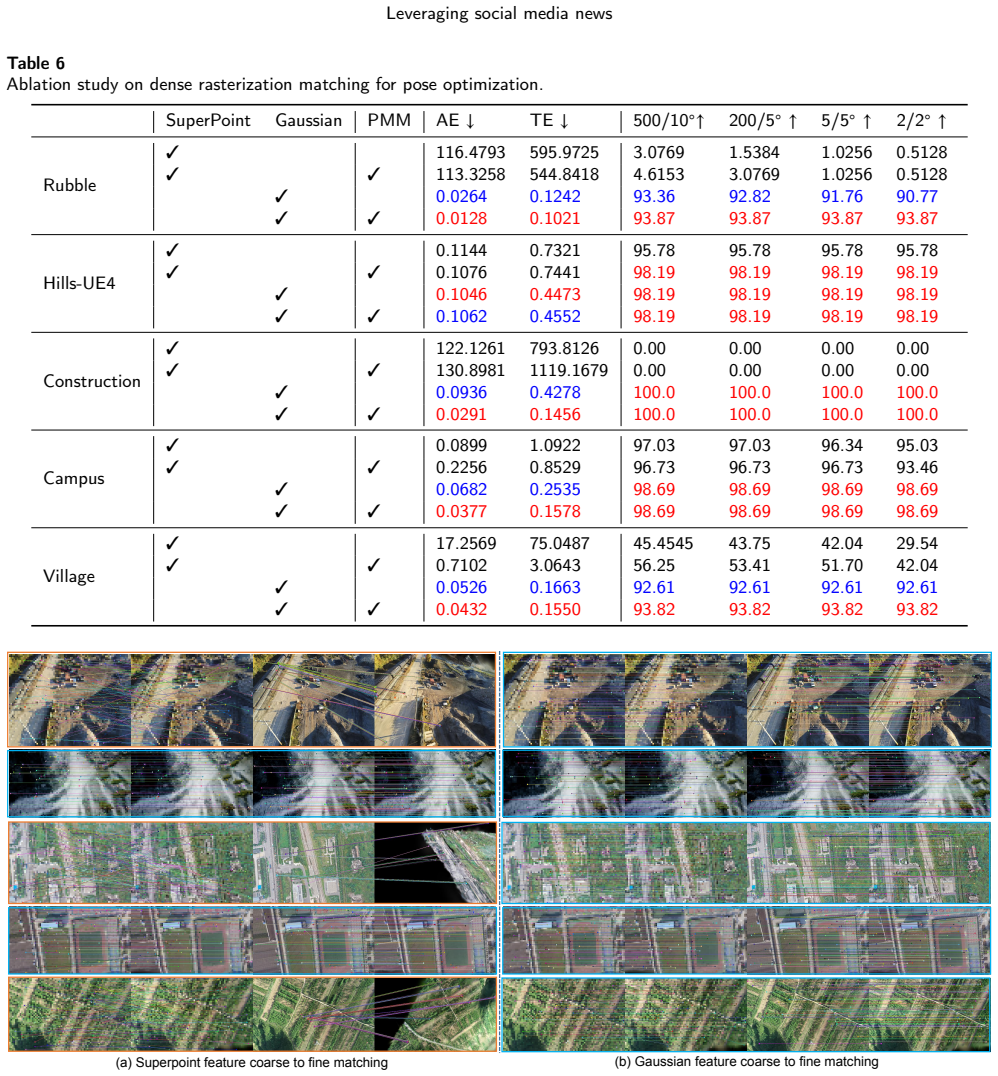
The central claim is that treating each 3D Gaussian primitive as a landmark carrying geometry, appearance, and a learned feature vector lets a two-stage pipeline go from a coarse 2D-3D pose to a refined pose by rasterizing the map from the current estimate and matching rendered features to query features. The sparse stage selects consistent, render-visible, well-distributed Gaussians as landmarks and trains a detector to find their projections in the query image; the dense stage refines the pose by probabilistic mutual matching on rendered feature and depth maps, then verifies consistency across several refinement iterations and outputs a pose only if those iterations agree. On the Cambridge Landmarks benchmark the method matches or beats structure-based baselines in median translation and rotation error, and on the remote-sensing scenes it reports median errors around 0.1 to 0.16 m and angular errors around 0.01 to 0.04 degrees, with 100% recall after filtering in Table 3.
Load-bearing premise
The load-bearing premise is that recall may be counted only over queries that survive the consistency check, so a rejected query is treated as a success rather than a failure; if rejected queries are included in the denominator, the reported 100% recall on Mill 19-Rubble drops to 93.87%.
Editorial extensions
If this is right
- If the central claim holds, a UAV can localize in GPS-denied areas against a prebuilt Gaussian map, with reported median translation errors of 0.10 to 0.16 m on Mill 19-Rubble, Construction, Campus, and Village scenes and angular errors near 0.01 to 0.04 degrees.
- The consistency verification turns the system into a conservative one: instead of emitting a wrong pose, it rejects the query when refinement rounds disagree by more than 20 degrees, which is why the reported final recall rises to 100%.
- Because matching relies on the Gaussian map's own rendered features and depth, the method does not depend on external descriptors trained on ground-level imagery, and the ablation shows that substituting SuperPoint features can collapse recall to 0% on the Construction scene.
- Partitioned Gaussian training and GPU-parallel windowed matching are what let 3DGS-based relocalization move beyond small indoor scenes to roughly one-square-kilometer aerial environments.
- The reported post-filter inference cost of about 0.24 ms per query would make the final stage compatible with real-time UAV loops, while the pre-filtering matching stage still costs on the order of one to five seconds per query.
Reading between the lines
- A direct implication the authors leave implicit is that the system's operational value is set by its rejection rate: in a new scene, if a large fraction of queries are flagged unreliable, the 100% recall on accepted queries no longer describes the vehicle's actual ability to localize.
- The per-scene detector training of up to 50 minutes and per-scene Gaussian fitting mean the method is a map-construction service rather than a zero-shot localizer; a useful test would measure how quickly a new scene can be mapped before localization becomes usable.
- Reporting recall over all queries including rejected ones, and publishing the per-scene rejection rate, would make comparisons with retrieval baselines such as MegaLoc fairer and would let practitioners set an explicit no-answer policy.
- Because the ablation isolates SuperPoint's failure, a natural extension is to swap in other foundation features for the Gaussian feature field and the detector backbone; if accuracy survives such swaps, the Gaussian landmark mechanism rather than the specific feature extractor is the load-bearing contribution.
Editorial analysis
A structured set of objections, weighed in public.
Referee Report
Summary. This paper proposes Hi^2-GSLoc, a 3D Gaussian Splatting (3DGS) based visual relocalization pipeline for UAV and remote sensing scenarios. The method first samples Gaussian landmarks using a render-aware significance score and trains a landmark-guided keypoint detector to establish 2D-3D correspondences for an initial PnP pose; it then renders dense feature and depth maps from the initial pose and refines the pose with coarse-to-fine probabilistic mutual matching; finally, a consistency verification step (Algorithm 2) rejects poses that disagree across repeated dense refinements. The authors evaluate on Cambridge Landmarks, Mill 19-Rubble, and a new Xi-MSTS dataset comprising real and synthetic aerial scenes. They report median errors around 0.1 m and 0.01 degrees, recall rates up to 100% after filtering, and inference times near 0.00024 s.
Significance. If validated, the paper would make a useful contribution: it is among the first attempts to adapt 3DGS feature fields to large-scale aerial relocalization, and the scalability ingredients (partitioned Gaussian training, batched landmark sampling, GPU-accelerated matching) are sensible engineering choices. The paper also introduces a new multi-scene UAV dataset and provides detailed ablations of the landmark sampling, detector, and dense matching components. However, the headline evaluation claims are currently not supported: the 100% recall after filtering is an artifact of the evaluation denominator, and the reported 'final' inference time measures only the verification overhead. The underlying ideas are plausible and the reanalysis needed to fix the evaluation is within the scope of a revision, but the evidence as presented does not yet establish the claimed reliability and efficiency.
major comments (4)
- [§4.3, Table 3, Table 4] The definition of recall in §4.3 ('the percentage of test images successfully localized within predefined error thresholds') is incompatible with the way the 'ours(final)' recall is computed. Table 3 reports 'ours' at 93.87% and 'ours(final)' at 100.0% for Mill 19-Rubble at the 2/2 threshold, and Table 4 shows the same pattern at every training iteration (e.g., 20,000 iterations: 91.32% after refinement versus 100.0% after filtering). Since the filtering step can only remove queries, final recall can exceed the unfiltered recall only if the rejected queries are excluded from the denominator. If every rejected query is counted as a localization failure, the final recall collapses to the unfiltered value. The statements in §4.5 and §5 that the consistency mechanism 'successfully eliminates 100% of unreliable pose estimates' and yields 'superior recall rates' are therefore unsupported. Please report recall over all test images, separately report the rejection rate, and either abandon the '100% recall' phrasing or redefine the metric as accepted-query recall with the rejection rate explicitly stated.
- [Table 3, Table 4, §4.6] The 'Inference/s' column for 'ours(final)' (0.00024 s) cannot represent the end-to-end latency of the system: the only difference between 'ours' and 'ours(final)' is the consistency verification of Algorithm 2, while the sparse matching and dense rasterization pipeline is measured at 1.1–5.0 s in the same table. The text in §4.6 correctly describes 0.24 ms as the overhead added by consistency checking, not as total inference time. The table therefore misleads readers about the practical efficiency of the method. Relabel this column as 'verification overhead' or report the full pipeline time as refine time plus overhead, and use the same convention in Table 4.
- [Algorithm 2] The pseudocode of the consistency verification loop does not implement the described 'checking angular differences across multiple results' or 'any two' comparisons. In Algorithm 2, the loop 'for i=1 to n−1' calls Ψ(T1,T2) on every iteration, so for the stated n=3 only the first pair of dense poses is ever compared and the third refined pose is never checked. If this is a typographical error, the pseudocode should read Ψ(T_i, T_{i+1}) (or all pairs), and the actual implementation should be described; if the implementation really compares only the first two poses, the claim that 100% of unreliable estimates are removed is not supported by the algorithm as written.
- [Table 3 vs §4.1, §4.5] The ground-truth source is inconsistent across the paper. Table 3 is captioned 'with SfM ground truth,' but §4.1 states that the Xi-MSTS real-world scenes use 'high-precision ground truth poses obtained through RTK-GPS measurements,' and §4.5 reports trajectory comparisons and mean errors directly against RTK-GPS. The interpretation of the sub-decimeter/centimeter-level accuracy figures depends on which reference is used and whether the SfM model is aligned to RTK-GPS. Clarify which ground truth is used for Table 3, Table 4, and Figure 7, and describe the alignment procedure if both references are involved.
minor comments (6)
- [Section 3 and figure captions] The Section 3 heading 'Methodlogy,' the Figure 5 caption 'Lnadmark-guided detector,' the Figure 7 caption 'Tarjectories,' and the Table 2 entry 'Cambrideg' contain typos that should be corrected.
- [Eqs. (9), (10), (11)] The symbol τ is reused for the detector confidence threshold in Eq. (9), the robust loss threshold in Eq. (10), and the PMM temperature in Eq. (11); using distinct symbols (e.g., τ_conf, τ_rob, τ_temp) would remove ambiguity.
- [§3.4, Algorithm 2] The consistency threshold of 20 degrees and the iteration count n=3 are introduced without sensitivity analysis; a short study or at least a statement of how these values affect the rejection rate would strengthen the filtering claim.
- [Table 1] The 'Acquisition time' column mixes dates, times, and 'None' entries and appears inconsistent; make the column uniform and define what is reported.
- [Figures 7 and 8] The error and trajectory plots would benefit from axis labels and units; the text reports means but no standard deviations or per-scene counts, which would help assess variability.
- [Eq. (10)] The notation for the 3D Gaussian point is inconsistent: Eq. (10) uses \tilde{g}^{3D}_i while the surrounding text uses g_i^{3D}; please unify the notation.
Circularity Check
The 100% recall of the consistency-filtered 'ours(final)' rows is computed on the self-selected subset of queries that pass the filter, so the headline robustness claim is true by definition rather than by ground-truth evaluation; the unfiltered median-error and recall results remain independent content.
-
self definitional
[Section 4.3 (Evaluation metric) and Section 4.5 / Table 3 (ours(final) rows)]
"The localization recall rate represents the percentage of test images successfully localized within predefined error thresholds. Specifically, an image is considered successfully localized when both translational and rotational errors fall below specified tolerance levels simultaneously."
Under this definition the denominator is all test images. In Table 3, Mill 19-Rubble 'ours' is 93.87% at 2/2 while 'ours(final)' is 100.0%, and Algorithm 2 only rejects poses without refining accepted ones. With the paper's own denominator, final recall cannot exceed the unfiltered recall; the only way to obtain 100% is to compute recall over queries that survived the consistency filter. Those queries are precisely the ones the filter labels reliable, so the reported '100% recall' is the filter's acceptance rate on its own accepted subset, not the percentage of all test images localized within the stated thresholds.
-
self definitional
[Section 3.4 (Consistency verification / Algorithm 2) and Section 4.5]
"During a single pose computation, if we detect pose inconsistency between any two coarse-to-fine iterative dense pose calculations—i.e., angular difference exceeding threshold τ = 20◦—we consider the result unreliable and directly skip to compute the next query, ensuring the localization system is not affected by erroneous results under extreme conditions."
Algorithm 2 defines 'unreliable' as any pose whose pairwise angular difference with another run exceeds τ and then returns final_pose only for the non-rejected cases. The later statement that the filtering mechanism 'successfully eliminates 100% of unreliable pose estimates' is therefore a restatement of the filter's own rejection rule: every estimate it labels unreliable is, by construction, one that it rejects. It is not a ground-truth measurement that rejected poses were actually inaccurate or that the accepted poses are correct, and the inflated final recall in Table 3 is presented as evidence of that tautology.
full rationale
The core pose estimation pipeline is not circular: landmark scoring uses Eq. (4)-(6), the landmark-guided detector is trained by projecting sampled Gaussian landmarks with rendering-visibility supervision (Eq. 8), and dense refinement minimizes a PnP objective (Eq. 10). These steps have internal structure whose outputs on held-out test queries are not predetermined by construction, and the median translation/rotation errors plus the unfiltered 'ours' recall rows in Tables 2-5 carry independent experimental content. The circularity is confined to the consistency-filtered results: Section 4.3 defines recall over all test images, but Algorithm 2 removes 'unreliable' queries before the reported final recall is computed. Since filtering does not alter accepted poses, Table 3's jump from 93.87% ('ours') to 100.0% ('ours(final)') on Mill 19-Rubble is impossible under the paper's own metric unless the denominator is the filter's accepted subset. The headline '100% recall' and 'eliminates 100% of unreliable pose estimates' are therefore true by definition of the rejection rule rather than by ground-truth evaluation. The unfiltered 93.87% recall and cm-level median errors remain legitimate evidence of the method's accuracy, which is why the score is 6 rather than higher. Separately, the reported 0.00024 s 'ours(final)' inference time appears to be only the consistency-check overhead, not the full sparse-plus-dense pipeline listed in the 'ours' rows; this is an evaluation-reporting artifact rather than a derivation-loop issue.
Assumptions & free parameters
free parameters (8)
- detector confidence threshold tau (Eq. 9) =
not stated
- NMS suppression radius r (Eq. 9) =
not stated
- PMM softmax temperature tau (Eq. 11) =
not stated
- top-k correspondences for PnP (Eq. 10) =
not stated
- number of sampled landmarks Q =
16384 per scene
- consistency verification threshold and iteration count =
tau=20 deg, n=3
- coarse-to-fine resolution ratio H_f/H_c =
8
- kNN neighborhood search radius r_i (Eq. 7) =
not stated
assumptions (5)
- domain assumption 3DGS with Feature-3DGS distilled feature fields provides features matchable across real query views
- domain assumption VastGaussian progressive partitioning yields a seamlessly merged large-scale scene usable for rendering and matching
- domain assumption The ground truth poses are accurate enough to support sub-decimeter error claims
- standard math PnP with RANSAC and robust loss recovers the correct pose from a set of mostly correct 2D-3D correspondences
- domain assumption Render-gradient visibility (Algorithm 1) is a valid proxy for landmark matchability across viewpoints
Cite this review
Pith. "Pith review of Hi^2-GSLoc: Dual-Hierarchical Gaussian-Specific Visual Relocalization for Remote Sensing." pith.science (2026). https://pith.science/paper/EMSPDQ5H
@misc{pith2026250715683,
  author       = {Pith},
  title        = {Pith review of: Hi^2-GSLoc: Dual-Hierarchical Gaussian-Specific Visual Relocalization for Remote Sensing},
  year         = {2026},
  howpublished = {\url{https://pith.science/paper/EMSPDQ5H}},
  note         = {Machine review of arXiv:2507.15683}
}
abstract
Visual relocalization, which estimates the 6-degree-of-freedom (6-DoF) camera pose from query images, is fundamental to remote sensing and UAV applications. Existing methods face inherent trade-offs: image-based retrieval and pose regression approaches lack precision, while structure-based methods that register queries to Structure-from-Motion (SfM) models suffer from computational complexity and limited scalability. These challenges are particularly pronounced in remote sensing scenarios due to large-scale scenes, high altitude variations, and domain gaps of existing visual priors. To overcome these limitations, we leverage 3D Gaussian Splatting (3DGS) as a novel scene representation that compactly encodes both 3D geometry and appearance. We introduce $\mathrm{Hi}^2$-GSLoc, a dual-hierarchical relocalization framework that follows a sparse-to-dense and coarse-to-fine paradigm, fully exploiting the rich semantic information and geometric constraints inherent in Gaussian primitives. To handle large-scale remote sensing scenarios, we incorporate partitioned Gaussian training, GPU-accelerated parallel matching, and dynamic memory management strategies. Our approach consists of two stages: (1) a sparse stage featuring a Gaussian-specific consistent render-aware sampling strategy and landmark-guided detector for robust and accurate initial pose estimation, and (2) a dense stage that iteratively refines poses through coarse-to-fine dense rasterization matching while incorporating reliability verification. Through comprehensive evaluation on simulation data, public datasets, and real flight experiments, we demonstrate that our method delivers competitive localization accuracy, recall rate, and computational efficiency while effectively filtering unreliable pose estimates. The results confirm the effectiveness of our approach for practical remote sensing applications.
Figures


Figures from the paper (8 more)



Reference graph
Works this paper leans on
-
[1]
author Arandjelovic, R. , author Gronat, P. , author Torii, A. , author Pajdla, T. , author Sivic, J. , year 2016 . title Netvlad: Cnn architecture for weakly supervised place recognition , in: booktitle Proceedings of the IEEE conference on computer vision and pattern recognition , pp. pages 5297--5307
work page 2016
-
[2]
MegaLoc: One Retrieval to Place Them All
author Berton, G. , author Masone, C. , year 2025 . title Megaloc: One retrieval to place them all . journal arXiv preprint arXiv:2502.17237
work page Pith review arXiv 2025
-
[3]
author Berton, G. , author Trivigno, G. , author Caputo, B. , author Masone, C. , year 2023 . title Eigenplaces: Training viewpoint robust models for visual place recognition , in: booktitle Proceedings of the IEEE/CVF International Conference on Computer Vision , pp. pages 11080--11090
work page 2023
-
[4]
author Brachmann, E. , author Krull, A. , author Nowozin, S. , author Shotton, J. , author Michel, F. , author Gumhold, S. , author Rother, C. , year 2017 . title Dsac-differentiable ransac for camera localization , in: booktitle Proceedings of the IEEE conference on computer vision and pattern recognition , pp. pages 6684--6692
work page 2017
-
[5]
author Brachmann, E. , author Rother, C. , year 2021 . title Visual camera re-localization from rgb and rgb-d images using dsac . journal IEEE transactions on pattern analysis and machine intelligence volume 44 , pages 5847--5865
work page 2021
-
[6]
author Brahmbhatt, S. , author Gu, J. , author Kim, K. , author Hays, J. , author Kautz, J. , year 2017 . title Geometry-aware learning of maps for camera localization . journal arXiv: Computer Vision and Pattern Recognition,arXiv: Computer Vision and Pattern Recognition
work page 2017
-
[7]
author Camposeco, F. , author Cohen, A. , author Pollefeys, M. , author Sattler, T. , year 2018 . title Hybrid scene compression for visual localization . journal arXiv: Computer Vision and Pattern Recognition,arXiv: Computer Vision and Pattern Recognition
work page 2018
-
[8]
author Chen, S. , author Li, X. , author Wang, Z. , author Prisacariu, V.A. , year 2022 . title Dfnet: Enhance absolute pose regression with direct feature matching , in: booktitle European Conference on Computer Vision , organization Springer . pp. pages 1--17
work page 2022
Show all 55 references
-
[9]
, author Wang, Z
author Chen, S. , author Wang, Z. , author Prisacariu, V. , year 2021 . title Direct-posenet: Absolute pose regression with photometric consistency , in: booktitle 2021 International Conference on 3D Vision (3DV) . http://dx.doi.org/10.1109/3dv53792.2021.00125, :10.1109/3dv537...
2021
-
[10]
, author Jiao, J
author Cheng, Y. , author Jiao, J. , author Wang, Y. , author Kanoulas, D. , year 2024 . title Logs: Visual localization via gaussian splatting with fewer training images . journal arXiv preprint arXiv:2410.11505
2024 arXiv
-
[11]
, author Wang, S
author Clark, R. , author Wang, S. , author Markham, A. , author Trigoni, N. , author Wen, H. , year 2017 . title Vidloc: A deep spatio-temporal model for 6-dof video-clip relocalization . journal Cornell University - arXiv,Cornell University - arXiv
2017
-
[12]
, author Malisiewicz, T
author DeTone, D. , author Malisiewicz, T. , author Rabinovich, A. , year 2018 . title Superpoint: Self-supervised interest point detection and description , in: booktitle 2018 IEEE/CVF Conference on Computer Vision and Pattern Recognition Workshops (CVPRW) . http://dx.doi.org...
2018
-
[13]
, author Sinha, S.N
author Do, T. , author Sinha, S.N. , year 2024 . title Improved scene landmark detection for camera localization , in: booktitle 2024 International Conference on 3D Vision (3DV) , organization IEEE . pp. pages 975--984
2024
-
[14]
, author Rocco, I
author Dusmanu, M. , author Rocco, I. , author Pajdla, T. , author Pollefeys, M. , author Sivic, J. , author Torii, A. , author Sattler, T. , year 2019 . title D2-net: A trainable cnn for joint description and detection of local features , in: booktitle 2019 IEEE/CVF Conferenc...
2019
-
[15]
, author Chen, S
author Feng, G. , author Chen, S. , author Fu, R. , author Liao, Z. , author Wang, Y. , author Liu, T. , author Hu, B. , author Xu, L. , author Pei, Z. , author Li, H. , et al., year 2025 . title Flashgs: Efficient 3d gaussian splatting for large-scale and high-resolution rend...
2025
-
[16]
, author Hou, X.R
author Gao, X.S. , author Hou, X.R. , author Tang, J. , author Cheng, H.F. , year 2003 . title Complete solution classification for the perspective-three-point problem . journal IEEE Transactions on Pattern Analysis and Machine Intelligence , pages 930–943 http://dx.doi.org/10...
2003 arXiv
-
[17]
, author Chen, L
author Hu, B. , author Chen, L. , author Chen, R. , author Bu, S. , author Han, P. , author Li, H. , year 2024 . title Curriculumloc: Enhancing cross-domain geolocalization through multi-stage refinement . journal IEEE Transactions on Geoscience and Remote Sensing
2024
-
[18]
, author Yu, H
author Huang, Z. , author Yu, H. , author Shentu, Y. , author Yuan, J. , author Zhang, G. , year 2025 . title From sparse to dense: Camera relocalization with scene-specific detector from feature gaussian splatting , in: booktitle Proceedings of the Computer Vision and Pattern...
2025
-
[19]
, author Karpur, A
author Jiang, H. , author Karpur, A. , author Cao, B. , author Huang, Q. , author Araujo, A. , year 2024 . title Omniglue: Generalizable feature matching with foundation model guidance , in: booktitle Proceedings of the IEEE/CVF Conference on Computer Vision and Pattern Recogn...
2024
-
[20]
, author Roumeliotis, S
author Ke, T. , author Roumeliotis, S. , year 2017 . title An efficient algebraic solution to the perspective-three-point problem . journal Cornell University - arXiv,Cornell University - arXiv
2017
-
[21]
, author Mishra, A
author Keetha, N. , author Mishra, A. , author Karhade, J. , author Jatavallabhula, K.M. , author Scherer, S. , author Krishna, M. , author Garg, S. , year 2023 . title Anyloc: Towards universal visual place recognition . journal IEEE Robotics and Automation Letters volume 9 ,...
2023
-
[22]
, author Cipolla, R
author Kendall, A. , author Cipolla, R. , year 2017 . title Geometric loss functions for camera pose regression with deep learning , in: booktitle 2017 IEEE Conference on Computer Vision and Pattern Recognition (CVPR) . http://dx.doi.org/10.1109/cvpr.2017.694, :10.1109/cvpr.2017.694
2017 doi
-
[23]
, author Grimes, M
author Kendall, A. , author Grimes, M. , author Cipolla, R. , year 2015 . title Posenet: A convolutional network for real-time 6-dof camera relocalization , in: booktitle Proceedings of the IEEE international conference on computer vision , pp. pages 2938--2946
2015
-
[24]
, author Kopanas, G
author Kerbl, B. , author Kopanas, G. , author Leimk\"uhler, T. , author Drettakis, G. , year 2023 . title 3d gaussian splatting for real-time radiance field rendering
2023
-
[25]
, author Cabon, Y
author Leroy, V. , author Cabon, Y. , author Revaud, J. , year 2024 . title Grounding image matching in 3d with mast3r , in: booktitle European Conference on Computer Vision , organization Springer . pp. pages 71--91
2024
-
[27]
, author Li, Z
author Lin, J. , author Li, Z. , author Tang, X. , author Liu, J. , author Liu, S. , author Liu, J. , author Lu, Y. , author Wu, X. , author Xu, S. , author Yan, Y. , author Yang, W. , year 2024 . title Vastgaussian: Vast 3d gaussians for large scene reconstruction . https://a...
2024 arXiv
-
[28]
, author Sarlin, P.E
author Lindenberger, P. , author Sarlin, P.E. , author Pollefeys, M. , author Zurich, E. , author Mixed, M. , . title Lightglue: Local feature matching at light speed
-
[29]
, author Chen, S
author Liu, C. , author Chen, S. , author Bhalgat, Y.S. , author Hu, S. , author Cheng, M. , author Wang, Z. , author Prisacariu, V.A. , author Braud, T. , year 2025 . title Gs-cpr: Efficient camera pose refinement via 3d gaussian splatting , in: booktitle The Thirteenth Inter...
2025
-
[30]
, author Jin, T
author Lu, F. , author Jin, T. , author Lan, X. , author Zhang, L. , author Liu, Y. , author Wang, Y. , author Yuan, C. , year 2025 . title Selavpr++: Towards seamless adaptation of foundation models for efficient place recognition . journal arXiv preprint arXiv:2502.16601
2025
-
[31]
, author Zhang, L
author Lu, F. , author Zhang, L. , author Lan, X. , author Dong, S. , author Wang, Y. , author Yuan, C. , year 2024 . title Towards seamless adaptation of pre-trained models for visual place recognition . journal arXiv preprint arXiv:2402.14505
2024 arXiv
-
[32]
, author Goel, R
author Mallick, S.S. , author Goel, R. , author Kerbl, B. , author Steinberger, M. , author Carrasco, F.V. , author De La Torre, F. , year 2024 . title Taming 3dgs: High-quality radiance fields with limited resources , in: booktitle SIGGRAPH Asia 2024 Conference Papers , pp. p...
2024
-
[33]
, author Piasco, N
author Moreau, A. , author Piasco, N. , author Bennehar, M. , author Tsishkou, D. , author Stanciulescu, B. , author Fortelle, A. , year 2023 . title Crossfire: Camera relocalization on self-supervised features from an implicit representation
2023
-
[34]
, author Darcet, T
author Oquab, M. , author Darcet, T. , author Moutakanni, T. , author Vo, H. , author Szafraniec, M. , author Khalidov, V. , author Fernandez, P. , author Haziza, D. , author Massa, F. , author El-Nouby, A. , et al., year 2023 . title Dinov2: Learning robust visual features wi...
2023 arXiv
-
[35]
, author Cadar, F
author Potje, G. , author Cadar, F. , author Araujo, A. , author Martins, R. , author Nascimento, E.R. , year 2024 . title Xfeat: Accelerated features for lightweight image matching , in: booktitle 2024 IEEE/CVF Conference on Computer Vision and Pattern Recognition (CVPR) , pp...
2024
-
[36]
, author Weinzaepfel, P
author Revaud, J. , author Weinzaepfel, P. , author Souza, C. , author Pion, N. , author Csurka, G. , author Cabon, Y. , author Humenberger, M. , year 2019 . title R2d2: Repeatable and reliable detector and descriptor. journal arXiv: Computer Vision and Pattern Recognition,arX...
2019
-
[37]
, author Cadena, C
author Sarlin, P.E. , author Cadena, C. , author Siegwart, R. , author Dymczyk, M. , year 2019 . title From coarse to fine: Robust hierarchical localization at large scale , in: booktitle 2019 IEEE/CVF Conference on Computer Vision and Pattern Recognition (CVPR) . http://dx.do...
2019
-
[38]
, author DeTone, D
author Sarlin, P.E. , author DeTone, D. , author Malisiewicz, T. , author Rabinovich, A. , year 2020 . title Superglue: Learning feature matching with graph neural networks , in: booktitle 2020 IEEE/CVF Conference on Computer Vision and Pattern Recognition (CVPR) . http://dx.d...
2020
-
[39]
, author Ferens, R
author Shavit, Y. , author Ferens, R. , author Keller, Y. , year 2021 . title Learning multi-scene absolute pose regression with transformers , in: booktitle 2021 IEEE/CVF International Conference on Computer Vision (ICCV) , pp. pages 2713--2722 . :10.1109/ICCV48922.2021.00273
2021
-
[40]
, author Mohrat, M
author Sidorov, G. , author Mohrat, M. , author Gridusov, D. , author Rakhimov, R. , author Kolyubin, S. , year 2025 . title Gsplatloc: Grounding keypoint descriptors into 3d gaussian splatting for improved visual localization
2025
-
[41]
, author Shen, Z
author Sun, J. , author Shen, Z. , author Wang, Y. , author Bao, H. , author Zhou, X. , year 2021 . title Loftr: Detector-free local feature matching with transformers , in: booktitle 2021 IEEE/CVF Conference on Computer Vision and Pattern Recognition (CVPR) . http://dx.doi.or...
2021
-
[42]
, author Okutomi, M
author Taira, H. , author Okutomi, M. , author Sattler, T. , author Cimpoi, M. , author Pollefeys, M. , author Sivic, J. , author Pajdla, T. , author Torii, A. , year 2021 . title Inloc: Indoor visual localization with dense matching and view synthesis . journal IEEE Transacti...
2021
-
[43]
, author Ramanan, D
author Turki, H. , author Ramanan, D. , author Satyanarayanan, M. , year 2022 . title Mega-nerf: Scalable construction of large-scale nerfs for virtual fly-throughs , in: booktitle Proceedings of the IEEE/CVF conference on computer vision and pattern recognition , pp. pages 12...
2022
-
[44]
, author Fua, P
author Tyszkiewicz, M. , author Fua, P. , author Trulls, E. , year 2020 . title Disk: Learning local features with policy gradient . journal Advances in Neural Information Processing Systems volume 33 , pages 14254--14265
2020
-
[45]
, author Hazirbas, C
author Walch, F. , author Hazirbas, C. , author Leal-Taixé, L. , author Sattler, T. , author Hilsenbeck, S. , author Cremers, D. , year 2016 . title Image-based localization using lstms for structured feature correlation . journal Cornell University - arXiv,Cornell University - arXiv
2016
-
[46]
, author Chen, S
author Wang, C. , author Chen, S. , author Song, Y. , author Xu, R. , author Zhang, Z. , author Zhang, J. , author Yang, H. , author Zhang, Y. , author Fu, K. , author Du, S. , et al., year 2025 a. title Focus on local: Finding reliable discriminative regions for visual place ...
2025
-
[47]
, author Yi, R
author Wang, X. , author Yi, R. , author Ma, L. , year 2024 . title Adr-gaussian: Accelerating gaussian splatting with adaptive radius , in: booktitle SIGGRAPH Asia 2024 Conference Papers , pp. pages 1--10
2024
-
[48]
, author Shi, D
author Wang, Z. , author Shi, D. , author Qiu, C. , author Jin, S. , author Li, T. , author Qiao, Z. , author Chen, Y. , year 2025 b. title Vecmaplocnet: Vision-based uav localization using vector maps in gnss-denied environments . journal ISPRS Journal of Photogrammetry and R...
2025
-
[49]
, author Shrestha, R
author Yang, L. , author Shrestha, R. , author Li, W. , author Liu, S. , author Zhang, G. , author Cui, Z. , author Tan, P. , year 2022 . title Scenesqueezer: Learning to compress scene for camera relocalization , in: booktitle Proceedings of the IEEE/CVF conference on compute...
2022
-
[50]
, author Luo, J
author Ye, Q. , author Luo, J. , author Lin, Y. , year 2024 . title A coarse-to-fine visual geo-localization method for gnss-denied uav with oblique-view imagery . journal ISPRS Journal of Photogrammetry and Remote Sensing volume 212 , pages 306--322
2024
-
[51]
, author Florence, P
author Yen-Chen, L. , author Florence, P. , author Barron, J.T. , author Rodriguez, A. , author Isola, P. , author Lin, T.Y. , year 2021 . title inerf: Inverting neural radiance fields for pose estimation , in: booktitle 2021 IEEE/RSJ International Conference on Intelligent Ro...
2021
-
[52]
, author Jiao, J
author Yin, P. , author Jiao, J. , author Zhao, S. , author Xu, L. , author Huang, G. , author Choset, H. , author Scherer, S. , author Han, J. , year 2025 . title General place recognition survey: Towards real-world autonomy . journal IEEE Transactions on Robotics
2025
-
[53]
, author Zhang, X
author Zhai, H. , author Zhang, X. , author Zhao, B. , author Li, H. , author He, Y. , author Cui, Z. , author Bao, H. , author Zhang, G. , year 2025 . title Splatloc: 3d gaussian splatting-based visual localization for augmented reality . journal IEEE Transactions on Visualiz...
2025
-
[54]
, author Yang, L
author Zhao, B. , author Yang, L. , author Mao, M. , author Bao, H. , author Cui, Z. , year 2024 . title Pnerfloc: Visual localization with point-based neural radiance fields , in: booktitle Proceedings of the AAAI Conference on Artificial Intelligence , pp. pages 7450--7459
2024
-
[55]
, author Maximov, M
author Zhou, Q. , author Maximov, M. , author Litany, O. , author Leal-Taixé, L. , year 2024 . title The nerfect match: Exploring nerf features for visual localization . https://arxiv.org/abs/2403.09577, arXiv:2403.09577 http://arxiv.org/abs/2403.09577
2024 arXiv
-
[56]
, author Chang, H
author Zhou, S. , author Chang, H. , author Jiang, S. , author Fan, Z. , author Zhu, Z. , author Xu, D. , author Chari, P. , author You, S. , author Wang, Z. , author Kadambi, A. , year 2023 . title Feature 3dgs: Supercharging 3d gaussian splatting to enable distilled feature fields
2023
Reviewed August 6, 2026 · model on record in the stance chip above.
Discussion (0). Sign in to comment.