REVIEW 2 major objections 3 minor 33 references
Identifying Conditional Causal Effects in MPDAGs
T0 review · 2 major / 3 minor · reviewed 2026-08-06 · deepseek-v4-flash
Pith's one-line read The paper proves a complete algorithm, CIDM, that decides exactly when a conditional causal effect is identifiable from observational data when the graph is known up to an MPDAG, and derives the identifying expression whenever one exists.
desk verdict Solid completeness result for MPDAG conditional effects; the completeness proof has a repairable gap that a referee should ask to be fixed. read the letter →
The pith
A machine-rendered reading of the paper's core claim, the machinery that carries it, and where it could break.
The reading
What carries the argument
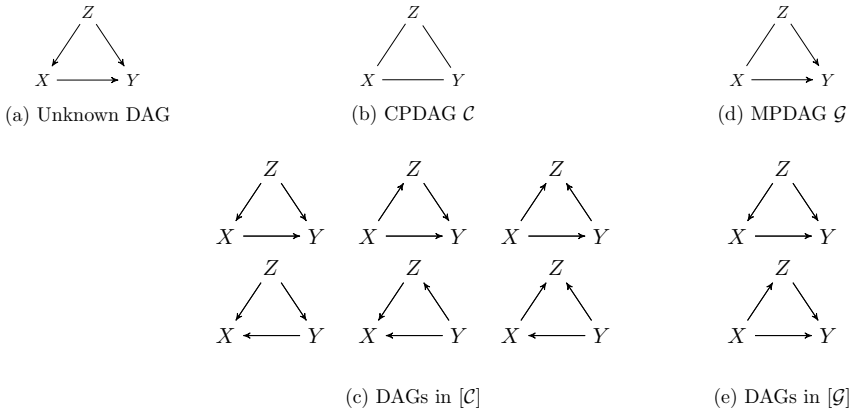
The central objects are maximally oriented partially directed acyclic graphs (MPDAGs), which represent the set [G] of DAGs sharing the same adjacencies and directed edges, the same unshielded colliders, and a partial causal ordering imposed by background knowledge. The argument is carried by three mechanisms: the PCO algorithm, which partitions node sets into buckets ordered by a partial causal ordering and yields the factorization in Theorem 3; the possibly causal path, a path with no backward edges whose presence or absence determines identifiability—in particular, a proper possibly causal path from X to Y that starts with an undirected edge is the obstruction that makes conditional effects unidentifiable; and mutilated MPDAGs GX, GXZ, and GX,Z'(W), obtained by deleting edges into X or out of Z, whose d-separations drive the three rules of the generalized do calculus. Algorithm 1 works by repeatedly moving treatment variables into the conditioning set via Rule 2 until no such undirected-starting possibly causal path remains, then applying Rule 3 or the ratio of two applications of Theorem 3.
What would settle it
Enumerate all small MPDAGs and, for each triple (X,Y,Z), compare CIDM's verdict against an exhaustive do-calculus search over the DAGs in [G]; any case where CIDM returns FAIL yet an identifying expression exists, or returns an expression that differs from the true interventional distribution under a linear Gaussian density consistent with G, would refute the soundness and completeness claims.
Extended reading notes
Core claim
The paper establishes that, for any causal MPDAG G and pairwise disjoint node sets X, Y, Z, the conditional interventional density f(y|do(x),z) is identifiable from the observational density of any density f consistent with G if and only if Algorithm 1 (CIDM) returns an expression; when it returns FAIL, the authors construct two densities consistent with G that are observationally identical yet disagree on f(y|do(x),z), so no identifying expression exists. This completeness result is Theorem 7, and it is obtained by combining three results: Theorem 3, an identification formula written in terms of bucket decompositions from the PCO algorithm that applies when Z is unaffected by treatment and no proper possibly causal path from X to Y starts with an undirected edge; Theorem 6, a do calculus for MPDAGs whose three rules mirror the classical do calculus but use d-separations in mutilated MPDAGs such as GX and GXZ; and the fractional decomposition f(y|do(x'),z') = f(y,zD|do(x'),zN)/f(zD|do(x'),zN) used by the algorithm to handle conditioning variables that are possible descendants of treatment. The calculus is shown to reduce exactly to the classical do calculus when the MPDAG is a DAG, and the identification formula reduces to the earlier unconditional MPDAG formula when Z is empty.
Load-bearing premise
The results assume that every variable influencing two or more measured variables is itself measured, so no hidden common causes exist; if hidden common causes are present, the identification formula, the do-calculus rules, and the completeness guarantee can all fail.
Editorial extensions
If this is right
- Any conditional effect that is identifiable given an MPDAG can be written down by CIDM; no identification algorithm in this setting needs to be more powerful.
- For pre-treatment covariates (Z unaffected by X), identifiability is fully characterized by the absence of a proper possibly causal path from X to Y that starts undirected, giving a fast graphical check.
- The do calculus for MPDAGs reproduces the classical do calculus exactly when the known graph is a DAG, so the new rules are a strict generalization rather than a competing framework.
- When the effect is not identifiable, Algorithm 2 (CIDME) enumerates candidate expressions by orienting each undirected edge of a shortest obstruction, producing a multiset that can be used for bounding the effect.
- Unconditional identification is a special case (Z = ∅) of the conditional formula, unifying the new result with earlier MPDAG identification work.
Reading between the lines
- The completeness boundary suggests that the hardness of conditional identification in causally sufficient systems lies entirely in the interaction between undirected-edge uncertainty and conditioning on possible descendants of treatment; a similar boundary for systems with latent variables would need structure beyond the chordal components that make ancestral-graph algorithms work.
- The fractional output A/B may make plug-in estimation practical: both numerator and denominator are ordinary observational quantities, so nonparametric estimators of each component could be combined, although the paper does not analyze finite-sample behavior.
- A natural test of the method is to apply CIDM to an MPDAG learned from data with known background knowledge and compare its identified expression to estimates from a randomized trial on the same variables; agreement would empirically validate the completeness claim.
Editorial analysis
A structured set of objections, weighed in public.
Referee Report
Summary. The manuscript addresses identification of conditional causal effects f(y|do(x),z) when the causal structure is known only up to an MPDAG and all variables are observed. It presents three results: a closed-form identification formula (Theorem 3) under the assumption that the conditioning set contains no possible descendants of the treatment; a three-rule do calculus for MPDAGs (Theorem 6) that is claimed to reduce to Pearl's calculus in the DAG case; and an algorithm (CIDM, Algorithm 1) that iteratively applies Rule 2 and then Theorem 3, with a completeness theorem (Theorem 7) stating that failure implies non-identifiability. The appendices contain long proofs, including explicit linear SEM counterexamples with numerical coefficients. The paper clearly states in Section 6 that latent confounding is outside the scope of the setting.
Significance. If the results are correct, the paper fills a genuine gap: prior MPDAG work either focused on unconditional effects or on conditional adjustment sets, which need not exist for identifiable conditional effects. The proposed do calculus and the completeness of Algorithm 1 are natural and nontrivial extensions of the existing theory, and the completeness theorem is the main technical contribution. The paper's strengths include explicit SEM-based non-identifiability constructions with concrete coefficients, detailed appendix proofs, and a clear statement of the causal-sufficiency limitation. The main caveat is that the proofs are long and not machine-checked, and one load-bearing step in the completeness proof is not fully justified as written.
major comments (2)
- [Appendix G, proof of Theorem 7, Case 1] The proof invokes Lemma 57 without first verifying the lemma's two standing assumptions. After defining the collider set C and the shortest causal paths q_i from each collider to Z, the proof states that 'by Lemma 57, Ci is the only node on both p' and q'_i, and there is no shared node between the causal paths q'_i and q'_j.' However, Lemma 57 is stated under the assumptions that (i) there is no possibly causal path from X to Y that starts undirected and avoids X\{X} ∪ Z, and (ii) there is a possibly causal path from X to Z that starts undirected and avoids X\{X} ∪ Y. Theorem 7's hypothesis supplies a path from X to Y∪Z, not necessarily to Z. If that path ends at Y and avoids Z, Proposition 41 already gives non-identifiability; if it contains a node of Z, a shortest prefix ending at a Z-node gives assumption (ii), and any violation of assumption (i) would also allow the proof to conclude via Proposition 41. These without-loss-of-generality reductions are not stated, so the written proof of Theorem 7 has a load-bearing gap, although the gap appears readily repairable.
- [Section 5.4, completeness argument for Algorithm 1] The completeness argument does not explicitly connect a FAIL at a later while-loop state (X', Z') to the original query (X, Z). Algorithm 1 can reach its FAIL branch only after some variables have been moved from the do-set to the conditioning set using Rule 2 of Theorem 6. Theorem 7, as stated, applies to arbitrary disjoint sets and would show non-identifiability of f(y|do(x'), z'), but one must additionally use the soundness of the preceding Rule-2 transformations to conclude non-identifiability of the original f(y|do(x), z). This equivalence is not spelled out in the proof of completeness; it should either be stated as an invariant of the algorithm or argued explicitly before Theorem 7 is applied.
minor comments (3)
- [Theorem 3, Equation (2)] The integration notation is ambiguous: the theorem defines B = An(Y, G_{V\X}) \ (Z ∪ Y), while the bucket decomposition is computed on An(Y, G_{V\X}) \ Z, which includes the bucket containing Y. As written, the integral in Equation (2) appears to integrate over all bucket variables, including Y. Example 1 makes clear that the intended integral is over all buckets except Y, but the notation should be made precise.
- [Algorithm 2, lines 12-13] The pseudocode uses two sequential 'Return' statements instead of combining the results into a single multiset. The intended behavior is presumably 'return the multiset union of CIDME(X', Z', Y, G1) and CIDME(X', Z', Y, G2)', and the pseudocode should say so explicitly.
- [References and typography] The reference list contains repeated typos such as 'Uncertianty of Artifical Intelligence', and Lemma 57 contains a typo in the phrase 'which leads us to a contradiction with the choice fo p'. A careful proofread is needed.
Circularity Check
No significant circularity: claimed identifications are proven from graph lemmas and Pearl's do calculus; self-citations are not load-bearing.
full rationale
I walked the derivation chain. Theorem 3's expression (2) is derived in Appendix D from Lemma 38, whose proof applies Pearl's do calculus to an arbitrary DAG in [G]; the buckets and PCO output are graph constructs, and the final expression is not presupposed. Theorem 6 is obtained from Pearl's rules via Lemmas 49, 51, and 54, which are proven from MPDAG path properties; no rule of the MPDAG calculus is assumed to prove another rule. Theorem 7 (completeness) is a non-identifiability proof: it constructs two SEM families with f1(v) = f2(v) but different interventional means, using Wright's rule and multivariate normal computations; the conclusion is not an input to the construction. The self-citations (Perković 2020 for PCO and Lemma D.1; LaPlante and Perković 2024 for conditional adjustment; Venkateswaran and Perković 2024 for future work) are not load-bearing in a circular sense: PCO is restated in Appendix B, Lemma D.1 is used only as an analogy while Lemma 38 is proved independently, and the 2024 papers are context and examples. I do flag one manuscript-level issue: in Appendix G, the proof of Theorem 7 invokes Lemma 57 (and Lemma 58 in Case 2) without explicitly verifying Lemma 57's two standing assumptions in Case 1; this appears repairable by the without-loss-of-generality arguments (if a possibly causal undirected-starting path to Y exists, Proposition 41 finishes; otherwise use a prefix to Z). That is a proof-completeness gap, not a circular definition or renamed input. Section 6's stated limitation (no latent confounding) is an assumption, not circularity. No fitted parameter is renamed as a prediction, and no target quantity is used to define its own identifying expression.
Assumptions & free parameters
assumptions (6)
- domain assumption Markov compatibility of observational density with an MPDAG via factorization over a DAG in [G]
- domain assumption Positivity: f(v)>0 for all values
- domain assumption Causal sufficiency: all variables observed, no latent confounding
- standard math Rules of Pearl's do calculus are valid for densities consistent with a DAG
- standard math Recorded MPDAG properties from Meek (1995) and Perkovic (2020), including correctness of the PCO algorithm
- standard math All DAGs represented by an MPDAG have the same adjacencies, unshielded colliders, and d-separations
Cite this review
Pith. "Pith review of Identifying Conditional Causal Effects in MPDAGs." pith.science (2026). https://pith.science/paper/WXMM4B6U
@misc{pith2026250715842,
  author       = {Pith},
  title        = {Pith review of: Identifying Conditional Causal Effects in MPDAGs},
  year         = {2026},
  howpublished = {\url{https://pith.science/paper/WXMM4B6U}},
  note         = {Machine review of arXiv:2507.15842}
}
read the original abstract
We consider identifying a conditional causal effect when a graph is known up to a maximally oriented partially directed acyclic graph (MPDAG). An MPDAG represents an equivalence class of graphs that is restricted by background knowledge and where all variables in the causal model are observed. We provide three results that address identification in this setting: an identification formula when the conditioning set is unaffected by treatment, a generalization of the well-known do calculus to the MPDAG setting, and an algorithm that is complete for identifying these conditional effects.
Figures


Figures from the paper (5 more)


Reference graph
Works this paper leans on
-
[1]
Bareinboim, E., Brito, C., and Pearl, J. (2012). Local characterizations of causal B ayesian networks. In Graph Structures for Knowledge Representation and Reasoning: Second International Workshop , pages 1--17
work page 2012
-
[2]
Chickering, D. M. (2002). Optimal structure identification with greedy search. Journal of Machine Learning Research , 3:507--554
work page 2002
-
[3]
Correa, J. and Bareinboim, E. (2020). A calculus for stochastic interventions: Causal effect identification and surrogate experiments. In The AAAI Conference on Artificial Intelligence , volume 34, pages 10093--10100
work page 2020
- [4]
-
[5]
Guo, F. R. and Perkovi\'c, E. (2021). Minimal enumeration of all possible total effects in a M arkov equivalence class. In International Conference on Artificial Intelligence and Statistics
work page 2021
-
[6]
Henckel, L., Perkovi \'c , E., and Maathuis, M. H. (2022). Graphical criteria for efficient total effect estimation via adjustment in causal linear models. Journal of the Royal Statistical Society: Series B , pages 579--599
work page 2022
-
[7]
Jaber, A., Ribeiro, A., Zhang, J., and Bareinboim, E. (2022). Causal identification under M arkov equivalence: C alculus, algorithm, and completeness. In Advances in Neural Information Processing Systems , volume 35, pages 3679--3690
work page 2022
-
[8]
Jaber, A., Zhang, J., and Bareinboim, E. (2018). A graphical criterion for effect identification in equivalence classes of causal diagrams. In International Joint Conference on Artificial Intelligence
work page 2018
Show all 33 references
-
[9]
Kivva, Y., Etesami, J., and Kiyavash, N. (2023). On identifiability of conditional causal effects. In Uncertainty in Artificial Intelligence
2023
-
[10]
and Perkovi \'c , E
LaPlante, S. and Perkovi \'c , E. (2024). Conditional adjustment in a M arkov equivalence class. In Artifical Intelligence and Statistics
2024
-
[11]
L., Dawid, A
Lauritzen, S. L., Dawid, A. P., Larsen, B. N., and Leimer, H.-G. (1990). Independence properties of directed M arkov fields. Networks , 20(5):491--505
1990
-
[12]
Maathuis, M. H. and Colombo, D. (2015). A generalized back-door criterion. Annals of Statistics
2015
-
[13]
H., Colombo, D., Kalisch, M., and B \"u hlmann, P
Maathuis, M. H., Colombo, D., Kalisch, M., and B \"u hlmann, P. (2010). Predicting causal effects in large-scale systems from observational data. Nature methods , 7(4):247--248
2010
-
[14]
H., Kalisch, M., and B \"u hlmann, P
Maathuis, M. H., Kalisch, M., and B \"u hlmann, P. (2009). Estimating high-dimensional intervention effects from observational data. Annals of Statistics , 37:3133--3164
2009
-
[15]
V., Kent, J
Mardia, K. V., Kent, J. T., and Bibby, J. M. (1980). Multivariate Analysis (Probability and Mathematical Statistics) . Academic Press London
1980
-
[16]
Meek, C. (1995). Causal inference and causal explanation with background knowledge. In Uncertianty of Artifical Intelligence , pages 403--410
1995
-
[17]
Moffett, L., Weissman, A., McCormick, M., Weiland, C., Hsueh, J., Snow, C., and Sachs, J. (2023). Enrollment in pre-k and children's social-emotional and executive functioning skills: To what extent are associations sustained across time? Journal of Educational Psychology , 115(3):460
2023
-
[18]
H., and Richardson, T
Nandy, P., Maathuis, M. H., and Richardson, T. S. (2017). Estimating the effect of joint interventions from observational data in sparse high-dimensional settings. Annals of Statistics , 45(2):647--674
2017
-
[19]
Pearl, J. (1995). Causal diagrams for empirical research. Biometrika , 82:669--688
1995
-
[20]
Pearl, J. (2009). Causality: Models, Reasoning, and Inference . Cambridge University Press
2009
-
[21]
Perkovi \'c , E. (2020). Identifying causal effects in maximally oriented partially directed acyclic graphs. In Uncertianty of Artifical Intelligence , pages 530--539
2020
-
[22]
Perkovi \'c , E., Kalisch, M., and Maathuis, M. H. (2017). Interpreting and using CPDAG s with background knowledge. In Uncertianty of Artifical Intelligence
2017
-
[23]
H., et al
Perkovi \'c , E., Textor, J., Kalisch, M., Maathuis, M. H., et al. (2018). Complete graphical characterization and construction of adjustment sets in markov equivalence classes of ancestral graphs. Journal of Machine Learning Research , 18(220):1--62
2018
-
[24]
ausler, D., Ernest, J., and B\
Rothenh\"ausler, D., Ernest, J., and B\"uhlmann, P. (2018). Causal inference in partially linear structural equation models: identifiability and estimation. Annals of Statistics , 46:2904--2938
2018
-
[25]
and Pearl, J
Shpitser, I. and Pearl, J. (2006). Identification of conditional interventional distributions. In Uncertainty in Artificial Intelligence , pages 437--444
2006
-
[26]
Shpitser, I., VanderWeele, T., and Robins, J. M. (2010). On the validity of covariate adjustment for estimating causal effects. In Uncertainty in Artificial Intelligence
2010
-
[27]
Spirtes, P., Glymour, C., and Scheines, R. (2000). Causation, Prediction, and Search . MIT Press, second edition
2000
-
[28]
Van der Zander, B., Liskiewicz, M., and Textor, J. (2014). Constructing separators and adjustment sets in ancestral graphs. In Uncertianty of Artifical Intelligence , pages 11--24
2014
-
[29]
and Perkovi \'c , E
Venkateswaran, A. and Perkovi \'c , E. (2024). Towards complete causal explanation with expert knowledge. arXiv preprint arXiv:2407.07338
2024 arXiv
-
[30]
Wright, S. (1921). Correlation and causation. Journal of Agricultural Research , 20(7):557--585
1921
-
[31]
Wright, S. (1934). The method of path coefficients. The Annals of Mathematical Statistics , 5(3):161--215
1934
-
[32]
Zhang, J. (2006). Causal Inference and Reasoning in Causally Insufficient Systems . PhD thesis, Carnegie Mellon University
2006
-
[33]
Zhang, J. (2008). Causal reasoning with ancestral graphs. Journal of Machine Learning Research , 9(7)
2008
Reviewed August 6, 2026 · model on record in the stance chip above.
Discussion (0). Continue with ORCID to comment.