REVIEW 4 major objections 5 minor 13 references
Belief Alignment vs Opinion Leadership: Understanding Cross-linguistic Digital Activism in K-pop and BLM Communities
T0 review · 4 major / 5 minor · reviewed 2026-08-06 · deepseek-v4-flash
Pith's one-line read K-pop fans' engagement with Black Lives Matter was driven by shared beliefs, not by BTS's endorsement, this study argues.
desk verdict Solid cross-lingual case study with a real methodological contribution, but the headline belief-alignment result is selected post hoc and the abstract overstates it. read the letter →
The pith
A machine-rendered reading of the paper's core claim, the machinery that carries it, and where it could break.
The reading
What carries the argument
The Belief Landscape Framework (BLF) is the central method: it parses tweets into subject-verb-object belief statements, embeds them with a cross-lingual language model, reduces them to two dimensions with UMAP, finds density peaks ('belief attractors') in user belief-vector space, and tracks which users occupy each attractor over time. The load-bearing pieces are the attractor homogeneity score, which measures how mixed a region's active K-pop and BLM population is in a given week, and the community bias score, which measures whether an attractor's belief content leans BLM or K-pop. The argument uses coordinated activity spikes in pre-mixed, BLM-leaning attractors as evidence for H1, and the stability of amplifier users' weighted bias across the BTS tweet as the test of H2.
What would settle it
A replication that pre-registers which attractors count as 'pre-mixed' before observing any spike, then checks whether the two communities spike in the same attractors during a new surge (for example, another police-killing event or another celebrity statement), would settle H1. For H2, comparing the 272 amplifiers' weighted attractor bias in the 24 hours immediately after BTS's tweet against a matched control group of non-amplifier K-pop users would show whether the tweet itself shifted belief position.
Extended reading notes
Core claim
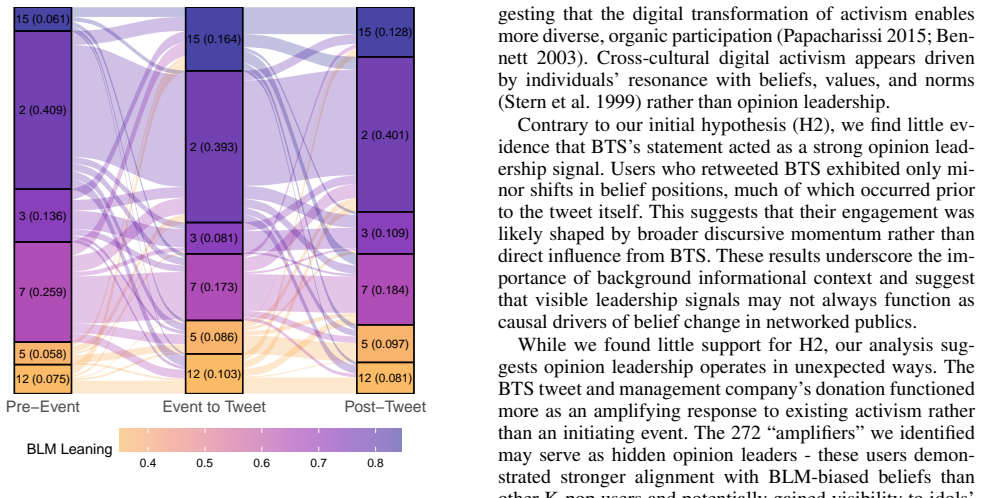
The paper's central claim is that belief alignment—people joining a distant movement because its expressed beliefs resonate with their own—is the primary driver of cross-cultural digital activism, while opinion leadership plays a secondary, amplifying role. The evidence comes from a belief landscape built from roughly 29 million tweets from 2,948 K-pop and BLM users: the only attractors with coordinated spikes from both communities between Floyd's murder and BTS's tweet were attractors 2 and 3, which were among the most heterogeneous (pre-mixed) regions and centred on race, police brutality, and accountability. The 272 K-pop users who retweeted BTS showed almost no shift in their attractor bias across the pre-murder, pre-tweet, and post-tweet periods, and their modest move toward BLM-leaning content happened before the tweet. The paper reads this as fan activism arising from shared beliefs, with the idol's statement acting as validation and amplification rather than the cause. It also finds a weak but statistically significant reduction in negative cross-community correlation between pre- and post-periods, suggesting slight belief convergence.
Load-bearing premise
The load-bearing premise is that the belief-landscape clustering of translated, noisy tweets captures users' actual expressed beliefs rather than topic similarity alone; if the spiking attractors look mixed because they share surface topics instead of shared beliefs, the conclusion that belief alignment drove the engagement collapses.
Editorial extensions
If this is right
- Cross-cultural digital activism is better modelled as belief resonance than as influence cascades; campaigns that hope to cross borders should look for pre-existing shared belief clusters rather than rely on celebrity endorsements alone.
- Celebrity or influencer statements can be expected to amplify an already-engaged audience, not to manufacture engagement from disengaged followers.
- The method can be applied to other language pairs and movements to map when communities converge around shared moral themes even without shared hashtags or languages.
- The slight rise in cross-community belief similarity suggests that even brief co-engagement can push two publics toward common discourse, though the paper treats this effect as exploratory rather than causal.
Reading between the lines
- The post-hoc selection of spiking attractors is the point where the paper's own evidence is weaker than its abstract; a pre-registered analysis that names the mixed attractors before observing the spike would be a sharper test of the belief-alignment hypothesis.
- If the amplification interpretation generalizes, celebrity donations and statements may function more as resources and signals to already-aligned networks than as persuasion, implying that activism campaigns should invest in grassroots belief infrastructure.
- The same pipeline could test whether the pattern holds when a celebrity endorses a foreign movement with no prior history in the fandom; a sudden spike in homogeneous, celebrity-driven attractors in that setting would support a stronger opinion-leadership effect.
- The retweet-as-endorsement assumption could be checked by building a follow-up model that uses quote tweets, where users can criticize or argue with the retweeted content, to see whether the 272 amplifiers were agreeing or merely broadcasting.
Editorial analysis
A structured set of objections, weighed in public.
Referee Report
Summary. The paper studies whether cross-cultural digital activism between K-pop fandoms and Black Lives Matter (BLM) discourse on Twitter is driven by belief alignment (H1) or opinion leadership (H2), using the Belief Landscape Framework (BLF) to identify clusters of users with shared expressed beliefs. On a balanced sample of 2,948 users and roughly 29 million tweets from 2020, the authors detect coordinated activity spikes in two attractors (2 and 3) after George Floyd's murder but before BTS's tweet, report that these attractors were among the more heterogeneous mixed-population attractors before the event, and interpret this as support for H1. For H2, they track 272 users who retweeted BTS's tweet and find little movement toward BLM-aligned beliefs, concluding that the tweet amplified but did not initiate activism. They also report a small, marginally significant reduction in between-community correlation as evidence of lasting belief convergence.
Significance. If the central claim were established, it would make a meaningful contribution to theories of cross-cultural digital activism, transnational fandom, and social influence: it would suggest that shared beliefs, rather than celebrity or influencer signaling, drive organic movement spread. The paper also contributes a bilingual application of the Belief Landscape Framework, including a translation pipeline, a sensitivity analysis across half-life settings, and a belief-coherence validation with manual inter-rater agreement. The authors publish code and data in a public repository, which is commendable for reproducibility. However, the headline conclusion rests on a post hoc selection of attractors and an unquantified comparison with non-spiking attractors; the abstract claim of 'strong evidence' is not matched by the results section's 'moderate support for H1'.
major comments (4)
- [H1: Belief alignment, Table 1] The H1 test is post hoc. The authors first detected coordinated spikes in attractors 2 and 3 (Figure 3) and then examined the pre-event homogeneity of those attractors, finding ranks 3 and 5 among 21 attractors in Table 1. Because the attractors were selected on the outcome (the spike), the rank-based observation does not test H1: under the null, some attractors will spike by chance, and any spiking attractor will have some homogeneity rank. The paper acknowledges that the two most heterogeneous attractors (6 and 7) did not exhibit coordinated spikes, but it does not integrate this into a statistical comparison of spiking versus non-spiking attractors. A proper test would define the candidate mixed and BLM-relevant attractors a priori, or use a permutation test that shuffles spike labels across attractors and weeks (preserving marginal spike rates) and compares the realized homogeneity of spiking attractors against the null distribution. As presented, the data are consistent with H1 but do not provide statistically distinguishable support for it.
- [H1: Belief alignment, paragraph contrasting attractors 2/3 with 6/7] The explanation for why the most heterogeneous attractors (6 and 7) did not spike is introduced after observing the outcome: the authors argue that attractor 7 is 'less clearly aligned with BLM discourse' and attractor 6 is a 'high-entropy attractor' defined by fandom content. This is a qualitative, post hoc distinction that is not operationalized as a quantitative predictor. The hypothesis 'belief-aligned mixed attractors spike' is therefore not distinguishable from the alternative 'some attractors spike for unmodeled reasons.' To make the evidence load-bearing, the authors should define an outcome-independent measure of BLM relevance (for example, using the community bias score described in the 'Relative Community Bias' subsection) and test whether spike probability increases with the combination of high mixing and BLM bias. Without such a test, the semantic contrast between attractors 2/3 and 6/7 is descriptive, not confirmatory.
- [Building the Belief Landscape: Translation and belief extraction] The validity of the entire attractor structure—and hence the H1 and H2 conclusions—depends on the faithfulness of the translated Korean text as input to the English dependency parser. The authors justify the KoBART model with BLEU scores (32.85) and a native-speaker evaluation, but BLEU does not establish that subject-verb-object belief tuples extracted after translation preserve the belief propositions, stance, or emphasis of the original Korean tweets. The belief-coherence validation (71% aligned pairs, Cohen's kappa 0.82) is performed on pairs of translated beliefs within attractors; it does not compare original Korean beliefs with their translated English counterparts. If translation systematically alters belief content, the attractor structure could be an artifact of translation rather than a representation of expressed beliefs. Please report a belief-level translation validation (e.g., back-translation consistency or manual comparison of extracted beliefs from original and translated tweets) to rule out this threat.
- [H2: Opinion Leadership, amplifier analysis] The negative result for H2 is based on the 272 users who retweeted BTS's statement. While the analysis is careful within this group, the broader conclusion that opinion leaders 'do not appear to be a direct cause' of activism is stronger than what this single-leader test can support. The paper acknowledges that exposure to the tweet is not observed and that other potential opinion leaders (e.g., fan 'pillar accounts' discussed in the literature) are not modeled. The observed absence of a belief shift among retweeters is consistent with H2 not operating through BTS's tweet, but it does not rule out opinion leadership by other actors. The abstract should be qualified to refer to the specific test of BTS as an opinion leader.
minor comments (5)
- [Abstract vs. Results] The abstract states 'strong evidence' for belief alignment, while the results section (H1 summary) states 'we find moderate support for H1.' Please align the language; 'strong evidence' overstates the inferential strength of the post hoc analysis.
- [RQ2: Persistent Belief Change, Table 2] The claim of a 'statistically significant difference (approximately p < .05)' between the pre-period correlation (r = -0.171) and post-period correlation (r = -0.015) is not supported by a reported test statistic. The 95% confidence intervals listed in Table 2 overlap slightly (Pre upper -0.077, Post lower -0.093), so a proper test (e.g., Fisher r-to-z for independent or dependent correlations) should be described with its p-value.
- [Weekly Attractor Homogeneity, Equation (1)] The homogeneity score uses the absolute value of the difference divided by the sum, so an attractor populated entirely by K-pop users receives the same score (1) as one populated entirely by BLM users. This is appropriate for measuring mixing but is worth stating explicitly so readers do not interpret the score as directional.
- [Figure 3 caption] The caption refers to 'the six attractors exhibiting the most heterogeneity prior to the murder,' but Table 1 lists ten such attractors. Please clarify the selection of the six shown in Figure 3 (e.g., attractors 1, 2, 3, 6, 7, 9, 10 appear in Table 1; the figure's subset is not precisely defined).
- [Results, H1 summary paragraph] The sentence 'We find moderate support for H1; although coordinated spikes do not appear in the most heterogeneous attractors...' uses 'although' where a conjunction such as 'and' or 'but' would be clearer; the current phrasing suggests the exception is surprising but the logic of the hypothesis is not specified.
Circularity Check
No by-construction circularity: the belief-alignment conclusion is an interpretation of fresh spike, amplifier, and correlation data, not a fitted output of the co-authored framework; the self-cited BLF is partly re-validated in-paper, and the H1 post-hoc attractor selection is a statistical validity concern rather than a reduction to its inputs.
full rationale
The derivation chain is not circular by construction. The central claim, that belief alignment rather than opinion leadership drove K-pop engagement, is not a parameter embedded in the Belief Landscape Framework; it is an interpretation of new measurements that could have come out differently: only attractors 2 and 3 exhibited coordinated pre-BTS spikes, the 272 amplifiers' weighted attractor bias stayed essentially flat (0.678, 0.680, 0.674; Results, H2), and the between-community correlation moved from r = -0.171 to r = -0.015 (Table 2). The H2 null result and the RQ2 correlation change are genuine empirical findings, so the headline conclusion has independent content. The measurement instrument is the co-author's prior framework (Introne 2023), a self-citation, but the paper does not merely re-import it: it re-validates belief coherence (71% aligned, Cohen's kappa 0.82), selects the half-life from its own lifespan distribution (Figure 1) with an explicit 4-8 week sensitivity analysis (Appendix C), and tests candidate embedding models on new probe pairs. Per the reviewing rules, the cited framework is independent support rather than a load-bearing self-citation because it is externally peer-reviewed and re-verified here. The strongest concern is the H1 test: attractors 2 and 3 were identified after observing their spikes, and the two most mixed attractors (6 and 7) did not spike; with 21 attractors and z > 2 event detection, the claim that attractors 2 and 3 are 'among the most heterogeneous' (ranks 3 and 5 in Table 1) is a post-hoc rank description without a comparison distribution or multiple-testing correction. The paper itself concedes 'moderate support for H1' while the abstract claims 'strong evidence.' However, the pre-event homogeneity of the selected attractors is measured independently of the spike outcome, so this is underdetermination and selection bias, a correctness risk, not a fitted-input-called-prediction reduction in which the evidence equals the fit. The paper also flags its own limitations: 'we cannot directly observe who saw the tweet or whether it influenced their behavior,' 'the lack of a principled theory for optimal window size remains a limitation,' and 'we do not claim a causal relationship' for RQ2. These concessions lower confidence in the causal reading but do not make the derivation equivalent to its inputs.
Assumptions & free parameters
free parameters (2)
- belief persistence half-life =
5 weeks
- z-score spike threshold =
2
assumptions (5)
- domain assumption Belief Landscape Framework validly captures belief dynamics
- domain assumption Retweet behavior indicates belief alignment or affiliative endorsement
- domain assumption KoBART translation preserves belief content for the English dependency parser
- domain assumption Attractor summaries generated by LLMs are accurate interpretations
- domain assumption Users are correctly assigned to communities by hashtag use
Cite this review
Pith. "Pith review of Belief Alignment vs Opinion Leadership: Understanding Cross-linguistic Digital Activism in K-pop and BLM Communities." pith.science (2026). https://pith.science/paper/DSL5TRRG
@misc{pith2026250716046,
  author       = {Pith},
  title        = {Pith review of: Belief Alignment vs Opinion Leadership: Understanding Cross-linguistic Digital Activism in K-pop and BLM Communities},
  year         = {2026},
  howpublished = {\url{https://pith.science/paper/DSL5TRRG}},
  note         = {Machine review of arXiv:2507.16046}
}
read the original abstract
The internet has transformed activism, giving rise to more organic, diverse, and dynamic social movements that transcend geo-political boundaries. Despite extensive research on the role of social media and the internet in cross-cultural activism, the fundamental motivations driving these global movements remain poorly understood. This study examines two plausible explanations for cross-cultural activism: first, that it is driven by influential online opinion leaders, and second, that it results from individuals resonating with emergent sets of beliefs, values, and norms. We conduct a case study of the interaction between K-pop fans and the Black Lives Matter (BLM) movement on Twitter following the murder of George Floyd. Our findings provide strong evidence that belief alignment, where people resonate with common beliefs, is a primary driver of cross-cultural interactions in digital activism. We also demonstrate that while the actions of potential opinion leaders--in this case, K-pop entertainers--may amplify activism and lead to further expressions of love and admiration from fans, they do not appear to be a direct cause of activism. Finally, we report some initial evidence that the interaction between BLM and K-pop led to slight increases in their overall belief similarity.
Figures


Figures from the paper (4 more)


Reference graph
Works this paper leans on
-
[1]
America has never fully addressed it’s oppression for Black people
-
[2]
There’s no discrimination in America
-
[3]
George Floyd died because of heart disease
-
[4]
George Floyd died because of police brutality
-
[5]
Bangtan is the best group
-
[6]
Scores for examined sentences pairs for each model testing are featured in Table 3
Proof that Bangtan are beautiful We then examined the similarity scores for a subset of pairs in order to identify a model that was compatible with our in- tuitions. Scores for examined sentences pairs for each model testing are featured in Table 3. B. Attractor Detail Figure 7 provides a visual summary of attractors that are ref- erenced in the main body...
-
[11]
The overall bias of an attractor
-
[12]
Traffic fluctuations over time; the top portion indicates BLM, and the bottom portion indicates K-pop
Show all 13 references
-
[13]
evoke joy and healing emotions in their fans
The top five beliefs in the attractor; bars indicate relative intensity (the x-axis marks the relative overall intensity for each visualized belief) and colors indicate the bias of that belief, as described in the main body of the text. C: Sensitivity Analysis We conducted a s...
2022
-
[2018]
Information, Communication & Soci- ety, 21(4): 626–642
Canada is #IdleNoMore: exploring dynam- ics of Indigenous political and civic protest in the Twitterverse. Information, Communication & Soci- ety, 21(4): 626–642. Publisher: Routledge eprint: https://doi.org/10.1080/1369118X.2017.1301522. Reimers, N.; and Gurevych, I. 2019. Se...
-
[2021]
In Proceedings of the 2021 CHI Conference on Human Factors in Computing Systems , CHI ’21, 1–14
Armed in ARMY: A Case Study of How BTS Fans Successfully Collaborated to #MatchAMillion for Black Lives Matter. In Proceedings of the 2021 CHI Conference on Human Factors in Computing Systems , CHI ’21, 1–14. New York, NY , USA: Association for Computing Machin- ery. ISBN 978-...
2021
-
[2022]
Language-agnostic BERT Sentence Embedding. In Muresan, S.; Nakov, P.; and Villavicencio, A., eds.,Proceed- ings of the 60th Annual Meeting of the Association for Com- putational Linguistics (V olume 1: Long Papers) , 878–891. Dublin, Ireland: Association for Computational Ling...
2016 arXiv
-
[2024]
arXiv:2402.01613
Nomic Embed: Training a Reproducible Long Con- text Text Embedder. arXiv:2402.01613. Papacharissi, Z. 2015. Affective Publics: Sentiment, Tech- nology, and Politics. Oxford University Press. ISBN 978-0- 19-999973-6. Google-Books-ID: ffMVDAAAQBAJ. Park, S. Y .; Santero, N. K.; ...
2015 arXiv
Reviewed August 6, 2026 · model on record in the stance chip above.
Discussion (0). Continue with ORCID to comment.