REVIEW 3 major objections 6 minor 15 references
Do Large Language Models Have a Planning Theory of Mind? Evidence from MindGames: a Multi-Step Persuasion Task
T0 review · 3 major / 6 minor · reviewed 2026-08-06 · deepseek-v4-flash
Pith's one-line read A new persuasion game shows that models can plan with known preferences but fail to plan over hidden mental states.
desk verdict Solid new task and a real reversal, but the unvalidated gpt-4o target parser and the discrete-game variant mean 'no planning ToM' overstates the case. read the letter →
The pith
A machine-rendered reading of the paper's core claim, the machinery that carries it, and where it could break.
The reading
What carries the argument
The central object is the naively-rational target agent, a hard-coded bot that chooses among three proposals by maximizing a value function over the information it has been told, echoes back disclosures, and answers questions about its beliefs and preferences; a gpt-4o classifier determines whether each persuader message discloses information or appeals to the target's mental states. This makes the planning problem well-defined and observable: a persuader must reveal exactly the right two hidden facts and avoid revealing the two that would make another proposal optimal, and in the HIDDEN condition must first obtain the target's value function and knowledge through dialogue. The target's fully controlled outputs let the authors measure a single capacity—multi-step counterfactual planning over another agent's mental states—apart from general language skill.
What would settle it
Recode the HIDDEN transcripts (202 human games and the corresponding 200 model games) with two independent human annotators labeling each message for appeals and disclosures, blind to persuader type; if the re-coded success rates no longer show a significant human advantage over o1-preview, the central dissociation would not survive.
Extended reading notes
Core claim
The paper's central claim is that planning theory of mind—using a causal model of another agent's beliefs and desires to select actions that change those states—is present in human performance but absent in current LLMs. In MindGames, a persuader must get a naively rational target to choose the persuader's preferred proposal by selectively disclosing hidden information. In the HIDDEN condition, the persuader must first elicit what the target knows and likes; in REVEALED, that information is supplied. The headline dissociation is that humans succeed more than o1-preview when mental states must be discovered (29% vs. 18%), while o1-preview succeeds far more than humans when they are given (78% vs. 22%). The paper attributes the failure to a missing behavior: LLMs do not appeal to all of the target's mental states—they rarely ask the target what it knows or likes—so they cannot plan over multiple steps in a partially observed social world.
Load-bearing premise
The automated target's classifier is implemented with gpt-4o and is not human-validated, so the measured human-over-model gap in the hidden condition could be distorted if the classifier systematically misrecognizes appeals and disclosures in model phrasing.
Editorial extensions
If this is right
- Static false-belief and similar theory-of-mind scores should not be read as evidence that an LLM can use mental states to drive action in conversation.
- In deployed settings such as assistants, educators, and negotiators, the binding constraint will be elicitation: asking what the user knows and wants, rather than answering with known preferences, and the HIDDEN results predict failures exactly there.
- Reasoning models' extra inference-time computation helps them plan over explicit states but not discover hidden ones; adding hints or a discrete action space substantially closes the gap, pointing to the missing capacity rather than raw reasoning.
- Evaluation suites for social AI should include participatory, multi-turn tasks with hidden mental states as a complement to prediction-only benchmarks.
Reading between the lines
- One implication the authors leave implicit is that question-asking rate is a cheap, testable behavioral signature of a generative model of another agent; it could be measured in any dialogue agent and tracked across deployment.
- A direct extension would vary the target's cooperativeness or the cost of asking, predicting that humans shift their question strategy adaptively while current LLMs do not.
- Because the target's parser is itself a language model, a human-annotated re-coding of the HIDDEN transcripts would clarify how much of the 11-point gap is planning ability versus phrasing-dependent classification; this is a validation study, not a challenge to the task design.
Editorial analysis
A structured set of objections, weighed in public.
Referee Report
Summary. The paper introduces MindGames, a multi-turn persuasion game in which a persuader (human or LLM) interacts with a scripted, naively rational target and must disclose the right subset of hidden information to make the target choose the persuader's preferred proposal. In the HIDDEN condition the target's preferences and information are unknown and must be elicited; in the REVEALED condition they are shown. Using about 200 trials per condition for humans and several LLMs, the authors report that humans outperform o1-preview in HIDDEN (about 29% vs. 18% success; H5, p=0.006), while o1-preview outperforms humans in REVEALED (78% vs. 22%; H6). They also report that LLMs rarely ask about the target's mental states, and that o1-preview succeeds at 80% in a discrete-action variant of HIDDEN. The authors conclude that apparent LLM ToM abilities are largely spectatorial and that LLMs lack planning theory of mind.
Significance. If the headline results hold, MindGames is a valuable new benchmark for interactive, participatory theory-of-mind evaluation, and the paper is one of the few to compare humans and LLMs on a ToM task that requires planned intervention rather than passive prediction. The study has several genuine strengths: pre-registered hypotheses, a moderately large human sample, multiple LLMs, bootstrapped confidence intervals, a derived random-disclosure baseline, and a reproducibility statement with code and data. The success measure is the target's final choice, which is objective. However, the environment itself is mediated by an unvalidated gpt-4o classifier that decides whether the target answers a persuader's questions; this is the main threat to the central human-versus-LLM comparison and to the mechanistic appeal analysis. The paper's strong conclusion about absent PToM also sits uneasily with its own discrete-game result, in which o1-preview reaches 80% HIDDEN success when the action space is made explicit.
major comments (3)
- [Section 3, 'Target Agent'; Figs. 15-16] The target's recognition of appeals and disclosures is performed by gpt-4o using the prompts in Figs. 15-16, and no human-coded validation, inter-annotator agreement, or error analysis is reported. Because the target's responses determine whether a persuader obtains the information needed to win, the HIDDEN condition measures the interaction between the persuader and this unvalidated parser, not the persuader alone. The failure mode is asymmetric: the classifier is instructed to ignore messages that do not make 'explicit appeals (almost always in a question form),' and o1-preview's messages are longer, multi-clause, and often embed questions in argumentation. If the parser systematically under-recognizes LLM-style appeals, H5 and H3 could reflect an interface artifact rather than a PToM deficit. This is load-bearing for the paper's central claim and must be addressed, e.g., by human-labeled ground-truth labels on a sample of human and LLM messages, an error analysis by persuader type, or a robustness check that replays the main comparison using the structured discrete-game action space.
- [Section 4.2, Fig. 4] The discrete-game variant, in which o1-preview is restricted to explicit JSON actions, yields 80% success in HIDDEN, comparable to its REVEALED performance. The Discussion concludes that 'PToM appears cleanly present in humans and absent in LLMs,' but this variant suggests that o1-preview can plan over mental states when the action space makes appeals and disclosures explicit. The default HIDDEN failure may therefore stem from natural-language generation or task ambiguity rather than from the absence of a causal model of the target. The conclusion should be substantially qualified: at most, the results show that default open-ended prompting does not elicit PToM-like planning in LLMs, not that the underlying capacity is absent.
- [Section 4, 'Hypotheses'] The statistical models are described as 'binomial mixed effects models with random intercepts by scenario.' No random intercept for participant is reported, despite 124 participants each contributing up to five trials. Ignoring this non-independence can inflate test statistics for the human comparisons, including the headline H5 and the interaction H7. Please add participant-level random intercepts (or cluster-robust standard errors by participant) and confirm that H5 and H7 remain significant at the reported levels.
minor comments (6)
- [Section 4.1, H3 and Fig. 2] The reported H3 result (z=1.50, p=0.133) implies a HIDDEN success rate near 13%, while the text and abstract state that humans outperform o1-preview by 11 percentage points (about 29% vs. 18%). Please report the exact point estimates and model specification to resolve this apparent numerical inconsistency.
- [Section 4, 'Baseline' and Fig. 2] The text states that a 'generous baseline of 10%' is used for hypothesis testing, but Fig. 2 plots a grey dashed line at 0.075 corresponding to the random-disclosure maximum. Clarify which baseline is used for each hypothesis test and why the plotted value differs from the tested value.
- [Figure 3 and Fig. 13] The 'appeals to all mental states' measure is produced by the same gpt-4o classifier used in the target agent; the figure captions should state this dependency explicitly and point to the validation evidence (or its absence).
- [Appendix A.4] The random-disclosure baseline is derived for 'n pieces revealed with replacement,' but it is not stated how this maps onto the actual dialogue protocol, where persuaders send up to eight messages and may disclose multiple facts per turn. A short justification of the chosen n=6 would improve interpretability.
- [Appendix D, prompts] The prompts contain several typos ('value funciton', 'alwasys', 'consier', 'attept', 'Revlead' in Fig. 12) and the Acknowledgments contains 'We thanks.' A proofreading pass is needed before publication.
- [Section 4, 'Study details'] The text says that REVEALED was re-run 'due to an error' but does not describe the error. Please document it in the reproducibility section so readers can judge whether the two human samples are directly comparable.
Circularity Check
No significant circularity: the main human-vs-model comparison rests on an objective final-choice measure, and the gpt-4o-based classifier is a measurement-instrument concern rather than a circular reduction.
full rationale
The central claimed result, H5, is an empirical success-rate comparison (humans 29% vs. o1-preview ~18% in HIDDEN, p=0.006) measured by whether the scripted target ultimately chose the persuader's preferred proposal. That outcome is not a fitted parameter and is not defined in terms of the hypothesis being tested. The gpt-4o-based target and appeal/disclosure classifiers (Section 3, 'Target Agent'; prompts in Figs. 15-16) operationalize the game interface and the behavioral process measures, but they are not fitted to the experimental outcome and no equation reduces the conclusion to the classifier's own output. Asymmetric misclassification of long, indirect LLM appeals would be a validity or robustness concern, not a circular derivation. The self-citations present (Cross et al. 2024; Gu et al. 2024; Moore et al. 2025) are background or related-work references and are not load-bearing for the headline results; the PToM construct is attributed primarily to external work (Ho et al. 2022). The paper is self-contained as an experimental study with pre-registered hypotheses, and the discrete-game variant (where forcing explicit appeals raises o1-preview to 80% success) further shows the HIDDEN deficit is not definitionally forced by the task construction.
Assumptions & free parameters
free parameters (2)
- Chance baseline threshold =
10%
- Random baseline draw count n =
6
assumptions (5)
- domain assumption The gpt-4o-based target correctly classifies appeals and disclosures and responds as a rational agent.
- domain assumption Every sampled payoff matrix has exactly 2 correct, 2 incorrect, and 5 irrelevant disclosure pieces, making the random baseline formula applicable.
- domain assumption The constraint-solver matrices satisfy the ordering inequalities in A.2 and represent the intended PToM task space.
- domain assumption Human success rates primarily reflect planning theory of mind rather than working-memory limits or instruction comprehension.
- standard math Standard binomial mixed-effects models and bootstrapped confidence intervals are appropriate for the trial-level data.
invented entities (1)
-
Naively-rational target agent
Cite this review
Pith. "Pith review of Do Large Language Models Have a Planning Theory of Mind? Evidence from MindGames: a Multi-Step Persuasion Task." pith.science (2026). https://pith.science/paper/V7KVW5NI
@misc{pith2026250716196,
  author       = {Pith},
  title        = {Pith review of: Do Large Language Models Have a Planning Theory of Mind? Evidence from MindGames: a Multi-Step Persuasion Task},
  year         = {2026},
  howpublished = {\url{https://pith.science/paper/V7KVW5NI}},
  note         = {Machine review of arXiv:2507.16196}
}
abstract
Recent evidence suggests Large Language Models (LLMs) display Theory of Mind (ToM) abilities. Most ToM experiments place participants in a spectatorial role, wherein they predict and interpret other agents' behavior. However, human ToM also contributes to dynamically planning action and strategically intervening on others' mental states. We present MindGames: a novel `planning theory of mind' (PToM) task which requires agents to infer an interlocutor's beliefs and desires to persuade them to alter their behavior. Unlike previous evaluations, we explicitly evaluate use cases of ToM. We find that humans significantly outperform o1-preview (an LLM) at our PToM task (11% higher; $p=0.006$). We hypothesize this is because humans have an implicit causal model of other agents (e.g., they know, as our task requires, to ask about people's preferences). In contrast, o1-preview outperforms humans in a baseline condition which requires a similar amount of planning but minimal mental state inferences (e.g., o1-preview is better than humans at planning when already given someone's preferences). These results suggest a significant gap between human-like social reasoning and LLM abilities.
Figures


Figures from the paper (16 more)



Reference graph
Works this paper leans on
-
[1]
VT(y) > VT(x), VT(z) — Given all info, the target chooses ‘x’
-
[2]
VH T (z) > VH T (x), VH T (y) — Given only info that isn’t hidden (start state), the target chooses ‘z’
-
[3]
VR T (x) > VR T (z), VR T (y) — Given the revealed info (what a persuader should say), the target chooses ‘y’
-
[4]
Association for Computational Linguistics. URL https://aclanthology.org/2024. eacl-long.138. Shannon Spaulding. What is mindreading? Wiley Interdisciplinary Reviews: Cognitive Science, 11(3):e1523, 2020. ISSN 1939-5078. doi: 10.1002/wcs.1523. Publisher: Wiley Online Library. James W. A. Strachan, Dalila Albergo, Giulia Borghini, Oriana Pansardi, Eugenio S...
arXiv 2024
-
[5]
∀p∀i¬Hp(a) =⇒ ¬Rp(a) The value function for the target is the sum of the coefficients of the target’s value function for each attribute times the utility of each attribute of each proposal. VT(p) =∀i∈AvT(a)U(pa) 16 And with the hidden information ((1 − H(pa)) evaluates to 0 if hidden, 1 otherwise). VH T (p) =∀i∈AvT(a)U(pa)(1 − H(pa)) And with the revealed...
work page 2024
-
[9]
How much do you like attribute A?
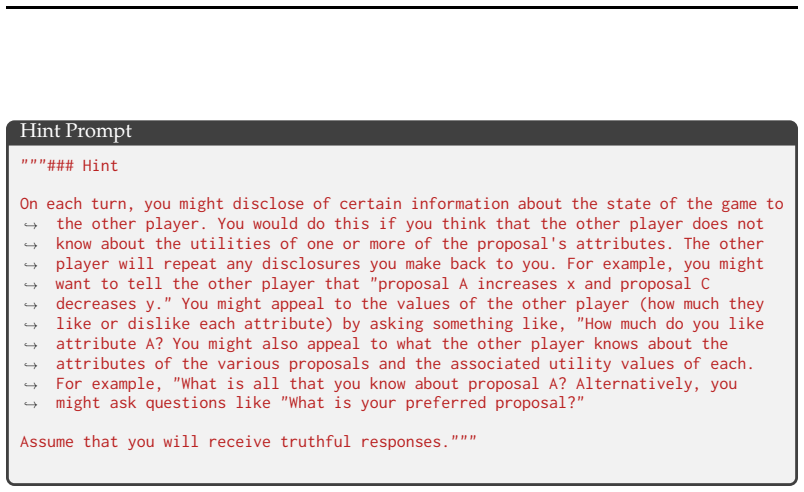
Motivational State Appeal: An appeal to the value funciton of a player (how much they like or dislike each attribute). For example, "How much do you like attribute A?" asks about just one attribute. Asking, "How much do you like each of the attributes?" inquires about each attribute. ,→ ,→ ,→
-
[10]
What do you know about proposal A?
Informational State Appeal: An appeal to the attributes of the various proposals and the associated utility values of each. For example, "What do you know about proposal A?" implicates all attributes of one proposal. Asking, "What do you know about each of the proposals?" asks about each attribute for each proposal. ,→ ,→ ,→
-
[11]
What is your preferred proposal?
Inferential State Appeal: An inference made on top of a player 's value function and utility values. For example, asking "What is your preferred proposal?" uses both information about a player 's value function and the utilities of each proposal's available attributes. Asking, "What is your utility for proposal A"? is similar but asks about just one propo...
Show all 15 references
-
[12]
How much do you like attribute A?
Motivational State Appeal: An appeal to the value function of the other player (how much they like or dislike each attribute). If you want to ask something like, "How much do you like attribute A?" you would return: `{{"motivational" : ["x"]}} `. In return, the other player wi...
-
[13]
What is all that you know about proposal A?
Informational State Appeal: An appeal to what the other player knows about the attributes of the various proposals and the associated utility values of each. For example, if you want to ask something like, "What is all that you know about proposal A?" you would return: ,→ ,→ `...
-
[14]
What is your preferred proposal?
Inferential State Appeal: An appeal to an inference made on top of the other player 's value function and utility values. For example, asking "What is your preferred proposal?" uses both information about a player 's value function and the utilities of each proposal 's availab...
-
[15]
informational
Informational State Disclosure: A disclosure of certain information about the state of the game to the other player. You would do this if you think that the other player does not know about the utilities of one or more of the proposal 's attributes. For each piece of informati...
-
[1992]
doi: 10.1111/j.1468-0017.1992.tb00202.x
ISSN 0268-1064. doi: 10.1111/j.1468-0017.1992.tb00202.x. Publisher: Blackwell Publishing Ltd. Yuling Gu, Oyvind Tafjord, Hyunwoo Kim, Jared Moore, Ronan Le Bras, Peter Clark, and Yejin Choi. SimpleToM: Exposing the Gap between Explicit ToM Inference and Implicit ToM Applicatio...
1992
-
[2024]
arXiv:2302.02083 [cs]
URL http://arxiv.org/abs/2302.02083. arXiv:2302.02083 [cs]. Jared Moore, Declan Grabb, William Agnew, Kevin Klyman, Stevie Chancellor, Desmond C. Ong, and Nick Haber. Expressing stigma and inappropriate responses prevents llms from safely replacing mental health providers. In ...
2025 arXiv
-
[2025]
ISBN 9798400714825
Association for Computing Machinery. ISBN 9798400714825. doi: 10.1145/3715275. 3732039. URL https://doi.org/10.1145/3715275.3732039. Aviv Netanyahu, Tianmin Shu, Boris Katz, Andrei Barbu, and Joshua B. Tenenbaum. PHASE: PHysically-grounded Abstract Social Events for Machine So...
Reviewed August 6, 2026 · model on record in the stance chip above.
Discussion (0). Sign in to comment.