REVIEW 4 major objections 9 minor 61 references
Positive Style Accumulation: A Style Screening and Continuous Utilization Framework for Federated DG-ReID
T0 review · 4 major / 9 minor · reviewed 2026-08-06 · deepseek-v4-flash
Pith's one-line read The paper claims that screening styles by the global model's Rank-1 gain and memorizing only positive styles improves federated person re-identification on both source and target domains.
desk verdict A plausible new style-screening memory for federated DG-ReID, but the paper never says what data the Rank-1 screening signal is computed on—the load-bearing assumption is unverifiable. read the letter →
The pith
A machine-rendered reading of the paper's core claim, the machinery that carries it, and where it could break.
The reading
What carries the argument
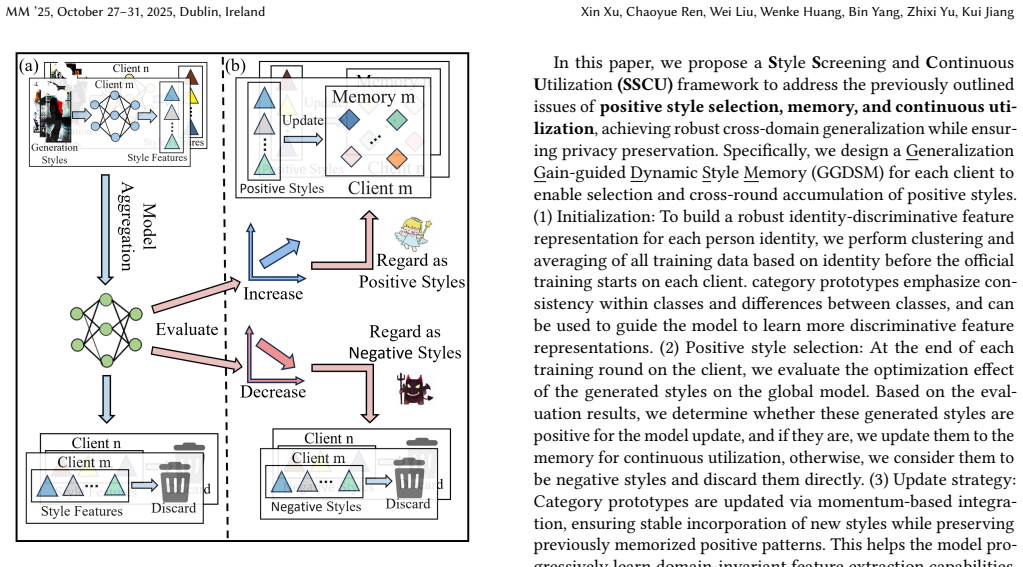
The load-bearing mechanism is the Generalization Gain-guided Dynamic Style Memory (GGDSM): each client holds one prototype vector per person identity, initialized from the pretrained global model's features. After each round, if the server-aggregated global model's Rank-1 has increased relative to the previous round, the style features generated in that round are folded into the matching identity prototypes by a momentum update (Eq. 3); if not, they are discarded as negative. The style memory recognition loss (Eq. 4) then trains features to be close to their own identity prototype and far from others, while Collaborative Style Training (CST) runs two branches in parallel: a new-style adaptation branch that trains the client-global model on freshly stylized images with cross-entropy and triplet losses, and a positive-style continuous utilization branch that trains both the client-local and client-global models on original images with the recognition loss.
What would settle it
Run the SSCU protocol twice, once where the per-round Rank-1 evaluation uses the target test set and once where it uses a source validation split held out from training; if the reported gains appear only in the first run, the screening is leaking target labels. Alternatively, replace the Rank-1-increase gate with a random accept/reject gate matched to the same acceptance rate; if mAP and Rank-1 do not drop, the gain signal itself is not doing the work.
Extended reading notes
Core claim
On the paper's own terms, the discovery is that generated styles are heterogeneous in value: some styles improve the model's generalization and some degrade it, so treating all generated styles equally wastes or even damages what style augmentation offers. The proposed answer is a per-client memory of category prototypes that screens styles by the generalization gain of the aggregated global model, accumulates only the positive ones with a momentum update, and keeps them available across communication rounds through a style memory recognition loss and a two-branch collaborative training strategy. The claimed consequence is that the global model generalizes better to unseen target domains while also retaining or improving its recognition accuracy on the source domains.
Load-bearing premise
The method assumes that a round-over-round increase in the global model's Rank-1 is a trustworthy signal that the styles generated that round are positive, and that this Rank-1 can be computed on some appropriately available set; the paper never says which data is used for that evaluation.
Editorial extensions
If this is right
- If the screening claim is right, style augmentation in federated ReID should not blindly accumulate generated data; selecting styles by measured generalization gain should be part of the training loop.
- Styles that survive the filter are reusable across rounds rather than discarded after one update, so their value is retained without recomputation or extra communication.
- The same framework is claimed to work with fewer source domains: under protocol-2, SSCU still beats the compared methods when one source domain is dropped.
- Both training branches matter: ablation results show that the new-style branch and the positive-style branch each improve performance and the best results come from using them together.
- Because only feature extractors are uploaded and each client's memory stays local, the claimed gains do not require sharing raw images or style data across clients.
Reading between the lines
- Beyond the paper: the Rank-1-gain gate is the crux of the method, and the paper does not state what data feeds that evaluation. If the evaluation uses the target test set, the screening would be supervised by test labels and the domain-generalization claim would not hold in the usual sense; if it uses source data only, then the screening signal is about source fit, and the target-domain transfer n
- Beyond the paper: the same screen-then-memorize loop could be tested in centralized domain generalization with an explicit held-out validation split, which would settle whether the positive/negative style distinction survives without any federated component.
- Beyond the paper: the per-client prototype memory is also a form of regularization that could reduce client drift between rounds; measuring prototype drift and per-client overfitting across rounds would show whether the memory's benefit is due to style selection, to stabilization, or to both.
Editorial analysis
A structured set of objections, weighed in public.
Referee Report
Summary. The paper proposes SSCU (Style Screening and Continuous Utilization) for federated domain generalization in person re-identification (FedDG-ReID). The method maintains per-client dynamic style memories initialized from category prototypes and updates them with style features that are deemed 'positive' when the global model's Rank-1 improves from one round to the next. A collaborative style training (CST) strategy uses two branches: one adapts to newly generated styles and the other exploits the accumulated positive styles via a style-memory recognition loss. Experiments on CUHK02, CUHK03, MSMT17, and Market1501 under three protocols report consistent improvements over existing methods, with the largest gain on MS+C2+C3->M (mAP 39.5, Rank-1 66.4).
Significance. If the claims hold, the paper addresses a legitimate weakness of prior style-diversification methods: not all generated styles improve generalization, and selectively retaining beneficial styles could boost both source and target performance. The idea of using round-over-round performance change of the global model as a screening signal is novel and practically relevant, and the paper includes a full algorithm, ablations of the two training branches, and comparisons against multiple federated and DG baselines. However, the significance is currently undermined by the unspecified evaluation set for the screening signal, missing hyperparameters (momentum m and temperature tau), the absence of statistical significance reporting, and the lack of an ablation that isolates the screening mechanism from the rest of the framework. These issues need to be resolved before the claimed gains can be trusted.
major comments (4)
- [Section 3.1; Algorithm 1 (lines 31-36)] The screening signal is never specified: the manuscript does not state which data and labels are used to compute the global model's Rank-1 that determines whether styles are 'positive.' In the FedDG-ReID setting the server has no raw data, so the evaluation must occur either on the held-out target test set or on some source-domain set. If the target test set is used, positive/negative style decisions are made using test labels, which violates the domain-generalization protocol and makes the reported improvements a form of label leakage. If a source-domain set is used, the criterion is in-sample and the paper provides no evidence that in-sample Rank-1 gains correlate with target-domain gains. The authors must specify exactly what data, what labels, and which party (server or clients) performs this evaluation, and confirm that the screening set is disjoint from the target test set.
- [Table 4; Section 4.3] The ablation does not isolate the screening contribution. 'Baseline+PSCU' is described as directly memorizing all generated styles without screening, while 'Baseline+NSA+PSCU' adds both the new-style adaptation branch and the screening/accumulation mechanism. The difference between these two configurations therefore conflates the NSA branch with the screening steps, so the +12.8 mAP attributed to the full method cannot be interpreted as evidence that screening itself helps. Add an ablation that toggles only the screening decision (e.g., memorize all styles versus memorize only styles that pass the Rank-1 criterion) while keeping the two training branches fixed, and report the corresponding mAP/Rank-1.
- [Section 4.1 (Implementation Details)] The hyperparameters introduced in the method are missing: the momentum coefficient m in Eq. (3) and the temperature tau in Eq. (4) are never given values, and the number of communication rounds E is not explicitly stated despite the '60 epochs' phrasing. In addition, all results are single-run; no standard deviations or numbers of seeds are reported. Given that the claimed advantages over the best baseline in Table 1 are 3.2 mAP and 5.2 Rank-1 for one setting and only 1.5 mAP in Table 2, statistical variability may be comparable to the reported margins. Please provide the missing hyperparameter values and report means and variances over at least three independent runs.
- [Section 3.1; Eq. (3)] There is a potential mismatch between the screening criterion and the memory-update rule. The screening decision is based on the aggregated global model's Rank-1 change, while the memory is updated with style features extracted by each client-global model; moreover, when the global model improves, the update is applied to every client's memory regardless of whether that client's styles contributed to the improvement. The paper does not justify this design. Please discuss why a global Rank-1 improvement is a reliable per-client style-quality signal, or modify the update rule to credit only the clients whose styles actually contributed (e.g., by evaluating per-client contributions on a local validation split).
minor comments (9)
- [Section 4.2, Table 1] The text states 'the mAP reaches 39.2%, and Rank-1 reaches 66.4%' while Table 1 reports mAP 39.5; the claimed margin 'at least ↑2.9%' also does not match the table, where DACS has mAP 36.3 (a margin of 3.2). Please correct the numbers in the text to agree with the table.
- [Algorithm 1, line 32] The condition 'if e=0 or f_server's Rank-1 increase' contains dead code because the loop starts at e=1; remove the e=0 clause or clarify the intended first-round behavior.
- [Section 4.4] There is a typo: 'CHUK02' should be 'CUHK02'.
- [Paper header / ACM reference format] The ACM reference line contains a duplication: 'In Proceedings of In Proceedings of the 33rd ACM International Conference on Multimedia.' Please fix.
- [Section 4.1] The phrase 'The number of training epochs is set to 60' is ambiguous: it is unclear whether this refers to local epochs per round, the total number of communication rounds, or something else. Please specify and state the value of E used in Algorithm 1.
- [Section 3.2; Eq. (2)] The style transformation model f_T is referenced from [44] (DACS), but the paper does not state whether f_T is trained, pretrained, or frozen, nor how it is initialized. Since DACS is used as a baseline, explicitly describe how f_T is set up to make the comparison fair.
- [References] Reference [46] (Fed4ReID) appears in the bibliography but is not cited in the body text; either cite it in the related work section or remove it.
- [Introduction / Fig. 3(b)] The 'discovery' that not all styles contribute to generalization is supported only by anecdotal visualizations; a quantitative analysis (e.g., correlation between a style's effect on validation accuracy and image content) would strengthen the motivation.
- [Throughout] The term 'generalization gain' is used for what is operationally a Rank-1 change on an unspecified set; if that set is a validation set, call it 'validation Rank-1 gain' to avoid overclaiming.
Circularity Check
Positive-style screening is gated on the global model's Rank-1, the same metric then reported as the result, and the paper never specifies the data used to compute that Rank-1; if it is the held-out target set, the reported gains are test-label-driven rather than independent.
-
self definitional
[Section 3.1 'Positive style screening and memory update'; Algorithm 1, lines 31-36; Tables 1-3]
"Specifically, after each training round, We assess the global model's performance, with Rank-1 serving as the key indicator of generalization capability. We then compare these evaluation outcomes with those from the preceding round. If the styles produced in the current round have helped to enhance the model's generalization performance, we regard them as positive styles and update them to the memory, otherwise, we regard them as negative styles and discard them directly. ... Algorithm 1: if e=0 or f_server's Rank-1 increase then ... M_k<-UPDATE(M_k, \hat F_k)"
The gating signal for the memory update is f_server's Rank-1, the same quantity reported in Tables 1-3 as the method's target-domain result. The paper never states the data used to compute this Rank-1. If it is the held-out target set, styles are admitted to memory exactly when target Rank-1 rises, so the final target Rank-1 is not an independent evaluation but the objective that selected the memorized styles; the reported gains, including the +12.8 mAP attributed to PSCU in Table 4, reduce to test-set selection. If it is source training data, no validation split is specified, and the in-sample Rank-1 is a training signal, not external evidence. Either way the central novelty is a self-referential feedback loop on the reported metric.
full rationale
Apart from the unspecified Rank-1 gating, the paper's remaining contributions are not circular: the style memory recognition loss (Eq. 4) and collaborative training branches (Eqs. 5-8) are concrete training objectives, the comparison baselines are external methods, and the paper does not rely on a load-bearing self-citation chain. The problem is localized to the screening/memory decision, which is the source of the largest ablation gain. Because the manuscript never specifies what data are used to compute the Rank-1 that triggers the memory update, the reader cannot verify that this Rank-1 is not the held-out target set; if it is, the main result is a form of test-label leakage rather than independent generalization. This is a conditional circularity: on the stated text, the claimed prediction (target Rank-1) is definitionally tied to the screening input (Rank-1 increase), but the paper does not exhibit the data split that would break the loop. Hence a moderate score of 4 rather than 6 or 8.
Assumptions & free parameters
free parameters (3)
- momentum coefficient m
- temperature tau
- Rank-1 improvement threshold =
0 (any increase)
assumptions (4)
- ad hoc to paper The global model's Rank-1 improvement between rounds is a valid measure of whether generated styles are positive.
- domain assumption Style-transformed images preserve the identity labels of their source images.
- domain assumption Category prototypes computed by averaging pretrained global features are sufficient identity-discriminative representations for the recognition loss.
- domain assumption The client-global model has richer generalization knowledge and is more suitable than the client-local model for rapidly learning new styles.
invented entities (1)
-
Positive and negative style labels
Cite this review
Pith. "Pith review of Positive Style Accumulation: A Style Screening and Continuous Utilization Framework for Federated DG-ReID." pith.science (2026). https://pith.science/paper/23BRLPUN
@misc{pith2026250716238,
  author       = {Pith},
  title        = {Pith review of: Positive Style Accumulation: A Style Screening and Continuous Utilization Framework for Federated DG-ReID},
  year         = {2026},
  howpublished = {\url{https://pith.science/paper/23BRLPUN}},
  note         = {Machine review of arXiv:2507.16238}
}
read the original abstract
The Federated Domain Generalization for Person re-identification (FedDG-ReID) aims to learn a global server model that can be effectively generalized to source and target domains through distributed source domain data. Existing methods mainly improve the diversity of samples through style transformation, which to some extent enhances the generalization performance of the model. However, we discover that not all styles contribute to the generalization performance. Therefore, we define styles that are beneficial or harmful to the model's generalization performance as positive or negative styles. Based on this, new issues arise: How to effectively screen and continuously utilize the positive styles. To solve these problems, we propose a Style Screening and Continuous Utilization (SSCU) framework. Firstly, we design a Generalization Gain-guided Dynamic Style Memory (GGDSM) for each client model to screen and accumulate generated positive styles. Meanwhile, we propose a style memory recognition loss to fully leverage the positive styles memorized by Memory. Furthermore, we propose a Collaborative Style Training (CST) strategy to make full use of positive styles. Unlike traditional learning strategies, our approach leverages both newly generated styles and the accumulated positive styles stored in memory to train client models on two distinct branches. This training strategy is designed to effectively promote the rapid acquisition of new styles by the client models, and guarantees the continuous and thorough utilization of positive styles, which is highly beneficial for the model's generalization performance. Extensive experimental results demonstrate that our method outperforms existing methods in both the source domain and the target domain.
Figures


Reference graph
Works this paper leans on
-
[1]
Yogesh Balaji, Swami Sankaranarayanan, and Rama Chellappa. 2018. Metareg: Towards domain generalization using meta-regularization.Advances in neural information processing systems31 (2018)
work page 2018
-
[2]
Neda Bugshan, Ibrahim Khalil, Mohammad Saidur Rahman, Mohammed Atiquz- zaman, Xun Yi, and Shahriar Badsha. 2022. Toward trustworthy and privacy- preserving federated deep learning service framework for industrial internet of things.IEEE Transactions on Industrial Informatics19, 2 (2022), 1535–1547
work page 2022
-
[3]
Seokeon Choi, Taekyung Kim, Minki Jeong, Hyoungseob Park, and Chang- ick Kim. 2021. Meta batch-instance normalization for generalizable person re-identification. InProceedings of the IEEE/CVF conference on Computer Vision and Pattern Recognition. 3425–3435
work page 2021
-
[4]
Yongxing Dai, Xiaotong Li, Jun Liu, Zekun Tong, and Ling-Yu Duan. 2021. Gen- eralizable person re-identification with relevance-aware mixture of experts. In Proceedings of the IEEE/CVF conference on computer vision and pattern recognition. 16145–16154
2021
-
[5]
Zan Gao, Lishuai Gao, Hua Zhang, Zhiyong Cheng, Richang Hong, and Shengy- ong Chen. 2020. DCR: A unified framework for holistic/partial person ReID.IEEE Transactions on Multimedia23 (2020), 3332–3345
work page 2020
-
[6]
Zan Gao, Hongwei Wei, Weili Guan, Weizhi Nie, Meng Liu, and Meng Wang
-
[7]
Wenke Huang, Mang Ye, and Bo Du. 2022. Learn from others and be yourself in heterogeneous federated learning. InCVPR
work page 2022
-
[8]
Wenke Huang, Mang Ye, Zekun Shi, and Bo Du. 2023. Generalizable Hetero- geneous Federated Cross-Correlation and Instance Similarity Learning.TPAMI (2023)
work page 2023
Show all 61 references
-
[9]
Wenke Huang, Mang Ye, Zekun Shi, He Li, and Bo Du. 2023. Rethinking Federated Learning with Domain Shift: A Prototype View. InCVPR
2023
-
[10]
Wenke Huang, Mang Ye, Zekun Shi, Guancheng Wan, He Li, Bo Du, and Qiang Yang. 2024. A Federated Learning for Generalization, Robustness, Fairness: A Survey and Benchmark.TPAMI(2024)
2024
-
[11]
Xun Huang and Serge Belongie. 2017. Arbitrary style transfer in real-time with adaptive instance normalization. InProceedings of the IEEE international conference on computer vision. 1501–1510
2017
-
[12]
Bingliang Jiao, Lingqiao Liu, Liying Gao, Guosheng Lin, Lu Yang, Shizhou Zhang, Peng Wang, and Yanning Zhang. 2022. Dynamically transformed instance normal- ization network for generalizable person re-identification. InEuropean conference on computer vision. Springer, 285–301
2022
-
[13]
Xin Jin, Cuiling Lan, Wenjun Zeng, Zhibo Chen, and Li Zhang. 2020. Style normal- ization and restitution for generalizable person re-identification. InProceedings of the IEEE/CVF conference on computer vision and pattern recognition. 3143–3152
2020
-
[14]
Juwon Kang, Sohyun Lee, Namyup Kim, and Suha Kwak. 2022. Style neophile: Constantly seeking novel styles for domain generalization. InProceedings of the IEEE/CVF Conference on Computer Vision and Pattern Recognition. 7130–7140
2022
-
[15]
Sai Praneeth Karimireddy, Satyen Kale, Mehryar Mohri, Sashank Reddi, Sebas- tian Stich, and Ananda Theertha Suresh. 2020. Scaffold: Stochastic controlled averaging for federated learning. InInternational conference on machine learning. PMLR, 5132–5143
2020
-
[16]
Jin Kim, Jiyoung Lee, Jungin Park, Dongbo Min, and Kwanghoon Sohn. 2022. Pin the memory: Learning to generalize semantic segmentation. InProceedings of the IEEE/CVF Conference on Computer Vision and Pattern Recognition. 4350–4360
2022
-
[17]
Qinbin Li, Bingsheng He, and Dawn Song. 2021. Model-contrastive federated learning. InProceedings of the IEEE/CVF conference on computer vision and pattern recognition. 10713–10722
2021
-
[18]
Tian Li, Anit Kumar Sahu, Manzil Zaheer, Maziar Sanjabi, Ameet Talwalkar, and Virginia Smith. 2020. Federated optimization in heterogeneous networks. Proceedings of Machine learning and systems2 (2020), 429–450
2020
-
[19]
Yiming Li, Shuo Shao, Yu He, Junfeng Guo, Tianwei Zhang, Zhan Qin, Pin-Yu Chen, Michael Backes, Philip Torr, Dacheng Tao, and Kui Ren. 2025. Rethinking Data Protection in the (Generative) Artificial Intelligence Era.arXiv preprint arXiv:2507.03034(2025)
2025 arXiv
-
[20]
Ying Li, Xingwei Wang, Rongfei Zeng, Praveen Kumar Donta, Ilir Murturi, Min Huang, and Schahram Dustdar. 2023. Federated domain generalization: A survey. arXiv preprint arXiv:2306.01334(2023)
2023 arXiv
-
[21]
Yiying Li, Yongxin Yang, Wei Zhou, and Timothy Hospedales. 2019. Feature-critic networks for heterogeneous domain generalization. InInternational conference on machine learning. PMLR, 3915–3924
2019
-
[22]
Ke Liang, Lingyuan Meng, Hao Li, Jun Wang, Long Lan, Miaomiao Li, Xinwang Liu, and Huaimin Wang. 2025. From Concrete to Abstract: Multi-view Clustering on Relational Knowledge.IEEE Transactions on Pattern Analysis and Machine Intelligence(2025), 1–18. doi:10.1109/TPAMI.2025.3582689
2025
-
[23]
Fangyi Liu, Mang Ye, and Bo Du. 2024. Domain generalized federated learning for Person Re-identification.Computer Vision and Image Understanding241 (2024), 103969
2024
-
[24]
Hao Luo, Youzhi Gu, Xingyu Liao, Shenqi Lai, and Wei Jiang. 2019. Bag of tricks and a strong baseline for deep person re-identification. InProceedings of the IEEE/CVF conference on computer vision and pattern recognition workshops. 0–0
2019
-
[25]
Fangrui Lv, Jian Liang, Shuang Li, Bin Zang, Chi Harold Liu, Ziteng Wang, and Di Liu. 2022. Causality inspired representation learning for domain generalization. In Proceedings of the IEEE/CVF conference on computer vision and pattern recognition. 8046–8056
2022
-
[26]
Yanbiao Ma, Wei Dai, Wenke Huang, and Jiayi Chen. 2025. Geometric Knowledge- Guided Localized Global Distribution Alignment for Federated Learning. In CVPR
2025
-
[27]
Divyat Mahajan, Shruti Tople, and Amit Sharma. 2021. Domain generalization using causal matching. InInternational conference on machine learning. PMLR, 7313–7324
2021
-
[28]
Massimiliano Mancini, Zeynep Akata, Elisa Ricci, and Barbara Caputo. 2020. To- wards recognizing unseen categories in unseen domains. InEuropean Conference on Computer Vision. Springer, 466–483
2020
-
[29]
Brendan McMahan, Eider Moore, Daniel Ramage, Seth Hampson, and Blaise Aguera y Arcas. 2017. Communication-efficient learning of deep net- works from decentralized data. InArtificial intelligence and statistics. PMLR, 1273–1282
2017
-
[30]
Oren Nuriel, Sagie Benaim, and Lior Wolf. 2021. Permuted adain: Reducing the bias towards global statistics in image classification. InProceedings of the IEEE/CVF conference on computer vision and pattern recognition. 9482–9491
2021
-
[31]
Lei Qi, Lei Wang, Yinghuan Shi, and Xin Geng. 2022. A novel mix-normalization method for generalizable multi-source person re-identification.IEEE Transactions on Multimedia25 (2022), 4856–4867
2022
-
[32]
Yichun Shi, Xiang Yu, Kihyuk Sohn, Manmohan Chandraker, and Anil K Jain
-
[33]
Yifan Sun, Liang Zheng, Yi Yang, Qi Tian, and Shengjin Wang. 2018. Beyond part models: Person retrieval with refined part pooling (and a strong convolutional baseline). InProceedings of the European conference on computer vision (ECCV). 480–496
2018
-
[34]
Zhiqiang Tang, Yunhe Gao, Yi Zhu, Zhi Zhang, Mu Li, and Dimitris N Metaxas
-
[35]
Riccardo Volpi and Vittorio Murino. 2019. Addressing model vulnerability to distributional shifts over image transformation sets. InProceedings of the IEEE/CVF International Conference on Computer Vision. 7980–7989
2019
-
[36]
Haochen Wang, Jiayi Shen, Yongtuo Liu, Yan Gao, and Efstratios Gavves. 2022. Nformer: Robust person re-identification with neighbor transformer. InPro- ceedings of the IEEE/CVF conference on computer vision and pattern recognition. 7297–7307
2022
-
[37]
Yang Wang, Jinjia Peng, Huibing Wang, and Meng Wang. 2022. Progressive learn- ing with multi-scale attention network for cross-domain vehicle re-identification. Science China Information Sciences65, 6 (2022), 160103
2022
-
[38]
Guile Wu and Shaogang Gong. 2021. Decentralised learning from independent multi-domain labels for person re-identification. InProceedings of the AAAI Conference on Artificial Intelligence, Vol. 35. 2898–2906
2021
-
[39]
Boqiang Xu, Jian Liang, Lingxiao He, and Zhenan Sun. 2021. Meta: Mimicking embedding via others’ aggregation for generalizable person re-identification. arXiv preprint arXiv:2112.08684(2021)
2021 arXiv
-
[40]
Chenggang Yan, Biao Gong, Yuxuan Wei, and Yue Gao. 2020. Deep multi-view enhancement hashing for image retrieval.IEEE Transactions on Pattern Analysis and Machine Intelligence43, 4 (2020), 1445–1451
2020
-
[41]
Chenggang Yan, Yiming Hao, Liang Li, Jian Yin, Anan Liu, Zhendong Mao, Zhenyu Chen, and Xingyu Gao. 2021. Task-adaptive attention for image caption- ing.IEEE Transactions on Circuits and Systems for Video technology32, 1 (2021), 43–51
2021
-
[42]
Chenggang Yan, Lixuan Meng, Liang Li, Jiehua Zhang, Zhan Wang, Jian Yin, Jiyong Zhang, Yaoqi Sun, and Bolun Zheng. 2022. Age-invariant face recognition by multi-feature fusionand decomposition with self-attention.ACM Transactions on Multimedia Computing, Communications, and Ap...
2022
-
[43]
Cheng Yan, Guansong Pang, Xiao Bai, Changhong Liu, Xin Ning, Lin Gu, and Jun Zhou. 2021. Beyond triplet loss: person re-identification with fine-grained MM ’25, October 27–31, 2025, Dublin, Ireland Xin Xu, Chaoyue Ren, Wei Liu, Wenke Huang, Bin Yang, Zhixi Yu, Kui Jiang differ...
2021
-
[44]
Fengxiang Yang, Zhun Zhong, Zhiming Luo, Yifan He, Shaozi Li, and Nicu Sebe
-
[45]
Mang Ye, Jianbing Shen, Gaojie Lin, Tao Xiang, Ling Shao, and Steven CH Hoi
-
[46]
Chong Zhang, Xiao Liu, Mingrong Xiang, Aiting Yao, Xiaoliang Fan, and Gang Li. 2023. Fed4ReID: Federated learning with data augmentation for person re- identification service in edge computing. In2023 IEEE International Conference on Web Services (ICWS). IEEE, 64–70
2023
-
[47]
Ji Zhang, Jingkuan Song, Lianli Gao, Ye Liu, and Heng Tao Shen. 2022. Progressive meta-learning with curriculum.IEEE Transactions on Circuits and Systems for Video Technology32, 9 (2022), 5916–5930
2022
-
[48]
Pengyi Zhang, Huanzhang Dou, Yunlong Yu, and Xi Li. 2022. Adaptive cross- domain learning for generalizable person re-identification. InEuropean conference on computer vision. Springer, 215–232
2022
-
[49]
Pengling Zhang, Huibin Yan, Wenhui Wu, and Shuoyao Wang. 2023. Improving federated person re-identification through feature-aware proximity and aggre- gation. InProceedings of the 31st ACM International Conference on Multimedia. 2498–2506
2023
-
[50]
Deep learning for person re-identification: A survey and outlook.IEEE transactions on pattern analysis and machine intelligence44, 6 (2021), 2872–2893
2021
-
[51]
Xinyu Zhang, Dongdong Li, Zhigang Wang, Jian Wang, Errui Ding, Javen Qinfeng Shi, Zhaoxiang Zhang, and Jingdong Wang. 2022. Implicit sample extension for unsupervised person re-identification. InProceedings of the IEEE/CVF conference on computer vision and pattern recognition....
2022
-
[52]
Yi-Fan Zhang, Zhang Zhang, Da Li, Zhen Jia, Liang Wang, and Tieniu Tan
-
[53]
Kaiyang Zhou, Yongxin Yang, Yu Qiao, and Tao Xiang. 2021. Domain generaliza- tion with mixstyle.arXiv preprint arXiv:2104.02008(2021)
2021 arXiv
-
[54]
Haowei Zhu, Wenjing Ke, Dong Li, Ji Liu, Lu Tian, and Yi Shan. 2022. Dual cross-attention learning for fine-grained visual categorization and object re- identification. InProceedings of the IEEE/CVF conference on computer vision and pattern recognition. 4692–4702
2022
-
[55]
Ruipeng Zhang, Qinwei Xu, Jiangchao Yao, Ya Zhang, Qi Tian, and Yanfeng Wang. 2023. Federated domain generalization with generalization adjustment. In Proceedings of the IEEE/CVF Conference on Computer Vision and Pattern Recognition. 3954–3963
2023
-
[58]
Learning domain invariant representations for generalizable person re- identification.IEEE Transactions on Image Processing32 (2022), 509–523
2022
-
[61]
Weiming Zhuang, Yonggang Wen, Xuesen Zhang, Xin Gan, Daiying Yin, Dongzhan Zhou, Shuai Zhang, and Shuai Yi. 2020. Performance optimization of federated person re-identification via benchmark analysis. InProceedings of the 28th ACM international conference on multimedia. 955–963
2020
-
[2020]
In Proceedings of the IEEE/CVF conference on computer vision and pattern recognition
Towards universal representation learning for deep face recognition. In Proceedings of the IEEE/CVF conference on computer vision and pattern recognition. 6817–6826
-
[2021]
In Proceedings of the IEEE/CVF International Conference on Computer Vision
Crossnorm and selfnorm for generalization under distribution shifts. In Proceedings of the IEEE/CVF International Conference on Computer Vision. 52–61
-
[2022]
InProceedings of the 30th ACM international conference on multi- media
Multigranular visual-semantic embedding for cloth-changing person re- identification. InProceedings of the 30th ACM international conference on multi- media. 3703–3711
-
[2024]
InProceedings of the AAAI Conference on Artificial Intelligence, Vol
Diversity-authenticity co-constrained stylization for federated domain generalization in person re-identification. InProceedings of the AAAI Conference on Artificial Intelligence, Vol. 38. 6477–6485
Reviewed August 6, 2026 · model on record in the stance chip above.
Discussion (0). Sign in to comment.