REVIEW 4 major objections 4 minor 1 cited by
One Polyp Identifies All: One-Shot Polyp Segmentation with SAM via Cascaded Priors and Iterative Prompt Evolution
T0 review · 4 major / 4 minor · reviewed 2026-08-06 · deepseek-v4-flash
Pith's one-line read A single annotated polyp can automatically prompt SAM2 to segment unseen polyps, achieving 76.93% IoU on Kvasir without any training.
desk verdict Genuinely new iterative prompting for one-shot SAM polyp segmentation, with solid ablations; the Kvasir headline number is over-tuned and the EPE stopping rule needs a calibration check, but it deserves a real review. read the letter →
The pith
A machine-rendered reading of the paper's core claim, the machinery that carries it, and where it could break.
The reading
What carries the argument
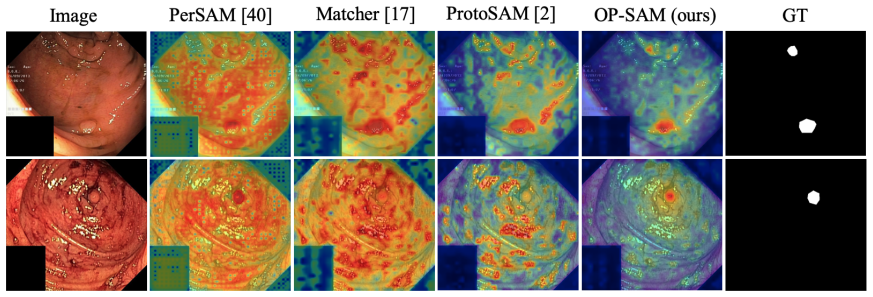
Three coupled components carry the argument. Correlation-based Prior Generation (CPG) computes a query-support cross-correlation matrix from DINOv2 patch features, transfers the support mask through it, then refines the result by repeated multiplication with a Sinkhorn-normalized self-correlation matrix, turning a rough label transfer into a smooth semantic prior. Scale-cascaded Prior Fusion (SPF) creates enlarged and shrunk copies of the support lesion, generates a prior for each scale, and weights the three priors by a confidence IoU obtained by reverse-transferring each candidate prior back onto the known support mask. Euclidean Prompt Evolution (EPE) is the feedback loop that finally prompts SAM2, a promptable image segmentation model: at each round it computes the Euclidean distance transform of the still-uncovered confident prior region, prompts at the point farthest from the background, and iterates until SAM2's predicted mask IoU and prior coverage both clear the 0.85 threshold, with a negative prompt available when the prediction spills outside the loose prior.
What would settle it
Run the EPE loop over a colonoscopy image set with expert polyp masks, and for each accepted round compare SAM2's predicted quality score with the true overlap against the expert mask; if many rounds that pass the 0.85 threshold have true overlap far below 0.85, the stopping rule is the weak link.
Extended reading notes
Core claim
The paper's central claim is that in one-shot SAM-based polyp segmentation, prompt placement can matter more than the amount of ground-truth information, and that a training-free feedback loop can outperform hand-crafted prompt strategies. The proposed pipeline transfers the support mask to the query by cross-correlating DINOv2 patch features, refines the coarse transfer with repeated self-correlation and Sinkhorn normalization, and repeats this for enlarged and shrunk versions of the support lesion; the three priors are weighted by a reverse-transfer confidence IoU that measures how well each prior reconstructs the known support mask. The fused prior is then consumed by an iterative prompting algorithm that adds one Euclidean-distance-transform-centered prompt per round, keeps the accumulated prompt list, and stops when both SAM2's predicted mask IoU and prior coverage exceed 0.85. On Kvasir the authors measure 76.93% IoU, 11.44 points above the best prior one-shot method and above their random three-point ground-truth oracle; ablations attribute the largest single gain to the iterative prompting rule, which drops to 58.04% IoU when the prompt center is replaced by a bounding-box center.
Load-bearing premise
The load-bearing premise is that the model's own estimate of segmentation quality, together with the fixed coverage threshold of 0.85, reliably tells when a polyp has been fully covered; if that estimate is miscalibrated on colonoscopy images, the loop stops early on under-segmented polyps or accepts noisy expansions, and the iterative-prompting gains shrink.
Editorial extensions
If this is right
- On Kvasir, OP-SAM's reported 76.93% IoU exceeds the random three-point ground-truth oracle's 71.88% IoU, so the authors conclude that prompt placement matters more than having ground-truth points to sample from.
- The scale-cascaded fusion with confidence weighting beats naive averaging: the paper's support-configuration ablation shows one support image with two scale augmentations plus SPF reaches 61.47% prior IoU, ahead of three separate support images with naive averaging at 37.88%.
- The EPE stopping rule, powered by SAM2's predicted mask IoU and prior coverage, accounts for the largest single effect in the paper's ablations: replacing its Euclidean-distance-transform center with a bounding-box center collapses Kvasir IoU from 76.93% to 58.04%.
- Across five randomly chosen support images, the method's IoU variance is 0.48, compared with 12.57 for PerSAM, 2.55 for Matcher, and 2.80 for ProtoSAM, indicating that performance does not hinge on a lucky support choice.
- On the extreme-size Kvasir-H subset, OP-SAM reports 57.31% IoU, 10.26 points above the second-best method, which the authors tie to the scale-cascaded prior fusion.
Reading between the lines
- Editorial inference: the same cascade—correlation priors from a frozen encoder, adaptive multi-scale fusion, and SAM2's predicted-IoU feedback—could in principle transfer to other lesion types or anatomical structures that SAM2 can already segment, with a single annotated exemplar per class.
- Editorial inference: the reported 'surpasses oracle' result is conditional on the oracle being three randomly placed points; a stronger oracle that places prompts optimally from ground truth would be a harder benchmark, so the comparison should be read as evidence about prompt placement rather than about information content.
- Editorial inference: because the loop treats SAM2's predicted mask IoU as a trusted stopping signal, the method's margin over baselines may shrink on domains where that prediction is poorly calibrated; a calibration study of the 0.85 threshold would separate prompt-placement gains from prior-generation gains.
- Editorial inference: a natural testable extension is to feed EPE's accepted prompts back as pseudo-labels for a small fine-tuning step; a training-free method that already performs well suggests these prompts carry usable supervision, but the paper does not test that upper bound.
Editorial analysis
A structured set of objections, weighed in public.
Referee Report
Summary. The paper proposes OP-SAM, a training-free one-shot polyp segmentation framework built on SAM2 and DINOv2. From a single annotated support image, it generates semantic priors via Correlation-based Prior Generation (CPG), fuses scale-cascaded priors via a reverse-transfer weighting scheme (SPF), and iteratively refines SAM2 prompts through Euclidean Prompt Evolution (EPE), which uses SAM2's internal mask-IoU predictions to decide when to stop or expand prompting. Experiments on five datasets report state-of-the-art IoU/Dice, including 76.93% IoU on Kvasir, which is claimed to surpass a random three-point ground-truth oracle.
Significance. The problem is practically important: reducing per-image annotation for polyp segmentation has clear clinical value, and a training-free pipeline that leverages foundation models is attractive. The paper's ablations (Tables 3–6) support the individual contributions of CPG, SPF, and EPE, and Table 7 shows some robustness to support-image selection. However, the central quantitative claims rest on a single support image with no variance estimates, and the EPE stopping rule depends on SAM2's mask-IoU calibration on out-of-distribution colonoscopy data, which is never validated. If these issues are addressed, the method could be a meaningful advance in one-shot medical segmentation; as presented, the headline numbers overstate the certainty of the result.
major comments (4)
- [§4.1, Table 1] The main results, including the 76.93% IoU on Kvasir and the 'surpasses oracle' claim, are reported for a single fixed support image with no error bars or multi-support statistics. Table 7 provides mean and variance only for an unspecified dataset and only for a five-support evaluation, not for the headline comparisons. Please report mean±std over at least five support images for all datasets (or justify why one support image is sufficient) and state the selection procedure and seed.
- [Algorithm 1, §4.2, Fig. 6] The EPE stopping rule (Algorithm 1, lines 12 and 28) relies on SAM2's predicted mask IoU (line 6) and a fixed threshold θ=0.85, but the paper provides no evidence that SAM2's IoU predictions are calibrated on colonoscopy images. If the predictor is overconfident, EPE terminates prematurely and degenerates to a one-shot prompt; if underconfident, it over-expands and accumulates false positives. Moreover, Fig. 6 selects ϑt and ϑl on the Kvasir test set and the headline number is computed on the same data, so the evaluation is not unbiased. Please include a calibration analysis of SAM2's IoU on a held-out dataset (e.g., PolypGen centers) and report sensitivity of the final IoU to θ within a reasonable range.
- [§4.3, Table 1] The 'Oracle' baseline is defined as randomly choosing three prompt points from the ground-truth mask. This is a weak baseline because random points can cluster or miss large polyp regions, so the conclusion that EPE surpasses the oracle is not strong evidence for the prompting strategy. Please strengthen the oracle to a more informative protocol, such as points selected to maximize coverage of the GT mask, or a GT-derived bounding box, and compare against that.
- [§4.2, Algorithm 1] Several hyperparameters used in the method are not specified, which harms reproducibility: the negative-area threshold η in Algorithm 1 line 22, the threshold τ used in the SPF reverse-transfer quality assessment in §3.2, and the maximum number of EPE rounds (mentioned only in prose as 'five rounds' but not given in Algorithm 1). Please report all numerical values and, where relevant, include them in the algorithm pseudocode.
minor comments (4)
- [Abstract] The phrase 'surpassing the state-of-the-art by 11.44%' should specify that this is an IoU improvement on Kvasir, not a generic statement across datasets.
- [§4.2] The lesion-scaling procedure mentions that 'the blank gap between the zoomed-out polyp and original polyp is filled by inpainting,' but no inpainting method is described; please provide details or a reference.
- [Table 6 caption] There is a typo: 'we we input' should read 'we input'.
- [§3.3, Fig. 2] The explanation of why the Euclidean distance transform (EDT) center is preferable to the bounding-box center would be clearer with a dedicated illustrative figure; the current 3rd-round example in Fig. 2 is difficult to parse.
Circularity Check
No significant circularity: the CPG/SPF/EPE pipeline derives query priors from the support mask and image features, never from query ground truth, and no load-bearing claim rests on a self-citation.
full rationale
The derivation chain is self-contained. CPG (Eqs. (1)-(2)) computes pori = [Sself]^ρ Scorr ms_r from DINOv2 features and the support mask; SPF (Eqs. (3)-(5)) chooses fusion weights via reverse transfer and cIoU against the support mask, which is the known label used as self-supervision rather than the query target. EPE (Algorithm 1) generates prompts from the fused prior and stops using SAM2's predicted mask IoU and prior coverage; the final mask is a union of SAM2 outputs. None of these steps uses the query ground-truth mask or a quantity fitted to it. The reverse-transfer cIoU reuses the support mask ms_r to score priors, but that is an explicit consistency heuristic, not an equivalence: a high cIoU does not by itself fix the query prior, and the final segmentation still comes from SAM2. The Kvasir hyper-parameter study (§4.4, Fig. 6) selects θ, ϑt, ϑl on the same dataset as the headline 76.93% IoU; this is a validation-selection caveat that can inflate the reported number and should be disclosed, but it is not a circular reduction: the selected constants are then applied to five other datasets and the ablation results are consistent. There are no load-bearing self-citations, no imported uniqueness theorems, and no renamed known results. Therefore, under the quoted-equation standard, no circular step is present.
Assumptions & free parameters
free parameters (7)
- tight prior threshold ϑt =
0.7
- loose prior threshold ϑl =
0.5
- score threshold θ =
0.85
- self-refinement rounds ρ
- negative area threshold η
- lesion zoom factor for extra-large and extra-small supports
- maximum EPE rounds =
5
assumptions (4)
- domain assumption DINOv2 patch features are transferable across colonoscopy images from different sites and devices.
- domain assumption SAM2's mask IoU prediction is a reliable quality estimate for stopping the prompt loop.
- domain assumption Sinkhorn row-column normalization from CLIP-ES applies to DINOv2 self-correlation matrices.
- domain assumption Reverse-transfer cIoU between query prior and support mask orders noisy priors correctly.
Cite this review
Pith. "Pith review of One Polyp Identifies All: One-Shot Polyp Segmentation with SAM via Cascaded Priors and Iterative Prompt Evolution." pith.science (2026). https://pith.science/paper/E4GFTSZB
@misc{pith2026250716337,
  author       = {Pith},
  title        = {Pith review of: One Polyp Identifies All: One-Shot Polyp Segmentation with SAM via Cascaded Priors and Iterative Prompt Evolution},
  year         = {2026},
  howpublished = {\url{https://pith.science/paper/E4GFTSZB}},
  note         = {Machine review of arXiv:2507.16337}
}
read the original abstract
Polyp segmentation is vital for early colorectal cancer detection, yet traditional fully supervised methods struggle with morphological variability and domain shifts, requiring frequent retraining. Additionally, reliance on large-scale annotations is a major bottleneck due to the time-consuming and error-prone nature of polyp boundary labeling. Recently, vision foundation models like Segment Anything Model (SAM) have demonstrated strong generalizability and fine-grained boundary detection with sparse prompts, effectively addressing key polyp segmentation challenges. However, SAM's prompt-dependent nature limits automation in medical applications, since manually inputting prompts for each image is labor-intensive and time-consuming. We propose OP-SAM, a One-shot Polyp segmentation framework based on SAM that automatically generates prompts from a single annotated image, ensuring accurate and generalizable segmentation without additional annotation burdens. Our method introduces Correlation-based Prior Generation (CPG) for semantic label transfer and Scale-cascaded Prior Fusion (SPF) to adapt to polyp size variations as well as filter out noisy transfers. Instead of dumping all prompts at once, we devise Euclidean Prompt Evolution (EPE) for iterative prompt refinement, progressively enhancing segmentation quality. Extensive evaluations across five datasets validate OP-SAM's effectiveness. Notably, on Kvasir, it achieves 76.93% IoU, surpassing the state-of-the-art by 11.44%.
Figures


Figures from the paper (3 more)


Forward citations
Cited by 1 Pith paper
-
Memory-Supported Synergistic Adaptation for Training-Free Test-Time Medical Image Segmentation
MSSA improves test-time medical image segmentation by storing reliable vision-language predictions in a memory bank and using stored images as prototypes to segment new images, without updating model weights.
Reference graph
Works this paper leans on
-
[1]
A multi-centre polyp detection and segmentation dataset for generalisability assessment
Sharib Ali, Debesh Jha, Noha Ghatwary, Stefano Realdon, Renato Cannizzaro, Osama E Salem, Dominique Lamarque, Christian Daul, Michael A Riegler, Kim V Anonsen, et al. A multi-centre polyp detection and segmentation dataset for generalisability assessment. Scientific Data, 10(1):75, 2023. 2, 5, 6, 7
work page 2023
-
[2]
Protosam-one shot medical image segmentation with foun- dational models
Lev Ayzenberg, Raja Giryes, and Hayit Greenspan. Protosam-one shot medical image segmentation with foun- dational models. arXiv preprint arXiv:2407.07042, 2024. 2, 3, 5, 6, 8
arXiv 2024
-
[3]
Wm-dova maps for accurate polyp highlighting in colonoscopy: Validation vs
Jorge Bernal, F Javier S ´anchez, Gloria Fern ´andez- Esparrach, Debora Gil, Cristina Rodr ´ıguez, and Fernando Vilari˜no. Wm-dova maps for accurate polyp highlighting in colonoscopy: Validation vs. saliency maps from physi- cians. Computerized medical imaging and graphics, 43:99– 111, 2015. 2, 5, 6
work page 2015
-
[4]
Semantically mean- ingful class prototype learning for one-shot image segmenta- tion
Tao Chen, Guo-Sen Xie, Yazhou Yao, Qiong Wang, Fumin Shen, Zhenmin Tang, and Jian Zhang. Semantically mean- ingful class prototype learning for one-shot image segmenta- tion. IEEE Transactions on Multimedia, 24:968–980, 2021. 3
work page 2021
-
[5]
Honghao Gao, Junsheng Xiao, Yuyu Yin, Tong Liu, and Jian- gang Shi. A mutually supervised graph attention network for few-shot segmentation: The perspective of fully utilizing limited samples. IEEE Transactions on neural networks and learning systems, 35(4):4826–4838, 2022. 3
work page 2022
-
[6]
Samir Jain, Rohan Atale, Anubhav Gupta, Utkarsh Mishra, Ayan Seal, Aparajita Ojha, Joanna Jaworek-Korjakowska, and Ondrej Krejcar. Coinnet: A convolution-involution net- work with a novel statistical attention for automatic polyp segmentation. IEEE Transactions on Medical Imaging , 42 (12):3987–4000, 2023. 1, 2, 5
work page 2023
-
[7]
Kvasir-seg: A segmented polyp dataset
Debesh Jha, Pia H Smedsrud, Michael A Riegler, P ˚al Halvorsen, Thomas De Lange, Dag Johansen, and H˚avard D Johansen. Kvasir-seg: A segmented polyp dataset. In MultiMedia modeling: 26th international conference, MMM 2020, Daejeon, South Korea, January 5–8, 2020, proceed- ings, part II 26, pages 451–462. Springer, 2020. 2, 5, 6, 7
work page 2020
-
[8]
Debesh Jha, Nikhil Kumar Tomar, Vanshali Sharma, and Ulas Bagci. Transnetr: transformer-based residual network for polyp segmentation with multi-center out-of-distribution testing. In Medical Imaging with Deep Learning , pages 1372–1384. PMLR, 2024. 2
work page 2024
Show all 41 references
-
[9]
Learning what not to segment: A new perspective on few- shot segmentation
Chunbo Lang, Gong Cheng, Binfei Tu, and Junwei Han. Learning what not to segment: A new perspective on few- shot segmentation. In Proceedings of the IEEE/CVF con- ference on computer vision and pattern recognition , pages 8057–8067, 2022. 3
2022
-
[10]
Cross-domain few-shot se- mantic segmentation
Shuo Lei, Xuchao Zhang, Jianfeng He, Fanglan Chen, Bowen Du, and Chang-Tien Lu. Cross-domain few-shot se- mantic segmentation. In European Conference on Computer Vision, pages 73–90. Springer, 2022. 3
2022
-
[11]
Semantic-sam: Segment and recognize anything at any gran- ularity
Feng Li, Hao Zhang, Peize Sun, Xueyan Zou, Shilong Liu, Jianwei Yang, Chunyuan Li, Lei Zhang, and Jianfeng Gao. Semantic-sam: Segment and recognize anything at any gran- ularity. arXiv preprint arXiv:2307.04767, 2023. 3
2023 arXiv
-
[12]
Adaptive prototype learning and allocation for few-shot segmentation
Gen Li, Varun Jampani, Laura Sevilla-Lara, Deqing Sun, Jonghyun Kim, and Joongkyu Kim. Adaptive prototype learning and allocation for few-shot segmentation. In Pro- ceedings of the IEEE/CVF conference on computer vision and pattern recognition, pages 8334–8343, 2021. 3
2021
-
[13]
Tcc- net: Temporally consistent context-free network for semi- supervised video polyp segmentation
Xiaotong Li, Jilan Xu, Yuejie Zhang, Rui Feng, Rui-Wei Zhao, Tao Zhang, Xuequan Lu, and Shang Gao. Tcc- net: Temporally consistent context-free network for semi- supervised video polyp segmentation. InIJCAI, pages 1109– 1115, 2022. 2
2022
-
[14]
Polyp-sam: Transfer sam for polyp segmentation
Yuheng Li, Mingzhe Hu, and Xiaofeng Yang. Polyp-sam: Transfer sam for polyp segmentation. In Medical Imaging 2024: Computer-Aided Diagnosis , pages 759–765. SPIE,
2024
-
[15]
Clip is also an efficient segmenter: A text-driven approach for weakly supervised semantic segmentation
Yuqi Lin, Minghao Chen, Wenxiao Wang, Boxi Wu, Ke Li, Binbin Lin, Haifeng Liu, and Xiaofei He. Clip is also an efficient segmenter: A text-driven approach for weakly supervised semantic segmentation. In Proceedings of the IEEE/CVF Conference on Computer Vision and Pattern Reco...
2023
-
[16]
Inter- mediate prototype mining transformer for few-shot semantic segmentation
Yuanwei Liu, Nian Liu, Xiwen Yao, and Junwei Han. Inter- mediate prototype mining transformer for few-shot semantic segmentation. Advances in Neural Information Processing Systems, 35:38020–38031, 2022. 3
2022
-
[17]
Matcher: Segment anything with one shot using all-purpose feature matching
Yang Liu, Muzhi Zhu, Hengtao Li, Hao Chen, Xinlong Wang, and Chunhua Shen. Matcher: Segment anything with one shot using all-purpose feature matching. arXiv preprint arXiv:2305.13310, 2023. 2, 3, 4, 6
2023 arXiv
-
[18]
Bad results with multiple point prompts
Lujiazho et al. Bad results with multiple point prompts. https : / / github . com / facebookresearch / segment- anything/issues/95 , 2023. Accessed: 2024-11-09. 4
2023
-
[19]
Segment anything in medical images
Jun Ma, Yuting He, Feifei Li, Lin Han, Chenyu You, and Bo Wang. Segment anything in medical images. Nature Communications, 15(1):654, 2024. 3
2024
-
[20]
Segic: Unleashing the emergent correspondence for in-context segmentation
Lingchen Meng, Shiyi Lan, Hengduo Li, Jose M Alvarez, Zuxuan Wu, and Yu-Gang Jiang. Segic: Unleashing the emergent correspondence for in-context segmentation. In European Conference on Computer Vision, pages 203–220. Springer, 2025. 6
2025
-
[21]
Cross-domain few-shot segmentation via iterative support-query correspon- dence mining
Jiahao Nie, Yun Xing, Gongjie Zhang, Pei Yan, Aoran Xiao, Yap-Peng Tan, Alex C Kot, and Shijian Lu. Cross-domain few-shot segmentation via iterative support-query correspon- dence mining. In Proceedings of the IEEE/CVF Conference on Computer Vision and Pattern Recognition , pa...
2024
-
[22]
Dinov2: Learning robust visual features without supervision
Maxime Oquab, Timoth ´ee Darcet, Th ´eo Moutakanni, Huy V o, Marc Szafraniec, Vasil Khalidov, Pierre Fernandez, Daniel Haziza, Francisco Massa, Alaaeldin El-Nouby, et al. Dinov2: Learning robust visual features without supervision. arXiv preprint arXiv:2304.07193, 2023. 2, 3, 5
2023 arXiv
-
[23]
Fuzzynet: A fuzzy attention module for polyp segmentation
Krushi Bharatbhai Patel, Fengjun Li, and Guanghui Wang. Fuzzynet: A fuzzy attention module for polyp segmentation. In NeurIPS’22 Workshop on All Things Attention: Bridging Different Perspectives on Attention, 2022. 2
2022
-
[24]
Learning transferable visual models from natural language supervi- sion
Alec Radford, Jong Wook Kim, Chris Hallacy, Aditya Ramesh, Gabriel Goh, Sandhini Agarwal, Girish Sastry, Amanda Askell, Pamela Mishkin, Jack Clark, et al. Learning transferable visual models from natural language supervi- sion. In International conference on machine learning, ...
2021
-
[25]
Medical im- age segmentation via cascaded attention decoding
Md Mostafijur Rahman and Radu Marculescu. Medical im- age segmentation via cascaded attention decoding. In Pro- ceedings of the IEEE/CVF Winter Conference on Applica- tions of Computer Vision, pages 6222–6231, 2023. 1, 2
2023
-
[26]
Pp-sam: Perturbed prompts for robust adaption of segment anything model for polyp segmentation
Md Mostafijur Rahman, Mustafa Munir, Debesh Jha, Ulas Bagci, and Radu Marculescu. Pp-sam: Perturbed prompts for robust adaption of segment anything model for polyp segmentation. In Proceedings of the IEEE/CVF Conference on Computer Vision and Pattern Recognition , pages 4989– ...
2024
-
[27]
Sam 2: Segment anything in images and videos
Nikhila Ravi, Valentin Gabeur, Yuan-Ting Hu, Ronghang Hu, Chaitanya Ryali, Tengyu Ma, Haitham Khedr, Roman R¨adle, Chloe Rolland, Laura Gustafson, et al. Sam 2: Segment anything in images and videos. arXiv preprint arXiv:2408.00714, 2024. 2, 3, 5, 6
2024 arXiv
-
[28]
Piccolo white-light and narrow- band imaging colonoscopic dataset: A performance compar- ative of models and datasets
Luisa F S ´anchez-Peralta, J Blas Pagador, Artzai Pic ´on, ´Angel Jos ´e Calder ´on, Francisco Polo, Nagore Andraka, Roberto Bilbao, Ben Glover, Cristina L Saratxaga, and Fran- cisco M S´anchez-Margallo. Piccolo white-light and narrow- band imaging colonoscopic dataset: A perf...
-
[29]
Dense cross-query-and-support attention weighted mask aggrega- tion for few-shot segmentation
Xinyu Shi, Dong Wei, Yu Zhang, Donghuan Lu, Munan Ning, Jiashun Chen, Kai Ma, and Yefeng Zheng. Dense cross-query-and-support attention weighted mask aggrega- tion for few-shot segmentation. In European Conference on Computer Vision, pages 151–168. Springer, 2022. 3
2022
-
[30]
Johansen, Dag Johansen, Michael A
Abhishek Srivastava, Debesh Jha, Sukalpa Chanda, Uma- pada Pal, H ˚avard D. Johansen, Dag Johansen, Michael A. Riegler, Sharib Ali, and P ˚al Halvorsen. Msrf-net: A multi- scale residual fusion network for biomedical image segmen- tation. IEEE Journal of Biomedical and Health ...
2022
-
[31]
Automated polyp detection in colonoscopy videos using shape and context information
Nima Tajbakhsh, Suryakanth R Gurudu, and Jianming Liang. Automated polyp detection in colonoscopy videos using shape and context information. IEEE transactions on medical imaging, 35(2):630–644, 2015. 2, 5, 6
2015
-
[32]
Self-supervised pseudo multi-class pre-training for unsupervised anomaly detection and segmentation in medi- cal images
Yu Tian, Fengbei Liu, Guansong Pang, Yuanhong Chen, Yuyuan Liu, Johan W Verjans, Rajvinder Singh, and Gustavo Carneiro. Self-supervised pseudo multi-class pre-training for unsupervised anomaly detection and segmentation in medi- cal images. Medical image analysis, 90:102930, 2023. 2
2023
-
[33]
S 2 me: Spatial-spectral mutual teaching and ensemble learning for scribble-supervised polyp seg- mentation
An Wang, Mengya Xu, Yang Zhang, Mobarakol Islam, and Hongliang Ren. S 2 me: Spatial-spectral mutual teaching and ensemble learning for scribble-supervised polyp seg- mentation. In International Conference on Medical Image Computing and Computer-Assisted Intervention , pages 35–
-
[34]
Xbound-former: Toward cross-scale boundary modeling in transformers
Jiacheng Wang, Fei Chen, Yuxi Ma, Liansheng Wang, Zhaodong Fei, Jianwei Shuai, Xiangdong Tang, Qichao Zhou, and Jing Qin. Xbound-former: Toward cross-scale boundary modeling in transformers. IEEE Transactions on Medical Imaging, 42(6):1735–1745, 2023. 2
2023
-
[35]
Seggpt: Towards seg- menting everything in context
Xinlong Wang, Xiaosong Zhang, Yue Cao, Wen Wang, Chunhua Shen, and Tiejun Huang. Seggpt: Towards seg- menting everything in context. In Proceedings of the IEEE/CVF International Conference on Computer Vision , pages 1130–1140, 2023. 3, 6
2023
-
[36]
Shallow attention network for polyp seg- mentation
Jun Wei, Yiwen Hu, Ruimao Zhang, Zhen Li, S Kevin Zhou, and Shuguang Cui. Shallow attention network for polyp seg- mentation. In Medical Image Computing and Computer As- sisted Intervention–MICCAI 2021: 24th International Con- ference, Strasbourg, France, September 27–October ...
2021
-
[37]
Eviprompt: A training-free evidential prompt generation method for adapting segment anything model in medical im- ages
Yinsong Xu, Jiaqi Tang, Aidong Men, and Qingchao Chen. Eviprompt: A training-free evidential prompt generation method for adapting segment anything model in medical im- ages. IEEE Transactions on Image Processing , 33:6204– 6215, 2024. 6
2024
-
[38]
Mianet: Aggregating unbiased instance and general informa- tion for few-shot semantic segmentation
Yong Yang, Qiong Chen, Yuan Feng, and Tianlin Huang. Mianet: Aggregating unbiased instance and general informa- tion for few-shot semantic segmentation. In Proceedings of the IEEE/CVF Conference on Computer Vision and Pattern Recognition, pages 7131–7140, 2023. 3
2023
-
[39]
Few-shot segmentation via cycle-consistent trans- former
Gengwei Zhang, Guoliang Kang, Yi Yang, and Yunchao Wei. Few-shot segmentation via cycle-consistent trans- former. Advances in Neural Information Processing Systems, 34:21984–21996, 2021. 3
2021
-
[40]
Personalize segment anything model with one shot
Renrui Zhang, Zhengkai Jiang, Ziyu Guo, Shilin Yan, Junt- ing Pan, Xianzheng Ma, Hao Dong, Peng Gao, and Hong- sheng Li. Personalize segment anything model with one shot. arXiv preprint arXiv:2305.03048, 2023. 2, 3, 4, 6, 8
2023 arXiv
-
[41]
Cross-level feature aggre- gation network for polyp segmentation.Pattern Recognition, 140:109555, 2023
Tao Zhou, Yi Zhou, Kelei He, Chen Gong, Jian Yang, Huazhu Fu, and Dinggang Shen. Cross-level feature aggre- gation network for polyp segmentation.Pattern Recognition, 140:109555, 2023. 2
2023
Reviewed August 6, 2026 · model on record in the stance chip above.
Discussion (0). Sign in to comment.