REVIEW 3 major objections 5 minor 1 cited by
Active RISs: Modeling and Optimization
T0 review · 3 major / 5 minor · reviewed 2026-08-06 · deepseek-v4-flash
Pith's one-line read Active RISs can overcome the double path loss effect that limits passive surfaces, and can do so with favorable energy efficiency.
desk verdict A useful consolidation of two active-RIS designs from the authors' prior work, undermined by a circular Gamma fit and a missing exponential factor in the TD power model. read the letter →
The pith
A machine-rendered reading of the paper's core claim, the machinery that carries it, and where it could break.
The reading
What carries the argument
The load-bearing object is the complex reflection coefficient. In the single-PA dual-RIS design the engine is the cascaded SNR expression $\gamma_{\mathrm{act}} = P_t |(\boldsymbol{\phi}^T \mathbf{h})(\boldsymbol{\theta}^T \mathbf{g})|^2 G/N / (G F |\boldsymbol{\theta}^T \mathbf{g}|^2 \sigma_{\mathrm{tot}}^2/N + \sigma_{\mathrm{rx}}^2)$, where $\boldsymbol{\phi}$ and $\boldsymbol{\theta}$ are the phase configurations of the two RISs; constructive phase alignment $\phi_i = e^{-j\angle h_i}$, $\theta_i = e^{-j\angle g_i}$ is the mechanism that turns the two-hop product into a coherent sum. The Gamma distribution with shape $k$ and scale $\nu$, and its moment generating function $(1-\nu s)^{-k}$, then carry the closed-form bit-error analysis. For the tunnel-diode design, the key object is the approximate reflection-vector representation $\boldsymbol{\gamma} \approx \mathrm{diag}\{0.25 e^{j\boldsymbol{\theta}} \odot (\mathbf{y}+\mathbf{x}\odot \bar{\boldsymbol{\alpha}})\}\mathbf{D}^T(\boldsymbol{\phi}\otimes\boldsymbol{\phi}) + \mathrm{diag}\{\ldots\}\boldsymbol{\phi} + \ldots$, which expresses the element's amplitude as a function of phase through a few fitting constants, turning the hardware-level amplitude-phase coupling into operations compatible with convex optimization and manifold gradient methods.
What would settle it
Run the single-PA system at a new geometry, such as Rician factor $K=0$ or a different $d_v/d_h$, and compare the analytic bit-error probability from the fitted Gamma against a large independent Monte Carlo simulation that does not reuse the fitting samples; a statistically significant mismatch would show the Gamma ansatz is local to the fitted parameter set. A Kolmogorov-Smirnov test between the empirical $\gamma_{\mathrm{act}}$ and the fitted Gamma across several $N$ and $P_t$ values would provide a direct quantitative check.
Extended reading notes
Core claim
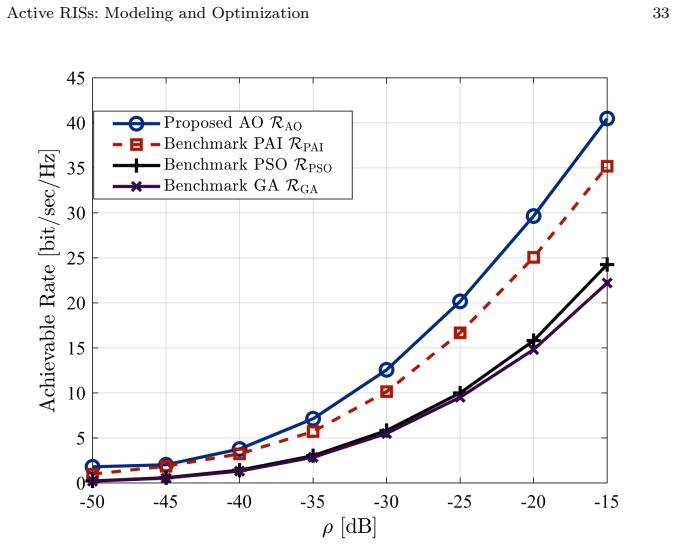
The paper's central claim is that active RISs—surfaces whose reflection elements amplify as well as phase-shift—genuinely fix the double path loss problem that limits passive RISs, without necessarily destroying energy efficiency. For the single-PA design, it claims that two passive RIS panels separated by one amplifier act as a low-complexity analog relay, that the received SNR $\gamma_{\mathrm{act}}$ of this cascade is well approximated by a Gamma distribution, and that this yields closed-form bit error probability and energy efficiency expressions. For the tunnel-diode design, it claims that each unit cell can amplify through the negative resistance region of the diode's I-V curve, and that the unavoidable coupling between reflection amplitude and phase can be captured compactly with linear algebra and exploited in an alternating optimization. The numerical results are used to claim that active RISs overcome the passive mid-way placement penalty, and that activating more elements is only beneficial when the power budget can support them.
Load-bearing premise
The closed-form error probabilities for the single-PA design assume the received SNR follows a Gamma distribution whose shape and scale parameters are fitted to Monte Carlo samples of that same SNR; if this fitted distribution is not the true distribution for a given geometry, the analytic bit-error curves inherit the mismatch.
Editorial extensions
If this is right
- The single-PA dual-RIS design can recover capacity where a passive RIS is weakest, namely when the surface sits midway between transmitter and receiver and the double path loss is most severe.
- When the PA output power saturates, increasing transmit power or adding more elements stops improving rate and can create an error floor; raising $P_{\max}$ avoids that floor.
- For tunnel-diode unit cells, modeling the phase-amplitude coupling in the optimization outperforms treating amplitude and phase as independent, and the gap grows with SNR.
- Under a tight RIS power budget, activating fewer but better-amplified elements can outperform activating all of them, so the optimal active-element fraction increases with the available power.
- Despite higher overall power consumption, the single-PA active RIS can show better energy efficiency than a passive RIS because the rate gain outweighs the extra power in many configurations.
Reading between the lines
- A practitioner should treat the Gamma shape and scale parameters in the closed-form bit-error expressions as calibrated approximations for the simulated parameter range, not as universal constants; re-fitting would be needed for other Rician factors, distances, or phase resolutions.
- The linear-algebra reflection model is not specific to tunnel diodes: any active load that produces a bounded, phase-dependent amplitude range fits the same parameterization, so the optimization machinery could transfer to other amplifier technologies.
- The power-budget results imply an element-activation scheduling design: with a fixed RIS power budget, powering down some unit cells and concentrating power on the rest can outperform activating all of them, a concrete design rule the chapter leaves as future work.
Editorial analysis
A structured set of objections, weighed in public.
Referee Report
Summary. The manuscript investigates two active-RIS hardware architectures. The first is a dual-RIS structure in which two passive RIS panels are interconnected through a single power amplifier; for this design the chapter develops a SISO system model, derives SNR, bit-error-probability, and energy-efficiency expressions, and simulates rate and EE behavior under amplifier output-power and gain constraints. The second is a unit-cell-level reflection-amplification architecture based on tunnel diodes; the chapter models the TD I-V characteristic, derives negative-resistance and power-consumption expressions, approximates the phase-amplitude coupling with a linear steepness model, and formulates a MIMO rate-maximization problem solved by alternating optimization. Numerical results compare the active designs with passive RISs and with genetic-algorithm and particle-swarm benchmarks, and examine the trade-off between the number of active elements and the available power budget.
Significance. If corrected, this chapter would be a useful consolidated reference on active RIS modeling. The transmission-line circuit model with tunnel diodes and the algebraic reformulation of the phase-amplitude coupling are valuable contributions, and the power-budget versus number-of-active-elements trade-off is practically relevant. The extensive simulation campaign and the alternating-optimization framework are strengths. However, two load-bearing issues currently undermine the quantitative claims: the BEP "theory" is validated circularly through a Gamma fit to the same Monte Carlo samples, and the tunnel-diode power model in Eq. (28) contains an algebraic error that propagates into the power-constraint results and the conclusions of Fig. 15. These issues are fixable, but the affected derivations and numerical sections need to be redone.
major comments (3)
- [3.1.2, Eqs. (13)-(15), Table 2, Fig. 3] The average BEP analysis is built on a Gamma distribution whose shape k and scale nu are obtained by moment-matching to Monte Carlo samples of gamma_act (Table 2), and the "theory" curves in Fig. 3 are then checked against the same Monte Carlo samples. This validation is self-referential: the analytical curve is a fit to the data it is compared with. To support the closed-form BEP claim, the authors should either derive k and nu from the channel statistics or, at minimum, split the data into fitting and validation sets and report the resulting prediction error. The Gamma assumption itself should be presented as an empirical approximation, not as a derived result.
- [3.2.2, Eq. (28)] The power-consumption expression omits the exponential factor. Starting from I_T(V) in Eq. (25) and the stable operating point V_r = (1+1/m)^{1/m} V0, one has (V_r/V0)^m = (m+1)/m and I_T(V_r) = (V_r/R0) exp(-(m+1)/m), so P(R_n) = (V0^2/R0)(1+1/m)^{2/m} exp(-(m+1)/m). Eq. (28) drops exp(-(m+1)/m), which overestimates the per-element power by factors of e^2 for m=1 and e^{4/3} for m=3. This error propagates into the total RIS power constraint in Eq. (37), the stated P_min=12.1 mW and P_max=40 mW in Section 3.2.5, and the PRIS ranges and conclusions drawn from Fig. 15. The claimed connection between Eq. (24) and Eq. (25) with R0=Vp/Ip is also inconsistent, since Eq. (25) then yields I_T(Vp)=Ip/e rather than Ip.
- [3.2.4-3.2.5, PAI benchmark and Fig. 13] The PAI benchmark is described as treating alpha and phi as independent optimization variables, which relaxes the coupling constraint in Eq. (37). With a larger feasible set, PAI should achieve a rate at least as high as AO, yet Fig. 13 shows AO outperforming PAI. Please clarify the exact constraints enforced by PAI and how the final achievable rate is evaluated; as written, the comparison does not demonstrate the benefit of modeling phase-amplitude coupling and may instead reflect differences in local-optima behavior between the two implementations.
minor comments (5)
- [Abstract and 3.1.2] The term "closed-form" is too strong for Eq. (15), which is an integral of the Gamma MGF with fitted parameters; please qualify it as "closed-form in terms of the Gamma MGF" or similar.
- [3.2.5, normalized SNR definition] The definition of P_L as lambda^4/(16*pi^2*(d_RIS,TX*d_RX,RIS)^2) does not match the standard cascaded free-space path-loss expression, which would have a (4*pi)^4 factor in the denominator. Since rho is used as a plotting parameter, this does not change relative comparisons, but the formula should be corrected.
- [3.2.4, Eq. (36)] The SINR denominator in Eq. (36) appears to contain an extraneous factor d before the summation over j≠i; please check consistency with the rate expression in Eq. (39).
- [3.2.3, Fig. 12] The approximation error of alpha_max at intermediate phase values is visible in Fig. 12; a quantitative maximum-error metric over the phase range would strengthen the claim that the linear steepness model is sufficiently accurate for optimization.
- [Throughout] The manuscript contains numerous typos and formatting errors, including "In parcticular" (Section 1), "learly" (Section 3.1.3), "weere" (Section 3.2.5), "Figs. 5a and 5a" (Section 3.1.4), and "t is constrained" (Section 4). A careful proofreading pass is needed.
Circularity Check
Closed-form BEP rests on a Gamma distribution fitted to the very SNR simulation setup used for validation, so the 'analytical' prediction is a transform of a fit rather than a derived result.
-
fitted input called prediction
[Sec. 3.1.2, Eqs. (12)-(15), Table 2, and Fig. 3]
"In Fig. 2, the distribution of gamma_act ... colored solid lines are Gamma distributions obtained from moment matching with samples of gamma_act ... Given the previous Gamma distribution fitting, the average Symbol Error Probability (SEP) ... can be analytically evaluated using the Moment Generation Function (MGF) of the Gamma distribution ... Results from the numerical evaluation of the analytical BER expression (theory) are included together with ones from simulations."
The Gamma shape k and scale nu in Table 2 are fitted by moment matching to Monte Carlo samples of gamma_act, and Eqs. (14)-(15) are just the MGF-based SEP/BEP of that fitted Gamma. The 'theory' curves in Fig. 3 therefore inherit the fitted parameters from the same simulation setup that is used as the validation reference. The Gamma assumption itself is asserted, not derived from the channel statistics; consequently, the closed-form BEP is a curve-fit prediction rather than a first-principles result. The agreement is to be expected by construction of the fit, not an independent confirmation.
full rationale
The only substantive circularity is in Sec. 3.1.2: the closed-form BEP (Eqs. 13-15) is obtained from a Gamma distribution whose parameters are moment-matched to Monte Carlo samples of gamma_act, and the same simulation setup is then used to validate the BER curves. This is a fitted input presented as an analytical prediction and warrants a score of 6. The tunnel-diode sections are largely an exposition of the authors' prior work [106]; citations to [106] provide the AO algorithm and the phase-amplitude linear-algebra model, but they are used as optimization machinery and are not the basis of a fresh prediction, so they do not add circularity. Note that Eq. (28) omits the exp(-(m+1)/m) factor in I_T(V_r)V_r and the claimed R0=Vp/Ip connection to Eq. (24) is not consistent with (25); these are algebraic correctness risks, not circularity. No other load-bearing reduction to inputs was found.
Assumptions & free parameters
free parameters (4)
- Gamma distribution shape k =
Table 2 values, e.g., 44.89 for N=64, P_t=-10 dBm, P_max=10 dBm
- Gamma distribution scale nu =
Table 2 values, e.g., 0.000405 for N=64, P_t=-10 dBm, P_max=10 dBm
- Amplitude-bound fitting variables delta_min, delta_max, beta_min, beta_max, theta =
Computed from exact circuit model for L1=4.5nH, L2=0.7nH, Z0=377 ohm, etc. (Fig. 12)
- Tunnel diode steepness parameter m =
Range 1 to 3, with R0=1 ohm, yielding R_sp in [-7.39,-1.26] ohm
assumptions (7)
- ad hoc to paper The SNR gamma_act follows a Gamma distribution (Section 3.1.2, after Fig. 2).
- domain assumption Noise at RIS 2 is ignored (Section 3.1.1, Eq. (7)).
- domain assumption Channels follow Rician/Rayleigh fading with 3GPP InH path loss (Eqs. (2)-(6)).
- domain assumption The generalized tunnel diode current model (25) is valid for the unit cell (Section 3.2.2).
- ad hoc to paper The linear steepness model with k=1 approximates the amplitude bounds (Section 3.2.3, Eqs. (32)-(33)).
- domain assumption Stability requires Re{Z_n + Z_0} > 0 and a nonzero imaginary part (Section 3.2.1).
- ad hoc to paper Phase configurations in (10)-(11) and the gain choice P_out <= P_max constitute the optimal solution to (9).
Cite this review
Pith. "Pith review of Active RISs: Modeling and Optimization." pith.science (2026). https://pith.science/paper/HNXB4HZF
@misc{pith2026250716499,
  author       = {Pith},
  title        = {Pith review of: Active RISs: Modeling and Optimization},
  year         = {2026},
  howpublished = {\url{https://pith.science/paper/HNXB4HZF}},
  note         = {Machine review of arXiv:2507.16499}
}
read the original abstract
Reconfigurable Intelligent Surfaces (RIS)-empowered communication has emerged as a transformative technology for next generation wireless networks, enabling the programmable shaping of the propagation environment. However, conventional RISs are fundamentally limited by the double path loss effect, which severely attenuates the reflected signals. To overcome this, active RIS architectures, capable of amplifying impinging signals, have been proposed. This chapter investigates the modeling, performance analysis, and optimization of active RISs, focusing on two hardware designs: a dual-RIS structure with a single Power Amplifier (PA), and a reflection amplification structure at the unit cell level using tunnel diodes. For the PA-based design, a comprehensive mathematical model is developed, and closed-form expressions for the received signal-to-noise ratio, bit error probability, and Energy Efficiency (EE) are derived. An optimization framework for configuring the phase shifts and amplifier gain is proposed to maximize system capacity under power constraints. Regarding the second design, the integration of a tunnel diode into the unit cell is carefully studied by analyzing its I-V characteristic, enabling the derivation of the negative resistance range and the power consumption model. Furthermore, the intrinsic phase-amplitude coupling of the reflection coefficient is characterized through compact linear algebra formulations, enabling practical optimization of active RISs. Extensive numerical simulations validate the theoretical analyses, demonstrating that active RISs can effectively overcome the double path loss limitation and achieve favorable EE trade-offs compared to passive RISs. Finally, the trade-off between the available power budget and the number of active elements is examined, revealing that a higher number of active elements does not always lead to optimal performance.
Figures


Figures from the paper (12 more)




Forward citations
Cited by 1 Pith paper
-
Space-Time Coded RIS-Assisted Wireless Systems with Practical Reflection Models: Error Rate Analysis and Negative Moment-Based Optimization with Saddle Point Approximation
Exact and saddle-point-approximated SER expressions for OSTBC/RIS with amplitude-dependent reflection, plus a negative-moment based phase optimization heuristic.
Reference graph
Works this paper leans on
-
[72]
Tasci, Fatih Kilinc, Ertugrul Basar, and George C
Recep A. Tasci, Fatih Kilinc, Ertugrul Basar, and George C. Alexandropoulos. A new RIS architecture with a single power amplifier: Energy efficiency and error per- formance analysis. IEEE Access, 10:44804–44815, 2022
work page 2022
-
[106]
Panagiotis Gavriilidis, Deepak Mishra, Besma Smida, Basar Etrugrul, Chau Yuen, and George C. Alexandropoulos. Active reconfigurable intelligent surfaces: Circuit modeling and reflection amplification optimization. IEEE Open J. Commun. Soc., 6:5693–5711, 2025
work page 2025
-
[1]
Di Renzo et al
M. Di Renzo et al. Smart radio environments empowered by reconfigurable AI meta- surfaces: An idea whose time has come. EURASIP J. Wireless Commun. Netw., 129(1):1–20, May 2019
2019
-
[2]
W. Saad, M. Bennis, and M. Chen. A vision of 6G wireless systems: Applications, trends, technologies, and open research problems. IEEE Netw., 34(3):134–142, Jun. 2020
2020
-
[3]
Alexandropoulos, Berk Canberk, Octavia A
Antonino Masaracchia, Dang Van Huynh, George C. Alexandropoulos, Berk Canberk, Octavia A. Dobre, and Trung Q. Duong. Toward the metaverse realization in 6G: Orchestration of RIS-enabled smart wireless environments via digital twins. IEEE Internet of Things Mag., 7(2):22–28, 2024
2024
-
[4]
Alexandropoulos, Yan Zhang, M´ erouane Debbah, and Chau Yuen
Xueyao Zhang, Bo Yang, Zhiwen Yu, Xuelin Cao, George C. Alexandropoulos, Yan Zhang, M´ erouane Debbah, and Chau Yuen. Reconfigurable intelligent computational surfaces for MEC-assisted autonomous driving networks: Design optimization and analysis. IEEE Trans. Intell. Transport. Sys., 26(1):1286–1303, 2025
2025
-
[6]
Keykhosravi et al
K. Keykhosravi et al. Leveraging RIS-enabled smart signal propagation for solving infeasible localization problems. IEEE Veh. Technol. Mag., 18(2):20–28, 2023. 38 R. A. Tasci, P. Gavriilidis, E. Basar, and G. C. Alexandropoulos
2023
-
[7]
Alexandropoulos
George C. Alexandropoulos. Position aided beam alignment for millimeter wave backhaul systems with large phased arrays. In Proc. IEEE Int. Workshop Comp. Adv. Multi-Sensor Adaptive Process., Cura¸ cao, Dutch Antilles, 2017
2017
Show all 106 references
-
[8]
T. Gong, P. Gavriilidis, R. Ji, C. Huang, G. C. Alexandropoulos, L. Wei, M. Debbah, H. V. Poor, and C. Yuen. Holographic MIMO communications: Theoretical founda- tions, enabling technologies, and future directions. IEEE Commun. Surveys & Tuts., 26(1):196–257, 2024
2024
-
[9]
Stylianopoulos, P
K. Stylianopoulos, P. Gavriilidis, G. Gradoni, and G. C. Alexandropoulos. Graph- CNNs for RF imaging: Learning the electric field integral equations. arXiv preprint arXiv:2503.14439, 2025
2025 arXiv
-
[10]
Z. Wang, J. Zhang, H. Du, D. Niyato, S. Cui, B. Ai, M. Debbah, K.B. Letaief, and H.V. Poor. A Tutorial on Extremely Large-Scale MIMO for 6G: Fundamentals, Signal Processing, and Applications. IEEE Commun. Surveys & Tuts., 26(3):1560–1605, 2024
2024
-
[11]
Alexandropoulos, Mohammadreza F
Nir Shlezinger, George C. Alexandropoulos, Mohammadreza F. Imani, Yonina C. Eldar, and David R. Smith. Dynamic metasurface antennas for 6G extreme massive MIMO communications. IEEE Wireless Commun., 28(2):106–113, Apr. 2021
2021
-
[12]
Emilio Calvanese Strinati, George C. Alexandropoulos, Navid Amani, Maurizio Croz- zoli, Giyyarpuram Madhusudan, Sami Mekki, Francois Rivet, Vincenzo Sciancale- pore, Philippe Sehier, Maximilian Stark, and Henk Wymeersch. Toward distributed and intelligent integrated sensing an...
2025
-
[13]
Alexandropoulos, Stefano Buzzi, and Yonina C
Sundeep Prabhakar Chepuri, Nir Shlezinger, Fan Liu, George C. Alexandropoulos, Stefano Buzzi, and Yonina C. Eldar. Integrated sensing and communications with reconfigurable intelligent surfaces: From signal modeling to processing. IEEE Signal Process. Mag., 40(6):41–62, 2023
2023
-
[14]
Alexandropoulos, M´ erouane Debbah, and Chau Yuen
Chongwen Huang, Alessio Zappone, George C. Alexandropoulos, M´ erouane Debbah, and Chau Yuen. Reconfigurable intelligent surfaces for energy efficiency in wireless communication. IEEE Trans. Wireless Commun., 18(8):4157–4170, Aug. 2019
2019
-
[15]
Wireless communications through reconfigurable intelligent surfaces
Ertugrul Basar, Marco Di Renzo, Julien De Rosny, Merouane Debbah, Mohamed-Slim Alouini, and Rui Zhang. Wireless communications through reconfigurable intelligent surfaces. IEEE Access, 7:116753–116773, 2019
2019
-
[16]
G. C. Alexandropoulos, G. Lerosey, M. Debbah, and M. Fink. Reconfigurable intel- ligent surfaces and metamaterials: The potential of wave propagation control for 6G wireless communications. IEEE ComSoc TCCN Newslett., 6(1):25–37, 2020
2020
-
[17]
Intelligent reflecting surface-aided wireless communications: A tutorial
Qingqing Wu, Shuowen Zhang, Beixiong Zheng, Changsheng You, and Rui Zhang. Intelligent reflecting surface-aided wireless communications: A tutorial. IEEE Trans. Commun., 69(5):3313–3351, May 2021
2021
-
[18]
G. C. Alexandropoulos, S. Samarakoon, M. Bennis, and M. Debbah. Phase configu- ration learning in wireless networks with multiple reconfigurable intelligent surfaces. In Proc. IEEE GLOBECOM, Taipei, Taiwan, Dec. 2020
2020
-
[19]
Calvanese Strinati, G
E. Calvanese Strinati, G. C. Alexandropoulos, H. Wymeersch, B. Denis, V. Sciancale- pore, R. D’Errico, A. Clemente, D.-T. Phan-Huy, E. De Carvalho, and P. Popovski. Reconfigurable, intelligent, and sustainable wireless environments for 6G smart con- nectivity. IEEE Commun. Mag...
2021
-
[20]
M. Jian, G. C. Alexandropoulos, E. Basar, C. Huang, R. Liu, Y. Liu, and C. Yuen. Reconfigurable intelligent surfaces for wireless communications: Overview of hardware designs, channel models, and estimation techniques. Intell. Converged Netw., 3(1):1– 32, 2022
2022
-
[21]
Alexandropoulos, Kyriakos Stylianopoulos, Chongwen Huang, Chau Yuen, Mehdi Bennis, and M´ erouane Debbah
George C. Alexandropoulos, Kyriakos Stylianopoulos, Chongwen Huang, Chau Yuen, Mehdi Bennis, and M´ erouane Debbah. Pervasive machine learning for smart radio environments enabled by reconfigurable intelligent surfaces.Proc. IEEE, 110(9):1494– 1525, 2022
2022
-
[22]
RIS-enabled smart wireless environments: Deployment scenarios, network architecture, bandwidth and area of influence
George C Alexandropoulos, Dinh-Thuy Phan-Huy, Konstantinos D Katsanos, Mau- rizio Crozzoli, Henk Wymeersch, Petar Popovski, Philippe Ratajczak, Yohann Active RISs: Modeling and Optimization 39 B´ en´ edic, Marie-Helene Hamon, Sebastien Herraiz Gonzalez, et al. RIS-enabled smar...
2023
-
[23]
G. C. Alexandropoulos, N. Shlezinger, and P. del Hougne. Reconfigurable intelligent surfaces for rich scattering wireless communications: Recent experiments, challenges, and opportunities. IEEE Commun. Mag., 59(6):28–34, 2021
2021
-
[24]
Alexandropoulos, Nir Shlezinger, Mo- hammadreza F
Rashid Faqiri, Chlo´ e Saigre-Tardif, George C. Alexandropoulos, Nir Shlezinger, Mo- hammadreza F. Imani, and Philipp del Hougne. Physfad: Physics-based end-to-end channel modeling of RIS-parametrized environments with adjustable fading. IEEE Trans. Wireless Commun., 22(1):580...
2023
-
[25]
Alexandropoulos, Robert Schober, and H
Vahid Jamali, George C. Alexandropoulos, Robert Schober, and H. Vincent Poor. Low-to-zero-overhead IRS reconfiguration: Decoupling illumination and channel es- timation. IEEE Commun. Lett., 26(4):932–936, 2022
2022
-
[26]
Alexandropoulos
Alireza Ghaneizadeh, Panagiotis Gavriilidis, Mojtaba Joodaki, and George C. Alexandropoulos. Metasurface energy harvesters: State-of-the-art designs and their potential for energy sustainable reconfigurable intelligent surfaces. IEEE Access, 12:160464–160494, 2024
2024
-
[27]
Alexandropoulos, Yuanwei Liu, Qingqing Wu, Shi Jin, Chau Yuen, Octavia A
Ertugrul Basar, George C. Alexandropoulos, Yuanwei Liu, Qingqing Wu, Shi Jin, Chau Yuen, Octavia A. Dobre, and Robert Schober. Reconfigurable intelligent sur- faces for 6G: Emerging hardware architectures, applications, and open challenges. IEEE Veh. Technol. Mag., 19(3):27–47, 2024
2024
-
[28]
Alexandropoulos, Chau Yuen, Zhu Han, H
Xuelin Cao, Bo Yang, Chongwen Huang, George C. Alexandropoulos, Chau Yuen, Zhu Han, H. Vincent Poor, and Lajos Hanzo. Massive access of static and mobile users via reconfigurable intelligent surfaces: Protocol design and performance analysis. IEEE J. Sel. Areas Commun., 40(4):...
2022
-
[29]
Chen-Hu, G
K. Chen-Hu, G. C. Alexandropoulos, and A. Garc ´ ıa Armada. Non-coherent modu- lation with random phase configurations in RIS-empowered cellular MIMO systems. ITU J. Future Evolv. Technol., 3(2):1–14, 2022
2022
-
[30]
Alexandropoulos, Shahrokh Valaee, and Henk Wymeersch
Hui Chen, Hyowon Kim, Mustafa Ammous, Gonzalo Seco-Granados, George C. Alexandropoulos, Shahrokh Valaee, and Henk Wymeersch. RISs and sidelink com- munications in smart cities: The key to seamless localization and sensing. IEEE Commun. Mag., 61(8):140–146, 2023
2023
-
[31]
Phan, Ping Jack Soh, Antonio Clemente, Lu ´ ıs M
S´ ergio Matos, Yihan Ma, Qi Luo, Jonas Deuermeier, Luca Lucci, Panagiotis Gavri- ilidis, Asal Kiazadeh, Ver´ onica Lain-Rubio, Tung D. Phan, Ping Jack Soh, Antonio Clemente, Lu ´ ıs M. Pessoa, and George C. Alexandropoulos. Reconfigurable intelli- gent surfaces for THz: Hardw...
2024
-
[32]
Alexandropoulos, Antonio Clemente, S´ ergio Matos, Ryan Husbands, Sean Ahearne, Qi Luo, Ver´ onica Lain-Rubio, Thomas K¨ urner, and Lu ´ ıs M
George C. Alexandropoulos, Antonio Clemente, S´ ergio Matos, Ryan Husbands, Sean Ahearne, Qi Luo, Ver´ onica Lain-Rubio, Thomas K¨ urner, and Lu ´ ıs M. Pessoa. Re- configurable intelligent surfaces for THz: Hardware design and signal processing chal- lenges. In Proc. European...
2024
-
[33]
Alexandropoulos, Bo Kum Jung, Panagiotis Gavriilidis, S´ ergio Matos, Lorenz H
George C. Alexandropoulos, Bo Kum Jung, Panagiotis Gavriilidis, S´ ergio Matos, Lorenz H. W. Loeser, Varvara Elesina, Antonio Clemente, Raffaele D’Errico, Lu ´ ıs M. Pessoa, and Thomas K¨ urner. Characterization of indoor RIS-assisted channels at 304 GHz: Experimental measurem...
2024
-
[34]
Modeling and analysis of recon- figurable intelligent surfaces for indoor and outdoor applications in future wireless networks
Ibrahim Yildirim, Ali Uyrus, and Ertugrul Basar. Modeling and analysis of recon- figurable intelligent surfaces for indoor and outdoor applications in future wireless networks. IEEE Trans. Commun., 69(2):1290–1301, Feb. 2021
2021
-
[35]
Reconfigurable intelligent surfaces for Doppler effect and multipath fading mitigation
Ertugrul Basar. Reconfigurable intelligent surfaces for Doppler effect and multipath fading mitigation. Front. Commun. Netw., 2:14, May. 2021
2021
-
[36]
Towards smart and reconfigurable environment: Intelli- gent reflecting surface aided wireless network
Qingqing Wu and Rui Zhang. Towards smart and reconfigurable environment: Intelli- gent reflecting surface aided wireless network. IEEE Commun. Mag., 58(1):106–112, Jan. 2020. 40 R. A. Tasci, P. Gavriilidis, E. Basar, and G. C. Alexandropoulos
2020
-
[37]
E. Basar. Reconfigurable intelligent surface-based index modulation: A new beyond MIMO paradigm for 6G. IEEE Trans. Commun., 68(5):3187–3196, May. 2020
2020
-
[38]
Alexandropoulos, Mesut Toka, and Marco Di Renzo
Rohit Singh, Aryan Kaushik, Wonjae Shin, George C. Alexandropoulos, Mesut Toka, and Marco Di Renzo. Indexed multiple access with reconfigurable intelligent surfaces: The reflection tuning potential. IEEE Commun. Mag., 62(4):120–126, 2024
2024
-
[39]
S. Lin, B. Zheng, G. C. Alexandropoulos, M. Wen, M. Di Renzo, and F. Chen. Recon- figurable intelligent surfaces with reflection pattern modulation: Beamforming design, channel estimation, and achievable rate analysis. IEEE Trans. Wireless Commun., 20(2):741–754, Feb. 2021
2021
-
[40]
Alexandropoulos, and Gaojie Chen
Jing Yuan, Miaowen Wen, Qiang Li, Ertugrul Basar, George C. Alexandropoulos, and Gaojie Chen. Receive quadrature reflecting modulation for RIS-empowered wireless communications. IEEE Trans. Veh. Technol., 70(5):5121–5125, Apr. 2021
2021
-
[41]
Jiakuo Zuo, Yuanwei Liu, Ertugrul Basar, and Octavia A. Dobre. Intelligent re- flecting surface enhanced millimeter-wave NOMA systems. IEEE Commun. Lett., 24(11):2632–2636, Nov. 2020
2020
-
[42]
A novel NOMA solution with RIS partitioning
Aymen Khaleel and Ertugrul Basar. A novel NOMA solution with RIS partitioning. IEEE J. Sel. Areas Commun., to appear in 2021
2021
-
[43]
Katsanos, Paolo Di Lorenzo, and George C
Konstantinos D. Katsanos, Paolo Di Lorenzo, and George C. Alexandropoulos. Multi- RIS-empowered multiple access: A distributed sum-rate maximization approach. IEEE J. Sel. Topics Signal Process., 18(7):1324–1338, 2024
2024
-
[44]
G. C. Alexandropoulos, K. Katsanos, M. Wen, and D. B. da Costa. Safeguarding MIMO communications with reconfigurable metasurfaces and artificial noise. InProc. IEEE ICC, Montreal, Canada, Jun. 2021
2021
-
[45]
Alexandropoulos, Konstantinos D
George C. Alexandropoulos, Konstantinos D. Katsanos, Miaowen Wen, and Daniel B. Da Costa. Counteracting eavesdropper attacks through reconfigurable intelligent surfaces: A new threat model and secrecy rate optimization. IEEE Open J. Commun. Society, 4:1285–1302, 2023
2023
-
[46]
Rexhepi, H
G. Rexhepi, H. S. Rou, G. T. F. de Abreu, and G. C. Alexandropoulos. Blind- ing the wiretapper: RIS-enabled user occultation in the isac era. arXiv preprint arXiv:2504.15033, 2025
2025
-
[47]
Alexandropoulos, Gonzalo Seco-Granados, Henk Wymeersch, and Riku J¨ antti
Reza Ghazalian, George C. Alexandropoulos, Gonzalo Seco-Granados, Henk Wymeersch, and Riku J¨ antti. Joint 3D user and 6D hybrid reconfigurable intelli- gent surface localization. IEEE Trans. Veh. Technol., 73(10):15302–15317, 2024
2024
-
[48]
Alexandropoulos
Ioannis Gavras and George C. Alexandropoulos. Simultaneous communications and sensing with hybrid reconfigurable intelligent surfaces. In Proc. IEEE Eur. Conf. Antennas Propag. (EuCAP), Stockholm, Sweden, 2025
2025
-
[49]
Alexandropoulos
Kuranage Roche Rayan Ranasinghe, Iv´ an Alexander Morales Sandoval, Hyeon Seok Rou, Giuseppe Thadeu Freitas de Abreu, and George C. Alexandropoulos. A doubly- dispersive mimo channel model parametrized with stacked intelligent metasurfaces. IEEE Trans. Wireless Commun., 2025. ...
2025
-
[50]
SimRIS channel simulator for reconfigurable intelligent surface-empowered communication systems
Ertugrul Basar and Ibrahim Yildirim. SimRIS channel simulator for reconfigurable intelligent surface-empowered communication systems. In Proc. IEEE Latin-Amer. Conf. Commun. (LATINCOM), pages 1–6, Nov. 2020
2020
-
[51]
Indoor and outdoor physical channel modeling and efficient positioning for reconfigurable intelligent surfaces in mmWave bands
Ertugrul Basar, Ibrahim Yildirim, and Fatih Kilinc. Indoor and outdoor physical channel modeling and efficient positioning for reconfigurable intelligent surfaces in mmWave bands. IEEE Trans. Commun., 69(12):8600–8611, Dec. 2021
2021
-
[52]
Physical channel modeling for RIS-empowered wireless networks in sub-6 GHz bands
Fatih Kilinc, Ibrahim Yildirim, and Ertugrul Basar. Physical channel modeling for RIS-empowered wireless networks in sub-6 GHz bands. Nov. 2021
2021
-
[53]
Alexandropoulos, Nir Shlezinger, H
Antonin Rabault, Luc Le Magoarou, J´ erˆ ome Sol, George C. Alexandropoulos, Nir Shlezinger, H. Vincent Poor, and Philipp del Hougne. On the tacit linearity assump- tion in common cascaded models of ris-parametrized wireless channels. IEEE Trans. Wireless Commun., 23(8):10001–...
2024
-
[54]
Alexandropoulos, Zhaohui Yang, Jun Yang, Wei E
Li Wei, Chongwen Huang, George C. Alexandropoulos, Zhaohui Yang, Jun Yang, Wei E. I. Sha, Zhaoyang Zhang, M´ erouane Debbah, and Chau Yuen. Tri-polarized Active RISs: Modeling and Optimization 41 holographic MIMO surfaces for near-field communications: Channel modeling and pre...
2023
-
[55]
Alexandropoulos, and Ekram Hossain
Dilki Wijekoon, Amine Mezghani, George C. Alexandropoulos, and Ekram Hossain. Physically-consistent modeling and optimization of non-local ris-assisted multi-user mimo communication systems. IEEE Trans. Wireless Commun., 2025. under revi- sion
2025
-
[56]
Vincent Poor
Ertugrul Basar and H. Vincent Poor. Present and future of reconfigurable intelligent surface-empowered communications. IEEE Signal Proc. Mag., 38(6):146–152, Nov. 2021
2021
-
[57]
Scatter- MIMO: Enabling virtual MIMO with smart surfaces
Manideep Dunna, Chi Zhang, Daniel Sievenpiper, and Dinesh Bharadia. Scatter- MIMO: Enabling virtual MIMO with smart surfaces. In Proc. 26th Annu. Int. Conf. Mobile Comput. Netw., pages 1–14, Apr. 2020
2020
-
[58]
Alexandropoulos, Vahid Jamali, Robert Schober, and H
George C. Alexandropoulos, Vahid Jamali, Robert Schober, and H. Vincent Poor. Near-field hierarchical beam management for RIS-enabled millimeter wave multi- antenna systems. In Proc. IEEE Sensor Array and Multichannel Signal Process. Workshop (SAM), pages 460–464, Trondheim, N...
2022
-
[59]
Alexandropoulos, and Petar Popovski
Fabio Saggese, Victor Croisfelt, Kyriakos Stylianopoulos, George C. Alexandropoulos, and Petar Popovski. Control plane for reconfigurable intelligent surfaces. IEEE Commun. Standards Mag., 8(4):24–30, 2024
2024
-
[60]
Alexandropoulos, and Petar Popovski
Fabio Saggese, Victor Croisfelt, Rados law Kotaba, Kyriakos Stylianopoulos, George C. Alexandropoulos, and Petar Popovski. On the impact of control sig- naling in RIS-empowered wireless communications. IEEE Open J. Commun.Society, 5:4383–4399, 2024
2024
-
[61]
Shlezinger, G
Haiyang Zhang, N. Shlezinger, G. C. Alexandropoulos, A. Shultzman, I. Alamzadeh, M. F. Imani, and Y. C. Eldar. Channel estimation with hybrid reconfigurable intel- ligent metasurfaces. IEEE Trans. Commun., 71(4):2441–2456, 2023
2023
-
[62]
Alexandropoulos and Evangelos Vlachos
George C. Alexandropoulos and Evangelos Vlachos. A hardware architecture for reconfigurable intelligent surfaces with minimal active elements for explicit channel estimation. In Proc. IEEE Int. Conf. Acoust. Speech Signal Process., pages 9175– 9179, Barcelona, Spain, May 2020
2020
-
[63]
Hybrid reconfigurable intelligent meta- surfaces: Enabling simultaneous tunable reflections and sensing for 6G wireless com- munications
George C Alexandropoulos, Nir Shlezinger, Idban Alamzadeh, Mohammadreza F Imani, Haiyang Zhang, and Yonina C Eldar. Hybrid reconfigurable intelligent meta- surfaces: Enabling simultaneous tunable reflections and sensing for 6G wireless com- munications. Apr. 2021
2021
-
[64]
A reconfigurable intelligent surface with integrated sensing capability
Idban Alamzadeh, George C Alexandropoulos, Nir Shlezinger, and Mohammadreza F Imani. A reconfigurable intelligent surface with integrated sensing capability. Sci. Rep., 11(20737):1–10, Oct. 2021
2021
-
[65]
Alexandropoulos, Gonzalo Seco-Granados, Henk Wymeersch, and Riku J¨ antti
Reza Ghazalian, Hui Chen, George C. Alexandropoulos, Gonzalo Seco-Granados, Henk Wymeersch, and Riku J¨ antti. Joint user localization and location calibration of a hybrid reconfigurable intelligent surface.IEEE Trans. Veh. Technol., 73(1):1435– 1440, 2024
2024
-
[66]
Gavras and George C
I. Gavras and George C. Alexandropoulos. Tracking-aided multi-user MIMO communications with hybrid reconfigurable intelligent surfaces. arXiv preprint arXiv:2504.18846, 2025
2025 arXiv
-
[67]
Gavras and George C
I. Gavras and George C. Alexandropoulos. Communications-centric secure ISAC with hybrid reconfigurable intelligent surfaces. arXiv preprint arXiv:2504.20608, 2025
2025 arXiv
-
[68]
Alexandropoulos, Jue Wang, Wenjin Wang, and Xiqi Gao
Li You, Jie Xu, George C. Alexandropoulos, Jue Wang, Wenjin Wang, and Xiqi Gao. Energy efficiency maximization of massive MIMO communications with dy- namic metasurface antennas. IEEE Trans. Wireless Commun., 22(1):393–407, 2023
2023
-
[69]
Vincent Poor
Zijian Zhang, Linglong Dai, Xibi Chen, Changhao Liu, Fan Yang, Robert Schober, and H. Vincent Poor. Active RIS vs. passive RIS: Which will prevail in 6G? IEEE Trans. Commun., 71(3):1707–1725, 2023
2023
-
[70]
Ruizhe Long, Ying-Chang Liang, Yiyang Pei, and Erik G. Larsson. Active recon- figurable intelligent surface-aided wireless communications. IEEE Trans. Wireless Commun., 20(8):4962–4975, Aug. 2021. 42 R. A. Tasci, P. Gavriilidis, E. Basar, and G. C. Alexandropoulos
2021
-
[71]
Hybrid relay-reflecting intelligent surface-assisted wireless communication
Nhan Thanh Nguyen, Quang-Doanh Vu, Kyungchun Lee, and Markku Juntti. Hybrid relay-reflecting intelligent surface-assisted wireless communication. Mar. 2021
2021
-
[73]
T. Q. Duong, V. N. Q. Bao, H. Tran, G. C. Alexandropoulos, , and H.–J. Zepernick. Effect of primary networks on the performance of spectrum sharing AF relaying. Electron. Lett., 48(1):25–27, 2012
2012
-
[74]
T. T. Duy, G. C. Alexandropoulos, T. T. Vu, N.-S. Vo, and T. Q. Duong. Outage per- formance of cognitive cooperative networks with relay selection over double-rayleigh fading channels. IET Commun., 10(1):57–67, 2016
2016
-
[75]
In- door coverage enhancement for RIS-assisted communication systems: Practical mea- surements and efficient grouping
Sefa Kayraklık, Ibrahim Yildirim, Yarkın Gevez, Ertugrul Basar, and Ali G¨ or¸ cin. In- door coverage enhancement for RIS-assisted communication systems: Practical mea- surements and efficient grouping. In IEEE Int. Conf. Commun., pages 485–490, May 2023
2023
-
[76]
Alexandropoulos
Kyriakos Stylianopoulos, Panagiotis Gavriilidis, and George C. Alexandropoulos. Asymptotically optimal closed-form phase configuration of 1-bit riss via sign align- ment. in Proc. IEEE SPA WC, pages 746–750, 2024
2024
-
[77]
Power scaling laws and near-field behaviors of massive MIMO and intelligent reflecting surfaces
Emil Bj¨ ornson and Luca Sanguinetti. Power scaling laws and near-field behaviors of massive MIMO and intelligent reflecting surfaces. IEEE Open Journal of the Communications Society, 1:1306–1324, Jul. 2020
2020
-
[78]
A. L. Moustakas, G. C. Alexandropoulos, and M. Debbah. Reconfigurable intelligent surfaces and capacity optimization: A large system analysis. IEEE Trans. Wireless Commun., 22(12):8736–8750, Dec. 2023
2023
-
[79]
Active re- configurable intelligent surface: Fully-connected or sub-connected? IEEE Commun
Kunzan Liu, Zijian Zhang, Linglong Dai, Shenheng Xu, and Fan Yang. Active re- configurable intelligent surface: Fully-connected or sub-connected? IEEE Commun. Lett., 26(1):167–171, Oct. 2022
2022
-
[80]
Active-passive IRS aided wireless communication: New hybrid architecture and elements allocation optimization.IEEE Trans
Zhenyu Kang, Changsheng You, and Rui Zhang. Active-passive IRS aided wireless communication: New hybrid architecture and elements allocation optimization.IEEE Trans. on Wireless Commun., 23(4):3450–3464, Aug. 2024
2024
-
[81]
G. C. Alexandropoulos, A. Papadogiannis, and P. C. Sofotasios. Outage performance of cognitive cooperative networks with relay selection over double-rayleigh fading channels. HINDA WI J. Computer Netw. Commun., 2011, Article ID 560528, 2011
2011
-
[82]
Full duplex hybrid A/D beamforming with reduced complexity multi-tap analog cancellation
George C Alexandropoulos, Md Atiqul Islam, and Besma Smida. Full duplex hybrid A/D beamforming with reduced complexity multi-tap analog cancellation. In Proc. IEEE 21st Int. Workshop Signal Process. Adv. Wireless Commun. (SPA WC), pages 1–5, May 2020
2020
-
[83]
Alexandropoulos
Ibrahim Yildirim, Fatih Kilinc, Ertugrul Basar, and George C. Alexandropoulos. Hybrid RIS-empowered reflection and decode-and-forward relaying for coverage ex- tension. IEEE Commun. Lett., 25(5):1692–1696, May. 2021
2021
-
[84]
Cooperative Communications for Improved Wireless Network Trans- mission: Framework for Virtual Antenna Array Applications
Murat Uysal. Cooperative Communications for Improved Wireless Network Trans- mission: Framework for Virtual Antenna Array Applications. IGI-Global, Hershey, PA, USA, Jul. 2009
2009
-
[85]
Alexandropoulos, Md Atiqul Islam, and Besma Smida
George C. Alexandropoulos, Md Atiqul Islam, and Besma Smida. Full-duplex mas- sive multiple-input, multiple-output architectures: Recent advances, applications, and future directions. IEEE Veh. Technol. Mag., 17(4):83–91, 2022
2022
-
[86]
Alexandropoulos and Melissa Duarte
George C. Alexandropoulos and Melissa Duarte. Joint design of multi-tap analog can- cellation and digital beamforming for reduced complexity full duplex MIMO systems. In Proc. IEEE Int. Conf. Commun., Paris, France, 2017
2017
-
[87]
Enabling high- quality untethered virtual reality
Omid Abari, Dinesh Bharadia, Austin Duffield, and Dina Katabi. Enabling high- quality untethered virtual reality. In 14th USENIX Symp. on Netw. Syst. Design Implement., pages 531–544, 2017
2017
-
[88]
3GPP TR 38.901 V16.1.0 - Study on channel model for frequencies from 0.5 to 100 GHz, Dec. 2019. Active RISs: Modeling and Optimization 43
2019
-
[89]
Intelligent reflecting surface enhanced wireless net- work via joint active and passive beamforming
Qingqing Wu and Rui Zhang. Intelligent reflecting surface enhanced wireless net- work via joint active and passive beamforming. IEEE Trans. on Wireless Commun., 18(11):5394–5409, Nov. 2019
2019
-
[90]
Distribution of a ratio of correlated gamma random variables
Ru-Ying Lee, Burt S Holland, and John A Flueck. Distribution of a ratio of correlated gamma random variables. SIAM J. Appl. Math., 36(2):304–320, Apr. 1979
1979
-
[91]
Over-the-air equal- ization with reconfigurable intelligent surfaces
Emre Arslan, Ibrahim Yildirim, Fatih Kilinc, and Ertugrul Basar. Over-the-air equal- ization with reconfigurable intelligent surfaces. Jun. 2021
2021
-
[92]
On the throughput and outage probability of multi-relay networks with imperfect power amplifiers
Behrooz Makki, Tommy Svensson, Thomas Eriksson, and Masoumeh Nasiri-Kenari. On the throughput and outage probability of multi-relay networks with imperfect power amplifiers. IEEE Trans. Wireless Commun., 14(9):4994–5008, Sep. 2015
2015
-
[93]
Daniel Persson, Thomas Eriksson, and Erik G. Larsson. Amplifier-aware multiple- input multiple-output power allocation. IEEE Commun. Lett., 17(6):1112–1115, Jun. 2013
2013
-
[94]
Reconfigurable intelligent surfaces for energy efficiency in D2D communication network
Shuaiqi Jia, Xiaojun Yuan, and Ying-Chang Liang. Reconfigurable intelligent surfaces for energy efficiency in D2D communication network. IEEE Wireless Commun. Lett., 10(3):683–687, Mar. 2021
2021
-
[95]
GaAs pHEMT MMIC 2 Watt power amplifier, 27.3-33.5 GHz
Analog Devices. GaAs pHEMT MMIC 2 Watt power amplifier, 27.3-33.5 GHz. HMC906A datasheet
-
[96]
Anirban Sarkar, Farshid Aryanfar, and Brian A. Floyd. A 28-GHz SiGe BiCMOS PA with 32% efficiency and 23-dBm output power. IEEE J. Solid-State Circuits, 52(6):1680–1686, Jun. 2017
2017
-
[97]
Ka-band HPA
Analog Devices. Ka-band HPA. HMC7054 datasheet
-
[98]
Coding metamaterials, digital metamaterials and programmable metamaterials
Tie Jun Cui et al. Coding metamaterials, digital metamaterials and programmable metamaterials. Light: Sci. & Appl., 3(10):e218, 2014
2014
-
[99]
Intelligent reflecting surface: Practical phase shift model and beamforming optimization
Samith Abeywickrama, Rui Zhang, and Chau Yuen. Intelligent reflecting surface: Practical phase shift model and beamforming optimization. IEEE Trans. Commun., 68(9):5849–5863, 2020
2020
-
[100]
Generalized impedance model of wireless links assisted by reconfigurable intelligent surfaces.IEEE Trans
Keisuke Konno, Sergio Terranova, Qiang Chen, and Gabriele Gradoni. Generalized impedance model of wireless links assisted by reconfigurable intelligent surfaces.IEEE Trans. Antennas Propag., 72(10):7691–7699, 2024
2024
-
[101]
Negative power devices and absolute negative resistance: Their en- ergy behavior
Rainer Taniloo. Negative power devices and absolute negative resistance: Their en- ergy behavior. In Proc. IEEE Norchip Conf., Link¨ oping, Sweden, 2006
2006
-
[102]
R.B. Green. The general theory of antenna scattering. Ph.D. Dissertation, Ohio State University, 1963
1963
-
[103]
A full-duplex bidirectional amplifier with low DC power consumption using tunnel diodes
Seiran Khaledian, Farhad Farzami, Danilo Erricolo, and Besma Smida. A full-duplex bidirectional amplifier with low DC power consumption using tunnel diodes. IEEE Microw. Wireless Compon. Lett, 27(12):1125–1127, 2017
2017
-
[104]
Semiconductor devices: physics and technology
Simon Min Sze. Semiconductor devices: physics and technology. John wiley & sons, 2008
2008
-
[105]
Multi-layered tunnel junction structure, light emitting device having the same, and production method of such device
Jingfeng Bi et al. Multi-layered tunnel junction structure, light emitting device having the same, and production method of such device. U.S. Patent No. 11,011,674 B2, May 2021. Assignee: Xiamen San’an Optoelectronics Co., Ltd., Fujian (CN)
2021
-
[107]
Heath Jr
Robert W. Heath Jr. and Angel Lozano. Foundations of MIMO Communication. Cambridge University Press, 2018
2018
Reviewed August 6, 2026 · model on record in the stance chip above.
Discussion (0). Sign in to comment.