REVIEW 4 major objections 6 minor 47 references
PlantSAM: An Object Detection-Driven Segmentation Pipeline for Herbarium Specimens
T0 review · 4 major / 6 minor · reviewed 2026-08-06 · deepseek-v4-flash
Pith's one-line read Object detection prompts SAM2 to isolate plants on herbarium scans.
desk verdict Useful engineering result, but the headline numbers mainly measure agreement with the authors' own prior pipeline, so the SOTA claim needs independent ground truth before it can be trusted. read the letter →
The pith
A machine-rendered reading of the paper's core claim, the machinery that carries it, and where it could break.
The reading
What carries the argument
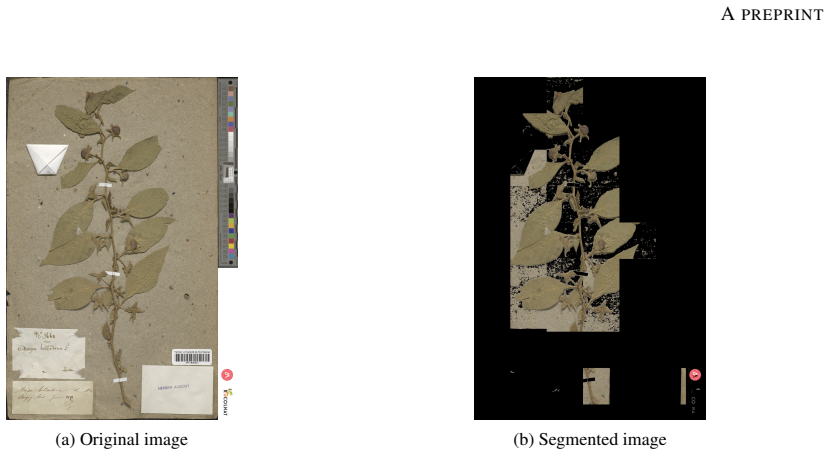
The load-bearing mechanism is detector-prompted segmentation. Large scans are split into patches; YOLOv10 proposes bounding boxes using a multi-region strategy that follows connected foreground clusters; those boxes are SAM2's only prompts; and the predicted patches are stitched back into a complete mask. The paper quantifies why the prompt matters: the multi-region strategy keeps 51.96% of the box area on plant material, versus 42.01% for a single enclosing box, so the detection step does much of the work of avoiding background noise.
What would settle it
Have independent annotators re-trace a random subset of the 333 test images by hand and compute PlantSAM2's IoU and Dice against those manual traces; if the scores fall materially below 0.94 and 0.97, the headline numbers partly reflect agreement with the semi-automatic reference masks. A second check is to rerun the trait-classification experiment using crops from manually drawn boxes rather than YOLO boxes and see whether the 4.36% gain persists.
Extended reading notes
Core claim
On its own terms, the paper shows that object detection can replace manual prompt design for promptable segmentation in a specialized domain. A fine-tuned YOLOv10 detector localizes plant material in image patches and emits bounding-box prompts; a fine-tuned SAM2 converts each box into a mask; and the masks are recombined into a full-resolution image mask. The authors claim this two-stage automatic prompting outperforms both a standalone SAM2 and a conventional UNet on herbarium images, with a multi-region prompting strategy that isolates connected components of the plant rather than one box per patch. They add a caveat that their own masks can exceed the annotation quality of the reference labels, so the IoU numbers may understate visual quality.
Load-bearing premise
The evaluation assumes that the masks from the earlier semi-automatic pipeline are accurate enough to be ground truth, because those masks generated YOLOv10's training boxes, the curated SAM2 fine-tuning set, and the 333-image test set; if those masks carry systematic errors, the IoU and Dice scores mostly show agreement with that pipeline, not true segmentation quality.
Editorial extensions
If this is right
- Background removal before trait classification yields consistent gains across all five tested traits, with the largest observed on armatures: +4.36% accuracy.
- Cropping to segmented plant regions preserves resolution, so fine morphological details survive the fixed-size resizing used by classifiers.
- Because prompts come from a detector rather than a human, the pipeline can scale to high-throughput digitized collections.
- The multi-region prompting strategy reduces background inside bounding boxes by about ten percentage points relative to single-box prompting.
- A semi-automatic annotation tool built on the pipeline lets experts correct poor masks with point prompts and expand the fine-tuning dataset.
Reading between the lines
- Inference: the same detector-prompted SAM scheme should transfer to other pressed-organism collections after fine-tuning on a modest sample, since the hard part is domain-specific detection, not the SAM decoder.
- Inference: because YOLOv10's training labels were derived by thresholding the prior pipeline's masks, a fair reading of the benchmark is that it measures consistency with that pipeline; an independent human-traced test set would reveal whether 0.94 IoU is a true ceiling or a floor.
- Inference: an ablation that holds SAM2 fixed and varies the prompt source (YOLO boxes, ground-truth boxes, a single random box) would isolate how much of the classification gain comes from detection quality versus segmentation refinement.
Editorial analysis
A structured set of objections, weighed in public.
Referee Report
Summary. The paper proposes PlantSAM, a pipeline that patches high-resolution herbarium scans, uses YOLOv10 to detect plant regions, feeds bounding-box prompts to SAM1/SAM2, and recombines the patch-level masks into a full-image foreground mask. The authors fine-tune YOLOv10 on bounding boxes derived from their earlier segmentation masks and fine-tune SAM on a curated subset of their earlier segmentation dataset. They report an IoU of 0.94 and a Dice coefficient of 0.97 for PlantSAM2 on a 333-image test set, compare against their own UNet and PlantSAM1, present a visual-evaluation generalization study on 171 out-of-distribution images, and report classification gains of up to +4.36% accuracy and +4.15% F1-score across five botanical traits using ResNet101. They also introduce a semi-automatic annotation tool for mask refinement.
Significance. If the quantitative claims hold, the pipeline is a practical and scalable foreground-isolation tool for herbarium imaging, with a plausible downstream benefit for trait classification. The release of the plant-region detection and segmentation datasets (refs. [6,7]) is a useful resource, and the semi-automatic refinement tool addresses a real operational bottleneck. However, the significance as stated in the abstract is not established by the evidence in this manuscript: segmentation accuracy is measured against masks from the same pipeline lineage, the out-of-distribution evaluation is subjective and based on very small samples, and no external baselines are compared. The contribution is promising but conditional on stronger evaluation.
major comments (4)
- [Sec. 3.2, 3.3, 4.2; Figure 7] The provenance of the segmentation ground truth is the central load-bearing issue. YOLOv10 training boxes are generated by thresholding the masks of [3] (Sec. 3.2); SAM1/SAM2 are fine-tuned on a curated subset of the same segmentation dataset [31] (Sec. 3.3); and the 333-image test set [6] is from the same lineage (Sec. 4.2). The IoU/Dice values in Tables 2 and 3 therefore measure agreement with the authors' prior semi-automatic pipeline rather than independently validated segmentation quality. Figure 7's caption calls the ground-truth mask 'manually annotated', which contradicts Sec. 4.2.2's admission that these masks are 'not perfect representations' of ideal segmentation masks. The authors need to clarify the exact annotation protocol and provide an independent manual evaluation on a held-out sample; without this, the headline 0.94/0.97 numbers cannot be interpreted as external accuracy.
- [Sec. 4.2.2, Tables 4-6] The generalization study is based on subjective 'visual evaluation' of masks into 'usable' and 'unusable' categories, with no operationalized criteria, no stated number of annotators, and no inter-annotator reliability. Several categories contain only 3-5 images (e.g., Orange background n=3, Long Leaves n=4, Pink background n=5), so percentages such as 33.33%, 60.00%, and 100.0% are not statistically stable. The authors should either add a quantitative metric on this OOD set, for example a small annotated subset evaluated with IoU/Dice under an agreed protocol, or frame Tables 4-6 as illustrative case studies rather than as evidence of generalization.
- [Abstract; Sec. 4.2.1] The 'state-of-the-art segmentation performance' claim in the abstract is not supported by the comparison set. The experiments compare PlantSAM1, PlantSAM2, and the authors' own UNet [3] only; no existing herbarium-segmentation method (e.g., Lee et al. [19], Triki et al. [37], GinJinn2 [22], White et al. [40]) is evaluated on the same test set. In addition, Tables 2 and 3 report no error bars, standard deviations, or significance tests, so per-taxon deltas as small as +0.14 IoU and +0.16 Dice (e.g., Litsea and Castanea rows) are not distinguishable from noise. A state-of-the-art claim requires external baselines and repeated runs.
- [Sec. 4.3, Table 8] The downstream classification claim of 'consistent performance improvements' is based on what appears to be a single ResNet101 run per condition, with no confidence intervals, no multiple seeds, and no significance testing. Several reported deltas are small (+0.32 accuracy, +0.43 accuracy, +0.78 accuracy), and the 'segmented cropped' condition changes image resolution and scale along with segmentation, so the gain cannot be attributed solely to background removal. The authors should report mean and standard deviation over at least three runs, provide statistical comparisons, and clarify how cropping interacts with input resolution.
minor comments (6)
- [Table 3] In the Castanea row, PlantSAM1's Dice is 0.9706 versus UNet's 0.9772, yet the delta is listed as +0.66; it should be approximately -0.66. Please correct and re-check the delta arithmetic in all tables.
- [Sec. 4.2.2, Figure 9] The text says 'See Figure 9 for an example of a usable mask', but the Figure 9 caption describes the image as an unusable mask. Please align the text and the caption.
- [Sec. 3.3 and Sec. 4.1] Dataset references are inconsistent: Section 3.3 says the SAM fine-tuning subset comes from [7] and [31], while Section 4.1 says training was conducted on 'the curated dataset of 1,476 herbarium segmentation masks [6]'. Since [6] is later used as the test set and [7] as the YOLO detection dataset, please clarify which dataset was actually used for SAM fine-tuning.
- [Sec. 4.2.2] The statement that 'PlantSAM2 reduced unusable masks by over 50% compared to UNet' is not uniformly supported by Table 4: for Blue background, 90.91% to 54.55% is a 40% relative reduction, and for Pink background there is no reduction (40.00% to 40.00%). Please rephrase or provide an aggregate statistic.
- [Algorithm 1 and Sec. 3.4] The variable is spelled 'patchs', and the threshold criterion (e.g., width/1024 > 3) deserves a one-sentence justification. Please also specify the overlap and padding strategy used when reassembling patches in the Unpatching step, since boundary artifacts at patch seams could affect IoU.
- [Sec. 4.1] Training details mention NVIDIA A100 GPUs but do not report inference time or total compute per image. For a pipeline aimed at large-scale herbarium digitization, a runtime estimate would be useful.
Circularity Check
IoU/Dice ground truth comes from the authors' own prior mask pipeline, the same lineage that supervises both YOLOv10 and SAM2, so the 0.94/0.97 headline partly measures self-agreement with those masks; the classification gains rest on independent manual trait labels.
-
fitted input called prediction
[Section 3.2 (YOLOv10 supervision from [3] masks), Section 3.3 (SAM2 fine-tuning on [31]/[3]), Section 4.1 (training on [6]), Section 4.2.1 (IoU/Dice test set [6]), Eqs. (1)-(2)]
"To train YOLOv10 for this task, we used the Plant Region Detection Dataset [7], which we constructed specifically for this work based on the segmented herbarium image dataset previously published in [3]. ... we then generated bounding boxes around the plant regions by detecting contiguous non-black pixel areas ... To fine-tune the SAM models, we used a curated subset [7] of the Segmentation dataset [31] published in our previous work [3]. ... The quantitative evaluation was conducted using a separate test dataset of 333 herbarium images [6]."
The mask standard that defines the task is the output of the authors' prior semi-automatic pipeline [3]: YOLOv10's box labels are produced by thresholding those masks ('detecting contiguous non-black pixel areas'), SAM2 is fine-tuned on a curated subset of the same mask dataset, and the 333-image test set [6] is from the same dataset lineage. Both model components are therefore optimized to reproduce the very masks that later serve as ground truth in Eqs. (1)-(2). The reported IoU of 0.94 and Dice of 0.97 thus measure how faithfully the learned pipeline regenerates the prior pipeline's masks, not agreement with independently annotated plant contours.
-
self citation load bearing
[Section 4.2.2 caveat; ground-truth provenance through references [3], [6], and [31], all published by the present authors' group]
"It is important to interpret these results cautiously, as the datasets used to compute IoU and Dice scores are not perfect representations of ideal segmentation masks. While they are close to the ground truth, we sometimes observe segmentation traits produced by PlantSAM2 that could be considered improvements over the provided annotations."
The paper's central premise, that the masks from [3]/[6]/[31] are reliable ground truth, is established solely through citations to datasets and papers authored by the present research group, without independent manual re-annotation or an external benchmark for the IoU/Dice evaluation. The cited prior work is the same semi-automatic pipeline whose outputs the models are trained to reproduce, making the reference standard an internal, self-cited artifact rather than an independent ground truth. The paper's own limitation passage admits these masks 'are not perfect representations' and that PlantSAM2 outputs may constitute 'improvements over the provided annotations,' confirming the reference is imperfect.
full rationale
The headline segmentation claim (IoU 0.94, Dice 0.97) is measured against ground-truth masks whose provenance is the authors' own prior semi-automatic pipeline [3]. The chain: [3] produced herbarium segmentation masks via a semi-automatic pipeline (morphological operations plus deep learning); dataset [31] supplies SAM2's fine-tuning masks (1,476 curated images), with [6] used for training in Section 4.1; dataset [7] supplies YOLOv10's supervision by thresholding those same masks into boxes; and the 333-image test set [6] comes from the same dataset lineage. Both model components are therefore optimized to reproduce the masks that then serve as the IoU/Dice reference. The resulting 0.94/0.97 is partly a self-consistency score with the earlier pipeline (the fitted-input-called-prediction pattern), and the paper's Section 4.2.2 caveat ('not perfect representations of ideal segmentation masks') confirms that the reference standard is imperfect and internal. This makes the absolute 'state-of-the-art' number partially circular, with the load-bearing ground truth resting on self-citation. The circularity is only partial, because three parts of the paper rest on independent evidence. (i) The relative ranking PlantSAM2 > UNet > PlantSAM1 is still informative, as all models share the same (flawed) reference. (ii) The OOD generalization evaluation (Tables 4-6) relies on human visual judgment of 'usable' masks rather than self-referential IoU. (iii) The classification experiment uses a separately, manually trait-labeled dataset with a standard ResNet101 baseline, so the accuracy and F1 gains are genuine external evidence that foreground isolation helps trait classification; they do not reduce to the same construction. If the authors had validated IoU/Dice against independent manual re-annotation, the headline would be externally grounded; as written, it largely certifies agreement with their earlier masks.
Assumptions & free parameters
free parameters (5)
- fine-tuning epochs =
80 (SAM), 100 (UNet), 250 (YOLOv10)
- patch sizes =
1024, 512, or 256 depending on image width
- multi-region vs single-box strategy =
multi-region
- morphological operation kernel =
unspecified
- curated training subset size =
1,476 images
assumptions (4)
- domain assumption The ground-truth masks from the semi-automatic pipeline of Ariouat et al. [3] accurately represent plant regions.
- domain assumption YOLOv10 bounding boxes are sufficient prompts for SAM to produce accurate masks.
- domain assumption Fine-tuning on 9 genera and 2 families generalizes to the test taxa.
- domain assumption The performance gain in classification comes from background removal rather than from the resolution change caused by cropping.
Cite this review
Pith. "Pith review of PlantSAM: An Object Detection-Driven Segmentation Pipeline for Herbarium Specimens." pith.science (2026). https://pith.science/paper/P76D4AO6
@misc{pith2026250716506,
  author       = {Pith},
  title        = {Pith review of: PlantSAM: An Object Detection-Driven Segmentation Pipeline for Herbarium Specimens},
  year         = {2026},
  howpublished = {\url{https://pith.science/paper/P76D4AO6}},
  note         = {Machine review of arXiv:2507.16506}
}
read the original abstract
Deep learning-based classification of herbarium images is hampered by background heterogeneity, which introduces noise and artifacts that can potentially mislead models and reduce classification accuracy. Addressing these background-related challenges is critical to improving model performance. We introduce PlantSAM, an automated segmentation pipeline that integrates YOLOv10 for plant region detection and the Segment Anything Model (SAM2) for segmentation. YOLOv10 generates bounding box prompts to guide SAM2, enhancing segmentation accuracy. Both models were fine-tuned on herbarium images and evaluated using Intersection over Union (IoU) and Dice coefficient metrics. PlantSAM achieved state-of-the-art segmentation performance, with an IoU of 0.94 and a Dice coefficient of 0.97. Incorporating segmented images into classification models led to consistent performance improvements across five tested botanical traits, with accuracy gains of up to 4.36% and F1-score improvements of 4.15%. Our findings highlight the importance of background removal in herbarium image analysis, as it significantly enhances classification accuracy by allowing models to focus more effectively on the foreground plant structures.
Figures


Figures from the paper (7 more)




Reference graph
Works this paper leans on
-
[3]
Hanane Ariouat, Youcef Sklab, Edi Prifti, Jean-Daniel Zucker, and Eric Chenin. Enhancing plant morphological trait identification in herbarium collections through deep learning–based segmentation.Applications in Plant Sciences, 13(2):e70000, 2025
work page 2025
-
[31]
Herbarium image segmentation dataset with plant masks for enhanced morphological trait analysis
Youcef Sklab, Hanane Sklab, Edi Prifti, Eric Chenin, and Jean-Daniel Zucker. Herbarium image segmentation dataset with plant masks for enhanced morphological trait analysis. Dataset, 2024
work page 2024
-
[6]
Florian Castanet, Hanane Ariouat Sklab, Eric Chenin, and Youcef Sklab. Digitised herbarium image segmenta- tion dataset.https://doi.org/10.6084/m9.figshare.29538065.v2, 2025. Dataset
-
[19]
S. Lee, H. Moon, S. Kim, and J. Lee. Multiple kernel-enhanced encoder for effective herbarium image segmen- tation.Electronics Letters, 61:e70155, 2025
work page 2025
-
[37]
Abdelaziz Triki, Bassem Bouaziz, Walid Mahdi, Hamdi Hamed, and Jitendra Gaikwad. Deep learning based approach for digitized herbarium specimen segmentation.Multimedia Tools and Applications, 81, 08 2022
work page 2022
- [22]
-
[40]
A. E. White, R. B. Dikow, M. Baugh, A. Jenkins, and P. B. Frandsen. Generating segmentation masks of herbarium specimens and a data set for training segmentation models using deep learning.Applications in Plant Sciences, 8(6):e11352, 2020. Published 2020 Jul 1
work page 2020
-
[1]
Abdelaziz, Bassem, and Walid. A deep learning-based approach for detecting plant organs from digitized herbar- ium specimen images.Ecological Informatics, 69:101590, 2022
work page 2022
Show all 47 references
-
[2]
Extracting masks from herbarium specimen images based on object detection and image segmentation techniques.Biodiversity Information Science and Standards, 7, 2023
Hanane Ariouat, Youcef Sklab, Marc Pignal, Régine Vignes Lebbe, Jean-Daniel Zucker, Edi Prifti, and Eric Chenin. Extracting masks from herbarium specimen images based on object detection and image segmentation techniques.Biodiversity Information Science and Standards, 7, 2023
2023
-
[4]
Sukhorukov, Alain Vanderpoorten, and Farid Jabbour
Guillaume Besnard, Maël Gaudeul, Sylvain Lavergne, Serge Muller, Grégory Rouhan, Andrey P. Sukhorukov, Alain Vanderpoorten, and Farid Jabbour. Herbarium-based science in the twenty-first century.Botany Letters, 165, 2018
2018
-
[5]
A deep learning based approach for automated plant disease classification using vision transformer.Scientific Reports, 12, 2022
Yaser Borhani, Javad Khoramdel, and Ebrahim Najafi. A deep learning based approach for automated plant disease classification using vision transformer.Scientific Reports, 12, 2022
2022
-
[7]
Plant region detection in digitised herbarium specimens
Florian Castanet, Hanane Ariouat Sklab, Eric Chenin, and Youcef Sklab. Plant region detection in digitised herbarium specimens. Dataset, 2025
2025
-
[8]
Robustsam: Segment anything robustly on degraded images.2024 IEEE/CVF Conference on Computer Vision and Pattern Recognition (CVPR), pages 4081–4091, 2024
Wei-Ting Chen, Yu-Jiet V ong, Sy-Yen Kuo, Sizhuo Ma, and Jian Wang. Robustsam: Segment anything robustly on degraded images.2024 IEEE/CVF Conference on Computer Vision and Pattern Recognition (CVPR), pages 4081–4091, 2024
2024
-
[9]
A survey of deep convolutional neural networks applied for prediction of plant leaf diseases
Vijaypal Singh Dhaka, Sangeeta Vaibhav Meena, Geeta Rani, Deepak Sinwar, Kavita, Muhammad Fazal Ijaz, and Marcin Wo´ zniak. A survey of deep convolutional neural networks applied for prediction of plant leaf diseases. Sensors, 21(14):4749, 2021
2021
-
[10]
An image is worth 16x16 words: Transformers for image recognition at scale, 2021
Alexey Dosovitskiy, Lucas Beyer, Alexander Kolesnikov, Dirk Weissenborn, Xiaohua Zhai, Thomas Unterthiner, Mostafa Dehghani, Matthias Minderer, Georg Heigold, Sylvain Gelly, Jakob Uszkoreit, and Neil Houlsby. An image is worth 16x16 words: Transformers for image recognition at...
2021
-
[11]
A segmentation-guided deep learning framework for leaf counting.Frontiers in Plant Science, 13, 2022
Xijian Fan, Rui Zhou, Tardi Tjahjadi, Sruti Das Choudhury, and Qiaolin Ye. A segmentation-guided deep learning framework for leaf counting.Frontiers in Plant Science, 13, 2022
2022
-
[12]
Doctoral thesis, University of Turin and Muséum National d’Histoire Naturelle of Paris, 2024
Gianluca Grasso.Soils associated with herbarium plants: a resource to address the temporal evolution of plant- associated microbiomes. Doctoral thesis, University of Turin and Muséum National d’Histoire Naturelle of Paris, 2024. 16 APREPRINT
2024
-
[13]
Deep residual learning for image recognition
Kaiming He, Xiangyu Zhang, Shaoqing Ren, and Jian Sun. Deep residual learning for image recognition. In 2016 IEEE Conference on Computer Vision and Pattern Recognition (CVPR), pages 770–778, 2016
2016
-
[14]
Semantic segmentation of herbarium specimens using deep learning techniques
Burhan Rashid Hussein, Owais Ahmed Malik, Wee-Hong Ong, and Johan Willem Frederik Slik. Semantic segmentation of herbarium specimens using deep learning techniques. In Rayner Alfred, Yuto Lim, Haviluddin Haviluddin, and Chin Kim On, editors,Computational Science and Technology...
-
[15]
Convolutional neural networks for image-based high-throughput plant phenotyp- ing: a review.Plant Phenomics, 2020:1–15, 2020
Yufei Jiang and Chenghai Li. Convolutional neural networks for image-based high-throughput plant phenotyp- ing: a review.Plant Phenomics, 2020:1–15, 2020
2020
-
[16]
Berg, Wan-Yen Lo, Piotr Dollár, and Ross Girshick
Alexander Kirillov, Eric Mintun, Nikhila Ravi, Hanzi Mao, Chloe Rolland, Laura Gustafson, Tete Xiao, Spencer Whitehead, Alexander C. Berg, Wan-Yen Lo, Piotr Dollár, and Ross Girshick. Segment anything. arXiv:2304.02643, 2023
2023 arXiv
-
[17]
Imagenet classification with deep convolutional neural networks
Alex Krizhevsky, Ilya Sutskever, and Geoffrey E Hinton. Imagenet classification with deep convolutional neural networks. In F. Pereira, C.J. Burges, L. Bottou, and K.Q. Weinberger, editors,Advances in Neural Information Processing Systems, volume 25. Curran Associates, Inc., 2012
2012
-
[18]
Lecun, L
Y . Lecun, L. Bottou, Y . Bengio, and P. Haffner. Gradient-based learning applied to document recognition. Proceedings of the IEEE, 86(11):2278–2324, 1998
1998
-
[20]
Roles of natural history collections.Annals of the Missouri Botanical Garden, 83(4):536–545, 1996
Lewis Meredith. Roles of natural history collections.Annals of the Missouri Botanical Garden, 83(4):536–545, 1996
1996
-
[21]
Computer vision-based phenotyping for improvement of plant productivity: a machine learning perspective
Kei Mochida, Shunsuke Koda, Koji Inoue, Takuya Hirayama, Seiji Tanaka, Ryosuke Nishii, and Fabio Melgani. Computer vision-based phenotyping for improvement of plant productivity: a machine learning perspective. GigaScience, 8, 2018
2018
-
[23]
T. Ott, C. Palm, R. V ogt, and C. Oberprieler. Ginjinn: An object-detection pipeline for automated feature extraction from herbarium specimens.Applications in Plant Sciences, 8(6):e11351, 2020
2020
-
[24]
Peter H. Raven. Saving plants, saving ourselves.Plants, People, Planet, 1:8–13, 2019
2019
-
[25]
Sam 2: Segment anything in images and videos.arXiv preprint arXiv:2408.00714, 2024
Nikhila Ravi, Valentin Gabeur, Yuan-Ting Hu, Ronghang Hu, Chaitanya Ryali, Tengyu Ma, Haitham Khedr, Roman Rädle, Chloe Rolland, Laura Gustafson, Eric Mintun, Junting Pan, Kalyan Vasudev Alwala, Nicolas Carion, Chao-Yuan Wu, Ross Girshick, Piotr Dollár, and Christoph Feichtenh...
2024 arXiv
-
[26]
Leveraging multimodal- ity for biodiversity data: Exploring joint representations of species descriptions and specimen images using CLIP
Maya Sahraoui, Youcef Sklab, Marc Pignal, Régine Vignes Lebbe, and Vincent Guigue. Leveraging multimodal- ity for biodiversity data: Exploring joint representations of species descriptions and specimen images using CLIP. Biodiversity Information Science and Standards, 7:e112666, 2023
2023
-
[27]
Very deep convolutional networks for large-scale image recognition
K Simonyan and A Zisserman. Very deep convolutional networks for large-scale image recognition. pages 1–14. Computational and Biological Learning Society, 2015
2015
-
[28]
Towards a deep learning-powered herbarium image analysis platform.Biodiversity Information Science and Standards, 2024
Youcef Sklab, Hanane Ariouat, Youssef Boudjydah, Yassine Qacami, Edi Prifti, Jean-Daniel Zucker, Régine Vi- gnes Lebbe, and Eric Chenin. Towards a deep learning-powered herbarium image analysis platform.Biodiversity Information Science and Standards, 2024
2024
-
[29]
Sim-net: A multimodal fusion network using inferred 3d object shape point clouds from rgb images for 2d classification.IET Computer Vision, 19(1):e70036, 2025
Youcef Sklab, Hanane Ariouat, Eric Chenin, Edi Prifti, and Jean-Daniel Zucker. Sim-net: A multimodal fusion network using inferred 3d object shape point clouds from rgb images for 2d classification.IET Computer Vision, 19(1):e70036, 2025
2025
-
[30]
Identification of non-plant elements in herbarium images using yolo
Youcef Sklab, Hanane Ariouat, Edi Prifti, Eric Chenin, and Jean-Daniel Zucker. Identification of non-plant elements in herbarium images using yolo. InProceedings of the Conférence Africaine sur la Recherche en Informatique et en Mathématiques (CARI), 2024
2024
-
[32]
Digitization of herbaria enables novel research.American Journal of Botany, 104:1281–1284, 2017
Pamela Soltis. Digitization of herbaria enables novel research.American Journal of Botany, 104:1281–1284, 2017
2017
-
[33]
Sweeney, Binil Sajan, Paul J
Patrick W. Sweeney, Binil Sajan, Paul J. Morris, Yiming Xia, Aimee Jirasek, Radhakrishnan Srinivasan, Christo- pher J. Grassa, and Charles C. Davis. Large-scale digitization of herbarium specimens: Development and usage of an automated, high-throughput conveyor system.Taxon, 2...
2018
-
[34]
Szegedy, Wei Liu, Yangqing Jia, P
C. Szegedy, Wei Liu, Yangqing Jia, P. Sermanet, S. Reed, D. Anguelov, D. Erhan, V . Vanhoucke, and A. Rabi- novich. Going deeper with convolutions. In2015 IEEE Conference on Computer Vision and Pattern Recognition (CVPR), pages 1–9, Los Alamitos, CA, USA, jun 2015. IEEE Comput...
2015
-
[35]
K. M. Thompson, R. Turnbull, E. Fitzgerald, and J. L. Birch. Identification of herbarium specimen sheet compo- nents from high-resolution images using deep learning.Ecology and Evolution, 13:e10395, 2023
2023
-
[36]
Deep leaf: Mask r-cnn based leaf detection and segmentation from digitized herbarium specimen images.Pattern Recognition Letters, 150:76–83, 2021
Abdelaziz Triki, Bassem Bouaziz, Jitendra Gaikwad, and Walid Mahdi. Deep leaf: Mask r-cnn based leaf detection and segmentation from digitized herbarium specimen images.Pattern Recognition Letters, 150:76–83, 2021
2021
-
[38]
Yolov10: Real-time end-to-end object detection.arXiv preprint arXiv:2405.14458, 2024
Ao Wang, Hui Chen, Lihao Liu, Kai Chen, Zijia Lin, Jungong Han, and Guiguang Ding. Yolov10: Real-time end-to-end object detection.arXiv preprint arXiv:2405.14458, 2024
2024 arXiv
-
[39]
Weaver and Stephen A
William N. Weaver and Stephen A. Smith. From leaves to labels: Building modular machine learning networks for rapid herbarium specimen analysis with leafmachine2.Applications in Plant Sciences, 11(5):e11548, 2023
2023
-
[41]
Wilde, Jason G
Brendan C. Wilde, Jason G. Bragg, and William Cornwell. Analyzing trait-climate relationships within and among taxa using machine learning and herbarium specimens.American Journal of Botany, 110(5):e16167, 2023
2023
-
[42]
Sams : One-shot learning for the segment anything model using similar images.2024 International Joint Conference on Neural Networks (IJCNN), pages 1–8, 2024
Fan Yin, Jun Li, Yifei Wei, Wei Zhang, and Chaoyi Xu. Sams : One-shot learning for the segment anything model using similar images.2024 International Joint Conference on Neural Networks (IJCNN), pages 1–8, 2024
2024
-
[43]
De- tection and annotation of plant organs from digitised herbarium scans using deep learning.Biodiversity Data Journal, 8:1–10, 2020
Sohaib Younis, Marco Schmidt, Christian Weiland, Stefan Dressler, Bernhard Seeger, and Thomas Hickler. De- tection and annotation of plant organs from digitised herbarium scans using deep learning.Biodiversity Data Journal, 8:1–10, 2020
2020
-
[44]
Personalize segment anything model with one shot.ArXiv, abs/2305.03048, 2023
Renrui Zhang, Zhengkai Jiang, Ziyu Guo, Shilin Yan, Junting Pan, Hao Dong, Peng Gao, and Hongsheng Li. Personalize segment anything model with one shot.ArXiv, abs/2305.03048, 2023
2023 arXiv
-
[45]
Deep-learning-based in-field citrus fruit detection and tracking.Horticulture Research, 9, 2022
Wenli Zhang, Jiaqi Wang, Yuxin Liu, Kaizheng Chen, Huibin Liu, Yulin Dai, Wenbin Wang, Yun Sun, and Wei Guo. Deep-learning-based in-field citrus fruit detection and tracking.Horticulture Research, 9, 2022
2022
-
[46]
Fast segment anything.ArXiv, abs/2306.12156, 2023
Xu Zhao, Wen-Yan Ding, Yongqi An, Yinglong Du, Tao Yu, Min Li, Ming Tang, and Jinqiao Wang. Fast segment anything.ArXiv, abs/2306.12156, 2023
2023 arXiv
-
[47]
Unet++: A nested u-net architecture for medical image segmentation.CoRR, abs/1807.10165, 2018
Zongwei Zhou, Md Mahfuzur Rahman Siddiquee, Nima Tajbakhsh, and Jianming Liang. Unet++: A nested u-net architecture for medical image segmentation.CoRR, abs/1807.10165, 2018. 18
2018 arXiv
Reviewed August 6, 2026 · model on record in the stance chip above.
Discussion (0). Sign in to comment.