REVIEW 4 major objections 6 minor 57 references
Odd Toric Code in a tilted field: Higgs-confinement multicriticality, spontaneous self-duality symmetry breaking, and valence bond solids
T0 review · 4 major / 6 minor · reviewed 2026-08-06 · deepseek-v4-flash
Pith's one-line read In the 'odd' Toric Code, one multicritical point at $h_c \approx 0.6(1)$ makes confinement, Higgs condensation, valence-bond order, and electric-magnetic-duality breaking onset simultaneously along the self-dual line.
desk verdict A genuinely new phase diagram for the odd toric code, with a plausible but not yet proven continuous multicritical point; the paper deserves review but the strongest claim needs stronger scaling evidence. read the letter →
The pith
A machine-rendered reading of the paper's core claim, the machinery that carries it, and where it could break.
The reading
What carries the argument
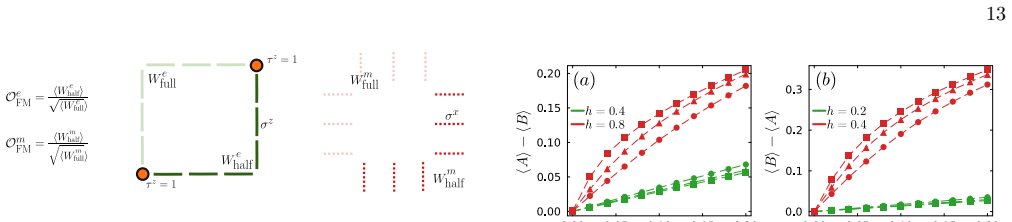
The load-bearing machinery has three parts. First, the 'odd' sign convention — positive $J_s$ and $J_p$, realized through the odd Gauss law $\tau^x_r = -A_r$ — places one static $e$ charge and one $\pi$-flux on every site and plaquette, so the deconfined ground state is a uniform background of both particles whose excitations are pairs of holes; the mutual semionic statistics of $e$ and $m$ then forces condensation at finite momentum, producing columnar VBS order and an $XY^*$ transition with emergent $U(1)$ symmetry. Second, the electric-magnetic duality $U_{\mathrm{em}}$, an explicit lattice map exchanging $\sigma^z \leftrightarrow \sigma^x$ and hence $h_z \leftrightarrow h_x$ (combined with a reflection on the cylinder geometry), makes the line $h_x = h_z$ an exact $\mathbb{Z}_2$ symmetry line along which the duality itself can spontaneously break; its order parameter is the linear-response susceptibility $O_{\mathrm{SD}}(\delta)$ to a perturbation $J_p \to J(1+\delta)$, $J_s \to J/(1+\delta)$. Third, the Fredenhagen-Marcu ratio $O_{\mathrm{FM}} = \tilde{W}_{\mathrm{half}}/\sqrt{W_{\mathrm{full}}}$ provides a screening-immune numerical probe of deconfinement, supplemented by the VBS order parameter $O_{\mathrm{VBS},\pi}$ measuring $\pi$-modulated bond order.
What would settle it
Two concrete observations would settle the claim. (1) On the self-dual line at $h \approx 0.6$, compute the first excitation gap and the VBS order parameter with a method reaching much larger scales, such as infinite projected entangled pair states or a Rydberg-atom quantum simulator: a gap that stays open while FM and VBS order grow, or a finite window with a third distinct pattern, would rule out the single continuous multicritical point. (2) Measure the duality-breaking susceptibility $O_{\mathrm{SD}}(\delta)$ just above $h_c$ for growing system sizes: spontaneous duality breaking requires a thermodynamic-limit value that grows with system size, so a saturating, size-independent value would disprove the duality-breaking part of the claim.
Extended reading notes
Core claim
The central discovery is a single, self-dual quantum critical point in the odd Toric Code at which deconfinement, translational symmetry breaking, and $\mathbb{Z}_2$ duality breaking set in together. On the self-dual line $h_x = h_z = h$, the Fredenhagen-Marcu order parameter, the columnar VBS order parameter, and the duality-breaking susceptibility $O_{\mathrm{SD}}(\delta)$ all rise at the same coupling $h_c \approx 0.6(1)$, and the first excitation gap softens at finite momentum $(0,\pi)$. The paper interprets this as the simultaneous condensation of electric and magnetic particles at finite momentum — condensation forced to finite momentum because the uniform background of static $e$ charges turns the lattice into a $\pi$-flux background for the $m$ particles, whose mutual semionic statistics then selects a columnar bond pattern. All energy observables (star, plaquette, and field terms) evolve continuously through the transition, and the authors conclude, within their numerical accuracy, that this is a single continuous transition rather than an accidental crossing of separate critical lines. Away from the critical point, the two dual columnar VBS phases are separated by a first-order transition across the self-dual line, and at stronger fields a cascade of progressively reorganized bond patterns leads into the trivial paramagnet.
Load-bearing premise
The finite-size DMRG data — cylinders of circumference 8 and lengths up to 10, with the $h = 0.8$ data not fully converged in bond dimension, as Appendix D states — is assumed to extrapolate to a single continuous multicritical point at $h_c \approx 0.6(1)$ in the thermodynamic limit; a weak first-order transition, or a narrow intermediate phase separating the two VBS states, would invalidate the central claim.
Editorial extensions
If this is right
- The deconfined phase of the odd Toric Code is a uniform background of $e$ and $m$ particles whose elementary excitations are pairs of holes, and any escape from this phase through increasing $h_x$ or $h_z$ passes through a region joining confinement or Higgs physics with columnar VBS order.
- Along the self-dual line, deconfinement, VBS formation, and spontaneous duality breaking share one critical coupling $h_c \approx 0.6(1)$, with all energy terms evolving continuously, so the transition is not of ordinary Landau type.
- For $h > h_c$, the two dual columnar VBS patterns are separated by a first-order transition across the self-dual line, so the duality symmetry is broken throughout the VBS region and not only at the critical point.
- Between the VBS region and the trivial paramagnet, the system traverses a cascade of bond-rearrangement phases, including patterns with enlarged unit cells that may become incommensurate in the thermodynamic limit.
Reading between the lines
- If the multicritical point is continuous as reported, extracting its critical exponents would test directly whether it belongs to the proposed Higgs-Yukawa-QED or mutual Chern-Simons universality classes; the paper does not compute those exponents, so this is an open and concrete next step.
- The mechanism identified — a static charge background forcing finite-momentum condensation and thereby twinning confinement with bond order and duality breaking — is generic, so similar multicritical structure should appear in odd-sector analogues on other lattices and with other gauge groups, a prediction a numerical scan could check.
- The apparent cascade of VBS phases suggests frustration-driven incommensurate ordering; if confirmed in the thermodynamic limit, the model would show a staircase of first-order transitions along diagonal cuts rather than a single VBS-to-paramagnet boundary, visible as jumps in the bond-energy density.
- Because the odd Toric Code is a stabilizer code perturbed by fields, it is a natural target for near-term quantum simulation, where the predicted simultaneous onset of confining, VBS, and duality-breaking orders could be observed directly while tuning a single field.
Editorial analysis
A structured set of objections, weighed in public.
Referee Report
Summary. The manuscript studies the phase diagram of a square-lattice Z2 gauge theory with an “odd” Gauss law, formulated as the positive-coupling Toric Code in a tilted field, Eq. (1). The authors use DMRG on cylinders with circumference Ly=8 and lengths up to L=10, together with exact diagonalization on a 4x4 torus, to map the hx–hz plane. They identify an odd deconfined phase, confinement- and Higgs-induced columnar VBS phases, an intermediate cascade of VBS patterns, and a trivial paramagnet. Their central claim is that along the self-dual line hx=hz=h there is a single multicritical point at hc=0.6(1), where deconfinement, VBS order, and spontaneous electric-magnetic duality breaking set in simultaneously and, within numerical accuracy, continuously, with the lowest excitation at finite momentum (0,π).
Significance. If established, the central result would be significant: it would provide a concrete lattice realization of a self-dual multicritical point where two XY* confinement/Higgs lines meet and where topological order, translational symmetry, and duality symmetry are lost together, connecting to the field-theoretic scenarios of Refs. [40,41,49]. The paper has clear strengths: an exact mapping to an odd Z2 gauge theory with a uniform static charge background, an explicit analytic construction of the h=0 ground state, careful definitions of Fredenhagen-Marcu and VBS order parameters adapted to cylindrical boundary conditions, use of the electric-magnetic duality to double the scanned phase diagram, and a data-availability statement. The authors are also appropriately cautious in places: the abstract states “within our numerical accuracy,” Appendix D explicitly flags incomplete L=10 convergence at h=0.8, and Section V D acknowledges that the cascade region beyond the VBS phase is not fully resolved.
major comments (4)
- [Section V C, Fig. 5] The evidence for a single continuous multicritical point at hc=0.6(1) consists of order-parameter curves, a growing peak in d^2 O_VBS/dh^2, and an increasing self-duality susceptibility, but no finite-size scaling collapse, Binder cumulant, or correlation-length scaling is presented. These diagnostics are not sufficient to distinguish a continuous transition from a weak first-order transition that appears continuous at L=8–10, especially because the quoted uncertainty ±0.1 is comparable to the apparent separation between the onsets of O_FM and O_VBS. Because the simultaneous-onset-at-a-single-continuous-critical-point claim is the central result, the manuscript needs a quantitative scaling analysis, such as a data collapse of O_FM and O_VBS with trial exponents or an explicit comparison of continuous versus weak-first-order scenarios.
- [Appendix D, Fig. 15] The L=10 data at h=0.8, which are the largest system sizes and lie in the claimed symmetry-broken regime just above hc, are explicitly not fully converged in bond dimension up to χ=11264. The sentence stating that these numbers are “close enough to the true value” is not quantified, and the FM and VBS order parameters at this h enter the finite-size sharpening that underlies the continuous-transition inference. This non-convergence introduces an unknown systematic error into the order-parameter magnitudes at the largest available size and weakens the distinction between a continuous transition and a weakly first-order one.
- [Section V E, Fig. 8b] The exact-diagonalization gap closing on the 4x4 torus is reported at h≈0.7, whereas the DMRG estimate is hc=0.6(1). While finite-size and boundary-condition differences are acknowledged, the discrepancy is of the same order as the quoted uncertainty, leaving open the possibility that deconfinement and VBS/duality breaking occur at two nearby but distinct couplings (hc1 and hc2>hc1) that the current resolution cannot separate. A systematic scan of the gap as a function of system size, or an explicit finite-size estimate of the gap-closing field, would be needed to close this loophole.
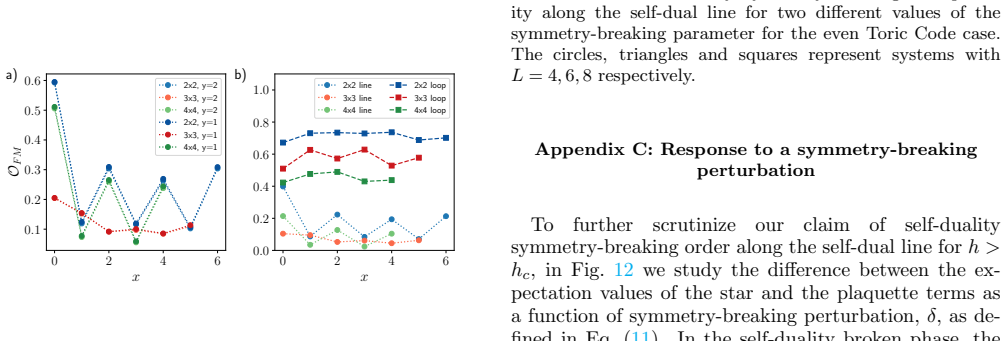
- [Section IV C, Fig. 5c and Appendix C] The self-duality breaking susceptibility O_SD is presented for only two finite values of the symmetry-breaking parameter δ per system size, and no explicit extrapolation to δ→0 or L→∞ is performed. The linear-response regime is checked only visually in Fig. 12, and the L=10 data are absent from Fig. 5c. Since the simultaneous onset of duality breaking with the VBS/deconfinement transition is one of the most distinctive claims, the convergence of O_SD in δ and L should be quantified and displayed, including for the largest accessible system sizes.
minor comments (6)
- [Fig. 8 caption] The word “markes” should be “marks.”
- [Section IV B, Eq. (8)] The normalization by L^2 is confusing because the cylinder has a length L_x and a circumference L_y; please define L_x and L_y explicitly in the text and figures, and specify whether L in the figures denotes the length in the open direction.
- [Fig. 3] The color scale for O_{e,m} in panel (c) is not described in the caption; the reader cannot tell which values correspond to Ising flux versus Z2 charge, or how the maximum is taken.
- [Section V A and Fig. 3] The global phase diagram is presented using a single circumference Ly=8 with no finite-size study of the phase boundaries; at minimum, the caption should state that all boundaries are estimates at Ly=8 rather than extrapolated thermodynamic values.
- [Abstract and Section III] The phrase “large-scale tensor network” overstates the numerical scope: the tensor-network calculations are DMRG on cylinders with Ly=8 and L up to 10, which is modest for a two-dimensional frustrated model. Rephrasing as “DMRG and exact diagonalization” would be more accurate.
- [Section V D] The statement that the intermediate cascade region “may be incommensurate” is speculative, and the profiles in Figs. 7c and 7d are only shown for L=8; adding a larger-L check or explicitly marking this region as unresolved in Fig. 1 would improve clarity.
Circularity Check
No significant circularity: the phase diagram and multicritical point are extracted from direct numerical observables on a fixed Hamiltonian, not from fitting or self-referential construction.
full rationale
The paper's central claims—an odd deconfined phase, confinement/Higgs-induced VBS phases, and a putative continuous multicritical point at h_c = 0.6(1) along the self-dual line—are obtained by computing standard observables (Fredenhagen–Marcu order parameters, VBS order parameters, self-duality susceptibility, and excitation gaps) directly from the Hamiltonian in Eq. (1). The critical coupling is estimated from the size dependence of these independent observables (Fig. 5) rather than being inserted as an input. The self-duality-breaking susceptibility O_SD(δ) is defined as a linear response to an explicit perturbation Jp→J(1+δ), Js→J/(1+δ); this is a standard order-parameter susceptibility and does not presuppose the location or continuity of the transition. The mapping to the odd gauge theory in Eqs. (2)–(3) is an exact duality transformation, not a renamed fit. Self-citations that appear (e.g., Refs. [27], [33]) are contextual references to the authors' earlier work on related models and operator content, and they are not load-bearing for the numerical phase diagram presented here. The main weakness—whether the apparent continuous multicritical point at h_c=0.6(1) survives thermodynamic limit against a weak first-order transition or two nearby transitions—is a numerical extrapolation concern, not a circularity. No step of the derivation reduces by construction to its own inputs.
Assumptions & free parameters
assumptions (5)
- standard math The star and plaquette operators of the toric code commute and have eigenvalues +/-1, so the h=0 ground state with all A_r = B_r* = -1 is a valid stabilizer state.
- domain assumption The electric-magnetic duality U_em (Eq. 5) is an exact symmetry of the Hamiltonian on the self-dual line h_x = h_z.
- domain assumption The deconfinement transition in the pure odd Z2 gauge theory belongs to the XY* universality class with an emergent U(1) symmetry and irrelevant D8 anisotropy, as established in Refs. [8,39].
- domain assumption DMRG on cylinders with open boundaries in one direction and periodic in the other, with the specific smooth/rough edge termination, yields bulk phase diagram information that is not qualitatively distorted by boundary effects.
- domain assumption The Fredenhagen-Marcu order parameter is a valid deconfinement order parameter in the presence of a static charge background.
Cite this review
Pith. "Pith review of Odd Toric Code in a tilted field: Higgs-confinement multicriticality, spontaneous self-duality symmetry breaking, and valence bond solids." pith.science (2026). https://pith.science/paper/2FBRUELG
@misc{pith2026250716523,
  author       = {Pith},
  title        = {Pith review of: Odd Toric Code in a tilted field: Higgs-confinement multicriticality, spontaneous self-duality symmetry breaking, and valence bond solids},
  year         = {2026},
  howpublished = {\url{https://pith.science/paper/2FBRUELG}},
  note         = {Machine review of arXiv:2507.16523}
}
abstract
We investigate the quantum phase diagram of an ``odd'' variant of the two-dimensional Ising Fradkin--Shenker model, characterized by a uniform background of static $e$ and $m$ charges. Using large-scale tensor network and exact diagonalization methods, we determine the topology of the phase diagram, identifying an ``odd'' deconfined phase, confinement- and Higgs-induced valence bond solids (VBS), and a trivial paramagnet. Most notably, we uncover an exotic multicritical point along the self-dual line, where electric and magnetic excitations are related by an enriched $\mathbb{Z}_2$ duality. This transition is marked by the simultaneous onset of confinement, Higgs condensation, translational symmetry breaking, and spontaneous duality symmetry breaking. Within our numerical accuracy, the transition appears continuous, involving the softening of excitation gaps for $e$ and $m$ anyons at finite momentum. At intermediate couplings, we further identify VBS phases with enlarged unit cells, potentially indicating frustration-induced crystalline order beyond commensurate limits.
Figures


Figures from the paper (11 more)





Reference graph
Works this paper leans on
-
[1]
Wen,Quantum Field Theory of Many-Body Systems, Oxford Graduate Texts (OUP Oxford, 2004)
X. Wen,Quantum Field Theory of Many-Body Systems, Oxford Graduate Texts (OUP Oxford, 2004)
work page 2004
-
[2]
Fradkin,Field Theories of Condensed Matter Physics (Cambridge University Press, 2013)
E. Fradkin,Field Theories of Condensed Matter Physics (Cambridge University Press, 2013)
2013
-
[3]
Sachdev,Quantum Phases of Matter(Cambridge Uni- versity Press, 2023)
S. Sachdev,Quantum Phases of Matter(Cambridge Uni- versity Press, 2023)
2023
-
[4]
J. B. Kogut, An introduction to lattice gauge theory and spin systems, Rev. Mod. Phys.51, 659 (1979)
1979
-
[5]
Elitzur, Impossibility of spontaneously breaking local symmetries, Phys
S. Elitzur, Impossibility of spontaneously breaking local symmetries, Phys. Rev. D12, 3978 (1975)
1975
-
[6]
Wilczek,Fractional statistics and anyon superconduc- tivity, Vol
F. Wilczek,Fractional statistics and anyon superconduc- tivity, Vol. 5 (World scientific, 1990)
1990
-
[7]
Fradkin and S
E. Fradkin and S. H. Shenker, Phase diagrams of lattice gauge theories with Higgs fields, Phys. Rev. D19, 3682 (1979)
1979
- [8]
Show all 57 references
-
[9]
Gazit, M
S. Gazit, M. Randeria, and A. Vishwanath, Emergent dirac fermions and broken symmetries in confined and deconfined phases ofZ 2 gauge theories, Nature Physics 13, 484 (2017)
2017
-
[10]
Gazit, F
S. Gazit, F. F. Assaad, S. Sachdev, A. Vishwanath, and C. Wang, Confinement transition ofZ 2 gauge theories coupled to massless fermions: Emergent quantum chro- modynamics andSO(5) symmetry, Proceedings of the National Academy of Sciences115, E6987 (2018)
2018
-
[11]
Dupont, S
M. Dupont, S. Gazit, and T. Scaffidi, Evidence for decon- finedu(1) gauge theory at the transition between toric code and double semion, Phys. Rev. B103, L140412 (2021)
2021
-
[12]
Savary and L
L. Savary and L. Balents, Quantum spin liquids: a re- view, Reports on Progress in Physics80, 016502 (2016). 15 FIG. 15. Convergence of (a) the energy and (b) the entropy (c) the VBS order parameter and (d) the FM order parameter at different points along the self-dual line as...
2016
-
[13]
Coupling ultracold matter to dynamical gauge fields in optical lattices: From flux attachment toZ 2 lattice gauge theories, Science Advances5, eaav7444 (2019)
2019
-
[14]
Homeier, C
L. Homeier, C. Schweizer, M. Aidelsburger, A. Fedorov, and F. Grusdt,Z 2 lattice gauge theories and kitaev’s toric code: A scheme for analog quantum simulation, Phys. Rev. B104, 085138 (2021)
2021
-
[15]
Lumia, P
L. Lumia, P. Torta, G. B. Mbeng, G. E. Santoro, E. Erco- lessi, M. Burrello, and M. M. Wauters, Two-dimensional 𭟋2 lattice gauge theory on a near-term quantum simula- tor: Variational quantum optimization, confinement, and topological order, PRX Quantum3, 020320 (2022)
2022
-
[16]
E. Zohar, Quantum simulation of lattice gauge theories in more than one space dimension—requirements, chal- lenges and methods, Philosophical Transactions of the Royal Society A: Mathematical, Physical and Engineer- ing Sciences380, 20210069 (2022)
2022
-
[17]
Homeier, A
L. Homeier, A. Bohrdt, S. Linsel, E. Demler, J. C. Hal- imeh, and F. Grusdt, Realistic scheme for quantum simu- lation ofZ 2 lattice gauge theories with dynamical matter in (2+1)d, Communications Physics6, 127 (2023)
2023
-
[18]
Irmejs, M.-C
R. Irmejs, M.-C. Ba˜ nuls, and J. I. Cirac, Quantum simu- lation ofZ 2 lattice gauge theory with minimal resources, Phys. Rev. D108, 074503 (2023)
2023
-
[19]
F. J. Wegner, Duality in generalized ising mod- els and phase transitions without local order pa- rameters, Journal of Mathematical Physics12, 2259 (1971), https://pubs.aip.org/aip/jmp/article- pdf/12/10/2259/19106483/2259 1 online.pdf
1971
-
[20]
Kitaev, Fault-tolerant quantum computation by anyons, Annals of Physics303, 2 (2003)
A. Kitaev, Fault-tolerant quantum computation by anyons, Annals of Physics303, 2 (2003)
2003
-
[21]
F. F. Assaad and T. Grover, Simple fermionic model of deconfined phases and phase transitions, Phys. Rev. X6, 041049 (2016)
2016
-
[22]
Borla, B
U. Borla, B. Jeevanesan, F. Pollmann, and S. Moroz, Quantum phases of two-dimensionalZ 2 gauge theory coupled to single-component fermion matter, Phys. Rev. B105, 075132 (2022)
2022
-
[23]
Borla, S
U. Borla, S. Gazit, and S. Moroz, Deconfined quantum criticality in ising gauge theory entangled with single- component fermions, Phys. Rev. B110, L201110 (2024)
2024
-
[24]
C. Chen, T. Yuan, Y. Qi, and Z. Y. Meng, Fermi arcs and pseudogap in a lattice model of a doped orthogonal metal, Phys. Rev. B103, 165131 (2021)
2021
-
[25]
E. J. K¨ onig, P. Coleman, and A. M. Tsvelik, Soluble limit and criticality of fermions in𭟋 2 gauge theories, Phys. Rev. B102, 155143 (2020)
2020
-
[26]
Gazit, F
S. Gazit, F. F. Assaad, and S. Sachdev, Fermi surface reconstruction without symmetry breaking, Phys. Rev. X10, 041057 (2020)
2020
-
[27]
Verresen, U
R. Verresen, U. Borla, A. Vishwanath, S. Moroz, and R. Thorngren, Higgs condensates are symmetry- protected topological phases: I. discrete symmetries (2024), arXiv:2211.01376 [cond-mat.str-el]
2024 arXiv
-
[28]
Vidal, S
J. Vidal, S. Dusuel, and K. P. Schmidt, Low-energy effec- tive theory of the toric code model in a parallel magnetic field, Phys. Rev. B79, 033109 (2009)
2009
-
[29]
I. S. Tupitsyn, A. Kitaev, N. V. Prokof’ev, and P. C. E. Stamp, Topological multicritical point in the phase dia- gram of the toric code model and three-dimensional lat- tice gauge Higgs model, Phys. Rev. B82, 085114 (2010)
2010
-
[30]
A. M. Somoza, P. Serna, and A. Nahum, Self-dual criti- cality in three-dimensionalZ 2 gauge theory with matter, Phys. Rev. X11, 041008 (2021)
2021
-
[31]
W.-T. Xu, F. Pollmann, and M. Knap, Critical behav- ior of the Fredenhagen-Marcu order parameter at topo- logical phase transitions (2024), arXiv:2402.00127 [cond- mat.str-el]
2024 arXiv
-
[32]
Bonati, A
C. Bonati, A. Pelissetto, and E. Vicari, Multicritical point of the three-dimensionalZ 2 gauge Higgs model, Phys. Rev. B105, 165138 (2022)
2022
-
[33]
Oppenheim, M
L. Oppenheim, M. Koch-Janusz, S. Gazit, and Z. Ringel, Machine learning the operator content of the critical self- dual ising-higgs lattice gauge theory, Phys. Rev. Res.6, 043322 (2024)
2024
-
[34]
Serna, A
P. Serna, A. M. Somoza, and A. Nahum, Worldsheet patching, 1-form symmetries, and landau ∗ phase tran- sitions, Phys. Rev. B110, 115102 (2024)
2024
-
[35]
G. C. Wick, A. S. Wightman, and E. P. Wigner, Super- selection rule for charge, Phys. Rev. D1, 3267 (1970)
1970
-
[36]
Feldman, J
N. Feldman, J. Knaute, E. Zohar, and M. Goldstein, Superselection-resolved entanglement in lattice gauge theories: a tensor network approach, Journal of High En- ergy Physics2024, 83 (2024)
2024
-
[37]
Senthil and M
T. Senthil and M. P. A. Fisher,Z 2 gauge theory of electron fractionalization in strongly correlated systems, Phys. Rev. B62, 7850 (2000)
2000
-
[38]
Moessner, S
R. Moessner, S. L. Sondhi, and E. Fradkin, Short-ranged resonating valence bond physics, quantum dimer models, and ising gauge theories, Phys. Rev. B65, 024504 (2001)
2001
-
[39]
R. A. Jalabert and S. Sachdev, Spontaneous alignment of frustrated bonds in an anisotropic, three-dimensional ising model, Phys. Rev. B44, 686 (1991)
1991
-
[40]
C.-M. Jian, A. Rasmussen, Y.-Z. You, and C. Xu, Emer- gent symmetry and tricritical points near the deconfined quantum critical point (2017), arXiv:1708.03050 [cond- mat.str-el]
2017 arXiv
-
[41]
T. T. Dumitrescu, P. Niro, and R. Thorngren, From qed3 to self-dual multicriticality in the fradkin-shenker model (2026), arXiv:2602.23420 [cond-mat.str-el]
2026
-
[42]
Gaiotto, A
D. Gaiotto, A. Kapustin, N. Seiberg, and B. Willett, Generalized global symmetries, Journal of High Energy 16 Physics2015, 10.1007/jhep02(2015)172 (2015)
2015 doi
-
[43]
McGreevy, Generalized symmetries in condensed mat- ter, Annual Review of Condensed Matter Physics14, 57 (2023)
J. McGreevy, Generalized symmetries in condensed mat- ter, Annual Review of Condensed Matter Physics14, 57 (2023)
2023
-
[44]
Weinberg and M
P. Weinberg and M. Bukov, QuSpin: a Python package for dynamics and exact diagonalisation of quantum many body systems. Part II: bosons, fermions and higher spins, SciPost Phys.7, 020 (2019)
2019
-
[45]
Fredenhagen and M
K. Fredenhagen and M. Marcu, Confinement criterion for qcd with dynamical quarks, Phys. Rev. Lett.56, 223 (1986)
1986
-
[46]
Gregor, D
K. Gregor, D. A. Huse, R. Moessner, and S. L. Sondhi, Diagnosing deconfinement and topological order, New Journal of Physics13, 025009 (2011)
2011
-
[47]
Verresen, M
R. Verresen, M. D. Lukin, and A. Vishwanath, Prediction of toric code topological order from rydberg blockade, Phys. Rev. X11, 031005 (2021)
2021
-
[49]
S. D. Geraedts and O. I. Motrunich, Exact realization of integer and fractional quantum hall phases in models in, Annals of Physics334, 288–315 (2013)
2013
-
[50]
Carleo and M
G. Carleo and M. Troyer, Solving the quantum many- body problem with artificial neural networks, Science 355, 602–606 (2017)
2017
-
[51]
Lange, A
H. Lange, A. V. de Walle, A. Abedinnia, and A. Bohrdt, From architectures to applications: A review of neural quantum states (2024), arXiv:2402.09402 [cond-mat.dis- nn]
2024 arXiv
-
[52]
D. S. Kufel, J. Kemp, S. M. Linsel, C. R. Laumann, and N. Y. Yao, Approximately-symmetric neural networks for quantum spin liquids (2024), arXiv:2405.17541 [quant- ph]
2024
-
[53]
Roy and E
K. Roy and E. J. K¨ onig,Z N lattice gauge theories with matter fields, Phys. Rev. B109, 195108 (2024)
2024
-
[54]
Sch¨ afer, C
R. Sch¨ afer, C. Chamon, and C. R. Laumann, Hall-on- toric: Descendant laughlin state in the chiralZ p toric code (2025), arXiv:2507.02035 [cond-mat.str-el]
2025 arXiv
-
[55]
S. M. Linsel, L. Pollet, and F. Grusdt, Independent e- and m-anyon confinement in the parallel field toric code on non-square lattices (2025), arXiv:2504.03512 [quant- ph]
2025
-
[56]
Hauschild, J
J. Hauschild, J. Unfried, S. Anand, B. Andrews, M. Bintz, U. Borla, S. Divic, M. Drescher, J. Geiger, M. Hefel, K. H´ emery, W. Kadow, J. Kemp, N. Kirchner, V. S. Liu, G. M¨ oller, D. Parker, M. Rader, A. Romen, S. Scalet, L. Schoonderwoerd, M. Schulz, T. Soejima, P. Thoma, Y....
2024
-
[57]
Fishman, S
M. Fishman, S. R. White, and E. M. Stoudenmire, The ITensor Software Library for Tensor Network Calcula- tions, SciPost Phys. Codebases , 4 (2022)
2022
-
[58]
Zenodo repository with the numerical data for “odd toric code in a tilted field: Higgs-confinement multicriticality, spontaneous self-duality symmetry breaking, and valence bond solids
Reviewed August 6, 2026 · model on record in the stance chip above.
Discussion (0). Sign in to comment.