Geometric and Resource-Theoretic Characterisation of Non-Stabiliserness in Quantum Algorithms
Pith reviewed 2026-05-19 03:38 UTC · model grok-4.3
The pith
Non-stabiliserness is used more efficiently in structured variational quantum algorithms than in unstructured ones.
A machine-rendered reading of the paper's core claim, the machinery that carries it, and where it could break.
Core claim
By pairing the resource theory of non-stabiliser entropies with the geometry of quantum state evolution and introducing permutation-agnostic distance measures, the work characterises non-stabiliserness in quantum algorithms. These measures reveal and quantify non-stabiliser effects hidden by a subset of Clifford operations. The results show different efficiency in non-stabiliserness use between structured and unstructured variational approaches, and demonstrate that greater freedom for classical optimisation in quantum-classical methods increases unnecessary non-stabiliser consumption.
What carries the argument
Permutation-agnostic distance measures that isolate non-stabiliser effects hidden by Clifford operations, used together with non-stabiliser entropies to track resource use during state evolution.
If this is right
- Structured variational approaches consume non-stabiliserness more efficiently than unstructured ones.
- Hybrid quantum-classical methods with greater classical optimisation freedom waste non-stabiliser resources.
- The geometric-resource pairing allows systematic tracking of non-classical contributions across different algorithms.
- These tools support more targeted design of algorithms that achieve quantum advantage with lower resource overhead.
Where Pith is reading between the lines
- The same characterisation could be used to set minimal non-stabiliserness budgets for given computational tasks.
- Analogous geometric and resource-theoretic pairings might quantify other resources such as entanglement or coherence in algorithm design.
- The approach may help identify circuit structures that achieve a given task with the least preparation cost for non-stabiliser states.
Load-bearing premise
The permutation-agnostic distance measures correctly isolate non-stabiliser effects hidden by Clifford operations without introducing new artifacts or depending on specific state representations.
What would settle it
A concrete simulation of a variational algorithm where the measured non-stabiliserness consumption is identical or higher for the structured case than the unstructured case, or where applying a Clifford gate to a known non-stabiliser state alters the distance measure in a way inconsistent with the claimed isolation of hidden effects.
Figures




read the original abstract
While there is strong evidence for advantages of quantum over classical computation, the repertoire of computational primitives with proven or conjectured quantum advantage remains limited. A big challenge of quantum algorithmic design is a still incomplete understanding of the sources of quantum computational power. Advancing towards systematic quantum advantage calls for a better understanding of the efficient use of non-classical resources like non-stabiliser states. We present an approach to track non-classical contributions in the form of non-stabiliserness across various algorithms by pairing resource theory of non-stabiliser entropies with the geometry of quantum state evolution, and introduce permutation agnostic distance measures that reveal and quantify non-stabiliser effects previously hidden by a subset of Clifford operations. We find different efficiency in the use of non-stabiliserness for structured and unstructured variational approaches, and show that greater freedom for classical optimisation in quantum-classical methods increases unnecessary non-stabiliser consumption. Our results open new means of analysing the efficient utilisation of quantum resources, and contribute towards the targeted construction of algorithmic quantum advantage.
Editorial analysis
A structured set of objections, weighed in public.
Referee Report
Summary. The manuscript develops a framework that combines the resource theory of non-stabiliser entropies with the geometry of quantum state evolution to track non-stabiliserness across quantum algorithms. It introduces permutation-agnostic distance measures, defined via orbit averages over permutations, to quantify non-stabiliser effects previously hidden by Clifford operations. The authors apply these tools to variational quantum algorithms and report differing efficiencies in non-stabiliserness consumption between structured and unstructured approaches, together with the observation that greater classical optimisation freedom in hybrid methods increases unnecessary non-stabiliser use.
Significance. If the central claims are substantiated, the work supplies a new analytic toolkit for dissecting resource consumption in quantum algorithms. The permutation-agnostic measures, if shown to be representation-independent, could enable more precise comparisons of algorithmic efficiency and support the design of circuits that avoid wasteful non-stabiliser overhead. The geometric perspective on state evolution also offers a concrete way to visualise resource dynamics that complements existing entropy-based approaches.
major comments (1)
- [§3] §3: The permutation-agnostic distance measures are constructed by averaging over a permutation orbit. The manuscript does not supply an explicit invariance proof (or counter-example verification) showing that the measures remain unchanged under local Clifford conjugation or under reparameterisation of the same physical state when the underlying representation is switched (e.g., from stabilizer tableau to density-matrix entries) for states produced by variational circuits. Because the headline efficiency comparisons between structured and unstructured methods rest on these measures isolating genuine non-stabiliser content, the absence of this check is load-bearing for the central claim.
minor comments (2)
- [§3] The notation for the orbit average in the definition of the distance measures could be made more explicit by including the explicit group action and the measure on the permutation group.
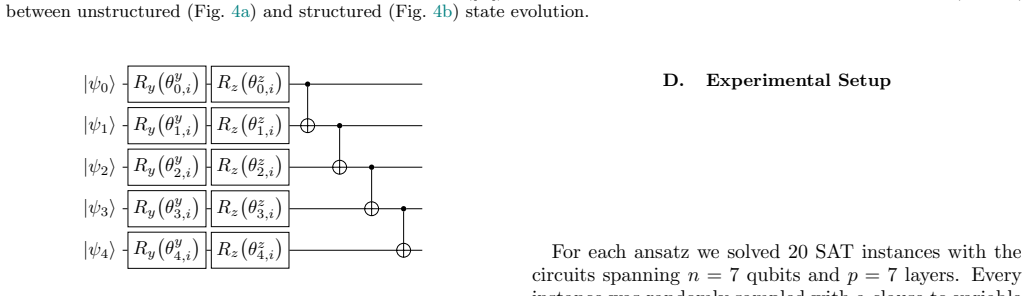
- [Figure 4] Figure captions should state the precise variational ansatz and the number of qubits used for each plotted curve to allow direct reproduction of the efficiency comparisons.
Simulated Author's Rebuttal
We thank the referee for their thorough review and insightful comments on our manuscript arXiv:2507.16543. We address the major comment regarding the invariance properties of the permutation-agnostic distance measures in detail below. We agree that providing an explicit proof will enhance the clarity and robustness of our claims.
read point-by-point responses
-
Referee: [§3] The permutation-agnostic distance measures are constructed by averaging over a permutation orbit. The manuscript does not supply an explicit invariance proof (or counter-example verification) showing that the measures remain unchanged under local Clifford conjugation or under reparameterisation of the same physical state when the underlying representation is switched (e.g., from stabilizer tableau to density-matrix entries) for states produced by variational circuits. Because the headline efficiency comparisons between structured and unstructured methods rest on these measures isolating genuine non-stabiliser content, the absence of this check is load-bearing for the central claim.
Authors: We appreciate the referee pointing out the need for an explicit invariance proof. The permutation-agnostic measures are defined through averaging over the orbit of permutations to eliminate dependencies on specific Clifford operations that might mask non-stabiliser effects. Although our numerical experiments on variational circuits implicitly support the invariance (as the efficiency comparisons hold across different representations), we concur that a formal proof is necessary to substantiate the central claims. In the revised manuscript, we will include a new subsection in §3 that provides a rigorous proof of invariance under local Clifford conjugations. This proof will demonstrate that conjugating the state by a local Clifford operator does not alter the orbit average, as the permutation group action commutes appropriately with the Clifford group. Additionally, we will show representation independence by proving equivalence between tableau-based and density-matrix-based computations of the distance. We will also include a brief verification for a small set of states from our variational algorithms. This revision will directly address the load-bearing aspect for our efficiency comparisons. revision: yes
Circularity Check
No significant circularity; measures and findings are independently defined
full rationale
The paper introduces permutation-agnostic distance measures in Section 3 as an orbit average over permutations to isolate non-stabiliser effects. These definitions stand as independent constructions without reducing to fitted parameters, self-citations, or prior results by the same authors. The reported efficiency differences between structured and unstructured variational approaches follow from applying these measures to algorithm executions rather than being presupposed by the measure definitions themselves. No load-bearing step equates a derived quantity to its input by construction, and the central claims remain falsifiable against external state representations or benchmarks.
Axiom & Free-Parameter Ledger
axioms (1)
- standard math Standard axioms of quantum mechanics and the resource theory of magic/non-stabiliserness hold.
invented entities (1)
-
Permutation-agnostic distance measures
no independent evidence
Lean theorems connected to this paper
-
IndisputableMonolith/Foundation/RealityFromDistinction.leanreality_from_one_distinction unclear?
unclearRelation between the paper passage and the cited Recognition theorem.
We present an approach to track non-classical contributions in the form of non-stabiliserness across various algorithms by pairing resource theory of non-stabiliser entropies with the geometry of quantum state evolution, and introduce permutation agnostic distance measures
-
IndisputableMonolith/Foundation/AlexanderDuality.leanalexander_duality_circle_linking unclear?
unclearRelation between the paper passage and the cited Recognition theorem.
Theorem 3. Let ˆσ be a permutation operator ... SREα(ˆσ |ψ⟩) = SREα(|ψ⟩)
What do these tags mean?
- matches
- The paper's claim is directly supported by a theorem in the formal canon.
- supports
- The theorem supports part of the paper's argument, but the paper may add assumptions or extra steps.
- extends
- The paper goes beyond the formal theorem; the theorem is a base layer rather than the whole result.
- uses
- The paper appears to rely on the theorem as machinery.
- contradicts
- The paper's claim conflicts with a theorem or certificate in the canon.
- unclear
- Pith found a possible connection, but the passage is too broad, indirect, or ambiguous to say the theorem truly supports the claim.
Reference graph
Works this paper leans on
- [1]
- [2]
- [3]
-
[4]
Entanglement and Quantum Computation
R. Jozsa, Entanglement and quantum computation, arXiv preprint quant-ph/9707034 (1997). 10
work page internal anchor Pith review Pith/arXiv arXiv 1997
-
[5]
Quantum computing and the entanglement frontier
J. Preskill, Quantum computing and the entanglement frontier, arXiv preprint arXiv:1203.5813 (2012)
work page internal anchor Pith review Pith/arXiv arXiv 2012
-
[6]
R. Jozsa and N. Linden, On the role of entanglement in quantum-computational speed-up, Proceedings of the Royal Society of London. Series A: Mathematical, Phys- ical and Engineering Sciences 459, 2011 (2003)
work page 2011
-
[7]
A. Datta and G. Vidal, Role of entanglement and cor- relations in mixed-state quantum computation, Physical Review A—Atomic, Molecular, and Optical Physics 75, 042310 (2007)
work page 2007
-
[8]
W. Mauerer, On colours, keys, and correlations: mul- timode parametric downconversion in the photon num- ber basis, Ph.D. thesis, Erlangen, N¨ urnberg, Univ., Diss. (2009)
work page 2009
-
[9]
A. Khrennikov, Roots of quantum computing supremacy: superposition, entanglement, or complementarity?, The European Physical Journal Special Topics 230, 1053 (2021)
work page 2021
-
[10]
J. Odavi´ c, M. Viscardi, and A. Hamma, Stabilizer entropy in non-integrable quantum evolutions, arXiv preprint arXiv:2412.10228 (2024)
-
[11]
The Heisenberg Representation of Quantum Computers
D. Gottesman, The Heisenberg representation of quan- tum computers, in 22nd International Colloquium on Group Theoretical Methods in Physics (1998) pp. 32–43, arXiv:quant-ph/9807006
work page internal anchor Pith review Pith/arXiv arXiv 1998
-
[12]
H. J. Garc´ ıa, I. L. Markov, and A. W. Cross, On the geometry of stabilizer states, Quantum Info. Comput.14, 683–720 (2014)
work page 2014
-
[14]
W. Mauerer and S. Scherzinger, 1-2-3 reproducibility for quantum software experiments, in 2022 IEEE Interna- tional Conference on Software Analysis, Evolution and Reengineering (SANER) (2022)
work page 2022
-
[15]
D. Gottesman, Stabilizer codes and quantum error cor- rection (California Institute of Technology, 1997)
work page 1997
-
[16]
S. Bravyi and A. Kitaev, Universal quantum computa- tion with ideal clifford gates and noisy ancillas, Physical Review A 71, 10.1103/physreva.71.022316 (2005)
-
[17]
E. Chitambar and G. Gour, Quantum resource theo- ries, Reviews of Modern Physics 91, 10.1103/revmod- phys.91.025001 (2019)
-
[18]
S. Bravyi, G. Smith, and J. A. Smolin, Trading classical and quantum computational resources, Physical Review X 6, 10.1103/physrevx.6.021043 (2016)
- [19]
-
[20]
M. Beverland, E. Campbell, M. Howard, and V. Kli- uchnikov, Lower bounds on the non-clifford resources for quantum computations, Quantum Science and Technol- ogy 5, 035009 (2020)
work page 2020
-
[21]
T. Haug and L. Piroli, Stabilizer entropies and nonstabi- lizerness monotones, Quantum 7, 1092 (2023)
work page 2023
-
[22]
L. Leone and L. Bittel, Stabilizer entropies are monotones for magic-state resource theory, Physical Review A 110, 10.1103/physreva.110.l040403 (2024)
-
[23]
S. F. E. Oliviero, L. Leone, and A. Hamma, Magic-state resource theory for the ground state of the transverse- field ising model, Physical Review A 106, 10.1103/phys- reva.106.042426 (2022)
-
[24]
S. F. E. Oliviero, L. Leone, A. Hamma, and S. Lloyd, Measuring magic on a quantum processor, npj Quantum Information 8, 10.1038/s41534-022-00666-5 (2022)
-
[25]
A. Gu, L. Leone, S. Ghosh, J. Eisert, S. F. Yelin, and Y. Quek, Pseudomagic quantum states, Physical Review Letters 132, 10.1103/physrevlett.132.210602 (2024)
-
[26]
J. Anandan and Y. Aharonov, Geometry of quantum evo- lution, Physical Review Letters 65, 1697–1700 (1990)
work page 1990
- [27]
-
[28]
This consideration is beyond the more abstract arguments presented in this paper
An additional establishment of locality and neighbour- hood comes from restrictions imposed by the coupling graph of the concrete quantum processor executing the circuit. This consideration is beyond the more abstract arguments presented in this paper
-
[29]
P. W. Shor, Polynomial-time algorithms for prime factor- ization and discrete logarithms on a quantum computer, SIAM Journal on Computing 26, 1484–1509 (1997)
work page 1997
-
[30]
T. Kr¨ uger and W. Mauerer, Out of the loop: Struc- tural approximation of optimisation landscapes and non- iterative quantum optimisation (2024)
work page 2024
discussion (0)
Sign in with ORCID, Apple, or X to comment. Anyone can read and Pith papers without signing in.