REVIEW 3 major objections 4 minor 1 cited by
Ring-based ML calibration with in situ pileup correction for real-time jet triggers
T0 review · 3 major / 4 minor · reviewed 2026-08-06 · deepseek-v4-flash
Pith's one-line read Ring-based ML jet calibration in the first-level trigger doubles the retained HH→bbbb signal by lowering the fourth-jet threshold from about 90 GeV to 75 GeV.
desk verdict Plausible and well-written ML jet calibration, but the factor-of-two HH4b gain hinges on an ambiguous baseline that may be uncalibrated primitive jets. read the letter →
The pith
A machine-rendered reading of the paper's core claim, the machinery that carries it, and where it could break.
The reading
What carries the argument
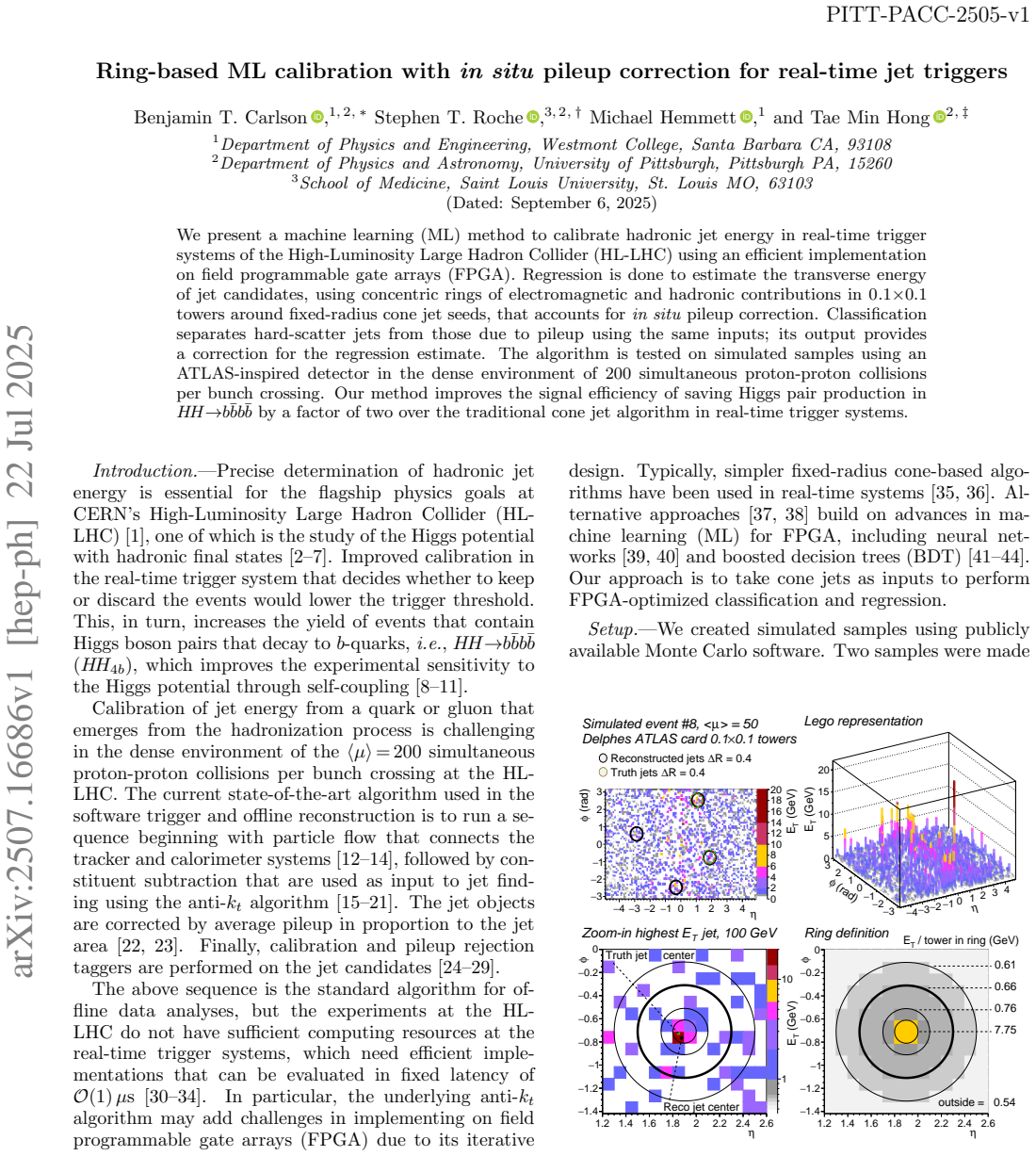
The central object is the ring-based jet representation: each primitive jet (a fixed-radius cone from a sliding-window seed) is described by the electromagnetic, hadronic, and total tower energy summed in four concentric annuli of 0.1×0.1 cells, with $\Delta R < 0.1$, $0.1 \le \Delta R < 0.2$, $0.2 \le \Delta R < 0.4$, and $0.4 \le \Delta R < 0.6$, plus the inner three rings combined as the 'ring jet' (the primitive jet itself). The outer rings are designed to measure the local pileup density in situ, while the inner rings capture the hard-scatter core. These inputs feed two boosted decision trees: a regressor (BDT$_\mathrm{ET}$) trained to reproduce the offline anti-$k_t$ jet $E_T$, and a classifier (BDT$_\mathrm{HS}$) trained to separate matched hard-scatter jets from unmatched pileup jets. The two outputs are combined as $E^T_\mathrm{ML} = p_\mathrm{HS}\cdot\mathrm{BDT}_\mathrm{ET}$, which is the quantity a trigger would threshold on.
What would settle it
Recompute the fourth-jet turn-on curve using a full, detailed detector simulation of the HL-LHC calorimeter trigger (or early real data at comparable pileup) fed through the trained two-BDT model; if the 80% HH4b efficiency threshold does not move from about 90 GeV down to about 75 GeV at 1% dijet acceptance, the claimed factor-of-two signal gain does not hold. A supporting check is whether the exact 30-tree, depth-8 BDT pair fits in the target FPGA at the required latency.
Extended reading notes
Core claim
On its own terms, the paper establishes that a pair of boosted decision trees trained on ring sums of calorimeter tower energy can correct the energy scale of primitive cone jets and simultaneously suppress pileup jets, and that the product $E^T_\mathrm{ML} = p_\mathrm{HS}\cdot\mathrm{BDT}_\mathrm{ET}$ provides a trigger quantity with a sharper turn-on than the raw primitive jet $E_T$. The regression BDT targets the offline anti-$k_t$ jet $E_T$; the classifier BDT outputs a hard-scatter probability $p_\mathrm{HS}$ calibrated by binning the score; multiplying the two yields the final jet quantity. In the HH4b benchmark, the 80% signal-efficiency threshold on the fourth leading jet moves from about 90 GeV to about 75 GeV at 1% dijet acceptance, a shift of 14.5 GeV, and the signal acceptance grows by a factor of 2.1. The paper also reports that the resolution gain is largest in the calibrated-$E_T$ bin of about 41–69 GeV, where the rms improves by 57% relative to primitive jets.
Load-bearing premise
The entire performance evaluation assumes that the fast detector simulation with its simplified sliding-window primitive jet algorithm faithfully represents the HL-LHC first-level calorimeter trigger environment at 200 simultaneous proton-proton collisions per bunch crossing.
Editorial extensions
If this is right
- A first-level trigger using this calibration can keep events whose fourth b-jet has $E_T$ near 75 GeV instead of requiring near 90 GeV, directly enlarging the dataset for measuring the Higgs self-coupling.
- The same ring-based calibration can be applied to other multi-jet trigger signatures, such as vector-boson-fusion Higgs production or four-top final states, where low jet thresholds are the limiting factor.
- Because the pileup correction is local to the jet, the method may relax the requirement on a global pileup-density measurement in the hardware trigger.
- The reported 57% resolution gain at $E_T \sim 41{-}69$ GeV implies the method becomes more valuable if trigger systems can accept lower jet thresholds in the future.
- The two-BDT structure is modular: the energy regressor and the hard-scatter tagger can be retrained independently if the pileup environment or detector geometry changes.
Reading between the lines
- A single combined model that outputs both the energy estimate and the hard-scatter probability might achieve the same gain with a smaller firmware footprint; the paper's two-BDT split is a hardware-motivated design choice, not a proven necessity.
- The ring features could also serve as a standalone online pileup-jet veto, a use beyond the $E^T_\mathrm{ML}$ threshold quantity.
- Applying the calibration to all jets in the event rather than only the fourth could produce an even steeper combined trigger turn-on, at the cost of more processing per event.
- The method's sensitivity to the tower granularity is untested; a coarser trigger tower geometry would change the ring definitions and could raise or remove the factor-of-two gain.
Editorial analysis
A structured set of objections, weighed in public.
Referee Report
Summary. The paper proposes an FPGA-oriented ML jet-energy calibration for real-time L1 triggers at the HL-LHC. Calorimeter-tower energies in four concentric rings around a sliding-window primitive jet seed are fed to two boosted decision trees: a regressor (BDT_ET) that estimates the jet transverse energy on the offline anti-kT scale, and a classifier (BDT_HS) whose score is converted into a hard-scatter probability p_HS. The final trigger quantity is E_ML^T = p_HS * BDT_ET (Eq. 1). Using Delphes ATLAS-card simulations of dijet and HH->bbbb events with <mu>=200 pileup, the authors report improved energy resolution, a 13.5-14.5 GeV reduction in the fourth-jet threshold at fixed dijet background acceptance, and a factor-2.1 increase in HH4b signal efficiency at 80% efficiency relative to primitive cone jets.
Significance. If the headline result holds, the paper is a useful proof-of-principle for real-time ML jet calibration with in situ pileup correction. The ring-based feature design is simple and plausibly FPGA-friendly, the training/evaluation workflow is clearly documented, the simulated samples are made public (Ref. [45]), and the authors cite prior work showing that similar BDTs fit within FPGA resource and latency budgets. The quantitative claims, however, rest on a comparison baseline whose definition is ambiguous, and the results are presented without statistical or systematic uncertainties. The core methodological idea is worth publishing, but the central factor-of-two claim needs to be re-established against a properly calibrated primitive-jet baseline.
major comments (3)
- [Results, Fig. 6] It must be stated explicitly whether the "Prim. jets" curves in Fig. 6 use the raw E_prim^T or the per-bin calibrated E_prim^T/R_hat introduced in Fig. 4. The paper says in the Machine Learning section that "to compare the performance, we calibrate each incoming ET by the R_hat derived above," but the Results section never says this calibration is applied to the primitive-jet baseline. If Fig. 6 uses uncalibrated primitive jets, the comparison is not like-for-like: the ML arm receives both a regression calibration and a p_HS pileup correction, while the baseline is denied the simple calibration step that Fig. 4 itself demonstrates. In that case the claimed 13.5-14.5 GeV threshold shift and factor-2.1 acceptance gain may be partly an artifact of an artificially weak control arm. The authors should add curves for the calibrated primitive jets (E_prim^T divided by R_hat in each bin) and report the threshold shift and acceptance gain relative to that baseline.
- [Results, Fig. 6] The quantitative claims (factor-2.1 acceptance gain, 13.5-14.5 GeV threshold shifts, 33% and 57% resolution gains in Fig. 4) are presented without statistical uncertainties or a systematic-error budget. With 100k simulated events, the 80% efficiency points carry statistical errors that may be small, but the simulation uses a single Delphes ATLAS card, a fixed <mu>=200, and specific choices for the matching radius (0.3), ring boundaries, BDT hyperparameters, and p_HS calibration binning. A sensitivity scan over these choices, or at least a table of variations around the nominal values, is needed to establish that the advertised factor-of-two improvement is robust rather than a point estimate from one simulation setup. This is load-bearing because the abstract and conclusions quote the factor of two as the main result.
- [Machine learning, last paragraph; Conclusions] The real-time applicability of the exact proposed algorithm is asserted but not demonstrated. The paper cites previous FPGA implementations of BDTs with "parameters similar to those in our paper," but the present design includes two BDTs (30 trees, depth 8), a ring-feature summation stage, a p_HS probability lookup/normalization, and the final multiplication in Eq. (1). No resource estimate, latency budget, or throughput analysis is given for this specific combination, nor for the surrounding sliding-window primitive-jet finding. The conclusion that the method "can lower the fourth leading jet ET by 10-15 GeV" in a real L1 trigger therefore goes beyond what the paper establishes. The authors should either provide a concrete FPGA resource/latency estimate for this model or soften the hardware claims to say the approach is compatible with previously demonstrated FPGA BDT performance.
minor comments (4)
- [Fig. 6 caption] The caption line "5%, ML jets" and "1%, Prim. jets" is clear, but the embedded text "dijet accept, alg, gain" is cryptic; please spell out what "alg" and "gain" refer to.
- [Fig. 4] The horizontal axis label "R/R_hat" may be confused with the jet radius R=0.4 used elsewhere; consider renaming the resolution variable (e.g., "E_T^est/E_T^offline" after calibration) to avoid ambiguity.
- [Setup, footnote 5] The primitive-jet seed threshold of E_seed^T > 20 GeV in the sliding-window algorithm could influence the low-energy turn-on behavior; please state how this threshold was chosen and whether the reported trigger curves are sensitive to it.
- [Abstract] The phrase "efficiency of saving Higgs pair production" is awkward; consider "efficiency for selecting" or "retaining" Higgs pair production events.
Circularity Check
No significant circularity: the ML calibration is an ordinary supervised regression/classification evaluated on a held-out sample, and the primitive-jet baseline is explicitly calibrated rather than a strawman.
full rationale
The derivation chain does not reduce to its own inputs. BDT_ET is trained to map calorimeter rings to the offline anti-kT jet ET, and the trigger turn-on is then measured against that same offline ET; this is the definition of jet-energy calibration, not a hidden equivalence, and all efficiencies are evaluated on the half of the sample not used for training. The HS tagger is trained on the geometric offline-match definition of a hard-scatter jet, and the probability p_HS = NHS/(NHS+NPU) is a standard binwise calibration of the classifier score from the same simulation; using it as a multiplicative correction in Eq. (1) is an explicitly stated construction rather than a fitted parameter relabeled as a prediction. The equal-rate primitive-jet curves in Fig. 6 are not presented as raw uncalibrated jets: the text preceding Fig. 4 states that 'to compare the performance, we calibrate each incoming ET by the R-hat derived above for each bin in E_prim^T,' so the skeptical concern that the baseline omits the paper's own per-bin calibration is not supported by the manuscript. The only self-citations appear in the FPGA-feasibility remark ('Previous work have demonstrated... [41-44]'), but the reported factor-of-two physics gain is obtained from simulation and does not depend on those citations; there is no imported uniqueness theorem, no ansatz smuggled in by citation, and no renaming of a known result.
Assumptions & free parameters
free parameters (5)
- Ring boundaries =
DeltaR < 0.1, 0.1 to 0.2, 0.2 to 0.4, 0.4 to 0.6
- Primitive jet matching radius =
DeltaR < 0.3
- BDT hyperparameters =
30 trees, maximum depth 8, adaptive boosting
- p_HS calibration binning =
Unspecified bins of BDT score
- ET flattening weights =
Inverse population per ET bin
assumptions (6)
- domain assumption Delphes 3.4 with the ATLAS card and pileup accurately models the HL-LHC trigger environment at mean pileup 200.
- domain assumption The anti-kt offline jet ET is the correct reference energy for trigger calibration.
- domain assumption Primitive jets within DeltaR < 0.3 of an offline jet are hard-scatter jets and all others are pileup.
- domain assumption Ring 3 and ring 4 tower energies are strongly correlated with local pileup density and can provide in situ pileup correction.
- ad hoc to paper A regressor trained only on hard-scatter jets can be corrected by multiplying by p_HS.
- domain assumption Prior FPGA implementations with similar model sizes guarantee the resource and latency feasibility of this exact model.
Cite this review
Pith. "Pith review of Ring-based ML calibration with in situ pileup correction for real-time jet triggers." pith.science (2026). https://pith.science/paper/NIIZMR7U
@misc{pith2026250716686,
  author       = {Pith},
  title        = {Pith review of: Ring-based ML calibration with in situ pileup correction for real-time jet triggers},
  year         = {2026},
  howpublished = {\url{https://pith.science/paper/NIIZMR7U}},
  note         = {Machine review of arXiv:2507.16686}
}
read the original abstract
We present a machine learning (ML) method to calibrate hadronic jet energy in real-time trigger systems of the High-Luminosity Large Hadron Collider (HL-LHC) using an efficient implementation on field programmable gate arrays (FPGA). Regression is done to estimate the transverse energy of jet candidates, using concentric rings of electromagnetic and hadronic contributions in 0.1 x 0.1 towers around fixed-radius cone jet seeds, that accounts for in situ pileup correction. Classification separates hard-scatter jets from those due to pileup using the same inputs; its output provides a correction for the regression estimate. The algorithm is tested on simulated samples using an ATLAS-inspired detector in the dense environment of 200 simultaneous proton-proton collisions per bunch crossing. Our method improves the signal efficiency of saving Higgs pair production in HH -> bbbb by a factor of two over the traditional cone jet algorithm in real-time trigger systems.
Figures


Figures from the paper (1 more)

Forward citations
Cited by 1 Pith paper
-
PhyGHT: Physics-Guided HyperGraph Transformer for Signal Purification at the HL-LHC
PhyGHT, a graph-transformer hybrid with a learned pileup-suppression gate, reports state-of-the-art jet energy and mass correction on simulated HL-LHC pileup.
Reference graph
Works this paper leans on
-
[45]
S. T. Roche, B. T. Carlson, and T. M. Hong, fwXmachina example: Jet energy resolution , Mendeley Data, 2025, doi:10.17632/v9z86dp9mv.1
- [1]
-
[2]
S. Di Vita, C. Grojean, G. Panico, M. Riembau, and T. Vantalon, A global view on the Higgs self-coupling , J. High Energy Phys. 09, 069 (2017)
work page 2017
- [3]
- [4]
-
[5]
U. Baur, T. Plehn, and D. L. Rainwater, Measuring the Higgs Boson Self Coupling at the LHC and Finite Top Mass Matrix Elements , Phys. Rev. Lett. 89, 151801 (2002)
work page 2002
-
[6]
T. Plehn and M. Rauch, Quartic Higgs coupling at hadron colliders, Phys. Rev. D 72, 053008 (2005)
work page 2005
-
[7]
The Reconstruction of Trilinear Higgs Couplings
A. Djouadi, W. Kilian, M. Muhlleitner, and P. M. Zerwas, The Reconstruction of trilinear Higgs couplings, Proceed- ings of DESY/ECF A LC Workshop: Physics with a High- Luminosity e+e− Linear Collider, DESY 99-123F, 2000, [hep-ph/0001169]
work page Pith review arXiv 2000
Show all 57 references
-
[8]
ATLAS Collaboration, Constraining the Higgs boson self- coupling from single- and double-Higgs production with the ATLAS detector using pp collisions at √s = 13 TeV, Phys. Lett. B 843, 137745 (2023)
2023
-
[9]
High Energy Phys
CMS Collaboration, Search for nonresonant Higgs boson pair production in the bbbb final state at √s = 13 TeV, J. High Energy Phys. 04, 112 (2019)
2019
-
[10]
ATLAS Collaboration, HL-LHC prospects for the mea- surement of Higgs boson pair production in the b¯bb¯b final state and combination with the b¯bγγ and b¯bτ +τ − final states at the ATLAS experiment, ATL-PHYS-PUB-2022- 053, 2022, http://cds.cern.ch/record/2841244
2022
-
[11]
ATLAS Collaboration, Measurement prospects of the pair production and self-coupling of the Higgs boson with the ATLAS experiment at the HL-LHC , ATL-PHYS-PUB- 2018-053, 2018, http://cds.cern.ch/record/2652727
2018
-
[12]
ATLAS Collaboration, The ATLAS trigger system for LHC Run 3 and trigger performance in 2022 , J. Instrum. 19, P06029 (2024), see Figure 43
2024
-
[13]
ATLAS Collaboration, Jet reconstruction and perfor- mance using particle flow with the ATLAS Detector, Eur. Phys. J. C 77, 466 (2017)
2017
-
[14]
In- strum
CMS Collaboration, Particle-flow reconstruction and global event description with the CMS detector , J. In- strum. 12, P10003 (2017)
2017
-
[15]
Cacciari, G
M. Cacciari, G. P. Salam, and G. Soyez, The anti- kt jet clustering algorithm , J. High Energy Phys. 04, 063 (2008)
2008
-
[16]
Berta, M
P. Berta, M. Spousta, D. W. Miller, and R. Leitner, Particle-level pileup subtraction for jets and jet shapes , J. High Energy Phys. 06, 092 (2014)
2014
-
[17]
Cacciari, G.P
M. Cacciari, G.P. Salam, and G. Soyez, SoftKiller, a particle-level pileup removal method , Eur. Phys. J. C 75, 59 (2015)
2015
-
[18]
ATLAS Collaboration, Constituent-level pile-up miti- gation techniques in ATLAS , ATLAS-CONF-2017-065, 2017, http://cds.cern.ch/record/2281055
2017
-
[19]
P. T. Komiske, E. M. Metodiev, B. Nachman, and M. D. Schwartz, Pileup Mitigation with Machine Learn- ing (PUMML) , J. High Energy Phys. 12, 051 (2017)
2017
-
[20]
Berta, L
P. Berta, L. Masetti, D. W. Miller, and M. Spousta, Pileup and Underlying Event Mitigation with Iterative Constituent Subtraction , J. High Energy Phys. 08, 175 (2019)
2019
-
[21]
CMS Collaboration, Pileup mitigation at CMS in 13 TeV data, J. Instrum. 15, P09018 (2020)
2020
-
[22]
Cacciari and G
M. Cacciari and G. P. Salam, Pileup subtraction using jet areas, Phys. Lett. B 659, 119 (2008)
2008
-
[23]
Cacciari, G
M. Cacciari, G. P. Salam and G. Soyez, The catchment area of jets , J. High Energy Phys. 04, 005 (2008)
2008
-
[24]
CMS Collaboration, Determination of Jet Energy Cali- bration and Transverse Momentum Resolution in CMS , J. Instrum. 6, 11002 (2011)
2011
-
[25]
CMS Collaboration, Jet energy scale and resolution in the CMS experiment in pp collisions at 8 TeV , J. Instrum. 12, P02014 (2017)
2017
-
[26]
ATLAS Collaboration, Jet energy scale and resolution measured in proton-proton collisions at√s = 13 TeV with the ATLAS detector, Eur. Phys. J. C 81, 689 (2021)
2021
-
[27]
ATLAS Collaboration, New techniques for jet calibration with the ATLAS detector, Eur. Phys. J. C 83, 761 (2023)
2023
-
[28]
ATLAS Collaboration, Tagging and suppression of pileup jets with the ATLAS detector , ATLAS-CONF-2014-018, 2014, http://cds.cern.ch/record/1700870
2014
-
[29]
ATLAS Collaboration, Performance of pile-up mitigation techniques for jets in pp collisions at √s = 8 TeV using the ATLAS detector, Eur. Phys. J. C 76, 581 (2016)
2016
-
[30]
CMS Collaboration, The CMS trigger system, J. Instrum. 12, P01020 (2017)
2017
-
[31]
CMS Collaboration, Performance of the CMS Level-1 trigger in proton-proton collisions at √s = 13 TeV , J. Instrum. 15, P10017 (2020)
2020
-
[32]
Achenbach, P
R. Achenbach, P. Adragna, V. Andrei, P. Apostologlou, B. ˚Asman, C. Ay, B. M. Barnett, B. Bauss, M. Bendel, C. Bohm, et al. , The ATLAS level-1 calorimeter trigger , J. Instrum. 3, P03001 (2008)
2008
-
[33]
CMS Collaboration, The Phase-2 Upgrade of the CMS Level-1 Trigger , CERN-LHCC-2020-004, CMS-TDR- 021, 2020, http://cds.cern.ch/record/2714892
2020
-
[34]
ATLAS Collaboration, Technical Design Report for the Phase-II Upgrade of the ATLAS TDAQ System , CERN-LHCC-2017-020 and ATLAS-TDR-029, 2017, http://cds.cern.ch/record/2285584
2017
-
[35]
Bystricky, D
J. Bystricky, D. Calvet, P. Le Du, E. Perez, G. Tarte, J. Ban, H. Evans, J. Mitrevski, J. Parsons, W. Sippach,et al., Algorithms and architecture for the L1 calorimeter trigger at D0 Run IIb , IEEE Trans. Nucl. Sci. 51, 351 (2004)
2004
-
[36]
Mehdiyev, Z
R. Mehdiyev, Z. V. Metreveli, P. Nevski, and D. Salihagic, Test of Sliding Window Algorithm fir Jets Reconstruc- tion in ATLAS Hadronic Calorimeters , ATL-CAL-99- 002, 1999, http://cds.cern.ch/record/683802
1999
-
[37]
B. Schlag, Jet Reconstruction in the ATLAS Level- 1 Calorimeter Trigger with Deep Artificial Neu- ral Networks , Master’s thesis, Johannes Gutenberg 6 University of Mainz, 2018, CERN-THESIS-2018-388, http://cds.cern.ch/record/2670301
2018
-
[38]
Odagiu, Z
P. Odagiu, Z. Que, J. Duarte, J. Haller, G. Kasieczka, A. Lobanov, V. Loncar, W. Luk, J. Ngadiuba, M. Pierini, et al. , Ultrafast jet classification at the HL-LHC , Mach. Learn. Sci. Tech. 5, 035017 (2024)
2024
-
[39]
Duarte S
J. Duarte S. Han, P. Harris, S. Jindariani, E. Kreinar, B. Kreis, J. Ngadiuba, M. Pierini, R. Rivera, N. Tran, et al., Fast inference of deep neural networks in FPGAs for particle physics, J. Instrum. 13, P07027 (2018)
2018
-
[40]
Aarrestad, V
T. Aarrestad, V. Loncar, N. Ghielmetti, M. Pierini, S. Summers, J. Ngadiuba, C. Petersson, H. Linander, Y. Iiyama, G. Di Guglielmo, et al. , Fast convolutional neural networks on FPGAs with hls4ml , Mach. Learn. Sci. Tech. 2, 045015 (2021)
2021
-
[41]
T. M. Hong, B. Carlson, B. Eubanks, S. Racz, S. Roche, J. Stelzer, and D. Stumpp, Nanosecond machine learning event classification with boosted decision trees in FPGA for high energy physics , J. Instrum. 16, P08016 (2021)
2021
-
[42]
Carlson, Q
B. Carlson, Q. Bayer, T. M. Hong, and S. Roche, Nanosecond machine learning regression with deep boosted decision trees in FPGA for high energy physics , J. Instrum. 17, P09039 (2022)
2022
-
[43]
Serhiayenka, S
P. Serhiayenka, S. Roche, B. Carlson, and T. M. Hong, Nanosecond hardware regression trees in FPGA at the LHC, Nucl. Instrum. Method A 1072, 170209 (2025)
2025
-
[44]
Summers, G
S. Summers, G. Di Guglielmo, J. Duarte, P. Harris, D. Hoang, S. Jindariani, E. Kreinar, V. Loncar, J. Ngadiuba, M. Pierini, et al. , Fast inference of Boosted Decision Trees in FPGAs for particle physics , J. Instrum. 15, P05026 (2020)
2020
-
[46]
Phys.: Conf
ATLAS Collaboration, Simulation of Pile-up in the AT- LAS Experiment , J. Phys.: Conf. Ser. 513, 022024 (2014)
2014
-
[47]
Apollinari, O
G. Apollinari, O. Br¨ uning, T. Nakamoto, and L. Rossi, High Luminosity Large Hadron Collider HL-LHC, CERN Yellow Rep. 5, 1–19 (2015)
2015
-
[48]
Update September 2024,
Longer term LHC schedule, “Update September 2024,” https://lhc-commissioning.web.cern.ch/schedule/LHC- long-term.htm, accessed July 14, 2025
2024
-
[49]
Alwall, M
J. Alwall, M. Herquet, F. Maltoni, O. Mattelaer, and T. Stelzer, MadGraph 5: Going Beyond , J. High Energy Phys. 06, 128 (2011)
2011
-
[50]
Sj¨ ostrandet al
T. Sj¨ ostrandet al. , An introduction to PYTHIA 8.2 , Comput. Phys. Commun. 191, 159–177 (2015)
2015
-
[51]
High Energy Phys
DELPHES 3 Collaboration, DELPHES 3, A modular framework for fast simulation of a generic collider ex- periment, J. High Energy Phys. 02, 057 (2014)
2014
-
[52]
ATLAS Collaboration, The ATLAS Experiment at the CERN Large Hadron Collider , J. Instrum. 3, S08003 (2008)
2008
-
[53]
ATLAS Collaboration, Technical Design Report for the Phase-I Upgrade of the ATLAS TDAQ System , CERN-LHCC-2013-018 and ATLAS-TDR-023, 2013, http://cds.cern.ch/record/1602235
2013
-
[54]
Cacciari, G
M. Cacciari, G. P. Salam, and G. Soyez, FastJet User Manual, Eur. Phys. J. C 72, 1896 (2012)
2012
-
[55]
(1) Each 0.1×0.1 tower generates a 0.3×0.3 square “seed” from the neighboring towers in each direction, whose sumET is the Eseed T
Algorithm in four steps: generate seeds, requre local maxima, apply threshold, and find jet centers. (1) Each 0.1×0.1 tower generates a 0.3×0.3 square “seed” from the neighboring towers in each direction, whose sumET is the Eseed T . (2) Each seed is compared to the seed ET of...
-
[56]
Hoecker, P
A. Hoecker, P. Speckmayer, J. Stelzer, J. Therhaag, E. von Toerne, H. Voss, M. Backes, T. Carli, O. Cohen, A. Christov, et al. , TMV A – Toolkit for Multi- variate Data Analysis , CERN-OPEN-2007-007, 2007, [physics/0703039]
2007 arXiv
-
[57]
ATLAS Collaboration, Trigger menu in 2018, ATL-DAQ-PUB-2019-001, 2019, http://cds.cern.ch/record/2693402
2018
Reviewed August 6, 2026 · model on record in the stance chip above.
Discussion (0). Continue with ORCID to comment.