REVIEW 3 major objections 4 minor 14 references
Temporally-Constrained Video Reasoning Segmentation and Automated Benchmark Construction
T0 review · 3 major / 4 minor · reviewed 2026-08-06 · deepseek-v4-flash
Pith's one-line read This paper introduces temporally-constrained video reasoning segmentation, a task that makes models infer when a query's target is relevant and output masks only then, plus an automatic pipeline that builds a 52-sample benchmark from…
desk verdict New task definition with real value; the benchmark labels need independent validation before the numbers mean anything. read the letter →
The pith
A machine-rendered reading of the paper's core claim, the machinery that carries it, and where it could break.
The reading
What carries the argument
The load-bearing mechanism is the temporal constraint function $\tau_Q(t)$, a 0/1 gate that decides from the query, the video, and the time step whether segmentation should be active; the whole task is $M_{\text{constrained}} = \{M^{(t)} \cdot \tau_Q(t)\}$. On the data side, the pipeline is built on a digital twin representation $J^{(t)} = \Omega(I^{(t)})$, a per-frame structured record that combines phase labels, instance masks and tracked object identities, depth statistics, optical flow, color and texture descriptors, object-level action descriptions, and semantic descriptions. This representation lets an LLM-based query generator embed implicit temporal boundaries in natural language and lets the ground truth masks be formed by gating the instance masks with the phase interval, which is the step that avoids manual mask annotation.
What would settle it
Take a random subset of TCVideoRSBenchmark frames within each sample's active phase, manually segment the target object, and compute pixel-level agreement with the SAM2-derived mask used as ground truth; substantial disagreement would show the benchmark's labels inherit tracking errors rather than measuring temporal reasoning.
Extended reading notes
Core claim
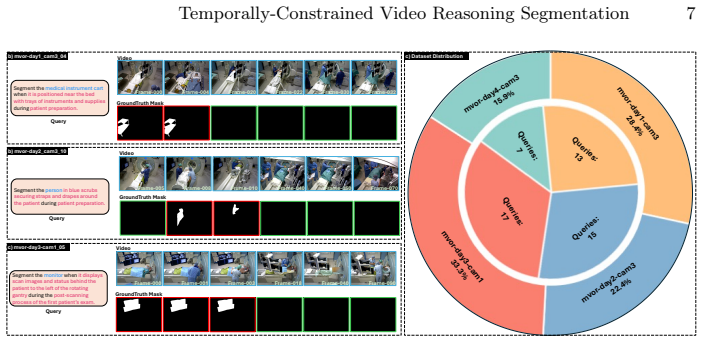
On its own terms, the paper claims that video reasoning segmentation should not be a continuous tracking problem: the query itself carries temporal information, and the model must infer a gate $\tau_Q(t)$ that zeroes out masks when the object is irrelevant. The formal task is $M_{\text{constrained}} = \{M^{(t)} \cdot \tau_Q(t)\}$, where $\tau_Q(t) = 1$ only when the query, video, and current time step jointly indicate the object is active. The paper further claims this gate can be studied on data manufactured without manual mask annotation: a digital-twin representation of each video feeds an LLM ensemble that selects object-phase pairs and writes natural-language queries with implicit temporal constraints, and the ground truth is the pre-existing instance mask of the selected object multiplied by a phase indicator. The delivered artifact is TCVideoRSBenchmark, 52 query-video-mask samples drawn from four MVOR operating-room videos.
Load-bearing premise
The benchmark's ground-truth masks are SAM2 instance masks multiplied by phase indicators, without fully independent human annotation of those masks; if SAM2 mis-segments the object during the relevant phase, the evaluation labels are wrong and scores computed on the benchmark are unreliable.
Editorial extensions
If this is right
- A model that solves this task must output empty masks for frames where the query's target is irrelevant; a method that segments all frames will accumulate false positives outside the active phase.
- The pipeline can, in principle, generate new benchmark samples from any video whose phases can be identified automatically, because no human writes the queries or draws the masks.
- Evaluation on TCVideoRSBenchmark measures temporal relevance understanding, not just spatial mask quality, adding a dimension missing from existing video reasoning segmentation benchmarks.
- Surgical workflow monitoring systems could query objects by procedural phase, such as segmenting anesthesia equipment only during patient preparation, without being given explicit phase boundaries at test time.
Reading between the lines
- Because the ground truth masks are SAM2 instance masks gated by phase boundaries, the benchmark inherits SAM2's failures: if the tracker drifts or misses the object during the active phase, the sample is mislabeled despite the manual query filter.
- The same temporal-gating formulation transfers to other phased domains, such as assembly lines, sports events, or autonomous driving through intersections, so the task definition rather than the surgical data is the reusable contribution.
- A natural immediate experiment is to run existing video reasoning segmentation methods on TCVideoRSBenchmark; the expected drop in temporal precision would quantify how much the continuous-relevance assumption costs.
Editorial analysis
A structured set of objections, weighed in public.
Referee Report
Summary. The paper proposes a new task, temporally-constrained video reasoning segmentation, in which a model must infer, from an implicit reasoning query, both which object to segment and during which temporal intervals (e.g., surgical phases) the object is relevant. Since manual annotation of such a benchmark would be expensive, the authors introduce an automated pipeline that builds a 'digital twin' representation of each video using pre-trained models (TwelveLabs Pegasus for phases, SAM2 for instance masks, DepthAnything2, LLaVA, Qwen2.5-VL), then uses LLM ensemble voting to select salient object-phase pairs and generate template-based temporally-constrained queries. The resulting benchmark, TCVideoRSBenchmark, contains 52 samples derived from four MVOR operating-room videos. The paper presents the task formulation and the benchmark construction pipeline but reports no baseline experiments or quantitative validation of the generated ground truth.
Significance. If validated, the paper would address a real gap: current video reasoning segmentation assumes objects are relevant for the entire video, which is unrealistic for structured workflows such as surgery. The proposed task formulation, with the temporal constraint function tau_Q and the masked ground truth definition, is a sensible formalization. The automated construction idea is also a useful contribution in principle, since manual annotation for such temporally-grounded tasks would be very costly. Credit is due for making the benchmark publicly available and for describing the pipeline in a reproducible way. However, the scientific value of the benchmark depends entirely on the trustworthiness of its ground truth, and the paper currently provides no evidence for that trustworthiness: no baseline models are run, no per-frame mask quality against human annotation is reported, and no statistics on query ambiguity or temporal alignment are given. As submitted, the central claim that TCVideoRSBenchmark is a valid evaluation resource is therefore unsupported.
major comments (3)
- [Section 3, Eq. (5) and the ground-truth definition Mgt = {M_i*(t) * tau_phi*(t)}] The ground-truth masks are SAM2 instance masks multiplied by a phase indicator, and the only safeguard described is that samples 'go through manual verification' and 'incorrect or improper ones' are filtered. The text does not state that annotators checked or corrected per-frame mask accuracy, nor does it quantify SAM2 failures such as missed objects, identity switches, or boundary drift. Because the queries are generated from the same DT representation that provides the masks, a model built on SAM2 and phase-recognition components could trivially match the labels, making evaluation scores on this benchmark uninterpretable. To support the benchmark claim, I ask for per-frame agreement statistics (e.g., IoU or Dice) against human annotations on a held-out subset, together with a description of the manual verification protocol that specifies whether masks were corrected or only whole samples discarded.
- [Section 4 and overall paper (no experiments)] The paper introduces a new task and a benchmark but never runs a single baseline. There is no result showing that existing video reasoning segmentation methods can be adapted to this setting and produce non-trivial scores, nor is there an oracle upper bound or an always-mask lower bound. Without these, the central claim that TCVideoRSBenchmark 'allows evaluation' of temporally-constrained video RS is unsupported. I request a minimal experimental study: at least one adapted existing video RS baseline, an oracle that receives the true temporal intervals, and a lower bound that masks all frames; report standard metrics such as mIoU and temporal IoU.
- [Section 3, Eq. (4) and Eq. (5), free parameters] The pipeline relies on several thresholds and weights (theta_vote, theta_conf, t_s, and w_k) but the paper gives no selected values, no sensitivity analysis, and no statistics on how many object-phase candidates pass the voting and temporal-alignment stages. In particular, Eq. (5) uses the existence of an action description a_i^t from Qwen2.5-VL as evidence of activity, but the reliability of that evidence is not assessed. Without these details, the reader cannot judge whether the benchmark contains hard, ambiguous, or trivially solvable examples, so the benchmark-difficulty claim is not yet substantiated.
minor comments (4)
- [Abstract and Section 1] There are several grammatical and typographical errors, including 'conventional video RS formulation assume' (should be 'formulations assume'), 'we do not know how well method perform' (should be 'methods perform'), and 'when the bed is wheeled into position' in Fig. 1. The paper would benefit from a careful proofread.
- [Fig. 3] In the caption and inside the figure, the subfigure labels are inconsistent: two subfigures are both labeled 'b)', and the third example is labeled 'c)' while the dataset distribution is also labeled 'c)'. Please renumber and ensure the text references match the figure labels.
- [Section 3, Dataset Statistics] The statement that 'MVOR dataset... consisting of 732 synchronized frames' is imprecise: it is unclear whether this is the total number of frames across all videos or per video, and the four selected videos are not further described. Clarify the video-level frame counts and durations, since temporal constraints depend on frame counts.
- [Section 3, Query Generation] The phrase 'manual verification' is vague about who performed it and how many annotators were involved. Even though this is an automated pipeline, the human verification step is a quality gate and should be described with enough detail to be reproducible (e.g., number of annotators, instructions, inter-annotator agreement if applicable).
Circularity Check
The benchmark labels are defined by SAM2 masks and Pegasus phase boundaries, so scores on TCVideoRSBenchmark reduce to those automatic outputs rather than to independent temporal reasoning.
-
self definitional
[Section 3, 'Query Generation with LLM' (ground-truth construction after Eq. 6)]
"The corresponding ground truth RS masks are extracted from the DT representation by applying temporal constraints to the pre-existing instance masks. Specifically, for the selected object i∗ and phase ϕ∗, the temporally-constrained ground truth is constructed as Mgt = {M (t)i∗ · τϕ∗ (t)|t = 1, 2, . . . , T}, where M (t)i∗ represents the instance mask for object i∗ at time t stored in the DT representation."
The DT representation's instance masks are generated by SAM2 (Eq. 3), not by independent human annotation. Therefore the benchmark's ground truth is, by construction, SAM2's own segmentation output. Any evaluated model that internally uses SAM2 can reproduce Mgt trivially, so the benchmark score would measure agreement with SAM2 rather than temporally-constrained reasoning. The paper's manual verification step only filters whole samples and does not state that per-frame mask accuracy was checked or corrected.
-
self definitional
[Section 3, 'Digital Twin Representation for Temporal Reasoning' and 'Query Generation with LLM' (temporal constraint τ)]
"Temporal information extraction begins with the identification of the surgical stage at the video level through TwelveLabs Pegasus 1.2... and τϕ∗ (t) is the temporal constraint function that equals 1 when t ∈ Tϕ∗ and 0 otherwise."
The same Pegasus phase boundaries are used both to generate the implicit temporal constraint in the query (via Tϕ∗ in Eq. 6) and to define the temporal gating τϕ∗ in the ground truth. Thus the 'when is the object relevant' component of the task is, by construction, the output of Pegasus phase classification. A model that predicts Pegasus's phase boundaries will trivially satisfy the temporal requirement, so the benchmark does not independently test temporal reasoning beyond that automatic phase model.
full rationale
The paper's central contribution is an automated benchmark construction pipeline, and the benchmark's ground-truth masks are explicitly extracted from the DT representation, which is built from SAM2 instance masks and Pegasus phase boundaries. Because the same automatic outputs are used both to synthesize the reasoning queries and to define the target masks, evaluation on TCVideoRSBenchmark is partially closed: a model built on the same components can match the labels by construction. The paper states that generated samples 'go through manual verification' and incorrect ones are filtered, but it does not describe per-frame mask correction or independent human annotation of the masks. The self-citations to prior DT work [8,9] are used for background and construction choices, but they are not the main source of circularity; the circularity is in the label-definition loop. For this reason the score is 6 rather than lower: the benchmark construction itself is not an independent measurement of temporally-constrained reasoning, though the task formulation and pipeline are clearly described and may have external value if the SAM2 masks and Pegasus phases were validated against human annotation.
Assumptions & free parameters
free parameters (4)
- Voting threshold θvote
- Confidence threshold θconf
- Temporal sampling interval ts
- LLM ensemble weights wk =
1/K
assumptions (4)
- domain assumption SAM2 provides accurate instance masks across all frames
- domain assumption TwelveLabs Pegasus 1.2 phase detection, after human verification, yields correct temporal boundaries
- domain assumption LLM-generated template queries encode implicit temporal constraints faithfully
- domain assumption Digital twin representation preserves the semantic, spatial, and temporal relationships needed for query generation
Cite this review
Pith. "Pith review of Temporally-Constrained Video Reasoning Segmentation and Automated Benchmark Construction." pith.science (2026). https://pith.science/paper/GJKBHKVS
@misc{pith2026250716718,
  author       = {Pith},
  title        = {Pith review of: Temporally-Constrained Video Reasoning Segmentation and Automated Benchmark Construction},
  year         = {2026},
  howpublished = {\url{https://pith.science/paper/GJKBHKVS}},
  note         = {Machine review of arXiv:2507.16718}
}
read the original abstract
Conventional approaches to video segmentation are confined to predefined object categories and cannot identify out-of-vocabulary objects, let alone objects that are not identified explicitly but only referred to implicitly in complex text queries. This shortcoming limits the utility for video segmentation in complex and variable scenarios, where a closed set of object categories is difficult to define and where users may not know the exact object category that will appear in the video. Such scenarios can arise in operating room video analysis, where different health systems may use different workflows and instrumentation, requiring flexible solutions for video analysis. Reasoning segmentation (RS) now offers promise towards such a solution, enabling natural language text queries as interaction for identifying object to segment. However, existing video RS formulation assume that target objects remain contextually relevant throughout entire video sequences. This assumption is inadequate for real-world scenarios in which objects of interest appear, disappear or change relevance dynamically based on temporal context, such as surgical instruments that become relevant only during specific procedural phases or anatomical structures that gain importance at particular moments during surgery. Our first contribution is the introduction of temporally-constrained video reasoning segmentation, a novel task formulation that requires models to implicitly infer when target objects become contextually relevant based on text queries that incorporate temporal reasoning. Since manual annotation of temporally-constrained video RS datasets would be expensive and limit scalability, our second contribution is an innovative automated benchmark construction method. Finally, we present TCVideoRSBenchmark, a temporally-constrained video RS dataset containing 52 samples using the videos from the MVOR dataset.
Figures


Figures from the paper (1 more)
Reference graph
Works this paper leans on
-
[1]
Shuai Bai et al. Qwen2. 5-vl technical report.arXiv preprint arXiv:2502.13923 , 2025
arXiv 2025
-
[2]
Kubilay Can Demir, Belen Lojo Rodriguez, Tobias Weise, Andreas Maier, and Seung Hee Yang. Towards intelligent speech assistants in operating rooms: A multimodal model for surgical workflow analysis.arXiv preprint arXiv:2406.14576, 2024
arXiv 2024
-
[3]
Maria Grammatikopoulou, Ricardo Sanchez-Matilla, Felix Bragman, David Owen, Lucy Culshaw, Karen Kerr, Danail Stoyanov, and Imanol Luengo. A spatio- temporal network for video semantic segmentation in surgical videos.International Journal of Computer Assisted Radiology and Surgery , 19(2):375–382, 2024
work page 2024
-
[4]
Temporal memory relation network for workflow recognition from surgical video
Yueming Jin, Yonghao Long, Cheng Chen, Zixu Zhao, Qi Dou, and Pheng-Ann Heng. Temporal memory relation network for workflow recognition from surgical video. IEEE Transactions on Medical Imaging , 40(7):1911–1923, 2021
work page 1911
-
[5]
Lisa: Reasoning segmentation via large language model
Xin Lai, Zhuotao Tian, Yukang Chen, et al. Lisa: Reasoning segmentation via large language model. InProceedings of the IEEE/CVF Conference on Computer Vision and Pattern Recognition , pages 9579–9589, 2024
work page 2024
-
[6]
Improved baselines with visual instruction tuning
Haotian Liu, Chunyuan Li, Yuheng Li, and Yong Jae Lee. Improved baselines with visual instruction tuning. In Proceedings of the IEEE/CVF Conference on Computer Vision and Pattern Recognition , pages 26296–26306, 2024
2024
-
[7]
Sam 2: Segment anything in images and videos
Nikhila Ravi, Valentin Gabeur, Yuan-Ting Hu, et al. Sam 2: Segment anything in images and videos. arXiv preprint arXiv:2408.00714 , 2024
arXiv 2024
-
[8]
Position: Foundation models need digital twin representations
Yiqing Shen, Hao Ding, Lalithkumar Seenivasan, Tianmin Shu, and Mathias Un- berath. Position: Foundation models need digital twin representations. arXiv preprint arXiv:2505.03798, 2025
arXiv 2025
Show all 14 references
-
[9]
Rvtbench: A benchmark for visual reasoning tasks.arXiv preprint arXiv:2505.11838 , 2025
Yiqing Shen, Chenjia Li, Chenxiao Fan, and Mathias Unberath. Rvtbench: A benchmark for visual reasoning tasks.arXiv preprint arXiv:2505.11838 , 2025
2025 arXiv
-
[10]
Operating room workflow analysis via reasoning segmentation over digital twins
Yiqing Shen, Chenjia Li, Bohan Liu, Cheng-Yi Li, Tito Porras, and Mathias Un- berath. Operating room workflow analysis via reasoning segmentation over digital twins. arXiv preprint arXiv:2503.21054 , 2025
2025 arXiv
-
[11]
Reasoning segmentation for images and videos: A survey
Yiqing Shen, Chenjia Li, Fei Xiong, Jeong-O Jeong, Tianpeng Wang, Michael Lat- man, and Mathias Unberath. Reasoning segmentation for images and videos: A survey. arXiv preprint arXiv:2505.18816 , 2025
2025 arXiv
-
[12]
Mvor: A multi-view rgb-d op- erating room dataset for 2d and 3d human pose estimation
Vinkle Srivastav, Thibaut Issenhuth, Abdolrahim Kadkhodamohammadi, Michel de Mathelin, Afshin Gangi, and Nicolas Padoy. Mvor: A multi-view rgb-d op- erating room dataset for 2d and 3d human pose estimation. arXiv preprint arXiv:1808.08180, 2018
2018 arXiv
-
[13]
Jialang Xu, Nazir Sirajudeen, Matthew Boal, Nader Francis, Danail Stoyanov, and Evangelos B Mazomenos. Sedmamba: Enhancing selective state space modelling with bottleneck mechanism and fine-to-coarse temporal fusion for efficient error detection in robot-assisted surgery.IEEE ...
2024
-
[14]
Depth anything v2.arXiv preprint arXiv:2406.09414, 2024
Lihe Yang, Bingyi Kang, Zilong Huang, et al. Depth anything v2.arXiv preprint arXiv:2406.09414, 2024
2024 arXiv
Reviewed August 6, 2026 · model on record in the stance chip above.
Discussion (0). Sign in to comment.