REVIEW 4 major objections 6 minor 1 cited by
Building a robust OAuth token based API Security: A High level Overview
T0 review · 4 major / 6 minor · reviewed 2026-08-06 · deepseek-v4-flash
Pith's one-line read Ten principles built on OAuth 2.0 and JWT can form a practical baseline for API token security.
desk verdict A competent practitioner overview of OAuth token security, with zero new research content and a 'ten principles' claim that the paper never actually enumerates. read the letter →
The pith
A machine-rendered reading of the paper's core claim, the machinery that carries it, and where it could break.
The reading
What carries the argument
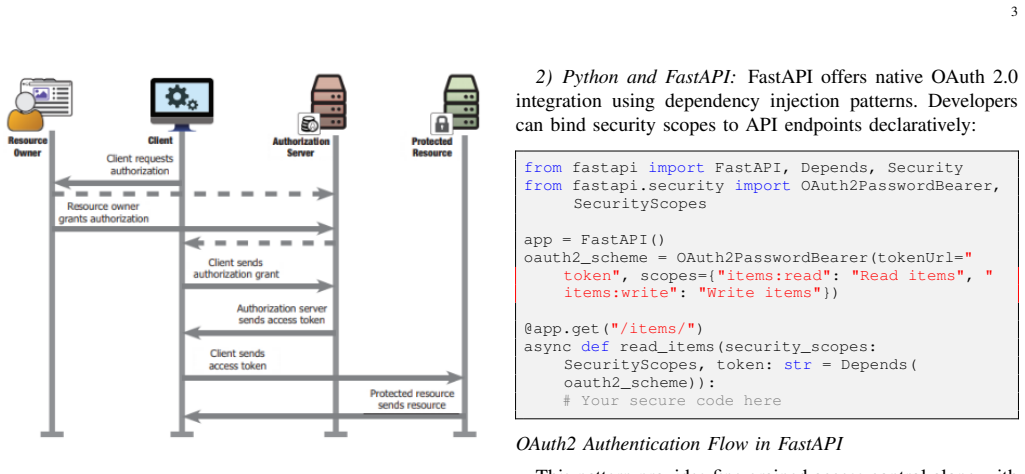
Two objects carry the argument: the OAuth 2.0 delegation protocol (with its authorization-code flow, scoped access tokens, refresh tokens, and revocation end points) and the JSON Web Token structure (header, payload, signature) used as the by-value token format. Around these, the paper places a token lifecycle state machine, issuance, validation, refresh, rotation, and revocation, plus by-value/by-reference persistence choices. The work these do is to turn 'secure your APIs' into a finite set of design decisions, each with a stated trade-off, so that a developer can assemble a baseline system rather than start from first principles.
What would settle it
Build a testbed that implements the ten principles exactly, then run a standardized OAuth attack battery, including replay of an expired token, replay after revocation, algorithm-substitution, and refresh-token rotation, and check whether any resource server accepts a token that should be invalid. If any such token is accepted in a conformant configuration, the 'robust baseline' claim fails.
Extended reading notes
Core claim
On its own terms, the paper's central claim is that the ten principles it outlines, from secure token architecture through lifecycle management, minimal scopes, multi-level revocation, automated key rotation, auditing, and adaptive rate limiting, constitute a practical and scalable foundation for modern API ecosystems. The claim is grounded in the OAuth 2.0 authorization framework rather than in new cryptography or new protocols; the novelty is the assembly of existing standards, incident lessons, and research results into a single design blueprint. By-value tokens in the JWT format, by-reference opaque tokens, and hybrid patterns such as phantom tokens are presented as interchangeable components with explicit trade-offs, so the 'foundation' claim rests on selecting the right component per context, not on one universal token format.
Load-bearing premise
The paper assumes its cited sources are real, correctly attributed, and accurately summarized, and that following the ten principles as described actually yields a robust security baseline.
Editorial extensions
If this is right
- An implementation following the ten principles should withstand common OAuth 2.0 attacks such as token replay after revocation, algorithm-substitution, and over-privileged scope misuse.
- Short-lived access tokens with refresh-token rotation and PKCE reduce the exposure window from credential theft and make mass revocation more manageable.
- Hybrid by-value/by-reference token patterns such as phantom tokens let teams retain stateless performance while gaining server-side revocation control.
- Continuous auditing combined with sequence-based anomaly detection should shift platforms from reactive incident response to proactive token-misuse detection.
- Elastic, multi-tier rate limiting can distinguish legitimate high-volume clients from application-layer DDoS traffic, preserving availability for trusted clients.
Reading between the lines
- Editorial inference: the ten principles could be operationalized as a maturity checklist; a team could score its API platform against each principle and use the score to prioritize security investment.
- Editorial inference: the paper's reliance on a single incident of mass token revocation suggests a testable scaling law for revocation infrastructure, namely that propagation latency should grow sublinearly with token count; that is a measurable performance claim the cited sources do not quantify.
- Editorial inference: combining the zero-knowledge token strand with the revocation and rate-limiting sections points to an open design question, how to verify claims without revealing token contents while still allowing fast revocation; a prototype comparing overhead against plain JWT would be a natural next step.
Editorial analysis
A structured set of objections, weighed in public.
Referee Report
Summary. This manuscript is a high-level, practitioner-oriented overview of token-based API security centered on OAuth 2.0 and JWT. It covers token architecture, JWT claim design and cryptographic considerations, token and application lifecycle management, by-value versus by-reference persistence, scopes and fine-grained authorization, revocation, key management, auditing and anomaly detection, and rate limiting. The paper concludes by asserting that 'the ten principles outlined in this work' provide a practical and scalable foundation for securing modern API ecosystems, while acknowledging the assistance of ChatGPT in manuscript preparation.
Significance. If the recommendations were properly supported, the paper could serve as a useful practitioner-level digest of OAuth 2.0, JWT design, token lifecycle management, scopes, revocation, and rate limiting. Its strengths include a clear high-level organization, illustrative code snippets for Spring Security, FastAPI, and Express, and a transparent disclosure of AI assistance. However, the paper makes no new technical or empirical contribution, and its central claim—that it defines ten principles offering a practical, scalable foundation—is not substantiated: the principles are never enumerated, and no evaluation or comparison supports 'practical and scalable.' The unverifiable citations further reduce confidence in the synthesis. The useful portions are mostly restatements of established OWASP and RFC guidance.
major comments (4)
- [§XIII] The concluding sentence asserts that 'the ten principles outlined in this work ... offer a practical and scalable foundation,' but no set of exactly ten principles is ever enumerated or summarized in the manuscript. Sections IV–XII discuss nine thematic topics, several of which contain multiple distinct recommendations, so the reader cannot identify the referent of 'ten principles.' This is not a stylistic issue: the conclusion's central claim is unverifiable and should be fixed by adding an explicit list of ten principles or by rewriting the conclusion to describe the actual contributions.
- [References [4], [6], [30] and their in-text uses (§II, §XI, §XII)] Several citations appear to be unverifiable or misattributed. Reference [4] ('Miksa and Others, Journal of Cloud Computing 12(1), 2023') and reference [6] ('H. Liu and Others, Journal of API Security, 2021') do not correspond to identifiable publications, and reference [30] is a course note with an inconsistent date that is not an authoritative source for the CAP theorem. The related-work summary in §II and the technical discussions in §XI–§XII rely on these sources, so the evidentiary basis needs to be corrected or replaced with verifiable references.
- [§XII] The statement that 'Brewer's CAP theorem [30] highlights the need to prioritize consistency over availability in security-sensitive operations' misrepresents the theorem. CAP states an impossibility trade-off among consistency, availability, and partition tolerance during network partitions; it does not prescribe a preference. If the paper wants to argue for strong consistency in revocation, it should justify that choice from the security requirements, not invoke CAP as if it were a design directive.
- [§XIII] The paper asserts that the proposed guidance is 'practical and scalable' without any evaluation, comparison, or even a structured argument for completeness. For instance, there is no discussion of when JWS versus JWE, by-value versus by-reference, or local versus distributed revocation should be chosen under given operational constraints, and no comparison with OWASP or other established frameworks is provided. Since the central claim is about practical value, the manuscript should either add such reasoning or explicitly frame itself as a checklist rather than a validated framework.
minor comments (6)
- [Abstract, §V.A, §X, §XI] There are several typos that should be corrected, including 'a such' in the abstract, 'Whike' in §V.A, 'by itslef' in §X, and 'lifecyle' in §XI.
- [§II.A] The OWASP API Security Top Ten is mentioned but not cited; please add an explicit reference to the relevant OWASP document.
- [§XIII] OpenID Connect is mentioned in the conclusion but is not discussed anywhere in the body; either add a brief treatment or remove the mention.
- [§IV.A.1] The Spring Security code snippet uses '@AuthorizeReturnObject', which is not a standard annotation in the shown context; if the snippet is intended to be illustrative, state that explicitly or correct the annotation.
- [Figures 1–5] Figure 1 states 'Adapted from [8]', while Figures 2–5 provide no source or credit; please clarify which figures are original and provide proper attribution for any reproduced material.
- [§V.G] The phrase 'propose limitation principles' is likely intended to be 'purpose limitation principles'; please correct this and check for similar wording issues elsewhere.
Circularity Check
No circularity found: this survey-style overview contains no derivation chain, no fitted parameters, and no self-citations for a self-referential argument to attach to.
full rationale
This paper is a high-level narrative synthesis of established OAuth 2.0 best practices and external literature; it contains no equations, no quantitative predictions, no fitted parameters, and no empirical evaluation. Claims such as 'By adhering to these principles, developers can establish a robust baseline' are recommendations supported by external citations rather than results derived from the paper's own inputs, so no claim reduces by construction to its own input. None of the 31 references is authored by this paper's author, so no self-citation chain is load-bearing. The conclusion's reference to 'the ten principles outlined in this work' is unsupported insofar as no ten principles are explicitly enumerated, but an unsupported or unverifiable assertion is a correctness and support gap, not circularity under the definitions applied here. The AI-assistance acknowledgment ([31]) is a standard disclosure with no bearing on circularity, and the reader's concern about possibly misattributed references ([4], [6], [30]) would affect factual reliability, not circular reasoning. Verdict: no significant circularity; score 0.
Assumptions & free parameters
assumptions (3)
- domain assumption OAuth 2.0 and JWT standards as described are correct and appropriate for the token architecture.
- domain assumption The cited best practices and references accurately reflect the state of the art.
- domain assumption CAP theorem is correctly stated and applied, prioritizing consistency over availability for security operations.
Cite this review
Pith. "Pith review of Building a robust OAuth token based API Security: A High level Overview." pith.science (2026). https://pith.science/paper/GX3774GU
@misc{pith2026250716870,
  author       = {Pith},
  title        = {Pith review of: Building a robust OAuth token based API Security: A High level Overview},
  year         = {2026},
  howpublished = {\url{https://pith.science/paper/GX3774GU}},
  note         = {Machine review of arXiv:2507.16870}
}
read the original abstract
APIs (Application Programming Interfaces) or Web Services are the foundational building blocks that enable interconnected systems. However this proliferation of APIs has also introduced security challenges that require systematic and scalable solutions for secure authentication and authorization. This paper presents the fundamentals necessary for building a such a token-based API security system. It discusses the components necessary, the integration of OAuth 2.0, extensibility of the token architectures, necessary cryptographic foundations, and persistence strategies to ensure secure and resilient operations. In addition to architectural concerns, the paper explores best practices for token lifecycle management, scope definition, expiration policies, and revocation mechanisms, all framed within a real-world scenario. By adhering to these principles, developers can establish a robust baseline while maintaining the flexibility to customize their domain-specific requirements. The approach does not claim to cover all variations necessary for diverse architectures but instead focuses on key principles essential for any standard API token authentication system. Throughout, the paper emphasizes balancing practical considerations with security imperatives and uses key concepts such as the CIA triad, OAuth standards, secure token life cycle, and practices for protecting sensitive user and application data. The intent is to equip developers with the foundational knowledge necessary to build secure, scalable token-based API security systems ready to handle the evolving threat landscape.
Figures


Figures from the paper (2 more)


Forward citations
Cited by 1 Pith paper
-
Toward cryptographically verifiable authorization for autonomous AI agents: A security hypothesis, preliminary formal model, and proof-of-concept implementation
Agent authorization can be formalized as a zero-knowledge-verifiable relation binding principal, request, context, and policy, with a Groth16 proof-of-concept.
Reference graph
Works this paper leans on
-
[4]
Enhancing microservices security with token- based access control,
T. Miksa and Others, “Enhancing microservices security with token- based access control,” Journal of Cloud Computing , vol. 12, no. 1, pp. 1–15, 2023
work page 2023
-
[6]
Enhancing api security through machine learning- based anomaly detection,
H. Liu and Others, “Enhancing api security through machine learning- based anomaly detection,” Journal of API Security , 2021
work page 2021
-
[30]
S. Simon, “Brewer’s cap theorem,” CS341 Distributed Information Systems, University of Basel (HS2012) , 2000
work page 2000
-
[1]
Panerabread.com leaks millions of customer records,
B. Krebs, “Panerabread.com leaks millions of customer records,” April 2018. [Online]. Available: https://krebsonsecurity.com/2018/04/ panerabread-com-leaks-millions-of-customer-records/
work page 2018
-
[2]
Meta, “Security Update,” September 2018. [Online]. Available: https://about.fb.com/news/2018/09/security-update/
work page 2018
-
[3]
Authentication and authorization orchestrator for microservice-based software archi- tectures,
A. B ´an´ati, E. Kail, K. Kar ´oczkai, and M. Kozlovszky, “Authentication and authorization orchestrator for microservice-based software archi- tectures,” in 2018 41st International Convention on Information and Communication Technology, Electronics and Microelectronics (MIPRO). IEEE, 2018, pp. 1180–1184
work page 2018
-
[5]
S. Rose, O. Borchert, S. Mitchell, and S. Connelly, “Zero trust architecture,” National Institute of Standards and Technology, Special Publication 800-207, August 2020. [Online]. Available: https: //nvlpubs.nist.gov/nistpubs/SpecialPublications/NIST.SP.800-207.pdf
work page 2020
-
[7]
Understanding the phantom token approach,
K. Sandoval, “Understanding the phantom token approach,” July 2024, accessed: 2025-04-04. [Online]. Available: https://nordicapis. com/understanding-the-phantom-token-approach/
work page 2024
Show all 31 references
-
[8]
Hardt, J
D. Hardt, J. Dennis, and A. P. Williams, OAuth 2 in Action . Manning Publications, 2017, accessed: 2025-04-04. [Online]. Available: https://www.manning.com/books/oauth-2-in-action
2017
-
[9]
Oauth 2.1 authorization framework (draft),
D. Hardt, J. Bradley, T. Lodderstedt, and N. Sakimura, “Oauth 2.1 authorization framework (draft),” https://datatracker.ietf.org/doc/html/ draft-ietf-oauth-v2-1-08, 2023
2023
-
[10]
Device fingerprinting for augmenting web authentication: Classification and analysis of methods,
F. Alaca and P. C. Van Oorschot, “Device fingerprinting for augmenting web authentication: Classification and analysis of methods,”Proceedings of the IEEE , vol. 104, no. 8, pp. 1649–1663, 2016
2016
-
[11]
Zero-knowledge proofs and oauth 2.0 for anonymity and security in distributed systems,
A. Nait Cherif, Y . Achir, M. Youssfi, M. Elgarej, and O. Bouattane, “Zero-knowledge proofs and oauth 2.0 for anonymity and security in distributed systems,” in Proceedings of the 5th International Conference on Electronics, Energy, and Measurement (ICEGC), E3S Web of Conferen...
2023
-
[12]
User identity and access management trends in it infrastructure-an overview,
M. A. Thakur and R. Gaikwad, “User identity and access management trends in it infrastructure-an overview,” in2015 International Conference on Pervasive Computing (ICPC) . IEEE, 2015, pp. 1–4
2015
-
[13]
Security evaluation of the oauth 2.0 framework,
E. Ferry, J. O Raw, and K. Curran, “Security evaluation of the oauth 2.0 framework,” Information & Computer Security , vol. 23, no. 1, pp. 73–101, 2015
2015
-
[14]
Advanced api security,
P. Siriwardena, “Advanced api security,” Apress: New York, NY, USA , 2014
2014
-
[15]
A json token-based authentication and access management schema for cloud saas applications,
O. Ethelbert, F. F. Moghaddam, P. Wieder, and R. Yahyapour, “A json token-based authentication and access management schema for cloud saas applications,” in 2017 IEEE 5th International Conference on Future Internet of Things and Cloud (FiCloud) . IEEE, 2017, pp. 47–53
2017
-
[16]
Analysis of web caching architectures: Hierarchical and distributed caching,
P. Rodriguez, C. Spanner, and E. W. Biersack, “Analysis of web caching architectures: Hierarchical and distributed caching,” IEEE/ACM Transactions On Networking , vol. 9, no. 4, pp. 404–418, 2001
2001
-
[17]
Role-based access control (rbac): Features and motivations,
D. Ferraiolo, J. Cugini, D. R. Kuhn et al. , “Role-based access control (rbac): Features and motivations,” in Proceedings of 11th annual com- puter security application conference , 1995, pp. 241–48
1995
-
[18]
Rbac models—concepts and trends,
E. Bertino, “Rbac models—concepts and trends,” Computers & Security, vol. 22, no. 6, pp. 511–514, 2003
2003
-
[19]
Access control: principle and practice,
R. S. Sandhu and P. Samarati, “Access control: principle and practice,” IEEE communications magazine , vol. 32, no. 9, pp. 40–48, 1994
1994
-
[20]
Systematically breaking and fixing openid security: Formal analysis, semi-automated empirical eval- uation, and practical countermeasures,
S.-T. Sun, K. Hawkey, and K. Beznosov, “Systematically breaking and fixing openid security: Formal analysis, semi-automated empirical eval- uation, and practical countermeasures,” Computers & Security , vol. 31, no. 4, pp. 465–483, 2012
2012
-
[21]
A key manage- ment framework for ami networks in smart grid,
S. Das, Y . Ohba, M. Kanda, D. Famolari, and S. K. Das, “A key manage- ment framework for ami networks in smart grid,” IEEE Communications Magazine, vol. 50, no. 8, pp. 30–37, 2012
2012
-
[22]
Disco: Efficient distributed window aggregation
L. Benson, P. M. Grulich, S. Zeuch, V . Markl, and T. Rabl, “Disco: Efficient distributed window aggregation.” in EDBT, vol. 20, 2020, pp. 423–426
2020
-
[23]
Deep learning-based anomaly detection in cyber-physical systems: Progress and opportuni- ties,
Y . Luo, Y . Xiao, L. Cheng, G. Peng, and D. Yao, “Deep learning-based anomaly detection in cyber-physical systems: Progress and opportuni- ties,” ACM Computing Surveys (CSUR) , vol. 54, no. 5, pp. 1–36, 2021
2021
-
[24]
User behaviour analysis using data analytics and machine learning to predict malicious user versus legitimate user,
R. Ranjan and S. S. Kumar, “User behaviour analysis using data analytics and machine learning to predict malicious user versus legitimate user,” High-Confidence Computing, vol. 1, p. 100034, 2022. [Online]. Available: https://doi.org/10.1016/j.hcc.2021.100034
2022
-
[25]
Model-based security testing: An empirical study on oauth 2.0 implementations,
R. Yang, G. Lee, W. C. Lau, K. Zhang, and P. Hu, “Model-based security testing: An empirical study on oauth 2.0 implementations,” in Proceedings of the 11th ACM on Asia Conference on Computer and Communications Security . ACM, 2016, pp. 651–662. [Online]. Available: https://dl...
2016
-
[26]
Cerberus: Query-driven scalable vulnerability detection in oauth service provider implementations,
T. A. Rahat, Y . Feng, and Y . Tian, “Cerberus: Query-driven scalable vulnerability detection in oauth service provider implementations,” in Proceedings of the 2022 ACM SIGSAC Conference on Computer and Communications Security . ACM, 2022, pp. 3127–3141. [Online]. Available: h...
2022
-
[27]
Anomaly detection and automated mitigation for mi- croservices security with ai,
V . Ramamoorthi, “Anomaly detection and automated mitigation for mi- croservices security with ai,” Applied Research in Artificial Intelligence and Cloud Computing , vol. 7, no. 6, pp. 211–222, 2024
2024
-
[28]
Api rate limit adoption–a pattern collection,
S. Serbout, A. El Malki, C. Pautasso, and U. Zdun, “Api rate limit adoption–a pattern collection,” in Proceedings of the 28th European Conference on Pattern Languages of Programs , 2023, pp. 1–20
2023
-
[29]
Ar- tificial intelligence based predictive analytics for website performance optimization,
S. Mathur, Y . Hasan, D. Bhargava, S. Bhattacharjee, and A. Rana, “Ar- tificial intelligence based predictive analytics for website performance optimization,” in 2024 7th International Conference on Contemporary Computing and Informatics (IC3I) , vol. 7. IEEE, 2024, pp. 795–800
2024
-
[31]
ChatGPT (mar 2024 version),
OpenAI, “ChatGPT (mar 2024 version),” 2024, https://openai.com/ chatgpt
2024
Reviewed August 6, 2026 · model on record in the stance chip above.
Discussion (0). Continue with ORCID to comment.