REVIEW 3 major objections 4 minor 1 cited by
Avoiding spectral pollution for transfer operators using residuals
T0 review · 3 major / 4 minor · reviewed 2026-08-06 · deepseek-v4-flash
Pith's one-line read This paper establishes a residual-based necessary condition that lets data-driven spectral computations reject spurious eigenvalues of transfer operators.
desk verdict Useful residual diagnostics for transfer operators, but the theorem's strict-positivity claim is false—a spurious point far outside the spectrum can pass any threshold. read the letter →
The pith
A machine-rendered reading of the paper's core claim, the machinery that carries it, and where it could break.
The reading
What carries the argument
The workhorse is the kernelized residual $k_{\mathrm{res}}(\lambda; r, M)$, built from the kernel matrices $\mathbf{G}$, $\mathbf{A}$, $\mathbf{J}$ of kernel EDMD after a truncated singular value decomposition of the snapshot matrix. The truncation is essential: it lets the dictionary size $N$ tend to infinity before the number of data points $M$, which is the order of limits needed to recover the true residual instead of the residual of the projected operator. In practice $k_{\mathrm{res}}(\lambda)^2$ is the smallest eigenvalue of the $r\times r$ matrix $\mathbf{U} = \mathbf{J} - \lambda\mathbf{A} - \bar{\lambda}\mathbf{A}^* + |\lambda|^2\mathbf{G}$, so the whole procedure reduces to a generalized eigenvalue problem on the compressed space.
What would settle it
Run Algorithm 3.2 on an expanding Blaschke map such as $S(z)=((z-\mu)/(1-\bar{\mu}z))^2$ with $|\mu|<1/3$, where the true spectrum is known exactly, and search for any EDMD eigenvalue outside that known spectrum whose computed residual falls below the chosen tolerance; a single such false positive would show that the residual filter does not by itself eliminate spectral pollution, a possibility the theorem leaves open because it gives no lower bound.
Extended reading notes
Core claim
The central claim is Theorem 3.2: for a Mercer kernel with largest eigenvalue $\mu_1$, the computed residual satisfies $\lim_{r\to\infty}\lim_{M\to\infty} k_{\mathrm{res}}(\lambda; r, M) \le \mu_1 \min_{\|h\|_{L^2}=1}\|(L-\lambda I)h\|_{L^2}$, and the left-hand side is strictly positive whenever the right-hand side is positive, although no uniform lower bound holds. This makes the residual a necessary condition for membership in the approximate point spectrum of the transfer operator $L$, so spurious eigenvalues produced by finite-dimensional approximations can be rejected. The same residual construction adapts the ResDMD framework of the Koopman operator to its adjoint, works when the number of snapshots is smaller than the dictionary size, and extends to reproducing kernel Hilbert spaces such as the Hardy–Hilbert space.
Load-bearing premise
The method rests on the data points forming a convergent quadrature scheme and on the kernel's reproducing kernel Hilbert space being dense in $L^2$; even under those assumptions the residual supplies only an upper bound, so thresholding can still admit false eigenvalues.
Editorial extensions
If this is right
- Existing EDMD or kernel EDMD computations can be filtered by computing one auxiliary matrix and discarding eigenvalues whose residual exceeds a chosen tolerance.
- The residual remains meaningful when there are fewer snapshots than dictionary functions, a regime where the standard Koopman residual vanishes identically.
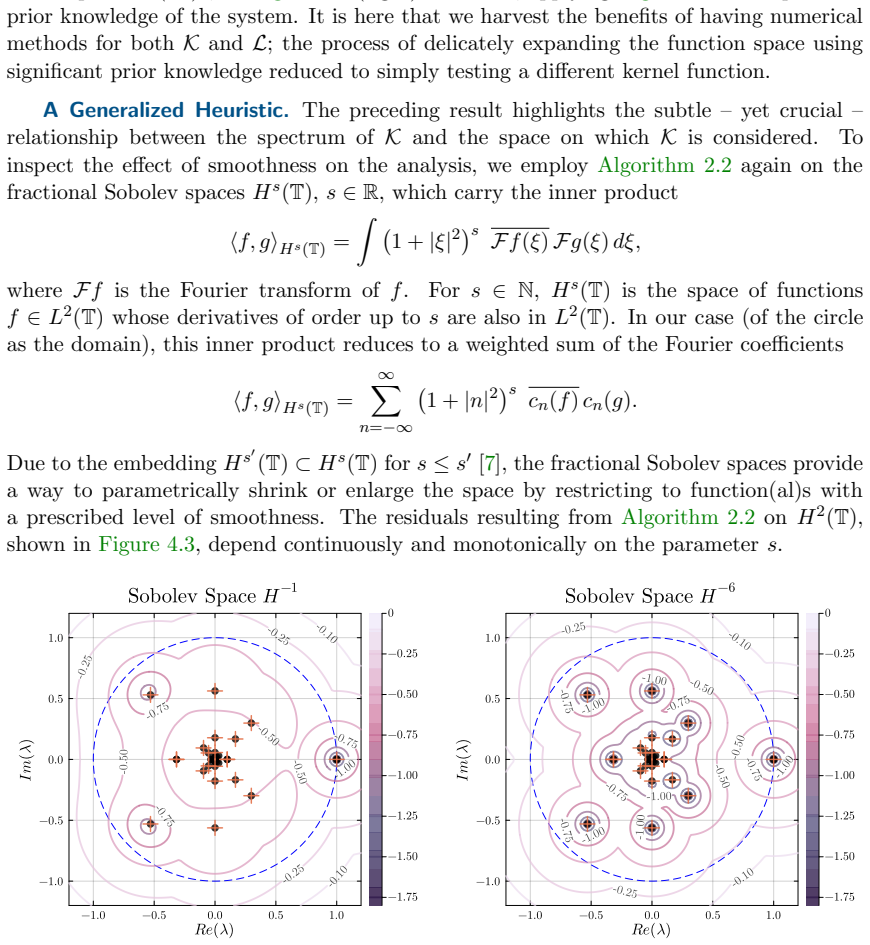
- The same machinery applies in spaces other than $L^2$, including Hardy–Hilbert and fractional Sobolev spaces, by substituting the appropriate kernel or inner product.
- In molecular dynamics, residual filtering can flag unreliable eigenvalues before constructing metastable-state or Markov-state models from transfer-operator data.
Reading between the lines
- Because Theorem 3.2 provides no uniform lower bound, a residual below threshold cannot be used as a certificate of a true eigenvalue; the method's role is rejection, not verification.
- By changing the kernel and observing how residuals move, one could turn the 'eigenfunction outside $L^2$' phenomenon into a systematic diagnostic for which function space the data actually supports.
- The same truncation-and-residual construction should extend to generators of continuous-time dynamics, where spectral pollution is equally common but residual formulas would need time-derivative data.
Editorial analysis
A structured set of objections, weighed in public.
Referee Report
Summary. The paper proposes residual-based methods for validating spectral computations of transfer (Frobenius–Perron) operators, in analogy with existing ResDMD methods for Koopman operators. The main algorithmic contribution is Algorithm 3.2, which evaluates a residual function kres(λ; r, M) for candidate eigenvalues produced by kernelized EDMD. Theorem 3.2 claims an upper bound relating this residual to the true minimal residual of L − λI, and asserts strict positivity of the double limit outside the spectrum. The authors test the method on families of Blaschke maps with known spectra and on an alanine dipeptide molecular-dynamics dataset, and they discuss the subtle role of the function space in defining the Koopman spectrum.
Significance. If the main theorem were correct, the paper would be a useful step toward certified spectral computations for transfer operators: it would provide a computable, operator-theoretically motivated residual, with code and benchmarks against analytically known spectra. The case studies, particularly the Blaschke-map examples and the rigged-Hilbert-space discussion, are informative and illustrate genuine spectral-invisibility phenomena. However, the central guarantee claimed in Theorem 3.2 is false, and the counterexample below shows that the proposed residual can vanish at points far outside the spectrum. The abstract and title claim that the algorithms compute spectra 'without spectral pollution'; the theorem as stated does not support this, and the strict-positivity statement actually contradicts the counterexample. The paper has useful heuristic content, but its advertised claim of avoiding spectral pollution is not established.
major comments (3)
- [Section 3.4, Theorem 3.2] The assertion that the left-hand side of (3.12) is strictly positive whenever min_{‖h‖=1}‖(L−λI)h‖>0 is false. Let S(x)=2x mod 1 on the unit circle, and let L be the transfer operator on L2(T); then σ(L) is the closed unit disk. Take λ=2, so min_{‖h‖=1}‖(L−2I)h‖ ≥ 1. Choose a Mercer kernel with Mercer features ψ_n=μ_n e_n, where e_n(z)=z^n is the Fourier basis and μ_n→0 (e.g. μ_n=ρ^{|n|}). For fixed r, the empirical PCA span converges as M→∞ to span{e_n : |n|≤N(r)} with N(r)→∞. For each r choose h_r=e_{2^{K(r)}} with 2^{K(r)}≤N(r) and K(r)→∞. Then (L−2I)h_r=e_{2^{K(r)-1}}−2e_{2^{K(r)}}, so Σ_j |⟨ψ_j,(L−2I)h_r⟩|^2 = μ_{2^{K(r)-1}}^2 + 4μ_{2^{K(r)}}^2 → 0. Hence lim_{r→∞} lim_{M→∞} kres(2;r,M)=0, while the right-hand side of (3.12) is at least μ_1>0. The proof only shows positivity for each fixed r and does not control the infimum over r; this counterexample shows the gap is fatal. Consequently, a spurious point far outside the spectrum can pass any fixed residual threshold, so the claimed pollution control is not delivered.
- [Appendix A, Lemma 3.1] The proof of (3.10) assumes that the quadrature estimate (A.2) holds uniformly over h ∈ span eΨ, but eΨ itself depends on M through the truncated PCA in (3.6). No argument is given that the empirical PCA subspaces converge to the r-dimensional Mercer eigenspace in a way that allows the quadrature error to be uniform along this M-dependent family. Since eΨ appears on both sides of (3.10), this is a genuine gap; a precise assumption on the data-generating quadrature and on the spectral gap of the kernel integral operator is needed before the limit can be taken.
- [Abstract and Section 1] The claim that the algorithms compute spectra 'without spectral pollution' is stronger than anything the theorem can support. The paper's own Interpretation paragraph correctly states that the result gives only a necessary condition and no uniform lower bound. The counterexample in the first major comment shows that even the strict-positivity part of Theorem 3.2 is false, so thresholding kres cannot certify that an accepted point is close to σ(L). The title, abstract, and introduction should be revised to present the residual as a heuristic diagnostic with a necessary-condition interpretation, rather than as a method that provably avoids spectral pollution.
minor comments (4)
- [Algorithm 3.2, line 6] The matrix name pU is inconsistent with the derived matrix eU in (3.13); renaming it to eU would avoid confusion with the pG, pA, pJ notation.
- [Equation (3.9)] The norm in the definition of kres(λ) is taken in C^M (or ℓ2^M), not in an infinite-dimensional ℓ2 space; this should be stated explicitly for clarity.
- [Figure 1.1 caption] The caption says 'see subsection 4.2' although the figure appears in Section 1; the cross-reference should point to Section 4.2.
- [Section 4.2, Figure 4.5 caption] The caption says 'See subsection 4.2 for analysis' but the figure is already inside subsection 4.2; this self-reference should be corrected or removed.
Circularity Check
No significant circularity: the residual functional is derived from first principles and its convergence is proven independently of fitted parameters.
full rationale
The paper's central contribution is the residual kres defined in (3.9) directly from the data matrices pG, pA, pJ and the truncated SVD. Lemma 3.1 (Appendix A) proves that its M -> infinity limit is the minimum over the PCA span of sum_j |<psi_j,(L - lambda I)h>|^2. That target is not the spectrum and is not defined in terms of the conclusions of Theorem 3.2; the theorem's upper bound follows by Parseval and the decay of mu_j, with no fitted parameter entering the argument. The strict positivity/absence-of-uniform-lower-bound part is an explicit mathematical claim, and the paper honestly states in Section 3.4 that no sufficient L2 condition can be obtained, so thresholding is only a necessary test. Self-citations (e.g., [19] for the ad hoc residual ykres, [5] for the analytic Blaschke spectrum, [24] for ResDMD) are used as motivation, benchmarks, or background; none is the premise of the convergence proof. No equation in the derivation is equivalent to its input by construction, and no fitted quantity is renamed as a prediction. The reviewer's concern about Theorem 3.2's strict-positivity statement is a correctness issue, not a circularity issue.
Assumptions & free parameters
free parameters (3)
- kernel width c =
c^2=0.01 for Blaschke maps, c=0.09 for alanine dipeptide
- compression rank r =
chosen per experiment, not reported precisely
- tolerance epsilon =
threshold in figures (e.g., 10^-p levels)
assumptions (5)
- domain assumption Known spectral structure of transfer operators for expanding circle maps (Bandtlow, Just, Slipantschuk, 2017)
- standard math Mercer's theorem: a continuous symmetric positive definite kernel admits an expansion in an orthonormal basis
- domain assumption The RKHS generated by the chosen kernel is dense in L2
- domain assumption Snapshots are generated by a convergent quadrature scheme
- domain assumption Gelfand triple H2(Ar) ⊂ L2(T) ⊂ H2(Ar)* with the isometric isomorphism to Xr
Cite this review
Pith. "Pith review of Avoiding spectral pollution for transfer operators using residuals." pith.science (2026). https://pith.science/paper/J7PPCBV3
@misc{pith2026250716915,
  author       = {Pith},
  title        = {Pith review of: Avoiding spectral pollution for transfer operators using residuals},
  year         = {2026},
  howpublished = {\url{https://pith.science/paper/J7PPCBV3}},
  note         = {Machine review of arXiv:2507.16915}
}
read the original abstract
Koopman operator theory enables linear analysis of nonlinear dynamical systems by lifting their evolution to infinite-dimensional function spaces. However, finite-dimensional approximations of Koopman and transfer (Frobenius--Perron) operators are prone to spectral pollution, introducing spurious eigenvalues that can compromise spectral computations. While recent advances have yielded provably convergent methods for Koopman operators, analogous tools for general transfer operators remain limited. In this paper, we present algorithms for computing spectral properties of transfer operators without spectral pollution, including extensions to the Hardy-Hilbert space. Case studies--ranging from families of Blaschke maps with known spectrum to a molecular dynamics model of protein folding--demonstrate the accuracy and flexibility of our approach. Notably, we demonstrate that spectral features can arise even when the corresponding eigenfunctions lie outside the chosen space, highlighting the functional-analytic subtleties in defining the "true" Koopman spectrum. Our methods offer robust tools for spectral estimation across a broad range of applications.
Figures


Figures from the paper (12 more)




Forward citations
Cited by 1 Pith paper
-
A pseudospectral approach to rigorous numerical estimation of resonances of transfer operators
A pseudospectral, computer-assisted framework yields certified enclosures and exclosures of Ruelle-Pollicott resonances for analytic expanding circle maps, demonstrated on a Blaschke benchmark and a perturbed doubling map.
Reference graph
Works this paper leans on
-
[1]
Georgii Ivanovich Petrov (on his 100th birthday) , Fluid Dynamics, 47 (2012), pp. 289–291
2012
-
[2]
M. A. Aizerman, E. M. Braverman, and L. I. Rozonoer , Theoretical foundation of potential functions method in pattern recognition , 2019
2019
-
[3]
Convergence properties of dynamic mode decomposition for analytic interval maps
E. Akindji, J. Slipantschuk, O. F. Bandtlow, and W. Just , Convergence properties of dynamic mode decomposition for analytic interval maps , 2024, https://arxiv.org/abs/2404.08512
work page Pith review arXiv 2024
-
[4]
D. J. Alford-Lago, C. W. Curtis, A. T. Ihler, and O. Issan , Deep learning enhanced dynamic mode decomposition, Chaos: An Interdisciplinary Journal of Nonlinear Science, 32 (2022)
2022
-
[5]
O. F. Bandtlow, W. Just, and J. Slipantschuk , Spectral structure of transfer operators for expanding circle maps , Annales de l’Institut Henri Poincar´ e C, Analyse non lin´ eaire, 34 (2017), pp. 31–43
2017
-
[6]
O. F. Bandtlow, W. Just, and J. Slipantschuk , Edmd for expanding circle maps and their complex perturbations, Applied and Computational Harmonic Analysis, 73 (2024), p. 101690
work page 2024
-
[7]
J. C. Bellido and G. Garc ´ıa-S´aez, Bessel potential spaces and complex interpolation: Continuous embeddings, 2025, https://arxiv.org/abs/2503.04310
arXiv 2025
-
[8]
J. Ben-Artzi, M. J. Colbrook, A. C. Hansen, O. Nevanlinna, and M. Seidel , Computing spectra – on the solvability complexity index hierarchy and towers of algorithms , 2020, https:// arxiv.org/abs/1508.03280
arXiv 2020
Show all 84 references
-
[9]
Berry, D
T. Berry, D. Giannakis, and J. Harlim , Nonparametric forecasting of low-dimensional dynamical systems, Physical Review E, 91 (2015), p. 032915
2015
-
[10]
Bieker, S
K. Bieker, S. Peitz, S. L. Brunton, J. N. Kutz, and M. Dellnitz , Deep model predictive flow control with limited sensor data and online learning , Theoretical and Computational Fluid Dynamics, 34 (2020), pp. 577–591
2020
-
[11]
Blank, G
M. Blank, G. Keller, and C. Liverani , Ruelle–Perron–Frobenius spectrum for Anosov maps , Nonlinearity, 15 (2002), pp. 1905–1973
2002
-
[12]
E. Bollt , On explaining the surprising success of reservoir computing forecaster of chaos? The universal machine learning dynamical system with contrast to V AR and DMD , Chaos: An Inter- disciplinary Journal of Nonlinear Science, 31 (2021)
2021
-
[13]
Boull ´e and M
N. Boull ´e and M. J. Colbrook , Multiplicative dynamic mode decomposition , arXiv preprint arXiv:2405.05334, (2024)
2024 arXiv
-
[14]
Boull ´e, M
N. Boull ´e, M. J. Colbrook, and G. Conradie , Convergent methods for Koopman operators on reproducing kernel Hilbert spaces, arXiv preprint arXiv:2506.15782, (2025)
2025 arXiv
-
[15]
S. L. Brunton, M. Budi ˇsi´c, E. Kaiser, and J. N. Kutz , Modern Koopman theory for dynamical systems, SIAM Review, 64 (2022), pp. 229–340
2022
-
[16]
Budiˇsi´c, R
M. Budiˇsi´c, R. Mohr, and I. Mezi ´c, Applied Koopmanism, Chaos: An Interdisciplinary Journal of Nonlinear Science, 22 (2012)
2012
-
[17]
Campbell, An introduction to kernel methods, Studies in Fuzziness and Soft Computing, 66 (2001), pp
C. Campbell, An introduction to kernel methods, Studies in Fuzziness and Soft Computing, 66 (2001), pp. 155–192
2001
-
[18]
M. J. Colbrook, The mpedmd algorithm for data-driven computations of measure-preserving dynam- ical systems, 2022, https://arxiv.org/abs/2209.02244
2022 arXiv
-
[19]
M. J. Colbrook, Another look at residual dynamic mode decomposition in the regime of fewer snap- shots than dictionary size , 2024, https://arxiv.org/abs/2403.05891
2024 arXiv
-
[20]
M. J. Colbrook, The multiverse of dynamic mode decomposition algorithms , vol. 25 of Handbook of Numerical Analysis, Elsevier, 2024, pp. 127–230
2024
-
[21]
M. J. Colbrook, L. J. Ayton, and M. Sz ˝oke, Residual dynamic mode decomposition: robust and verified Koopmanism, Journal of Fluid Mechanics, 955 (2023)
2023
-
[22]
M. J. Colbrook, C. Drysdale, and A. Horning , Rigged dynamic mode decomposition: Data- driven generalized eigenfunction decompositions for Koopman operators, SIAM Journal on Applied Dynamical Systems, 24 (2025), pp. 1150–1190
2025
-
[23]
M. J. Colbrook, I. Mezi ´c, and A. Stepanenko , Limits and powers of Koopman learning , arXiv preprint arXiv:2407.06312, (2024)
2024 arXiv
-
[24]
M. J. Colbrook and A. Townsend , Rigorous data-driven computation of spectral properties of 22 Koopman operators for dynamical systems , Communications on Pure and Applied Mathematics, 77 (2023), pp. 221–283
2023
-
[25]
Cucker and S
F. Cucker and S. Smale , On the mathematical foundations of learning , Bulletin of the American Mathematical Society, 39 (2001), pp. 1–49
2001
-
[26]
Dellnitz and O
M. Dellnitz and O. Junge, On the approximation of complicated dynamical behavior, SIAM Journal on Numerical Analysis, 2 (1999)
1999
-
[27]
Deuflhard, M
P. Deuflhard, M. Dellnitz, O. Junge, and C. Sch ¨utte, Computation of essential molecular dynamics by subdivision techniques, in Computational Molecular Dynamics: Challenges, Methods, Ideas, P. Deuflhard, J. Hermans, B. Leimkuhler, A. E. Mark, S. Reich, and R. D. Skeel, eds., ...
1999
-
[28]
Froyland, An analytic framework for identifying finite-time coherent sets in time-dependent dy- namical systems, Physica D, 250 (2013), pp
G. Froyland, An analytic framework for identifying finite-time coherent sets in time-dependent dy- namical systems, Physica D, 250 (2013), pp. 1–19
2013
-
[29]
Froyland, C
G. Froyland, C. Gonz ´alez-Tokman, and A. Quas , Detecting isolated spectrum of transfer and koopman operators with fourier analytic tools , Journal of Computational Dynamics, 1 (2014), pp. 249–278
2014
-
[30]
Froyland, N
G. Froyland, N. Santitissadeekorn, and A. Monahan , Transport in time-dependent dynamical systems: finite-time coherent sets , Chaos, 20 (2010), pp. 043116, 10
2010
-
[31]
Y. Gao, T. Li, X. Li, and J.-G. Liu , Transition path theory for langevin dynamics on manifolds: Optimal control and data-driven solver , Multiscale Modeling & Simulation, 21 (2023), pp. 1–33
2023
-
[32]
Giannakis, J
D. Giannakis, J. Slawinska, and Z. Zhao, Spatiotemporal feature extraction with data-driven Koop- man operators, in Proceedings of the 1st International Workshop on Feature Extraction: Modern Questions and Challenges at NIPS 2015, D. Storcheus, A. Rostamizadeh, and S. Kumar, e...
2015
-
[33]
Giannakis and C
D. Giannakis and C. V alva, Consistent spectral approximation of Koopman operators using resolvent compactification, Nonlinearity, 37 (2024), p. 075021
2024
-
[34]
J. H. Tu, C. W. Rowley, D. M. Luchtenburg, S. L. Brunton, and J. Nathan Kutz , On dynamic mode decomposition: Theory and applications , Journal of Computational Dynamics, 1 (2014), p. 391–421
2014
-
[35]
Hastie, R
T. Hastie, R. Tibshirani, and J. Friedman , The Elements of Statistical Learning , Springer New York, 2009
2009
-
[36]
Herwig , Alanine dipeptide model simulations
A. Herwig , Alanine dipeptide model simulations . https://github.com/April-Hannah-Lena/ schoolwork/tree/21db29b63016fe822ce455bac86ae035cd91d88c/Master%20Thesis/scripts, 2024
2024
-
[37]
Hofmann, B
T. Hofmann, B. Sch ¨olkopf, and A. J. Smola , Kernel methods in machine learning , (2008)
2008
-
[38]
M. R. Jovanovi´c, P. J. Schmid, and J. W. Nichols , Sparsity-promoting dynamic mode decompo- sition, Physics of Fluids, 26 (2014)
2014
-
[39]
O. F. B. Julia Slipantschuk and W. Just , Analytic expanding circle maps with explicit spectra , Nonlinearity, 26 (2013), pp. 3231–3245
2013
-
[40]
Junge, D
O. Junge, D. Matthes, and B. Schmitzer , Entropic transfer operators , Nonlinearity, 37 (2024), p. 065004
2024
-
[41]
S. Klus, A. Bittracher, I. Schuster, and C. Sch ¨utte, A kernel-based approach to molecular conformation analysis, The Journal of Chemical Physics, 149 (2018)
2018
-
[42]
S. Klus, P. Koltai, and C. Sch¨utte, On the numerical approximation of the Perron–Frobenius and Koopman operator, Journal of Computational Dynamics, 3 (2016), pp. 51–79
2016
-
[43]
S. Klus, F. N¨uske, S. Peitz, J.-H. Niemann, C. Clementi, and C. Sch¨utte, Data-driven approx- imation of the Koopman generator: Model reduction, system identification, and control , Physica D: Nonlinear Phenomena, 406 (2020), p. 132416
2020
-
[44]
Koltai and S
P. Koltai and S. Weiss, Diffusion maps embedding and transition matrix analysis of the large-scale flow structure in turbulent Rayleigh–B´ enard convection, Nonlinearity, 33 (2020), p. 1723
2020
-
[45]
Koltai, H
P. Koltai, H. Wu, F. No´e, and C. Sch¨utte, Optimal data-driven estimation of generalized Markov state models for non-equilibrium dynamics , Computation, 6 (2018)
2018
-
[46]
B. O. Koopman , Hamiltonian systems and transformations in Hilbert space , Proc. Natl. Acad. Sci. USA, 17 (1931), pp. 315–318. 23
1931
-
[47]
B. O. Koopman and J. V. Neumann , Dynamical systems of continuous spectra , Proceedings of the National Academy of Sciences of the United States of America, 18 (1932), pp. 255–263
1932
-
[48]
Lax, Functional Analysis, Pure and Applied Mathematics: A Wiley Series of Texts, Monographs and Tracts, Wiley, 2002
P. Lax, Functional Analysis, Pure and Applied Mathematics: A Wiley Series of Texts, Monographs and Tracts, Wiley, 2002
2002
-
[49]
Q. Li, F. Dietrich, E. M. Bollt, and I. G. Kevrekidis , Extended dynamic mode decomposition with dictionary learning: A data-driven adaptive spectral decomposition of the Koopman operator , Chaos: An Interdisciplinary Journal of Nonlinear Science, 27 (2017)
2017
-
[50]
Lusch, J
B. Lusch, J. N. Kutz, and S. L. Brunton , Deep learning for universal linear embeddings of non- linear dynamics, Nature Communications, 9 (2018), p. 4950
2018
-
[51]
Mauroy and I
A. Mauroy and I. Mezi´c, Global stability analysis using the eigenfunctions of the Koopman operator , IEEE Transactions on Automatic Control, 61 (2016), pp. 3356–3369
2016
-
[52]
Mauroy, I
A. Mauroy, I. Mezi ´c, and J. Moehlis , Isostables, isochrons, and Koopman spectrum for the ac- tion–angle representation of stable fixed point dynamics , Physica D: Nonlinear Phenomena, 261 (2013), pp. 19–30
2013
-
[53]
Mercer and A
J. Mercer and A. R. Forsyth , XVI. functions of positive and negative type, and their connection the theory of integral equations , Philosophical Transactions of the Royal Society of London. Series A, Containing Papers of a Mathematical or Physical Character, 209 (1909), pp. 415–446
1909
-
[54]
Mezi ´c, Spectral properties of dynamical systems, model reduction and decompositions , Nonlinear Dynamics, 41 (2005), pp
I. Mezi ´c, Spectral properties of dynamical systems, model reduction and decompositions , Nonlinear Dynamics, 41 (2005), pp. 309–325
2005
-
[55]
Mezi´c, On numerical approximations of the Koopman operator , Mathematics, 10 (2022), p
I. Mezi´c, On numerical approximations of the Koopman operator , Mathematics, 10 (2022), p. 1180
2022
-
[56]
Mezi ´c, Analysis of fluid flows via spectral properties of the Koopman operator , Annual Review of Fluid Mechanics, 45 (2013), pp
I. Mezi ´c, Analysis of fluid flows via spectral properties of the Koopman operator , Annual Review of Fluid Mechanics, 45 (2013), pp. 357–378
2013
-
[57]
I. Mezi ´c, On applications of the spectral theory of the Koopman operator in dynamical systems and control theory, in 2015 54th IEEE Conference on Decision and Control (CDC), 2015, pp. 7034– 7041
2015
-
[58]
Mezi´c and S
I. Mezi´c and S. Wiggins, A method for visualization of invariant sets of dynamical systems based on the ergodic partition, Chaos: An Interdisciplinary Journal of Nonlinear Science, 9 (1999), pp. 213– 218
1999
-
[59]
H. Q. Minh, Some properties of Gaussian reproducing kernel hilbert spaces and their implications for function approximation and learning theory , Constructive Approximation, 32 (2010), pp. 307–338
2010
-
[60]
Mironov, Y
V. Mironov, Y. Alexeev, V. K. Mulligan, and D. G. Fedorov , A systematic study of minima in alanine dipeptide , Journal of Computational Chemistry, 40 (2019), pp. 297–309
2019
-
[61]
M ¨uller, S
K.-R. M ¨uller, S. Mika, K. Tsuda, and K. Sch ¨olkopf, An introduction to kernel-based learning algorithms, in Handbook of neural network signal processing, CRC Press, 2018, pp. 4–1
2018
-
[62]
N ¨uske, H
F. N ¨uske, H. Wu, J.-H. Prinz, C. Wehmeyer, C. Clementi, and F. No ´e, Markov state models from short non-equilibrium simulations—analysis and correction of estimation bias , The Journal of Chemical Physics, 146 (2017)
2017
-
[63]
S. E. Otto and C. W. Rowley , Linearly recurrent autoencoder networks for learning dynamics , SIAM Journal on Applied Dynamical Systems, 18 (2019), pp. 558–593
2019
-
[64]
Ramachandran, C
G. Ramachandran, C. Ramakrishnan, and V. Sasisekharan , Stereochemistry of polypeptide chain configurations, Journal of Molecular Biology, 7 (1963), pp. 95–99
1963
-
[65]
Reddy , An introduction to the finite element method , The Aeronautical Journal, 88 (1984), p
J. Reddy , An introduction to the finite element method , The Aeronautical Journal, 88 (1984), p. 147–147
1984
-
[66]
C. W. Rowley, I. Mezi ´c, S. Bagheri, P. Schlatter, and D. S. Henningson , Spectral analysis of nonlinear flows , Journal of Fluid Mechanics, 641 (2009), pp. 115–127
2009
-
[67]
Runde, A new and simple proof of schauder’s theorem , 2011, https://arxiv.org/abs/1010.1298
V. Runde, A new and simple proof of schauder’s theorem , 2011, https://arxiv.org/abs/1010.1298
2011 arXiv
-
[68]
Saitoh and Y
S. Saitoh and Y. Sawano , Theory of Reproducing Kernels and Applications , Springer Singapore, 2016
2016
-
[69]
Schmid and J
P. Schmid and J. Sesterhenn , Dynamic Mode Decomposition of numerical and experimental data , in 61st Annual Meeting of the APS Division of Fluid Dynamics, vol. 53, 2008
2008
-
[70]
P. J. Schmid , Dynamic mode decomposition of numerical and experimental data , Journal of fluid mechanics, 656 (2010), pp. 5–28
2010
-
[71]
Sch¨utte and M
C. Sch¨utte and M. Sarich , Metastability and Markov state models in molecular dynamics , vol. 24, 24 American Mathematical Soc., 2013
2013
-
[72]
A. S. Sharma, I. Mezi´c, and B. J. McKeon, Correspondence between Koopman mode decomposition, resolvent mode decomposition, and invariant solutions of the Navier–Stokes equations , Physical Review Fluids, 1 (2016)
2016
-
[73]
Simon , Trace Ideals and Their Applications , Mathematical surveys and monographs, American Mathematical Society, 2005
B. Simon , Trace Ideals and Their Applications , Mathematical surveys and monographs, American Mathematical Society, 2005
2005
-
[74]
Simon, Operator theory, A Comprehensive Course in Analysis, Providence, R.I., American Math- ematical Society, 2015
B. Simon, Operator theory, A Comprehensive Course in Analysis, Providence, R.I., American Math- ematical Society, 2015
2015
-
[75]
Slipantschuk, O
J. Slipantschuk, O. F. Bandtlow, and W. Just, Dynamic mode decomposition for analytic maps , Communications in Nonlinear Science and Numerical Simulation, 84 (2020), p. 105179
2020
-
[76]
L. N. Trefethen and M. Embree , Spectra and Pseudospectra, Princeton University Press, 2005
2005
-
[77]
V alva and D
C. V alva and D. Giannakis, Physics-informed spectral approximation of Koopman operators , 2024, https://arxiv.org/abs/2408.05663
2024 arXiv
-
[78]
van Sebille, M
E. van Sebille, M. H. England, and G. Froyland , Origin, dynamics and evolution of ocean garbage patches from observed surface drifters , Environmental Research Letters, 7 (2012), p. 044040
2012
-
[79]
M. O. Williams, I. G. Kevrekidis, and C. W. Rowley , A data–driven approximation of the Koopman operator: Extending dynamic mode decomposition , Journal of Nonlinear Science, 25 (2015), pp. 1307–1346
2015
-
[80]
M. O. Williams, C. W. Rowley, and I. G. Kevrekidis , A kernel-based approach to data-driven Koopman spectral analysis, 2015, https://arxiv.org/abs/1411.2260
2015 arXiv
-
[81]
M. O. Williams, C. W. Rowley, I. Mezi ´c, and I. G. Kevrekidis , Data fusion via intrinsic dynamic variables: An application of data-driven Koopman spectral analysis , EPL (Europhysics Letters), 109 (2015), p. 40007
2015
-
[82]
Wormell , Orthogonal polynomial approximation and extended dynamic mode decomposition in chaos, SIAM Journal on Numerical Analysis, 63 (2025), pp
C. Wormell , Orthogonal polynomial approximation and extended dynamic mode decomposition in chaos, SIAM Journal on Numerical Analysis, 63 (2025), pp. 122–148
2025
-
[83]
Wu and F
H. Wu and F. No´e, Variational approach for learning Markov processes from time series data, Journal of Nonlinear Science, 30 (2020), pp. 23–66
2020
-
[84]
H. Wu, F. N ¨uske, F. Paul, S. Klus, P. Koltai, and F. No ´e, Variational Koopman models: Slow collective variables and molecular kinetics from short off-equilibrium simulations , The Journal of Chemical Physics, 146 (2017). Appendix A. Proof of Lemma 3.1. Proof of Lemma 3.1. ...
2017
Reviewed August 6, 2026 · model on record in the stance chip above.
Discussion (0). Continue with ORCID to comment.