REVIEW 4 major objections 5 minor 1 cited by
Compatibility of Max and Sum Objectives for Committee Selection and $k$-Facility Location
T0 review · 4 major / 5 minor · reviewed 2026-08-06 · deepseek-v4-flash
Pith's one-line read The paper proves that, in any metric space, for every pair of the four natural sum/max objectives for choosing $k$ facilities, there exists a single solution that is within a small constant factor of optimal for both objectives…
desk verdict The main compatibility results are correct and the Theorem 4.4 concern raised by the reader does not land; the paper's real issues are localized algebra errors in Theorems 4.9 and 4.14 that are fixable without changing the conclusions. read the letter →
The pith
A machine-rendered reading of the paper's core claim, the machinery that carries it, and where it could break.
The reading
What carries the argument
The engine is a set-valued triangle inequality: a client-cost function $f$ over facility sets obeys $f(i,A)\le f(i,B)+f(j,B)+f(j,A)$ for all clients $i,j$ and facility sets $A,B$. Both $\sum_{a\in A} d(i,a)$ and $\max_{a\in A} d(i,a)$ satisfy it, which lets Section 2 embed every choice of $k$ facilities as a single point in a new metric and import the known $1+\sqrt{2}$ single-facility simultaneous-approximation result. The improved bounds for $\text{Sum-Sum}$ vs $\text{Max-Sum}$ are carried by a second identity, Lemma 4.1: $f(A,B)\le \frac{|B|}{|C|}f(A,C)+\frac{|A|}{|C|}f(B,C)$, which controls the cross-cost between the parts of the two optimal solutions; the paper's candidate is $A=O\cup Q_{M\Sigma}\cup Q_{\Sigma\Sigma}$, the overlap plus the cheapest halves of each optimum. For the different-client-cost pair $\text{Max-Max}$/$\text{Max-Sum}$, the key object is the ratio identity $\alpha_{M\Sigma}(O_{MM})\cdot\alpha_{MM}(O_{M\Sigma})=k_2/k_1$, where $k_1,k_2$ record how many times the worst client's max distance fits into its sum distance for each optimum.
What would settle it
Enumerate all metric spaces on a small set of points (say 4 clients and 3–4 facility locations) and all choices of $k=3$; compute $O_{\Sigma\Sigma}$, $O_{M\Sigma}$, the stitched solution, and the exact simultaneous approximation ratio. If any instance has ratio strictly larger than $1+\sqrt{5/3}$, or the coefficient inequality $f(i,Q_{\Sigma\Sigma})\le f(i,R_{M\Sigma})+\frac{2}{k'+1}f(R_{M\Sigma},Q_{\Sigma\Sigma})$ fails while the ratio exceeds the claimed bound, Theorem 4.4 is false.
Extended reading notes
Core claim
On its own terms, the discovery is a compatibility theorem: the four objectives defined by client-level max or sum and society-level max or sum are pairwise compatible with small constant factors, and the paper supplies matching or near-matching lower bounds. For $\text{Sum-Sum}$ versus $\text{Max-Sum}$, the optimal $\text{Sum-Sum}$ solution is a 3-approximation for $\text{Max-Sum}$, while for $k\ge 3$ the best of the two optima and a 'stitched' solution that keeps the cheapest halves of each optimum achieves $1+\sqrt{5/3}$, with no algorithm able to beat $(4+\sqrt{7})/3$. For $\text{Max-Max}$ versus $\text{Max-Sum}$, whose individual client cost functions differ, at least one of the two optima is always a 2-approximation for the other objective, so the pair is 2-compatible for every $k$; the lower bound is $\sqrt{2}$ at $k=2$. The paper also shows $\text{Sum-Sum}$ versus $\text{Sum-Max}$ is approximable within $\min(\sqrt{k},3)$, so small committees need not trade one desideratum for the other.
Load-bearing premise
The load-bearing premise is the coefficient inequality used in Theorem 4.4: for an odd leftover count $k'$, the cost of the cheapest half of the Sum-Sum optimum to any client is at most the cost of the leftover Max-Sum facilities plus $\frac{2}{k'+1}$ times the cross-cost between those two parts; if that inequality fails, the $1+\sqrt{5/3}$ bound fails with it.
Editorial extensions
If this is right
- If the theorems are correct, a decision-maker can take the optimal $\text{Sum-Sum}$ committee and be within factor 3 of every other objective, with no need to know which objective is the correct one.
- For $k\ge 3$, the $\text{Sum-Sum}$/$\text{Max-Sum}$ gap shrinks to $1+\sqrt{5/3}\approx 2.29$, and the lower bound $(4+\sqrt{7})/3\approx 2.22$ shows the remaining gap is small and structural.
- $\text{Max-Max}$ and $\text{Max-Sum}$ can be optimized simultaneously within factor 2 for any $k$, a pair whose compatibility had not been studied before.
- For $\text{Sum-Sum}$ vs $\text{Sum-Max}$, the simultaneous ratio is at most $\min(\sqrt{k},3)$, so for small committees the bound is often better than the generic 3.
- The same inequality framework yields a polynomial-time multi-winner voting rule whose distortion is at most 3 for any $l$-centrum objective whose single-voter cost obeys the triangle inequality.
Reading between the lines
- A natural next step, beyond what the paper proves, is that the stitching technique should extend to any pair of client-cost functions satisfying the set-valued triangle inequality, plausibly producing constants analogous to $1+\sqrt{5/3}$.
- The paper's results are existential rather than algorithmic; testing whether the stitched solution or a factor-2 $\text{Max-Max}$/$\text{Max-Sum}$ solution can be found in polynomial time would be a direct computational follow-up.
- Because the lower-bound examples are line metrics, the compatibility constants may be smaller in structured metrics such as trees or low-dimensional Euclidean spaces; checking this is a concrete testable extension.
Signed reviews
Editorial analysis
A structured set of objections, weighed in public.
Referee Report
Summary. The paper studies the k-facility location / committee-selection problem in an arbitrary metric space under four objectives: Max-Max, Max-Sum, Sum-Max, and Sum-Sum. It asks whether one can always choose k facilities that are simultaneously close to optimal for a pair of these objectives. The paper first proves that the optimal Sum-Sum solution is a 3-approximation for all four objectives, and it extends prior single-facility results of [15] to multiple facilities via a reduction that maps each k-subset to a point in a derived metric. It then gives pair-specific improved bounds: Sum-Sum and Max-Sum are simultaneously approximable within 1+√(5/3) ≈ 2.29 for k ≥ 3, with a lower bound of (4+√7)/3 ≈ 2.215; Max-Sum and Max-Max are 2-compatible for all k, with a √2 lower bound for k = 2; Sum-Max and Max-Max remain 1+√2-compatible; and Sum-Sum and Sum-Max are simultaneously approximable within min(√k, 3). An appendix also gives a polynomial-time multi-winner voting rule with distortion at most 3 for l-centrum objectives.
Significance. If the proofs are repaired, the paper makes a solid contribution to the small literature on simultaneous approximation of facility-location objectives. The main results are clean and use elementary metric arguments; the constants are explicit, there are no free parameters, and the lower-bound instances are explicit and falsifiable. The 2-compatibility of Max-Sum and Max-Max and the near-tight bounds for Sum-Sum/Max-Sum are genuinely new for k > 1, and the reduction framework of Section 2 is useful. The weaknesses are concentrated in presentation and verification: several displayed equalities and table entries in the lower-bound constructions are inconsistent, and one theorem statement in Section 4.4 is false as written. These issues are local and repairable rather than evidence against the main approach.
major comments (4)
- [§4.4, Theorem 4.14] The claimed identity αΣΣ(OΣM)·αΣM(OΣΣ) = k is false. For example, with two clients at distinct points and k = 2, if the facility multiset contains two copies of each client location, both Sum-Max and Sum-Sum are optimized by the same pair of facilities, giving product 1, not 2. The proof actually establishes only the inequality αΣΣ(OΣM)·αΣM(OΣΣ) ≤ k, and that inequality is sufficient for Corollary 4.14.1. Please replace the equality with an inequality and correct the proof accordingly.
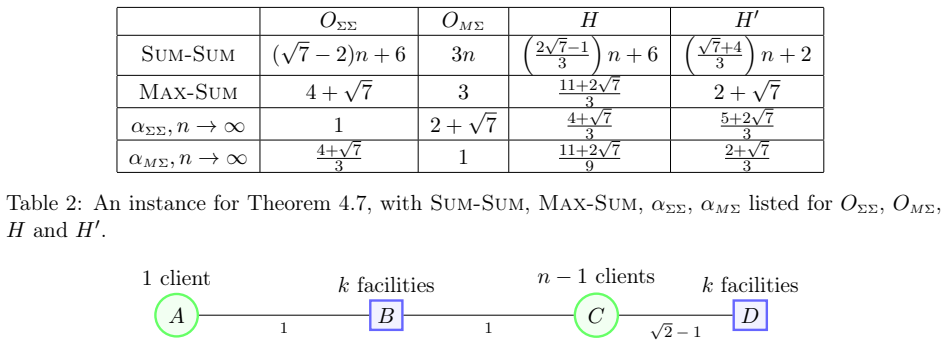
- [§4.1, Theorem 4.7 and Table 2] The lower-bound instance is described inconsistently. With H defined as one facility from OΣΣ (all D) and two from OMΣ (all B), the correct asymptotic ratios are αΣΣ = (5+2√7)/3 and αMΣ = (10+√7)/9, whereas Table 2 lists for H the values (4+√7)/3 and (11+2√7)/9, which are the values for the two-D/one-B mixture. The statement that choosing either OΣΣ or H gives a (4+√7)/3 approximation is true only for the two-D/one-B mixture. Please swap or rename H and H′ and recheck every entry in Table 2.
- [§4.3, proof of Theorem 4.9] The displayed derivation contains an inverted factor. Since αMΣ(OMM) = Max-Sum(OMM)/Max-Sum(OMΣ), the second displayed equality should contain 1/(k1·αMΣ(OMM)), not αMΣ(OMM) in the numerator. As printed, the equality αMM(OMΣ)·αMΣ(OMM) = k2/k1 does not follow from the surrounding equations. The statement of Theorem 4.9 is true and the proof is easily repaired, but the current proof is not correct.
- [§4.1, Theorems 4.2 and 4.4] The stitching proofs contain two load-bearing typos. In the proof of Theorem 4.2, the inequality "f(i,QMΣ) ≤ f(i,RMΣ) + (2/k′)f(RMΣ,QΣΣ)" should have f(i,QΣΣ) on the left. In the proof of Theorem 4.4, the line "QΣΣ = argmin_{A⊆OΣΣ\O:|A|=(k′−1)/2}" contradicts the definition with |A|=(k′+1)/2, and the subsequent bound Σ_i f(i,QΣΣ) ≤ ((k′+1)/(k′−1)) Σ_i f(i,RΣΣ) is not immediate from the definition alone; it requires a short averaging argument over the subsets RΣΣ∪{q}. The final optimization "similar to the proof for Lemma 4.3" is also asserted rather than proved. Please correct the typos and include the missing justification.
minor comments (5)
- [§4.1, Theorem 4.5, Table 1] The Sum-Sum entry for OΣΣ should be (√2−1)n+2 rather than (√2−1)n+1; the asymptotic ratios in the table are unaffected.
- [§4.1, Theorem 4.7, text] For k = 3 the text says "both facilities on B" and "both facilities on D"; these should read "all three facilities" for both OMΣ and OΣΣ.
- [§4.2, Theorem 4.8, Table 3] The entries for the mixed solution H are marked with asterisks; please provide the exact asymptotic ratios or an argument that every mixture yields simultaneous ratio at least 1+√2.
- [Figure 1] The edge labels in the figure are difficult to associate with the four objective pairs; please make the correspondence between each edge and its [lower, upper] bound label explicit.
- [Appendix B, Theorem B.1] The proof uses a matching property of Plurality Veto without stating it formally; please state or cite the exact property being invoked.
Circularity Check
No circular reduction found: the main compatibility bounds are derived from the paper's own inequalities, and the imported 1+sqrt(2) baseline from [15] is legitimate prior work rather than a forced premise.
full rationale
I walked the derivation chain. Theorem 3.4 is proved directly using triangle inequality and Lemma 3.1, with no fitted parameters. The improved Sum-Sum/Max-Sum upper bounds in Theorems 4.2 and 4.4 are built on Lemma 4.1, which is proved inside the paper; the seemingly load-bearing inequality in Theorem 4.4's proof is exactly Lemma 4.1 applied with A={i}, B=QSigmaSigma, C=RMaxSum, since |B|=|C|=(k'+1)/2, so it is not equivalent to the theorem's conclusion. The Max-Max/Max-Sum 2-compatibility in Theorem 4.12 follows from Lemmas 4.10-4.11, which are proved without circular appeals. The only inherited ingredient is the (1+sqrt(2))-compatibility baseline for two objective pairs, imported from [15] by two of the same authors; that is a separate prior result, used as an external theorem through a metric embedding, and the paper's new bounds do not reduce to it. I note one non-circular presentation issue: in the proof of Theorem 4.4, a line reads 'QSigmaSigma = argmin_{A subset of OSigmaSigma without O, |A|=(k'-1)/2}' although QSigmaSigma was defined to have (k'+1)/2 elements; the surrounding algebra uses the correct cardinalities, so this is a typo or correctness concern, not a circularity. No prediction is obtained by fitting, and no result is defined in terms of its own conclusion.
Assumptions & free parameters
assumptions (4)
- standard math Metric space (M,d) satisfies the triangle inequality.
- domain assumption Client set C is finite and facilities can be chosen as a multiset from F.
- domain assumption The cost function f for the l-centrum results obeys Inequality (1); proved for sum and max.
- domain assumption Plurality Veto has the matching property used in the distortion proof.
Cite this review
Pith. "Pith review of Compatibility of Max and Sum Objectives for Committee Selection and $k$-Facility Location." pith.science (2026). https://pith.science/paper/NHQ2JLY2
@misc{pith2026250717063,
  author       = {Pith},
  title        = {Pith review of: Compatibility of Max and Sum Objectives for Committee Selection and $k$-Facility Location},
  year         = {2026},
  howpublished = {\url{https://pith.science/paper/NHQ2JLY2}},
  note         = {Machine review of arXiv:2507.17063}
}
abstract
We study a version of the metric facility location problem (or, equivalently, variants of the committee selection problem) in which we must choose $k$ facilities in an arbitrary metric space to serve some set of clients $C$. We consider four different objectives, where each client $i\in C$ attempts to minimize either the sum or the maximum of its distance to the chosen facilities, and where the overall objective either considers the sum or the maximum of the individual client costs. Rather than optimizing a single objective at a time, we study how compatible these objectives are with each other, and show the existence of solutions which are simultaneously close-to-optimum for any pair of the above objectives. Our results show that when choosing a set of facilities or a representative committee, it is often possible to form a solution which is good for several objectives at the same time, instead of sacrificing one desideratum to achieve another.
Figures


Figures from the paper (2 more)

Forward citations
Cited by 1 Pith paper
-
Distortion of Metric Voting with Bounded Randomness
Constant-randomness voting can achieve metric distortion below 3, breaking the deterministic barrier with only a fixed-size uniform lottery.
Reference graph
Works this paper leans on
-
[15]
Optimizing multiple simultaneous ob- jectives for voting and facility location
Yue Han, Christopher Jerrett, and Elliot Anshelevich. Optimizing multiple simultaneous ob- jectives for voting and facility location. InProceedings of the AAAI Conference on Artificial Intelligence, volume 37, pages 5665–5672, 2023
work page 2023
-
[1]
A bicriteria approximation algorithm for the k-center and k-median problems
Soroush Alamdari and David Shmoys. A bicriteria approximation algorithm for the k-center and k-median problems. InInternational Workshop on Approximation and Online Algorithms, pages 66–75. Springer, 2017
work page 2017
-
[2]
Recent developments in approximation algorithms for facilitylocationandclusteringproblems
Hyung-Chan An and Ola Svensson. Recent developments in approximation algorithms for facilitylocationandclusteringproblems. In Combinatorial Optimization and Graph Algorithms: Communications of NII Shonan Meetings, pages 1–19. Springer, 2017. 25
work page 2017
-
[3]
Distortion in social choice problems: The first 15 years and beyond
Elliot Anshelevich, Aris Filos-Ratsikas, Nisarg Shah, and Alexandros A Voudouris. Distortion in social choice problems: The first 15 years and beyond. In Proceedings of the Thirtieth International Joint Conference on Artificial Intelligence Survey Track., 2021
work page 2021
-
[4]
The metric distortion of multiwinner voting.Artificial Intelligence, 313:103802, 2022
Ioannis Caragiannis, Nisarg Shah, and Alexandros A Voudouris. The metric distortion of multiwinner voting.Artificial Intelligence, 313:103802, 2022
work page 2022
-
[5]
Interpolating between k-median and k-center: Approximation algorithms for ordered k-median
Deeparnab Chakrabarty and Chaitanya Swamy. Interpolating between k-median and k-center: Approximation algorithms for ordered k-median. In 45th International Colloquium on Au- tomata, Languages, and Programming (ICALP 2018). Schloss Dagstuhl-Leibniz-Zentrum fuer Informatik, 2018
work page 2018
-
[6]
Mechanism design for facility location problems: A survey
Hau Chan, Aris Filos-Ratsikas, Bo Li, Minming Li, and Chenhao Wang. Mechanism design for facility location problems: A survey. InProceedings of the Thirtieth International Joint Con- ference on Artificial Intelligence, IJCAI-21, pages 4356–4365. International Joint Conferences on Artificial Intelligence Organization, 2021
work page 2021
-
[7]
Facility location games with ordinal preferences.Theoretical Computer Science, 979:114208, 2023
Hau Chan, Zifan Gong, Minming Li, Chenhao Wang, and Yingchao Zhao. Facility location games with ordinal preferences.Theoretical Computer Science, 979:114208, 2023
work page 2023
Show all 31 references
-
[8]
Facility location games with optional preference.Theoretical Computer Science, 847:185–197, 2020
Zhihuai Chen, Ken CK Fong, Minming Li, Kai Wang, Hongning Yuan, and Yong Zhang. Facility location games with optional preference.Theoretical Computer Science, 847:185–197, 2020
2020
-
[9]
Voudouris
Argyrios Deligkas, Mohammad Lotfi, and Alexandros A. Voudouris. Agent-constrained truthful facility location games.Journal of Combinatorial Optimization, 49(2):24, 2025
2025
-
[10]
A survey and annotated bibliography of multiob- jective combinatorial optimization.OR-spektrum, 22(4):425–460, 2000
Matthias Ehrgott and Xavier Gandibleux. A survey and annotated bibliography of multiob- jective combinatorial optimization.OR-spektrum, 22(4):425–460, 2000
2000
-
[11]
Enelow and Melvin J
James M. Enelow and Melvin J. Hinich.The spatial theory of voting: An introduction. CUP Archive, 1984
1984
-
[12]
Multiple criteria facility location problems: A survey.Applied mathematical modelling, 34(7):1689–1709, 2010
Reza Zanjirani Farahani, Maryam SteadieSeifi, and Nasrin Asgari. Multiple criteria facility location problems: A survey.Applied mathematical modelling, 34(7):1689–1709, 2010
2010
-
[13]
Two-facility-location games with mixed types of agents.Applied Mathematics and Computation, 466:128479, 2024
Ling Gai, Mengpei Liang, and Chenhao Wang. Two-facility-location games with mixed types of agents.Applied Mathematics and Computation, 466:128479, 2024
2024
-
[14]
Resolving the optimal metric distortion conjecture
Vasilis Gkatzelis, Daniel Halpern, and Nisarg Shah. Resolving the optimal metric distortion conjecture. In Proceedings of the 61st IEEE Annual Symposium on Foundations of Computer Science (FOCS), pages 1427–1438, 2020
2020
-
[16]
Truthful two-facility location with candidate locations
Panagiotis Kanellopoulos, Alexandros A Voudouris, and Rongsen Zhang. Truthful two-facility location with candidate locations. InInternational Symposium on Algorithmic Game Theory, pages 365–382. Springer, 2023
2023
-
[17]
Plurality veto: A simple voting rule achieving optimal metric distortion
Fatih Erdem Kizilkaya and David Kempe. Plurality veto: A simple voting rule achieving optimal metric distortion. InInternational Joint Conference on Artificial Intelligence, 2022. 26
2022
-
[18]
Fairness measures for resource allocation.SIAM Journal on Computing, 36(3):657–680, 2006
Amit Kumar and Jon Kleinberg. Fairness measures for resource allocation.SIAM Journal on Computing, 36(3):657–680, 2006
2006
-
[19]
On truthful constrained heterogeneous facility location with max-variant cost.Operations Research Letters, 52:107060, 2024
Mohammad Lotfi and Alexandros A Voudouris. On truthful constrained heterogeneous facility location with max-variant cost.Operations Research Letters, 52:107060, 2024
2024
-
[20]
A single facility rectilinear location problem with multiple criteria
Leon F McGinnis and John A White. A single facility rectilinear location problem with multiple criteria. Transportation Science, 12(3):217–231, 1978
1978
-
[21]
Cambridge University Press, 1999
Samuel Merrill III, Samuel Merrill, and Bernard Grofman.A unified theory of voting: Direc- tional and proximity spatial models. Cambridge University Press, 1999
1999
-
[22]
A geometrical solution for quadratic bicriteria location models.European Journal of Operational Research, 114(2):380–388, 1999
Yoshiaki Ohsawa. A geometrical solution for quadratic bicriteria location models.European Journal of Operational Research, 114(2):380–388, 1999
1999
-
[23]
Heterogeneous facility location without money.Theoretical Computer Science, 636:27–46, 2016
Paolo Serafino and Carmine Ventre. Heterogeneous facility location without money.Theoretical Computer Science, 636:27–46, 2016
2016
-
[24]
David B. Shmoys. Approximation algorithms for facility location problems. In Klaus Jansen and Samir Khuller, editors,Approximation Algorithms for Combinatorial Optimization, pages 27–32, Berlin, Heidelberg, 2000. Springer Berlin Heidelberg
2000
-
[25]
Approximation Algorithms for Multiwinner Elections and Clustering Prob- lems
Krzysztof Sornat. Approximation Algorithms for Multiwinner Elections and Clustering Prob- lems. PhD thesis, University of Wrocław, 2019
2019
-
[26]
The k-centrum multi-facility location problem
Arie Tamir. The k-centrum multi-facility location problem. Discrete Applied Mathematics, 109(3):293–307, 2001
2001
-
[27]
Strategy proof mechanisms for facility location at limited locations
Toby Walsh. Strategy proof mechanisms for facility location at limited locations. InPacific Rim International Conference on Artificial Intelligence, pages 113–124. Springer, 2021
2021
-
[28]
Cambridge university press, 2011
David P Williamson and David B Shmoys.The design of approximation algorithms. Cambridge university press, 2011
2011
-
[29]
Two-facility location games with minimum distance requirement
Xinping Xu, Bo Li, Minming Li, and Lingjie Duan. Two-facility location games with minimum distance requirement. Journal of Artificial Intelligence Research, 70:719–756, 2021
2021
-
[30]
Constrained heterogeneous facility location games with max-variant cost.Journal of Combinatorial Optimization, 45(3):90, 2023
Qi Zhao, Wenjing Liu, Qingqin Nong, and Qizhi Fang. Constrained heterogeneous facility location games with max-variant cost.Journal of Combinatorial Optimization, 45(3):90, 2023
2023
-
[31]
Constrained heterogeneous two-facility location games with sum-variant.Journal of Combinatorial Optimization, 47(4):65, 2024
Qi Zhao, Wenjing Liu, Qingqin Nong, and Qizhi Fang. Constrained heterogeneous two-facility location games with sum-variant.Journal of Combinatorial Optimization, 47(4):65, 2024. Appendix A Extension to the l-centrum Problem As we have briefly mentioned in Section 2, the extens...
2024
Reviewed August 6, 2026 · model on record in the stance chip above.
Discussion (0). Continue with ORCID to comment.