Dispersion of active particles in oscillatory Poiseuille flow
Pith reviewed 2026-05-19 02:43 UTC · model grok-4.3
The pith
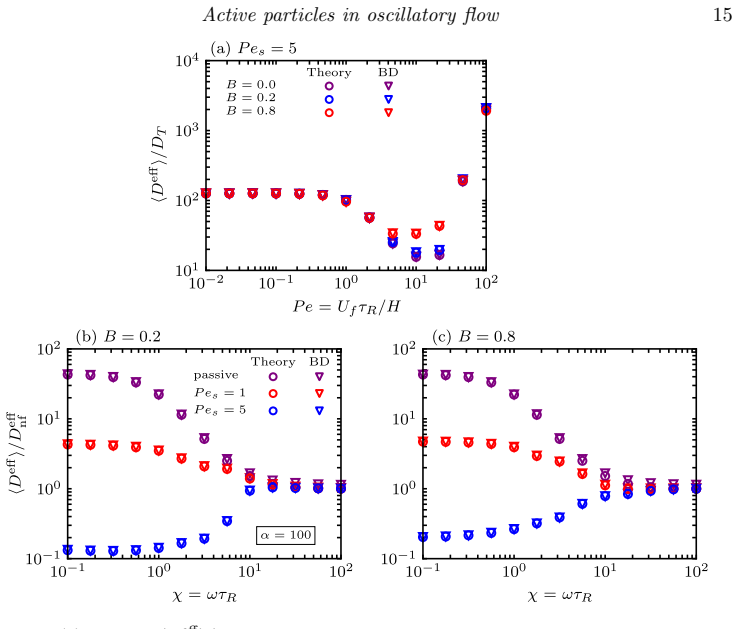
The dispersion coefficient of active particles in oscillatory Poiseuille flow exhibits oscillatory behavior with distinct minima and maxima as a function of oscillation frequency.
A machine-rendered reading of the paper's core claim, the machinery that carries it, and where it could break.
Core claim
The central claim is that active Brownian particles in oscillatory Poiseuille flow within a planar channel exhibit a time-averaged longitudinal dispersion coefficient that varies non-monotonically with flow speed and activity and shows an oscillatory dependence on the flow oscillation frequency, with distinct minima and maxima at specific frequencies. This oscillatory behavior results from the interplay between the particles' self-propulsion and the advection imposed by the oscillatory flow, a mechanism that does not appear in passive particles or steady flows.
What carries the argument
Generalized Taylor dispersion theory adapted to time-periodic flows, which derives the time-averaged dispersion coefficient by solving an auxiliary advection-diffusion problem for active particles in confinement.
If this is right
- In the weak-activity limit, activity can enhance or hinder dispersion compared to the passive case.
- For arbitrary activity, dispersion varies non-monotonically with both flow speed and particle activity.
- Dispersion can be tuned by selecting specific flow oscillation frequencies.
- The oscillatory behavior is a direct consequence of coupling between self-propulsion and time-varying advection.
Where Pith is reading between the lines
- Similar frequency-dependent tuning might apply to other active particle systems such as those with different propulsion mechanisms or in non-planar channels.
- The mechanism could enable frequency-based separation or sorting of particles with varying activity levels in microfluidic setups.
- Collective interactions among particles might alter the locations of dispersion minima and maxima, suggesting a testable extension.
Load-bearing premise
Generalized Taylor dispersion theory remains valid for deriving a time-averaged long-time dispersion coefficient when the flow is time-periodic and the particles are active and confined.
What would settle it
Brownian dynamics simulations or experiments that plot the dispersion coefficient against oscillation frequency and find monotonic behavior without distinct minima and maxima would falsify the oscillatory dispersion result.
Figures


read the original abstract
Active particles exhibit complex transport dynamics in flows through confined geometries such as channels or pores. In this work, we employ a generalized Taylor dispersion (GTD) theory to study the long-time dispersion behavior of active Brownian particles (ABPs) in an oscillatory Poiseuille flow within a planar channel. We quantify the time-averaged longitudinal dispersion coefficient as a function of the flow speed, flow oscillation frequency, and particle activity. In the weak-activity limit, asymptotic analysis shows that activity can either enhance or hinder the dispersion compared to the passive case. For arbitrary activity levels, we numerically solve the GTD equations and validate the results with Brownian dynamics simulations. We show that the dispersion coefficient could vary non-monotonically with both the flow speed and particle activity. Furthermore, the dispersion coefficient shows an oscillatory behavior as a function of the flow oscillation frequency, exhibiting distinct minima and maxima at different frequencies. The observed oscillatory dispersion results from the interplay between self-propulsion and oscillatory flow advection -- a coupling absent in passive or steady systems. Our results show that time-dependent flows can be used to tune the dispersion of active particles in confinement.
Editorial analysis
A structured set of objections, weighed in public.
Referee Report
Summary. The paper employs generalized Taylor dispersion (GTD) theory to analyze the long-time dispersion of active Brownian particles (ABPs) in an oscillatory Poiseuille flow within a planar channel. Through asymptotic analysis in the weak-activity limit, numerical solution of the GTD equations for arbitrary activity, and validation with Brownian dynamics simulations, it reports that the time-averaged longitudinal dispersion coefficient varies non-monotonically with flow speed and activity, and exhibits oscillatory behavior with distinct minima and maxima as a function of the flow oscillation frequency due to the interplay between self-propulsion and oscillatory advection.
Significance. This work is significant for advancing understanding of active particle transport in time-dependent confined flows. The finding that dispersion can be tuned via flow oscillation frequency, with oscillatory dependence arising from activity-flow coupling, has implications for microfluidic applications and biological transport. Strengths include the parameter-free nature of the GTD approach, the combination of asymptotics and numerics, and direct simulation validation, which support the central claims if the underlying assumptions hold.
major comments (1)
- The extraction of a single time-averaged long-time dispersion coefficient from the GTD cell problem for time-periodic base flow assumes that period-averaging commutes with the long-time limit. For ABPs, the self-propulsion term introduces a persistence timescale 1/Dr that can resonate with the flow period; the manuscript should explicitly verify, perhaps via comparison of averaged GTD predictions with unaveraged long-time moments from simulations, that no additional oscillatory corrections arise near the reported minima/maxima frequencies.
minor comments (2)
- The comparison with Brownian dynamics simulations would benefit from quantitative error bars, reported convergence with respect to simulation duration and ensemble size, and specification of the parameter ranges explored to confirm the observed oscillatory behavior.
- Ensure that figure legends clearly indicate the values of key dimensionless parameters (e.g., Peclet number, activity strength, oscillation frequency) for each curve to facilitate reproducibility.
Simulated Author's Rebuttal
We thank the referee for their positive evaluation of our work and for identifying an important point regarding the commutation of period averaging with the long-time limit. We address this major comment below and have incorporated additional verification in the revised manuscript.
read point-by-point responses
-
Referee: The extraction of a single time-averaged long-time dispersion coefficient from the GTD cell problem for time-periodic base flow assumes that period-averaging commutes with the long-time limit. For ABPs, the self-propulsion term introduces a persistence timescale 1/Dr that can resonate with the flow period; the manuscript should explicitly verify, perhaps via comparison of averaged GTD predictions with unaveraged long-time moments from simulations, that no additional oscillatory corrections arise near the reported minima/maxima frequencies.
Authors: We agree that this is a substantive point that merits explicit verification, particularly given the intrinsic persistence time of ABPs. In our GTD formulation, the cell problem is solved subject to time-periodic conditions on the base flow, after which the dispersion coefficient is obtained by period averaging; this follows the standard procedure for time-periodic advection-diffusion problems. The long-time limit is taken after decay of transients over many periods. To directly address possible resonance effects between 1/Dr and the oscillation period, we have added a new comparison in the revised manuscript. Specifically, at the frequencies corresponding to the reported dispersion minima and maxima, we extract the effective dispersion directly from the unaveraged second moments of particle positions in Brownian dynamics simulations (i.e., without imposing period averaging). These unaveraged simulation results agree quantitatively with the period-averaged GTD predictions, showing no evidence of additional oscillatory corrections. A new paragraph and supplementary figure documenting this check have been included in the results section. revision: yes
Circularity Check
No significant circularity; dispersion computed from GTD cell problem and validated by simulation
full rationale
The paper extends generalized Taylor dispersion theory to active Brownian particles in time-periodic Poiseuille flow, solves the resulting cell problem numerically to obtain the time-averaged long-time dispersion coefficient, and confirms the non-monotonic and oscillatory dependence on frequency via independent Brownian dynamics simulations. No free parameters are fitted to data and then relabeled as predictions, no load-bearing step reduces to a self-citation whose content is itself unverified, and the oscillatory behavior emerges from the explicit coupling between self-propulsion and periodic advection in the Fokker-Planck operator rather than by construction or renaming. The derivation is therefore self-contained against external benchmarks.
Axiom & Free-Parameter Ledger
axioms (1)
- domain assumption Generalized Taylor dispersion theory yields a well-defined time-averaged longitudinal dispersion coefficient for active particles in time-periodic Poiseuille flow
Lean theorems connected to this paper
-
IndisputableMonolith/Foundation/RealityFromDistinction.leanreality_from_one_distinction unclear?
unclearRelation between the paper passage and the cited Recognition theorem.
We employ a generalized Taylor dispersion (GTD) theory... time-averaged longitudinal dispersion coefficient... oscillatory behavior as a function of the flow oscillation frequency
-
IndisputableMonolith/Cost/FunctionalEquation.leanwashburn_uniqueness_aczel unclear?
unclearRelation between the paper passage and the cited Recognition theorem.
the observed oscillatory dispersion results from the interplay between self-propulsion and oscillatory flow advection
What do these tags mean?
- matches
- The paper's claim is directly supported by a theorem in the formal canon.
- supports
- The theorem supports part of the paper's argument, but the paper may add assumptions or extra steps.
- extends
- The paper goes beyond the formal theorem; the theorem is a base layer rather than the whole result.
- uses
- The paper appears to rely on the theorem as machinery.
- contradicts
- The paper's claim conflicts with a theorem or certificate in the canon.
- unclear
- Pith found a possible connection, but the passage is too broad, indirect, or ambiguous to say the theorem truly supports the claim.
Reference graph
Works this paper leans on
-
[1]
, " * write output.state after.block = add.period write newline
ENTRY address author booktitle chapter edition editor howpublished institution journal key month note number organization pages publisher school series title type volume year eprint label extra.label sort.label short.list INTEGERS output.state before.all mid.sentence after.sentence after.block FUNCTION init.state.consts #0 'before.all := #1 'mid.sentence ...
-
[2]
" write newline "" before.all 'output.state := FUNCTION n.dashify 't := "" t empty not t #1 #1 substring "-" = t #1 #2 substring "--" = not "--" * t #2 global.max substring 't := t #1 #1 substring "-" = "-" * t #2 global.max substring 't := while if t #1 #1 substring * t #2 global.max substring 't := if while FUNCTION word.in bbl.in capitalize " " * FUNCT...
-
[3]
Alonso-Matilla, Roberto , Chakrabarti, Brato & Saintillan, David 2019 Transport and dispersion of active particles in periodic porous media . Phys. Rev. Fluids 4 (4), 043101
work page 2019
-
[4]
Anand, Shalabh K & Singh, Sunil P 2021 Migration of active filaments under P oiseuille flow in a microcapillary tube . Eur. Phys. J. E 44 , 1--10
work page 2021
-
[5]
Apaza, Leonardo & Sandoval, Mario 2016 Ballistic behavior and trapping of self-driven particles in a P oiseuille flow . Phys. Rev. E. 93 (6), 062602
work page 2016
-
[6]
Aris, Rutherford 1956 On the dispersion of a solute in a fluid flowing through a tube . Proc. R. Soc. Lond. A 235 (1200), 67--77
work page 1956
-
[7]
Aris, Rutherford 1960 On the dispersion of a solute in pulsating flow through a tube . Proc. R. Soc. Lond. A 259 (1298), 370--376
work page 1960
-
[8]
Bechinger, Clemens , Di Leonardo, Roberto , L \"o wen, Hartmut , Reichhardt, Charles , Volpe, Giorgio & Volpe, Giovanni 2016 Active particles in complex and crowded environments . Rev. Mod. Phys. 88 (4), 045006
work page 2016
-
[9]
Berg, Howard C 1993 Random walks in biology\/ . Princeton University Press
work page 1993
-
[10]
Bowden, KF 1965 Horizontal mixing in the sea due to a shearing current . J. Fluid Mech. 21 (1), 83--95
work page 1965
-
[11]
Brenner, Howard 1980 Dispersion resulting from flow through spatially periodic porous media . Philos. Trans. R. Soc. Lond. A Math. Phys. Sci. 297 (1430), 81--133
work page 1980
-
[12]
Van den Broeck, C 1982 A stochastic description of longitudinal dispersion in uniaxial flows . Physica A 112 (1-2), 343--352
work page 1982
-
[13]
Burns, Keaton J , Vasil, Geoffrey M , Oishi, Jeffrey S , Lecoanet, Daniel & Brown, Benjamin P 2020 Dedalus: A flexible framework for numerical simulations with spectral methods . Phys. Rev. Res. 2 (2), 023068
work page 2020
-
[14]
arXiv preprint arXiv:2505.17788
Caldag, Hakan Osman & Bees, Martin Alan 2025 Fine-tuning the dispersion of active suspensions with oscillatory flows . arXiv preprint arXiv:2505.17788
-
[15]
Castiglione, P , Crisanti, A , Mazzino, A , Vergassola, M & Vulpiani, A 1998 Resonant enhanced diffusion in time-dependent flow . J. Phys. A 31 (35), 7197
work page 1998
-
[16]
Chakrabarti, Brato & Saintillan, David 2020 Shear-induced dispersion in peristaltic flow . Phys. Fluids 32 (11)
work page 2020
-
[17]
Chakraborty, Rik , Maiti, Arnab , Sharma, Nikita & Dey, Krishna Kanti 2022 Active matter dynamics in confined microfluidic environments . Prog. Mol. Biol. Transl. Sci. 186 (1), 245--265
work page 2022
-
[18]
Chandragiri, Santhan , Doostmohammadi, Amin , Yeomans, Julia M & Thampi, Sumesh P 2020 Flow states and transitions of an active nematic in a three-dimensional channel . Phys. Rev. Lett. 125 (14), 148002
work page 2020
-
[19]
Chatwin, P. C. 1975 On the longitudinal dispersion of passive contaminant in oscillatory flows in tubes . J. Fluid Mech. 71 (3), 513–527
work page 1975
-
[20]
Chatwin, P. C. 1977 The initial development of longitudinal dispersion in straight tubes . J. Fluid Mech. 80 (1), 33–48
work page 1977
-
[21]
Chepizhko, Oleksandr & Franosch, Thomas 2022 Resonant diffusion of a gravitactic circle swimmer . Phys. Rev. Lett. 129 (22), 228003
work page 2022
-
[22]
Choudhary, Akash , Paul, Subhechchha , R \"u hle, Felix & Stark, Holger 2022 How inertial lift affects the dynamics of a microswimmer in P oiseuille flow . Commun. Phys. 5 (1), 14
work page 2022
-
[23]
Chu, Henry CW , Garoff, Stephen , Przybycien, Todd M , Tilton, Robert D & Khair, Aditya S 2019 Dispersion in steady and time-oscillatory two-dimensional flows through a parallel-plate channel . Phys. Fluids 31 (2)
work page 2019
-
[24]
Chu, Henry CW , Garoff, Stephen , Tilton, Robert D & Khair, Aditya S 2020 Dispersion in steady and time-oscillatory flows through an eccentric annulus . AIChE J. 66 (2), e16831
work page 2020
-
[25]
Chuphal, Prabha , Sahoo, Soudamini & Thakur, Snigdha 2021 Effect of P oiseuille flow on the dynamics of active vesicle . Soft Mater. 19 (3), 359--372
work page 2021
-
[26]
D \' ez, Paula , Lucena-S \'a nchez, Elena , Escudero, Andrea , Llopis-Lorente, Antoni , Villalonga, Reynaldo & Martinez-Manez, Ramon 2021 Ultrafast directional janus pt--mesoporous silica nanomotors for smart drug delivery . ACS Nano 15 (3), 4467--4480
work page 2021
-
[27]
Ezhilan, Barath & Saintillan, David 2015 Transport of a dilute active suspension in pressure-driven channel flow . J. Fluid Mech. 777 , 482--522
work page 2015
-
[28]
Figueroa-Morales, Nuris , Rivera, Aramis , Soto, Rodrigo , Lindner, Anke , Altshuler, Ernesto & Cl \'e ment, \'E ric 2020 E. coli “super-contaminates” narrow ducts fostered by broad run-time distribution . Sci. Adv. 6 (11), eaay0155
work page 2020
-
[29]
Ganesh, A , Douarche, C , Dentz, Marco & Auradou, Harold 2023 Numerical modeling of dispersion of swimming bacteria in a P oiseuille flow . Phys. Rev. Fluids 8 (3), 034501
work page 2023
-
[30]
Ghosh, Arijit , Xu, Weinan , Gupta, Neha & Gracias, David 2020 Active matter therapeutics . Nano Today 31 , 100836
work page 2020
-
[31]
Gomez-Solano, Juan Ruben , Blokhuis, Alex & Bechinger, Clemens 2016 Dynamics of self-propelled janus particles in viscoelastic fluids . Phys. Rev. Lett. 116 (13), 138301
work page 2016
-
[32]
Hettiarachchi, HDM , Hsu, Ying , Harris, Timothy J & Linninger, Andreas A 2011 The effect of pulsatile flow on intrathecal drug delivery in the spinal canal . Ann. Biomed. Eng. 39 , 2592--2602
work page 2011
-
[33]
Heyes, DM & Melrose, JR 1993 B rownian dynamics simulations of model hard-sphere suspensions . J. Non-Newton. Fluid Mech. 46 (1), 1--28
work page 1993
-
[34]
Hill, NA & Bees, MA 2002 Taylor dispersion of gyrotactic swimming micro-organisms in a linear flow . Phys. Fluids 14 (8), 2598--2605
work page 2002
-
[35]
Jeffery, George Barker 1922 The motion of ellipsoidal particles immersed in a viscous fluid . Proc. R. Soc. Lond. A 102 (715), 161--179
work page 1922
-
[36]
Jing, Guangyin , Z \"o ttl, Andreas , Cl \'e ment, \'E ric & Lindner, Anke 2020 Chirality-induced bacterial rheotaxis in bulk shear flows . Sci. Adv. 6 (28), eabb2012
work page 2020
- [37]
-
[38]
Kantsler, Vasily , Dunkel, J \"o rn , Blayney, Martyn & Goldstein, Raymond E 2014 Rheotaxis facilitates upstream navigation of mammalian sperm cells . eLife 3 , e02403
work page 2014
-
[39]
Kaya, Tolga & Koser, Hur 2012 Direct upstream motility in E scherichia coli . Biophys. J. 102 (7), 1514--1523
work page 2012
-
[40]
Khatri, Narender & Burada, PS 2022 Diffusion of chiral active particles in a P oiseuille flow . Phys. Rev. E. 105 (2), 024604
work page 2022
-
[41]
Kim, Minyoung Kevin , Drescher, Knut , Pak, On Shun , Bassler, Bonnie L & Stone, Howard A 2014 Filaments in curved streamlines: rapid formation of staphylococcus aureus biofilm streamers . New J. Phys. 16 (6), 065024
work page 2014
-
[42]
Lane, M Chelsea , Lockatell, Virginia , Monterosso, Greta , Lamphier, Daniel , Weinert, Julia , Hebel, J Richard , Johnson, David E & Mobley, Harry LT 2005 Role of motility in the colonization of uropathogenic E scherichia coli in the urinary tract . Infect. Immun. 73 (11), 7644--7656
work page 2005
-
[43]
Leahy, Brian D , Koch, Donald L & Cohen, Itai 2015 The effect of shear flow on the rotational diffusion of a single axisymmetric particle . J. Fluid Mech. 772 , 42--79
work page 2015
-
[44]
Lin, Ruyi , Yu, Wenqi , Chen, Xianchun & Gao, Huile 2021 Self-propelled micro/nanomotors for tumor targeting delivery and therapy . Adv. Healthc. Mater. 10 (1), 2001212
work page 2021
-
[45]
Mathijssen, Arnold JTM , Figueroa-Morales, Nuris , Junot, Gaspard , Cl \'e ment, \'E ric , Lindner, Anke & Z \"o ttl, Andreas 2019 Oscillatory surface rheotaxis of swimming E . coli bacteria . Nat. Commun. 10 (1), 3434
work page 2019
-
[46]
Mazumder, Bijoy S & Das, Samir K 1992 Effect of boundary reaction on solute dispersion in pulsatile flow through a tube . J. Fluid Mech. 239 , 523--549
work page 1992
-
[47]
McDonald, DA 1955 The relation of pulsatile pressure to flow in arteries . J. Physiol. 127 (3), 533
work page 1955
-
[48]
Ng, Chiu-On 2006 Dispersion in steady and oscillatory flows through a tube with reversible and irreversible wall reactions . Proc. R. Soc. A. 462 (2066), 481--515
work page 2006
-
[49]
Omori, Toshihiro & Ishikawa, Takuji 2016 Upward swimming of a sperm cell in shear flow . Phys. Rev. E 93 (3), 032402
work page 2016
-
[50]
Park, Byung-Wook , Zhuang, Jiang , Yasa, Oncay & Sitti, Metin 2017 Multifunctional bacteria-driven microswimmers for targeted active drug delivery . ACS Nano 11 (9), 8910--8923
work page 2017
-
[51]
Peng, Zhiwei 2024 Macrotransport of active particles in periodic channels and fields: Rectification and dispersion . J. Chem. Phys. 161 (15)
work page 2024
-
[52]
Peng, Zhiwei & Brady, John F 2020 Upstream swimming and T aylor dispersion of active B rownian particles . Phys. Rev. Fluids 5 (7), 073102
work page 2020
-
[53]
Plan, Emmanuel LC VI M , Yeomans, Julia M & Doostmohammadi, Amin 2020 Active matter in a viscoelastic environment . Phys. Rev. Fluids 5 (2), 023102
work page 2020
-
[54]
Romanczuk, Pawel , B \"a r, Markus , Ebeling, Werner , Lindner, Benjamin & Schimansky-Geier, Lutz 2012 Active B rownian particles: From individual to collective stochastic dynamics . Eur. Phys. J. Spec. Top. 202 , 1--162
work page 2012
-
[55]
Rusconi, Roberto , Lecuyer, Sigolene , Guglielmini, Laura & Stone, Howard A 2010 Laminar flow around corners triggers the formation of biofilm streamers . J. R. Soc. Interface. 7 (50), 1293--1299
work page 2010
-
[56]
Schweitzer, Frank , Ebeling, Werner & Tilch, Benno 1998 Complex motion of B rownian particles with energy depots . Phys. Rev. Lett. 80 (23), 5044
work page 1998
-
[57]
Secomb, Timothy W 2016 Hemodynamics . Compr. Physiol. 6 (2), 975
work page 2016
-
[58]
Shapiro, M & Brenner, H 1990 Taylor dispersion in the presence of time-periodic convection phenomena. part ii. transport of transversely oscillating B rownian particles in a plane P oiseuille flow . Phys. Fluids A 2 (10), 1744--1753
work page 1990
-
[59]
Siitonen, Anja & Nurminen, Marjatta 1992 Bacterial motility is a colonization factor in experimental urinary tract infection . Infect. Immun. 60 (9), 3918--3920
work page 1992
-
[60]
Soler, Lluis , Magdanz, Veronika , Fomin, Vladimir M , Sanchez, Samuel & Schmidt, Oliver G 2013 Self-propelled micromotors for cleaning polluted water . ACS Nano 7 (11), 9611--9620
work page 2013
-
[61]
Sridhar, Varun , Podjaski, Filip , Alapan, Yunus , Kr \"o ger, Julia , Grunenberg, Lars , Kishore, Vimal , Lotsch, Bettina V & Sitti, Metin 2022 Light-driven carbon nitride microswimmers with propulsion in biological and ionic media and responsive on-demand drug delivery . Sci. Robot. 7 (62), eabm1421
work page 2022
-
[62]
Taylor, Geoffrey Ingram 1953 Dispersion of soluble matter in solvent flowing slowly through a tube . Proc. R. Soc. Lond. A 219 (1137), 186--203
work page 1953
-
[63]
Taylor, Geoffrey Ingram 1954 a\/ Conditions under which dispersion of a solute in a stream of solvent can be used to measure molecular diffusion . Proc. R. Soc. Lond. A 225 (1163), 473--477
work page 1954
-
[64]
Taylor, Geoffrey Ingram 1954 b\/ The dispersion of matter in turbulent flow through a pipe . Proc. R. Soc. Lond. A 223 (1155), 446--468
work page 1954
-
[65]
Urso, Mario , Ussia, Martina & Pumera, Martin 2023 Smart micro- and nanorobots for water purification . Nat. Rev. Bioeng. 1 , 1--16
work page 2023
-
[66]
Valani, Rahil N , Harding, Brendan & Stokes, Yvonne M 2024 Active particle motion in P oiseuille flow through rectangular channels . Phys. Rev. E 110 (3), 034603
work page 2024
-
[67]
Walker, Benjamin J , Ishimoto, Kenta , Moreau, Cl \'e ment , Gaffney, Eamonn A & Dalwadi, Mohit P 2022 Emergent rheotaxis of shape-changing swimmers in P oiseuille flow . J. Fluid Mech. 944 , R2
work page 2022
-
[68]
Watson, E. J. 1983 Diffusion in oscillatory pipe flow . J. Fluid Mech. 133 , 233–244
work page 1983
-
[69]
Womersley, John R 1955 Method for the calculation of velocity, rate of flow and viscous drag in arteries when the pressure gradient is known . J. Physiol. 127 (3), 553
work page 1955
-
[70]
Zia, Roseanna N & Brady, John F 2010 Single-particle motion in colloids: force-induced diffusion . J. Fluid Mech. 658 , 188--210
work page 2010
-
[71]
Z \"o ttl, Andreas & Stark, Holger 2012 Nonlinear dynamics of a microswimmer in P oiseuille flow . Phys. Rev. Lett. 108 (21), 218104
work page 2012
-
[72]
Z \"o ttl, Andreas & Stark, Holger 2013 Periodic and quasiperiodic motion of an elongated microswimmer in P oiseuille flow . Eur. Phys. J. E 36 , 1--10
work page 2013
discussion (0)
Sign in with ORCID, Apple, or X to comment. Anyone can read and Pith papers without signing in.