REVIEW 3 major objections 4 minor 70 references
Time-hidden magnetic order in a multi-orbital Mott insulator
T0 review · 3 major / 4 minor · reviewed 2026-08-06 · deepseek-v4-flash
Pith's one-line read Photo-doping Ca2RuO4 produces a metastable intra-layer ferromagnetic state at 10 microseconds, after antiferromagnetic order has melted and carriers have recombined, with broken glide-plane symmetry.
desk verdict Real metastable FM-like state found at 10 µs, but the 'intermediate timescale' emergence claim rests on a stroboscopic pre-pump snapshot, not on resolved dynamics. read the letter →
The pith
A machine-rendered reading of the paper's core claim, the machinery that carries it, and where it could break.
The reading
What carries the argument
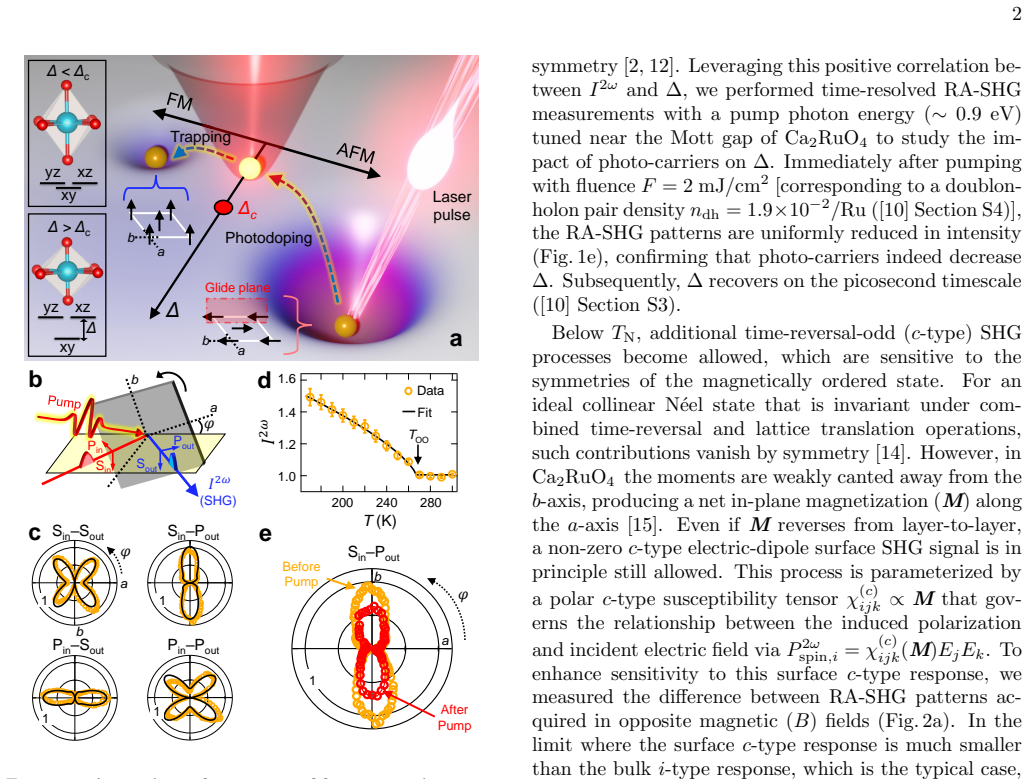
The control parameter is the orbital splitting between the dxy orbital and the dyz/xz doublet in the flattened RuO6 octahedra. Photodoping reduces that splitting by lowering the charge gap, and when it drops below a critical value the intra-layer magnetic ground state switches from antiferromagnetic (moments along b) to ferromagnetic (moments along c). The experiments use two bulk-sensitive probes: magnetic-field-induced second-harmonic generation, whose time-reversal-odd tensor records the magnetic point group, and modulation-based differential birefringence, which detects loss of the bc glide plane. The timescale argument is carried by the transient-trapping mechanism proposed for systems with competing orders, in which the system is captured in a local valley while the original potential landscape is restored. The two-site exact-diagonalization model supplies the splitting-dependent energy landscape and the weak azimuthal anisotropy that explains slow domain growth.
What would settle it
Run the same pump-probe experiment at a repetition rate low enough (for example 1 kHz) that the sample fully relaxes between pulses, and look for the ferromagnetic signal 10 microseconds after a single pump pulse; if the signal disappears, the 10 microsecond state is a multi-pulse artifact rather than the single-cycle intermediate-time state.
Extended reading notes
Core claim
The central claim is that photo-doping Ca2RuO4 at fluences above a threshold melts the intralayer antiferromagnetic order within about 2 ps and then leaves the crystal in a metastable state that, by 10 microseconds, shows second-harmonic and birefringence signatures incompatible with any equilibrium phase: the bc glide plane is broken and the magnetic point group drops from m to 1, consistent with intra-layer ferromagnetic moments pointing along the c-axis. The state appears only after the antiferromagnetic order parameter has collapsed and after photocarriers have recombined, and only below the Neel temperature; it is insulating, and it relaxes back to the antiferromagnetic state within a minute. Exact-diagonalization of a two-site model of the RuO6 network shows that reducing the orbital splitting below a critical value switches the ground state from antiferromagnetic (b-axis) to ferromagnetic (c-axis), and that the ferromagnetic valley has very weak in-plane anisotropy, so small domains can take much longer than electronic relaxation times to grow into a detectable net signal.
Load-bearing premise
The 10 microsecond snapshot is taken while a 100 kHz pulse train is still hitting the sample, and the paper's Section S12 concedes that the crystal does not fully recover between pulses; the whole picture assumes that what is seen at 10 microseconds is the state produced within one excitation cycle rather than an accumulated multi-pulse effect.
Editorial extensions
If this is right
- Microsecond time delays become a valid hunting ground: hidden states in driven quantum materials can appear after electronic and phononic relaxation has finished, when domain coarsening or trapping has had time to act.
- A fluence threshold and a temperature below the Neel point are required: the intra-layer ferromagnetic state appears only once the pump has melted the antiferromagnetic order and only if the system starts from the antiferromagnetic phase, not from the paramagnet.
- The new state is thermally inaccessible in equilibrium and is insulating, so it is a different object from the pressure- or strain-driven itinerant ferromagnetism previously reported in Ca2RuO4.
- The observable onset of the hidden order is set by domain growth, not by the initial electronic relaxation, so optical signals can stay zero for nanoseconds and then rise on the microsecond scale.
- Within one pulse cycle the state forms, persists for an appreciable fraction of the 10 microsecond period, and then the crystal recovers to the antiferromagnetic state within about a minute, defining the metastable lifetime.
Reading between the lines
- The paper's 10 microsecond point is a stroboscopic pre-pump snapshot in a 100 kHz pulse train; the claim that this is the single-pulse intermediate-time state would be directly tested by a low-repetition-rate or single-shot measurement that lets the sample fully relax between pulses.
- If the splitting-controlled antiferromagnetic-to-ferromagnetic switch is generic, other d4 or multi-orbital Mott insulators with a similar orbital splitting might host analogous time-hidden ferromagnetic states, and epitaxial strain or chemical pressure might stabilize them in equilibrium.
- Because optical measurements determine symmetries but not atomic positions, a neutron or resonant X-ray scattering experiment timed to the 10 microsecond window would be a cleaner confirmation of the c-axis ferromagnetic moment arrangement.
- The weak in-plane anisotropy predicted by the two-site model implies the hidden order should appear as small domains first; spatially resolved probes could observe domain growth directly rather than infer it from the integrated signal.
Editorial analysis
A structured set of objections, weighed in public.
Referee Report
Summary. The paper reports time-resolved second-harmonic generation (SHG) and optical birefringence experiments on the multi-orbital Mott insulator Ca2RuO4. After intense photoexcitation above a critical fluence, the authors observe at a nominal 10 μs delay a state in which the bc glide-plane symmetry is broken, as evidenced by rotational-anisotropy SHG patterns that require a surface magnetic point group 1 tensor fit, and by a bulk-sensitive birefringence asymmetry that is zero in equilibrium and grows above a fluence threshold. The magnetic-field-induced SHG data are interpreted as consistent with intra-layer ferromagnetic order with moments along the c-axis, arising after the intra-layer antiferromagnetic order has melted. A two-site exact-diagonalization model shows that reducing the orbital splitting Δ drives a ground-state crossover from intra-layer AFM to intra-layer FM correlations, and a mean-field calculation shows that photodoping reduces Δ. The authors conclude that photo-doping accesses a metastable 'time-hidden' magnetic state on the intermediate microsecond timescale, distinct from all equilibrium phases.
Significance. If the identification holds, this is a striking result: a metastable, glide-symmetry-broken magnetic state in a Mott insulator that appears on a microsecond timescale, populating a previously little-explored time window between ultrafast and quasi-static regimes. The paper's strengths are its internal consistency and cross-validation: the equilibrium AFM phase is fit with the expected magnetic point group m, the metastable phase requires point group 1, the same conclusion is reached by surface-sensitive SHG and bulk-sensitive birefringence, and the domain-reversal measurements support an ordered state rather than a heating artifact. The two-site model is solved by exact diagonalization and inherits parameters from prior work, with only one fitted spring constant in the mean-field analysis. The main weakness is that the temporal claim of emergence in the intermediate window is not directly established by the data, as discussed below; the state is well characterized at 10 μs under repetitive excitation, but its single-pulse evolution from 100 ps to 10 μs is inferred rather than measured.
major comments (3)
- [Fig. 4e and Section S12] The central 'intermediate time window' claim is not directly established by the data. The 10 μs data (e.g., Fig. 2d(iii)) are acquired with the probe pulse arriving slightly before the pump in a 100 kHz train, and Section S12 concedes that for F > Fc the sample does not fully recover between pulses and that the metastable state is already present before the pump arrives. The measurement therefore reports a steady-state, multi-pulse condition rather than the state reached about 10 μs after a single excitation pulse; the signal could accumulate over many cycles. No data are shown between 100 ps and 10 μs, so the slow domain-coalescence evolution in Fig. 4e is inferred, not measured. The abstract's claim that the state 'emerges' in the previously unexplored intermediate window should either be supported by single-pulse or variable-repetition-rate experiments, or be rephrased to describe a metastable state sustained under repetitive excitation.
- [Fig. 4e and Section S9] The trapping mechanism is invoked but not demonstrated for Ca2RuO4. The two-site exact-diagonalization calculation establishes that the FM state is a local minimum for Δ below Δc, and the Section S2 mean-field calculation shows that photodoping reduces Δ, but neither calculation simulates the relaxation dynamics or the population of the FM valley after the potential is restored. The statement in Fig. 4e that the system is trapped 'possibly through the transient trapping mechanism proposed by Sun and Millis [22]' is an untested assumption, and the word 'trajectory' in the abstract is stronger than what the calculations show. The authors should either perform a time-dependent simulation of the relaxation or explicitly label this step as a hypothesis.
- [Sections S6, S7, and title] The magnetic nature of the new state is inferred from symmetry fits rather than measured by a direct magnetic probe. The BFISH data are fit by a magnetic point group 1 tensor and the birefringence asymmetry shows glide-plane breaking, but no direct measurement of a c-axis ordered moment is presented; the absence of Kerr rotation in Section S7 is attributed to antiparallel stacking of FM planes. The abstract and main text are appropriately cautious in saying the observations are 'consistent with' intra-layer FM order, but the title 'Time-hidden magnetic order' goes beyond the directly measured quantities. A direct probe (e.g., time-resolved resonant x-ray scattering or a local magnetic probe) or a softening of the title and framing is needed.
minor comments (4)
- [First paragraph and references] The citation of '[2, 12]' for the steep increase in Δ below TOO and for the 'previous neutron and x-ray diffraction measurements' is incorrect: reference [12] is Dean et al. on Sr2IrO4, not a Ca2RuO4 orbital-order study. Please replace with the appropriate Ca2RuO4 structural references.
- [Fig. 4c context, reference [17]] The statement that the AFM-to-FM crossover as Δ is reduced is 'consistent with prior work [17]' appears to cite the wrong reference: [17] is a Keldysh control paper by Li et al., whereas the relevant prior two-site model is Meetei et al. (reference [8] in the main text or [16] in the Supplemental Information). Please correct this citation.
- [Section S8 and main text] The notation for the glide-symmetry-breaking order parameter is inconsistent: the main text uses ηFM (Fig. 2f) while Section S8 introduces ηM. Please unify the notation.
- [Methods, time-resolved SHG] The phrase '10 μs snapshot was obtained by having the probe pulse arrive slightly before the pump which, in a repetitive measurement, is equivalent to setting the time delay to the laser pulsing period' should explicitly note that this only samples the pre-pump steady state if the system has reached a periodic steady state; the associated assumption is acknowledged in S12 but should also be flagged in the main text.
Circularity Check
No significant circularity: the glide-symmetry-broken magnetic state is identified by direct symmetry fits to measured SHG and birefringence data, and the model Hamiltonian calculation is an interpretive overlay rather than the source of the empirical claim.
full rationale
The central empirical result—a metastable state at 10 microseconds with broken bc glide plane and field response consistent with c-axis intra-layer FM order—is derived from polarization-resolved BFISH and birefringence measurements through symmetry-based tensor fits (main text Figs. 2d(iii), 3b; SI Sections S6, S8). The fits use measured intensities as inputs and independently discriminate surface magnetic point group m (bc glide preserved) from point group 1 (glide broken); the birefringence asymmetry Delta-I-perp provides a separate bulk-sensitive check. None of these quantities is generated by the two-site exact-diagonalization model or fitted to its output. The model calculation (Fig. 4c) predicts an AFM-to-FM transition as Delta is reduced, using parameters from prior work (Refs. 7, 16, 17) and a lattice spring constant K calibrated to the equilibrium Delta = 0.72 eV (SI S2); the photoinduced Delta reduction is then inferred from a measured SHG intensity drop, not from the model. This is a consistency argument, not a circular derivation. Self-citations (Refs. 17, 18) are used for carrier-recombination timescales but are corroborated by external Refs. 11 and 12, and they do not carry the symmetry identification. SI Section S12 openly discloses that above F_c the sample does not fully recover between 100 kHz pulses, so the 10 microsecond snapshot is a pre-pump stroboscopic readout; this is a real temporal-resolution caveat but it is an acknowledged limitation, not a case where a prediction equals its input. No fitted parameter is renamed as a prediction, and no load-bearing uniqueness theorem is imported from the authors' prior work.
Assumptions & free parameters
free parameters (3)
- K (Jahn-Teller spring constant) =
0.0926 eV^-1
- Two-site model parameters (txy=1.5, tyz=1, txz=0, U=10, JH=2.5, lambda=0.4)
- Photodoping fraction in mean-field simulation =
10% of electrons
assumptions (6)
- domain assumption Surface electric-dipole SHG dominates the lattice response in Ca2RuO4, with point group mm2 (C2 || b).
- domain assumption The c-type BFISH signal is proportional to surface magnetization M, with Ispin approximately 2Pspin/Platt.
- domain assumption Photo-doping reduces the crystal-field splitting Delta, coupling the pump to the magnetic transition.
- domain assumption A two-site exact diagonalization model with parameters from prior work captures the AFM-to-FM transition of Ca2RuO4 as a function of Delta.
- domain assumption The transient trapping mechanism for systems with competing orders (Sun and Millis, Ref. 22) applies to Ca2RuO4.
- domain assumption The 100 kHz stroboscopic geometry with probe before pump provides a valid 10 microsecond snapshot of the metastable state.
Cite this review
Pith. "Pith review of Time-hidden magnetic order in a multi-orbital Mott insulator." pith.science (2026). https://pith.science/paper/K6FWQSKS
@misc{pith2026250717146,
  author       = {Pith},
  title        = {Pith review of: Time-hidden magnetic order in a multi-orbital Mott insulator},
  year         = {2026},
  howpublished = {\url{https://pith.science/paper/K6FWQSKS}},
  note         = {Machine review of arXiv:2507.17146}
}
abstract
Photo-excited quantum materials can be driven into thermally inaccessible metastable states that exhibit structural, charge, spin, topological and superconducting orders. Metastable states typically emerge on timescales set by the intrinsic electronic and phononic energy scales, ranging from femtoseconds to picoseconds, and can persist for weeks. Therefore, studies have primarily focused on ultrafast or quasi-static limits, leaving the intermediate time window less explored. Here we reveal a metastable state with broken glide-plane symmetry in photo-doped Ca$_2$RuO$_4$ using time-resolved optical second-harmonic generation and birefringence measurements. We find that the metastable state appears long after intralayer antiferromagnetic order has melted and photo-carriers have recombined. Its properties are distinct from all known states in the equilibrium phase diagram and are consistent with intralayer ferromagnetic order. Furthermore, model Hamiltonian calculations reveal that a non-thermal trajectory to this state can be accessed via photo-doping. Our results expand the search space for out-of-equilibrium electronic matter to metastable states emerging at intermediate timescales.
Figures


Figures from the paper (18 more)




Reference graph
Works this paper leans on
-
[22]
Sun, Z. & Millis, A. J. Transient trapping into metastable states in systems with competing orders. Physical Review X 10, 021028 (2020)
work page 2020
-
[1]
Braden, M., Andr´ e, G., Nakatsuji, S. & Maeno, Y. Crys- tal and magnetic structure of Ca 2RuO4 : magnetoelastic coupling and the metal-insulator transition. Phys. Rev. B 58, 847–861 (1998)
work page 1998
-
[2]
Zegkinoglou, I. et al. Orbital ordering transition in ca2ruo4 observed with resonant x-ray diffraction. Phys. Rev. Lett. 95, 136401 (2005). URL https://link.aps. org/doi/10.1103/PhysRevLett.95.136401
-
[3]
Excitonic magnetism in van vleck–type d4 mott insulators
Khaliullin, G. Excitonic magnetism in van vleck–type d4 mott insulators. Phys. Rev. Lett. 111, 197201 (2013). URL https://link.aps.org/doi/10.1103/ PhysRevLett.111.197201
work page 2013
-
[4]
Souliou, S.-M. et al. Raman scattering from Higgs mode oscillations in the two-dimensional antiferromag- net Ca2RuO4. Phys. Rev. Lett.119, 067201 (2017)
work page 2017
-
[5]
Jain, A. et al. Higgs mode and its decay in a two- dimensional antiferromagnet. Nature Physics 13, 633– 637 (2017)
work page 2017
-
[7]
Fang, Z. & Terakura, K. Magnetic phase diagram of ca2−xsrxruo4 governed by structural distortions. Phys. Rev. B64, 020509 (2001). URL https://link.aps.org/ doi/10.1103/PhysRevB.64.020509
-
[8]
Meetei, O. N., Cole, W. S., Randeria, M. & Trivedi, N. Novel magnetic state in d4 mott insulators. Physical Re- view B 91, 054412 (2015)
work page 2015
Show all 70 references
-
[9]
& Singh, A
Mohapatra, S. & Singh, A. Magnetic reorientation tran- sition in a three orbital model for Ca2RuO4—interplay of spin–orbit coupling, tetragonal distortion, and coulomb interactions. Journal of Physics: Condensed Matter32, 485805 (2020)
2020
-
[10]
See Supplemental Information at [URL] for extensive computation and experimental details
-
[11]
de la Torre, A. et al. Decoupling of static and dynamic criticality in a driven mott insulator. Communications Physics 5, 35 (2022). URL https://doi.org/10.1038/ s42005-022-00813-6
2022
-
[12]
Dean, M. P. M. et al. Ultrafast energy- and momentum- resolved dynamics of magnetic correlations in the photo- doped mott insulator sr2iro4. Nature Materials 15, 601– 605 (2016). URL https://doi.org/10.1038/nmat4641
2016 doi
-
[13]
W., Niu, L., Woss, A
Harter, J. W., Niu, L., Woss, A. J. & Hsieh, D. High- speed measurement of rotational anisotropy nonlinear optical harmonic generation using position-sensitive de- tection. Optics Letters 40, 4671 (2015)
2015
-
[14]
Torre, A. d. l. et al.Mirror symmetry breaking in a model insulating cuprate. Nature Physics 17, 777–781 (2021). URL https://doi.org/10.1038/s41567-021-01210-6
2021 doi
-
[15]
Pincini, D. et al. Persistence of antiferromagnetic order upon la substitution in the 4 d4 mott insulator ca 2ruo4. Phys. Rev. B 98, 014429 (2018). URL https://link. aps.org/doi/10.1103/PhysRevB.98.014429
2018 doi
-
[16]
Cao, G., McCall, S., Shepard, M., Crow, J. E. & Guertin, R. P. Magnetic and transport properties of single-crystal ca2ruo4 : relationship to superconducting sr2ruo4. Phys. Rev. B 56, R2916–R2919 (1997). URL https: //link.aps.org/doi/10.1103/PhysRevB.56.R2916
1997 doi
-
[18]
Ning, H. et al. A coherent phonon-induced hidden quadrupolar ordered state in ca2ruo4. Nature Commu- nications 14, 8258 (2023). URL https://doi.org/10. 1038/s41467-023-44021-4
2023
-
[20]
Georges, A., Medici, L. d. & Mravlje, J. Strong correla- tions from hund’s coupling. Annu. Rev. Condens. Mat- ter Phys.4, 137–178 (2013). URL https://doi.org/10. 1146/annurev-conmatphys-020911-125045
2013
-
[24]
& Maeno, Y
Nakatsuji, S. & Maeno, Y. Quasi-two-dimensional mott transition system ca 2−x srx ruo4. Phys. Rev. Lett. 84, 2666–2669 (2000). URL https://link.aps.org/doi/ 10.1103/PhysRevLett.84.2666
2000 doi
-
[25]
Nakamura, F. et al. From mott insulator to ferromag- netic metal: A pressure study of ca 2ruo4. Phys. Rev. B 65, 220402 (2002). URL https://link.aps.org/doi/ 10.1103/PhysRevB.65.220402
2002 doi
-
[26]
Steffens, P. et al. High-pressure diffraction studies on ca2ruo4. Phys. Rev. B 72, 094104 (2005). URL https: //link.aps.org/doi/10.1103/PhysRevB.72.094104
2005 doi
-
[27]
Ricc` o, S. et al. In situ strain tuning of the metal-insulator-transition of ca2ruo4 in angle-resolved photoemission experiments. Nature Communications 9, 4535 (2018). URL https://doi.org/10.1038/ s41467-018-06945-0
2018
-
[28]
Nakamura, F. et al. Electric-field-induced metal main- tained by current of the Mott insulator Ca 2RuO4. Sci. Rep. 3, 2536 (2013)
2013
-
[29]
Zhao, H. et al. Nonequilibrium orbital transitions via applied electrical current in calcium ruthenates. Phys. Rev. B 100, 241104 (2019). URL https://link.aps. org/doi/10.1103/PhysRevB.100.241104
2019 doi
-
[30]
Miao, L. et al. Itinerant ferromagnetism and geo- metrically suppressed metal-insulator transition in epitaxial thin films of Ca2RuO4. Applied Physics Letters 100, 052401 (2012). URL https://doi.org/10. 1063/1.3680250. https://pubs.aip.org/aip/apl/article- pdf/doi/10.1063/1.36...
2012 doi
-
[32]
Vogelgesang, S. et al. Phase ordering of charge density waves traced by ultrafast low-energy electron diffraction. Nature Physics 14, 184–190 (2018). URL https://doi. org/10.1038/nphys4309
2018 doi
-
[33]
Liu, Q. M. et al. Photoinduced multistage phase transi- tions in ta2nise5. Nature Communications 12 (2021)
2021
-
[34]
Morrison, V. R. et al.A photoinduced metal-like phase of monoclinic VO2 revealed by ultrafast electron diffraction. Science 346, 445–448 (2014)
2014
-
[35]
et al.Transient photoinduced ‘hidden’ phase in a manganite
Ichikawa, H. et al.Transient photoinduced ‘hidden’ phase in a manganite. Nature Materials 10, 101–105 (2011). URL https://doi.org/10.1038/nmat2929
2011 doi
-
[36]
Stojchevska, L. et al. Ultrafast switching to a stable hid- den quantum state in an electronic crystal. Science 344, 177–180 (2014)
2014
-
[37]
Kogar, A. et al. Light-induced charge density wave in LaTe3. Nature Physics 16, 159–163 (2019)
2019
-
[38]
Yoshikawa, N. et al. Ultrafast switching to an insulating- like metastable state by amplitudon excitation of a charge density wave. Nature Physics 17, 909–914 (2021)
2021
-
[39]
Duan, S. et al. Optical manipulation of electronic dimensionality in a quantum material. Nature 595, 239–244 (2021). URL https://doi.org/10.1038/ s41586-021-03643-8
2021
-
[40]
Han, T.-R. T. et al. Exploration of metastability and hidden phases in correlated electron crystals visualized by femtosecond optical doping and electron crystallography. Science Advances 1, e1400173 (2023). URL https:// doi.org/10.1126/sciadv.1400173
2023 doi
-
[41]
Li, X. et al. Terahertz field–induced ferroelectricity in quantum paraelectric SrTiO 3. Science 364, 1079–1082 (2019)
2019
-
[42]
F., Disa, A
Nova, T. F., Disa, A. S., Fechner, M. & Cavalleri, A. Metastable ferroelectricity in optically strained SrTiO 3. Science 364, 1075–1079 (2019)
2019
-
[43]
Li, T. et al. Femtosecond switching of magnetism via strongly correlated spin–charge quantum excitations.Na- ture 496, 69–73 (2013)
2013
-
[44]
Zhang, J. et al. Cooperative photoinduced metastable phase control in strained manganite films. Nature Mate- rials 15, 956–960 (2016)
2016
-
[45]
Disa, A. S. et al. Photo-induced high-temperature ferro- magnetism in YTiO3. Nature 617, 73–78 (2023)
2023
-
[46]
Afanasiev, D. et al. Ultrafast control of magnetic inter- actions via light-driven phonons. Nature Materials 20, 607–611 (2021)
2021
-
[47]
Kimel, A. V. et al. Inertia-driven spin switching in anti- ferromagnets. Nature Physics 5, 727–731 (2009)
2009
-
[48]
Sie, E. J. et al. An ultrafast symmetry switch in a weyl semimetal. Nature 565, 61–66 (2019). URL https:// doi.org/10.1038/s41586-018-0809-4
2019 doi
-
[49]
Zhang, M. Y. et al. Light-induced subpicosecond lat- tice symmetry switch in mote 2. Phys. Rev. X 9, 021036 (2019). URL https://link.aps.org/doi/10. 1103/PhysRevX.9.021036
2019
-
[50]
Ning, H. et al. Light-induced weyl semiconductor-to- metal transition mediated by peierls instability. Phys. Rev. B 106, 205118 (2022). URL https://link.aps. org/doi/10.1103/PhysRevB.106.205118
2022 doi
-
[51]
Fausti, D. et al. Light-induced superconductivity in a stripe-ordered cuprate. Science 331, 189–191 (2011)
2011
-
[52]
et al.Possible light-induced superconductiv- ity in k3c60 at high temperature
Mitrano, M. et al.Possible light-induced superconductiv- ity in k3c60 at high temperature. Nature 530, 461–464 (2016)
2016
-
[53]
Shan, J.-Y. et al. Giant modulation of optical nonlinear- ity by floquet engineering. Nature 600, 235–239 (2021). URL https://doi.org/10.1038/s41586-021-04051-8
2021 doi
-
[54]
Zhou, S. et al. Pseudospin-selective floquet band engi- neering in black phosphorus. Nature 614, 75–80 (2023). URL https://doi.org/10.1038/s41586-022-05610-3
2023 doi
-
[55]
Afanasiev, D. et al. Controlling the anisotropy of a van der waals antiferromagnet with light. Sci- ence Advances 7, eabf3096 (2021). URL https:// www.science.org/doi/abs/10.1126/sciadv.abf3096. https://www.science.org/doi/pdf/10.1126/sciadv.abf3096. MA TERIALS AND METHODS Mat...
2021 doi
-
[56]
Cao, G. et al. Ground-state instability of the Mott in- sulator Ca 2RuO4 : impact of slight La doping on the metal-insulator transition and magnetic ordering. Phys. Rev. B 61, R5053–R5057 (2000)
2000
-
[60]
Cao, G. et al. Ground-state instability of the Mott insulator Ca 2RuO4 : impact of slight La doping on the metal-insulator transition and magnetic ordering. Phys. Rev. B61, R5053–R5057 (2000)
2000
-
[61]
F., Korneta, O
Qi, T. F., Korneta, O. B., Parkin, S., Hu, J. & Cao, G. Magnetic and orbital orders coupled to negative thermal expansion in Mott insulators Ca 2Ru1−xMxO4 (M = Mn and Fe). Phys. Rev. B85, 165143 (2012)
2012
-
[62]
Ravnik, J. et al. A time-domain phase diagram of metastable states in a charge ordered quantum material. Nature Communications 12 (2021)
2021
-
[63]
Seyler, K. L. et al. Spin-orbit-enhanced magnetic surface second-harmonic generation in sr2Iro4. Phys. Rev. B102, 201113 (2020). URL https://link.aps.org/doi/10.1103/PhysRevB.102.201113
2020 doi
-
[64]
& Terakura, K
Fang, Z., Nagaosa, N. & Terakura, K. Orbital-dependent phase control in Ca 2−xSrxRuO4. Phys. Rev. B 69, 045116 (2004)
2004
-
[65]
Sutter, D. et al. Hallmarks of hunds coupling in the mott insulator ca2ruo4. Nature Communications 8, 15176 (2017). URL https://doi.org/10.1038/ncomms15176
2017 doi
-
[66]
& Yamada, K
Nomura, T. & Yamada, K. Magnetic properties of quasi-two-dimensional ruthenates studied by mean field theoretical approach. J. Phys. Soc. Jpn.69, 1856–1864 (2000). URL https://doi.org/10.1143/JPSJ.69.1856
2000 doi
-
[67]
& Millis, A
Okamoto, S. & Millis, A. J. Electron-lattice coupling, orbital stability, and the phase diagram of ca 2−xsrxRuo4. Phys. Rev. B 70, 195120 (2004). URL https://link.aps.org/doi/10.1103/PhysRevB.70.195120
2004 doi
-
[68]
Nonlinear Optics (Academic Press, 2008)
Boyd, R. Nonlinear Optics (Academic Press, 2008)
2008
-
[69]
Birss, R. R. Symmetry and Magnetism(North-Holland Pub. Co., 1966)
1966
-
[70]
Li, X. et al. Keldysh space control of charge dynamics in a strongly driven mott insulator. Phys. Rev. Lett.128, 187402 (2022). URL https://link.aps.org/doi/10.1103/PhysRevLett.128.187402
2022 doi
-
[71]
& Maeno, Y
Braden, M., Andr´ e, G., Nakatsuji, S. & Maeno, Y. Crystal and magnetic structure of Ca 2RuO4 : magnetoelastic coupling and the metal-insulator transition. Phys. Rev. B58, 847–861 (1998)
1998
-
[72]
Fiebig, M., Pavlov, V. V. & Pisarev, R. V. Second-harmonic generation as a tool for studying electronic and magnetic structures of crystals: review. Journal of the Optical Society of America B22, 96 (2005)
2005
-
[73]
Tang, G. et al. Structural domain imaging and direct determination of crystallographic orientation in noncentrosymmetric ca3ru2o7 using polarized light reflectance*. Chinese Physics Letters 37, 106102 (2020). URL https://dx.doi.org/10. 1088/0256-307X/37/10/106102
2020
-
[74]
Khomskii, D. I. Review—orbital physics: Glorious past, bright future. ECS Journal of Solid State Science and Technology 11, 054004 (2022). URL https://dx.doi.org/10.1149/2162-8777/ac6906
2022 doi
-
[75]
N., Cole, W
Meetei, O. N., Cole, W. S., Randeria, M. & Trivedi, N. Novel magnetic state in d4 mott insulators. Physical Review B91, 054412 (2015)
2015
-
[76]
& Singh, A
Mohapatra, S. & Singh, A. Magnetic reorientation transition in a three orbital model for Ca 2RuO4—interplay of spin–orbit coupling, tetragonal distortion, and coulomb interactions. Journal of Physics: Condensed Matter32, 485805 (2020)
2020
-
[77]
H., Balzer, K
Mentink, J. H., Balzer, K. & Eckstein, M. Ultrafast and reversible control of the exchange interaction in Mott insulators. Nat. Commun. 6, 6708 (2015)
2015
-
[78]
Qi, T. F. et al. Negative volume thermal expansion via orbital and magnetic orders in ca2ru1-xcrxo4. Phys. Rev. Lett. 105, 177203 (2010). URL https://link.aps.org/doi/10.1103/PhysRevLett.105.177203
2010 doi
-
[79]
Verma, A. et al. Picosecond volume expansion drives a later-time insulator-metal transition in a nano-textured mott insulator. Nature Physics (2024). URL https://doi.org/10.1038/s41567-024-02396-1
2024 doi
Reviewed August 6, 2026 · model on record in the stance chip above.
Discussion (0). Continue with ORCID to comment.