REVIEW 3 major objections 6 minor 62 references
Perceptual Classifiers: Detecting Generative Images using Perceptual Features
T0 review · 3 major / 6 minor · reviewed 2026-08-06 · deepseek-v4-flash
Pith's one-line read The paper claims that a two-layer classifier trained on frozen features of no-reference image quality assessment models, especially CONTRIQUE, outperforms dedicated generative-image detectors on unseen generative models, reaching 90.04…
desk verdict Frozen CONTRIQUE features with a small head genuinely beat DRCT/UnivFD on GenImage, but the DRCT-2M headline is compromised by shared real images and the abstract overstates robustness. read the letter →
The pith
A machine-rendered reading of the paper's core claim, the machinery that carries it, and where it could break.
The reading
What carries the argument
The load-bearing object is the frozen feature space of no-reference IQA models, with CONTRIQUE's contrastively trained ResNet-50 backbone as the primary example. The classifier itself is a two-layer neural network trained with a margin-based contrastive loss plus a cross-entropy loss on real, fake, and Stable-Diffusion-reconstructed versions of both classes. Because the IQA backbone is frozen, the same features that feed a quality predictor also feed the real/fake detector, making the two tasks share a single forward pass.
What would settle it
A direct test would ablate the IQA-specific training: freeze a randomly initialized or ImageNet-pretrained ResNet-50 and train the same two-layer classifier on the same real/fake/reconstructed samples; if the GenImage and DRCT-2M accuracy advantage over the IQA backbone mostly disappears, then the paper's mechanism, and not the classifier architecture or reconstruction data, is what carries the result.
Extended reading notes
Core claim
On the paper's own terms, the central discovery is that the feature space of IQA models—particularly the self-supervised ResNet-50 backbone of CONTRIQUE—is a strong and efficient space for distinguishing real from AI-generated images. A two-layer classifier frozen on those features achieves 90.04% mean accuracy on GenImage, 91.23% on DRCT-2M, and the best cross-dataset transfer among the compared methods, including when trained on one dataset and tested on another. The paper attributes this to the hypothesis that IQA models implicitly model the distribution of real images from a distortion perspective, so generated images appear as an out-of-distribution deviation. The evidence for the mechanism is a t-SNE plot showing clearer separation for CONTRIQUE and ReIQA features than for CLIP or supervised IQA models.
Load-bearing premise
The premise that IQA models trained on real and distorted images implicitly model the distribution of real images, so their feature space separates real from AI-generated content, is supported only by a t-SNE visualization on one dataset subset; if that separation does not generalize, the detector's gains would be a dataset-specific artifact.
Editorial extensions
If this is right
- Platforms that already run no-reference IQA for streaming, storage, or quality-of-experience monitoring can add AI-generated-image detection with only a small trained classifier on top of the same frozen features.
- Self-supervised IQA backbones generalize to unseen generative models better than supervised ones, so quality models should be chosen with pretraining strategy in mind when used for detection.
- The GenImage-trained CONTRIQUE classifier transfers across datasets better than the compared state-of-the-art detectors, suggesting the perceptual features are not overfit to one generator family.
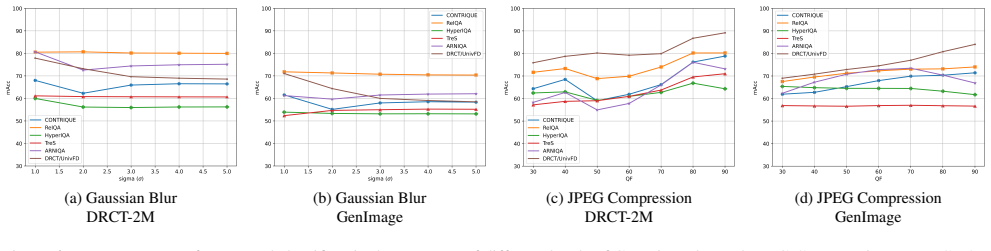
- Robustness to Gaussian blur is competitive with prior art, while JPEG compression remains a weaker point, so deployment should consider compression-aware variants.
Reading between the lines
- Because the frozen features are shared with quality prediction, an attacker who degrades an image to fool the detector would also lower the perceived quality score, coupling the two tasks in a way the paper does not explore.
- A natural next experiment the paper does not run is fine-tuning the IQA backbone on real/fake pairs; that would likely improve accuracy further but would sacrifice the multi-task reuse that makes the approach cheap.
- The t-SNE evidence is limited to one Stable Diffusion subset; a broader map across GAN and autoregressive models would test whether the separation is a general property of IQA features or specific to diffusion artifacts.
Editorial analysis
A structured set of objections, weighed in public.
Referee Report
Summary. The paper proposes "perceptual classifiers": frozen no-reference IQA backbones (CONTRIQUE, ReIQA, ARNIQA, HyperIQA, TReS) whose features are passed to a two-layer MLP trained with a combination of cross-entropy and margin-based contrastive loss on real, fake, real-reconstructed, and fake-reconstructed images. The classifiers are evaluated on GenImage, DRCT-2M, and UniversalFakeDetection, and the authors report state-of-the-art mean accuracy for CONTRIQUE (90.04 mAcc on GenImage, 91.23 mAcc on DRCT-2M), along with cross-dataset and distortion-robustness experiments.
Significance. If the evaluation is sound, the result is practically significant: CNN-based IQA backbones are lighter than CLIP-style transformers, already deployed in many image delivery pipelines, and their features can serve both quality prediction and fake-image detection. The paper offers broad comparisons across many generative models, cross-dataset transfer results, and fixed hyperparameters taken from prior work. The claim of state-of-the-art performance on GenImage and DRCT-2M is, however, weakened by a potentially confounded DRCT-2M protocol and by the absence of error bars; the abstract's robustness claim is also not supported by the paper's own Section 5.4. The work does not exhibit circularity: the classifier is trained on labeled real and fake data and evaluated on external test sets.
major comments (3)
- [§5.2, Tables 2–3] The DRCT-2M evaluation as described does not support the claim of generalization to unseen generators. Section 5.2 states that "the validation set contains the same set of real images from the MSCOCO dataset across all generative models," and Section 4.1 trains the classifier on the SDv1.4 subset of DRCT-2M. Since mAcc is the average of real-class and fake-class accuracy, if those same MSCOCO real images are used during training, a detector can inflate its real-class accuracy on every test subset by memorizing those images, independently of generator-specific artifacts. The 0.74 mAcc margin over DRCT/UnivFD in Table 2 (91.23 vs 90.49) is then not strong evidence of cross-generator generalization. The same protocol applies to all baselines, but the relative ordering can still be biased if CONTRIQUE's feature space is more sensitive to content identity. Please state the explicit train/validation split, confirm whether real images overlap, and report per-class accuracies or re-evaluate on a disjoint real-image set.
- [§5.4, Fig. 6, Abstract, §6] The abstract's claim of "significant robustness against image degradations" is contradicted by Section 5.4, which states that the CONTRIQUE classifier—the method achieving the headline SOTA numbers—"exhibited higher vulnerability to image distortions when compared to ReIQA and DRCT/UnivFD classifiers." The Conclusion's statement that "Our proposed models delivered better robustness against Gaussian blur" is likewise not supported by Figure 6 or the surrounding text. Please report numeric mAcc values and standard deviations for each method at each degradation level, attribute robustness separately to each classifier, and revise the abstract and conclusion to match the actual results.
- [Tables 1–3, §5.1] The headline SOTA margins are small (90.04 vs 89.48 mAcc on GenImage; 91.23 vs 90.49 on DRCT-2M) and are presented without error bars, repeated-seed variance, or significance tests. The per-subset numbers show that CONTRIQUE trails DRCT/UnivFD on BigGAN by 11.72 mAcc in Table 1 and on 7 of 16 DRCT-2M subsets in Table 2, so the aggregate advantage is driven by a subset of generators. Without variance estimates or a paired comparison, it is unclear whether the claimed advantage is stable. Please report at least three training runs with mean and standard deviation, or a paired test across subsets.
minor comments (6)
- [§4.2] The metric "mAcc" is not precisely defined; please state whether it is the arithmetic mean of per-generator accuracies, the mean class accuracy, or overall accuracy, since the label affects how the tables are read.
- [§3.3] The sentence "we used only data augmentation when studying specific degradation" is unclear; please describe whether augmentations are applied at inference in the robustness experiments and how that interacts with the degradation being studied.
- [§5.2] The description of the DRCT-2M validation protocol should include the number of real images and an explicit statement of whether the same real images are reused across all generator subsets; this information is essential for interpreting Table 2.
- [References] Reference [62] appears to be titled "LSUN: Construction of a Large-scale Image Dataset...", but the dataset described in the text is GenImage; please verify the citation and title.
- [Text and Tables] There are small presentation errors: "DRCT/CovnNext-B" should be "DRCT/ConvNext-B", and the Table 2 column header "LDMSDv1.4" should be separated into "LDM" and "SDv1.4".
- [§3.3] For reproducibility, please report the hidden-layer width of the two-layer classifier and the feature dimension used for each IQA backbone.
Circularity Check
No significant circularity: the perceptual classifiers are trained on labeled real/fake data and evaluated on held-out datasets; the IQA feature spaces, though partly from the same research group, are pretrained independently and tested rather than defined by the target result.
full rationale
The paper's derivation chain is empirical and self-contained. A two-layer network is trained on frozen IQA backbone features using cross-entropy and contrastive losses (Eqs. 1-3) on the SDv1.4 train split of GenImage/DRCT-2M, and then evaluated on held-out generative-model subsets and cross-dataset benchmarks (Tables 1-3). The claimed state-of-the-art results are benchmark measurements, not quantities that equal their inputs by construction. The central hypothesis (Section 3.1) that IQA features separate real from generated images is tested by t-SNE and by the benchmark itself; it is not assumed as the conclusion. The IQA models CONTRIQUE, ReIQA, and ARNIQA are from the same lab as co-author Bovik, and the paper reasonably cites them as existing feature extractors; however, these citations are not load-bearing in the logical sense because the paper does not invoke them as a uniqueness theorem or as proof of its claim, and the classifiers' performance is independently evaluated against multiple external baselines on the GenImage and DRCT-2M test protocols. Any concern about the DRCT-2M protocol using the same MSCOCO real images across all generator subsets (Section 5.2) is a potential evaluation confound affecting fair comparison, not circularity: it does not make the reported mAcc equal to a fitted parameter or reduce a prediction to its training input by construction. Similarly, borrowing the reconstruction-augmentation scheme and loss hyperparameters from DRCT [8] is method transfer, not circular validation. No equation in the paper is defined in terms of the target result, and no fitted value is renamed as a prediction. Hence the correct circularity score is 0.
Assumptions & free parameters
free parameters (7)
- contrastive loss weight lambda =
0.3
- contrastive margin m =
1
- learning rate =
1e-4
- weight decay =
4e-5
- reconstruction steps =
50
- guidance scale =
7.5
- evaluation threshold =
0.5 (GenImage, DRCT); optimal on validation (UniversalFakeDetection)
assumptions (4)
- domain assumption The feature space of IQA models trained to measure deviations from naturalness separates real from AI-generated images.
- domain assumption Frozen IQA backbones provide sufficient features; no backbone fine-tuning is needed.
- domain assumption SDv1 inpainting reconstructions with an empty prompt produce hard samples that improve generalization to unseen generative models.
- domain assumption Baseline results quoted from DRCT [8] and UnivFD [37] are accurate and directly comparable to the authors' runs.
Cite this review
Pith. "Pith review of Perceptual Classifiers: Detecting Generative Images using Perceptual Features." pith.science (2026). https://pith.science/paper/UWWYJ7XR
@misc{pith2026250717240,
  author       = {Pith},
  title        = {Pith review of: Perceptual Classifiers: Detecting Generative Images using Perceptual Features},
  year         = {2026},
  howpublished = {\url{https://pith.science/paper/UWWYJ7XR}},
  note         = {Machine review of arXiv:2507.17240}
}
read the original abstract
Image Quality Assessment (IQA) models are employed in many practical image and video processing pipelines to reduce storage, minimize transmission costs, and improve the Quality of Experience (QoE) of millions of viewers. These models are sensitive to a diverse range of image distortions and can accurately predict image quality as judged by human viewers. Recent advancements in generative models have resulted in a significant influx of "GenAI" content on the internet. Existing methods for detecting GenAI content have progressed significantly with improved generalization performance on images from unseen generative models. Here, we leverage the capabilities of existing IQA models, which effectively capture the manifold of real images within a bandpass statistical space, to distinguish between real and AI-generated images. We investigate the generalization ability of these perceptual classifiers to the task of GenAI image detection and evaluate their robustness against various image degradations. Our results show that a two-layer network trained on the feature space of IQA models demonstrates state-of-the-art performance in detecting fake images across generative models, while maintaining significant robustness against image degradations.
Figures


Figures from the paper (3 more)


Reference graph
Works this paper leans on
- [1]
-
[2]
Everypixel Journal - Your Guide to the Entangled World of AI 2024, 2024. 1
work page 2024
-
[3]
Shruti Agarwal and Hany Farid. Photo forensics from JPEG dimples.IEEE Workshop on Information Forensics and Se- curity (WIFS), pages 1–6, 2017. 1
work page 2017
-
[4]
Lorenzo Agnolucci, Leonardo Galteri, Marco Bertini, and Alberto Del Bimbo. ARNIQA: Learning Distortion Mani- fold for Image Quality Assessment.IEEE/CVF Winter Con- ference on Applications of Computer Vision (WACV), pages 188–197, 2024. 3, 4, 6, 7, 8
work page 2024
-
[5]
Quentin Bammey. Synthbuster: Towards Detection of Diffu- sion Model Generated Images.IEEE Open Journal of Signal Processing, 5:1–9, 2024. 2
work page 2024
-
[6]
Large Scale GAN Training for High Fidelity Natural Image Syn- thesis.ArXiv, abs/1809.11096, 2018
Andrew Brock, Jeff Donahue, and Karen Simonyan. Large Scale GAN Training for High Fidelity Natural Image Syn- thesis.ArXiv, abs/1809.11096, 2018. 1
arXiv 2018
-
[7]
Lucy Chai, David Bau, Ser-Nam Lim, and Phillip Isola. What makes fake images detectable? Understanding prop- erties that generalize.European Conference on Computer Vision, 2020. 2
work page 2020
-
[8]
Baoying Chen, Jishen Zeng, Jianquan Yang, and Rui Yang. DRCT: Diffusion Reconstruction Contrastive Training to- wards Universal Detection of Diffusion Generated Images. International Conference on Machine Learning, 2024. 1, 2, 3, 4, 5, 6, 7, 8
work page 2024
Show all 62 references
-
[9]
A single simple patch is all you need for AI-generated image detection.arXiv preprint arXiv:2402.01123, 2024
Jiaxuan Chen, Jieteng Yao, and Li Niu. A single simple patch is all you need for AI-generated image detection.arXiv preprint arXiv:2402.01123, 2024. 2
2024 arXiv
-
[10]
A Bayesian-MRF approach for PRNU- based image forgery detection.IEEE Transactions on In- formation Forensics and Security, 9(4):554–567, 2014
Giovanni Chierchia, Giovanni Poggi, Carlo Sansone, and Luisa Verdoliva. A Bayesian-MRF approach for PRNU- based image forgery detection.IEEE Transactions on In- formation Forensics and Security, 9(4):554–567, 2014. 2
2014
-
[11]
On the de- tection of synthetic images generated by diffusion models,
Riccardo Corvi, Davide Cozzolino, Giada Zingarini, Gio- vanni Poggi, Koki Nagano, and Luisa Verdoliva. On the de- tection of synthetic images generated by diffusion models,
-
[12]
Riccardo Corvi, Davide Cozzolino, Giovanni Poggi, Koki Nagano, and Luisa Verdoliva. Intriguing properties of syn- thetic images: from generative adversarial networks to dif- fusion models .IEEE/CVF Conference on Computer Vision and Pattern Recognition, pages 973–982, 2023. 2
2023
-
[13]
Forensictrans- fer: Weakly-supervised domain adaptation for forgery detec- tion.arXiv preprint arXiv:1812.02510, 2018
Davide Cozzolino, Justus Thies, Andreas R ¨ossler, Christian Riess, Matthias Nießner, and Luisa Verdoliva. Forensictrans- fer: Weakly-supervised domain adaptation for forgery detec- tion.arXiv preprint arXiv:1812.02510, 2018. 3
2018 arXiv
-
[14]
ImageNet: A large-scale hierarchical im- age database.2009 IEEE Conference on Computer Vision and Pattern Recognition, pages 248–255, 2009
Jia Deng, Wei Dong, Richard Socher, Li-Jia Li, Kai Li, and Li Fei-Fei. ImageNet: A large-scale hierarchical im- age database.2009 IEEE Conference on Computer Vision and Pattern Recognition, pages 248–255, 2009. 2, 5, 7
2009
-
[15]
Diffusion Models Beat GANs on Image Synthesis.Advances in Neural Information Processing Systems, pages 8780–8794, 2021
Prafulla Dhariwal and Alexander Quinn Nichol. Diffusion Models Beat GANs on Image Synthesis.Advances in Neural Information Processing Systems, pages 8780–8794, 2021. 1
2021
-
[16]
Leveraging Fre- quency Analysis for Deep Fake Image Recognition.Interna- tional Conference on Machine Learning, pages 3247–3258,
Joel Frank, Thorsten Eisenhofer, Lea Sch ¨onherr, Asja Fis- cher, Dorothea Kolossa, and Thorsten Holz. Leveraging Fre- quency Analysis for Deep Fake Image Recognition.Interna- tional Conference on Machine Learning, pages 3247–3258,
-
[17]
Alireza Golestaneh, Saba Dadsetan, and Kris M
S. Alireza Golestaneh, Saba Dadsetan, and Kris M. Kitani. No-Reference Image Quality Assessment via Transformers, Relative Ranking, and Self-Consistency .IEEE/CVF Win- ter Conference on Applications of Computer Vision, WACV 2022, Waikoloa, HI, USA, January 3-8, 2022, pages 398...
2022
-
[18]
Generative Adversarial Networks.Advances in Neural Information Processing Systems, 27, 2014
Ian Goodfellow, Jean Pouget-Abadie, Mehdi Mirza, Bing Xu, David Warde-Farley, Sherjil Ozair, Aaron Courville, and Yoshua Bengio. Generative Adversarial Networks.Advances in Neural Information Processing Systems, 27, 2014. 1
2014
-
[19]
Attributing and Detecting Fake Images Generated by Known GANs.2020 IEEE Secu- rity and Privacy Workshops, SP Workshops, San Francisco, CA, USA, May 21, 2020, pages 8–14, 2020
Matthew Joslin and Shuang Hao. Attributing and Detecting Fake Images Generated by Known GANs.2020 IEEE Secu- rity and Privacy Workshops, SP Workshops, San Francisco, CA, USA, May 21, 2020, pages 8–14, 2020. 2
2020
-
[20]
Progressive growing of gans for improved quality, stability, and variation.arXiv preprint arXiv:1710.10196, 2017
Tero Karras, Timo Aila, Samuli Laine, and Jaakko Lehtinen. Progressive growing of gans for improved quality, stability, and variation.arXiv preprint arXiv:1710.10196, 2017. 1, 2, 3
2017 arXiv
-
[21]
A Style- Based Generator Architecture for Generative Adversarial Networks.IEEE/CVF Conference on Computer Vision and Pattern Recognition, pages 4401–4410, 2019
Tero Karras, Samuli Laine, and Timo Aila. A Style- Based Generator Architecture for Generative Adversarial Networks.IEEE/CVF Conference on Computer Vision and Pattern Recognition, pages 4401–4410, 2019. 1
2019
-
[22]
Musiq: Multi-scale image quality transformer
Junjie Ke, Qifei Wang, Yilin Wang, Peyman Milanfar, and Feng Yang. Musiq: Multi-scale image quality transformer. IEEE/CVF International Conference on Computer Vision, pages 5148–5157, 2021. 3
2021
-
[23]
Fully deep blind image quality predictor.IEEE Journal of selected Topics in Signal Processing, 11(1):206–220, 2016
Jongyoo Kim and Sanghoon Lee. Fully deep blind image quality predictor.IEEE Journal of selected Topics in Signal Processing, 11(1):206–220, 2016. 3
2016
-
[24]
Belongie, James Hays, Pietro Perona, Deva Ramanan, Piotr Doll ´ar, and C
Tsung-Yi Lin, Michael Maire, Serge J. Belongie, James Hays, Pietro Perona, Deva Ramanan, Piotr Doll ´ar, and C. Lawrence Zitnick. Microsoft coco: Common objects in context. 2014. 5, 7
2014
-
[25]
Global Texture Enhancement for Fake Face Detection in the Wild
Zhengzhe Liu, Xiaojuan Qi, and Philip HS Torr. Global Texture Enhancement for Fake Face Detection in the Wild. IEEE/CVF Conference on Computer Vision and Pattern Recognition, pages 8060–8069, 2020. 6, 7
2020
-
[26]
Global Texture Enhancement for Fake Face Detection in the Wild
Zhengzhe Liu, Xiaojuan Qi, and Philip HS Torr. Global Texture Enhancement for Fake Face Detection in the Wild. IEEE/CVF Conference on Computer Vision and Pattern Recognition, pages 8060–8069, 2020. 2
2020
-
[27]
Image Quality Assessment using Contrastive Learning.IEEE Transactions on Image Processing, 31:4149–4161, 2022
Pavan C Madhusudana, Neil Birkbeck, Yilin Wang, Balu Adsumilli, and Alan C Bovik. Image Quality Assessment using Contrastive Learning.IEEE Transactions on Image Processing, 31:4149–4161, 2022. 2, 3, 4, 6, 7
2022
-
[28]
Do GANs leave artificial fingerprints? 2019 IEEE conference on multimedia information process- ing and retrieval (MIPR), pages 506–511, 2019
Francesco Marra, Diego Gragnaniello, Luisa Verdoliva, and Giovanni Poggi. Do GANs leave artificial fingerprints? 2019 IEEE conference on multimedia information process- ing and retrieval (MIPR), pages 506–511, 2019. 2
2019
-
[29]
No-Reference Image Quality Assessment in the Spa- tial Domain.IEEE Transactions on Image Processing, 21 (12):4695–4708, 2012
Anish Mittal, Anush Krishna Moorthy, and Alan Conrad Bovik. No-Reference Image Quality Assessment in the Spa- tial Domain.IEEE Transactions on Image Processing, 21 (12):4695–4708, 2012. 3
2012
-
[30]
Completely Blind
Anish Mittal, Rajiv Soundararajan, and Alan C. Bovik. Mak- ing a “Completely Blind” Image Quality Analyzer.IEEE Signal Processing Letters, 20(3):209–212, 2013. 3
2013
-
[31]
Blind Im- age Quality Assessment: From Natural Scene Statistics to Perceptual Quality .IEEE Transactions on Image Process- ing, 20(12):3350–3364, 2011
Anush Krishna Moorthy and Alan Conrad Bovik. Blind Im- age Quality Assessment: From Natural Scene Statistics to Perceptual Quality .IEEE Transactions on Image Process- ing, 20(12):3350–3364, 2011. 3
2011
-
[32]
Detecting GAN generated fake images using co-occurrence matrices
Lakshmanan Nataraj, Tajuddin Manhar Mohammed, Shiv- kumar Chandrasekaran, Arjuna Flenner, Jawadul H Bappy, Amit K Roy-Chowdhury, and BS Manjunath. Detecting GAN generated fake images using co-occurrence matrices. arXiv preprint arXiv:1903.06836, 2019. 1
1903 arXiv
-
[33]
Bappy, Amit K
Lakshmanan Nataraj, Tajuddin Manhar Mohammed, Shiv- kumar Chandrasekaran, Arjuna Flenner, Jawadul H. Bappy, Amit K. Roy-Chowdhury, and B. S. Manjunath. Detecting GAN generated Fake Images using Co-occurrence Matrices,
-
[34]
Toward a Practical Perceptual Video Quality Metric.https://netflixtechblog
Netflix Technology Blog. Toward a Practical Perceptual Video Quality Metric.https://netflixtechblog. com / toward - a - practical - perceptual - video - quality - metric - 653f208b9652, 2016. Accessed: 2024-09-07. 2
2016
-
[35]
Alexander Quinn Nichol, Prafulla Dhariwal, Aditya Ramesh, Pranav Shyam, Pamela Mishkin, Bob McGrew, Ilya Sutskever, and Mark Chen. GLIDE: Towards Photorealistic Image Generation and Editing with Text-Guided Diffusion Models.International Conference on Machine Learning, ICML 20...
2022
-
[36]
Exposing photo manipu- lation with inconsistent reflections.ACM Trans
James F O’brien and Hany Farid. Exposing photo manipu- lation with inconsistent reflections.ACM Trans. Graph., 31 (1):4–1, 2012. 1
2012
-
[37]
Utkarsh Ojha, Yuheng Li, and Yong Jae Lee. Towards Uni- versal Fake Image Detectors that Generalize Across Gen- erative Models .IEEE/CVF Conference on Computer Vi- sion and Pattern Recognition, CVPR 2023, Vancouver, BC, Canada, June 17-24, 2023, pages 24480–24489, 2023. 1, 2, ...
2023
-
[38]
Semantic Image Synthesis with Spatially-Adaptive Normalization.IEEE/CVF Conference on Computer Vision and Pattern Recognition, pages 2337–2346, 2019
Taesung Park, Ming-Yu Liu, Ting-Chun Wang, and Jun-Yan Zhu. Semantic Image Synthesis with Spatially-Adaptive Normalization.IEEE/CVF Conference on Computer Vision and Pattern Recognition, pages 2337–2346, 2019. 1
2019
-
[39]
Thinking in Frequency: Face Forgery Detection by Mining Frequency-aware Clues .European Conference on Computer Vision, pages 86–103, 2020
Yuyang Qian, Guojun Yin, Lu Sheng, Zixuan Chen, and Jing Shao. Thinking in Frequency: Face Forgery Detection by Mining Frequency-aware Clues .European Conference on Computer Vision, pages 86–103, 2020. 6, 7
2020
-
[40]
Learning Transferable Visual Models From Natural Language Supervision.International Conference on Machine Learning, 139:8748–8763, 2021
Alec Radford, Jong Wook Kim, Chris Hallacy, Aditya Ramesh, Gabriel Goh, Sandhini Agarwal, Girish Sastry, Amanda Askell, Pamela Mishkin, Jack Clark, Gretchen Krueger, and Ilya Sutskever. Learning Transferable Visual Models From Natural Language Supervision.International Confere...
2021
-
[41]
Zero-Shot Text-to-Image Generation, 2021
Aditya Ramesh, Mikhail Pavlov, Gabriel Goh, Scott Gray, Chelsea V oss, Alec Radford, Mark Chen, and Ilya Sutskever. Zero-Shot Text-to-Image Generation, 2021. 1
2021
-
[42]
Blattmann, Dominik Lorenz, Patrick Esser, and Bj ¨orn Ommer
Robin Rombach, A. Blattmann, Dominik Lorenz, Patrick Esser, and Bj ¨orn Ommer. High-Resolution Image Synthe- sis with Latent Diffusion Models.IEEE/CVF Conference on Computer Vision and Pattern Recognition (CVPR), pages 10674–10685, 2021. 1, 5
2021
-
[43]
Saad and Alan C
Michele A. Saad and Alan C. Bovik. Blind quality assess- ment of videos using a model of natural scene statistics and motion coherency .2012 Conference Record of the Forty Sixth Asilomar Conference on Signals, Systems and Com- puters (ASILOMAR), pages 332–336, 2012. 3
2012
-
[44]
Re-IQA: Unsupervised Learning for Image Quality Assessment in the Wild.IEEE/CVF Conference on Computer Vision and Pat- tern Recognition, pages 5846–5855, 2023
Avinab Saha, Sandeep Mishra, and Alan C Bovik. Re-IQA: Unsupervised Learning for Image Quality Assessment in the Wild.IEEE/CVF Conference on Computer Vision and Pat- tern Recognition, pages 5846–5855, 2023. 2, 3, 4, 7
2023
-
[45]
LAION- 400M: Open Dataset of CLIP-Filtered 400 Million Image- Text Pairs.arXiv preprint arXiv:2111.02114, 2021
Christoph Schuhmann, Richard Vencu, Romain Beaumont, Robert Kaczmarczyk, Clayton Mullis, Aarush Katta, Theo Coombes, Jenia Jitsev, and Aran Komatsuzaki. LAION- 400M: Open Dataset of CLIP-Filtered 400 Million Image- Text Pairs.arXiv preprint arXiv:2111.02114, 2021. 5, 7
2021 arXiv
-
[46]
Zeyang Sha, Zheng Li, Ning Yu, and Yang Zhang. DE- FAKE: Detection and Attribution of Fake Images Generated by Text-to-Image Generation Models.ACM SIGSAC Con- ference on Computer and Communications Security, pages 3418–3432, 2023. 2, 3, 6, 7
2023
-
[47]
Lsun: Construction of a large-scale image dataset using deep learning with humans in the loop .arXiv preprint arXiv:1506.03365, 2015
Fisher Yu Yinda Zhang Shuran Song and Ari Seff Jianxiong Xiao. Lsun: Construction of a large-scale image dataset using deep learning with humans in the loop .arXiv preprint arXiv:1506.03365, 2015. 3, 5
2015 arXiv
-
[48]
Shaolin Su, Qingsen Yan, Yu Zhu, Cheng Zhang, Xin Ge, Jinqiu Sun, and Yanning Zhang. Blindly Assess Image Qual- ity in the Wild Guided by a Self-Adaptive Hyper Network .2020 IEEE/CVF Conference on Computer Vision and Pat- tern Recognition, CVPR 2020, Seattle, WA, USA, June 13-...
2020
-
[49]
RAPIQUE: Rapid and accurate video quality prediction of user generated content
Zhengzhong Tu, Xiangxu Yu, Yilin Wang, Neil Birkbeck, Balu Adsumilli, and Alan C Bovik. RAPIQUE: Rapid and accurate video quality prediction of user generated content . IEEE Open Journal of Signal Processing, 2:425–440, 2021. 3
2021
-
[50]
Maxvit: Multi-axis vision transformer.European Conference on Computer Vision, pages 459–479, 2022
Zhengzhong Tu, Hossein Talebi, Han Zhang, Feng Yang, Peyman Milanfar, Alan Bovik, and Yinxiao Li. Maxvit: Multi-axis vision transformer.European Conference on Computer Vision, pages 459–479, 2022. 3
2022
-
[51]
CNN-generated images are surprisingly easy to spot
Sheng-Yu Wang, Oliver Wang, Richard Zhang, Andrew Owens, and Alexei A Efros. CNN-generated images are surprisingly easy to spot... for now.IEEE/CVF Conference on Computer Vision and Pattern Recognition, pages 8695– 8704, 2020. 2, 3, 6, 7
2020
-
[52]
Image quality assessment: from error visibility to structural similarity.IEEE Transactions on Image Process- ing, 13(4):600–612, 2004
Zhou Wang, Alan C Bovik, Hamid R Sheikh, and Eero P Si- moncelli. Image quality assessment: from error visibility to structural similarity.IEEE Transactions on Image Process- ing, 13(4):600–612, 2004. 2
2004
-
[53]
DIRE for Diffusion-Generated Image Detection.arXiv preprint arXiv:2303.09295, 2023
Zhendong Wang, Jianmin Bao, Wengang Zhou, Weilun Wang, Hezhen Hu, Hong Chen, and Houqiang Li. DIRE for Diffusion-Generated Image Detection.arXiv preprint arXiv:2303.09295, 2023. 3, 4, 6, 7
2023 arXiv
-
[54]
Detecting fake images by identifying potential texture difference.Future Gener
Jiachen Yang, Shuai Xiao, Aiyun Li, Guipeng Lan, and Hui- hui Wang. Detecting fake images by identifying potential texture difference.Future Gener. Comput. Syst., 125:127– 135, 2021. 1, 2
2021
-
[55]
From Patches to Pic- tures (PaQ-2-PiQ): Mapping the Perceptual Space of Picture Quality .IEEE/CVF Conference on Computer Vision and Pattern Recognition (CVPR), 2020
Zhenqiang Ying, Haoran Niu, Praful Gupta, Dhruv Mahajan, Deepti Ghadiyaram, and Alan Bovik. From Patches to Pic- tures (PaQ-2-PiQ): Mapping the Perceptual Space of Picture Quality .IEEE/CVF Conference on Computer Vision and Pattern Recognition (CVPR), 2020. 3
2020
-
[56]
Attributing Fake Images to GANs: Learning and Analyzing GAN Finger- prints.IEEE/CVF International Conference on Computer Vision, pages 7556–7566, 2019
Ning Yu, Larry S Davis, and Mario Fritz. Attributing Fake Images to GANs: Learning and Analyzing GAN Finger- prints.IEEE/CVF International Conference on Computer Vision, pages 7556–7566, 2019. 2
2019
-
[57]
A probabilistic quality representation approach to deep blind image quality prediction .arXiv preprint arXiv:1708.08190, 2017
Hui Zeng, Lei Zhang, and Alan C Bovik. A probabilistic quality representation approach to deep blind image quality prediction .arXiv preprint arXiv:1708.08190, 2017. 3
2017 arXiv
-
[58]
Blind Image Quality Assessment Using a Deep Bi- linear Convolutional Neural Network .IEEE Transactions on Circuits and Systems for Video Technology, 30(1):36–47,
Weixia Zhang, Kede Ma, Jia Yan, Dexiang Deng, and Zhou Wang. Blind Image Quality Assessment Using a Deep Bi- linear Convolutional Neural Network .IEEE Transactions on Circuits and Systems for Video Technology, 30(1):36–47,
-
[59]
Xu Zhang, Svebor Karaman, and Shih-Fu Chang. Detecting and Simulating Artifacts in GAN Fake Images.IEEE Inter- national Workshop on Information Forensics and Security, WIFS 2019, Delft, The Netherlands, December 9-12, 2019, pages 1–6, 2019. 1
2019
-
[60]
Detecting and Simulating Artifacts in GAN Fake Images.IEEE In- ternational Workshop on Information Forensics and Security (WIFS), pages 1–6, 2019
Xu Zhang, Svebor Karaman, and Shih-Fu Chang. Detecting and Simulating Artifacts in GAN Fake Images.IEEE In- ternational Workshop on Information Forensics and Security (WIFS), pages 1–6, 2019. 2, 3
2019
-
[61]
Patchcraft: Exploring texture patch for efficient ai-generated image detection .arXiv preprint arXiv:2311.12397, pages 1–18, 2024
Nan Zhong, Yiran Xu, Sheng Li, Zhenxing Qian, and Xin- peng Zhang. Patchcraft: Exploring texture patch for efficient ai-generated image detection .arXiv preprint arXiv:2311.12397, pages 1–18, 2024. 2
2024 arXiv
-
[62]
LSUN: Construction of a Large-scale Image Dataset using Deep Learning with Humans in the Loop.Ad- vances in Neural Information Processing Systems, 36, 2024
Mingjian Zhu, Hanting Chen, Qiangyu Yan, Xudong Huang, Guanyu Lin, Wei Li, Zhijun Tu, Hailin Hu, Jie Hu, and Yunhe Wang. LSUN: Construction of a Large-scale Image Dataset using Deep Learning with Humans in the Loop.Ad- vances in Neural Information Processing Systems, 36, 2024....
2024
Reviewed August 6, 2026 · model on record in the stance chip above.
Discussion (0). Sign in to comment.