REVIEW 4 major objections 6 minor 31 references
From Points to Spheres: A Geometric Reinterpretation of Variational Autoencoders
T0 review · 4 major / 6 minor · reviewed 2026-08-06 · deepseek-v4-flash
Pith's one-line read The paper argues that the constraining effect of KL divergence on the latent space, not reparameterization or stochastic sampling, is what gives autoencoders generative power, and the same compactness explains VQ-VAE.
desk verdict Useful metrics and an honest but flawed VQ-VAE unification: the paper deserves review, but its central claim about compactness over stochasticity needs a learned-prior control. read the letter →
The pith
A machine-rendered reading of the paper's core claim, the machinery that carries it, and where it could break.
The reading
What carries the argument
The central object is the Gaussian ball: each latent code is an anisotropic ellipsoid centered at the encoder mean $\mu$ with shape set by the encoder variance $\sigma^2$, rather than a deterministic point. The KL divergence to a standard normal prior acts as the load-bearing constraint: it pushes the variance toward 1 and the mean toward 0, so the balls occupy stable volume, push against one another, and distribute more uniformly. The paper measures that effect with two new tools: Coefficient of Variation of Nearest-Neighbor Distances (CV-NND), which scores local-density uniformity, and Dynamic Latent Coverage (DLC), which tracks how much of the prior is covered by real encodings during training. In the VQ-VAE extension, the same role is played by a learnable codebook constraint that pulls encodings to cluster centers.
What would settle it
Train a matched pair of models with identical architectures, initialization, data, and the same KL/spread regularization: one trained with reparameterization sampling, the other trained deterministically on mean codes only. If the deterministic model, after equal training, decodes random draws from $\mathcal{N}(0, I)$ into samples of comparable quality to the VAE's, then compactness alone is sufficient; if it clearly fails, reparameterization is doing load-bearing work.
Extended reading notes
Core claim
On the paper's own terms, the discovery is that "the constraining effect of the KL divergence on the latent space is key to the emergence of semantics, rather than the reparameterization itself." A VAE's encoder is best understood as placing a Gaussian ball, not a point, at each input's latent location; the KL term prevents these balls from collapsing to arbitrarily small regions. Reparameterization then teaches the decoder to reconstruct from within those stochastic regions, acting as a regularizer and an encoder-decoder contract that expands the set of latent points with defined meaning. Because the essential function is anti-collapse compactness, the paper shows that replacing the KL term with an asymmetric spread penalty or with an MSE constraint toward a learnable codebook yields the same generative behavior, and it interprets VQ-VAE as the discrete special case where generation is enabled by compactness rather than stochasticity.
Load-bearing premise
The load-bearing assumption is that when a randomly initialized decoder trained only on the encoder's mean codes fails to produce meaningful stochastic samples, the failure is caused by the absence of reparameterization during training rather than by the decoder's random starting point, its different training trajectory, or weaker alignment with the original latent distribution.
Editorial extensions
If this is right
- If compactness rather than stochastic sampling is the active ingredient, then a plain autoencoder equipped with a compactness regularizer should support meaningful random sampling without reparameterization; the paper's asymmetric-spread and codebook experiments demonstrate this.
- The KL term can be replaced by cheaper, more targeted regularizers, such as penalizing only under-dispersed dimensions or penalizing squared log-variance, and still match VAE generation behavior.
- VQ-VAE is explained without a continuous prior: its discrete codes work because the codebook learning and commitment loss keep the encoder's image compact and anchored to cluster centers, not because of stochasticity.
- Latent-space health can be monitored with the two proposed metrics, CV-NND and DLC, giving a training-time signal for whether the semantic manifold is becoming uniform and well covered.
- The encoder-decoder contract matters: if the decoder is trained without seeing stochastic or quantized variants of the code, sampling from the prior can fail even when interpolation along fixed dimensions remains meaningful.
Reading between the lines
- If the compactness view is right, a deterministic autoencoder regularized by explicit uniformity penalties, such as a repulsive nearest-neighbor term, should match VAE random-sample quality; the paper does not run this exact test.
- The DLC coverage trajectory is a natural predictor of downstream generation quality; one could test whether models whose coverage saturates early also produce better samples, giving a cheap early-stopping or architecture-search signal.
- The contractual-mechanism idea suggests a design rule for discrete autoencoders: decoders should consume only codebook entries, not raw encoder outputs, and large codebooks may need a matching increase in decoder exposure to quantized codes to avoid semantic collapse.
- The framework predicts that any latent-space model, continuous or discrete, will gain generative ability roughly to the degree its encoder's image is compact and well covered, so generation quality should track compactness metrics rather than the form of the prior.
Editorial analysis
A structured set of objections, weighed in public.
Referee Report
Summary. The paper proposes a geometric reinterpretation of variational autoencoders, viewing each latent code as a Gaussian ball rather than a deterministic point. It claims that the constraining effect of the KL divergence on the encoder is the primary cause of semantic manifold formation, that reparameterization acts as a regularization and contractual mechanism rather than as the source of generative ability, and that VQ-VAEs generate successfully because of latent-space compactness rather than stochasticity. The paper introduces two metrics, CV-NND and Dynamic Latent Coverage, and presents qualitative experiments on MNIST, FashionMNIST, CIFAR-10, CelebA, and 3D Chairs, including a codebook-regularized autoencoder offered as a unified framework. The authors explicitly acknowledge that formal theoretical underpinnings are deferred to future work.
Significance. If the central claim were established, the paper would provide a useful conceptual unification of VAE and VQ-VAE, redirecting attention from stochastic sampling to latent-space geometry. The proposed metrics are simple and potentially reusable, and the paper is honest about its limitations. However, the evidence is currently qualitative and partly confounded; the VQ-VAE half is not tested under standard conditions, and the decoder-replacement experiment has a major confound. The paper is best read as an interpretation and hypothesis-generation contribution rather than a demonstration of its central claim.
major comments (4)
- [§3.5] The VQ-VAE half of the central claim is not supported by the experiments in §3.5. The model trained there (path A in Figure 6) passes the raw encoder output to the decoder and uses the codebook only as a regularizer; it is not a VQ-VAE. The failure of uniform random codebook sampling to produce meaningful images (Figure 9) is not evidence about VQ-VAE, because standard VQ-VAE generation samples from a learned autoregressive prior over code indices, not from a uniform distribution. The authors' own observation that uniform sampling fails is direct evidence that compactness alone is insufficient for generation. To support the claim in §3.3 that 'the key lies in the compactness of the latent space, not necessarily in stochastic quantization,' the authors need to train a standard VQ-VAE and evaluate sampling under its standard protocol, or at least compare uniform versus learned-prior sampling in their model.
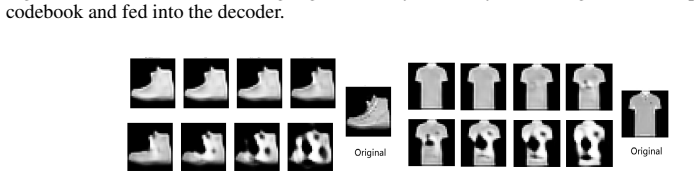
- [§2.3] The decoder-replacement experiment in §2.3 is confounded and therefore cannot carry the claim that reparameterization 'effectively increases the density of semantic definition.' The replacement decoder is randomly initialized and trained only on mean codes, without KL regularization, sampling, or any constraint that aligns it with the original encoder's stochastic regions. Its failure to produce meaningful outputs from stochastic samples could be due to a different training trajectory, a mismatch between its training distribution (deterministic μ codes) and the evaluation distribution (stochastic samples), or insufficient optimization. The authors acknowledge that 'the underlying mechanism remains unclear,' yet the conclusion in §4 relies on this experiment as evidence. A control that trains the replacement decoder on stochastic samples from the frozen original encoder, or that uses the same optimizer and epochs and verifies convergence, is needed before this result can be interpreted.
- [§2.1, §3.3] The empirical evidence for the central claim is not quantitatively grounded. Figures 2b and 5 show single runs with no error bars or repeated seeds, and most other results are grid images without quantitative quality metrics. The paper's conclusions are qualitative ('smooth and meaningful,' 'fragmented outputs'), which is insufficient for a claim that distinguishes between two mechanisms. At minimum, report means and standard deviations over multiple seeds for CV-NND and DLC, and include a quantitative measure of generated-sample quality (e.g., FID or a reconstruction-based metric) for the sampling and perturbation experiments.
- [§4] The paper's own limitation statement in §4 ('formal theoretical underpinnings ... remain an important subject for future investigation') accurately describes the state of the manuscript, but this makes the central claim—that compactness, not stochasticity, is the fundamental enabler—rest entirely on the empirical arguments above. Since those arguments are confounded and not quantitative, the claim is currently an interpretation rather than a demonstrated result. The manuscript should either provide a formal argument linking KL/regularization to the geometric properties it invokes, or substantially strengthen the experimental design.
minor comments (6)
- [§2.2] The text states that 'both versions can achieve the same results as VAE' but only shows results for the Asymmetric Expansion variant; the Symmetric Stabilization variant should either be shown or the claim should be qualified.
- [§3.2] The loss in §3.2 differs from the standard VQ-VAE objective, which uses stop-gradient and a commitment loss; the claim that VQ-VAE is a special case of the proposed framework needs a precise statement of how the objectives match.
- [Appendix A.1] In Algorithm 1, the loop 'for j = 2 to knn' skips the closest neighbor; this should be stated explicitly in the main text because it affects the interpretation of the adaptive radius τ.
- [References] The Baldi and Hornik reference appears twice (as [7] and [8]) with the same content; the duplicate should be removed.
- [Throughout] The term 'compactness' is used in several different senses (KL pulling variance toward 1, a finite codebook, and the informal 'inverse compactness constraint'); a precise definition or at least a disambiguation would improve clarity.
- [§2.1] The 'AE with KL' baseline is not a standard autoencoder but a VAE whose decoder ignores the sampled noise; this should be stated more prominently so readers do not confuse it with an ordinary AE.
Circularity Check
No significant circularity: the paper offers an interpretive geometric framework supported by experiments; no claim reduces to its own inputs by construction.
full rationale
The paper does not fit parameters and then rename them as predictions. The proposed metrics (CV-NND, DLC) are descriptive and are not fitted to the central claim. The decoder-replacement experiment and the codebook-regularized autoencoder experiments are empirical probes, and their limitations are acknowledged in the text as open questions rather than disguised definitions. VQ-VAE is described as a special case of the framework by construction—the codebook loss is literally the VQ-VAE constraint—but this construction is used only to draw a conceptual connection, not to mathematically force the conclusion that compactness explains generative capability. There are no load-bearing self-citations: the sole author cites no prior work of their own, and the 'compactness rather than stochasticity' idea is attributed externally to De Bortoli et al. (2021). The main weaknesses of the VQ-VAE argument—such as the absence of a learned autoregressive prior control and the confounding of the decoder-replacement setup—are matters of empirical support and external validity, not circularity. Therefore no circular step meets the required evidentiary bar.
Assumptions & free parameters
free parameters (4)
- KL weight beta =
0.05, 0.1
- Codebook regularization weight lambda =
0.1
- DLC percentile eta =
95
- knn (number of nearest neighbors) =
5
assumptions (3)
- domain assumption Euclidean nearest-neighbor distance in the latent space is a meaningful proxy for semantic uniformity
- domain assumption Training an autoencoder to output a variance and applying KL while discarding the sampled code isolates the effect of stochastic sampling from the effect of the KL constraint
- domain assumption A decoder retrained on mean codes can be used to test whether reparameterization is necessary for generation; failure of the replacement decoder is attributable to absence of reparameterization rather than to optimization or architecture differences
Cite this review
Pith. "Pith review of From Points to Spheres: A Geometric Reinterpretation of Variational Autoencoders." pith.science (2026). https://pith.science/paper/QQBT34T7
@misc{pith2026250717255,
  author       = {Pith},
  title        = {Pith review of: From Points to Spheres: A Geometric Reinterpretation of Variational Autoencoders},
  year         = {2026},
  howpublished = {\url{https://pith.science/paper/QQBT34T7}},
  note         = {Machine review of arXiv:2507.17255}
}
read the original abstract
Variational Autoencoder is typically understood from the perspective of probabilistic inference. In this work, we propose a new geometric reinterpretation which complements the probabilistic view and enhances its intuitiveness. We demonstrate that the proper construction of semantic manifolds arises primarily from the constraining effect of the KL divergence on the encoder. We view the latent representations as a Gaussian ball rather than deterministic points. Under the constraint of KL divergence, Gaussian ball regularizes the latent space, promoting a more uniform distribution of encodings. Furthermore, we show that reparameterization establishes a critical contractual mechanism between the encoder and decoder, enabling the decoder to learn how to reconstruct from these stochastic regions. We further connect this viewpoint with VQ-VAE, offering a unified perspective: VQ-VAE can be seen as an autoencoder where encodings are constrained to a set of cluster centers, with its generative capability arising from the compactness rather than its stochasticity. This geometric framework provides a new lens for understanding how VAE shapes the latent geometry to enable effective generation.
Figures


Figures from the paper (17 more)




Reference graph
Works this paper leans on
-
[1]
Deep generative clustering with vaes and expectation- maximization
Michael Adipoetra and Ségolène Martin. Deep generative clustering with vaes and expectation- maximization. arXiv preprint arXiv:2103.10365,
-
[7]
URL https://arxiv.org/abs/2006.10599. Li Deng. The mnist database of handwritten digit images for machine learning research. IEEE Signal Processing Magazine, 29(6):141–142,
work page Pith review arXiv 2006
-
[8]
URL https: //arxiv.org/abs/1406.2661. Irina Higgins, Loic Matthey, Arka Pal, Christopher Burgess, Xavier Glorot, Matthew Botvinick, Shakir Mohamed, and Alexander Lerchner. beta-V AE: Learning basic visual concepts with a constrained variational framework. In International Conference on Learning Representations ,
-
[10]
Tero Karras, Samuli Laine, and Timo Aila
URL https://arxiv.org/abs/1710.10196. Tero Karras, Samuli Laine, and Timo Aila. A style-based generator architecture for generative adversarial networks,
-
[11]
Yannic Kilcher, Aurélien Lucchi, and Thomas Hofmann
URL https://arxiv.org/abs/1812.04948. Yannic Kilcher, Aurélien Lucchi, and Thomas Hofmann. Semantic interpolation in implicit models. CoRR, abs/1710.11381,
-
[12]
Semantic Interpolation in Implicit Models
URL http://arxiv.org/abs/1710.11381. Diederik P. Kingma and Jimmy Ba. Adam: A method for stochastic optimization,
-
[13]
Diederik P Kingma and Max Welling
URL https://arxiv.org/abs/1412.6980. Diederik P Kingma and Max Welling. Auto-encoding variational bayes,
-
[14]
URL https: //arxiv.org/abs/1312.6114. Yonghyeon Lee. A geometric perspective on autoencoders,
Show all 31 references
-
[16]
Ziwei Liu, Ping Luo, Xiaogang Wang, and Xiaoou Tang
URL https://arxiv.org/abs/2106.16091. Ziwei Liu, Ping Luo, Xiaogang Wang, and Xiaoou Tang. Deep learning face attributes in the wild. In Proceedings of International Conference on Computer Vision (ICCV), December
-
[19]
Yuki Matsuoka, Masanori Saito, Yuji Oishi, and Shohei Shimizu
URL http://arxiv.org/abs/1511.05644. Yuki Matsuoka, Masanori Saito, Yuji Oishi, and Shohei Shimizu. Generalized multimodal elbo. arXiv preprint arXiv:2106.12134,
-
[21]
Learning sparse generative models of audiovisual signals
Paul K Rubenstein, Luca Bongini, Bernhard Schölkopf, and Joachim M Buhmann. Learning sparse generative models of audiovisual signals. In 2018 IEEE International Conference on Acoustics, Speech and Signal Processing (ICASSP), pages 2781–2785. IEEE,
2018
-
[23]
Ilya Tolstikhin, Olivier Bousquet, Sylvain Gelly, and Bernhard Schoelkopf
URL https://arxiv.org/abs/1807.06650. Ilya Tolstikhin, Olivier Bousquet, Sylvain Gelly, and Bernhard Schoelkopf. Wasserstein auto- encoders,
-
[24]
Arash Vahdat, William G
URL https://arxiv.org/abs/1711.01558. Arash Vahdat, William G. Macready, and Zhengbing Bian. Dvae++: Discrete variational autoencoders with overlapping transformations. arXiv preprint arXiv:1802.04920,
-
[26]
Laurens Van der Maaten and Geoffrey Hinton
URL http://arxiv.org/abs/1711.00937. Laurens Van der Maaten and Geoffrey Hinton. Visualizing data using t-sne. Journal of Machine Learning Research, 9:2579–2605,
-
[30]
URL https://arxiv.org/abs/2302.11756. 13 A Appendix A.1 Algorithm of Dynamic Latent Coverage Algorithm 1 Dynamic Latent Coverage at Epoch t Input: Encoder f µ, eval set D = {xi}M i=1, M = 1000 Prior samples N = 1000, knn = 5, percentile η (e.g.,
-
[32]
[2019, 2018] This section will further explore and validate the generative potential of AEs from this perspective
Similar with the operation in StyleGAN.Karras et al. [2019, 2018] This section will further explore and validate the generative potential of AEs from this perspective. A.3 Perturbation and Interpolation of Latent Codes in Autoencoders Figure 10: Add perturbation on the first 8...
2019
-
[33]
Extending the Geometric View: Connection to VQ-V AE
The interpolation is defined as: z = (1− α)z1 + αz2, α ∈ [0, 1] where z1 and z2are the latent codes of two input images, and α controls the interpolation weight. The decoder produces smoothly transitioning outputs, demonstrating continuous variation between the original images...
2017
-
[95]
Output: Coveraget ∈ [0, 1] 1: for i = 1to M do µi ← f µ(xi) 2: end for 3: S ← {µ1, . . . , µM } 4: D ← ∅ 5: for i = 1to M do Find knn nearest neighbors of µi in S \ {µi} for j = 2to knn do // skip closest d ← ∥µi − µ(j)∥2; Append d to D end for 6: end for 7: τ ← percentile(D, ...
2023
-
[1986]
URL https://doi.org/10.1038/323533a0
doi: 10.1038/323533a0. URL https://doi.org/10.1038/323533a0. Received: 01 May 1986; Accepted: 31 July 1986; Published: 09 October
1986 doi
-
[2008]
Vector quantized wasserstein auto-encoder
Tung-Long Vuong, Trung Le, and He Zhao. Vector quantized wasserstein auto-encoder. arXiv preprint arXiv:2104.06872,
-
[2014]
Neural networks and principal component analysis: Learning from examples without local minima
Pierre Baldi and Kurt Hornik. Neural networks and principal component analysis: Learning from examples without local minima. Neural Networks, 2(1):53–58, 1989a. ISSN 0893-6080. doi: https: //doi.org/10.1016/0893-6080(89)90014-2. URL https://www.sciencedirect.com/science/ artic...
-
[2015]
Understanding posterior collapse in generative latent variable models
James Lucas, George Tucker, Roger Grosse, and Mohammad Norouzi. Understanding posterior collapse in generative latent variable models. arXiv preprint arXiv:1901.03416,
1901 arXiv
-
[2016]
Qien Yu, Shengxin Dai, Ran Dong, and Soichiro Ikuno
URL https://arxiv.org/abs/1609.04468. Qien Yu, Shengxin Dai, Ran Dong, and Soichiro Ikuno. Attention-based vector quantized variational autoencoder for anomaly detection by using orthogonal subspace constraints. Pattern Recognition, 164:111500,
-
[2017]
Irina Higgins, Loic Matthey, Arka Pal, Christopher P Burgess, Xavier Glorot, Matthew Botvinick, Shakir Mohamed, and Alexander Lerchner
URL https://openreview.net/forum?id=Sy2fzU9gl. Irina Higgins, Loic Matthey, Arka Pal, Christopher P Burgess, Xavier Glorot, Matthew Botvinick, Shakir Mohamed, and Alexander Lerchner. Understanding disentangling in beta-vae. arXiv preprint arXiv:1804.03599,
-
[2018]
Zichuan Chen and Peng Liu
URL http://arxiv.org/abs/1807.07543. Zichuan Chen and Peng Liu. Towards better data augmentation using wasserstein distance in variational auto-encoder,
-
[2019]
Generalizing backpropagation for better learning in deep networks
Yoshua Bengio, Guillaume Alain, and Hugo Larochelle. Generalizing backpropagation for better learning in deep networks. arXiv preprint arXiv:1305.6663, 2013a. Yoshua Bengio, Aaron Courville, and Pascal Vincent. Representation learning: A review and new perspectives. IEEE Trans...
-
[2020]
Vignesh Prasad, Dipanjan Das, and Brojeshwar Bhowmick
URL https://arxiv.org/abs/1802.03426. Vignesh Prasad, Dipanjan Das, and Brojeshwar Bhowmick. Variational clustering: Leveraging variational autoencoders for image clustering. In Proceedings of the International Conference on Pattern Recognition (ICPR),
-
[2021]
Valentin De Bortoli, Shixiao Xu, and Yee Whye Teh
URL https://arxiv.org/abs/2006.10597. Valentin De Bortoli, Shixiao Xu, and Yee Whye Teh. From variational to deterministic autoencoders. arXiv preprint arXiv:2106.05211,
2006 arXiv
-
[2022]
Brian Cheung, Jesse A Livezey, Arun K Bansal, and Bruno A Olshausen
URL https://arxiv.org/abs/2109.14795. Brian Cheung, Jesse A Livezey, Arun K Bansal, and Bruno A Olshausen. Discovering hidden factors of variation in deep networks. arXiv preprint arXiv:1412.6583,
-
[2023]
Felix Leeb, Stefan Bauer, Michel Besserve, and Bernhard Schölkopf
URL https://arxiv.org/abs/ 2309.08247. Felix Leeb, Stefan Bauer, Michel Besserve, and Bernhard Schölkopf. Exploring the latent space of autoencoders with interventional assays,
-
[2025]
doi: https://doi.org/10.1016/j.patcog.2025.111500
ISSN 0031-3203. doi: https://doi.org/10.1016/j.patcog.2025.111500. URL https://www.sciencedirect.com/science/article/pii/S0031320325001608. Yijia Zheng, Tong He, Yixuan Qiu, and David Wipf. Learning manifold dimensions with conditional variational autoencoders,
2025
Reviewed August 6, 2026 · model on record in the stance chip above.
Discussion (0). Sign in to comment.