REVIEW 4 major objections 5 minor 3 references
Pictorial and Documentary Guide for Research, Teaching, and Education through Astronomy, Physics, and Mathematics Pursued under the Umbrella of the United Nations (1974-2024)
T0 review · 4 major / 5 minor · reviewed 2026-08-06 · deepseek-v4-flash
Pith's one-line read A fifty-year guide assembles the United Nations' record of space-science education, teaching, and research.
desk verdict A useful but error-prone archival compilation; the 'comprehensive' claim needs softening and the centre count needs fixing. read the letter →
The pith
A machine-rendered reading of the paper's core claim, the machinery that carries it, and where it could break.
The reading
What carries the argument
The object that carries the argument is the guide itself: a chronological, region-by-region inventory of UN documents, workshop reports, curricula, photographs, and proceedings links, organized around the seven affiliated regional centres and the twenty workshops. Within the research strand, the mathematical machinery doing the work is fractional calculus and the theory of special functions, with the Mittag-Leffler function described as the 'queen function' of fractional calculus and the Fox H-function as central to fractional quantum mechanics; these objects convert physical problems such as solar neutrino flux deficits and anomalous diffusion into closed-form analytic expressions. The guide treats these two levels—the documentary inventory and the mathematical research line—as one fifty-year program.
What would settle it
Compare the guide's list of workshops, centres, and curricula against the document repository of the UN Office for Outer Space Affairs; if a UN-affiliated space-science workshop, regional-centre curriculum, or education report from 1974-2024 is missing, the comprehensiveness claim falls.
Extended reading notes
Core claim
The paper claims to be a comprehensive guide to five decades of UN-affiliated activity in space science and technology. It inventories the establishment of seven regional centres for space science and technology education in Africa, Latin America and the Caribbean, Asia and the Pacific, Western Asia, and Europe; the development of graduate-level curricula in remote sensing and GIS, satellite meteorology and global climate, satellite communications, space and atmospheric science, and global navigation satellite systems; and the series of twenty UN workshops on basic space science, the International Heliophysical Year 2007, and the International Space Weather Initiative. It also documents the research strand that accompanied these educational programs, including analytic solar models and nuclear reaction rates connected to the solar neutrino problem, the formation of structure in the early universe, and the use of fractional calculus and special functions such as the Mittag-Leffler and Fox H-functions. The guide's stated purpose is to give access to the underlying documents and proceedings in Arabic, Chinese, English, French, Russian, and Spanish.
Load-bearing premise
The guide's claim to comprehensiveness rests on the assumption that the authors' prior publications and the UN documents they cite accurately and completely describe the fifty-year history, without omitting relevant workshops, centres, or curricula.
Editorial extensions
If this is right
- A single access point now exists for locating the UN General Assembly workshop reports, curricula, and proceedings from 1974-2024 in six official languages.
- The seven regional-centre curricula define a standard university-level syllabus for remote sensing, satellite meteorology, satellite communications, space and atmospheric science, and global navigation satellite systems.
- The workshop series is documented as a channel that delivered telescopes, planetariums, and space-weather instruments to institutions in developing countries.
- The research narrative ties the resolution of the solar neutrino problem to analytic methods from fractional calculus and special functions, making that mathematical toolkit part of the historical record.
Reading between the lines
- A structured dataset built from the guide's workshop list could test, host country by host country, whether instrument donations were followed by sustained local research output.
- The entropy-production analysis of solar neutrino data mentioned in the paper suggests a quantitative extension: compare the predictions of anomalous-diffusion entropy models against the full Super-Kamiokande time series.
- The guide's regional-centre model could be compared with other international capacity-building schemes to see which curriculum features correlate with long-term institutional survival.
- If the omitted or inaccessible workshop reports were recovered, the 'comprehensive' description would shift from an authorial claim to an independently verifiable archive.
Editorial analysis
A structured set of objections, weighed in public.
Referee Report
Summary. This manuscript, submitted as a pictorial and documentary guide, recounts fifty years (1974-2024) of education, teaching, and research activities in astronomy, physics, and mathematics conducted by the authors, partly under the auspices of the United Nations. It covers the authors' solar-neutrino and structure-formation research, the development of teaching curricula for UN-affiliated regional centres, and a workshop-by-workshop inventory of twenty UN basic space science, IHY2007, and ISWI workshops with links to UN documents and proceedings. The paper concludes that it serves as a comprehensive guide offering access to documents in the six official UN languages and documents an unprecedented multi-agency educational effort.
Significance. If its factual contents are reliable, the paper provides a useful archival record of a multi-decade UN capacity-building programme: it assembles direct links to UN OOSA reports, workshop proceedings, curricula, and related open-access publications, and it identifies the network of regional centres and the sequence of workshops in one place. These strengths are real and give the paper documentary value for historians of science education and for practitioners in space-science capacity building. However, the archival value depends on the accuracy and consistency of the inventory, and the current manuscript contains several concrete discrepancies that undercut the 'comprehensive guide' claim: a mismatch between the abstract's seven regional centres and the six listed in the body, an assertion that reports for all 20 workshops are openly accessible while four are explicitly marked as unavailable, and at least two figure captions with wrong dates. These are fixable within the manuscript's scope, so the central idea remains defensible, but the claims need to be qualified and corrected before the paper can be considered reliable as a reference guide.
major comments (4)
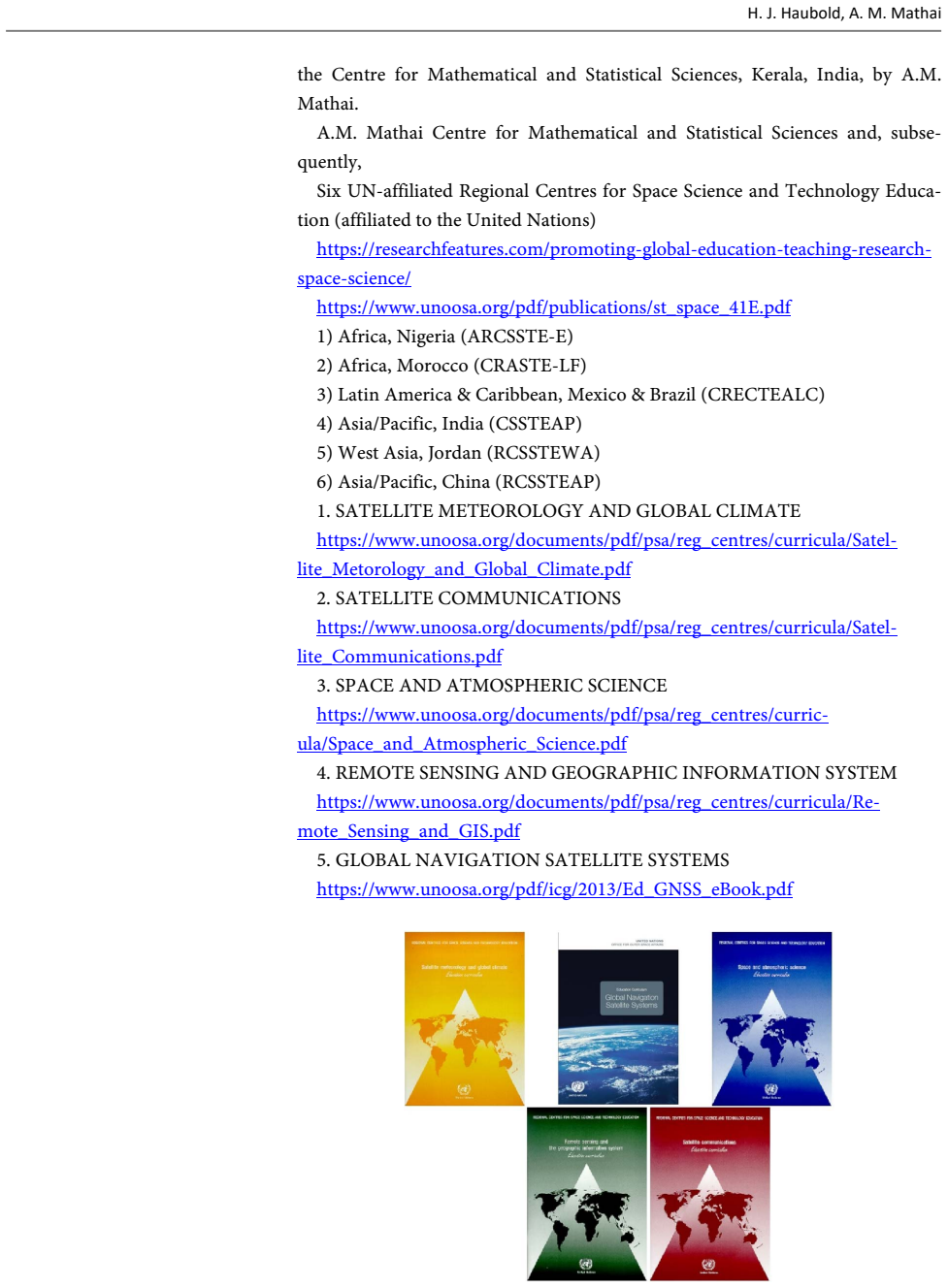
- [Abstract and 'Six UN-affiliated Regional Centres' list] The Abstract states that 'seven regional centres for space science and technology education were established in all regions of the world: Asia and the Pacific, Latin America and the Caribbean, Africa, Western Asia, and Europe,' but the body's list (the itemized 'Six UN-affiliated Regional Centres for Space Science and Technology Education') enumerates only six centres (Nigeria, Morocco, Mexico/Brazil, India, Jordan, China) and includes no European centre. The Conclusion repeats the 'comprehensive guide' claim without addressing this discrepancy. Please reconcile the count and the regional coverage, or explicitly qualify the abstract and conclusion.
- [Workshop inventory (entries 01-04)] In the section 'Education Workshops ... Prepared at the United Nations, New York, USA, 1988-2012', the text states 'Below the reports on each of the 20 workshops are Open Accessible in the six official languages of the United Nations.' This is directly contradicted by the entries for 01_India_1991, 02_Columbia and Costa Rica_1992, 03_Nigeria_1993, and 04_Egypt_1994, each of which is marked '(report not available online)'. The abstract's weaker claim of access to 'most' documents is compatible with these missing reports, but the sentence asserting open accessibility of the reports on all 20 workshops is false as written. Please revise the wording to indicate which reports are available online and which are not.
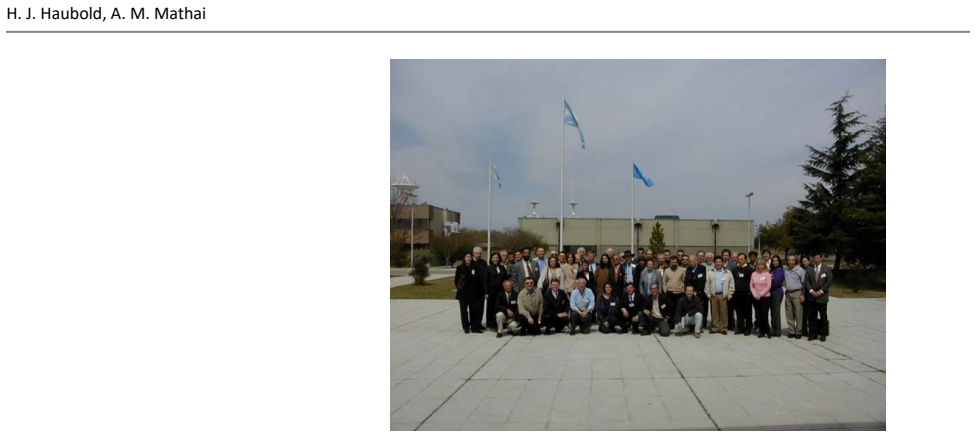
- [Figure captions 21 and 29] Figure 29 is captioned 'Group photo of the 2001 workshop in Nigeria' but the corresponding entry is 19_Nigeria_2011 (Abuja, 17-21 October 2011). Similarly, Figure 21 is captioned 'meeting for discussions during the 2004 United Arab Emirates workshop' while the text and UN document reference for workshop 13 specify 20-23 November 2005. Since the paper's value is as a documentary record, these caption errors are substantive rather than cosmetic; they should be corrected and the remaining figure captions checked systematically against the dates in the text.
- [Title and Introduction chronology] The title claims the activities were 'Pursued under the Umbrella of the United Nations (1974-2024)', but the Introduction states that in 1974 Treder advised the authors to take up the solar neutrino problem, and only in 1988 was one author relocated to the Outer Space Affairs Division of the United Nations. The 1974-1988 research was thus conducted outside the UN umbrella. The 50-year framing therefore conflates a pre-UN research period with the UN-affiliated period. Please either qualify the title/abstract to reflect that the UN activities began in 1988, or explain how the earlier period falls under the paper's stated scope.
minor comments (5)
- [Line 'five aeras'] In the section introducing the regional-centre teaching curricula, 'five aeras of space science and technology' should read 'five areas'.
- [Figure 9 caption] The caption '1989 Dorothy Michelson Livingston with BH on the Michelson Livingston premises' uses the abbreviation 'BH' without defining it; please spell out the individual's name in full.
- [Workshop entry 02] The entry '02_Columbia and Costa Rica_1992' misspells Colombia; the body text and report title use the correct spelling.
- [References] The reference 'Capacily Building (2008)' and the in-text citation 'Capacily-Building in Space Science...' contain the same typo; they should read 'Capacity Building'.
- [Various figure captions and parenthetical references] Several places use 'Nobel Price' instead of 'Nobel Prize' (e.g., the links for R. Davis and W.A. Fowler), and the parenthetical reference 'Figure 3, Figure 4 and 30' omits the word 'Figure' before 30; these should be standardized.
Circularity Check
No circular reasoning: the paper is an archival guide whose claims are empirical and independently checkable, not derived from its own assumptions.
full rationale
This paper does not contain a derivation chain, prediction, or fitted parameter; it is a historical and documentary guide to UN-affiliated education, teaching, and research activities over 1974-2024. Its central claim that it is a 'comprehensive guide' (Conclusion) is an empirical coverage claim supported by a catalogue of twenty workshops with UN document links, official-language reports, curricula, and regional centres. The heavy use of the authors' own prior publications (e.g., Mathai & Haubold, 2018; Haubold, 2024; Pyenson et al., 2019) is not circular reasoning: those works are cited as source documents describing events the authors helped organize, and the guide's statements are verifiable against UN General Assembly documents (A/AC.105/...), proceedings links, and the cited curricula. No uniqueness theorem, ansatz, or fitted input is invoked, and no conclusion is equivalent by construction to an assumption. The manuscript itself flags a genuine completeness limitation: reports for workshops 01-04 are marked 'report not available online,' and the Abstract's 'seven regional centres' is not matched by the body's list of six centres. These are accuracy and coverage concerns, not circularity; they weaken the 'comprehensive' claim but do not make the guide's assertions self-referential in the sense of this analysis. Accordingly, no circular step is identified.
Assumptions & free parameters
assumptions (3)
- domain assumption The UN documents and proceedings cited are authentic and accurately represent the workshops.
- domain assumption The authors' personal recollections and photographs accurately depict the events.
- domain assumption The enumeration of more than twenty workshops and seven regional centres is complete and correct.
Cite this review
Pith. "Pith review of Pictorial and Documentary Guide for Research, Teaching, and Education through Astronomy, Physics, and Mathematics Pursued under the Umbrella of the United Nations (1974-2024)." pith.science (2026). https://pith.science/paper/Q6JIVZTK
@misc{pith2026250717283,
  author       = {Pith},
  title        = {Pith review of: Pictorial and Documentary Guide for Research, Teaching, and Education through Astronomy, Physics, and Mathematics Pursued under the Umbrella of the United Nations (1974-2024)},
  year         = {2026},
  howpublished = {\url{https://pith.science/paper/Q6JIVZTK}},
  note         = {Machine review of arXiv:2507.17283}
}
read the original abstract
This paper was prepared for Open-Access-only publication as a guide reporting on Education (all aspects of space science and technology), Teaching (remote sensing and GIS, satellite meteorology and global climate, satellite communication, space and atmospheric sciences, global navigation satellite systems), and Research (solar neutrino problem, formation of structure in the Universe) in astronomy (solar physics, cosmology), physics (nuclear physics, neutrino physics), and mathematics (fractional calculus, special functions of mathematical physics) exercised over 50 years (1974-2024). In this period, more than twenty workshops were held and seven regional centres for space science and technology education were established in all regions of the world: Asia and the Pacific, Latin America and the Caribbean, Africa, Western Asia, and Europe. This effort was undertaken in cooperation with ESA, NASA, JAXA, and 193 member states of the United Nations under the auspices of the UN, also supported by the Committee on Space Research (COSPAR) and the International Astronomical Union (IAU). The paper provides access to most of the documents in the six official languages of the United Nations (Arabic, Chinese, English, French, Russian, and Spanish), proceedings, and published papers and books focusing on education, teaching, and research (listed in Google Scholar and Research Gate).
Figures


Figures from the paper (26 more)








Reference graph
Works this paper leans on
-
[1]
Alpher, R. A., & Herman, R. (2001). Genesis of the Big Bang. Oxford University Press. Capacily Building (2008). Capacily-Building in Space Science and Technology, Regional Centres for Space Science and Technology Education Affiliated to the United Nations . United Nations, Office for Outer Space Affairs. https://www.unoosa.org/pdf/publications/st_space_41...
arXiv 2001
-
[3]
November 1911), mit einem Anhange über die Entwicklung der Quantentheorie vom Herbst 1911 bis zum Sommer 1913, in deutscher Sprache herausgegeben von A. Eucken. von Wilhelm Knapp. Pyenson, L., Mathai, A. M., & Haubold, H. J. (2019). United Nations Education Program in Space Science and Technology 1988-2018. Creative Education, 10, 2219-2231. https://doi.o...
-
[1981]
https://doi.org/10.4236/ce.2024.156071 Haubold, H
Creative Education, 15, 1166-1194. https://doi.org/10.4236/ce.2024.156071 Haubold, H. J., & Mathai, A. M. (1997). Sun. In J. H. Shirley, & R. W. Fairbridge (Eds.), Encyclopedia of Planetary Sciences (pp. 786-794). Kluwer Academic Publishers. https://doi.org/10.1007/1-4020-4520-4_390 Haubold, H. J., & Mathai, A. M. (1998) Structure of the Universe. In G. L...
Reviewed August 6, 2026 · model on record in the stance chip above.
Discussion (0). Sign in to comment.