REVIEW 3 major objections 6 minor 45 references
PointLAMA: Latent Attention meets Mamba for Efficient Point Cloud Pretraining
T0 review · 3 major / 6 minor · reviewed 2026-08-06 · deepseek-v4-flash
Pith's one-line read This paper claims that adding one lightweight latent-attention block to a Mamba state-space encoder, together with task-specific point serialization and feature-space diffusion pretraining, achieves state-of-the-art point cloud…
desk verdict A useful engineering combination with a missing diffusion ablation: the paper never isolates its headline pretraining contribution, so the claimed gains are under-supported. read the letter →
The pith
A machine-rendered reading of the paper's core claim, the machinery that carries it, and where it could break.
The reading
What carries the argument
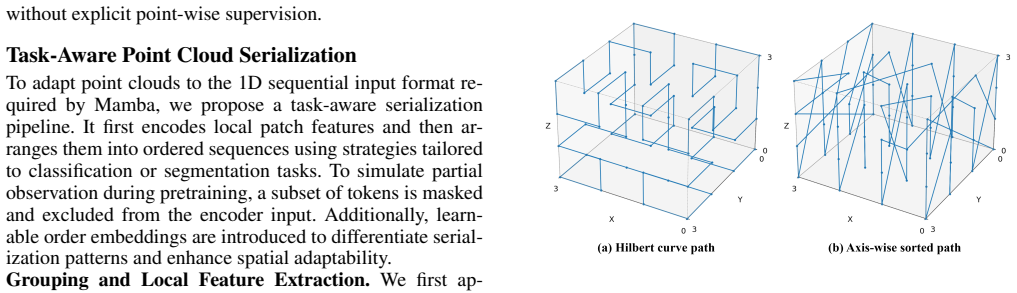
The load-bearing component is the Point-wise Multi-head Latent Attention (PMLA) block, inserted once in the middle of an 11-block Mamba encoder. Instead of full QKV projections, PMLA forms Q from a 1D convolution over the serialized token sequence and projects K and V into a low-dimensional latent space (dimension 48) with gating, then computes softmax attention over these latent key/value pairs. The paper argues this is conceptually aligned with Mamba's selective state update, approximating the PMLA output as $\hat{x}^{\text{PMLA}}_t \approx \sigma(W_K x_t) \cdot \tilde{x}^{\text{SSM}}_t$. Two other mechanisms carry the argument: task-specific serialization (Hilbert and Trans-Hilbert curves for classification, axis-wise sorting and concatenation for segmentation) and a conditional diffusion pretraining loss that denoises masked feature tokens conditioned on visible tokens, avoiding Chamfer/EMD reconstruction.
What would settle it
Retrain PointLAMA on a rotation-augmented or indoor-scene point cloud benchmark with the axis-wise sorting fixed; if accuracy collapses to the Mamba-only baseline (or below the reported ~0.2-point gap over PointMamba), the serialization premise is falsified.
Extended reading notes
Core claim
The paper's central claim is that a hybrid encoder—eleven Mamba blocks plus one PMLA block—together with Hilbert/Trans-Hilbert serialization for classification and axis-wise sorting for segmentation, and a feature-space conditional diffusion pretraining objective, produces point cloud representations that outperform prior self-supervised and hybrid methods. On ScanObjectNN, PointLAMA reaches 94.51% on OBJ-BG, 92.86% on OBJ-ONLY, and 89.53% on PB-T50-RS, exceeding PointMamba, PointGPT, and PoinTramba; on ModelNet40 it reaches 94.5% overall accuracy. The authors attribute the gains to PMLA's shared latent-space design with Mamba, which acts as a learnable gate over the SSM's state accumulation, and to the serialization order that injects spatial locality priors.
Load-bearing premise
The approach assumes that hand-picking the scan order—Hilbert curves for classification, axis-wise sorting for segmentation—preserves enough local geometry that a uni-directional Mamba scan plus one PMLA block can exploit, and the paper provides no formal guarantee that this ordering stays effective on new datasets.
Editorial extensions
If this is right
- A single PMLA block inserted mid-encoder improves ScanObjectNN over Mamba-only from 89.31% to 89.53% PB-T50-RS and from 92.60% to 92.86% OBJ-ONLY, at a cost of roughly 0.5M parameters.
- Random serialization drops PB-T50-RS to 84.45% and part segmentation mIoU by about 3 points, so the task-specific orderings are doing essential structural work.
- Axis-wise sorting plus PMLA yields the best ShapeNetPart results (85.5% class mIoU, 87.5% instance mIoU) among self-supervised models.
- Diffusion pretraining in feature space avoids explicit point reconstruction and transfers to downstream tasks, matching or beating transformer-based pretraining at a fraction of the parameters.
Reading between the lines
- Since only one PMLA block is used, the results suggest Mamba's main weakness for point clouds is a single locality bottleneck; inserting more attention blocks might give diminishing returns, which is a direct testable extension.
- The axis-wise sorting strategy triples the sequence length (3G tokens) yet keeps FLOPs at 3.2 G, illustrating Mamba's linear scaling; other cheap orderings, such as angle-based or learned permutations, could be tried as replacements.
- The claimed alignment between PMLA gating and SSM state updates (Eq. 9) is a heuristic; a deeper test would be to derive PMLA from a selective SSM update or compare gate activations against state-space summary vectors.
- Because the benchmarks are clean, the method's biggest open question is whether the serialization priors survive real-world scenarios with no natural axis alignment, such as indoor or 4D point clouds.
Editorial analysis
A structured set of objections, weighed in public.
Referee Report
Summary. PointLAMA is a point cloud pretraining framework that combines a Mamba-based sequential encoder with a single lightweight Point-wise Multi-head Latent Attention (PMLA) block, task-specific serialization (Hilbert/Trans-Hilbert curves for classification, axis-wise sorting for segmentation), and a feature-space conditional diffusion pretraining objective. The encoder is pretrained by corrupting token features with Gaussian noise and denoising them conditioned on visible tokens, then fine-tuned on downstream tasks. Experiments report improved accuracy over cited baselines on ScanObjectNN, ModelNet40, few-shot ModelNet40, and ShapeNetPart, with 12.8M parameters and 3.2 GFLOPs on ScanObjectNN.
Significance. If the benchmark numbers are reproducible, the paper demonstrates a parameter-efficient hybrid Mamba/attention point cloud backbone: the reported FLOPs and parameter counts are competitive with PointMamba while improving accuracy, and the ablation tables (Tables 5–8) provide direct evidence for the serialization and PMLA design choices. The main gap is that the diffusion pretraining contribution, one of the three stated contributions, has no isolated experiment, so the causal role of pretraining in the reported gains is unverified. The paper is clearly written and the comparisons to cited baselines are internally consistent.
major comments (3)
- [§4.3 (Conditional Diffusion for Masked Token Denoising) and §5 (Experiments)] The diffusion pretraining contribution is never isolated. The abstract and the contributions credit the conditional diffusion mechanism with improving representation learning, but Tables 1–4 compare PointLAMA only against other pretrained models, and Tables 5–8 ablate serialization and PMLA but not the diffusion loss. There is no from-scratch baseline (same architecture trained without pretraining), no variant with the diffusion loss removed, and no pretraining-only evaluation. Since the encoder is fine-tuned end-to-end, the reported gains could in principle come entirely from supervised fine-tuning plus the rotational augmentation marked with † in Table 1. Please add at least a from-scratch PointLAMA row to Tables 1–4, a 'w/o diffusion pretraining' ablation on PB-T50-RS and ShapeNetPart, and a full specification of the pretraining dataset, masking ratio, number of diffusion steps, noise schedule, and optimization hyperparameters so that the reported numbers can be traced to a concrete pretraining procedure.
- [§5.1 (Experimental Setup) and Table 1] The 'state-of-the-art' claim on ScanObjectNN rests on margins of 0.19–0.26 percentage points (94.51 vs 94.32 for OBJ-BG, 92.86 vs 92.60 for OBJ-ONLY, 89.53 vs 89.31 for PB-T50-RS), yet no error bars or multiple runs are reported for any of the main tables. Given the small margins, please report mean and standard deviation over at least three seeds for PointLAMA and the closest baselines, and temper the SOTA claim if the variance overlaps.
- [§4.1 (Task-Specific Serialization and Alignment)] The axis-wise sorting strategy in Eqs. (5)–(6) concatenates three independently sorted copies of the token sequence, tripling the sequence length to 3G tokens. The paper provides no analysis of whether this ordering actually preserves local geometric structure, and the Limitation section acknowledges that the serialization may limit generality. Since the segmentation results in Table 4 and the serialization ablation in Table 5 are central to the method, please provide a quantitative locality measure (e.g., average spatial distance of consecutive tokens in the serialized order) or an additional segmentation benchmark to support the claim that axis-wise sorting is a robust design rather than a dataset-specific choice.
minor comments (6)
- [§4.2 (Theoretical Connection Between State Space and Latent Attention)] Equation (9) is presented as an approximation ('We further approximate') but no derivation or empirical validation is provided; since the empirical ablation in Table 6 already supports PMLA, I recommend presenting Eq. (9) explicitly as a heuristic motivation rather than a theoretical connection.
- [Table 5] The row labeled 'Hilbert and Trans-Hilbert' reports a single accuracy value for classification but does not explain how the two curves are combined or alternated; please clarify whether the model uses both during pretraining or randomly selects one per sample.
- [Table 5] The 'Random' row should state explicitly that random ordering is used for both the classification and segmentation tasks, and whether the random ordering is fixed across pretraining and fine-tuning; otherwise the comparison with the structured rows is ambiguous.
- [Table 4] The row labeled 'Transformer (Yu et al. 2022)' is ambiguous because Yu et al. propose Point-BERT; please identify the exact Transformer backbone and the source of these numbers, or use the same naming convention as in the original paper.
- [Table 4 caption] The caption contains a typo: 'Supervised Learing Only' should read 'Supervised Learning Only'.
- [§5.1 (Experimental Setup)] The paper states that all experiments run on a single RTX 4090 but reports no training time or pretraining compute; since efficiency is a stated contribution, please include wall-clock time or total GPU-hours for pretraining and fine-tuning.
Circularity Check
No significant circularity; the paper's evaluation is external and its main weakness is missing ablation evidence, not circular reduction.
full rationale
The derivation chain is self-contained against external benchmarks. The central empirical claims (task-aware serialization, the PMLA block, and the hybrid Mamba encoder) are tested in Tables 1-8 against ScanObjectNN, ModelNet40, and ShapeNetPart, with ablations isolating serialization (Table 5), PMLA inclusion (Table 6), insertion position (Table 7), and latent dimension (Table 8). No fitted parameter is renamed as a prediction: the diffusion objective in Eq. 13 is a standard DDPM-style noise-prediction loss, and the reported accuracies come from fine-tuning on held-out benchmarks. The asserted 'theoretical connection' in Eq. 9 is an approximation used to motivate the architecture, not a result whose conclusion was assumed in its premises; it does not define any experimental outcome. The only self-citation, PointDif (Zheng et al. 2024), is credited in Related Work as prior art and is not load-bearing; the method does not depend on an unverified theorem from the same authors. The paper's Limitations section honestly notes that task-specific serialization may limit generality, which is a scope caveat rather than a circular step. The absence of a from-scratch fine-tuning baseline weakens support for the diffusion pretraining contribution specifically, but that is a missing-evidence problem, not a circularity: the claimed contribution is not shown to be equivalent to its input by construction.
Assumptions & free parameters
free parameters (4)
- PMLA latent dimension r =
48
- PMLA insertion position =
middle layer
- Encoder depth and width =
11 Mamba blocks, feature dim 384
- Masking ratio and diffusion timesteps =
not reported
assumptions (4)
- domain assumption The serialized sequence ordering preserves geometric locality usable by a uni-directional SSM.
- ad hoc to paper Selective SSM state accumulation and PMLA's gated latent projection are aligned enough that Eq. 9 can guide architecture design.
- domain assumption Standard DDPM forward and reverse processes and the MSE noise-prediction objective apply to point feature tokens and transfer to downstream tasks.
- domain assumption FPS/KNN patch grouping plus a lightweight PointNet preserves sufficient local geometry before serialization.
Cite this review
Pith. "Pith review of PointLAMA: Latent Attention meets Mamba for Efficient Point Cloud Pretraining." pith.science (2026). https://pith.science/paper/3R7LWREX
@misc{pith2026250717296,
  author       = {Pith},
  title        = {Pith review of: PointLAMA: Latent Attention meets Mamba for Efficient Point Cloud Pretraining},
  year         = {2026},
  howpublished = {\url{https://pith.science/paper/3R7LWREX}},
  note         = {Machine review of arXiv:2507.17296}
}
read the original abstract
Mamba has recently gained widespread attention as a backbone model for point cloud modeling, leveraging a state-space architecture that enables efficient global sequence modeling with linear complexity. However, its lack of local inductive bias limits its capacity to capture fine-grained geometric structures in 3D data. To address this limitation, we propose \textbf{PointLAMA}, a point cloud pretraining framework that combines task-aware point cloud serialization, a hybrid encoder with integrated Latent Attention and Mamba blocks, and a conditional diffusion mechanism built upon the Mamba backbone. Specifically, the task-aware point cloud serialization employs Hilbert/Trans-Hilbert space-filling curves and axis-wise sorting to structurally align point tokens for classification and segmentation tasks, respectively. Our lightweight Latent Attention block features a Point-wise Multi-head Latent Attention (PMLA) module, which is specifically designed to align with the Mamba architecture by leveraging the shared latent space characteristics of PMLA and Mamba. This enables enhanced local context modeling while preserving overall efficiency. To further enhance representation learning, we incorporate a conditional diffusion mechanism during pretraining, which denoises perturbed feature sequences without relying on explicit point-wise reconstruction. Experimental results demonstrate that PointLAMA achieves competitive performance on multiple benchmark datasets with minimal parameter count and FLOPs, validating its effectiveness for efficient point cloud pretraining.
Figures


Reference graph
Works this paper leans on
-
[1]
, " * write output.state after.block = add.period write newline
ENTRY address archivePrefix author booktitle chapter edition editor eid eprint howpublished institution isbn journal key month note number organization pages publisher school series title type volume year label extra.label sort.label short.list INTEGERS output.state before.all mid.sentence after.sentence after.block FUNCTION init.state.consts #0 'before.a...
-
[2]
write newline
" write newline "" before.all 'output.state := FUNCTION n.dashify 't := "" t empty not t #1 #1 substring "-" = t #1 #2 substring "--" = not "--" * t #2 global.max substring 't := t #1 #1 substring "-" = "-" * t #2 global.max substring 't := while if t #1 #1 substring * t #2 global.max substring 't := if while FUNCTION word.in bbl.in capitalize " " * FUNCT...
-
[3]
Afham, M.; Dissanayake, I.; Dissanayake, D.; Dharmasiri, A.; Thilakarathna, K.; and Rodrigo, R. 2022. Crosspoint: Self-supervised cross-modal contrastive learning for 3d point cloud understanding
work page 2022
-
[4]
Chen, G.; Wang, M.; Yang, Y.; Yu, K.; Yuan, L.; and Yue, Y. 2023. PointGPT: Auto-regressively Generative Pre-training from Point Clouds
work page 2023
-
[5]
Dong, R.; Qi, Z.; Zhang, L.; Zhang, J.; Sun, J.; Ge, Z.; Yi, L.; and Ma, K. 2022. Autoencoders as Cross-Modal Teachers: Can Pretrained 2D Image Transformers Help 3D Representation Learning?
work page 2022
-
[6]
Fan, H.; Su, H.; and Guibas, L. J. 2017. A point set generation network for 3d object reconstruction from a single image
work page 2017
-
[7]
Gu, A.; and Dao, T. 2024. Mamba: Linear-time sequence modeling with selective state spaces. In Conference on Language Modeling
work page 2024
-
[8]
Gu, A.; Goel, K.; Gupta, A.; and R \'e , C. 2022 a . On the parameterization and initialization of diagonal state space models
work page 2022
Show all 45 references
-
[9]
D.; et al
Gu, A.; Goel, T. D.; et al. 2022. Efficiently modeling long sequences with structured state spaces. In ICLR
2022
-
[10]
Gu, A.; Johnson, I.; Timalsina, A.; Rudra, A.; and Re, C. 2022 b . How to Train your HIPPO: State Space Models with Generalized Orthogonal Basis Projections
2022
-
[11]
R.; and Hu, S.-M
Guo, M.-H.; Cai, J.-X.; Liu, Z.-N.; Mu, T.-J.; Martin, R. R.; and Hu, S.-M. 2021. Pct: Point cloud transformer. Computational Visual Media
2021
-
[12]
Guo, Z.; Zhang, R.; Qiu, L.; Li, X.; and Heng, P.-A. 2023. Joint-mae: 2d-3d joint masked autoencoders for 3d point cloud pre-training
2023
-
[13]
Gupta, A.; Gu, A.; and Berant, J. 2022. Diagonal state spaces are as effective as structured state spaces
2022
-
[14]
Han, K.; Xiao, A.; Wu, E.; Guo, J.; Xu, C.; and Wang, Y. 2021. Transformer in transformer. In NeurIPS
2021
-
[15]
Ho, J.; Jain, A.; and Abbeel, P. 2020. Denoising diffusion probabilistic models. In NeurIPS
2020
-
[16]
Jaegle, A.; et al. 2021. Perceiver: General perception with iterative attention. In ICML
2021
-
[17]
Li, Y.; Bu, R.; Sun, M.; Wu, W.; Di, X.; and Chen, B. 2018. Pointcnn: Convolution on x-transformed points
2018
-
[18]
Liang, D.; Zhou, X.; Xu, W.; Zhu, X.; Zou, Z.; Ye, X.; Tan, X.; and Bai, X. 2024. PointMamba: A Simple State Space Model for Point Cloud Analysis. In Advances in Neural Information Processing Systems
2024
-
[19]
Liu, H.; Cai, M.; and Lee, Y. J. 2022. Masked discrimination for self-supervised learning on point clouds
2022
-
[20]
Ma, X.; Qin, C.; You, H.; Ran, H.; and Fu, Y. 2022. Rethinking network design and local geometry in point cloud: A simple residual MLP framework
2022
-
[21]
V.; Faloutsos, C.; and Saltz, J
Moon, B.; Jagadish, H. V.; Faloutsos, C.; and Saltz, J. H. 2001. Analysis of the clustering properties of the Hilbert space-filling curve. IEEE Transactions on Knowledge and Data Engineering, 13(1): 124--141
2001
-
[22]
E.; Liu, W.; Tian, Y.; and Yuan, L
Pang, Y.; Wang, W.; Tay, F. E.; Liu, W.; Tian, Y.; and Yuan, L. 2022. Masked autoencoders for point cloud self-supervised learning
2022
-
[23]
V.; Le Nguyen, M.; Nguyen, Y
Phan, A. V.; Le Nguyen, M.; Nguyen, Y. L. H.; and Bui, L. T. 2018. Dgcnn: A convolutional neural network over large-scale labeled graphs. Neural Networks
2018
-
[24]
Poursaeed, O.; Jiang, T.; Qiao, H.; Xu, N.; and Kim, V. G. 2020. Self-supervised learning of point clouds via orientation estimation. In Intl. Conf. on 3D Vision. IEEE
2020
-
[25]
R.; Su, H.; Mo, K.; and Guibas, L
Qi, C. R.; Su, H.; Mo, K.; and Guibas, L. J. 2017 a . Pointnet: Deep learning on point sets for 3d classification and segmentation
2017
-
[26]
R.; Yi, L.; Su, H.; and Guibas, L
Qi, C. R.; Yi, L.; Su, H.; and Guibas, L. J. 2017 b . Pointnet++: Deep hierarchical feature learning on point sets in a metric space
2017
-
[27]
Qi, Z.; Dong, R.; Fan, G.; Ge, Z.; Zhang, X.; Ma, K.; and Yi, L. 2023. Contrast with Reconstruct: Contrastive 3D Representation Learning Guided by Generative Pretraining. arXiv preprint arXiv:2302.02318
2023 arXiv
-
[28]
Qian, G.; Li, Y.; Peng, H.; Mai, J.; Hammoud, H.; Elhoseiny, M.; and Ghanem, B. 2022. Pointnext: Revisiting pointnet++ with improved training and scaling strategies
2022
-
[29]
Rubner, Y.; Tomasi, C.; and Guibas, L. J. 2000. The earth mover's distance as a metric for image retrieval. International journal of computer vision
2000
-
[30]
Sohl-Dickstein, J.; Weiss, E.; Maheswaranathan, N.; and Ganguli, S. 2015. Deep Unsupervised Learning using Nonequilibrium Thermodynamics. In International Conference on Machine Learning (ICML), 2256--2265
2015
-
[31]
A.; Pham, Q.-H.; Hua, B.-S.; Nguyen, T.; and Yeung, S.-K
Uy, M. A.; Pham, Q.-H.; Hua, B.-S.; Nguyen, T.; and Yeung, S.-K. 2019. Revisiting point cloud classification: A new benchmark dataset and classification model on real-world data
2019
-
[32]
N.; Kaiser, .; and Polosukhin, I
Vaswani, A.; Shazeer, N.; Parmar, N.; Uszkoreit, J.; Jones, L.; Gomez, A. N.; Kaiser, .; and Polosukhin, I. 2017. Attention is all you need
2017
-
[33]
E.; Bronstein, M
Wang, Y.; Sun, Y.; Liu, Z.; Sarma, S. E.; Bronstein, M. M.; and Solomon, J. M. 2019. Dynamic graph cnn for learning on point clouds. ACM Transactions on Graphics
2019
-
[34]
Wang, Z.; Chen, Z.; Wu, Y.; Zhao, Z.; Zhou, L.; and Xu, D. 2024. PoinTramba: A Hybrid Transformer-Mamba Framework for Point Cloud Analysis. arXiv preprint arXiv:2405.15463
2024 arXiv
-
[35]
Wu, Z.; Song, S.; Khosla, A.; Yu, F.; Zhang, L.; Tang, X.; and Xiao, J. 2015. 3d shapenets: A deep representation for volumetric shapes
2015
-
[36]
G.; Ceylan, D.; Shen, I.-C.; Yan, M.; Su, H.; Lu, C.; Huang, Q.; Sheffer, A.; and Guibas, L
Yi, L.; Kim, V. G.; Ceylan, D.; Shen, I.-C.; Yan, M.; Su, H.; Lu, C.; Huang, Q.; Sheffer, A.; and Guibas, L. 2016. A scalable active framework for region annotation in 3d shape collections. ACM Transactions on Graphics
2016
-
[37]
Yu, X.; Tang, L.; Rao, Y.; Huang, T.; Zhou, J.; and Lu, J. 2022. Point-bert: Pre-training 3d point cloud transformers with masked point modeling
2022
-
[38]
Zha, Y.; Wang, J.; Dai, T.; Chen, B.; Wang, Z.; and Xia, S.-T. 2023. Instance-aware Dynamic Prompt Tuning for Pre-trained Point Cloud Models
2023
-
[39]
Zhang, R.; Guo, Z.; Gao, P.; Fang, R.; Zhao, B.; Wang, D.; Qiao, Y.; and Li, H. 2022. Point-m2ae: multi-scale masked autoencoders for hierarchical point cloud pre-training
2022
-
[40]
Zhang, T.; Li, X.; Yuan, H.; Ji, S.; and Yan, S. 2024. Point Cloud Mamba: Point Cloud Learning via State Space Model. arXiv preprint arXiv:2403.00762
2024 arXiv
-
[41]
H.; and Koltun, V
Zhao, H.; Jiang, L.; Jia, J.; Torr, P. H.; and Koltun, V. 2021. Point transformer. In ICCV
2021
-
[42]
Zheng, X.; Huang, X.; Mei, G.; Hou, Y.; Lyu, Z.; Dai, B.; Ouyang, W.; and Gong, Y. 2024. Point Cloud Pre-training with Diffusion Models. In CVPR, 22935--22945
2024
-
[43]
Zhou, L.; Du, Y.; and Wu, J. 2021. 3D Shape Generation and Completion through Point‑Voxel Diffusion. In ICCV
2021
-
[44]
Zhou, X.; Liang, D.; Xu, W.; Zhu, X.; Xu, Y.; Zou, Z.; and Bai, X. 2024. Dynamic Adapter Meets Prompt Tuning: Parameter-Efficient Transfer Learning for Point Cloud Analysis
2024
-
[45]
Zhou, Y.; Li, J.; Xu, R.; and et al. 2023. PVD: A Point-Voxel Diffusion Framework for 3D Pretraining. In NeurIPS
2023
Reviewed August 6, 2026 · model on record in the stance chip above.
Discussion (0). Sign in to comment.