REVIEW 4 major objections 4 minor 44 references
Physics-based Human Pose Estimation from a Single Moving RGB Camera
T0 review · 4 major / 4 minor · reviewed 2026-08-06 · deepseek-v4-flash
Pith's one-line read Replacing the flat-ground assumption with a real scene height map in a physics optimizer yields more accurate global human motion from a moving camera.
desk verdict The MoviCam dataset is a real contribution that fills a gap; the PhysDynPose method is an incremental integration whose reported gains are undermined by oracle inputs and its own physical-plausibility metrics. read the letter →
The pith
A machine-rendered reading of the paper's core claim, the machinery that carries it, and where it could break.
The reading
What carries the argument
The central mechanism is a physics optimizer whose character is simulated as a floating-base humanoid with joint torques and contact forces constrained by the equation of motion, a friction cone, and a no-sliding condition. Two modifications carry the claim: the penetration test for a contacting foot uses the scene height map $h(x,z)$ rather than a flat floor, and the root translation is supervised using future frames to prevent long-sequence drift. The dataset's ground-truth camera motion, mesh, and contact labels make these effects measurable.
What would settle it
Run the method on the same sequences but replace the ground-truth contact labels with labels predicted by an automatic contact estimator, leaving everything else fixed; if the reported advantages over the kinematic baseline vanish or reverse, the headline result depends on oracle contact information.
Extended reading notes
Core claim
PhysDynPose shows that incorporating a scene height map into a physics-based pose optimizer, in place of the usual flat-ground inequality, and adding root-position supervision from future frames yields global human trajectories that are more accurate and less prone to drift than prior kinematic and physics-based methods on moving-camera, non-flat scenes. The paper further establishes MoviCam as a benchmark for this setting, and reports it is the first non-synthetic dataset to combine ground-truth camera trajectories, scene geometry, 3D human motion, and foot-contact labels.
Load-bearing premise
The optimizer receives ground-truth foot-contact labels and a pre-scanned scene mesh as inputs; if those must be predicted from the RGB video, the physics constraints become noisy and the reported trajectory and foot-sliding gains may not hold.
Editorial extensions
If this is right
- Because the physics module is plug-and-play and needs no training, it can be attached to any kinematic pose estimator and any camera trajectory estimator, provided scene geometry and contact information are available.
- The height-map penetration check can be reused by other physics-based trackers, replacing the flat-ground inequality and extending them to non-planar scenes.
- Root supervision with future frames is a simple addition that reduces long-sequence drift, and the paper shows removing it degrades global trajectory error.
- MoviCam supplies ground truth for metrics that go beyond per-joint error, such as scene penetration, elevation above the scene, jitter, and foot sliding, enabling comparisons in world coordinates.
Reading between the lines
- A natural stress test is to replace the ground-truth contact labels with automatic ones; the paper's reported gains over the kinematic baseline would likely shrink, since contact is an explicit input to the optimizer.
- The same scene-mesh and height-map machinery could be extended to contacts beyond the feet, such as hands or torso, once the optimizer monitors additional body parts, which would broaden it to climbing and crouching interactions.
- Because MoviCam provides accurate camera ground truth alongside RGB video, it could serve as a testbed for monocular SLAM scale calibration in human-centric scenes, where scale ambiguity is usually unresolved.
- The manual PD-controller gains could be learned from data, which would likely make the optimizer more robust to different body shapes and interaction styles than the fixed settings used here.
Signed reviews
Editorial analysis
A structured set of objections, weighed in public.
Referee Report
Summary. The paper proposes two contributions. First, it introduces MoviCam, a new benchmark captured in a controlled studio with a moving RGB camera, multi-view GT camera trajectories, scene geometry (mesh and height map), SMPL human poses, global trajectories, and foot-contact labels. Second, it proposes PhysDynPose, a physics-based optimization pipeline that combines 4DHumans kinematic estimates and DROID-SLAM camera trajectories with a PIP-style dual-PD physics optimizer extended by scene-height-map penetration checks and root supervision. The method is evaluated on MoviCam against GLAMR, WHAM, and 4DHumans, with reported improvements in global trajectory metrics (W-MPJPE, RTE) and foot sliding, while pose accuracy and scene-penetration metrics are mixed.
Significance. The MoviCam dataset is a potentially valuable resource: it is, to my knowledge, the first non-synthetic moving-RGB-camera dataset to provide scene geometry, global human motion, dynamic camera trajectories, and contact labels simultaneously. If the method claims were supported, the paper would make a useful step toward physics-based global human pose estimation in non-flat scenes. However, the evaluation as presented does not support the central claim that PhysDynPose robustly estimates human and camera poses from a single RGB camera while remaining physically plausible, because the method receives ground-truth contact labels and scene geometry as inputs and uses ground-truth camera frames to fix SLAM scale, and because its own penetration metrics are worse than two baselines. The dataset contribution may be salvageable, but the method contribution in its current form is not established.
major comments (4)
- [Section 4 and Section 4.1] The method description states that the inputs include 'scene mesh and foot contact labels' (Section 4, first paragraph), and Section 4.1 states that the DROID-SLAM trajectory is aligned using the first two frames of the ground-truth camera trajectory. The baselines in Section 5.2 are initialized only with ground-truth orientation and translation from the first two frames and do not receive scene mesh or contact labels. Consequently, the reported gains in W-MPJPE, RTE, and foot sliding in Tables 2 and 3 are partly attributable to test-time oracle information, not to the proposed optimization alone. In particular, the contact labels directly feed the no-sliding constraint in Eq. (5), making the foot-sliding improvement unsurprising. This undermines the abstract claim that the method 'robustly estimates both human and camera poses in world coordinates' from a single RGB camera.
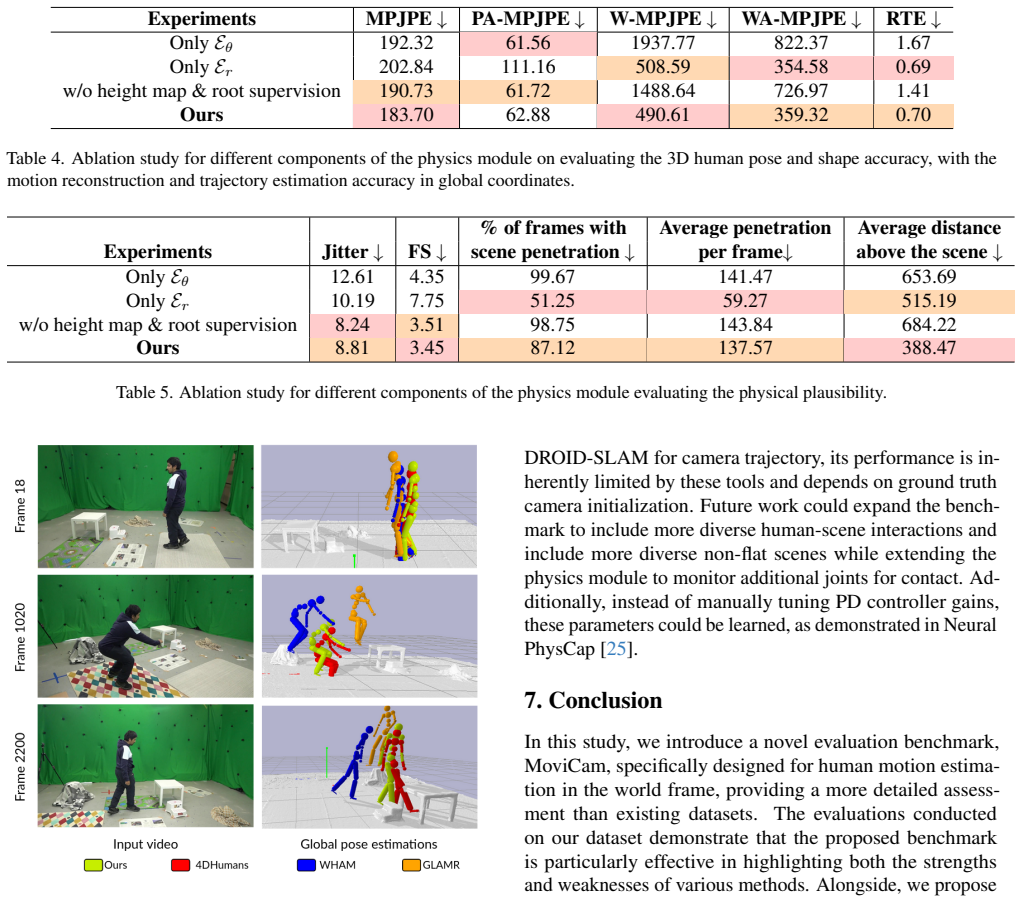
- [Table 3 and Section 7] The physical-plausibility results in Table 3 (non-flat rows) contradict the conclusion that PhysDynPose 'achieves a balance between physical plausibility and motion accuracy.' PhysDynPose has 68.13% frames with scene penetration and 119.23 mm average penetration depth, whereas WHAM has 16.19% and 40.23 mm and GLAMR has 1.74% and 2.92 mm. Its average distance above the scene (377.37 mm) is also worse than 4DHumans (285.54 mm). Even with access to the ground-truth scene height map and contact labels, the method is less physically plausible than two baselines on the paper's own primary plausibility metrics. The only plausibility metric improved is foot sliding, which is directly supervised by the ground-truth contact labels.
- [Tables 4 and 5] The ablation study does not support the claimed benefit of the full objective. On sequence 3, the 'Only Er' ablation achieves 51.25% penetration frames and 59.27 mm average penetration depth, while the full method 'Ours' achieves 87.12% and 137.57 mm. The full method improves W-MPJPE only slightly (490.61 vs 508.59) and matches RTE (0.70 vs 0.69). Thus the combined joint-angle and joint-position controller with contact constraints is substantially worse on scene penetration than the position-only controller, and the text in Section 5.4 that claims these components are complementary is not borne out by the penetration metrics.
- [Section 6] The Limitations section acknowledges that PhysDynPose 'depends on ground truth camera initialization,' but it does not acknowledge the equally load-bearing dependence on ground-truth foot contact labels and the ground-truth scene mesh, even though these are listed as method inputs in Section 4. This omission matters because the paper's comparisons are framed as evidence of a deployable monocular RGB method, whereas the method actually requires scene geometry and contact supervision that are not available in the claimed application setting.
minor comments (4)
- [Section 5.4] The ablation 'w/o height map & root supervision' removes two components simultaneously, so the individual contributions of the height map and root supervision to the reported degradation cannot be separated; an ablation removing one at a time would be more informative.
- [References] References [17] and [18] cite the same SMPL paper in different formats; one duplicate should be removed or merged.
- [Table 1] The table header 'Global Motion' is unclear because the entries include both real and simulated camera motion; a footnote defining the symbols would improve readability.
- [Section 3.3] The dataset contains 7 sequences and approximately 22,000 images, all captured in one studio scene; the paper should be cautious in describing this as 'complex scenes' and should state the scene diversity limits when positioning MoviCam as a general benchmark.
Circularity Check
Foot-sliding 'improvement' is enforced by the no-sliding constraint and GT contact labels; global trajectory is seeded by GT camera scale; penetration metrics contradict the claimed balance.
-
self definitional
[Section 4.2.1, Eq. (5); Section 5.1; Section 4 inputs]
"The inputs to our method are an image sequence I = {It}T t=1 with T frames capturing a person navigating through non-flat terrain, scene mesh and foot contact labels. ... arg min ˙q,λ,τ EPD + Ereg s.t. ... ˙rj(¨q) ∈ C (no sliding) ... Following [26], we compute foot sliding as the average toe joint displacement during contact (mm)."
The optimizer imposes the no-sliding constraint ˙rj(¨q) ∈ C using ground-truth foot contact labels, and the evaluation metric 'foot sliding' is exactly the average toe joint displacement during contact. Because the contact frames are supplied as ground-truth inputs and the constraint is active on those same frames, the low foot-sliding value reported in Table 3 is enforced by the optimization objective rather than predicted from RGB video. The comparison against baselines that do not receive GT contact labels therefore measures the privileged input, not a deployable improvement.
-
fitted input called prediction
[Section 4.1, Eq. (2); Section 5.1 metrics]
"Due to SLAM suffering from scale ambiguity, we align it using the first two frames of the ground-truth camera trajectory."
The world-frame root translation wπ in Eq. (2) is computed from the DROID-SLAM camera trajectory RS, TS, and TS is explicitly aligned using the first two ground-truth camera frames. The global trajectory that is later scored with W-MPJPE, W A-MPJPE, and RTE therefore is seeded with the ground-truth camera scale, so the 'prediction' of global human and camera trajectories is partly constructed from the target ground-truth world frame rather than estimated from monocular RGB alone. This makes the trajectory metrics oracle-conditioned rather than fully predictive.
full rationale
The core physics optimization is not circular in the mathematical sense: Eq. (5) is a genuine constrained optimization over accelerations, torques, and contact forces, and it is built on external components (4DHumans, DROID-SLAM, PyBullet, PIP) rather than on a self-citation uniqueness theorem. The MoviCam dataset claim is an empirical contribution with its own capture pipeline and is not a renamed known result. However, two load-bearing evaluation quantities reduce to privileged inputs. First, the foot-sliding metric is defined as toe displacement during contact, and the same ground-truth contact labels activate the no-sliding constraint in Eq. (5), so the reported FS improvement is by construction. Second, the global trajectory is aligned with ground-truth camera scale before any physics refinement, so W-MPJPE and RTE are not purely monocular predictions. The paper's own Limitations section acknowledges this dependency ('depends on ground truth camera initialization'). In addition, even with these oracle inputs, Table 3 shows penetration of 68.13% of non-flat frames, worse than WHAM (16.19%) and GLAMR (1.74%), which undercuts the claimed 'balance between physical plausibility and motion accuracy.' These issues make the evaluation partially circular and oracle-bound rather than a demonstration of a fully self-contained method.
Assumptions & free parameters
free parameters (4)
- PD controller gains (from PIP physics optimizer) =
not reported; inherited from PIP [39]
- One-Euro filter parameters =
minimum cut-off 0.004, speed coefficient 0.7
- Contact label distance threshold =
5 cm
- SLAM scale alignment frames =
first 2 frames of ground-truth camera trajectory
assumptions (4)
- domain assumption The scene is static and pre-scanned, and its mesh and height map are available to the method.
- ad hoc to paper Ground-truth foot contact labels are available at evaluation time.
- domain assumption A floating-base humanoid with dual PD controllers in PyBullet adequately models human dynamics.
- ad hoc to paper Monocular SLAM scale can be fixed using the first two frames of the ground-truth camera trajectory.
Cite this review
Pith. "Pith review of Physics-based Human Pose Estimation from a Single Moving RGB Camera." pith.science (2026). https://pith.science/paper/65E2ZI47
@misc{pith2026250717406,
  author       = {Pith},
  title        = {Pith review of: Physics-based Human Pose Estimation from a Single Moving RGB Camera},
  year         = {2026},
  howpublished = {\url{https://pith.science/paper/65E2ZI47}},
  note         = {Machine review of arXiv:2507.17406}
}
read the original abstract
Most monocular and physics-based human pose tracking methods, while achieving state-of-the-art results, suffer from artifacts when the scene does not have a strictly flat ground plane or when the camera is moving. Moreover, these methods are often evaluated on in-the-wild real world videos without ground-truth data or on synthetic datasets, which fail to model the real world light transport, camera motion, and pose-induced appearance and geometry changes. To tackle these two problems, we introduce MoviCam, the first non-synthetic dataset containing ground-truth camera trajectories of a dynamically moving monocular RGB camera, scene geometry, and 3D human motion with human-scene contact labels. Additionally, we propose PhysDynPose, a physics-based method that incorporates scene geometry and physical constraints for more accurate human motion tracking in case of camera motion and non-flat scenes. More precisely, we use a state-of-the-art kinematics estimator to obtain the human pose and a robust SLAM method to capture the dynamic camera trajectory, enabling the recovery of the human pose in the world frame. We then refine the kinematic pose estimate using our scene-aware physics optimizer. From our new benchmark, we found that even state-of-the-art methods struggle with this inherently challenging setting, i.e. a moving camera and non-planar environments, while our method robustly estimates both human and camera poses in world coordinates.
Figures


Figures from the paper (1 more)
Reference graph
Works this paper leans on
-
[1]
Ijaz Akhter and Michael J. Black. Pose-conditioned joint an- gle limits for 3d human pose reconstruction. 2015 IEEE Con- ference on Computer Vision and Pattern Recognition (CVPR), pages 1446–1455, 2015. 2
work page 2015
-
[2]
1C filter: a simple speed-based low-pass filter for noisy input in inter- active systems
Géry Casiez, Nicolas Roussel, and Daniel V ogel. 1C filter: a simple speed-based low-pass filter for noisy input in inter- active systems. Proceedings of the SIGCHI Conference on Human Factors in Computing Systems, 2012. 5
work page 2012
-
[3]
Pybullet, a python mod- ule for physics simulation for games, robotics and machine learning, 2016
Erwin Coumans and Yunfei Bai. Pybullet, a python mod- ule for physics simulation for games, robotics and machine learning, 2016. 3, 4, 5
work page 2016
-
[4]
Sloper4d: A scene-aware dataset for global 4d human pose estimation in urban environments
Yudi Dai, Yitai Lin, Xiping Lin, Chenglu Wen, Lan Xu, Hong- wei Yi, Siqi Shen, Yuexin Ma, and Cheng Wang. Sloper4d: A scene-aware dataset for global 4d human pose estimation in urban environments. In 2023 IEEE/CVF Conference on Com- puter Vision and Pattern Recognition (CVPR), pages 682–692,
work page 2023
-
[5]
Humans in 4d: Re- constructing and tracking humans with transformers
Shubham Goel, Georgios Pavlakos, Jathushan Rajasegaran, Angjoo Kanazawa, and Jitendra Malik. Humans in 4d: Re- constructing and tracking humans with transformers. 2023 IEEE/CVF International Conference on Computer Vision (ICCV), pages 14737–14748, 2023. 2, 3, 5, 6, 7
work page 2023
-
[6]
Vladimir Guzov, Aymen Mir, Torsten Sattler, and Gerard Pons-Moll. Human poseitioning system (hps): 3d human pose estimation and self-localization in large scenes from body- mounted sensors. 2021 IEEE/CVF Conference on Computer Vision and Pattern Recognition (CVPR), pages 4316–4327,
work page 2021
-
[7]
Mohamed Hassan, Vasileios Choutas, Dimitrios Tzionas, and Michael J. Black. Resolving 3d human pose ambiguities with 3d scene constraints. 2019 IEEE/CVF International Conference on Computer Vision (ICCV), pages 2282–2292,
work page 2019
-
[8]
Bodyslam: joint camera localisation, mapping, and human motion tracking
Dorian F Henning, Tristan Laidlow, and Stefan Leutenegger. Bodyslam: joint camera localisation, mapping, and human motion tracking. In European Conference on Computer Vi- sion, pages 656–673. Springer, 2022. 3
work page 2022
Show all 44 references
-
[9]
Huang, Hongwei Yi, Markus Höschle, Matvey Safroshkin, Tsvetelina Alexiadis, Senya Polikovsky, Daniel Scharstein, and Michael J
Chun-Hao P. Huang, Hongwei Yi, Markus Höschle, Matvey Safroshkin, Tsvetelina Alexiadis, Senya Polikovsky, Daniel Scharstein, and Michael J. Black. Capturing and inferring dense full-body human-scene contact. In 2022 IEEE/CVF Conference on Computer Vision and Pattern Recognitio...
2022
-
[10]
Human3.6m: Large scale datasets and predic- tive methods for 3d human sensing in natural environments
Catalin Ionescu, Dragos Papava, Vlad Olaru, and Cristian Sminchisescu. Human3.6m: Large scale datasets and predic- tive methods for 3d human sensing in natural environments. IEEE Transactions on Pattern Analysis and Machine Intelli- gence, 36:1325–1339, 2014. 2
2014
-
[11]
Total capture: A 3d deformation model for tracking faces, hands, and bodies
Hanbyul Joo, Tomas Simon, and Yaser Sheikh. Total capture: A 3d deformation model for tracking faces, hands, and bodies. 2018 IEEE/CVF Conference on Computer Vision and Pattern Recognition, pages 8320–8329, 2018. 2
2018
-
[12]
Emdb: The electromagnetic database of global 3d human pose and shape in the wild
Manuel Kaufmann, Jie Song, Chen Guo, Kaiyue Shen, Tian- jian Jiang, Chengcheng Tang, Juan José Zárate, and Otmar Hilliges. Emdb: The electromagnetic database of global 3d human pose and shape in the wild. 2023 IEEE/CVF In- ternational Conference on Computer Vision (ICCV), page...
2023
-
[13]
Black, Otmar Hilliges, Jan Kautz, and Umar Iqbal
Muhammed Kocabas, Ye Yuan, Pavlo Molchanov, Yunrong Guo, Michael J. Black, Otmar Hilliges, Jan Kautz, and Umar Iqbal. Pace: Human and camera motion estimation from in- the-wild videos. 2024 International Conference on 3D Vision (3DV), pages 397–408, 2023. 1, 2, 4
2024
-
[14]
Black, and Kostas Daniilidis
Nikos Kolotouros, Georgios Pavlakos, Michael J. Black, and Kostas Daniilidis. Learning to reconstruct 3d human pose and shape via model-fitting in the loop. 2019 IEEE/CVF International Conference on Computer Vision (ICCV), pages 2252–2261, 2019. 1, 2
2019
-
[15]
Hybrik: A hybrid analytical-neural inverse kinematics solution for 3d human pose and shape estimation
Jiefeng Li, Chao Xu, Zhicun Chen, Siyuan Bian, Lixin Yang, and Cewu Lu. Hybrik: A hybrid analytical-neural inverse kinematics solution for 3d human pose and shape estimation. 2021 IEEE/CVF Conference on Computer Vision and Pattern Recognition (CVPR), pages 3382–3392, 2020. 1, 2
2021
-
[16]
D&d: Learning human dynamics from dynamic camera
Jiefeng Li, Siyuan Bian, Chaoshun Xu, Gang Liu, Gang Yu, and Cewu Lu. D&d: Learning human dynamics from dynamic camera. In European Conference on Computer Vision, 2022. 3
2022
-
[17]
Matthew Loper, Naureen Mahmood, Javier Romero, Ger- ard Pons-Moll, and Michael J. Black. SMPL: A skinned multi-person linear model. ACM Trans. Graphics (Proc. SIG- GRAPH Asia), 34(6):248:1–248:16, 2015. 4
2015
-
[18]
Matthew Loper, Naureen Mahmood, Javier Romero, Gerard Pons-Moll, and Michael J. Black. Smpl: A skinned multi- person linear model. Seminal Graphics Papers: Pushing the Boundaries, Volume 2, 2023. 2, 4
2023
-
[19]
Troje, Ger- ard Pons-Moll, and Michael J
Naureen Mahmood, Nima Ghorbani, Nikolaus F. Troje, Ger- ard Pons-Moll, and Michael J. Black. Amass: Archive of mo- tion capture as surface shapes. 2019 IEEE/CVF International Conference on Computer Vision (ICCV), pages 5441–5450,
2019
-
[20]
Fua, Oleksandr Sotnychenko, Weipeng Xu, and Christian Theobalt
Dushyant Mehta, Helge Rhodin, Dan Casas, Pascal V . Fua, Oleksandr Sotnychenko, Weipeng Xu, and Christian Theobalt. Monocular 3d human pose estimation in the wild using im- proved cnn supervision. 2017 International Conference on 3D Vision (3DV), pages 506–516, 2016. 1, 2
2017
-
[21]
Single-shot multi-person 3d pose estimation from monocular rgb
Dushyant Mehta, Oleksandr Sotnychenko, Franziska Mueller, Weipeng Xu, Srinath Sridhar, Gerard Pons-Moll, and Chris- tian Theobalt. Single-shot multi-person 3d pose estimation from monocular rgb. 2018 International Conference on 3D Vision (3DV), pages 120–130, 2017. 1, 2
2018
-
[22]
Tesch, David T
Priyanka Patel, Chun-Hao Paul Huang, J. Tesch, David T. Hoffmann, Shashank Tripathi, and Michael J. Black. Agora: Avatars in geography optimized for regression analysis. 2021 IEEE/CVF Conference on Computer Vision and Pattern Recognition (CVPR), pages 13463–13473, 2021. 2
2021
-
[23]
Georgios Pavlakos, Vasileios Choutas, Nima Ghorbani, Timo Bolkart, Ahmed A. A. Osman, Dimitrios Tzionas, and Michael J. Black. Expressive body capture: 3d hands, face, and body from a single image. 2019 IEEE/CVF Conference on Computer Vision and Pattern Recognition (CVPR), pag...
2019
-
[24]
Soshi Shimada, Vladislav Golyanik, Weipeng Xu, and Chris- tian Theobalt. Physcap. ACM Transactions on Graphics (TOG), 39:1 – 16, 2020. 1, 3, 4, 6
2020
-
[25]
Neural monocular 3d human motion capture with physical awareness
Soshi Shimada, Vladislav Golyanik, Weipeng Xu, Patrick P’erez, and Christian Theobalt. Neural monocular 3d human motion capture with physical awareness. ACM Transactions on Graphics (TOG), 40:1 – 15, 2021. 3, 8
2021
-
[26]
Soyong Shin, Juyong Kim, Eni Halilaj, and Michael J. Black. Wham: Reconstructing world-grounded humans with accu- rate 3d motion. ArXiv, abs/2312.07531, 2023. 3, 4, 6, 7
2023 arXiv
-
[27]
Balan, and Michael J
Leonid Sigal, Alexandru O. Balan, and Michael J. Black. Humaneva: Synchronized video and motion capture dataset and baseline algorithm for evaluation of articulated human motion. International Journal of Computer Vision, 87:4–27,
-
[28]
Strobl and Gerd Hirzinger
Klaus H. Strobl and Gerd Hirzinger. Optimal hand-eye cali- bration. 2006 IEEE/RSJ International Conference on Intelli- gent Robots and Systems, pages 4647–4653, 2006. 4
2006
-
[29]
Yu Sun, Qian Bao, Wu Liu, Tao Mei, and Michael J. Black. Trace: 5d temporal regression of avatars with dynamic cam- eras in 3d environments. 2023 IEEE/CVF Conference on Computer Vision and Pattern Recognition (CVPR) , pages 8856–8866, 2023. 2, 3
2023
-
[30]
Droid-slam: deep visual slam for monocular, stereo, and rgb-d cameras
Zachary Teed and Jia Deng. Droid-slam: deep visual slam for monocular, stereo, and rgb-d cameras. In Proceedings of the 35th International Conference on Neural Information Processing Systems, Red Hook, NY , USA, 2021. Curran As- sociates Inc. 2, 5
2021
-
[31]
The captury, 2020
TheCaptury. The captury, 2020. Accessed: 2020. 3, 4
2020
-
[32]
Human pose estimation from video and imus
Timo von Marcard, Gerard Pons-Moll, and Bodo Rosenhahn. Human pose estimation from video and imus. IEEE Trans- actions on Pattern Analysis and Machine Intelligence , 38: 1533–1547, 2016. 2
2016
-
[33]
Black, Bodo Rosenhahn, and Gerard Pons-Moll
Timo von Marcard, Roberto Henschel, Michael J. Black, Bodo Rosenhahn, and Gerard Pons-Moll. Recovering ac- curate 3d human pose in the wild using imus and a moving camera. In Proceedings of the European Conference on Com- puter Vision (ECCV), 2018. 2, 3
2018
-
[34]
Tram: Global trajectory and motion of 3d humans from in-the- wild videos
Yufu Wang, Ziyun Wang, Lingjie Liu, and Kostas Daniilidis. Tram: Global trajectory and motion of 3d humans from in-the- wild videos. In European Conference on Computer Vision, pages 467–487. Springer, 2024. 3
2024
-
[35]
Geometric pose affordance: Monocular 3d human pose estimation with scene constraints
Zhe Wang, Liyan Chen, Shaurya Rathore, Daeyun Shin, and Charless Fowlkes. Geometric pose affordance: Monocular 3d human pose estimation with scene constraints. In European Conference on Computer Vision, pages 3–18. Springer, 2022. 2
2022
-
[36]
Freeman, Rahul Sukthankar, and Cristian Smin- chisescu
Hongyi Xu, Eduard Gabriel Bazavan, Andrei Zanfir, William T. Freeman, Rahul Sukthankar, and Cristian Smin- chisescu. Ghum & ghuml: Generative 3d human shape and articulated pose models. 2020 IEEE/CVF Conference on Computer Vision and Pattern Recognition (CVPR) , pages 6183–619...
2020
-
[37]
Decoupling human and camera motion from videos in the wild
Vickie Ye, Georgios Pavlakos, Jitendra Malik, and Angjoo Kanazawa. Decoupling human and camera motion from videos in the wild. 2023 IEEE/CVF Conference on Computer Vision and Pattern Recognition (CVPR), pages 21222–21232,
2023
-
[38]
Hongwei Yi, Chun-Hao Paul Huang, Dimitrios Tzionas, Muhammed Kocabas, Mohamed Hassan, Siyu Tang, Justus Thies, and Michael J. Black. Human-aware object placement for visual environment reconstruction. 2022 IEEE/CVF Con- ference on Computer Vision and Pattern Recognition (CVPR)...
2022
-
[39]
Physi- cal inertial poser (pip): Physics-aware real-time human mo- tion tracking from sparse inertial sensors
Xinyu Yi, Yuxiao Zhou, Marc Habermann, Soshi Shimada, Vladislav Golyanik, Christian Theobalt, and Feng Xu. Physi- cal inertial poser (pip): Physics-aware real-time human mo- tion tracking from sparse inertial sensors. 2022 IEEE/CVF Conference on Computer Vision and Pattern Rec...
2022
-
[40]
Humbi: A large multiview dataset of human body expressions
Zhixuan Yu, Jae Shin Yoon, In Kyu Lee, Prashanth Venkatesh, Jaesik Park, Jihun Yu, and Hyun Soo Park. Humbi: A large multiview dataset of human body expressions. 2020 IEEE/CVF Conference on Computer Vision and Pattern Recognition (CVPR), pages 2987–2997, 2018. 2
2020
-
[41]
Glamr: Global occlusion-aware human mesh recovery with dynamic cameras
Ye Yuan, Umar Iqbal, Pavlo Molchanov, Kris Kitani, and Jan Kautz. Glamr: Global occlusion-aware human mesh recovery with dynamic cameras. 2022 IEEE/CVF Conference on Computer Vision and Pattern Recognition (CVPR), pages 11028–11039, 2021. 1, 2, 3, 4, 6, 7
2022
-
[42]
Ye Yuan, Shih-En Wei, Tomas Simon, Kris Kitani, and Ja- son M. Saragih. Simpoe: Simulated character control for 3d human pose estimation. 2021 IEEE/CVF Conference on Computer Vision and Pattern Recognition (CVPR) , pages 7155–7165, 2021. 1, 3
2021
-
[43]
Ego- body: Human body shape and motion of interacting people from head-mounted devices
Siwei Zhang, Qianli Ma, Yan Zhang, Zhiyin Qian, Taein Kwon, Marc Pollefeys, Federica Bogo, and Siyu Tang. Ego- body: Human body shape and motion of interacting people from head-mounted devices. In European Conference on Computer Vision, 2021. 1, 2, 3
2021
-
[44]
4d association graph for realtime multi-person motion capture using multiple video cameras
Yuxiang Zhang, Liang An, Tao Yu, Xiu Li, Kun Li, and Yebin Liu. 4d association graph for realtime multi-person motion capture using multiple video cameras. 2020 IEEE/CVF Con- ference on Computer Vision and Pattern Recognition (CVPR), pages 1321–1330, 2020. 2
2020
Reviewed August 6, 2026 · model on record in the stance chip above.
Discussion (0). Continue with ORCID to comment.