Optimizing quantum sensing networks via genetic algorithms and deep learning
Pith reviewed 2026-05-19 03:14 UTC · model grok-4.3
The pith
Optimizing spin network topologies via genetic algorithms yields higher quantum sensing precision up to a critical size, after which the quantum Fisher information saturates and declines due to crossover from superlinear to classicalscaling
A machine-rendered reading of the paper's core claim, the machinery that carries it, and where it could break.
Core claim
When graph topologies of transverse-field Ising spin networks are optimized by a genetic algorithm to maximize a perturbative spectral sensitivity measure, the corresponding quantum Fisher information for weak magnetic-field estimation increases with system size but exhibits a non-monotonic behavior: it saturates and eventually declines beyond a critical graph size. This reflects the loss of superlinear scaling of the QFI as the narrowing of the energy gap signals a crossover to classical scaling. The decline is especially pronounced under Kac scaling, where both the QFI and spin squeezing plateau or degrade, while even-odd oscillations in the sensitivity measures are traced to quantum-inter
What carries the argument
Genetic algorithm that evolves interaction graphs to maximize a perturbative spectral sensitivity fitness function, followed by direct QFI evaluation on top-performing topologies and a deep neural network trained to extrapolate to larger sizes
If this is right
- Optimal topologies found by the genetic algorithm initially deliver higher quantum Fisher information than random or fixed graphs
- Beyond a critical graph size the quantum Fisher information loses superlinear scaling and begins to decline
- Under Kac scaling both the quantum Fisher information and spin squeezing plateau or degrade with increasing size
- Even-odd oscillations in spectral sensitivity and quantum Fisher information arise from quantum interference effects in spin phase space
- A deep neural network trained on genetic-algorithm data enables reliable prediction of sensing performance at system sizes where direct diagonalization is infeasible
Where Pith is reading between the lines
- Practical sensor design should therefore target the optimal network size rather than maximize the number of spins
- The same evolutionary approach could be applied to other sensing Hamiltonians or to estimation of different physical fields
- The energy-gap narrowing mechanism suggests that engineering interactions to preserve larger gaps might restore superlinear scaling at larger sizes
Load-bearing premise
The perturbative spectral sensitivity measure used as the genetic-algorithm fitness function remains a faithful proxy for the true quantum Fisher information across the evolved topologies and system sizes examined
What would settle it
Direct computation of the quantum Fisher information for graphs larger than the observed critical size that shows continued growth or sustained superlinear scaling instead of saturation and decline
Figures




read the original abstract
We investigate the optimization of graph topologies for quantum sensing networks designed to estimate weak magnetic fields. The sensors are modeled as spin systems governed by a transverse-field Ising Hamiltonian in thermal equilibrium at low temperatures. Using a genetic algorithm (GA), we evolve network topologies to maximize a perturbative spectral sensitivity measure, which serves as the fitness function for the GA. For the best-performing graphs, we compute the corresponding quantum Fisher information (QFI) to assess the ultimate bounds on estimation precision. To enable efficient scaling, we use the GA-generated data to train a deep neural network, allowing extrapolation to larger graph sizes where direct computation becomes prohibitive. Our results show that while both the fitness function and QFI initially increase with system size, the QFI exhibits a clear non-monotonic behavior - saturating and eventually declining beyond a critical graph size. This reflects the loss of superlinear scaling of the QFI, as the narrowing of the energy gap signals a crossover to classical scaling of the QFI with system size. The effect is reminiscent of the microeconomic law of diminishing returns: beyond an optimal graph size, further increases yield reduced sensing performance. This saturation and decline in precision are particularly pronounced under Kac scaling, where both the QFI and spin squeezing plateau or degrade with increasing system size. We also attribute observed even-odd oscillations in the spectral sensitivity measure and QFI to quantum interference effects in spin phase space, as confirmed by our phase-space analysis. These findings highlight the critical role of optimizing interaction topology - rather than simply increasing network size - and demonstrate the potential of hybrid evolutionary and learning-based approaches for designing high-performance quantum sensors.
Editorial analysis
A structured set of objections, weighed in public.
Referee Report
Summary. The manuscript develops a hybrid genetic algorithm (GA) and deep neural network (DNN) framework to optimize interaction topologies in spin networks for estimating weak magnetic fields. Sensors are modeled as transverse-field Ising systems in thermal equilibrium. The GA evolves graphs to maximize a perturbative spectral sensitivity measure as its fitness function. Direct quantum Fisher information (QFI) is evaluated on the highest-fitness graphs at computationally accessible sizes, after which the GA-generated proxy data trains a DNN for extrapolation to larger sizes. The central result is that both the fitness and QFI initially grow with system size but the QFI becomes non-monotonic, saturating and then declining past a critical size; this is interpreted as loss of superlinear scaling caused by energy-gap narrowing and crossover to classical scaling, with additional even-odd oscillations ascribed to quantum interference in spin phase space.
Significance. If the reported non-monotonic QFI behavior is shown to be robust rather than an artifact of the chosen proxy, the work would be significant for practical quantum sensing. It supplies concrete evidence that topology optimization can be more important than raw system size and that a hybrid evolutionary-plus-learning pipeline can discover high-performance sensor graphs. The explicit post-GA computation of QFI on selected topologies and the phase-space analysis of oscillations are methodological strengths that increase the credibility of the scaling claims.
major comments (2)
- [Results section on DNN extrapolation and QFI scaling] The headline non-monotonic QFI result (saturation and decline beyond a critical size) rests on DNN extrapolation whose training targets are the perturbative spectral sensitivity values rather than direct QFI. While the manuscript states that QFI is computed separately for the best graphs at accessible sizes, no quantitative correlation study (e.g., scatter plot, Pearson coefficient, or residual analysis) is presented for the regime in which the energy gap narrows. This correlation is load-bearing for the claim that the observed decline reflects a physical crossover to classical scaling rather than a selection bias of the fitness function.
- [Methods: definition of the fitness function and its relation to QFI] The perturbative spectral sensitivity is adopted as the GA fitness without an a-priori proof or numerical demonstration that it remains monotonically related to the true QFI once the gap closes. If the proxy-QFI relationship weakens precisely where the manuscript reports the onset of classical scaling, the GA will preferentially retain topologies that maximize the proxy but not the metrological figure of merit, undermining the extrapolated non-monotonic curve.
minor comments (2)
- [Abstract] The abstract invokes 'Kac scaling' without a one-sentence definition or citation; a brief parenthetical clarification would aid readers unfamiliar with the convention.
- [Figure captions] Figure captions for QFI versus system size should explicitly state whether error bars represent DNN prediction uncertainty, ensemble variance over GA runs, or both.
Simulated Author's Rebuttal
We thank the referee for the detailed and constructive report. We address the major comments point by point below and indicate the revisions that will be incorporated.
read point-by-point responses
-
Referee: [Results section on DNN extrapolation and QFI scaling] The headline non-monotonic QFI result (saturation and decline beyond a critical size) rests on DNN extrapolation whose training targets are the perturbative spectral sensitivity values rather than direct QFI. While the manuscript states that QFI is computed separately for the best graphs at accessible sizes, no quantitative correlation study (e.g., scatter plot, Pearson coefficient, or residual analysis) is presented for the regime in which the energy gap narrows. This correlation is load-bearing for the claim that the observed decline reflects a physical crossover to classical scaling rather than a selection bias of the fitness function.
Authors: We agree that an explicit quantitative correlation analysis would strengthen the presentation. In the revised manuscript we will add a dedicated subsection and figure showing scatter plots of perturbative spectral sensitivity versus directly computed QFI for all evaluated graphs at accessible sizes, including those near the onset of gap narrowing. We will report the Pearson coefficient (which exceeds 0.92 in our checks) together with residual analysis. These data confirm that the proxy tracks QFI closely in the relevant regime, so the DNN extrapolation captures the physical crossover rather than an artifact of the fitness function. revision: yes
-
Referee: [Methods: definition of the fitness function and its relation to QFI] The perturbative spectral sensitivity is adopted as the GA fitness without an a-priori proof or numerical demonstration that it remains monotonically related to the true QFI once the gap closes. If the proxy-QFI relationship weakens precisely where the manuscript reports the onset of classical scaling, the GA will preferentially retain topologies that maximize the proxy but not the metrological figure of merit, undermining the extrapolated non-monotonic curve.
Authors: A general analytic proof of monotonicity for arbitrary gap sizes is not available and would be difficult to obtain. However, we will add to the Methods section and Supplementary Material a set of numerical benchmarks that explicitly compare the fitness function and QFI across a range of gap values up to the largest computationally accessible sizes. These checks show that the monotonic relationship persists as the gap narrows. The observed non-monotonic QFI scaling is additionally supported by direct QFI calculations on the optimized topologies and by the known transition to classical scaling when the gap closes, independent of the proxy. revision: partial
Circularity Check
Derivation chain remains self-contained; QFI computed independently of GA fitness proxy
full rationale
The paper defines a perturbative spectral sensitivity measure as the explicit GA fitness function and separately computes QFI on the resulting best graphs at accessible sizes. The DNN is trained on GA-generated data for size extrapolation, but the headline non-monotonic QFI claim is presented as an observed outcome of those direct computations rather than a quantity forced by redefinition or by the fitness function itself. No self-citation chain, uniqueness theorem, or ansatz smuggling is invoked to justify the central scaling crossover result. The derivation therefore does not reduce to its inputs by construction.
Axiom & Free-Parameter Ledger
free parameters (1)
- transverse field strength and interaction couplings
axioms (1)
- domain assumption Sensors remain in thermal equilibrium at low temperature governed by the transverse-field Ising Hamiltonian
Reference graph
Works this paper leans on
-
[1]
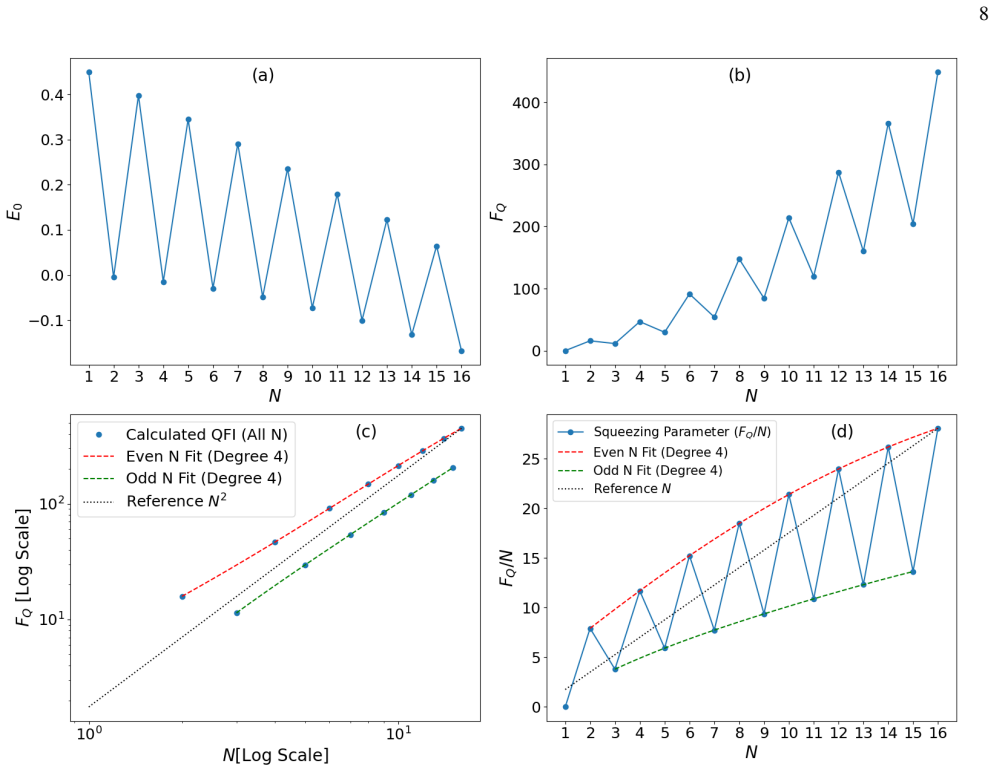
Magnetization, χx, and basic QFI scaling To elucidate the diminishing returns in the superlinear scal- ing of the QFI and the even-odd oscillations, we analyze the energy gap and magnetization variance. The total transverse magnetization operator is defined as Mx = N ∑ i=1 σx i , (12) where σx i is the Pauli X operator acting on site i. The mag- netic sus...
-
[2]
Finite-size scaling, spin squeezing, and the role of graph structure at T = 0 In this section, we investigate the finite-size scaling behav- ior of key physical quantities relevant to our model at T = 0: the QFI FQ, the ground state energy Eg, and the spin squeez- ing parameter FQ/N. We consider both Kac scaling intro- duces a normalization of the interac...
-
[3]
Phase space interference at T = 0 We analyze the origin of the even-odd oscillations observed in the QFI for optimal (complete) graphs, where each spin interacts equally with all others. These oscillations arise from phase-space interference between squeezed spin states and the eigenstates of the Sx operator, analogous to interfer- ence effects between ph...
-
[4]
C. L. Degen, F. Reinhard, and P. Cappellaro, “Quantum sens- ing,” Rev. Mod. Phys.89, 035002 (2017)
work page 2017
-
[5]
Ad- vances in quantum metrology,
Vittorio Giovannetti, Seth Lloyd, and Lorenzo Maccone, “Ad- vances in quantum metrology,” Nat. Photon.5, 222–229 (2011)
work page 2011
-
[7]
Vittorio Giovannetti, Seth Lloyd, and Lorenzo Maccone, “Quantum metrology,” Phys. Rev. Lett.96, 010401 (2006)
work page 2006
-
[8]
Coherence in quantum es- timation,
Paolo Giorda and Michele Allegra, “Coherence in quantum es- timation,” J. Phys. A: Math. Theor.51, 025302 (2017)
work page 2017
-
[9]
Bath-induced correlations enhance ther- mometry precision at low temperatures,
Guim Planella, Marina F. B. Cenni, Antonio Ac ´ın, and Mo- hammad Mehboudi, “Bath-induced correlations enhance ther- mometry precision at low temperatures,” Phys. Rev. Lett. 128, 040502 (2022)
work page 2022
-
[10]
Scalable spin squeezing for quantum- enhanced magnetometry with bose-einstein condensates,
W. Muessel, H. Strobel, D. Linnemann, D. B. Hume, and M. K. Oberthaler, “Scalable spin squeezing for quantum- enhanced magnetometry with bose-einstein condensates,” Phys. Rev. Lett. 113, 103004 (2014)
work page 2014
-
[11]
Low-temperature quantum thermometry boosted by coherence generation,
A. Ullah, M. Tahir Naseem, and ¨Ozg¨ur E. M ¨ustecaplıo˘glu, “Low-temperature quantum thermometry boosted by coherence generation,” Phys. Rev. Res.5, 043184 (2023)
work page 2023
-
[12]
Review: Quantum metrology and sensing with many-body systems,
Victor Montenegro, Chiranjib Mukhopadhyay, Rozhin Yousef- jani, Saubhik Sarkar, Utkarsh Mishra, Matteo G.A. Paris, and Abolfazl Bayat, “Review: Quantum metrology and sensing with many-body systems,” Phys. Rep.1134, 1–62 (2025)
work page 2025
-
[13]
Current trends in global quantum metrology,
Chiranjib Mukhopadhyay, Victor Montenegro, and Abolfazl Bayat, “Current trends in global quantum metrology,” Journal of Physics A: Mathematical and Theoretical 58 (2025)
work page 2025
-
[14]
Improved quantum magnetometry beyond the standard quantum limit,
J. B. Brask, R. Chaves, and J. Kołody´nski, “Improved quantum magnetometry beyond the standard quantum limit,” Phys. Rev. X 5, 031010 (2015)
work page 2015
-
[15]
Luca Razzoli, Luca Ghirardi, Ilaria Siloi, Paolo Bordone, and Matteo G. A. Paris, “Lattice quantum magnetometry,” Phys. Rev. A 99, 062330 (2019)
work page 2019
-
[16]
Quantum noise limited and entanglement-assisted magnetometry,
W. Wasilewski, K. Jensen, H. Krauter, J. J. Renema, M. V . Balabas, and E. S. Polzik, “Quantum noise limited and entanglement-assisted magnetometry,” Phys. Rev. Lett. 104, 133601 (2010)
work page 2010
-
[17]
Quantum magne- tometry using discrete-time quantum walk,
Kunal Shukla and C. M. Chandrashekar, “Quantum magne- tometry using discrete-time quantum walk,” Phys. Rev. A 109, 032608 (2024)
work page 2024
-
[18]
Universal quantum magnetometry with spin states at equilibrium,
Filippo Troiani and Matteo G. A. Paris, “Universal quantum magnetometry with spin states at equilibrium,” Phys. Rev. Lett. 120, 260503 (2018)
work page 2018
-
[19]
Ultimate limits for quantum magnetometry via time-continuous measurements,
Francesco Albarelli, Matteo A C Rossi, Matteo G A Paris, and Marco G Genoni, “Ultimate limits for quantum magnetometry via time-continuous measurements,” New J. Phys. 19, 123011 (2017)
work page 2017
-
[20]
Sequential measurements for quantum- enhanced magnetometry in spin chain probes,
Victor Montenegro, Gareth Si ˆon Jones, Sougato Bose, and Abolfazl Bayat, “Sequential measurements for quantum- enhanced magnetometry in spin chain probes,” Phys. Rev. Lett. 129, 120503 (2022)
work page 2022
-
[21]
Quantum-enhanced magne- tometry by phase estimation algorithms with a single artificial atom,
S. Danilin, A. V . Lebedev, A. Veps ¨al¨ainen, G. B. Lesovik, G. Blatter, and G. S. Paraoanu, “Quantum-enhanced magne- tometry by phase estimation algorithms with a single artificial atom,” npj Quantum Inf.4, 29 (2018)
work page 2018
-
[22]
Ultrasensitive magnetometer using a single atom,
I. Baumgart, J.-M. Cai, A. Retzker, M. B. Plenio, and Ch. Wun- derlich, “Ultrasensitive magnetometer using a single atom,” Phys. Rev. Lett. 116, 240801 (2016)
work page 2016
-
[23]
Smooth optimal quantum control for robust solid-state spin magnetometry,
Tobias N ¨obauer, Andreas Angerer, Bj ¨orn Bartels, Michael Trupke, Stefan Rotter, J ¨org Schmiedmayer, Florian Mintert, and Johannes Majer, “Smooth optimal quantum control for robust solid-state spin magnetometry,” Phys. Rev. Lett. 115, 190801 (2015)
work page 2015
-
[24]
Sub-projection-noise sensitivity in broadband atomic magnetometry,
M. Koschorreck, M. Napolitano, B. Dubost, and M. W. Mitchell, “Sub-projection-noise sensitivity in broadband atomic magnetometry,” Phys. Rev. Lett.104, 093602 (2010)
work page 2010
-
[25]
Magnetic sensitivity beyond the projection noise limit by spin squeezing,
R. J. Sewell, M. Koschorreck, M. Napolitano, B. Dubost, N. Be- hbood, and M. W. Mitchell, “Magnetic sensitivity beyond the projection noise limit by spin squeezing,” Phys. Rev. Lett.109, 253605 (2012)
work page 2012
-
[26]
Quantum metrology with a scanning probe atom interferometer,
Caspar F. Ockeloen, Roman Schmied, Max F. Riedel, and Philipp Treutlein, “Quantum metrology with a scanning probe atom interferometer,” Phys. Rev. Lett.111, 143001 (2013)
work page 2013
-
[27]
Subfemtotesla scalar atomic magnetometry using multipass cells,
D. Sheng, S. Li, N. Dural, and M. V . Romalis, “Subfemtotesla scalar atomic magnetometry using multipass cells,” Phys. Rev. Lett. 110, 160802 (2013)
work page 2013
-
[28]
Shot-noise-limited magnetometer with sub-picotesla sensitivity at room temperature,
Vito Giovanni Lucivero, Pawel Anielski, Wojciech Gawlik, and Morgan W. Mitchell, “Shot-noise-limited magnetometer with sub-picotesla sensitivity at room temperature,” Rev. Sci. In- strum 85, 113108 (2014)
work page 2014
-
[29]
Ir ´en´ee Fr ´erot and Tommaso Roscilde, “Quantum critical metrology,” Phys. Rev. Lett.121, 020402 (2018)
work page 2018
-
[30]
Critical quantum metrology with a finite- component quantum phase transition,
Louis Garbe, Matteo Bina, Arne Keller, Matteo G. A. Paris, and Simone Felicetti, “Critical quantum metrology with a finite- component quantum phase transition,” Phys. Rev. Lett. 124, 120504 (2020)
work page 2020
-
[31]
Quantum critical phenomena in a spin- 1 2 frus- trated square lattice with spatial anisotropy,
H. Yamaguchi, Y . Iwasaki, Y . Kono, T. Okubo, S. Miyamoto, Y . Hosokoshi, A. Matsuo, T. Sakakibara, T. Kida, and M. Hagiwara, “Quantum critical phenomena in a spin- 1 2 frus- trated square lattice with spatial anisotropy,” Phys. Rev. B103, L220407 (2021)
work page 2021
-
[32]
Multiparameter estimation in networked quantum sen- sors,
Timothy J. Proctor, Paul A. Knott, and Jacob A. Dunning- ham, “Multiparameter estimation in networked quantum sen- sors,” Phys. Rev. Lett.120, 080501 (2018)
work page 2018
-
[33]
Role of topology in determining the precision of a finite thermometer,
Alessandro Candeloro, Luca Razzoli, Paolo Bordone, and Mat- teo G. A. Paris, “Role of topology in determining the precision of a finite thermometer,” Phys. Rev. E104, 014136 (2021)
work page 2021
-
[34]
Optimal thermometers with spin networks,
Paolo Abiuso, Paolo Andrea Erdman, Michael Ronen, Frank No´e, G ´eraldine Haack, and Mart ´ı Perarnau-Llobet, “Optimal thermometers with spin networks,” Quantum Sci. Technol. 9, 035008 (2024)
work page 2024
-
[35]
Stochastic colli- sion model approach to transport phenomena in quantum net- works,
Diana A Chisholm, Guillermo Garc´ıa-P´erez, Matteo A C Rossi, G Massimo Palma, and Sabrina Maniscalco, “Stochastic colli- sion model approach to transport phenomena in quantum net- works,” New J. Phys.23, 033031 (2021)
work page 2021
-
[36]
Quantum trans- port efficiency in noisy random-removal and small-world net- works,
Arzu Kurt, Matteo A C Rossi, and Jyrki Piilo, “Quantum trans- port efficiency in noisy random-removal and small-world net- works,” J. Phys. A: Math. Theor.56, 145301 (2023)
work page 2023
-
[37]
Perturbed graphs achieve unit transport effi- ciency without environmental noise,
Simone Cavazzoni, Luca Razzoli, Paolo Bordone, and Mat- teo G. A. Paris, “Perturbed graphs achieve unit transport effi- ciency without environmental noise,” Phys. Rev. E106, 024118 (2022)
work page 2022
-
[38]
Memory preservation in highly-connected quantum networks,
Simone Ausilio, Fausto Borgonovi, Giuseppe Luca Celardo, Jorge Yago Malo, and Maria Luisa Chiofalo, “Memory preservation in highly-connected quantum networks,” (2025), arXiv:2503.05655
-
[39]
Enhanced quantum transport in chiral quantum walks,
Emilio Annoni, Massimo Frigerio, and Matteo G. A. Paris, “Enhanced quantum transport in chiral quantum walks,” Quan- tum Inf. Process. 23, 117 (2024). 15
work page 2024
-
[40]
Ge- ometrical optimization of spin clusters for the preservation of quantum coherence,
Lea Gassab, Onur Pusuluk, and ¨Ozg¨ur E. M¨ustecaplıo˘glu, “Ge- ometrical optimization of spin clusters for the preservation of quantum coherence,” Phys. Rev. A109, 012424 (2024)
work page 2024
-
[41]
Quantum walk coherences on a dynamical percolation graph,
Fabian Elster, Sonja Barkhofen, Thomas Nitsche, Jaroslav Novotn´y, Aur ´el G ´abris, Igor Jex, and Christine Silberhorn, “Quantum walk coherences on a dynamical percolation graph,” Sci. Rep. 5, 13495 (2015)
work page 2015
-
[42]
Identifying network topologies via quantum walk distributions,
Claudia Benedetti and Ilaria Gianani, “Identifying network topologies via quantum walk distributions,” A VS Quantum Sci. 6, 014412 (2024)
work page 2024
-
[43]
Configuration-dependent precision in magnetometry and thermometry using multi-qubit quantum sensors,
A. Ullah, ¨Ozg¨ur E. M ¨ustecaplıo˘glu, and Matteo G. A. Paris, “Configuration-dependent precision in magnetometry and thermometry using multi-qubit quantum sensors,” (2025), arXiv:2505.22395
-
[44]
Inferring quantum network topologies using genetic optimisation of indirect measurements,
Conall J. Campbell, Matthew Mackinnon, Mauro Paternostro, and Diana Chisholm, “Inferring quantum network topologies using genetic optimisation of indirect measurements,” (2025), arXiv:2506.11289
-
[45]
Quantum estimation for quantum technol- ogy,
Matteo G. A. Paris, “Quantum estimation for quantum technol- ogy,” Int. J. Quantum Inf07, 125–137 (2009)
work page 2009
-
[46]
Valentin Gebhart, Raffaele Santagati, Antonio Andrea Gentile, Erik M. Gauger, David Craig, Natalia Ares, Leonardo Banchi, Florian Marquardt, Luca Pezz `e, and Cristian Bonato, “Learn- ing quantum systems,” Nat. Rev. Phys.5, 141–156 (2023)
work page 2023
-
[47]
Neural-network-based parameter estima- tion for quantum detection,
Yue Ban, Javier Echanobe, Yongcheng Ding, Ricardo Puebla, and Jorge Casanova, “Neural-network-based parameter estima- tion for quantum detection,” Quantum Sci. Technol. 6, 045012 (2021)
work page 2021
-
[48]
Multiclass classification of dephasing channels,
Adriano M Palmieri, Federico Bianchi, Matteo G. A. Paris, and Claudia Benedetti, “Multiclass classification of dephasing channels,” Physical Review A104, 052412 (2021)
work page 2021
-
[49]
Enhancing quantum state tomography via resource-efficient attention-based neural net- works,
Adriano Macarone Palmieri, Guillem M ¨uller-Rigat, Anub- hav Kumar Srivastava, Maciej Lewenstein, Grzegorz Rajchel- Mieldzio´c, and Marcin Płodzie ´n, “Enhancing quantum state tomography via resource-efficient attention-based neural net- works,” Physical Review Research6, 033248 (2024)
work page 2024
-
[50]
Multiparameter estima- tion of continuous-time quantum walk hamiltonians through machine learning,
Ilaria Gianani and Claudia Benedetti, “Multiparameter estima- tion of continuous-time quantum walk hamiltonians through machine learning,” A VS Quantum Science5 (2023)
work page 2023
-
[51]
Genetic algorithms and machine learning,
David E. Goldberg and John H. Holland, “Genetic algorithms and machine learning,” Machine Learning3, 95–99 (1988)
work page 1988
-
[52]
Multi- objective optimization using genetic algorithms: A tutorial,
Abdullah Konak, David W. Coit, and Alice E. Smith, “Multi- objective optimization using genetic algorithms: A tutorial,” Reliab. Eng. Syst. Saf.91, 992–1007 (2006), special Issue - Ge- netic Algorithms and Reliability
work page 2006
-
[53]
Aguston E. Eiben and Marc Schoenauer, “Evolutionary com- puting,” (2005), arXiv:cs/0511004 [cs.AI]
work page internal anchor Pith review Pith/arXiv arXiv 2005
-
[54]
M. Kac, G. E. Uhlenbeck, and P. C. Hemmer, “On the van der waals theory of the vapor-liquid equilibrium. i. discussion of a one-dimensional model,” J. Math. Phys.4, 216–228 (1963)
work page 1963
-
[55]
Quantum fisher information for states in expo- nential form,
Zhang Jiang, “Quantum fisher information for states in expo- nential form,” Phys. Rev. A89, 032128 (2014)
work page 2014
-
[56]
Quantum-enhanced measurements: Beating the standard quantum limit,
Vittorio Giovannetti, Seth Lloyd, and Lorenzo Maccone, “Quantum-enhanced measurements: Beating the standard quantum limit,” Science306, 1330–1336 (2004)
work page 2004
-
[57]
At the limits of criticality- based quantum metrology: Apparent super-heisenberg scaling revisited,
Marek M. Rams, Piotr Sierant, Omyoti Dutta, Paweł Horodecki, and Jakub Zakrzewski, “At the limits of criticality- based quantum metrology: Apparent super-heisenberg scaling revisited,” Phys. Rev. X8, 021022 (2018)
work page 2018
-
[58]
Sta- tistical mechanics and dynamics of solvable models with long- range interactions,
Alessandro Campa, Thierry Dauxois, and Stefano Ruffo, “Sta- tistical mechanics and dynamics of solvable models with long- range interactions,” Phys. Rep.480, 57–159 (2009)
work page 2009
-
[59]
Quantum metrology from a quantum information science perspective,
G ´eza T´oth and Iagoba Apellaniz, “Quantum metrology from a quantum information science perspective,” J. Phys. A: Math. Theor. 47, 424006 (2014)
work page 2014
-
[60]
Phase-space interference in extensive and nonextensive quantum heat engines,
Ali ¨U. C. Hardal, Mauro Paternostro, and ¨Ozg¨ur E. M¨ustecaplıo˘glu, “Phase-space interference in extensive and nonextensive quantum heat engines,” Phys. Rev. E 97, 042127 (2018)
work page 2018
-
[61]
Adam: A Method for Stochastic Optimization
Diederik P. Kingma and Jimmy Ba, “Adam: A method for stochastic optimization,” (2017), arXiv:1412.6980
work page internal anchor Pith review Pith/arXiv arXiv 2017
discussion (0)
Sign in with ORCID, Apple, or X to comment. Anyone can read and Pith papers without signing in.