REVIEW 3 major objections 5 minor 36 references
One year of ASPEX-SWIS operation -- Characteristic features, observations and science potential
T0 review · 3 major / 5 minor · reviewed 2026-08-06 · deepseek-v4-flash
Pith's one-line read Aditya-L1's SWIS solar wind speed measurements match Wind's to a correlation of 0.94 over 17 months.
desk verdict A genuinely useful first-year validation of a new L1 solar wind ion spectrometer, with solid velocity agreement against Wind, but the density and temperature moment products need substantial clarification and sensitivity testing. read the letter →
The pith
A machine-rendered reading of the paper's core claim, the machinery that carries it, and where it could break.
The reading
What carries the argument
The central machinery is the dual Top-Hat Electrostatic Analyzer configuration (THA-1 in the ecliptic plane and THA-2 in the perpendicular plane), a curved-plate energy selector that turns 0.1–20 keV ion energy spectra into velocity-space moments. Assuming the proton distribution is approximately Maxwellian and isotropic in the spacecraft frame, the paper derives number density, bulk speed, and thermal speed from flux-weighted moments, with a parametric Gaussian fit used to cross-check the non-parametric estimates. The dual-plane design is what lets SWIS claim directional sensitivity without a spinning platform, and the moment derivation is what produces the bulk parameters validated against Wind and DSCOVR.
What would settle it
Compare SWIS moment-derived density and thermal speed with Wind-3DP-PLSP during intervals selected for strong proton beam or temperature anisotropy, and check whether the SWIS-minus-Wind residuals grow with the measured anisotropy; if the residuals do not track anisotropy, the Maxwellian-and-isotropic assumption is not the limiting factor, whereas if they do, the two-plane moment derivation is the cause.
Extended reading notes
Core claim
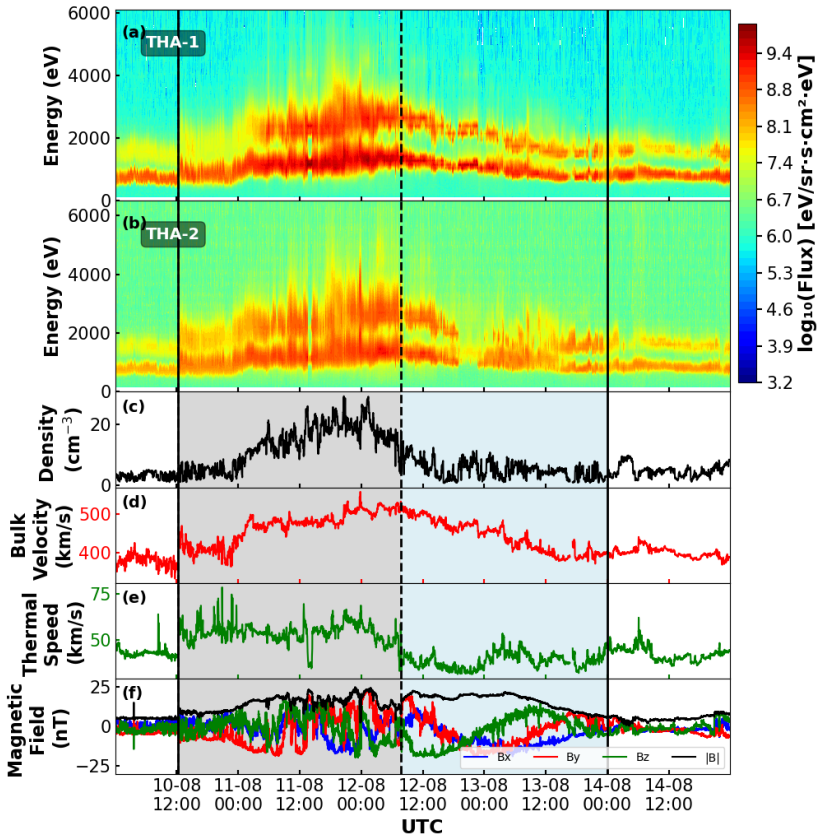
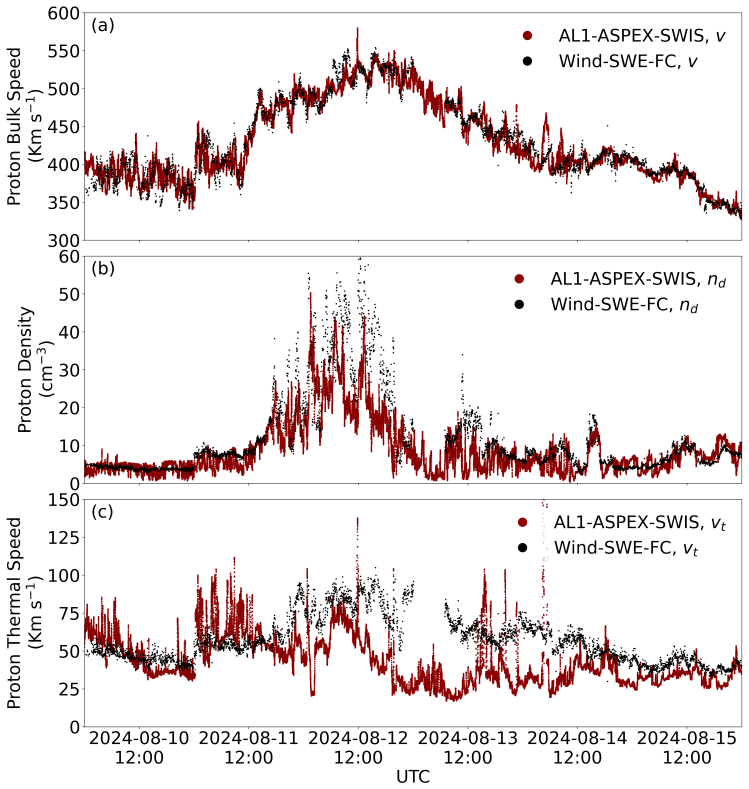
The paper's central discovery is that a two-plane, top-hat electrostatic analyzer on a 3-axis stabilized spacecraft—without full three-dimensional distribution coverage—can recover solar wind bulk velocity with accuracy comparable to established spinning-platform instruments. Concretely, over January 2024 to May 2025 the AL1-ASPEX-SWIS bulk speed matches Wind-SWE-FC with $R^2=0.94$ and slope $0.97$, and matches Wind-3DP-PLSP with slope $1.00$ and $R^2=0.94$, while the 11–12 August 2024 ICME shock, sheath, and magnetic cloud boundaries appear in SWIS data at the same times as in Wind and DSCOVR. The authors take this as confirmation that SWIS is suited to monitor both transient solar wind structures and long-term solar wind conditions from L1.
Load-bearing premise
The load-bearing assumption is that the protons streaming past the spacecraft have speeds spread out evenly in every direction, although SWIS only samples two planes and ignores all particles slower than 280 km/s; if the flow is beamed or direction-dependent, the derived density and temperature are biased.
Editorial extensions
If this is right
- SWIS bulk velocity data can be used as a reliable L1 solar wind speed input for space weather monitoring, with agreement to Wind at $R^2=0.94$.
- Transient events like ICMEs can be identified in SWIS energy-time spectrograms and moment time series, including shock, sheath, and magnetic cloud phases.
- Density and thermal speed from SWIS should be used with caution or after instrument-specific cross-calibration, since their agreement with reference instruments is weaker.
- The observed difference between THA-1 and THA-2 fluxes indicates SWIS can be used to study solar wind ion anisotropy and alpha-particle directionality.
- SWIS velocity fluctuations can support inertial-range turbulence studies, with power spectral slopes near the MHD prediction.
Reading between the lines
- If SWIS's density and thermal speed biases come mainly from the two-plane sampling assumption, then adding a response-model correction for the unsampled out-of-plane direction could bring density and temperature into closer agreement with Wind-3DP without changing the velocity result.
- The ratio of THA-1 to THA-2 flux is itself a local measure of anisotropy, so it could be compared against moment-derived temperatures to flag intervals where the isotropy assumption fails.
- The weak density and thermal speed agreement with DSCOVR suggests that spacecraft separation or Faraday-cup response, not SWIS alone, may dominate those discrepancies; a triple co-location study could separate those effects.
- Over a longer baseline, SWIS's 5-second cadence could resolve kinetic-scale solar wind fluctuations at L1 with better temporal resolution than Wind-SWE-FC's 92-second cadence, making it a useful complement for turbulence studies.
Editorial analysis
A structured set of objections, weighed in public.
Referee Report
Summary. The paper reports on the first year of operations of the Aditya-L1 ASPEX-SWIS solar wind ion spectrometer. It describes the instrument and the derivation of proton density, bulk speed, and thermal speed from dual top-hat electrostatic analyzer data, assuming an isotropic Maxwellian distribution in the spacecraft frame. The authors validate SWIS against Wind and DSCOVR through an August 2024 ICME case study, a dual-plane anisotropy analysis, a turbulence power spectral density comparison, and a 17-month statistical comparison (January 2024 to May 2025). The central claim is that SWIS bulk velocity measurements agree strongly with Wind (R2 = 0.94), while density and thermal speed show larger scatter attributed to inter-instrument differences, and that SWIS is scientifically useful for both transient and long-term solar wind monitoring.
Significance. If the validation is robust, the paper establishes a new L1 solar wind monitor with high-cadence dual-plane measurements, which would be valuable for multi-point heliospheric studies and space weather monitoring. The strongest positive evidence is the bulk velocity agreement with Wind: R2 = 0.94 with slopes near unity for both Wind-SWE-FC and Wind-3DP-PLSP, a well-resolved ICME case study, and a turbulence spectral slope close to the MHD inertial-range expectation. The paper also provides public data access for the cruise-phase dataset and clear documentation of the instrument configuration. However, the density and thermal speed products, which are central to the long-term monitoring claim, are derived under an isotropic-spacecraft-frame assumption that is physically questionable for the supersonic solar wind, and the validation metrics for those parameters are poor (e.g., density R2 = -0.35 against Wind-3DP and thermal speed R2 = 0.07 against DSCOVR). The scientific significance is therefore conditional on reworking or carefully qualifying the moment derivation and the associated validation claims.
major comments (3)
- [Section 2.2] The moment formulas n = Σ f_i Δv_i, v = (1/n) Σ f_i v_i Δv_i, and σ² = (1/n) Σ f_i (v_i − v)² Δv_i treat the measured fluxes as a one-dimensional speed distribution, but a proper phase-space moment requires a Jacobian factor (e.g., 4πv² in the isotropic case) and a transformation from the spacecraft frame to the plasma frame. The stated assumption that the proton distribution is 'approximately Maxwellian and isotropic in the spacecraft frame' is inconsistent with the solar wind being a supersonic beam in that frame (V ≈ 400 km/s, thermal speed ≈ 20 km/s). This is not merely a cosmetic issue: the derived density and thermal speed are systematically biased, and this bias is a direct, untested explanation for the poor validation metrics in Table 2, such as density R2 = -0.35 against Wind-3DP and thermal speed R2 = 0.07 against DSCOVR. The paper needs to either derive the moments correctly for a beam-like distribution, quantify the bias introduced by the current 1D isotropic treatment, or restrict the validated products to bulk velocity only.
- [Section 2.2, low-speed cutoff] The exclusion of data bins with v < 280 km/s removes a substantial portion of the slow solar wind and is applied without any sensitivity analysis. Because the cutoff is applied before the moment calculations, it systematically truncates the low-speed wing of the distribution and biases the density and thermal speed estimates, especially in slow-wind intervals. Given that the density and thermal speed comparisons already show weak or negative R2 values in Table 2, the paper should quantify how sensitive the reported statistical results are to the choice of cutoff, or justify the cutoff with a demonstrated physical or instrumental reason rather than as an unexamined preprocessing step.
- [Sections 3.6 and 4, Table 2] The abstract and conclusion claim 'expected variability in thermal speed and density due to inter-instrument differences' and 'strong agreement' in bulk velocity, but Table 2 shows that the DSCOVR comparisons are weak even for velocity: bulk velocity slope 0.82 with R2 = 0.44, thermal speed R2 = 0.07, and proton density R2 = 0.09. The paper does not provide error bars on the slopes or R2 values, nor any statistical test that the observed scatter is consistent with the claimed 'expected' inter-instrument differences. The central validation claim should be narrowed to the Wind velocity comparison, or the DSCOVR discrepancies need a quantitative treatment (e.g., regression uncertainties, cross-calibration factors, or a demonstration that the discrepancies are consistent with known instrument geometry and sampling differences).
minor comments (5)
- [Abstract] The sentence beginning 'In this study, we assess the performance of SWIS...' appears twice in the abstract and should be removed once.
- [Section 2.2] The sentence describing the total uncertainty starts with 'These sources are combined in quadrature to compute the total uncertainty in the differential flux' but then stops without giving the explicit formula or the resulting uncertainty propagation to n, v, and vt; please complete the derivation or provide a reference.
- [Figure 10 and Section 3.5] The spectral slope value of approximately -1.501 for AL1-ASPEX-SWIS is reported without an uncertainty or a description of the fitting procedure; since the text emphasizes agreement with Wind, the Wind slope and its uncertainty should also be given.
- [Section 3.2] The text refers to 'a simple exercise (not shown here)' involving a frequency-domain filter; either include this analysis in a supplemental figure or remove the reference to it, because the reader cannot evaluate the claimed improvement in correlation.
- [Data Availability] The ISSDC link is given as 'https://pradan1.issdc.gov.in/al1/'; please confirm that this is the correct public URL and that the dataset identifier is stable.
Circularity Check
No significant circularity: validation is anchored to independent Wind/DSCOVR benchmarks; self-citations are contextual instrument references.
full rationale
The derivation chain in this paper is a validation exercise: SWIS L2 moments are computed from measured flux (Sec. 2.2) and then compared, via scatter plots and Table 2 regressions, with bulk parameters from Wind (SWE-FC, 3DP) and DSCOVR (PlasMag-FC). The targets of comparison are external datasets, so the central claim (bulk-velocity correlation R2=0.94; ICME timing agreement; PSD inertial-range slope -1.501) does not reduce by construction to any fitted input or to a self-citation. The moment formulas n=Σf_iΔv_i, v=(1/n)Σf_iv_iΔv_i, σ²=(1/n)Σf_i(v_i-v)²Δv_i are indeed 1D speed-space reductions that assume isotropy in the spacecraft frame; this is a physical-modelling assumption that could bias density and thermal speed, and Table 2's low/negative R2 values (e.g., density R2=-0.35 vs Wind-3DP, thermal speed R2=0.07 vs DSCOVR) are consistent with such bias. However, that is a correctness/validity limitation, not a circularity: the paper does not define Wind's or DSCOVR's density or temperature in terms of SWIS measurements, nor does it fit a parameter to a subset and then 'predict' the same quantity. Self-citations [1]-[4] and [33] are instrument-description, calibration, prior-comparison, and data-release papers by the same team; they support instrument configuration and ground calibration as external artifacts, and none of them is the sole load-bearing justification for the validation outcome. The attribution of density/thermal-speed scatter to 'inter-instrument calibration differences' is not quantified, but that is an evidentiary weakness, not a circular step. No self-definitional equation, uniqueness import, or ansatz-smuggled-by-citation was found.
Assumptions & free parameters
free parameters (2)
- Low-speed cutoff v_min =
280 km/s (bins below excluded)
- Inertial-range fit interval =
10^-4 to 10^-2 Hz
assumptions (3)
- domain assumption Solar wind proton velocity distribution is approximately Maxwellian and isotropic in the spacecraft frame.
- domain assumption Wind and DSCOVR measurements are contemporaneous and approximately co-located references at L1 for intercomparison.
- standard math Flux-to-phase-space-density transformation is valid for moment computation.
Cite this review
Pith. "Pith review of One year of ASPEX-SWIS operation -- Characteristic features, observations and science potential." pith.science (2026). https://pith.science/paper/V3P65L6K
@misc{pith2026250717523,
  author       = {Pith},
  title        = {Pith review of: One year of ASPEX-SWIS operation -- Characteristic features, observations and science potential},
  year         = {2026},
  howpublished = {\url{https://pith.science/paper/V3P65L6K}},
  note         = {Machine review of arXiv:2507.17523}
}
read the original abstract
The Aditya-L1 mission, India's first dedicated solar observatory positioned at the first Lagrange point (L1) of the Sun-Earth system, carries the Solar Wind Ion Spectrometer (SWIS) as part of the ASPEX payload suite. Even before settling into its Halo orbit, SWIS has been providing nearly continuous in-situ measurements of solar wind ion spectra. Moments of the velocity distribution functions (VDFs) have been calculated to derive key solar wind parameters such as density, bulk speed, and temperature. In this study, we assess the performance of SWIS (hereafter referred to as AL1-ASPEX-SWIS) by comparing its measurements with contemporaneous data from the Wind and DSCOVR missions. In this study, we assess the performance of SWIS (hereafter referred to as AL1-ASPEX-SWIS) by comparing its measurements with contemporaneous data from the Wind and DSCOVR missions. A detailed case study of the interplanetary coronal mass ejection (ICME) event on August 7, 2024, is presented, where sharp changes in bulk speed, thermal speed, and number density were found to be well-aligned with independent observations-confirming the instrument's ability to capture dynamic solar wind features. Spectral analysis of kinetic fluctuations revealed a well-defined inertial range with a spectral slope consistent with magnetohydrodynamic (MHD) turbulence. Furthermore, a 17-month statistical comparison (from January 2024 to May 2025) shows a strong correlation in bulk velocity (R2 = 0.94 with Wind), with expected variations in thermal speed and density arising from differences between instruments. These findings demonstrate the scientific value of AL1-ASPEX-SWIS for monitoring both transient solar events and long-term solar wind conditions.
Figures


Figures from the paper (9 more)



Reference graph
Works this paper leans on
-
[1]
Dibyendu Chakrabarty, Bijoy Dalal, Santosh Vadawale, and others, Energetic ( < 2 MeV) Ion Environment of the Magnetosphere as measured by ASPEX-STEPS on board Aditya-L1 during its earth-bound phase , Preprint at https://arxiv.org/abs/2506. 21919, 2025
work page 2025
-
[2]
Prashant Kumar, Bhas Bapat, Manan S. Shah, and others, Aditya Solar Wind Particle Experiment (ASPEX) on Board Aditya—L1: The Solar Wind Ion Spectrometer (SWIS), Solar Physics, vol. 300, no. 4, p. 37, 2025. doi:10.1007/s11207-025-02443-x
-
[3]
Shiv Kumar Goyal, Neeraj Kumar Tiwari, Arpit R. Patel, and others,Aditya Solar Wind Particle Experiment on Board Aditya–L1: The Supra-Thermal and Energetic Particle Spectrometer, Solar Physics, vol. 300, p. 35, 2025. doi:10.1007/s11207-025-02441-z
-
[4]
Jacob Sebastian, Abhishek Kumar, Dibyendu Chakrabarty, and others, Comparison of Solar Wind flux and bulk parameters obtained from Aditya L1-ASPEX with Wind- 3DP-PESA-L and ACE-EPAM-LEMS120 , GSICS Quarterly, vol. 18, no. 4, 2025. doi:10.25923/gmzc-9a28
-
[5]
P. Loto’aniu, K. Romich, W. Rowland, and others, Validation of the DSCOVR Space- craft Mission Space Weather Solar Wind Products , Space Weather, vol. 20, 2022. doi:10.1029/2022SW003085
-
[6]
L. Wilson, A. Brosius, N. Gopalswamy, and others, A Quarter Century of Wind Space- craft Discoveries, Reviews of Geophysics, vol. 59, 2021. doi:10.1029/2020RG000714
-
[7]
D. Tripathi, D. Chakrabarty, A. Nandi, and others, The Aditya-L1 mission of ISRO , Proc. IAU, vol. 18, pp. 17–27, 2022. doi:10.1017/S1743921323001230
-
[8]
K. W. Ogilvie, D. J. Chornay, R. J. Fritzenreiter, and others, SWE, a comprehensive plasma instrument for the WIND spacecraft , Space Science Reviews, vol. 71, no. 1, pp. 55–77, 1995. doi:10.1007/BF00751326
Show all 36 references
-
[9]
R. P. Lin, K. A. Anderson, S. Ashford, and others, A three-dimensional plasma and energetic particle investigation for the WIND spacecraft , Space Science Reviews, vol. 71, pp. 125–153, 1995. doi:10.1007/BF00751328
1995 doi
-
[10]
Daly, Analysis Methods for Multi-Spacecraft Data , ISSI Scientific Reports Series, vol
G¨ otz Paschmann and Patrick W. Daly, Analysis Methods for Multi-Spacecraft Data , ISSI Scientific Reports Series, vol. 1, ESA/ISSI, 1998
1998
-
[11]
Feldman, E
U. Feldman, E. Landi, N. A. Schwadron, On the sources of fast and slow solar wind , JGR: Space Physics, vol. 110, no. A7, 2005. doi:10.1029/2004JA010918
2005 doi
-
[12]
Alterman and J
B. Alterman and J. Kasper, Helium Variation across Two Solar Cycles Reveals a Speed- dependent Phase Lag , ApJ, vol. 879, p. L6, 2019. doi:10.3847/2041-8213/ab2391
2019 doi
-
[13]
Chakrabarty, N
Yogesh, D. Chakrabarty, N. Srivastava, New insights on the behaviour of solar wind protons and alphas in the Stream Interaction Region in solar cycle 23 and 24 , MNRAS Letters, 2023. doi:10.1093/mnrasl/slad112 20
2023 doi
-
[14]
Kilpua, H
E. Kilpua, H. E. J. Koskinen, T. I. Pulkkinen, Coronal mass ejections and their sheath regions in interplanetary space , Living Rev. Solar Phys., vol. 14, no. 1, p. 5, 2017. doi:10.1007/s41116-017-0009-6
2017 doi
-
[15]
D. F. Webb and T. A. Howard, Coronal Mass Ejections: Observations , Living Rev. Solar Phys., vol. 9, no. 1, p. 3, 2012. doi:10.12942/lrsp-2012-3
2012 doi
-
[16]
J. D. Richardson, Shocks and sheaths in the heliosphere , JASTP, vol. 73, no. 11, pp. 1385–1389, 2011. doi:10.1016/j.jastp.2010.06.005
2011 doi
-
[17]
J. D. Richardson, Y. Liu, C. Wang, and others, ICMEs at very large distances , Adv. Space Res., vol. 38, no. 3, pp. 528–534, 2006. doi:10.1016/j.asr.2005.06.049
2006 doi
-
[18]
J. J. Podesta, D. A. Roberts, M. L. Goldstein, Power spectrum of small-scale tur- bulent velocity fluctuations in the solar wind , JGR: Space Physics, vol. 111, 2006. doi:10.1029/2006JA011834
2006 doi
-
[19]
Smith, Comparison of plasma parameter values obtained from the WIND SWE and 3DP instruments , NOAA Technical Memorandum ERL SEC 91, 1998
Z. Smith, Comparison of plasma parameter values obtained from the WIND SWE and 3DP instruments , NOAA Technical Memorandum ERL SEC 91, 1998
1998
-
[20]
Kasper, Michael L
Justin C. Kasper, Michael L. Stevens, Alan J. Lazarus, and others, Solar Wind Helium Abundance as a Function of Speed and Heliographic Latitude , ApJ, vol. 660, no. 1, p. 901, 2007. doi:10.1086/510842
2007 doi
-
[21]
Borrini, J
G. Borrini, J. D. Richardson, K. W. Ogilvie, and others, Helium abundance enhancements in the solar wind , JGR, vol. 87, no. A9, pp. 7370–7378, 1982. doi:10.1029/JA087iA09p07370
1982 doi
-
[22]
T. H. Zurbuchen, I. G. Richardson, In-Situ Solar Wind and Magnetic Field Sig- natures of Interplanetary CMEs , Space Science Reviews, vol. 123, pp. 31–43, 2006. doi:10.1007/s11214-006-9010-4
2006 doi
-
[23]
Chakrabarty, N
Yogesh, D. Chakrabarty, N. Srivastava, Distinctive changes in solar wind helium abundance in solar cycle 24 , MNRAS Letters, vol. 503, no. 1, pp. L17–L22, 2021. doi:10.1093/mnrasl/slab016
2021 doi
-
[24]
Chakrabarty, N
Yogesh, D. Chakrabarty, N. Srivastava, Helium enrichment in ICMEs: new insights , MNRAS Letters, vol. 513, no. 1, pp. L106–L111, 2022. doi:10.1093/mnrasl/slac044
2022 doi
-
[25]
E. N. Parker, Dynamics of the Interplanetary Gas and Magnetic Fields , ApJ, vol. 128, pp. 664–676, 1958. doi:10.1086/146579
1958 doi
-
[26]
S. R. Cranmer, Coronal Holes and the High-Speed Solar Wind , Living Rev. Solar Phys., vol. 6, no. 3, 2009. doi:10.12942/lrsp-2009-3
2009 doi
-
[27]
J. T. Gosling, CMEs and Magnetic Reconnection in the Solar Wind , JGR, vol. 98, pp. 18937–18949, 1993. doi:10.1029/93JA01405
1993 doi
-
[28]
W. H. Matthaeus, M. Velli, Turbulence Effects in the Heliosphere and on the Solar Wind, Space Science Reviews, vol. 160, pp. 145–168, 2005. doi:10.1007/s11214-005-3824-3 21
2005 doi
-
[29]
Grevesse, A
N. Grevesse, A. J. Sauval, Standard Solar Composition, Space Science Reviews, vol. 85, pp. 161–174, 1998. doi:10.1023/A:1005161325181
1998 doi
-
[30]
J. J. Podesta, D. A. Roberts, M. L. Goldstein, Spectral Exponents of Kinetic and Mag- netic Energy Spectra, ApJ, vol. 664, no. 1, p. 543, 2007. doi:10.1086/519211
2007 doi
-
[31]
Asplund, N
M. Asplund, N. Grevesse, A. J. Sauval, and others, The Chemical Composition of the Sun, ARA&A, vol. 47, pp. 481–522, 2009. doi:10.1146/annurev.astro.46.060407.145222
2009
-
[32]
J. M. Laming, A Unified Picture of FIP and Inverse-FIP Effects , ApJ, vol. 614, no. 2, p. 1063, 2004. doi:10.1086/423780
2004 doi
-
[33]
doi:10.5281/zenodo.15861770
Abhishek Kumar, Prashant Kumar, Dibyendu Chakrabarty, and others, AL1-ASPEX-SWIS [06–12 November 2023], L2 Data , Zenodo, July 2025. doi:10.5281/zenodo.15861770
2023 doi
-
[34]
Ogilvie, Richard J
Keith W. Ogilvie, Richard J. Fitzenreiter, Alan J. Lazarus, Justin C. Kasper, Michael Stevens, Wind SWE 92-sec Definitive Solar Wind Proton Data , NASA HPDE, 2021. https://hpde.io/NASA/NumericalData/Wind/SWE/Definitive/PT92S
2021
-
[35]
Lin, Stuart D
Robert P. Lin, Stuart D. Bale, Lynn B. Wilson III, Peter Schroeder, Wind 3DP 24- sec Ion OmniDirectional Fluxes and Moments , NASA HPDE, 2021. https://hpde.io/ NASA/NumericalData/Wind/3DP/PLSP/PT24S
2021
-
[36]
doi:10.7289/V51Z42F7 22
NOAA SWPC, Deep Space Climate Observatory (DSCOVR) , NOAA Dataset, 2016. doi:10.7289/V51Z42F7 22
2016 doi
Reviewed August 6, 2026 · model on record in the stance chip above.
Discussion (0). Continue with ORCID to comment.