Using optical tweezers to simultaneously trap, charge and measure the charge of a microparticle in air
Pith reviewed 2026-05-19 02:58 UTC · model grok-4.3
The pith
The laser in optical tweezers charges a trapped microparticle in air through a two-photon process.
A machine-rendered reading of the paper's core claim, the machinery that carries it, and where it could break.
Core claim
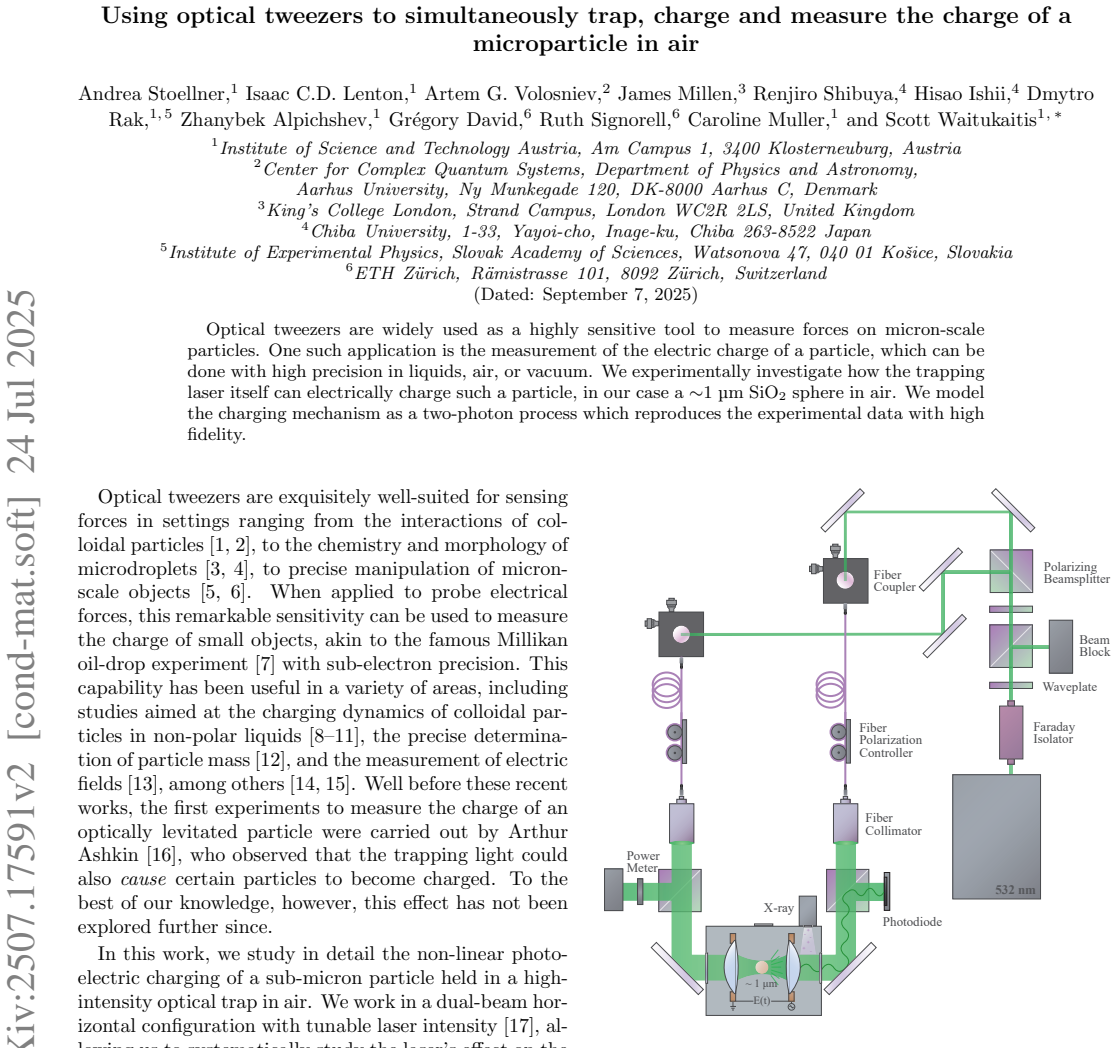
The authors show that a focused trapping laser can simultaneously hold a ~1 μm SiO2 sphere in air and electrically charge it, with the charge increasing steadily as the laser remains on. They attribute the effect to a two-photon absorption mechanism that reproduces the measured charging curves when fitted to the data.
What carries the argument
Two-photon absorption process induced by the trapping laser, which ejects electrons and produces positive charge on the particle.
Load-bearing premise
The charging is produced by two-photon absorption from the trapping laser rather than by single-photon ionization, heating, or environmental ions.
What would settle it
Record the rate of charge increase while varying laser intensity or wavelength and check whether the dependence follows the quadratic scaling expected for a two-photon process.
Figures


read the original abstract
Optical tweezers are widely used as a highly sensitive tool to measure forces on micron-scale particles. One such application is the measurement of the electric charge of a particle, which can be done with high precision in liquids, air, or vacuum. We experimentally investigate how the trapping laser itself can electrically charge such a particle, in our case a $\sim 1\,\mathrm{\mu m\;SiO_2}$ sphere in air. We model the charging mechanism as a two-photon process which reproduces the experimental data with high fidelity.
Editorial analysis
A structured set of objections, weighed in public.
Referee Report
Summary. The manuscript experimentally investigates the use of optical tweezers to trap a ~1 μm SiO2 sphere in air while the trapping laser simultaneously induces electrical charging of the particle. The authors model the charging as a two-photon absorption process and state that this model reproduces the experimental charging data with high fidelity.
Significance. If validated, the result would offer a practical method for combined trapping, charging, and charge measurement of microparticles in air using a single laser, which could simplify setups in aerosol physics or precision force measurements. The work extends known optical tweezers capabilities, but its impact hinges on rigorously establishing the two-photon mechanism over plausible alternatives.
major comments (1)
- [Charging mechanism and data fitting] The central claim that the charging arises from a two-photon process rests on the model reproducing the data with high fidelity, yet the manuscript provides no explicit test of intensity scaling (e.g., rate ∝ I² versus rate ∝ I for single-photon ionization or Arrhenius heating). Without a direct comparison of residuals, Bayesian evidence, or controls such as wavelength variation at fixed intensity, the mechanism identification is not uniquely supported and could be consistent with thermionic emission or ambient-ion attachment.
minor comments (1)
- [Experimental methods] Additional details on error analysis, data exclusion criteria, and full experimental parameters (laser power, wavelength, particle size distribution) would strengthen verifiability.
Simulated Author's Rebuttal
We thank the referee for their careful reading of the manuscript and for the constructive comments on the charging mechanism. We have revised the manuscript to include additional analysis addressing the intensity scaling of the charging process.
read point-by-point responses
-
Referee: The central claim that the charging arises from a two-photon process rests on the model reproducing the data with high fidelity, yet the manuscript provides no explicit test of intensity scaling (e.g., rate ∝ I² versus rate ∝ I for single-photon ionization or Arrhenius heating). Without a direct comparison of residuals, Bayesian evidence, or controls such as wavelength variation at fixed intensity, the mechanism identification is not uniquely supported and could be consistent with thermionic emission or ambient-ion attachment.
Authors: We agree that an explicit test of intensity scaling strengthens the identification of the two-photon mechanism. The original manuscript demonstrates that the two-photon model reproduces the charging dynamics with high fidelity across the measured intensities. In the revised version we have added a supplementary figure plotting the charging rate against laser intensity, which exhibits quadratic scaling. We also include a direct comparison of fit quality (residuals and R² values) for the two-photon model versus linear (single-photon) and Arrhenius-type models, showing that the I² dependence provides the best description of the data. This reduces the likelihood of thermionic emission or ambient-ion attachment as the dominant process under our conditions. Wavelength variation at fixed intensity would be a valuable additional control but requires a different laser source and new experiments outside the scope of the present revision. revision: partial
- Wavelength variation at fixed intensity as a control
Circularity Check
No significant circularity detected
full rationale
The paper's central claim rests on an experimental observation of laser-induced charging of a SiO2 microparticle, followed by the proposal of a two-photon absorption model that is stated to reproduce the measured charging rates with high fidelity. This constitutes a standard physical hypothesis tested against data via parameter fitting, with no reduction of any derived quantity to its own inputs by construction. No self-definitional loops, fitted parameters relabeled as independent predictions, or load-bearing self-citations appear in the provided abstract or described derivation chain. The two-photon mechanism is an independent physical ansatz motivated by multiphoton ionization physics rather than being defined in terms of the observed rates themselves, leaving the overall argument self-contained against external benchmarks.
Axiom & Free-Parameter Ledger
Lean theorems connected to this paper
-
IndisputableMonolith/Cost/FunctionalEquation.leanwashburn_uniqueness_aczel unclear?
unclearRelation between the paper passage and the cited Recognition theorem.
We model the charging mechanism as a two-photon process which reproduces the experimental data with high fidelity.
-
IndisputableMonolith/Foundation/AlphaCoordinateFixation.leancostAlphaLog_high_calibrated_iff unclear?
unclearRelation between the paper passage and the cited Recognition theorem.
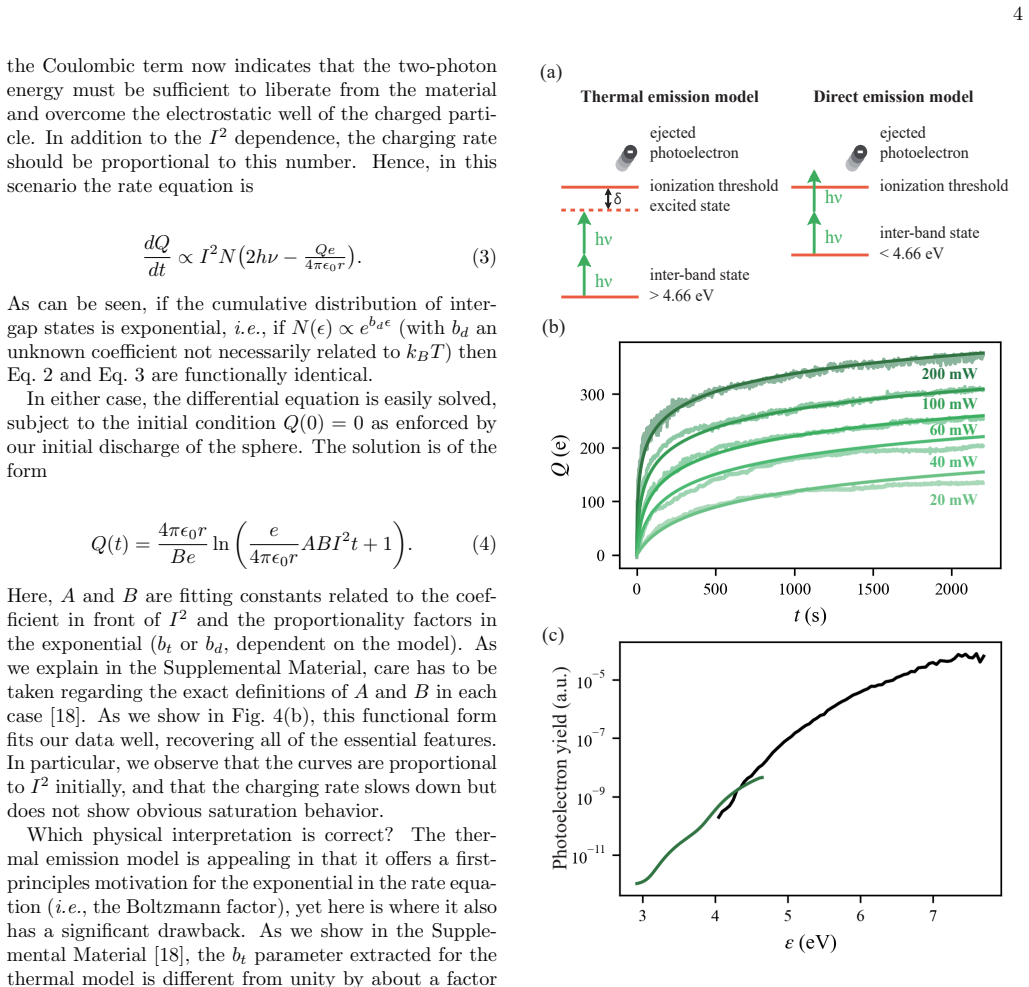
the charging rate equation dQ/dt ∝ I² exp(−bt Q e / (4πϵ₀ r k_B T))
What do these tags mean?
- matches
- The paper's claim is directly supported by a theorem in the formal canon.
- supports
- The theorem supports part of the paper's argument, but the paper may add assumptions or extra steps.
- extends
- The paper goes beyond the formal theorem; the theorem is a base layer rather than the whole result.
- uses
- The paper appears to rely on the theorem as machinery.
- contradicts
- The paper's claim conflicts with a theorem or certificate in the canon.
- unclear
- Pith found a possible connection, but the passage is too broad, indirect, or ambiguous to say the theorem truly supports the claim.
Reference graph
Works this paper leans on
-
[1]
J. W. Merrill, S. K. Sainis, and E. R. Dufresne, Phys. Rev. Lett. 103, 138301 (2009)
work page 2009
- [2]
-
[3]
M. A. Mohajer, P. Basuri, A. Evdokimov, G. David, D. Zindel, E. Miliordos, and R. Signorell, Science 388, 1426 (2025)
work page 2025
-
[4]
R. C. Sullivan, H. Boyer-Chelmo, K. Gorkowski, and H. Beydoun, Acc. Chem. Res. 53, 2498 (2020)
work page 2020
-
[5]
D. B. Ruffner and D. G. Grier, Phys. Rev. Lett. 108, 173602 (2012)
work page 2012
-
[6]
H. Rubinsztein-Dunlop, A. B. Stilgoe, D. Preece, A. Bui, and T. A. Nieminen, in Photonics (”John Wiley & Sons, Inc.”, Hoboken, NJ, USA, 2015) pp. 287–339
work page 2015
-
[7]
R. A. Millikan., Phys. Rev. 2, 109 (1913)
work page 1913
- [8]
-
[9]
F. Beunis, F. Strubbe, K. Neyts, and D. Petrov, Physical Review Letters 108, 10.1103/PhysRevLett.108.016101 (2012). 6
-
[10]
C. Schreuer, S. Vandewiele, F. Strubbe, K. Neyts, and F. Beunis, J. Colloid Interface Sci. 515, 248 (2018)
work page 2018
-
[11]
C. Schreuer, S. Vandewiele, T. Brans, F. Strubbe, K. Neyts, and F. Beunis, J. Appl. Phys. 123, 015105 (2018)
work page 2018
-
[13]
S. Zhu, Z. Fu, X. Gao, C. Li, Z. Chen, Y. Wang, X. Chen, and H. Hu, Photon. Res. 11, 279 (2023)
work page 2023
- [14]
-
[15]
J. T. Marmolejo, M. Urquiza-Gonz´ alez, O. Isaksson, A. Johansson, R. M´ endez-Fragoso, and D. Hanstorp, Sci- entific Reports 11, 10.1038/s41598-021-89714-2 (2021)
- [16]
- [17]
-
[18]
See Supplemental Material at [URL will be inserted by publisher]
-
[19]
W. C. Hinds, Aerosol technology: properties, behavior, and measurement of airborne particles (John Wiley & Sons, Incorporated, 1999)
work page 1999
- [20]
-
[21]
N. Fujimura, A. Ohta, K. Makihara, and S. Miyazaki, Jpn. J. Appl. Phys 55, 08P (2016)
work page 2016
-
[22]
M. L. O’Brien, C. Koitzsch, and R. J. Nemanich, J. Vac. Sci. Technol. B Microelectron. Nanometer Struct. Pro- cess. Meas. Phenom. 18, 1776 (2000)
work page 2000
-
[23]
C. C. Fulton, G. Lucovsky, and R. J. Nemanich, J. Appl. Phys. 99, 063708 (2006)
work page 2006
-
[24]
J. F. Wager, AIP Adv. 7, 125321 (2017)
work page 2017
-
[25]
J. Singh and K. Shimakawa, Advances in Amorphous Semiconductors (“Taylor & Francis”, 2003)
work page 2003
-
[26]
J. Frenkel, Phys. Rev. 54, 647 (1938). Supplementary Information: Using optical tweezers to simultaneously tra p, charge and measure the charge of a microparticle in air Andrea Stoellner, 1 Isaac C.D. Lenton, 1 Artem G. Volosniev, 2 James Millen, 3 Renjiro Shibuya, 4 Hisao Ishii, 4 Dmytro Rak,1, 5 Zhanybek Alpichshev, 1 Gr´ egory David,6 Ruth Signorell, 6...
work page 1938
-
[27]
66 eV. However, as the particle becomes more and more charged, the electros tatic potential energy acts as an additional energetic barrier that the electrons need to overcome usi ng the energy 2 hν. By defining the “effective” ionization energy ϵ(Q) = 2 hν − Qe 4πϵ0r (S14) and plotting it against the charging rate dQ dt (green curve in Fig. 4(c) in the main...
- [28]
-
[29]
D. Petersen, M. Bailey, J. Hallett, and W. Beasley, Quarterly Journal of the Royal Meteorological Society 141, 1283–1293 (2014)
work page 2014
-
[30]
J. Bateman, S. Nimmrichter, K. Hornberger, and H. Ulbricht, Nat . Commun. 5, 4788 (2014)
work page 2014
discussion (0)
Sign in with ORCID, Apple, or X to comment. Anyone can read and Pith papers without signing in.