Reconstructing the unitary part of a noisy quantum channel
Pith reviewed 2026-05-19 02:40 UTC · model grok-4.3
The pith
A unitary quantum evolution can be reconstructed from two mixed states or d+1 pure states, with the method extending approximately to noisy channels when decoherence remains moderate.
A machine-rendered reading of the paper's core claim, the machinery that carries it, and where it could break.
Core claim
For ideal, fully coherent evolution, the unitary can be reconstructed from two mixed states or d+1 pure states, where d is the size of the Hilbert space. The reconstruction method can be extended to approximate the unitary part of a dynamical map, provided the decoherence is not too strong to render this question meaningless.
What carries the argument
Reconstruction of the unitary operator by matching its action on a minimal set of input-output state pairs, solved directly for the ideal case and optimized for the noisy case.
If this is right
- Pure-state reconstruction requires the least channel uses when the dynamics is close to unitary.
- Mixed-state reconstruction uses fewer resources than pure-state or Choi-matrix methods once decoherence becomes appreciable.
- Both approaches remain effective in the presence of state preparation and measurement errors.
- The relative performance conclusions hold independently of Hilbert-space dimension.
Where Pith is reading between the lines
- Experimental groups characterizing gates on quantum hardware could adopt the mixed-state variant when calibration drift introduces moderate noise.
- The same minimal-state principle might be tested on other near-unitary processes such as adiabatic passages or parametric gates.
- Combining the reconstruction with existing error-suppression techniques could push the usable noise threshold higher.
Load-bearing premise
Decoherence must stay moderate enough that an approximate unitary part of the channel remains meaningfully defined and extractable.
What would settle it
Apply the method to an exactly known unitary using exactly two mixed states and verify that the recovered operator matches the original up to global phase; a statistically significant mismatch would disprove the ideal-case claim.
Figures




read the original abstract
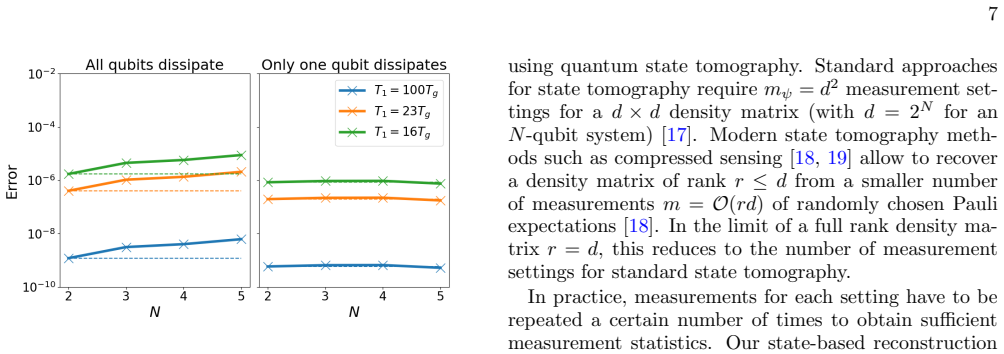
We consider the problem of reconstructing the unitary describing the evolution of a quantum system, or quantum channel, from a set of input and output states. For ideal, fully coherent evolution, we show that the unitary can be reconstructed from two mixed states or $d+1$ pure states, where $d$ is the size of Hilbert space. The reconstruction method can be extended to approximate the unitary part of a dynamical map, provided the decoherence is not too strong to render this question meaningless. We exemplify the method for the example of the cross-resonance gate as well as a random set of unitaries, comparing the reconstruction from pure, respectively mixed, states to an approach based on the Choi matrix. We find that the pure state reconstruction requires the least amount of resources when the dynamics is close to unitary, whereas the mixed state approach outperforms the pure state reconstruction in terms of channel uses for appreciable decoherence. These conclusions hold also in the presence of SPAM errors and irrespective of the Hilbert space size.
Editorial analysis
A structured set of objections, weighed in public.
Referee Report
Summary. The paper claims that for ideal unitary evolution, the unitary can be reconstructed from two mixed input-output states or from d+1 pure states. It further asserts that the same reconstruction procedure can be used to approximate the unitary part of a general dynamical map when decoherence is not too strong, and demonstrates this numerically on the cross-resonance gate and ensembles of random unitaries. The work compares the resource cost of the pure-state and mixed-state reconstructions against a Choi-matrix baseline, reports that pure-state reconstruction is cheapest near the unitary limit while mixed-state reconstruction is more efficient for moderate noise, and states that these conclusions persist under SPAM errors independent of Hilbert-space dimension.
Significance. If the ideal-case reconstruction is rigorously derived and the noisy extension is placed on a well-defined footing, the method could reduce the number of channel uses needed to characterize near-unitary gates relative to full process tomography. The explicit resource comparison between pure- and mixed-state inputs and the reported robustness to SPAM errors are concrete practical contributions. The absence of a canonical definition of the “unitary part” and of any quantitative threshold for acceptable decoherence, however, prevents the noisy-case claim from being immediately usable or falsifiable.
major comments (2)
- [Abstract and noisy-extension section] Abstract and the section on extension to noisy channels: the statement that the reconstruction “can be extended to approximate the unitary part of a dynamical map, provided the decoherence is not too strong to render this question meaningless” supplies neither a precise definition of the unitary part (e.g., polar decomposition of the Choi operator, closest unitary in diamond norm, or fixed point of an iteration) nor any quantitative bound (diamond distance, process fidelity, or noise-strength parameter) that would indicate when the approximation remains well-posed. This renders the central practical claim dependent on an unquantified assumption.
- [Numerical examples section] Numerical examples for the cross-resonance gate: it is not stated how the “unitary part” is extracted from the simulated noisy channel (e.g., which norm or decomposition is minimized) nor what metric quantifies the reconstruction error, making it impossible to judge whether the reported superiority of the mixed-state approach for “appreciable decoherence” is robust or an artifact of the particular noise model chosen.
minor comments (2)
- [Ideal-case reconstruction] The abstract states that the ideal-case result holds for “two mixed states or d+1 pure states”; the manuscript should explicitly indicate whether these are minimal numbers and whether the reconstruction is unique up to global phase.
- [Figures] Figure captions and axis labels should clarify whether the plotted fidelities are process fidelities, average gate fidelities, or diamond-norm distances, and whether error bars include only statistical or also SPAM contributions.
Simulated Author's Rebuttal
We thank the referee for the careful reading and constructive comments. We address the two major comments point by point below. Where the manuscript was insufficiently precise, we have revised it to incorporate explicit definitions, quantitative bounds, and additional methodological details.
read point-by-point responses
-
Referee: [Abstract and noisy-extension section] Abstract and the section on extension to noisy channels: the statement that the reconstruction “can be extended to approximate the unitary part of a dynamical map, provided the decoherence is not too strong to render this question meaningless” supplies neither a precise definition of the unitary part (e.g., polar decomposition of the Choi operator, closest unitary in diamond norm, or fixed point of an iteration) nor any quantitative bound (diamond distance, process fidelity, or noise-strength parameter) that would indicate when the approximation remains well-posed. This renders the central practical claim dependent on an unquantified assumption.
Authors: We agree that a canonical definition and quantitative criterion are necessary for the noisy-case claim to be falsifiable and practically usable. In the revised manuscript we now define the unitary part explicitly as the unitary factor U obtained from the polar decomposition of the Choi operator of the dynamical map (i.e., the unique unitary that maximizes the process fidelity with the given channel). We further introduce a quantitative threshold: the reconstruction is considered meaningful when the diamond distance between the channel and its unitary part is at most 0.1 (equivalently, process fidelity ≳ 0.9). This bound is justified by a first-order perturbation argument for weak decoherence and is stated both in the abstract and in the noisy-extension section, together with a short discussion of its relation to the diamond-norm distance. revision: yes
-
Referee: [Numerical examples section] Numerical examples for the cross-resonance gate: it is not stated how the “unitary part” is extracted from the simulated noisy channel (e.g., which norm or decomposition is minimized) nor what metric quantifies the reconstruction error, making it impossible to judge whether the reported superiority of the mixed-state approach for “appreciable decoherence” is robust or an artifact of the particular noise model chosen.
Authors: We acknowledge that the extraction procedure and error metric were not stated with sufficient clarity. In the revised numerical-examples section we now specify that the reference unitary part is obtained by polar decomposition of the Choi operator of the simulated noisy channel. Reconstruction error is quantified by the average gate fidelity between the reconstructed unitary and this reference unitary, evaluated over an ensemble of random pure states. We have added these definitions, together with supplementary plots that vary the noise model (amplitude damping, dephasing, and depolarizing) while keeping the diamond distance fixed, to demonstrate that the relative performance of the mixed-state versus pure-state methods is not an artifact of the particular cross-resonance noise realization. revision: yes
Circularity Check
No significant circularity in reconstruction procedure
full rationale
The paper presents a direct constructive procedure to reconstruct the unitary from two mixed states or d+1 pure states for ideal coherent evolution, with an extension to approximate the unitary part of a dynamical map when decoherence is moderate. No load-bearing step reduces by the paper's own equations to a self-definition, a fitted input renamed as prediction, or a self-citation chain. The central claims remain independent of the inputs and are not forced by construction or unverified self-reference.
Axiom & Free-Parameter Ledger
axioms (1)
- domain assumption Decoherence is not too strong to render the unitary-part approximation meaningless.
Lean theorems connected to this paper
-
IndisputableMonolith/Cost/FunctionalEquation.leanwashburn_uniqueness_aczel unclear?
unclearRelation between the paper passage and the cited Recognition theorem.
For ideal, fully coherent evolution, we show that the unitary can be reconstructed from two mixed states or d+1 pure states... The reconstruction method can be extended to approximate the unitary part of a dynamical map, provided the decoherence is not too strong
-
IndisputableMonolith/Foundation/RealityFromDistinction.leanreality_from_one_distinction unclear?
unclearRelation between the paper passage and the cited Recognition theorem.
We employ the gate fidelity FG... and the unitarity of the Choi matrix u(χ)
What do these tags mean?
- matches
- The paper's claim is directly supported by a theorem in the formal canon.
- supports
- The theorem supports part of the paper's argument, but the paper may add assumptions or extra steps.
- extends
- The paper goes beyond the formal theorem; the theorem is a base layer rather than the whole result.
- uses
- The paper appears to rely on the theorem as machinery.
- contradicts
- The paper's claim conflicts with a theorem or certificate in the canon.
- unclear
- Pith found a possible connection, but the passage is too broad, indirect, or ambiguous to say the theorem truly supports the claim.
Forward citations
Cited by 1 Pith paper
-
Enhancing Phase Retrievability of Quantum Channels via Interferometric Coupling
A quantum channel is phase retrievable iff its complementary channel is pure-state informationally complete, and coherent interferometric coupling via port operators can enhance this property even for individually non...
Reference graph
Works this paper leans on
-
[1]
M. A. Nielsen and I. L. Chuang, Quantum computation and quantum information (Cambridge university press, 2010)
work page 2010
-
[2]
R. Blume-Kohout, T. Proctor, and K. Young, Quan- tum characterization, verification, and validation (2025), arXiv:2503.16383 [quant-ph]
-
[3]
Z. Cai, R. Babbush, S. C. Benjamin, S. Endo, W. J. Huggins, Y. Li, J. R. McClean, and T. E. O’Brien, Rev. Mod. Phys. 95, 045005 (2023)
work page 2023
-
[4]
I. Roth, R. Kueng, S. Kimmel, Y.-K. Liu, D. Gross, J. Eisert, and M. Kliesch, Phys. Rev. Lett. 121, 170502 (2018)
work page 2018
-
[5]
D. M. Reich, G. Gualdi, and C. P. Koch, Physical Review A 88, 042309 (2013)
work page 2013
-
[6]
D. M. Reich, G. Gualdi, and C. P. Koch, Phys. Rev. Lett. 111, 200401 (2013)
work page 2013
-
[7]
K. ˙Zyczkowski and I. Bengtsson, Open systems & infor- mation dynamics 11, 3 (2004)
work page 2004
-
[8]
H.-P. Breuer and F. Petruccione, The theory of open quantum systems (Oxford University Press, 2007)
work page 2007
- [9]
-
[10]
How to generate random matrices from the classical compact groups
F. Mezzadri, How to generate random matrices from the classical compact groups (2007), arXiv:math-ph/0609050 [math-ph]
work page internal anchor Pith review Pith/arXiv arXiv 2007
- [11]
- [12]
-
[13]
E. Magesan, J. M. Gambetta, and J. Emerson, Phys. Rev. A 85, 042311 (2012)
work page 2012
-
[14]
General teleportation channel, singlet fraction and quasi-distillation
P. Horodecki, M. Horodecki, and R. Horodecki, Gen- eral teleportation channel, singlet fraction and quasi- distillation (1999), arXiv:quant-ph/9807091 [quant-ph]
work page internal anchor Pith review Pith/arXiv arXiv 1999
-
[15]
J. Wallman, C. Granade, R. Harper, and S. T. Flammia, New Journal of Physics 17, 113020 (2015)
work page 2015
-
[16]
P. Schindler, D. Nigg, T. Monz, J. T. Barreiro, E. Mar- tinez, S. X. Wang, S. Quint, M. F. Brandl, V. Nebendahl, C. F. Roos, M. Chwalla, M. Hennrich, and R. Blatt, New Journal of Physics 15, 123012 (2013)
work page 2013
-
[17]
M. Mohseni, A. T. Rezakhani, and D. A. Lidar, Phys. Rev. A 77, 032322 (2008)
work page 2008
-
[18]
D. Gross, Y.-K. Liu, S. T. Flammia, S. Becker, and J. Eis- ert, Phys. Rev. Lett. 105, 150401 (2010)
work page 2010
-
[19]
S. T. Flammia, D. Gross, Y.-K. Liu, and J. Eisert, New Journal of Physics 14, 095022 (2012)
work page 2012
-
[20]
S. T. Flammia and Y.-K. Liu, Physical Review Letters 106, 10.1103/physrevlett.106.230501 (2011)
-
[21]
A. Rosy Morgillo, M. F. Sacchi, and C. Macchiavello, Quantum Machine Intelligence 7, 47 (2025)
work page 2025
- [22]
- [23]
-
[24]
M. M. M¨ uller, D. M. Reich, M. Murphy, H. Yuan, J. Vala, K. B. Whaley, T. Calarco, and C. P. Koch, Phys. Rev. A 84, 042315 (2011)
work page 2011
- [25]
-
[26]
M. H. Goerz, G. Gualdi, D. M. Reich, C. P. Koch, F. Mot- zoi, K. B. Whaley, J. c. v. Vala, M. M. M¨ uller, S. Mon- tangero, and T. Calarco, Phys. Rev. A91, 062307 (2015). 10 Appendix A: Proof for Unitary Reconstruction via Mixed Input States Since DU (ρB) originates from a unitary transforma- tion from ρB the spectrum of ρB and DU (ρB) is iden- tical. Bec...
work page 2015
discussion (0)
Sign in with ORCID, Apple, or X to comment. Anyone can read and Pith papers without signing in.