ASP-Assisted Symbolic Regression: Uncovering Hidden Physics in Fluid Mechanics
Pith reviewed 2026-05-19 03:29 UTC · model grok-4.3
The pith
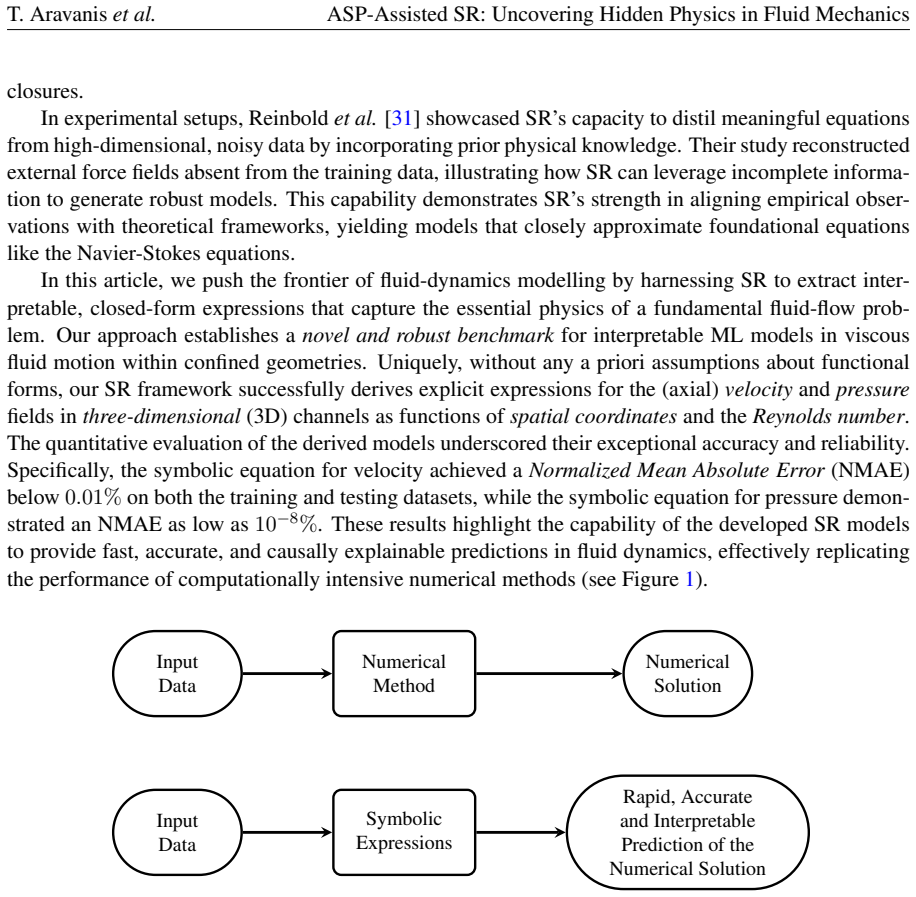
Symbolic regression combined with answer set programming derives compact equations for laminar channel flow that match analytical solutions.
A machine-rendered reading of the paper's core claim, the machinery that carries it, and where it could break.
Core claim
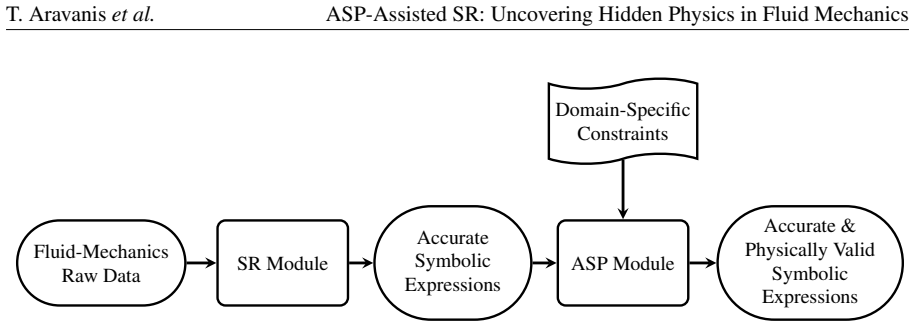
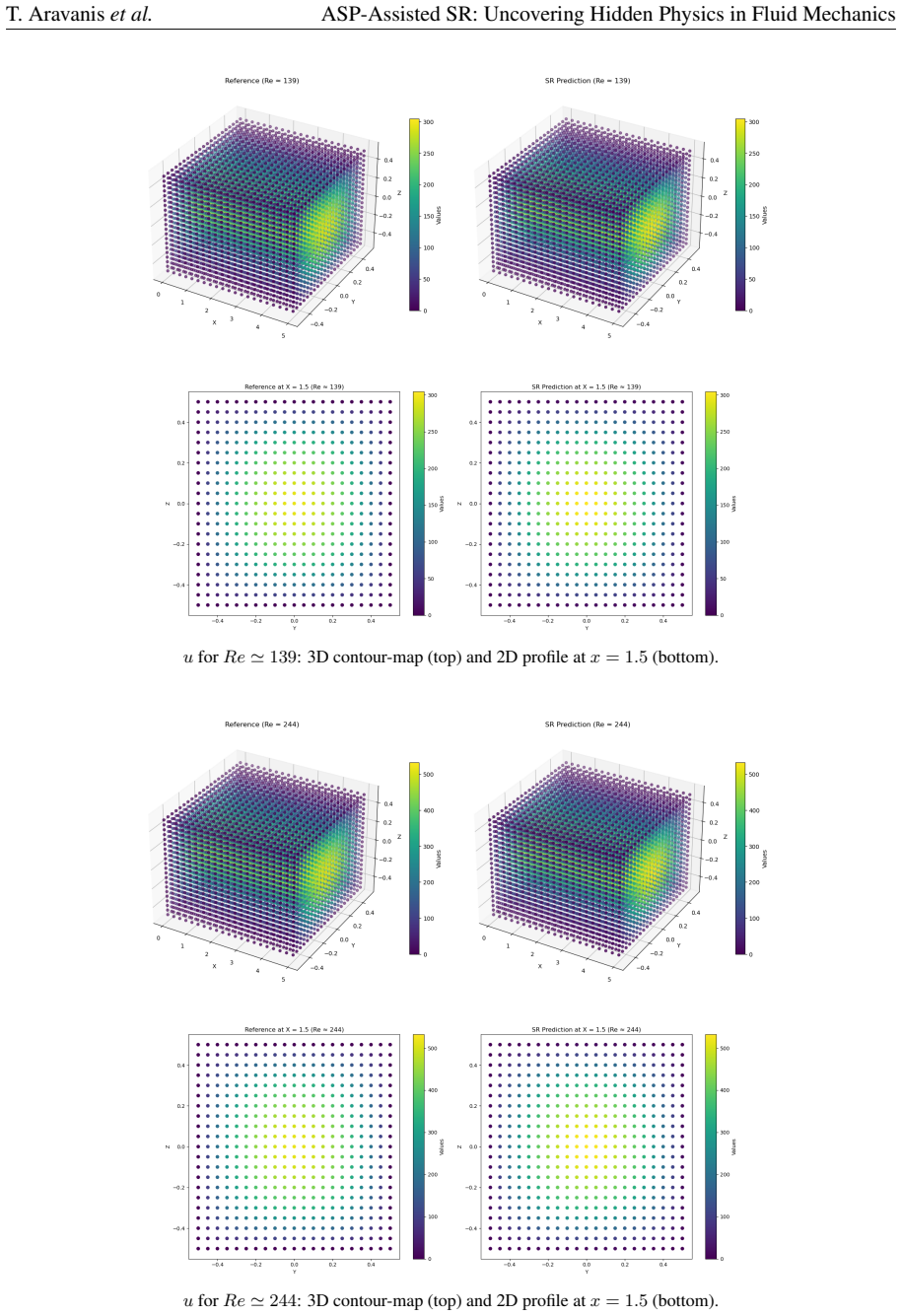
Applying symbolic regression to data from numerical simulations of 3D laminar flow in a rectangular channel yields compact symbolic equations for the axial velocity and pressure fields. These equations reproduce the parabolic velocity profile and linear pressure drop with excellent agreement to analytical solutions in the literature. Integrating answer set programming encodes physical constraints so that the generated expressions remain both statistically accurate and physically plausible.
What carries the argument
The SR/ASP hybrid framework, in which symbolic regression generates candidate expressions from a user-defined set of mathematical primitives while answer set programming declaratively enforces domain-specific physical constraints to guide selection toward valid solutions.
If this is right
- The resulting compact equations allow direct prediction of velocity and pressure without running full numerical simulations each time.
- Physical constraints enforced by answer set programming reduce the chance of obtaining unphysical or statistically plausible but invalid expressions.
- The approach supplies interpretable models that can be inspected and potentially extended analytically in fluid mechanics.
- Similar hybrids could be used on other laminar or steady flow configurations where data are available but governing expressions are sought.
Where Pith is reading between the lines
- The method may help discover governing relations in flows where no closed-form analytical solution is known beforehand.
- Blending generative regression with logical constraint checking could transfer to other physics domains that involve partial differential equations and known invariants.
- Testing the framework on data from turbulent or geometrically complex flows would reveal whether it can surface previously unrecognized relationships.
- The combination points toward scientific discovery tools that remain trustworthy by construction rather than by post-hoc validation alone.
Load-bearing premise
That answer set programming can encode the relevant physical constraints for the flow without excluding important but non-obvious relationships or requiring advance knowledge of the exact solution form.
What would settle it
Generate new simulation data for the same rectangular channel at a different aspect ratio or flow rate, then test whether the previously derived symbolic equations still match the new velocity and pressure fields within the reported accuracy.
Figures




read the original abstract
Symbolic Regression (SR) offers an interpretable alternative to conventional Machine-Learning (ML) approaches, which are often criticized as ``black boxes''. In contrast to standard regression models that require a prescribed functional form, SR constructs expressions from a user-defined set of mathematical primitives, enabling the automated discovery of compact formulas that fit the data and reveal underlying physical relationships. In fluid mechanics, where understanding the underlying physics is as crucial as predictive accuracy, this study applies SR to model three-dimensional (3D) laminar flow in a rectangular channel, focusing on the axial velocity and pressure fields. Compact symbolic equations were derived from numerical simulation data, accurately reproducing the expected parabolic velocity profile and linear pressure drop, and showing excellent agreement with analytical solutions from the literature. To address the limitation that purely data-driven SR models may overlook domain-specific constraints, an innovative hybrid framework that integrates SR with Answer Set Programming (ASP) is also introduced. This integration combines the generative power of SR with the declarative reasoning capabilities of ASP, ensuring that derived equations remain both statistically accurate and physically plausible. The proposed SR/ASP methodology demonstrates the potential of combining data-driven and knowledge-representation approaches to enhance interpretability, reliability, and alignment with physical principles in fluid dynamics and related domains.
Editorial analysis
A structured set of objections, weighed in public.
Referee Report
Summary. The paper introduces a hybrid Symbolic Regression (SR) and Answer Set Programming (ASP) framework to derive compact symbolic expressions for the axial velocity and pressure fields in 3D laminar flow through a rectangular channel, starting from numerical simulation data. It claims these expressions accurately reproduce the expected parabolic velocity profile and linear pressure drop, show excellent agreement with analytical solutions in the literature, and remain physically plausible due to the incorporation of domain-specific constraints via ASP.
Significance. If the quantitative validation and generality of the ASP constraints hold, the work would contribute to interpretable physics discovery in fluid mechanics by showing how declarative constraints can steer SR away from unphysical models. It offers a concrete example of combining data-driven search with knowledge representation for improved reliability in engineering applications. The absence of error metrics and implementation details in the current manuscript limits the immediate impact.
major comments (3)
- [Abstract] Abstract: The assertion of 'excellent agreement with analytical solutions' and 'accurately reproducing the expected parabolic velocity profile' is presented without any quantitative error metrics (e.g., L2 norm, maximum relative error, or R² values) for the derived velocity or pressure expressions versus the analytical Poiseuille solution. This omission is load-bearing for the central claim of accuracy and physical plausibility.
- [Methods] Methods/Implementation (inferred from workflow description): No details are supplied on the mathematical primitive set for SR, the specific ASP predicates or rules used to encode physical constraints (e.g., no-slip boundaries, incompressibility, or axial momentum balance), or the exact mechanism of hybrid integration. Without these, it is impossible to determine whether the ASP component supplies only general domain constraints or implicitly favors the known quadratic transverse dependence and constant axial gradient of the target solution.
- [Results] Results section: The manuscript does not report how the SR/ASP expressions were validated against the simulation data (training vs. test split, cross-validation procedure) or against the analytical solution, nor does it compare performance to pure SR without ASP. This information is required to substantiate that the hybrid approach improves both statistical fit and physical consistency beyond what data-driven SR alone achieves.
minor comments (2)
- [Abstract] The abstract uses the phrase 'uncovering hidden physics' while the workflow begins from external numerical data and known analytical targets; a brief clarification of what 'hidden' refers to would improve precision.
- [Results] Notation for the channel geometry (e.g., dimensions, coordinate system) and the exact form of the derived symbolic expressions should be stated explicitly in the main text or a table for reproducibility.
Simulated Author's Rebuttal
We thank the referee for the constructive and detailed comments, which help clarify the presentation of our hybrid SR/ASP framework for discovering physically plausible expressions in laminar channel flow. We address each major comment below and will revise the manuscript to incorporate the requested quantitative metrics, implementation details, and validation comparisons.
read point-by-point responses
-
Referee: [Abstract] Abstract: The assertion of 'excellent agreement with analytical solutions' and 'accurately reproducing the expected parabolic velocity profile' is presented without any quantitative error metrics (e.g., L2 norm, maximum relative error, or R² values) for the derived velocity or pressure expressions versus the analytical Poiseuille solution. This omission is load-bearing for the central claim of accuracy and physical plausibility.
Authors: We agree that quantitative error metrics are necessary to rigorously support the claims of accuracy and physical plausibility. In the revised manuscript we will add explicit L2-norm errors, maximum relative errors, and R² values for both the axial velocity and pressure fields when compared to the analytical Poiseuille solution. These metrics will appear in the Results section and will be referenced concisely in the Abstract. revision: yes
-
Referee: [Methods] Methods/Implementation (inferred from workflow description): No details are supplied on the mathematical primitive set for SR, the specific ASP predicates or rules used to encode physical constraints (e.g., no-slip boundaries, incompressibility, or axial momentum balance), or the exact mechanism of hybrid integration. Without these, it is impossible to determine whether the ASP component supplies only general domain constraints or implicitly favors the known quadratic transverse dependence and constant axial gradient of the target solution.
Authors: We acknowledge the need for greater transparency in the Methods section. The revised version will explicitly enumerate the mathematical primitives supplied to the symbolic regression engine, list the ASP predicates and rules that encode the no-slip condition, incompressibility, and axial momentum balance, and describe the precise interface by which ASP constraints are injected into the SR search. These additions will demonstrate that the constraints are general physical principles rather than solution-specific biases. revision: yes
-
Referee: [Results] Results section: The manuscript does not report how the SR/ASP expressions were validated against the simulation data (training vs. test split, cross-validation procedure) or against the analytical solution, nor does it compare performance to pure SR without ASP. This information is required to substantiate that the hybrid approach improves both statistical fit and physical consistency beyond what data-driven SR alone achieves.
Authors: We agree that a clear validation protocol and baseline comparison are required. The revised Results section will document the data partitioning (training versus held-out test points), any cross-validation procedure employed, and quantitative performance metrics for the hybrid SR/ASP model versus a pure SR baseline without ASP constraints. This comparison will quantify the gains in both statistical accuracy and physical consistency attributable to the ASP component. revision: yes
Circularity Check
No significant circularity; derivation starts from external simulation data
full rationale
The paper applies symbolic regression to numerical simulation data for 3D laminar channel flow, deriving compact expressions for axial velocity and pressure that match expected parabolic and linear profiles. ASP is introduced to enforce declarative physical constraints for plausibility. No load-bearing step reduces by construction to fitted parameters, self-citations, or pre-specified target forms; the workflow remains independent of the final analytical agreement, which is checked against external literature solutions. This is the normal non-circular case for data-driven discovery with added domain constraints.
Axiom & Free-Parameter Ledger
axioms (1)
- domain assumption Numerical simulation data faithfully represents the 3D laminar flow physics in a rectangular channel.
Lean theorems connected to this paper
-
IndisputableMonolith/Foundation/ArithmeticFromLogic.leanreality_from_one_distinction unclear?
unclearRelation between the paper passage and the cited Recognition theorem.
Compact symbolic equations were derived from numerical simulation data, accurately reproducing the expected parabolic velocity profile and linear pressure drop... usymb = Re (2.18 − 8.46 Y²)(1 − 3.89 Z²)
What do these tags mean?
- matches
- The paper's claim is directly supported by a theorem in the formal canon.
- supports
- The theorem supports part of the paper's argument, but the paper may add assumptions or extra steps.
- extends
- The paper goes beyond the formal theorem; the theorem is a base layer rather than the whole result.
- uses
- The paper appears to rely on the theorem as machinery.
- contradicts
- The paper's claim conflicts with a theorem or certificate in the canon.
- unclear
- Pith found a possible connection, but the passage is too broad, indirect, or ambiguous to say the theorem truly supports the claim.
Reference graph
Works this paper leans on
-
[1]
Todd M. Alam, Joshua P. Allers, Calen J. Leverant, and Jacob A. Harvey. Symbolic regression development of empirical equations for diffusion in Lennard-Jones fluids.The Journal of Chemical Physics, 157(014503), 2022
work page 2022
-
[2]
Dimitrios Angelis, Filippos Sofos, and Theodoros E. Karakasidis. Artificial Intelligence in physical sciences: Symbolic regression trends and perspectives. Archives of Computational Methods in Engineering, 30:3845–3865, 2023
work page 2023
-
[3]
Dimitrios Angelis, Filippos Sofos, and Theodoros E. Karakasidis. Reassessing the transport prop- erties of fluids: A symbolic regression approach. Physical Review E, 109(015105), 2024
work page 2024
-
[4]
Answer Set Programming at a glance
Gerhard Brewka, Thomas Eiter, and Mirosław Truszczy´nski. Answer Set Programming at a glance. Communications of the ACM, 54(12):93–103, 2011
work page 2011
-
[5]
Shengze Cai, Zhiping Mao, Zhicheng Wang, Minglang Yin, and George Em. Karniadakis. Physics- informed neural networks (PINNs) for fluid mechanics: A review. Acta Mechanica Sinica , 37:1727–1738, 2021
work page 2021
-
[6]
Yousuff Hussaini, Alfio Quarteroni, and Thomas A
Claudio Canuto, M. Yousuff Hussaini, Alfio Quarteroni, and Thomas A. Zang. Spectral Methods in Fluid Dynamics. Springer, 1988
work page 1988
-
[7]
A. Chakrabarty and Sergey N. Yakovenko. Data-driven turbulence modelling using symbolic re- gression. Journal of Physics: Conference Series, 2099(012020), 2021
work page 2099
-
[8]
Interpretable Machine Learning for Science with PySR and SymbolicRegression.jl
Miles Cranmer. Interpretable machine learning for science with PySR and SymbolicRegression.jl. arXiv:2305.01582, 2023
work page internal anchor Pith review Pith/arXiv arXiv 2023
-
[9]
Madeline Endres, Sarah Fakhoury, Saikat Chakraborty, and Shuvendu K. Lahiri. Can large lan- guage models transform natural language intent into formal method postconditions? Proceedings of the ACM on Software Engineering, 1:24, 2024
work page 2024
-
[10]
Applications of Answer Set Programming
Esra Erdem, Michael Gelfond, and Nicola Leone. Applications of Answer Set Programming. AI Magazine, 37(3):53–68, 2016
work page 2016
-
[11]
Andreas Falkner, Gerhard Friedrich, Konstantin Schekotihin, Richard Taupe, and Erich C. Teppan. Industrial applications of Answer Set Programming. KI – K ¨unstliche Intelligenz, 32:165–176, 2018
work page 2018
-
[12]
Potassco, University of Potsdam, 2nd edition, 2017
Martin Gebser, Roland Kaminski, Benjamin Kaufmann, Marius Lindauer, Max Ostrowski, Javier Romero, Torsten Schaub, and Sven Thiele.Potassco User Guide. Potassco, University of Potsdam, 2nd edition, 2017
work page 2017
-
[13]
Synthesis Lectures on Artificial Intelligence and Machine Learning
Martin Gebser, Ronald Kaminski, Benjamin Kaufmann, and Torsten Schaub.Answer Set Solving in Practice. Synthesis Lectures on Artificial Intelligence and Machine Learning. Morgan & Claypool Publishers, 2012
work page 2012
-
[14]
Yousef M. F. El Hasadi and Johan T. Padding. Solving fluid flow problems using semi-supervised symbolic regression on sparse data. AIP Advances, 9(115218), 2019
work page 2019
-
[15]
M Y Hussaini and Thomas A. Zang. Spectral methods in fluid dynamics. Annual Review of Fluid Mechanics, 19:339–367, 1987
work page 1987
-
[16]
Shah, and Win Aung.Handbook of Single-Phase Convective Heat Trans- fer
Sadik Kakac ¸, Ramesh K. Shah, and Win Aung.Handbook of Single-Phase Convective Heat Trans- fer. Wiley-Interscience, 1987. 19 T. Aravanis et al. ASP-Assisted SR: Uncovering Hidden Physics in Fluid Mechanics
work page 1987
-
[17]
Lu, Srijon Mukherjee, Michael Gilbert, Li Jing, Vladimir˘Ceperi´c, and Marin Solja˘ci´c
Samuel Kim, Peter Y . Lu, Srijon Mukherjee, Michael Gilbert, Li Jing, Vladimir˘Ceperi´c, and Marin Solja˘ci´c. Integration of neural network-based symbolic regression in deep learning for scientific discovery. IEEE Transactions on Neural Networks and Learning Systems, 32, 2021
work page 2021
-
[18]
Winkler, and Michael Af- fenzeller
Gabriel Kronberger, Bogdan Burlacu, Michael Kommenda, Stephan M. Winkler, and Michael Af- fenzeller. Symbolic Regression. CRC Press, 2024
work page 2024
-
[19]
Iat Tou Leong and Raul Barbosa. Translating natural language requirements to formal specifi- cations: A study on GPT and symbolic NLP. In 2023 53rd Annual IEEE/IFIP International Conference on Dependable Systems and Networks Workshops (DSN-W) , pages 259–262. IEEE, 2023
work page 2023
- [20]
-
[21]
Interpretable scientific discovery with symbolic regression: A review
Nour Makke and Sanjay Chawla. Interpretable scientific discovery with symbolic regression: A review. Artificial Intelligence Review, 57(2), 2024
work page 2024
-
[22]
Numerical Methods for Partial Differential Equations: Finite Difference and Finite Volume Methods
Sandip Mazumder. Numerical Methods for Partial Differential Equations: Finite Difference and Finite Volume Methods. Academic Press, 2016
work page 2016
-
[23]
Marko Milo ˇsevi´c, Dejan Brki´c, Pavel Praks, Dragan Litriˇcin, and Zoran Staji´c. Hydraulic losses in systems of conduits with flow from laminar to fully turbulent: A new symbolic regression formu- lation. Axioms, 11(5), 2022
work page 2022
-
[24]
Fadl Moukalled, Luca Mangani, and Marwan Darwish. The Finite Volume Method in Compu- tational Fluid Dynamics: An Advanced Introduction with OpenFOAM ® and Matlab. Springer, 2016
work page 2016
-
[25]
Bruce R. Munson, Alric P. Rothmayer, Theodore H. Okiishi, and Wade W. Huebsch.Fundamentals of Fluid Mechanics. Wiley, 7th edition, 2012
work page 2012
-
[26]
Alain P ´etrowski and Sana Ben-Hamida. Evolutionary Algorithms. Wiley, 2017
work page 2017
-
[27]
Andr ´e Platzer. Intersymbolic AI. In Tiziana Margaria and Bernhard Steffen, editors, Leveraging Applications of Formal Methods, Verification and Validation. Software Engineering Methodolo- gies, ISoLA 2024, pages 1070–1080. Springer, 2024
work page 2024
-
[28]
Symbolic regression-based genetic approximations of the Colebrook equation for flow friction
Pavel Praks and Dejan Brki ´c. Symbolic regression-based genetic approximations of the Colebrook equation for flow friction. Water, 10(9), 2018
work page 2018
-
[29]
Philip J. Pritchard and John C. Leylegian. Fox and McDonald’s Introduction to Fluid Mechanics. John Wiley & Sons, 8th edition, 2011
work page 2011
-
[30]
Maziar Raissi, Paris Perdikaris, and George Em. Karniadakis. Physics-informed neural networks: A deep learning framework for solving forward and inverse problems involving nonlinear partial differential equations. Journal of Computational Physics, 378:686–707, 2019
work page 2019
-
[31]
Patrick A. K. Reinbold, Logan M. Kageorge, Michael F. Schatz, and Roman O. Grigoriev. Robust learning from noisy, incomplete, highdimensional experimental data via physically constrained symbolic regression. Nature Communications, 12(3219), 2021
work page 2021
-
[32]
Wolfgang Roland, Christian Marschik, Michael Krieger, Bernhard L¨ow-Baselli, and J¨urgen Mieth- linger. Symbolic regression models for predicting viscous dissipation of three-dimensional non- newtonian flows in single-screw extruders. Journal of Non-Newtonian Fluid Mechanics, 268:12– 29, 2019. 20 T. Aravanis et al. ASP-Assisted SR: Uncovering Hidden Physi...
work page 2019
-
[33]
Distilling free-form natural laws from experimental data
Michael Schmidt and Hod Lipson. Distilling free-form natural laws from experimental data. Sci- ence, 324:81–85, 2009
work page 2009
-
[34]
Filippos Sofos, Avraam Charakopoulos, Konstantinos Papastamatiou, and Theodoros E. Karaka- sidis. A combined clustering/symbolic regression framework for fluid property prediction.Physics of Fluids, 34(062004), 2022
work page 2022
-
[35]
E. E. Tzirtzilakis, V . D. Sakalis, N. G. Kafoussias, and P. M. Hatzikonstantinou. Biomagnetic fluid flow in a 3D rectangular duct. International Journal for Numerical Methods in Fluids , 44(12):1279–1298, 2004
work page 2004
-
[36]
AI Feynman: A physics-inspired method for symbolic regression
Silviu-Marian Udrescu and Max Tegmark. AI Feynman: A physics-inspired method for symbolic regression. Science Advances, 6, 2020
work page 2020
-
[37]
Lihui Wang, Amos H. C. Ng, and Kalyanmoy Deb. Multi-Objective Evolutionary Optimisation for Product Design and Manufacturing. Springer, London, 2011
work page 2011
-
[38]
Frank M. White. Fluid Mechanics. McGraw Hill, 7th edition, 2011
work page 2011
-
[39]
Chenyu Wu and Yufei Zhang. Enhancing the shear-stress-transport turbulence model with sym- bolic regression: A generalizable and interpretable data-driven approach. Physical Review Fluids, 8(084604), 2023. 21
work page 2023
discussion (0)
Sign in with ORCID, Apple, or X to comment. Anyone can read and Pith papers without signing in.