REVIEW 3 major objections 5 minor 49 references
A Concept-based approach to Voice Disorder Detection
T0 review · 3 major / 5 minor · reviewed 2026-08-06 · deepseek-v4-flash
Pith's one-line read Concept-based models trained on clinical concepts extracted from patient anamneses detect voice pathologies with accuracy and F1 scores close to an opaque end-to-end transformer, while producing interpretable concept-based justifications…
desk verdict A clean, readable application of concept-based models to voice disorder detection, with a real but addressable weakness: the LLM-derived concept labels are only validated on 69 of 385 files. read the letter →
The pith
A machine-rendered reading of the paper's core claim, the machinery that carries it, and where it could break.
The reading
What carries the argument
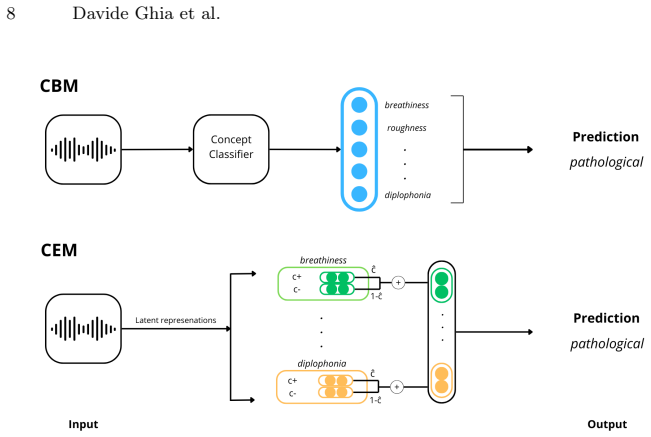
The load-bearing mechanism is the concept bottleneck or concept embedding layer placed between a pre-trained HuBERT audio encoder and a binary task classifier. In the CBM, each node of the bottleneck layer corresponds to one predicted concept, and the task classifier receives only the concatenation of predicted and patient-provided concepts, never the raw audio; in the CEM, each concept is represented by two learned embeddings, one active and one inactive, combined by the predicted concept probability. This architecture forces the final diagnosis to be a function of human-understandable concepts, which is what yields the interpretable justifications and enables expert intervention.
What would settle it
Manually annotate all 385 anamneses, or a fresh random sample substantially larger than 69, with the 14 concepts, retrain the CBM and CEM on those labels, and check whether task F1 and concept accuracy remain within the reported ranges; if they drop materially, the claimed comparability rests on unvalidated annotation quality.
Extended reading notes
Core claim
The paper claims that concept-based architectures can achieve performance comparable to an end-to-end transformer on the voice disorder detection task while remaining interpretable by design. On the Italian Pathological Voice dataset, the CBM reaches a task accuracy of 0.8776 and F1 of 0.8566, and the CEM reaches 0.8730 and 0.8599, compared with 0.9133 and 0.9085 for a HuBERT model with a two-layer classification head. The concept layers predict nine GRBAS-aligned concepts, such as dysphonia severity, roughness, breathiness, and strain, with a concept accuracy of about 84.5 percent; an Ideal CBM that receives the true concept values reaches an F1 of 0.8953, indicating that the selected concepts carry most of the discriminative information. The central claim is that interpretability can be obtained without a large performance sacrifice, making concept-based models a viable alternative to black-box detectors in clinical screening.
Load-bearing premise
The LLM's concept annotations on the 385 training files are as reliable as the ones on the 69 manually checked files, since those labels are the only supervision for the concept layers and annotation quality was measured on a small subset.
Editorial extensions
If this is right
- A clinician-facing screening system could display which GRBAS-related concepts, such as dysphonia severity or breathiness, drove each pathological call.
- Because the task classifier sees only concepts, a clinician could intervene by flipping a predicted concept and observing how the diagnosis changes, without retraining the model.
- The approach transfers to other voice-disorder datasets that include anamnesis text, since the LLM and textual annotations are only required during training.
- The Ideal CBM result of 0.8953 F1 indicates that better concept supervision could further narrow the gap to the end-to-end HuBERT baseline.
Reading between the lines
- The roughly 84.5 percent concept accuracy suggests that the residual gap to end-to-end models may be an annotation-quality problem rather than an inherent ceiling of concept-based architectures, a testable hypothesis the paper does not pursue.
- The same LLM annotation pipeline could be audited for bias: if anamnesis writing style varies by clinic or patient gender, the LLM's concept extraction might inherit systematic errors that propagate through the classifier.
- Beyond voice, the recipe of LLM-extracted concepts from free-text clinical notes combined with an audio or imaging backbone could give other screening tasks interpretable detectors without manual concept labeling.
Editorial analysis
A structured set of objections, weighed in public.
Referee Report
Summary. The paper proposes a concept-based approach to binary voice-disorder detection. Concept annotations are extracted from patient anamnesis texts using a Gemini LLM with few-shot prompting, validated against 69 manually annotated files, and then applied to all 385 available anamneses. A HuBERT encoder is used to predict 9 clinical concepts from audio, which are concatenated with 5 patient-provided concepts and fed to a task classifier in both a Concept Bottleneck Model (CBM) and a Concept Embedding Model (CEM). Experiments with 10-fold cross-validation on the same 385-case subset report CBM and CEM task F1 scores of 0.8566 and 0.8599, respectively, versus 0.9085 for an end-to-end HuBERT baseline, and the authors conclude that concept-based models achieve comparable performance while offering interpretable justifications.
Significance. If the result holds, the paper provides a useful empirical demonstration that concept bottlenecks can be applied to voice disorder screening with a modest accuracy cost and clinically readable explanations. The study has several strengths: all models are evaluated on the same 385-case subset with 10-fold cross-validation and reported standard deviations; the LLM annotation pipeline is compared between two models; and an Ideal CBM upper bound is included to assess the informativeness of the concept set. The main risks are the unvalidated full-dataset concept labels and the lack of a formal statistical test for the 'comparable performance' claim, both of which are load-bearing for the paper's central conclusion.
major comments (3)
- [§3.1, §4.2, Table 2] The concept labels that supervise the CBM and CEM are produced by Gemini on all 385 anamneses, but the pipeline is validated on only 69 manually annotated files (Table 2). Because the combined loss weights the concept loss at λ=0.9 (Section 4.2), any systematic degradation of Gemini's annotation accuracy on the remaining 316 files directly corrupts both the learned concept representations and the task head. Moreover, the concept accuracy values in Table 3 are computed against the same Gemini labels, so they measure agreement with the LLM rather than clinical validity. I request a random-sample human audit (e.g., 50–100 files) of the full-dataset annotations, or an analysis of annotation confidence and error patterns stratified by file source; without this, the training signal for the concept pathway is an unverified assumption.
- [§5, Table 3] The central claim that concept-based models achieve results 'comparable' to the end-to-end approach is not backed by a statistical test. The F1 gap between CBM/CEM (0.8566/0.8599) and HuBERT (0.9085) is about 5 points, and the reported standard deviations overlap. Since all models are evaluated on the same 10 folds, a paired significance test (e.g., Wilcoxon signed-rank or a bootstrap over folds/patients) or an equivalence test with a pre-specified margin is straightforward and should be reported. Without such a test, 'comparable' remains an informal reading of overlapping standard deviations.
- [§3.1, Table 1, Table 3] The Ideal CBM upper bound is partly self-referential because the concept set includes the four dysphonia-severity concepts, which are nearly the same construct as the binary pathological/euphonic label. An Ideal CBM fed with these concepts can reach F1 0.8953 (Table 3) almost by reading off the label, which inflates the impression that the concept set captures clinically meaningful, non-redundant information. To support the interpretability claim, I recommend an ablation that removes the dysphonia-severity concepts from the Ideal CBM and reports the resulting drop in F1, or per-concept utility measures. This would clarify what the audio model must actually learn beyond severity and whether the explanations are not merely tautological.
minor comments (5)
- [§3.1, Listing 1.1] The four few-shot examples used in the annotation prompt are not reported; including them in an appendix would improve reproducibility, especially since the examples were manually edited to cover every possible concept value.
- [§3.2, Eq. (1)] In the combined-loss equation, the index j in LCj(ĉ; c(i)) is not defined; the loss appears to be summed over the 9 predicted concepts, but this should be stated explicitly to avoid ambiguity.
- [§4.2] Hyperparameters such as λ=0.9, the CEM embedding size h=16, and the 2-epoch warm-up are reported without sensitivity analysis or justification; a brief discussion of their effect on the trade-off between concept accuracy and task accuracy would help the reader judge robustness.
- [§4.2] The paper states that all audio signals are resampled to 16 kHz and padded to the maximum length, but it does not report the maximum length or the padding method (e.g., zero-padding vs. repetition), which can affect HuBERT's frame-level representations before max pooling.
- [General] No statement is provided about the availability of code, trained models, or the annotated concept dataset; adding an availability statement would strengthen the reproducibility of the work.
Circularity Check
Minor self-reference in the Ideal CBM upper-bound argument; the main CBM/CEM audio-based result is independent.
-
self definitional
[Section 5, 'Voice pathologies prediction', Table 3 discussion]
"we trained a model (referred to as Ideal CBM), which receives the true concept values as input and predicts the corresponding class. ... with an ideal concept accuracy of 100.00% (Ideal CBM), the performance of the CBM is very close to that of HuBERT, highlighting the effectiveness of the selected concepts for the classification task."
The 'true concept values' given to the Ideal CBM are produced by Gemini from the written anamnesis, the same document on which the pathological/euphonic ground-truth label rests. The concept set includes 'dysphonia' with severity values (no/light/moderate/severe), which is essentially the same construct as the target label (dysphonic vs euphonic voice). Thus the Ideal CBM mainly measures how well the anamnesis predicts its own diagnosis, not whether concepts can be recovered from audio; the claim that it 'highlights the effectiveness of the selected concepts' for the audio classification task is therefore overstated. The actual CBM/CEM must predict concepts from audio, so the headline result is not forced.
full rationale
The central claim — that CBM and CEM achieve task F1 values close to an end-to-end HuBERT baseline while predicting concepts from audio — is an empirical benchmark, not a derivation. Training uses a combined loss (Section 3.2) where concept supervision comes from Gemini-annotated anamneses and the task head sees only the predicted concepts; no equation reduces the task prediction to the input labels. The CEM architecture is adopted from prior work [48] (one co-author overlap) but is not re-derived or justified by a self-citation chain; HuBERT [16] is an external pre-trained model. The only identifiable circular step is the Ideal CBM upper-bound argument, which uses LLM-extracted 'true concepts' from the same anamnesis that determines the diagnosis, including the concept 'dysphonia' that is definitionally close to the label. This makes the upper-bound analysis partly self-referential, but it is an auxiliary sanity check rather than the load-bearing result. The 69-file validation of Gemini annotations and the absence of a significance test for the 5-point F1 gap are correctness/robustness concerns, not circularity. Overall score 2: one minor self-referential step, central claim still has independent empirical content.
Assumptions & free parameters
free parameters (5)
- Concept loss weight lambda =
0.9
- CEM embedding size h =
16
- LLM sampling temperature =
0.1
- Concept binarization threshold =
0.5
- Warm-up duration =
2 epochs with concept loss only
assumptions (4)
- domain assumption The IPV dataset's pathological and euphonic labels and anamnesis text are accurate ground truth.
- ad hoc to paper Gemini annotations on the full dataset are as reliable as on the 69-file validation set.
- domain assumption HuBERT embeddings, after max pooling, retain the phonatory information needed to predict both concepts and pathology.
- ad hoc to paper The selected concept set is sufficient and clinically meaningful for voice disorder classification.
Cite this review
Pith. "Pith review of A Concept-based approach to Voice Disorder Detection." pith.science (2026). https://pith.science/paper/ZMYD4A4D
@misc{pith2026250717799,
  author       = {Pith},
  title        = {Pith review of: A Concept-based approach to Voice Disorder Detection},
  year         = {2026},
  howpublished = {\url{https://pith.science/paper/ZMYD4A4D}},
  note         = {Machine review of arXiv:2507.17799}
}
read the original abstract
Voice disorders affect a significant portion of the population, and the ability to diagnose them using automated, non-invasive techniques would represent a substantial advancement in healthcare, improving the quality of life of patients. Recent studies have demonstrated that artificial intelligence models, particularly Deep Neural Networks (DNNs), can effectively address this task. However, due to their complexity, the decision-making process of such models often remain opaque, limiting their trustworthiness in clinical contexts. This paper investigates an alternative approach based on Explainable AI (XAI), a field that aims to improve the interpretability of DNNs by providing different forms of explanations. Specifically, this works focuses on concept-based models such as Concept Bottleneck Model (CBM) and Concept Embedding Model (CEM) and how they can achieve performance comparable to traditional deep learning methods, while offering a more transparent and interpretable decision framework.
Figures

Reference graph
Works this paper leans on
-
[1]
Alvarez-Melis, D., Jaakkola, T.S.: Towards robust interpretability with self- explaining neural networks (2018), https://arxiv.org/abs/1806.07538
arXiv 2018
-
[2]
Nature medicine25(1), 70–74 (2019)
Attia, Z.I., Kapa, S., Lopez-Jimenez, F., McKie, P.M., Ladewig, D.J., Satam, G., Pellikka, P.A., Enriquez-Sarano, M., Noseworthy, P.A., Munger, T.M., et al.: Screening for cardiac contractile dysfunction using an artificial intelligence–enabled electrocardiogram. Nature medicine25(1), 70–74 (2019)
work page 2019
-
[3]
Bhattacharyya, N.: The prevalence of voice problems among adults in the united states. The Laryngoscope (2014)
work page 2014
-
[4]
Brunner, E., Eberhard, K., Gugatschka, M.: Prevalence of benign vocal fold lesions: Long-term results from a single european institution. Journal of Voice (2023)
work page 2023
-
[5]
In: Advances in Neural Infor- mation Processing Systems (NeurIPS)
Chen, C., Li, O., Tao, A., Barnett, A., Rudin, C., Su, J.K.: This looks like that: Deep learning for interpretable image recognition. In: Advances in Neural Infor- mation Processing Systems (NeurIPS). vol. 32 (2019)
work page 2019
-
[6]
In: Proceedings of the Workshops of the EDBT/ICDT 2024 Joint Conference
Ciravegna, G., Koudounas, A., Fantini, M., Cerquitelli, T., Baralis, E., Crosetti, E., Succo, G., et al.: Non-invasive ai-powered diagnostics: The case of voice-disorder detection-vision paper. In: Proceedings of the Workshops of the EDBT/ICDT 2024 Joint Conference. vol. 3651. CEUR (2024)
work page 2024
-
[7]
The Laryngoscope 124(9), 2118–2124 (Sep 2014)
Cohen, S.M., Thomas, S., Roy, N., Kim, J., Courey, M.: Frequency and factors associated with use of videolaryngostroboscopy in voice disorder assessment. The Laryngoscope 124(9), 2118–2124 (Sep 2014). https://doi.org/10.1002/lary.24688, epub 2014 May 7
-
[8]
Cohen, S.M.: Self-reported impact of dysphonia in a primary care population: An epidemiological study. The Laryngoscope (2010)
work page 2010
Show all 49 references
-
[9]
nature (2017)
Esteva, A., Kuprel, B., Novoa, R.A., Ko, J., Swetter, S.M., Blau, H.M., Thrun, S.: Dermatologist-level classification of skin cancer with deep neural networks. nature (2017)
2017
-
[10]
Cureus16(11) (2024)
Fantini, M., Ciravegna, G., Koudounas, A., Cerquitelli, T., Baralis, E., Succo, G., Crosetti, E.: The rapidly evolving scenario of acoustic voice analysis in otolaryn- gology. Cureus16(11) (2024)
2024
-
[11]
Gemini Team: Gemini: A family of highly capable multimodal models (2025), https://arxiv.org/abs/2312.11805
2025 arXiv
-
[12]
Ghorbani, A., Wexler, J., Zou, J., Kim, B.: Towards automatic concept-based ex- planations (2019), https://arxiv.org/abs/1902.03129
2019 arXiv
-
[13]
Goyal, Y., Feder, A., Shalit, U., Kim, B.: Explaining classifiers with causal concept effect (cace) (2020), https://arxiv.org/abs/1907.07165
2020 arXiv
-
[14]
jama316(22), 2402–2410 (2016)
Gulshan, V., Peng, L., Coram, M., Stumpe, M.C., Wu, D., Narayanaswamy, A., Venugopalan, S., Widner, K., Madams, T., Cuadros, J., et al.: Development and validation of a deep learning algorithm for detection of diabetic retinopathy in retinal fundus photographs. jama316(22), 24...
2016
-
[15]
Journal of Voice 37(2), 282–286 (2023)
Hamdan, A.L., Ghanem, A., Natout, T.E., Khalifee, E.: Diagnostic yield of office-based laryngeal biopsy in patients with leukoplakia; a case study with review of the literature. Journal of Voice 37(2), 282–286 (2023). https://doi.org/10.1016/j.jvoice.2020.11.026, epub 2021 Jan 28
2023 doi
-
[16]
Hsu, W.N., Bolte, B., Tsai, Y.H.H., Lakhotia, K., Salakhutdinov, R., Mohamed, A.: Hubert: Self-supervised speech representation learning by masked prediction of hidden units (2021), https://arxiv.org/abs/2106.07447
2021 arXiv
-
[17]
A Concept-based approach to Voice Disorder Detection 13 Computer Methods and Programs in Biomedicine Update 2, 100074 (2022)
Islam, R., Abdel-Raheem, E., Tarique, M.: Voice pathology detection using con- volutional neural networks with electroglottographic (egg) and speech signals. A Concept-based approach to Voice Disorder Detection 13 Computer Methods and Programs in Biomedicine Update 2, 100074 (...
2022
-
[18]
In: Fernandes, F.D.M
Jesus, L.M., Belo, I., Machado, J., Hall, A.: The advanced voice func- tion assessment databases (avfad): Tools for voice clinicians and speech re- search. In: Fernandes, F.D.M. (ed.) Advances in Speech-language Pathology, chap. 14. IntechOpen, Rijeka (2017). https://doi.org/1...
2017 doi
-
[19]
Jiang, A.Q., Sablayrolles, A., Mensch, A., Bamford, C., Chaplot, D.S., de las Casas, D., Bressand, F., Lengyel, G., Lample, G., Saulnier, L., Lavaud, L.R., Lachaux, M.A., Stock, P., Scao, T.L., Lavril, T., Wang, T., Lacroix, T., Sayed, W.E.: Mistral 7b (2023), https://arxiv.or...
2023 arXiv
-
[20]
IEEE Journal of Selected Topics in Signal Processing14(2), 367– 379 (2020)
Kadiri, S.R., Alku, P.: Analysis and detection of pathological voice using glottal source features. IEEE Journal of Selected Topics in Signal Processing14(2), 367– 379 (2020). https://doi.org/10.1109/JSTSP.2019.2957988
2020
-
[21]
BMC Medical Informatics and Decision Making (2020)
Karabayir, I., Goldman, S.M., Pappu, S., Akbilgic, O.: Gradient boosting for parkinson’s disease diagnosis from voice recordings. BMC Medical Informatics and Decision Making (2020)
2020
-
[22]
American Journal of Speech-Language Pathology18, 124–132 (05 2009)
Kempster, G., Gerratt, B., Verdolini Abbott, K., Barkmeier-Kraemer, J., Hillman, R.: Consensus auditory-perceptual evaluation of voice: Development of a stan- dardized clinical protocol. American Journal of Speech-Language Pathology18, 124–132 (05 2009). https://doi.org/10.104...
2009 doi
-
[23]
Kim, B., Wattenberg, M., Gilmer, J., Cai, C., Wexler, J., Viegas, F., Sayres, R.: Interpretability beyond feature attribution: Quantitative testing with concept ac- tivation vectors (tcav) (2018), https://arxiv.org/abs/1711.11279
2018 arXiv
-
[24]
Kim, E., Jung, D., Park, S., Kim, S., Yoon, S.: Probabilistic concept bottleneck models (2023), https://arxiv.org/abs/2306.01574
2023 arXiv
-
[25]
In: Proceedings of the 37th International Conference on Machine Learning (ICML)
Koh, P.W., Nguyen, T., Tang, Y.S., Mussmann, S., Pierson, E., Kim, B., Liang, P.: Concept bottleneck models. In: Proceedings of the 37th International Conference on Machine Learning (ICML). Proceedings of Machine Learning Research, vol. 119, pp. 5338–5352. PMLR (2020), https:/...
2020
-
[26]
In: Interspeech
Koudounas, A., Ciravegna, G., Fantini, M., Crosetti, E., Succo, G., Cerquitelli, T., Baralis, E.: Voice disorder analysis: A transformer-based approach. In: Interspeech
-
[27]
In: Proc
Koudounas, A., La Quatra, M., Ciravegna, G., Fantini, M., Crosetti, E., Succo, G., Cerquitelli, T., Siniscalchi, S.M., Baralis, E.: Mvp: Multi-source voice pathology detection. In: Proc. Interspeech 2025 (2025)
2025
-
[28]
In: ICASSP 2025 - 2025 IEEE International Conference on Acoustics, Speech and Signal Processing (ICASSP)
Koudounas,A.,LaQuatra,M.,Siniscalchi,S.M.,Baralis,E.:voc2vec:Afoundation model for non-verbal vocalization. In: ICASSP 2025 - 2025 IEEE International Conference on Acoustics, Speech and Signal Processing (ICASSP). pp. 1–5 (2025). https://doi.org/10.1109/ICASSP49660.2025.10890672
2025
-
[29]
In: Proc
La Quatra, M., Koudounas, A., Salerno, V.M., Siniscalchi, S.M.: Exploring gener- ative error correction for dysarthric speech recognition. In: Proc. Interspeech 2025 (2025)
2025
-
[30]
In: 2024 IEEE International Conference on Acoustics, Speech, and Signal Processing Workshops (ICASSPW)
La Quatra, M., Koudounas, A., Vaiani, L., Baralis, E., Cagliero, L., Garza, P., Siniscalchi, S.M.: Benchmarking representations for speech, music, and acoustic events. In: 2024 IEEE International Conference on Acoustics, Speech, and Signal Processing Workshops (ICASSPW). pp. 5...
2024
-
[31]
In: CEUR WORK- SHOP PROCEEDINGS
Liu, Q., Ciravegna, G., Koudounas, A., Cerquitelli, T., Baralis, E., et al.: Multi- modal fusion techniques to enhance voice disorder diagnoses. In: CEUR WORK- SHOP PROCEEDINGS. vol. 3946. CEUR (2025)
2025
-
[32]
Neurocomputing 599, 128111 (Sep 2024)
Mersha, M., Lam, K., Wood, J., AlShami, A.K., Kalita, J.: Explainable artificial intelligence: A survey of needs, tech- niques, applications, and future direction. Neurocomputing 599, 128111 (Sep 2024). https://doi.org/10.1016/j.neucom.2024.128111, http://dx.doi.org/10.1016/j....
2024
-
[33]
arXiv preprint arXiv:2304.06129 (2023), https://arxiv.org/abs/2304.06129
Oikarinen, T., Das, S., Nguyen, L.M., Weng, T.W.: Label-free concept bottleneck models. arXiv preprint arXiv:2304.06129 (2023), https://arxiv.org/abs/2304.06129
2023 arXiv
-
[34]
In: Healthcare
Palaniappan, K., Lin, E.Y.T., Vogel, S.: Global regulatory frameworks for the use of artificial intelligence (ai) in the healthcare services sector. In: Healthcare. vol. 12, p. 562. MDPI (2024)
2024
-
[35]
In: Proceedings of the 18th Conference of the European Chapter of the Association for Computational Linguistics (Volume 1: Long Papers)
Pastor, E., Koudounas, A., Attanasio, G., Hovy, D., Baralis, E.: Explaining speech classification models via word-level audio segments and paralinguistic features. In: Proceedings of the 18th Conference of the European Chapter of the Association for Computational Linguistics (...
2024
-
[36]
Scientific Reports13, 7264 (2023)
Peng, X., Xu, H., Liu, J., et al.: Voice disorder classification using convolutional neural network based on deep transfer learning. Scientific Reports13, 7264 (2023). https://doi.org/10.1038/s41598-023-34461-9, https://doi.org/10.1038/s41598-023- 34461-9
2023 doi
-
[37]
Scientific Reports11(1), 20480 (2021)
Pietruszewska,W.,Just,M.,Morawska,J.,Malinowski,J.,Hoffman,J.,Racino,A., Barańska, M., Kowalczyk, M., Niebudek-Bogusz, E.: Comparative analysis of high- speedvideolaryngoscopyimagesandsounddatasimultaneouslyacquiredfromrigid and flexible laryngoscope: a pilot study. Scientific...
2021 doi
-
[38]
Poeta, E., Ciravegna, G., Pastor, E., Cerquitelli, T., Baralis, E.: Concept-based ex- plainable artificial intelligence: A survey (2023), https://arxiv.org/abs/2312.12936
2023
-
[39]
IEEE Access (2023)
Ribas, D., Pastor, M.A., Miguel, A., Martínez, D., Ortega, A., Lleida, E.: Auto- matic voice disorder detection using self-supervised representations. IEEE Access (2023)
2023
-
[40]
The Laryngoscope (2005)
Roy, N., Merrill, R.M., Gray, S.D., Smith, E.M.: Voice disorders in the general population: prevalence, risk factors, and occupational impact. The Laryngoscope (2005)
2005
-
[41]
Conference proceedings :
Saenz-Lechon, N., godino llorente, J., Osma-Ruiz, V., Blanco-Velasco, M., Cruz-Roldan, F.: Automatic assessment of voice quality according to the gr- bas scale. Conference proceedings : ... Annual International Conference of the IEEE Engineering in Medicine and Biology Society...
2006
-
[42]
Salhi,L.,Talbi,M.,Cherif,A.:Voicedisordersidentificationusinghybridapproach: Waveletanalysisandmultilayerneuralnetworks.InternationalJournalofElectrical and Computer Engineering2(9), 3003–3012 (2008)
2008
-
[43]
prevalence and risk factors
Spantideas,N.,Drosou,E.,Karatsis,A.,Assimakopoulos,D.:Voicedisordersinthe general greek population and in patients with laryngopharyngeal reflux. prevalence and risk factors. Journal of Voice (2015)
2015
-
[44]
Advances in neural information pro- cessing systems 30 (2017) A Concept-based approach to Voice Disorder Detection 15
Vaswani,A.,Shazeer,N.,Parmar,N.,Uszkoreit,J.,Jones,L.,Gomez,A.N.,Kaiser, Ł., Polosukhin, I.: Attention is all you need. Advances in neural information pro- cessing systems 30 (2017) A Concept-based approach to Voice Disorder Detection 15
2017
-
[45]
Neurodegenerative Diseases (2020)
Vieira, H., Costa, N., Sousa, T., Reis, S., Coelho, L.: Voice-based classification of amyotrophic lateral sclerosis: where are we and where are we going? a systematic review. Neurodegenerative Diseases (2020)
2020
- [46]
-
[47]
In: Proceedings of the IEEE/CVF Conference on Computer Vision and Pattern Recognition (CVPR)
Yang, Y., Panagopoulou, A., Zhou, S., Jin, D., Callison-Burch, C., Yatskar, M.: Language in a bottle: Language model guided concept bottlenecks for interpretable image classification. In: Proceedings of the IEEE/CVF Conference on Computer Vision and Pattern Recognition (CVPR)....
2023
-
[48]
Zarlenga, M.E., Barbiero, P., Ciravegna, G., Marra, G., Giannini, F., Diligenti, M., Shams, Z., Precioso, F., Melacci, S., Weller, A., Lio, P., Jamnik, M.: Con- cept embedding models: Beyond the accuracy-explainability trade-off (2022), https://arxiv.org/abs/2209.09056
2022 arXiv
-
[2024]
3040–3044
pp. 3040–3044. ISCA (Sep 2024). https://doi.org/10.21437/interspeech.2024- 1122, http://dx.doi.org/10.21437/Interspeech.2024-1122
2024 doi
Reviewed August 6, 2026 · model on record in the stance chip above.
Discussion (0). Sign in to comment.