REVIEW 3 major objections 6 minor 59 references
DiNAT-IR: Exploring Dilated Neighborhood Attention for High-Quality Image Restoration
T0 review · 3 major / 6 minor · reviewed 2026-08-15 · deepseek-v4-flash
Pith's one-line read The paper claims DiNAT-IR, which alternates local and dilated neighborhood attention with a channel-aware module, reaches 33.80 dB PSNR on GoPro and 31.57 dB on HIDE, matching or surpassing all compared methods.
desk verdict Solid architecture paper with a credible GoPro deblurring result, but the multi-benchmark claim is softer than the abstract says. read the letter →
The pith
A machine-rendered reading of the paper's core claim, the machinery that carries it, and where it could break.
The reading
What carries the argument
The central object is the Dual Transformer Block with channel-aware self-attention. Each block combines a spatial-attention branch that alternates between local Neighborhood Attention ($\delta=1$) and Dilated Neighborhood Attention with stage-specific larger dilations ($\delta\in\{36,18,9,4\}$ paired with 1), and a channel-aware branch that takes the layer-normalized input, applies global average pooling, a 1-D convolution of kernel size 3 along the channel dimension, and a sigmoid; the two branches are merged by element-wise multiplication. This mechanism carries the paper's argument because it isolates the failure mode of the vanilla NA-DiNA hybrid, limited global context from the local NA branch, and provides the compensating global signal.
What would settle it
Retrain DiNAT-IR on GoPro with a held-out validation split, choose the checkpoint by validation PSNR, and then compare test PSNR with NAFNet and MaIR under identical training budgets; if the 0.11 dB margin over NAFNet shrinks or reverses, the paper's central improvement claim fails. The same validation-based selection should be applied to the DPDD and SIDD checkpoints, where the stated iterations (290K, 140K, 40K fine-tune, 220K) were selected without a reported validation split.
Extended reading notes
Core claim
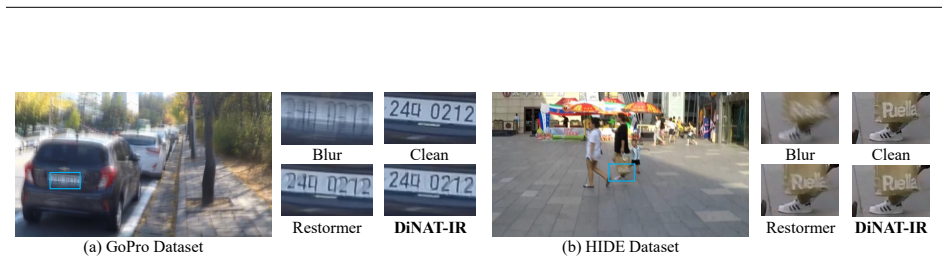
The paper's central claim is that a U-Net restoration model can beat channel-wise self-attention baselines by alternating Neighborhood Attention ($\delta=1$) with Dilated Neighborhood Attention (stage dilation pairs $\{1,36\},\{1,18\},\{1,9\},\{1,4\}$), provided each block is gated by a lightweight channel-aware module that recovers global context. On motion deblurring this architecture reports 33.80 dB PSNR on GoPro and 31.57 dB on HIDE, matching or surpassing Restormer, NAFNet, MaIR, and the other compared methods, and it reports the highest combined PSNR (27.05 dB) for dual-pixel defocus deblurring on DPDD. The authors also state a negative result that motivates the design: the vanilla NA-DiNA hybrid, as used for high-level vision, degrades deblurring performance compared with a DiNA-only design, which they attribute to the local NA branch restricting global context; the channel-aware module is introduced to fix exactly that. The paper is explicit that the advantage is not universal: on deraining benchmarks DiNAT-IR trails Restormer on PSNR while nearly matching SSIM.
Load-bearing premise
The load-bearing premise is that the reported test numbers come from an honest evaluation protocol, meaning the model checkpoints were picked at the stated training iterations without looking at test-set metrics; if that premise is false, the small reported margins, like 0.01 dB on the combined DPDD PSNR, could disappear under a correct protocol.
Editorial extensions
If this is right
- If the reported GoPro and HIDE numbers hold, Dilated Neighborhood Attention becomes a viable spatial-attention backbone for restoration, not just for detection and segmentation.
- The ablation result, with the channel-aware module adding 0.19 dB to the full NA-DiNA configuration on a 16-channel GoPro baseline, implies that other local-attention transformers for low-level vision could gain from the same cheap global-context fix.
- The dual-pixel DPDD result (27.05 dB combined PSNR, best among the compared methods) suggests the alternation of local and dilated attention is especially beneficial for defocus patterns, which have structured spatial extent.
- Because the model was trained only on GoPro and then evaluated on HIDE, the reported HIDE performance supports the claim that the architecture generalizes to new blur distributions without task-specific retraining.
- At 25.90 M parameters, performance comparable to MaIR is reached with fewer parameters, so the design is a parameter-efficient alternative for deployment.
Reading between the lines
- Editorial inference: the reported margin over NAFNet on GoPro is 0.11 dB and over Restormer is 0.88 dB, but the latter comparison uses very different training schedules and patch sizes; a reader should treat cross-model gaps as protocol-dependent until a common training recipe is used.
- Editorial inference: the channel-aware module is a near-free global context signal, so the same GAP-Conv1d-sigmoid gate could be tested as a drop-in addition to other windowed or neighborhood attention models, including super-resolution and video restoration.
- Editorial inference: because the paper selects checkpoints at fixed iterations without a validation split, the published numbers should be read as upper-bound estimates of what the architecture can do; independent code release would allow re-evaluation with validation-based early stopping.
- Editorial inference: the qualitative argument that NA improves text sharpness despite near-identical PSNR and LPIPS suggests perception metrics may not capture the visual claim; a user study on restored text could test whether the hybrid branch is worth its cost.
Signed reviews
Editorial analysis
A structured set of objections, weighed in public.
Referee Report
Summary. DiNAT-IR is presented as a Transformer architecture for image restoration. It builds on Restormer's U-Net and replaces the self-attention blocks by alternating Neighborhood Attention (NA, dilation δ=1) and Dilated Neighborhood Attention (DiNA) with stage-dependent dilation pairs, plus a lightweight channel-aware module (CAM) that multiplies the attention output by channel attention computed from global average pooling and a 1D convolution. The paper evaluates the method on motion deblurring (GoPro/HIDE), defocus deblurring (DPDD single and dual pixel), deraining (five benchmarks), and denoising (SIDD). It reports PSNR 33.80/31.57 dB on GoPro/HIDE, 27.05 dB combined PSNR for dual-pixel DPDD, close-to-Restormer deraining results, and 39.89 dB on SIDD. An ablation on a 16-channel GoPro setup shows that CAM improves NA, DiNA, and NA-DiNA variants and that the hybrid NA-DiNA with CAM has the best FID. The paper states that code will be released but does not provide it; the authors also note that the GoPro model may not have converged and that the ablation is limited to GoPro.
Significance. If the reported results are reliable, the contribution is meaningful: a local+global attention mechanism with a cheap channel-aware module reaches state-of-the-art or near-state-of-the-art results on deblurring at comparable parameters and FLOPs. The GoPro/HIDE evaluation is relatively robust because HIDE is an unseen benchmark and the GoPro checkpoint is the last iteration, not a test-set-selected checkpoint. The ablation in Table 5 is internally consistent and supports the design choices, and the candid statements about deraining PSNR and possible GoPro under-convergence are to the authors' credit. The evidence is entirely empirical; no theoretical analysis or code is supplied. The main significance is a new architecture with competitive results, but the multi-benchmark claim needs a stronger evaluation protocol to be fully convincing.
major comments (3)
- [Section 4, Implementation Details; Tables 2-4] The final checkpoints for DPDD-D (290K iterations), DPDD-S (140K), Rain13K (40K of fine-tuning), and SIDD (220K) are selected by training iteration, but the paper does not state that these choices were made on a held-out validation split. Because the reported margins over the next-best methods are as small as 0.01 dB on DPDD combined PSNR (27.05 vs 27.04 for DiNAT-IRD vs GRL-BD in Table 2), 0.06 dB on Rain100L (38.93 vs 38.99 for Restormer in Table 3), and 0.13 dB on SIDD (39.89 vs 40.02 for Restormer in Table 4), test-set-informed checkpoint selection could change the ordinal claims made in Sections 4.2-4.4 and in the abstract. Please specify the validation protocol, or if none was used, adopt a pre-specified selection rule and report the sensitivity of the conclusions to the choice of checkpoint.
- [Tables 1-4] All reported benchmark numbers appear to come from a single training run, with no error bars, confidence intervals, or seed-level statistics. In comparisons where the differences are 0.01-0.13 dB, it is not possible to determine whether the headline improvements (e.g., 33.80 vs 33.69 dB on GoPro in Table 1) are within run-to-run variation. Please report the mean and standard deviation over at least three independent training runs for the proposed method and, if available, for the closest baselines, or otherwise justify why single runs are sufficient for the ordinal claims.
- [Section 3, Figure 2] The architecture description does not fully specify the proposed model: the number of Transformer blocks and channel widths per stage, the mapping of the dilation pairs δ∈{1,36},{1,18},{1,9},{1,4} to encoder and decoder levels, the location of the channel-aware module within the block, and the input fusion for the dual-pixel variant DiNAT-IRD are not stated. Since the code is only announced for future release ('Our codes will be released soon'), these omissions make the main architectural claim difficult to verify or reproduce as written.
minor comments (6)
- [Section 1 and Section 3.1] The introduction attributes 'the original DiNAT' to Hua et al. (2019), but that reference describes a dilated fully convolutional network for depth estimation; the relevant DiNAT work is Hassani & Shi (2022), which is cited in Section 2. Please correct the citation and the corresponding sentence.
- [Table 3, Section 3.2, Figure 2] There are several typographical errors: 'DiNA T-IR' in Table 3 has an extra space, 'receptive filed' in Section 3.2 should be 'receptive field', and the Figure 2 caption 'sigmoid summation' should be 'sigmoid'.
- [Section 5] Section 5 states that NIQE is used as a perception metric, but Table 5 reports FID and LPIPS only; please add NIQE to the table or delete the mention.
- [Section 4, GoPro implementation details] The GoPro paragraph states that 'DiNAT-IR may not fully converge to an optimal solution'; please state explicitly how the final 600K+200K training schedule was chosen and whether continuing training changed the reported 33.80 dB result, or position the reported number as a lower bound.
- [Abstract and Section 4.1] On HIDE, DiNAT-IR ties MaIR's PSNR but has slightly lower SSIM (0.945 vs 0.946), and on GoPro MaIR has higher SSIM (0.969 vs 0.967); the wording 'matching or surpassing all compared methods' should be made explicitly about PSNR to avoid overstating the result on both metrics.
- [Section 7] The limitation section acknowledges that the ablation was performed only on GoPro; the final version should discuss whether the 1.74 dB improvement over the 16-channel Restormer baseline in Table 5 transfers to the full-resolution models and to deraining and denoising tasks.
Circularity Check
No significant circularity; the architecture and benchmark claims are empirically evaluated against external baselines, with any concerns limited to checkpoint-selection protocol and a citation-accuracy issue.
full rationale
DiNAT-IR is an empirical architecture paper; no derivation chain is claimed that could reduce to its inputs. The channel-aware module (Eq. 1) is a design choice (GAP + 1-D Conv + sigmoid, multiplied with attention output), not a 'prediction' fitted from the benchmarks it later reports. The alternating NA-DiNA scheme is adopted from Hassani & Shi (2022), an external source, and the paper's own ablation (Table 5) compares against a Restormer baseline under fixed training settings, so the central architectural choice is not justified by a self-citation. The benchmark tables (GoPro, HIDE, DPDD, Rain13K, SIDD) are independent external comparisons; no reported number is obtained by construction from a fitted parameter. One citation-accuracy concern: the sentence 'The original DiNAT (Hua et al., 2019) reports...' appears to mis-attribute the DiNAT hybrid design to an overlapping-author paper whose title is about dilated fully convolutional networks, but the same claim is also tied to Hassani & Shi (2022), and the architecture's value is established by the paper's own GoPro ablations and external test sets. A separate validity concern is that per-task checkpoints (290K DPDD-D, 140K DPDD-S, 40K Rain13K fine-tune, 220K SIDD) are selected without a described held-out validation split, so small margins (e.g., 0.01 dB on DPDD combined PSNR) could be sensitive to selection protocol; this is a correctness/external-validity issue, not circularity, because the selected model is still being evaluated against independently published baselines. For these reasons, no step in the paper's argument reduces to its own inputs.
Assumptions & free parameters
free parameters (3)
- Dilation factor pairs per stage =
{1,36},{1,18},{1,9},{1,4}
- Final checkpoint iteration per task =
GoPro: last (800K total); DPDD-D: 290K; DPDD-S: 140K; Rain13K: 40K fine-tune; SIDD: 220K
- CAM 1D convolution kernel size =
3
assumptions (3)
- domain assumption PSNR, SSIM, FID, LPIPS and NIQE are appropriate proxies for restoration quality
- domain assumption Results on the GoPro dataset generalize to other restoration tasks
- domain assumption The standard training recipe (AdamW, cosine schedule, progressive fine-tuning) is sufficient for fair architecture comparison
Cite this review
Pith. "Pith review of DiNAT-IR: Exploring Dilated Neighborhood Attention for High-Quality Image Restoration." pith.science (2026). https://pith.science/paper/7O4IC6DZ
@misc{pith2026250717892,
  author       = {Pith},
  title        = {Pith review of: DiNAT-IR: Exploring Dilated Neighborhood Attention for High-Quality Image Restoration},
  year         = {2026},
  howpublished = {\url{https://pith.science/paper/7O4IC6DZ}},
  note         = {Machine review of arXiv:2507.17892}
}
read the original abstract
Transformers, with their self-attention mechanisms for modeling long-range dependencies, have become a dominant paradigm in image restoration tasks. However, the high computational cost of self-attention limits scalability to high-resolution images, making efficiency-quality trade-offs a key research focus. To address this, Restormer employs channel-wise self-attention, which computes attention across channels instead of spatial dimensions. While effective, this approach may overlook localized artifacts that are crucial for high-quality image restoration. To bridge this gap, we explore Dilated Neighborhood Attention (DiNA) as a promising alternative, inspired by its success in high-level vision tasks. DiNA balances global context and local precision by integrating sliding-window attention with mixed dilation factors, effectively expanding the receptive field without excessive overhead. However, our preliminary experiments indicate that directly applying this global-local design to the classic deblurring task hinders accurate visual restoration, primarily due to the constrained global context understanding within local attention. To address this, we introduce a channel-aware module that complements local attention, effectively integrating global context without sacrificing pixel-level precision. The proposed DiNAT-IR, a Transformer-based architecture specifically designed for image restoration, achieves competitive results across multiple benchmarks, offering a high-quality solution for diverse low-level computer vision problems.
Figures


Figures from the paper (2 more)


Reference graph
Works this paper leans on
-
[1]
A high-quality denoising dataset for smartphone cameras
Abdelrahman Abdelhamed, Stephen Lin, and Michael S Brown. A high-quality denoising dataset for smartphone cameras. In Proceedings of the IEEE conference on computer vision and pattern recognition, pp.\ 1692--1700, 2018
2018
-
[2]
Defocus deblurring using dual-pixel data
Abdullah Abuolaim and Michael S Brown. Defocus deblurring using dual-pixel data. In European Conference on Computer Vision, pp.\ 111--126. Springer, 2020
work page 2020
-
[3]
Learning to reduce defocus blur by realistically modeling dual-pixel data
Abdullah Abuolaim, Mauricio Delbracio, Damien Kelly, Michael S Brown, and Peyman Milanfar. Learning to reduce defocus blur by realistically modeling dual-pixel data. In Proceedings of the IEEE/CVF International Conference on Computer Vision, pp.\ 2289--2298, 2021
work page 2021
-
[4]
Mark R Banham and Aggelos K Katsaggelos. Digital image restoration. IEEE signal processing magazine, 14 0 (2): 0 24--41, 1997
work page 1997
-
[5]
Simple baselines for image restoration
Liangyu Chen, Xiaojie Chu, Xiangyu Zhang, and Jian Sun. Simple baselines for image restoration. In European conference on computer vision, pp.\ 17--33. Springer, 2022
work page 2022
-
[6]
Lgit: local--global interaction transformer for low-light image denoising
Zuojun Chen, Pinle Qin, Jianchao Zeng, Quanzhen Song, Pengcheng Zhao, and Rui Chai. Lgit: local--global interaction transformer for low-light image denoising. Scientific Reports, 14 0 (1): 0 21760, 2024
work page 2024
-
[7]
Rethinking coarse-to-fine approach in single image deblurring
Sung-Jin Cho, Seo-Won Ji, Jun-Pyo Hong, Seung-Won Jung, and Sung-Jea Ko. Rethinking coarse-to-fine approach in single image deblurring. In Proceedings of the IEEE/CVF international conference on computer vision, pp.\ 4641--4650, 2021
work page 2021
-
[8]
Improving image restoration by revisiting global information aggregation
Xiaojie Chu, Liangyu Chen, Chengpeng Chen, and Xin Lu. Improving image restoration by revisiting global information aggregation. In European Conference on Computer Vision, pp.\ 53--71. Springer, 2022
work page 2022
Show all 59 references
-
[9]
Image denoising by sparse 3-d transform-domain collaborative filtering
Kostadin Dabov, Alessandro Foi, Vladimir Katkovnik, and Karen Egiazarian. Image denoising by sparse 3-d transform-domain collaborative filtering. IEEE Transactions on image processing, 16 0 (8): 0 2080--2095, 2007
2007
-
[10]
Cu-mamba: Selective state space models with channel learning for image restoration
Rui Deng and Tianpei Gu. Cu-mamba: Selective state space models with channel learning for image restoration. In 2024 IEEE 7th International Conference on Multimedia Information Processing and Retrieval (MIPR), pp.\ 328--334. IEEE, 2024
2024
-
[11]
Perceptual enhancement for autonomous vehicles: Restoring visually degraded images for context prediction via adversarial training
Feng Ding, Keping Yu, Zonghua Gu, Xiangjun Li, and Yunqing Shi. Perceptual enhancement for autonomous vehicles: Restoring visually degraded images for context prediction via adversarial training. IEEE Transactions on Intelligent Transportation Systems, 23 0 (7): 0 9430--9441, 2021
2021
-
[12]
Masked autoencoders as image processors
Huiyu Duan, Wei Shen, Xiongkuo Min, Danyang Tu, Long Teng, Jia Wang, and Guangtao Zhai. Masked autoencoders as image processors. arXiv preprint arXiv:2303.17316, 2023
2023 arXiv
-
[13]
Mambair: A simple baseline for image restoration with state-space model
Hang Guo, Jinmin Li, Tao Dai, Zhihao Ouyang, Xudong Ren, and Shu-Tao Xia. Mambair: A simple baseline for image restoration with state-space model. In European Conference on Computer Vision, pp.\ 222--241. Springer, 2024
2024
-
[14]
Dilated neighborhood attention transformer
Ali Hassani and Humphrey Shi. Dilated neighborhood attention transformer. arXiv preprint arXiv:2209.15001, 2022
2022 arXiv
-
[15]
Neighborhood attention transformer
Ali Hassani, Steven Walton, Jiachen Li, Shen Li, and Humphrey Shi. Neighborhood attention transformer. In Proceedings of the IEEE/CVF Conference on Computer Vision and Pattern Recognition, pp.\ 6185--6194, 2023
2023
-
[16]
Gans trained by a two time-scale update rule converge to a local nash equilibrium
Martin Heusel, Hubert Ramsauer, Thomas Unterthiner, Bernhard Nessler, and Sepp Hochreiter. Gans trained by a two time-scale update rule converge to a local nash equilibrium. Advances in neural information processing systems, 30, 2017
2017
-
[17]
Dilated fully convolutional neural network for depth estimation from a single image
Yindong Hua, Yifeng Liu, Binghan Li, and Mi Lu. Dilated fully convolutional neural network for depth estimation from a single image. In 2019 International Conference on Computational Science and Computational Intelligence (CSCI), pp.\ 612--616. IEEE, 2019
2019
-
[18]
Spach transformer: Spatial and channel-wise transformer based on local and global self-attentions for pet image denoising
Se-In Jang, Tinsu Pan, Ye Li, Pedram Heidari, Junyu Chen, Quanzheng Li, and Kuang Gong. Spach transformer: Spatial and channel-wise transformer based on local and global self-attentions for pet image denoising. IEEE transactions on medical imaging, 43 0 (6): 0 2036--2049, 2023
2023
-
[19]
Multi-scale progressive fusion network for single image deraining
Kui Jiang, Zhongyuan Wang, Peng Yi, Chen Chen, Baojin Huang, Yimin Luo, Jiayi Ma, and Junjun Jiang. Multi-scale progressive fusion network for single image deraining. In Proceedings of the IEEE/CVF conference on computer vision and pattern recognition, pp.\ 8346--8355, 2020
2020
-
[20]
Edge-based defocus blur estimation with adaptive scale selection
Ali Karaali and Claudio Rosito Jung. Edge-based defocus blur estimation with adaptive scale selection. IEEE Transactions on Image Processing, 27 0 (3): 0 1126--1137, 2017
2017
-
[21]
Deep defocus map estimation using domain adaptation
Junyong Lee, Sungkil Lee, Sunghyun Cho, and Seungyong Lee. Deep defocus map estimation using domain adaptation. In Proceedings of the IEEE/CVF conference on computer vision and pattern recognition, pp.\ 12222--12230, 2019
2019
-
[22]
Iterative filter adaptive network for single image defocus deblurring
Junyong Lee, Hyeongseok Son, Jaesung Rim, Sunghyun Cho, and Seungyong Lee. Iterative filter adaptive network for single image defocus deblurring. In Proceedings of the IEEE/CVF conference on computer vision and pattern recognition, pp.\ 2034--2042, 2021
2021
-
[23]
Mair: A locality- and continuity-preserving mamba for image restoration
Boyun Li, Haiyu Zhao, Wenxin Wang, Peng Hu, Yuanbiao Gou, and Xi Peng. Mair: A locality- and continuity-preserving mamba for image restoration. In IEEE Conference on Computer Vision and Pattern Recognition, Nashville, TN, June 2025
2025
-
[24]
Recurrent squeeze-and-excitation context aggregation net for single image deraining
Xia Li, Jianlong Wu, Zhouchen Lin, Hong Liu, and Hongbin Zha. Recurrent squeeze-and-excitation context aggregation net for single image deraining. In Proceedings of the European conference on computer vision (ECCV), pp.\ 254--269, 2018
2018
-
[25]
Efficient and explicit modelling of image hierarchies for image restoration
Yawei Li, Yuchen Fan, Xiaoyu Xiang, Denis Demandolx, Rakesh Ranjan, Radu Timofte, and Luc Van Gool. Efficient and explicit modelling of image hierarchies for image restoration. In Proceedings of the IEEE/CVF Conference on Computer Vision and Pattern Recognition, pp.\ 18278--18...
2023
-
[26]
Swinir: Image restoration using swin transformer
Jingyun Liang, Jiezhang Cao, Guolei Sun, Kai Zhang, Luc Van Gool, and Radu Timofte. Swinir: Image restoration using swin transformer. In Proceedings of the IEEE/CVF international conference on computer vision, pp.\ 1833--1844, 2021
2021
-
[27]
Network in network
Min Lin, Qiang Chen, and Shuicheng Yan. Network in network. arXiv preprint arXiv:1312.4400, 2013
2013 arXiv
-
[28]
Swin transformer: Hierarchical vision transformer using shifted windows
Ze Liu, Yutong Lin, Yue Cao, Han Hu, Yixuan Wei, Zheng Zhang, Stephen Lin, and Baining Guo. Swin transformer: Hierarchical vision transformer using shifted windows. In Proceedings of the IEEE/CVF international conference on computer vision, pp.\ 10012--10022, 2021
2021
-
[29]
Decoupled weight decay regularization
Ilya Loshchilov and Frank Hutter. Decoupled weight decay regularization. arXiv preprint arXiv:1711.05101, 2017
2017 arXiv
-
[30]
Dynamic attentive graph learning for image restoration
Chong Mou, Jian Zhang, and Zhuoyuan Wu. Dynamic attentive graph learning for image restoration. In Proceedings of the IEEE/CVF international conference on computer vision, pp.\ 4328--4337, 2021
2021
-
[31]
Deep multi-scale convolutional neural network for dynamic scene deblurring
Seungjun Nah, Tae Hyun Kim, and Kyoung Mu Lee. Deep multi-scale convolutional neural network for dynamic scene deblurring. In Proceedings of the IEEE conference on computer vision and pattern recognition, pp.\ 3883--3891, 2017
2017
-
[32]
Multi-temporal recurrent neural networks for progressive non-uniform single image deblurring with incremental temporal training
Dongwon Park, Dong Un Kang, Jisoo Kim, and Se Young Chun. Multi-temporal recurrent neural networks for progressive non-uniform single image deblurring with incremental temporal training. In European conference on computer vision, pp.\ 327--343. Springer, 2020
2020
-
[33]
On aliased resizing and surprising subtleties in gan evaluation
Gaurav Parmar, Richard Zhang, and Jun-Yan Zhu. On aliased resizing and surprising subtleties in gan evaluation. In CVPR, 2022
2022
-
[34]
Spatially-adaptive image restoration using distortion-guided networks
Kuldeep Purohit, Maitreya Suin, AN Rajagopalan, and Vishnu Naresh Boddeti. Spatially-adaptive image restoration using distortion-guided networks. In Proceedings of the IEEE/CVF international conference on computer vision, pp.\ 2309--2319, 2021
2021
-
[35]
Image restoration for remote sensing: Overview and toolbox
Behnood Rasti, Yi Chang, Emanuele Dalsasso, Loic Denis, and Pedram Ghamisi. Image restoration for remote sensing: Overview and toolbox. IEEE Geoscience and Remote Sensing Magazine, 10 0 (2): 0 201--230, 2021
2021
-
[36]
Progressive image deraining networks: A better and simpler baseline
Dongwei Ren, Wangmeng Zuo, Qinghua Hu, Pengfei Zhu, and Deyu Meng. Progressive image deraining networks: A better and simpler baseline. In Proceedings of the IEEE/CVF conference on computer vision and pattern recognition, pp.\ 3937--3946, 2019
2019
-
[37]
Human-aware motion deblurring
Ziyi Shen, Wenguan Wang, Xiankai Lu, Jianbing Shen, Haibin Ling, Tingfa Xu, and Ling Shao. Human-aware motion deblurring. In Proceedings of the IEEE/CVF international conference on computer vision, pp.\ 5572--5581, 2019
2019
-
[38]
Just noticeable defocus blur detection and estimation
Jianping Shi, Li Xu, and Jiaya Jia. Just noticeable defocus blur detection and estimation. In Proceedings of the IEEE Conference on Computer Vision and Pattern Recognition, pp.\ 657--665, 2015
2015
-
[39]
Single image defocus deblurring using kernel-sharing parallel atrous convolutions
Hyeongseok Son, Junyong Lee, Sunghyun Cho, and Seungyong Lee. Single image defocus deblurring using kernel-sharing parallel atrous convolutions. In Proceedings of the IEEE/CVF International Conference on Computer Vision, pp.\ 2642--2650, 2021
2021
-
[40]
Scale-recurrent network for deep image deblurring
Xin Tao, Hongyun Gao, Xiaoyong Shen, Jue Wang, and Jiaya Jia. Scale-recurrent network for deep image deblurring. In Proceedings of the IEEE conference on computer vision and pattern recognition, pp.\ 8174--8182, 2018
2018
-
[41]
Stripformer: Strip transformer for fast image deblurring
Fu-Jen Tsai, Yan-Tsung Peng, Yen-Yu Lin, Chung-Chi Tsai, and Chia-Wen Lin. Stripformer: Strip transformer for fast image deblurring. In European conference on computer vision, pp.\ 146--162. Springer, 2022
2022
-
[42]
Attention is all you need
A Vaswani. Attention is all you need. Advances in Neural Information Processing Systems, 2017
2017
-
[43]
Eca-net: Efficient channel attention for deep convolutional neural networks
Qilong Wang, Banggu Wu, Pengfei Zhu, Peihua Li, Wangmeng Zuo, and Qinghua Hu. Eca-net: Efficient channel attention for deep convolutional neural networks. In Proceedings of the IEEE/CVF conference on computer vision and pattern recognition, pp.\ 11534--11542, 2020
2020
-
[44]
Uformer: A general u-shaped transformer for image restoration
Zhendong Wang, Xiaodong Cun, Jianmin Bao, Wengang Zhou, Jianzhuang Liu, and Houqiang Li. Uformer: A general u-shaped transformer for image restoration. In Proceedings of the IEEE/CVF conference on computer vision and pattern recognition, pp.\ 17683--17693, 2022
2022
-
[45]
Semi-supervised transfer learning for image rain removal
Wei Wei, Deyu Meng, Qian Zhao, Zongben Xu, and Ying Wu. Semi-supervised transfer learning for image rain removal. In Proceedings of the IEEE/CVF conference on computer vision and pattern recognition, pp.\ 3877--3886, 2019
2019
-
[46]
Uncertainty guided multi-scale residual learning-using a cycle spinning cnn for single image de-raining
Rajeev Yasarla and Vishal M Patel. Uncertainty guided multi-scale residual learning-using a cycle spinning cnn for single image de-raining. In Proceedings of the IEEE/CVF conference on computer vision and pattern recognition, pp.\ 8405--8414, 2019
2019
-
[47]
Variational denoising network: Toward blind noise modeling and removal
Zongsheng Yue, Hongwei Yong, Qian Zhao, Deyu Meng, and Lei Zhang. Variational denoising network: Toward blind noise modeling and removal. Advances in neural information processing systems, 32, 2019
2019
-
[48]
Learning enriched features for real image restoration and enhancement
Syed Waqas Zamir, Aditya Arora, Salman Khan, Munawar Hayat, Fahad Shahbaz Khan, Ming-Hsuan Yang, and Ling Shao. Learning enriched features for real image restoration and enhancement. In Computer Vision--ECCV 2020: 16th European Conference, Glasgow, UK, August 23--28, 2020, Pro...
2020
-
[49]
Multi-stage progressive image restoration
Syed Waqas Zamir, Aditya Arora, Salman Khan, Munawar Hayat, Fahad Shahbaz Khan, Ming-Hsuan Yang, and Ling Shao. Multi-stage progressive image restoration. In Proceedings of the IEEE/CVF conference on computer vision and pattern recognition, pp.\ 14821--14831, 2021
2021
-
[50]
Restormer: Efficient transformer for high-resolution image restoration
Syed Waqas Zamir, Aditya Arora, Salman Khan, Munawar Hayat, Fahad Shahbaz Khan, and Ming-Hsuan Yang. Restormer: Efficient transformer for high-resolution image restoration. In Proceedings of the IEEE/CVF conference on computer vision and pattern recognition, pp.\ 5728--5739, 2022
2022
-
[51]
A review on deep learning in medical image reconstruction
Hai-Miao Zhang and Bin Dong. A review on deep learning in medical image reconstruction. Journal of the Operations Research Society of China, 8 0 (2): 0 311--340, 2020
2020
-
[52]
Density-aware single image de-raining using a multi-stream dense network
He Zhang and Vishal M Patel. Density-aware single image de-raining using a multi-stream dense network. In Proceedings of the IEEE conference on computer vision and pattern recognition, pp.\ 695--704, 2018
2018
-
[53]
Accurate image restoration with attention retractable transformer
Jiale Zhang, Yulun Zhang, Jinjin Gu, Yongbing Zhang, Linghe Kong, and Xin Yuan. Accurate image restoration with attention retractable transformer. arXiv preprint arXiv:2210.01427, 2022
2022 arXiv
-
[54]
Beyond a gaussian denoiser: Residual learning of deep cnn for image denoising
Kai Zhang, Wangmeng Zuo, Yunjin Chen, Deyu Meng, and Lei Zhang. Beyond a gaussian denoiser: Residual learning of deep cnn for image denoising. IEEE transactions on image processing, 26 0 (7): 0 3142--3155, 2017 a
2017
-
[55]
Learning deep cnn denoiser prior for image restoration
Kai Zhang, Wangmeng Zuo, Shuhang Gu, and Lei Zhang. Learning deep cnn denoiser prior for image restoration. In Proceedings of the IEEE conference on computer vision and pattern recognition, pp.\ 3929--3938, 2017 b
2017
-
[56]
Deblurring by realistic blurring
Kaihao Zhang, Wenhan Luo, Yiran Zhong, Lin Ma, Bjorn Stenger, Wei Liu, and Hongdong Li. Deblurring by realistic blurring. In Proceedings of the IEEE/CVF conference on computer vision and pattern recognition, pp.\ 2737--2746, 2020
2020
-
[57]
The unreasonable effectiveness of deep features as a perceptual metric
Richard Zhang, Phillip Isola, Alexei A Efros, Eli Shechtman, and Oliver Wang. The unreasonable effectiveness of deep features as a perceptual metric. In Proceedings of the IEEE conference on computer vision and pattern recognition, pp.\ 586--595, 2018
2018
-
[58]
Comprehensive and delicate: An efficient transformer for image restoration
Haiyu Zhao, Yuanbiao Gou, Boyun Li, Dezhong Peng, Jiancheng Lv, and Xi Peng. Comprehensive and delicate: An efficient transformer for image restoration. In Proceedings of the IEEE/CVF conference on computer vision and pattern recognition, pp.\ 14122--14132, 2023
2023
-
[59]
write newline
" write newline "" before.all 'output.state := FUNCTION n.dashify 't := "" t empty not t #1 #1 substring "-" = t #1 #2 substring "--" = not "--" * t #2 global.max substring 't := t #1 #1 substring "-" = "-" * t #2 global.max substring 't := while if t #1 #1 substring * t #2 gl...
Reviewed August 15, 2026 · model on record in the stance chip above.
Discussion (0). Continue with ORCID to comment.