REVIEW 2 major objections 5 minor 68 references
Registration beyond Points: General Affine Subspace Alignment via Geodesic Distance on Grassmann Manifold
T0 review · 2 major / 5 minor · reviewed 2026-08-06 · deepseek-v4-flash
Pith's one-line read The paper claims to be the first to derive an optimizable cost function for aligning affine subspaces—lines and planes—by minimizing geodesic distance on the Grassmann manifold directly as a function of rotation $\mathbf{R}$ and…
desk verdict A useful new cost function for affine subspace registration, but the translation BnB's global optimality claim rests on an unproven, likely invalid bound. read the letter →
The pith
A machine-rendered reading of the paper's core claim, the machinery that carries it, and where it could break.
The reading
What carries the argument
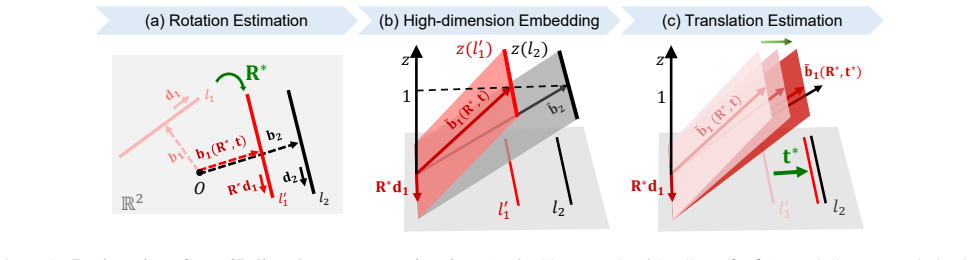
The central object is the affine Grassmannian embedding, the map from an affine subspace to a linear subspace one dimension higher, together with the basis-spans-subspace criterion from Theorem 2. The embedding lets a line or plane be represented by an orthonormal matrix whose columns are the transformed source basis and a normalized displacement vector; the Grassmann distance between two such matrices is the metric the paper wants to optimize. The basis criterion replaces the non-differentiable singular-value computation of principal angles with squared Euclidean residuals between each basis vector and its projection onto the transformed target subspace. These residuals are polynomial in $\mathbf{R}$ and $\mathbf{t}$, so the cost can be minimized by ordinary nonlinear least squares and bounded for branch-and-bound search.
What would settle it
Generate random line correspondences and, for a fixed rotation and a small translation cube, compute the true maximum over $\mathbf{t}$ of $\| (\tilde{b}_2^\top \tilde{b}_1'(R^*, t_0)) \tilde{b}_1'(R^*, t_0) - (\tilde{b}_2^\top \tilde{b}_1'(R^*, t)) \tilde{b}_1'(R^*, t) \|$ using dense sampling or local optimization, and compare it with the maximum over the cube's vertices; finding any interior point with a larger value than all vertices would invalidate Eq. (62), making the lower bound unsound and allowing the branch-and-bound search to prune the global optimum.
Extended reading notes
Core claim
Using the orthonormal matrix representation of the affine Grassmannian—embedding a $k$-dimensional affine subspace $A + b_0$ into $\mathrm{Gr}(k+1, n+1)$ via $Y_{z(A+b_0)} = \begin{pmatrix} A & b_0/\sqrt{1+\|b_0\|^2} \\ 0 & 1/\sqrt{1+\|b_0\|^2} \end{pmatrix}$—the paper proves that the $\mathrm{SE}(n)$ group action moves the subspace's linear part and displacement in a closed form (Theorem 1), and that zero Grassmann distance between two embedded subspaces of possibly different dimension is equivalent to every orthonormal basis vector of the smaller one being in the span of the larger one (Theorem 2). From this it constructs Problem 2, Eq. (7): for $N$ paired affine primitives, minimize $\sum_i \left( \sum_{j=1}^{k_i} \| P_{R \cdot B_i} a_i^j - a_i^j \|_2^2 + \| P_{z(T \cdot (B_i + d_i^0))} \tilde{c}_i^0 - \tilde{c}_i^0 \|_2^2 \right)$, where $P$ denotes orthogonal projection onto the transformed source subspace. The paper claims that the zero set of this cost coincides exactly with zero geodesic distance, that the cost separates into rotation-only and translation-dependent terms, and that exact bounds can be derived for a branch-and-bound inlier-set maximizer. Experiments across four computer vision tasks support the claim that this cost improves convergence of existing linear solvers or outperforms them.
Load-bearing premise
The translation branch-and-bound lower bound rests on the claim that, along the arc traced by the normalized displacement as $\mathbf{t}$ varies within a cube, the inner product with the fixed embedded target vector is always monotonic, convex, or concave, so the residual difference of Eq. (60) is maximized at a cube vertex; the paper supports this only empirically, writing "in every tested case in our experiments," and gives no proof.
Editorial extensions
If this is right
- Rotation and translation can be estimated in stages: the linear-subspace terms in Eq. (7) depend only on $\mathbf{R}$, so an inlier-maximizing rotation search can be run first and the translation search second.
- The same cost applies to any pair of affine subspaces of different dimensions, including lines-to-planes, which lets the perspective-n-line problem be reformulated as a line-to-plane registration.
- With the derived bounds, the branch-and-bound solver finds a deterministic global optimum of the inlier set, effective at outlier ratios up to 80% in synthetic PnL experiments, and supports correspondence-free localization.
- Because the cost is agnostic to the sign of basis vectors, refining a conventional parameter-based linear solver with this cost reduces translation error, as shown in object registration and RGB-D odometry.
Reading between the lines
- The basis-spanning criterion is metric-free, so the cost could be generalized to weighted or robustified residuals, folding in feature covariance or correspondence confidence without changing the zero-distance equivalence; the paper does not develop this.
- The appendix's numerical observation that the two antipodal straight-line parameter paths map to arcs whose lengths sum to $\pi$, with one matching the geodesic to numerical precision, hints at an explicit closed-geodesic formula on $\mathrm{Gr}(2,3)$; if pursued, it could yield a direct differentiable expression for the longer arc connecting two subspaces.
- The cost is defined for arbitrary dimensions $n$ and $k$, so it should extend beyond 3D lines and planes to higher-dimensional affine subspace features in structure-from-motion or model fitting; this is a direct generalization of the presented framework.
Editorial analysis
A structured set of objections, weighed in public.
Referee Report
Summary. The paper proposes a registration cost for affine subspaces (lines and planes) by embedding them into a higher-dimensional Grassmannian and measuring projection residuals of the embedded bases. It derives an SE(n) action on the affine Grassmannian (Theorem 1), proves that zero Grassmann distance is equivalent to zero projection residual (Theorem 2), and formulates a cost function explicitly parameterized by rotation R and translation t (Problem 2, Eq. (7)). The authors then develop a branch-and-bound solver that maximizes inlier sets for rotation and translation and evaluate the method on object registration, RGB-D odometry, perspective-n-line, and correspondence-free localization tasks.
Significance. If the cost function and the bounds were fully validated, the paper would provide a unified geometric framework for line/plane registration that avoids the sign ambiguity of vector parameterizations. The authors give self-contained derivations of the group action and of the zero-set equivalence, release code, and compare against standard baselines on public datasets. The two-stage BnB inlier-set maximization pipeline is a practical contribution. However, the advertised equivalence with geodesic-distance minimization and the deterministic global-optimality guarantee rest on points that need correction or additional proof, so the paper requires major revision.
major comments (2)
- [§4.2, Eq. (7); Appendix 7.4] The abstract and Section 4 claim that Problem 2 (Eq. (7)) minimizes the squared Grassmann geodesic distance of Eq. (6). Appendix 7.4 proves only that the residual in Eq. (31) is zero if and only if the Grassmann distance is zero; it does not establish equality between the summed squared projection residuals in Eq. (7) and the summed squared geodesic distances in Eq. (6). For 1D subspaces, the projection residual is |sin θ| while the geodesic distance is θ, so the two objectives differ away from zero. The phrase 'equivalently optimize Eq. (6)' is therefore unsupported, and the claim of 'minimizing the geodesic distance' should be replaced by a statement that Eq. (7) is a chordal/projection cost with the same zero set, unless a new proof of cost equivalence is supplied.
- [Appendix 8.4.1, Eqs. (60)–(63)] The translation lower bound relies on the assertion that Eq. (60) is maximized at a vertex of the translation cube because the inner products (tilde_b2)^T tilde_b1'(R*, t) are 'monotonic increasing, monotonic decreasing, convex, or concave', justified only by 'in every tested case in our experiments'. This is not a proof, and the geometric statement preceding it is inaccurate: t -> R*b1 + R*(I - dd^T)R*^T t maps the cube through a rank-2 linear map, so after normalization the image is a 2D surface in S^3, not a line segment with two endpoints. A concave inner-product profile can place the maximum of Eq. (60) in the interior of the cube, in which case Eq. (62) overestimates the lower bound and the BnB in Algorithm 5 can prune the global optimum. Because this bound is the only support for the deterministic global-optimality claims in the abstract and Section 5, the authors must either prove a vertex-maximum property or replace the bound with a valid one.
minor comments (5)
- [Appendix 8.4.1] The text references 'Theorem 3' without defining it; presumably Theorem 1 or Corollary 1.1 is intended.
- [Algorithms 3–5] The condition 'If.size < ¯νr' compares an integer inlier count with a real-valued bound; please clarify the intended comparison and notation.
- [§4.2, Eq. (8)–(9)] Because the method solves Eq. (8) for R and then Eq. (9) for t, the manuscript should state explicitly that the two-stage procedure does not guarantee joint global optimality of Problem 2 unless the cost separates exactly.
- [Appendix 9.2, Fig. 9–10] The empirical observations that the projected curve length equals the geodesic length and that l1 + l2 = π are reported without proof; either add a derivation or soften the claim.
- [§5.4, Correspondence-free Localization] The localization experiment reports 0.65° and 0.03% error but gives no number of test frames and no comparison baseline; please add these details.
Circularity Check
No significant circularity: the cost derivation is self-contained and the flagged translation-bound gap is an unproven assumption, not a circular step.
full rationale
The manuscript constructs its central cost, Problem 2 / Eq. (7), from Theorem 1 (the SE(n) group action on the affine Grassmannian) and Theorem 2 (zero Grassmann distance iff every basis of the smaller subspace is spanned by the larger subspace), both proved in the appendix from standard Grassmann geometry. No parameter is fitted to data and then renamed as a prediction; the experiments compare against external baselines and public datasets. The only load-bearing concern raised by the reviewer, the translation BnB bound in Appendix 8.4.1, rests on the empirical assertion that inner-product profiles are monotonic/convex/concave 'in every tested case in our experiments,' which is an unproven correctness assumption about the bound, not a circular reduction of the result to its own inputs. The paper's citations to prior work, including the Go-ICP rotation bound, are external standard lemmas rather than self-citations that smuggle in the desired conclusion. Finally, while the projection-residual cost in Eq. (7) is not numerically equal to the squared geodesic distance away from the zero set, the paper only proves and uses zero-set equivalence for exact alignment, so this is a fidelity or correctness issue rather than circularity. No enumerated circularity pattern is present.
Assumptions & free parameters
free parameters (1)
- Inlier thresholds epsilon_R, epsilon_t =
Not stated in paper; set per experiment
assumptions (4)
- standard math Standard geometry of the Grassmann manifold, including principal angles and geodesic distance via SVD.
- domain assumption The z-embedding of affine subspaces into Gr(k+1, n+1) preserves the relevant metric geometry.
- standard math Triangle inequality and the Go-ICP bound d_Gr(R0 d, R d) <= min(pi/2, sqrt(3) sigma_r) hold for the rotation search cubes.
- ad hoc to paper The function in Eq. (60) is maximized at a cube vertex because the inner products are monotonic or convex/concave.
Cite this review
Pith. "Pith review of Registration beyond Points: General Affine Subspace Alignment via Geodesic Distance on Grassmann Manifold." pith.science (2026). https://pith.science/paper/4RDLPOTB
@misc{pith2026250717998,
  author       = {Pith},
  title        = {Pith review of: Registration beyond Points: General Affine Subspace Alignment via Geodesic Distance on Grassmann Manifold},
  year         = {2026},
  howpublished = {\url{https://pith.science/paper/4RDLPOTB}},
  note         = {Machine review of arXiv:2507.17998}
}
abstract
Affine Grassmannian has been favored for expressing proximity between lines and planes due to its theoretical exactness in measuring distances among features. Despite this advantage, the existing method can only measure the proximity without yielding the distance as an explicit function of rigid body transformation. Thus, an optimizable distance function on the manifold has remained underdeveloped, stifling its application in registration problems. This paper is the first to explicitly derive an optimizable cost function between two Grassmannian features with respect to rigid body transformation ($\mathbf{R}$ and $\mathbf{t}$). Specifically, we present a rigorous mathematical proof demonstrating that the bases of high-dimensional linear subspaces can serve as an explicit representation of the cost. Finally, we propose an optimizable cost function based on the transformed bases that can be applied to the registration problem of any affine subspace. Compared to vector parameter-based approaches, our method is able to find a globally optimal solution by directly minimizing the geodesic distance which is agnostic to representation ambiguity. The resulting cost function and its extension to the inlier-set maximizing Branch-and-Bound (BnB) solver have been demonstrated to improve the convergence of existing solutions or outperform them in various computer vision tasks. The code is available on https://github.com/joomeok/GrassmannRegistration.
Figures


Figures from the paper (11 more)




Reference graph
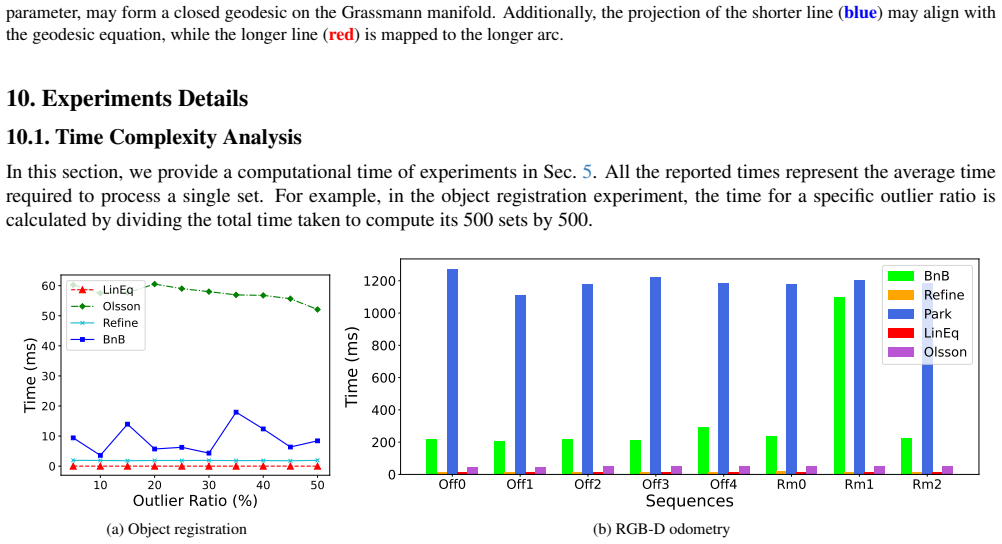
Works this paper leans on
-
[1]
Sameer Agarwal, Keir Mierle, and The Ceres Solver Team. Ceres solver, 2022. 6
work page 2022
-
[2]
S ´ergio Agostinho, Jo˜ao Gomes, and Alessio Del Bue. CvxP- nPL: A unified convex solution to the absolute pose estima- tion problem from point and line correspondences. Journal of Mathematical Imaging and Vision, 65(3):492–512, 2023. 7, 8, 13
work page 2023
-
[3]
Geometric mean and geodesic regression on grass- mannians
Ekkehard Batzies, Knut H ¨uper, Luis Machado, and F Silva Leite. Geometric mean and geodesic regression on grass- mannians. Linear Algebra and its Applications, 466:83–101,
-
[4]
A grassmann manifold handbook: Basic geometry and compu- tational aspects
Thomas Bendokat, Ralf Zimmermann, and P-A Absil. A grassmann manifold handbook: Basic geometry and compu- tational aspects. Advances in Computational Mathematics , 50(1):6, 2024. 10
work page 2024
-
[5]
Numerical methods for computing angles between linear subspaces
¯Ake Bj ¨orck and Gene H Golub. Numerical methods for computing angles between linear subspaces. Mathematics of computation, 27(123):579–594, 1973. 4, 3
work page 1973
-
[6]
Convex global 3D registration with Lagrangian duality
Jesus Briales and Javier Gonzalez-Jimenez. Convex global 3D registration with Lagrangian duality. InProc. IEEE Conf. on Comput. Vision and Pattern Recog. , pages 4960–4969,
-
[7]
Globally optimal 2D-3D registration from points or lines without correspondences
Mark Brown, David Windridge, and Jean-Yves Guillemaut. Globally optimal 2D-3D registration from points or lines without correspondences. In Proc. IEEE Intl. Conf. on Com- put. Vision, pages 2111–2119, 2015. 4
work page 2015
-
[8]
Globally-optimal inlier set maximisation for camera pose and correspondence estimation
Dylan Campbell, Lars Petersson, Laurent Kneip, and Hong- dong Li. Globally-optimal inlier set maximisation for camera pose and correspondence estimation. IEEE Trans. Pattern Analysis and Machine Intell., 42(2):328–342, 2018. 5, 6
work page 2018
Show all 68 references
-
[9]
Pose determination from line-to-plane corre- spondences: existence condition and closed-form solutions
Homer H Chen. Pose determination from line-to-plane corre- spondences: existence condition and closed-form solutions. IEEE Trans. Pattern Analysis and Machine Intell. , 13(06): 530–541, 1991. 2, 4
1991
-
[10]
A plane-based approach for indoor point clouds reg- istration
Ketty Favre, Muriel Pressigout, Eric Marchand, and Luce Morin. A plane-based approach for indoor point clouds reg- istration. In International Conference on Pattern Recogni- tion, pages 7072–7079, 2021. 6
2021
-
[11]
Efficient and accurate registration of point clouds with plane to plane cor- respondences
Wolfgang Forstner and Kourosh Khoshelham. Efficient and accurate registration of point clouds with plane to plane cor- respondences. In Proceedings of the IEEE international con- ference on computer vision workshops , pages 2165–2173,
-
[12]
The canonical cor- relations of matrix pairs and their numerical computation
Gene H Golub and Hongyuan Zha. The canonical cor- relations of matrix pairs and their numerical computation . Springer, 1995. 3
1995
-
[13]
PL-SLAM: A stereo SLAM system through the combination of points and line segments
Ruben Gomez-Ojeda, Francisco-Angel Moreno, David Zuniga-No¨el, Davide Scaramuzza, and Javier Gonzalez- Jimenez. PL-SLAM: A stereo SLAM system through the combination of points and line segments. IEEE Trans. Robot., 35(3):734–746, 2019. 1
2019
-
[14]
Multiple View Ge- ometry in Computer Vision
Richard Hartley and Andrew Zisserman. Multiple View Ge- ometry in Computer Vision . Cambridge University Press,
-
[15]
Relations between two sets of variates
Harold Hotelling. Relations between two sets of variates. In Breakthroughs in statistics: methodology and distribution , pages 162–190. 1992. 3
1992
-
[16]
Learning to parse wireframes in images of man-made environments
Kun Huang, Yifan Wang, Zihan Zhou, Tianjiao Ding, Shenghua Gao, and Yi Ma. Learning to parse wireframes in images of man-made environments. In Proc. IEEE Conf. on Comput. Vision and Pattern Recog., pages 626–635, 2018. 1
2018
-
[17]
Projection metric learning on Grassmann manifold with application to video based face recognition
Zhiwu Huang, Ruiping Wang, Shiguang Shan, and Xilin Chen. Projection metric learning on Grassmann manifold with application to video based face recognition. In Proc. IEEE Conf. on Comput. Vision and Pattern Recog. , pages 140–149, 2015. 2
2015
-
[18]
Closed-form solutions for estimating a rigid motion from plane correspondences extracted from point clouds
Kourosh Khoshelham. Closed-form solutions for estimating a rigid motion from plane correspondences extracted from point clouds. ISPRS Journal of Photogrammetry and Remote Sensing, 114:78–91, 2016. 6
2016
-
[19]
Scalable dense non-rigid structure-from-motion: A Grassmannian perspective
Suryansh Kumar, Anoop Cherian, Yuchao Dai, and Hong- dong Li. Scalable dense non-rigid structure-from-motion: A Grassmannian perspective. In Proc. IEEE Conf. on Comput. Vision and Pattern Recog., pages 254–263, 2018. 2
2018
-
[20]
The grass- mannian of affine subspaces
Lek-Heng Lim, Ken Sze-Wai Wong, and Ke Ye. The grass- mannian of affine subspaces. Foundations of Computational Mathematics, 21:537–574, 2021. 3
2021
-
[21]
Pluck- ernet: Learn to register 3D line reconstructions
Liu Liu, Hongdong Li, Haodong Yao, and Ruyi Zha. Pluck- ernet: Learn to register 3D line reconstructions. In Proc. IEEE Conf. on Comput. Vision and Pattern Recog. , pages 1842–1852, 2021. 1, 2, 4, 6, 7
2021
-
[22]
3D line mapping revisited
Shaohui Liu, Yifan Yu, R ´emi Pautrat, Marc Pollefeys, and Viktor Larsson. 3D line mapping revisited. In Proc. IEEE Conf. on Comput. Vision and Pattern Recog., pages 21445– 21455, 2023. 1
2023
-
[23]
Globally op- timal camera orientation estimation from line correspon- dences by BnB algorithm
Yinlong Liu, Guang Chen, and Alois Knoll. Globally op- timal camera orientation estimation from line correspon- dences by BnB algorithm. IEEE Trans. Robot. and Automat., 6(1):215–222, 2020. 4, 7, 8, 13
2020
-
[24]
Global data association for SLAM with 3D Grassmannian manifold objects
Parker C Lusk and Jonathan P How. Global data association for SLAM with 3D Grassmannian manifold objects. InProc. IEEE/RSJ Intl. Conf. on Intell. Robots and Sys., pages 4463– 4470, 2022. 1, 2, 8
2022
-
[25]
Complete closed-form and accurate solution to pose estimation from 3D correspondences
Ezio Malis. Complete closed-form and accurate solution to pose estimation from 3D correspondences. IEEE Robot. and Automat. Lett., 8(3):1786–1793, 2023. 2
2023
-
[26]
A novel closed-form approach for enhancing ef- ficiency in pose estimation from 3D correspondences
Ezio Malis. A novel closed-form approach for enhancing ef- ficiency in pose estimation from 3D correspondences. IEEE Robot. and Automat. Lett., 2024. 2
2024
-
[27]
Globally op- timal pose estimation from line correspondences
Faraz M Mirzaei and Stergios I Roumeliotis. Globally op- timal pose estimation from line correspondences. In Proc. IEEE Intl. Conf. on Robot. and Automat., pages 5581–5588,
-
[28]
ORB-SLAM: a versatile and accurate monocular SLAM system
Raul Mur-Artal, Jose Maria Martinez Montiel, and Juan D Tardos. ORB-SLAM: a versatile and accurate monocular SLAM system. IEEE Trans. Robot., 31(5):1147–1163, 2015. 1
2015
-
[29]
Solving quadratically con- strained geometrical problems using Lagrangian duality
Carl Olsson and Anders Eriksson. Solving quadratically con- strained geometrical problems using Lagrangian duality. In Proc. Intl. Conf. Pattern Recog., pages 1–5, 2008. 1, 2, 6, 7, 14 9
2008
-
[30]
Branch- and-bound methods for Euclidean registration problems
Carl Olsson, Fredrik Kahl, and Magnus Oskarsson. Branch- and-bound methods for Euclidean registration problems. IEEE Trans. Pattern Analysis and Machine Intell. , 31(5): 783–794, 2008. 1, 2, 5, 6
2008
-
[31]
Colored point cloud registration revisited
Jaesik Park, Qian-Yi Zhou, and Vladlen Koltun. Colored point cloud registration revisited. In Proc. IEEE Intl. Conf. on Comput. Vision, pages 143–152, 2017. 6, 7, 14
2017
-
[32]
Gluestick: Robust image matching by stick- ing points and lines together
R ´emi Pautrat, Iago Su ´arez, Yifan Yu, Marc Pollefeys, and Viktor Larsson. Gluestick: Robust image matching by stick- ing points and lines together. In Proc. IEEE Intl. Conf. on Comput. Vision, pages 9706–9716, 2023. 7, 14
2023
-
[33]
A review of point cloud registration algorithms for mobile robotics
Franc ¸ois Pomerleau, Francis Colas, Roland Siegwart, et al. A review of point cloud registration algorithms for mobile robotics. Foundations and Trends® in Robotics, 4(1):1–104,
-
[34]
Structure- from-motion revisited
Johannes L Schonberger and Jan-Michael Frahm. Structure- from-motion revisited. In Proc. IEEE Conf. on Comput. Vi- sion and Pattern Recog., pages 4104–4113, 2016. 1
2016
-
[35]
Gen- eralized ICP
Aleksandr Segal, Dirk Haehnel, and Sebastian Thrun. Gen- eralized ICP. In Proc. Robot.: Science & Sys. Conf. , page 435, 2009. 1
2009
-
[36]
Object tracking via non-Euclidean ge- ometry: A Grassmann approach
Sareh Shirazi, Mehrtash T Harandi, Brian C Lovell, and Conrad Sanderson. Object tracking via non-Euclidean ge- ometry: A Grassmann approach. In Proceedings of the IEEE/CVF Winter Conference on Applications of Computer Vision, pages 901–908, 2014. 2
2014
-
[37]
The replica dataset: A digital replica of indoor spaces
Julian Straub, Thomas Whelan, Lingni Ma, Yufan Chen, Erik Wijmans, Simon Green, Jakob J Engel, Raul Mur-Artal, Carl Ren, Shobhit Verma, et al. The replica dataset: A digital replica of indoor spaces. arXiv preprint arXiv:1906.05797,
1906 arXiv
-
[38]
A benchmark for the eval- uation of rgb-d slam systems
J ¨urgen Sturm, Nikolas Engelhard, Felix Endres, Wolfram Burgard, and Daniel Cremers. A benchmark for the eval- uation of rgb-d slam systems. In Proc. IEEE/RSJ Intl. Conf. on Intell. Robots and Sys., pages 573–580. IEEE, 2012. 7
2012
-
[39]
Pose estimation from line correspondences: A complete analysis and a series of solutions
Chi Xu, Lilian Zhang, Li Cheng, and Reinhard Koch. Pose estimation from line correspondences: A complete analysis and a series of solutions. IEEE Trans. Pattern Analysis and Machine Intell., 39(6):1209–1222, 2016. 7, 8, 13
2016
-
[40]
Go-ICP: A globally optimal solution to 3D ICP point- set registration
Jiaolong Yang, Hongdong Li, Dylan Campbell, and Yunde Jia. Go-ICP: A globally optimal solution to 3D ICP point- set registration. IEEE Trans. Pattern Analysis and Machine Intell., 38(11):2241–2254, 2015. 6, 8, 4
2015
-
[41]
Grassmann manifold flows for stable shape generation
Ryoma Yataka, Kazuki Hirashima, and Masashi Shiraishi. Grassmann manifold flows for stable shape generation. Ad- vances in Neural Information Processing Sys. Conf. , 36: 72377–72411, 2023. 2
2023
-
[42]
Schubert varieties and distances between subspaces of different dimensions.SIAM Journal on Matrix Analysis and Applications, 37(3):1176–1197, 2016
Ke Ye and Lek-Heng Lim. Schubert varieties and distances between subspaces of different dimensions.SIAM Journal on Matrix Analysis and Applications, 37(3):1176–1197, 2016. 3
2016
-
[43]
Slim: Scalable and lightweight lidar mapping in urban environments
Zehuan Yu, Zhijian Qiao, Wenyi Liu, Huan Yin, and Shaojie Shen. Slim: Scalable and lightweight lidar mapping in urban environments. arXiv preprint arXiv:2409.08681, 2024. 1, 8
2024 arXiv
-
[44]
Grassmann graph embedding
Bingxin Zhou, Xuebin Zheng, Yu Guang Wang, Ming Li, and Junbin Gao. Grassmann graph embedding. In ICLR workshop on geometrical and topological representation learning, 2021. 2
2021
-
[45]
A com- plete, accurate and efficient solution for the perspective-n- line problem
Lipu Zhou, Daniel Koppel, and Michael Kaess. A com- plete, accurate and efficient solution for the perspective-n- line problem. IEEE Trans. Robot. and Automat. , 6(2):699– 706, 2020. 7, 8, 13
2020
-
[46]
Nice-slam: Neural implicit scalable encoding for SLAM
Zihan Zhu, Songyou Peng, Viktor Larsson, Weiwei Xu, Hu- jun Bao, Zhaopeng Cui, Martin R Oswald, and Marc Polle- feys. Nice-slam: Neural implicit scalable encoding for SLAM. In Proc. IEEE Conf. on Comput. Vision and Pattern Recog., pages 12786–12796, 2022. 6 10 Registration bey...
2022
-
[47]
Proof of Theorem 1 Proof
Proof of Theorems 7.1. Proof of Theorem 1 Proof. We need to show that f satisfies the following two properties of the group action. 1.∀X ∈ Gr(k, n), I · X = X (Identity ) 2.∀(X ∈ Gr(k, n), T1, T2 ∈ SE (n)), (T1T2) · X = T1 · (T2 · X) (Compatibility )
-
[48]
For the identity matrix I, it is straightforward that I · X = X, as the rotation matrix is the identity, and the translation is the zero vector: I · (A + b) = (I · A) + (Ib + I(I − AA⊤)I⊤0) (16) = A + b
-
[49]
Given two elements of SE (n), T1 = (R1, t1) and T2 = (R2, t2), T1 · (T2 · X) is derived by following process: T2 · X = (R2 · A) + R2b + R2(I − AA⊤)R⊤ 2 t2 (17) T1 · (T2 · X) = R1 · (R2 · A) + R1(R2b + R2(I − AA⊤)R⊤ 2 t2) + R1(I − R2A(R2A)⊤)R⊤ 1 t1 (18) = R1 · (R2 · A) + R1R2(b...
-
[50]
Grassmann Distance Inducing the geodesic distance on the Grassmannian requires a principal vector and angle defined as follows [42]: Definition 4 (Principal Vector)
Derivation Details 8.1. Grassmann Distance Inducing the geodesic distance on the Grassmannian requires a principal vector and angle defined as follows [42]: Definition 4 (Principal Vector). Let A ∈ Gr(k, n), B ∈ Gr(l, n), and k ⩽ l < nbe positive integers. Then ith principal v...
-
[51]
for an arbitrary rotation R within the cube Cr using the triangle inequality of the Grassmann distance: dGr(Rdi 1, di
-
[52]
(44) Then from [40], an upper bound for dGr(R0di 1, Rdi
− dGr(R0di 1, Rdi 1). (44) Then from [40], an upper bound for dGr(R0di 1, Rdi
-
[53]
is written as: dGr(R0di 1, Rdi
-
[54]
(45) From Eq
≤ min( π 2 , √ 3σr). (45) From Eq. (44) and Eq. (45), an upper bound for the objective function of Eq. (43) is derived as: max R∈Cr NX i=1 1 ϵ − dGr(Rdi 1, di 2)2 ≤ NX i=1 1 ϵ − max 0, dGr(R0di 1, di
-
[55]
(47) Additionally, a lower bound for the objective function in Eq
− min( π 2 , √ 3σr) 2 (46) := ¯νr. (47) Additionally, a lower bound for the objective function in Eq. (43) is readily derived as: max R∈Cr NX i=1 1 ϵ − dGr(Rdi 1, di 2)2 ≥ NX i=1 1 ϵ − dGr(R0di 1, di 2)2 (48) := νr (49) 8.3.2. Line-to-plane case An objective function for this ...
-
[56]
Then, from the triangle inequality of Euclidean distance, lower bound of Pz(T · li
˜bi 2 − ˜bi 2 2 2 , (58) where T = ( R∗, t) and Pz(T · li 1)bi 2 = (˜bi 2)⊤R∗di 1 R∗di 1 + (˜bi 2)⊤ ˜b ′i 1 (R∗, t) ˜b ′i 1 (R∗, t). Then, from the triangle inequality of Euclidean distance, lower bound of Pz(T · li
-
[57]
˜bi 2 − ˜bi 2 2 is: Pz(T · li
-
[58]
˜bi 2 − ˜bi 2 2 ≥ Pz(T0 · li
-
[59]
˜bi 2 − ˜bi 2 2 − Pz(T0 · li
-
[60]
From its definition, Pz(T0 · li
˜bi 2 2 , (59) where T0 = (R∗, t0). From its definition, Pz(T0 · li
-
[61]
˜bi 2 2 can be rewritten as: Pz(T0 · li
-
[62]
(60) Recall that from Theorem 3: b ′i 1 (R∗, t) = R∗bi 1 + R∗(I − dd⊤)R∗⊤t
˜bi 2 2 = (˜bi 2)⊤ ˜b ′i 1 (R∗, t0) ˜b ′i 1 (R∗, t0) − (˜bi 2)⊤ ˜b ′i 1 (R∗, t) ˜b ′i 1 (R∗, t) 2 . (60) Recall that from Theorem 3: b ′i 1 (R∗, t) = R∗bi 1 + R∗(I − dd⊤)R∗⊤t. (61) Since t ∈ Ct, a set of vectors b ′i 1 (R∗, t) forms a line segment within R3, where its two end-...
-
[63]
˜bi 2 − ˜bi 2 2 2 ≥ NX i=1 max(0, Pz(T0 · li
-
[64]
˜bi 2 − ˜bi 2 2 − ψt) 2 (63) = et (64) Also, an upper bound is: min t∈Ct NX i=1 Pz(T · li
-
[65]
˜bi 2 − ˜bi 2 2 2 ≤ NX i=1 Pz(T0 · li
-
[66]
˜bi 2 − ˜bi 2 2 2 (65) = ¯et (66) The process for obtaining the bounds is exactly the same for the case of the line-to-plane and plane-to-plane cases. 6 8.5. Algorithms This section introduces the entire pipeline for solving the line-to-line registration problem with our BnB s...
-
[67]
Measurement Variation of Point-based Registration In this section, we further analyze how the optimal rotation of point-based cost functions varies with changes in point location
Analysis on Point-based and Parameter-based Methods 9.1. Measurement Variation of Point-based Registration In this section, we further analyze how the optimal rotation of point-based cost functions varies with changes in point location. For simplicity, our analysis focuses on ...
-
[68]
Time Complexity Analysis In this section, we provide a computational time of experiments in Sec
Experiments Details 10.1. Time Complexity Analysis In this section, we provide a computational time of experiments in Sec. 5. All the reported times represent the average time required to process a single set. For example, in the object registration experiment, the time for a ...
Reviewed August 6, 2026 · model on record in the stance chip above.
Discussion (0). Continue with ORCID to comment.