REVIEW 4 major objections 6 minor 72 references
Degradation-Consistent Learning via Bidirectional Diffusion for Low-Light Image Enhancement
T0 review · 4 major / 6 minor · reviewed 2026-08-06 · deepseek-v4-flash
Pith's one-line read A diffusion model trained with two opposing degradation paths—low-to-normal and normal-to-low—learns where detail and color are lost, and the enhanced images come out cleaner than unidirectional diffusion.
desk verdict Bidirectional training idea is plausible and the benchmark gains are real, but Eq. (4)'s undefined noise-difference term is a load-bearing hole that needs fixing before the core claim can be verified. read the letter →
The pith
A machine-rendered reading of the paper's core claim, the machinery that carries it, and where it could break.
The reading
What carries the argument
The carrier of the argument is the bidirectional diffusion loss. A standard DDPM forward process creates $x_t$ from the normal-light image; the L2H and H2L paths are conditional denoisers $\epsilon_\theta(x_t, x_l, t)$ and $\epsilon_\theta(x_t, x_h, t)$ that share the U-Net encoder but have separate decoders. The objective $\mathcal{L}_{\text{diff}}$ combines the per-path noise prediction error with a cross-path term $\|\bar{\epsilon}_t - \epsilon_{\min}\|^2$, where $\epsilon_{\min}$ is the difference between the two paths' predicted noises; minimizing this term is what is meant to enforce degradation consistency. The adaptive feature interaction block (AFI) passes attention-weighted features between paths with a learnable mixing weight $\lambda$, and RACM applies channel and spatial attention to a Retinex reflection map.
What would settle it
Inspect the released training code and expand Eq. (4): if $\bar{\epsilon}_t$ resolves to something that does not couple the two paths' noise predictions—for example, if it is just the standard noise added to the L2H path—then the bidirectional objective contains no symmetry constraint. A direct experiment is to train the same model with only the first term of $\mathcal{L}_{\text{diff}}$; if PSNR on LOL-v1 stays near 26.9 dB, the reported H2L-path gain of 2.071 dB would not be reproducible, and the central claim would be falsified.
Extended reading notes
Core claim
The central claim is that degradation is not a one-way street: the normal-to-low-light transition and the low-to-normal-light restoration are inverse views of the same underlying process, so jointly optimizing both diffusion paths makes the model learn where and how detail is lost. The implemented bidirectionality takes a single noisy latent $x_t$ and denoises it under two conditions—low-light image $x_l$ and normal-light image $x_h$—with a shared-encoder U-Net; the training loss in Eq. (4) pushes the L2H path's noise estimate to match the H2L path's estimate, which the paper calls an implicit symmetry constraint on illumination attenuation and noise distribution. At inference only the L2H path runs, followed by the reflection-aware correction module (RACM) that uses a Retinex reflection map to restore color and suppress overexposed areas. On the paired benchmarks the method reports the best PSNR, SSIM, and LPIPS on LOL-v1, LOL-v2-Syn, and UHD-LL, and best SSIM and LPIPS on LOL-v2-Real, with ablations attributing the largest single gain to adding the H2L path.
Load-bearing premise
The claim stands or falls on the cross-path term in the training loss; the paper never defines one of its two ingredients, so the symmetry constraint may not be implemented as stated.
Editorial extensions
If this is right
- At inference the H2L path is discarded, so bidirectional training buys quality without extra sampling cost; only 10 denoising steps are needed.
- If the symmetry constraint works as claimed, the same idea should hold for any paired degradation and restoration problem, not only low light.
- The shared encoder with independent decoders lets the model learn common degradation features while keeping each direction's specific noise, which supports the reported generalization to denoising and inpainting.
- The reported ablation gain of 2.071 dB from adding the H2L path is the direct evidence the paper offers for the bidirectionality claim.
Reading between the lines
- The paper's symmetry constraint is only implicit; an explicit version, such as a cycle-consistency loss between the two paths' outputs, might remove the ambiguity in Eq. (4) and could strengthen the method on unpaired data.
- The same bidirectional training recipe could be transferred to reciprocal tasks like haze synthesis and dehazing or rain synthesis and deraining, where paired forward and inverse degradation data are available; the paper does not test this.
- Because RACM relies on the Retinex assumption that reflection is illumination-invariant, its overexposure suppression may degrade on images with strong colored light sources or specular highlights, which the current benchmarks only partially cover.
Editorial analysis
A structured set of objections, weighed in public.
Referee Report
Summary. The paper proposes BidDiff, a diffusion-based low-light image enhancement method. During training, a shared-encoder U-Net is run in two directions: low-to-normal (L2H) and normal-to-low (H2L), with separate decoders. An adaptive feature interaction (AFI) block and a reflection-aware correction module (RACM) are added. The core conceptual claim is that minimizing the difference between the noise estimates of the two paths imposes an implicit symmetry constraint on illumination attenuation and noise distribution, improving the L2H enhancement path. The method is evaluated on LOL-v1, LOL-v2-Real, LOL-v2-Syn, UHD-LL, and unpaired datasets, with state-of-the-art or competitive reported PSNR/SSIM/LPIPS/MUSIQ. Ablations are provided for the H2L path, AFI, RACM, and loss terms, plus cross-task results for denoising and inpainting.
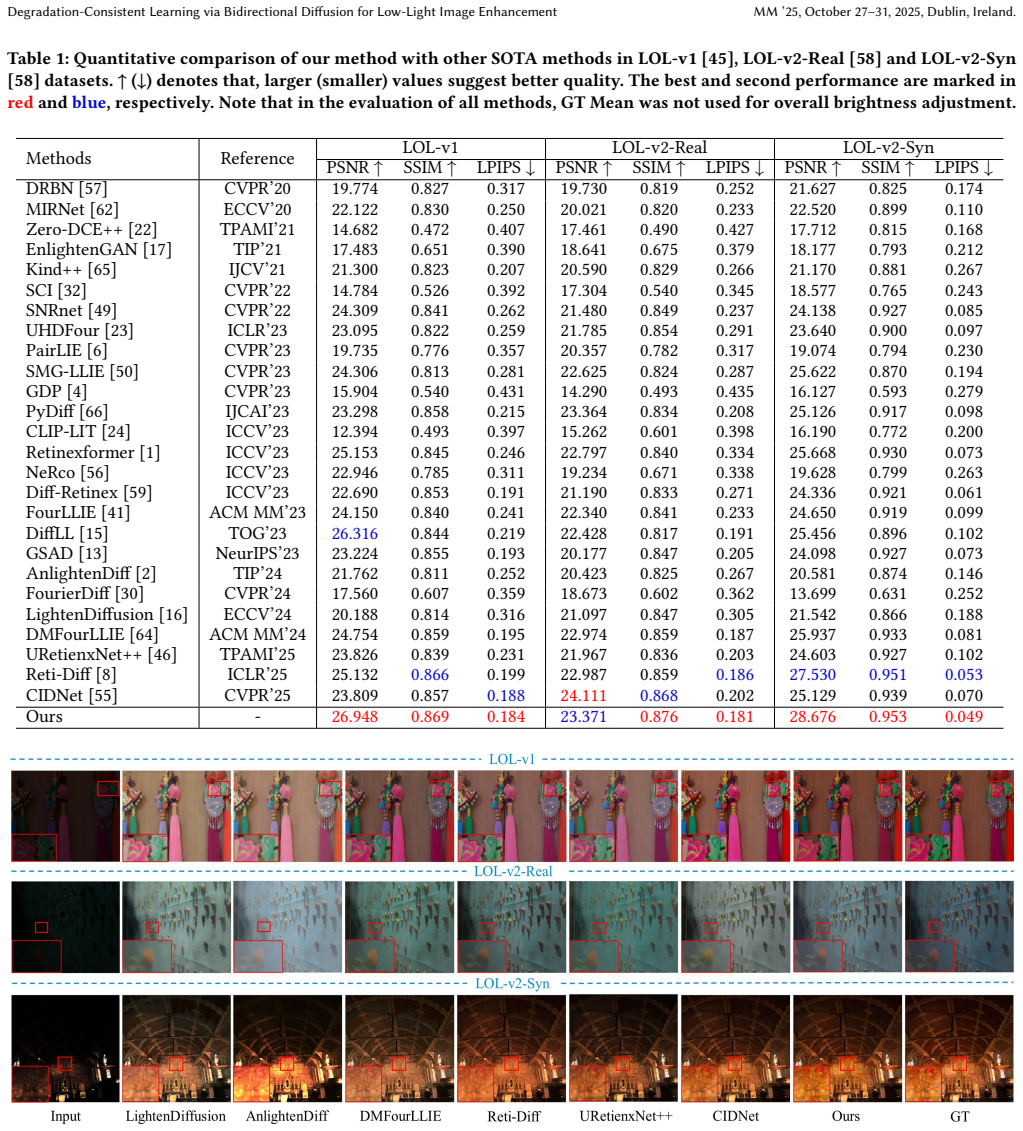
Significance. If the proposed bidirectional training mechanism is validated as described, it would be a useful and reasonably novel contribution to diffusion-based low-light enhancement: it is a training-time strategy that does not add inference cost, and the reported gains over strong baselines (e.g., 26.948 PSNR on LOL-v1 vs. 26.316 for DiffLL in Table 1) are meaningful. The paper also reports parameter counts, full comparison tables, and a code repository link, which are strengths. However, the conceptual core of the method—the implicit symmetry constraint implemented by the second term of Eq. (4)—is not specified well enough to be reproduced, and the ablation evidence for that specific term is weakened by a table inconsistency. The paper's central claim therefore needs clarification and re-analysis before its significance can be fully assessed.
major comments (4)
- [Eq. (4), Section 3.1] The term \bar{\epsilon}_t in the second loss term of Eq. (4) is never defined. The sentence '\bar{\epsilon}_t represents the noise difference \epsilon used at step t for both paths' is not a definition, and the text gives no formula or explanation of how this quantity is obtained from the two paths. Since this term is presented as the implementation of the 'implicit symmetry constraint' that is the paper's central novelty, the loss as written is not implementable from the paper, and the claimed mechanism cannot be verified or reproduced. Please provide the exact definition of \bar{\epsilon}_t, preferably as an explicit formula in terms of the two noise estimates and the forward-process noise, and clarify how it relates to the shared noisy latent x_t shown in Figure 3.
- [Table 5 vs. Table 6, Section 4.5] The ablations do not cleanly isolate the diffusion loss L_diff. The 'w/o L_diff' row in Table 6 reports PSNR 25.648, which is exactly the same as configuration #2 in Table 5 (H2L path without AFI or RACM). If the 'w/o L_diff' model still uses the H2L path, the comparison against the Default row conflates the effect of removing L_diff with the effects of AFI and RACM. Please report the full configuration for each ablation row, and provide an ablation that removes only the second (symmetry) term of Eq. (4) while keeping the first term and the H2L path, so the contribution of the symmetry constraint can be separately assessed.
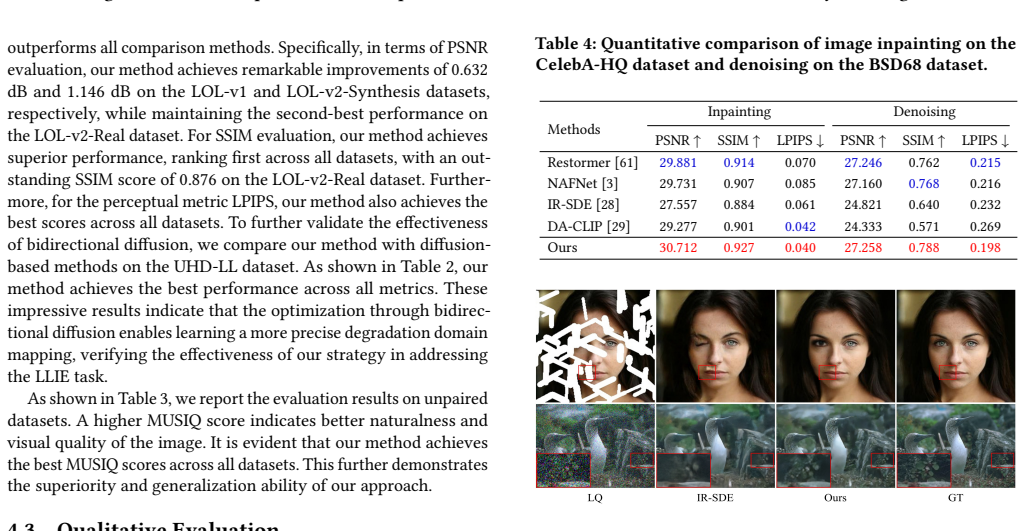
- [Section 4.4, Cross-Task Validation] The cross-task validation on CBSD68 denoising and CelebA-HQ inpainting lacks any training protocol. The model is trained for low-light enhancement, but the text does not state whether the reported denoising/inpainting results use the same LLIE-trained weights without any fine-tuning, or whether the model is retrained or adapted for each task. This is essential for interpreting Table 4: without this information, the 'generalization' claim is not verifiable. Please specify the exact protocol used for each cross-task experiment.
- [Eq. (4), noise prediction formulation] The diffusion objective in Eq. (4) is written as \|\epsilon_t - \epsilon_\theta(x_t,x_l,t)\|^2, but the denoising process described in Section 3.1 and Figure 3 starts from a noisy latent x_t generated from the normal-light image x_h. This raises a consistency question: is the ground-truth noise \epsilon_t associated with the noising of x_h or of x_l, and how is the L2H path's prediction target defined when x_t is not a noised version of x_l? Please clarify this in the text, as it is central to understanding both the forward process and the symmetry constraint.
minor comments (6)
- [Abstract] The sentence 'While diffusion-based methods have shown promising performance due to their strong generative capabilities. However, ...' contains a grammatical error: 'While' starts a dependent clause that is followed by a period, and 'However' then begins a new sentence. Please rewrite for clarity.
- [Section 4.5, Table 5 caption] The caption says 'index H2L AFI RACM' but the table rows show only checkmarks or blank entries for H2L, AFI, and RACM. Please add a legend (e.g., a tick means the component is used) and explicitly indicate that '#4' is the Default configuration, since the text refers to '#4' as the full configuration but the table does not label it as 'Default'.
- [Section 4.5, text] In the ablation discussion, the text states that configuration #2 gives gains of '2.071 dB and 0.23' in PSNR and SSIM. The SSIM gain is 0.858 - 0.835 = 0.023, not 0.23. Please correct this typo.
- [Section 4.5, text] In the 'Effectiveness of the Loss Function' paragraph, the sentence about removing the content loss says 'PSNR and SSIM improve by 1.571 dB and 0.16, respectively'. Comparing w/o L_content (25.378) with Default (26.948), the PSNR difference is 1.570 dB (not 1.571), and the SSIM difference is 0.869 - 0.853 = 0.016 (not 0.16). Please correct these numbers and clarify whether the sentence refers to degradation or improvement.
- [Figure 3] The caption of Figure 3 states that x_t is generated from the normal-light image X_h, but the text of Section 3.1 says 'we first apply forward diffusion to the input real image x_h'. Later, Eq. (4) uses epsilon_theta(x_t, x_l, t) as the L2H prediction. Please make the notation consistent and explain how the L2H path can receive a noisy latent derived from X_h while predicting the noise for X_l.
- [References] Some references appear incomplete or inconsistent: [57] is cited as 'LOL-v2-Real [57]' in the experiments but as Yang et al. 2020 in the reference list, while [58] is the LOL-v2 paper. Please check that all dataset citations point to the correct entries.
Circularity Check
No significant circularity: the central claim is an empirical training objective evaluated against external benchmarks, and the undefined \bar{\epsilon}_t in Eq. (4) is an underspecification rather than a reduction of the result to its inputs.
full rationale
The derivation chain is self-contained. The proposed bidirectional diffusion mechanism is a training-time regularizer: Eq. (4) combines a standard DDPM denoising term with a consistency term that penalizes the difference between the H2L and L2H noise predictions; this is an objective to be optimized, not a parameter fitted to a subset of the test data and then reported as a prediction. All reported improvements are measured on held-out benchmark datasets (LOL-v1, LOL-v2, UHD-LL, DICM/LIME/MEF) against independently published methods, so the central claim does not reduce by construction to an input of the method. The second term in Eq. (4) is indeed under-specified because \bar{\epsilon}_t is never explicitly defined; however, ambiguity in the target of a loss term is a completeness or reproducibility concern, not a circularity in the sense of the target being defined as the output or a fitted value being renamed as a prediction. The self-citations ([11], [52], [53]) appear only in general related-work enumerations of diffusion-based restoration and enhancement methods; they are not invoked as a uniqueness theorem, an ansatz, or otherwise load-bearing premises that force the paper's conclusions. The coincidence between Table 6's "w/o L_diff" entry and Table 5's #2 entry may indicate an ablation confound, but that is an experimental-validity issue, not a circular derivation. Therefore no circular step can be exhibited from the paper's equations or citations.
Assumptions & free parameters
free parameters (3)
- loss weights omega1, omega2, omega3 =
[1, 0.3, 1]
- content loss weights tau1, tau2 =
[0.9, 0.1]
- number of denoising steps =
10
assumptions (3)
- standard math Standard DDPM forward and reverse processes with predefined variance schedule (Eqs. 1 and 2).
- domain assumption Retinex decomposition I = R * L, with reflection R invariant across illumination conditions (Eq. 7).
- ad hoc to paper Implicit symmetry constraint between illumination attenuation and noise distribution across the L2H and H2L paths.
Cite this review
Pith. "Pith review of Degradation-Consistent Learning via Bidirectional Diffusion for Low-Light Image Enhancement." pith.science (2026). https://pith.science/paper/QQ2JHLSV
@misc{pith2026250718144,
  author       = {Pith},
  title        = {Pith review of: Degradation-Consistent Learning via Bidirectional Diffusion for Low-Light Image Enhancement},
  year         = {2026},
  howpublished = {\url{https://pith.science/paper/QQ2JHLSV}},
  note         = {Machine review of arXiv:2507.18144}
}
read the original abstract
Low-light image enhancement aims to improve the visibility of degraded images to better align with human visual perception. While diffusion-based methods have shown promising performance due to their strong generative capabilities. However, their unidirectional modelling of degradation often struggles to capture the complexity of real-world degradation patterns, leading to structural inconsistencies and pixel misalignments. To address these challenges, we propose a bidirectional diffusion optimization mechanism that jointly models the degradation processes of both low-light and normal-light images, enabling more precise degradation parameter matching and enhancing generation quality. Specifically, we perform bidirectional diffusion-from low-to-normal light and from normal-to-low light during training and introduce an adaptive feature interaction block (AFI) to refine feature representation. By leveraging the complementarity between these two paths, our approach imposes an implicit symmetry constraint on illumination attenuation and noise distribution, facilitating consistent degradation learning and improving the models ability to perceive illumination and detail degradation. Additionally, we design a reflection-aware correction module (RACM) to guide color restoration post-denoising and suppress overexposed regions, ensuring content consistency and generating high-quality images that align with human visual perception. Extensive experiments on multiple benchmark datasets demonstrate that our method outperforms state-of-the-art methods in both quantitative and qualitative evaluations while generalizing effectively to diverse degradation scenarios. Code at https://github.com/hejh8/BidDiff
Figures


Figures from the paper (6 more)




Reference graph
Works this paper leans on
-
[52]
Minglong Xue, Jinhong He, Shivakumara Palaiahnakote, and Mingliang Zhou
-
[1]
Yuanhao Cai, Hao Bian, Jing Lin, Haoqian Wang, Radu Timofte, and Yulun Zhang
-
[2]
Cheuk-Yiu Chan, Wan-Chi Siu, Yuk-Hee Chan, and H. Anthony Chan. 2024. AnlightenDiff: Anchoring Diffusion Probabilistic Model on Low Light Image Enhancement. IEEE Transactions on Image Processing 33 (2024), 6324–6339. https: //doi.org/10.1109/TIP.2024.3486610
arXiv 2024
-
[3]
Liangyu Chen, Xiaojie Chu, Xiangyu Zhang, and Jian Sun. 2022. Simple baselines for image restoration. InEuropean conference on computer vision. Springer, 17–33
work page 2022
-
[4]
Ben Fei, Zhaoyang Lyu, Liang Pan, Junzhe Zhang, Weidong Yang, Tianyue Luo, Bo Zhang, and Bo Dai. 2023. Generative Diffusion Prior for Unified Image Restoration and Enhancement. In Proceedings of the IEEE/CVF Conference on Computer Vision and Pattern Recognition . 9935–9946
work page 2023
-
[5]
Xueyang Fu, Delu Zeng, Yue Huang, Xiao-Ping Zhang, and Xinghao Ding. 2016. A weighted variational model for simultaneous reflectance and illumination estimation. In Proceedings of the IEEE conference on computer vision and pattern recognition. 2782–2790
work page 2016
-
[6]
Zhenqi Fu, Yan Yang, Xiaotong Tu, Yue Huang, Xinghao Ding, and Kai-Kuang Ma. 2023. Learning a simple low-light image enhancer from paired low-light instances. In Proceedings of the IEEE/CVF conference on computer vision and pattern recognition. 22252–22261
work page 2023
-
[7]
Xiaojie Guo, Yu Li, and Haibin Ling. 2016. LIME: Low-light image enhancement via illumination map estimation. IEEE Transactions on image processing 26, 2 (2016), 982–993
work page 2016
Show all 72 references
-
[8]
Chunming He, Chengyu Fang, Yulun Zhang, Tian Ye, Kai Li, Longxiang Tang, Zhenhua Guo, Xiu Li, and Sina Farsiu. 2023. Reti-diff: Illumination degradation image restoration with retinex-based latent diffusion model. arXiv preprint arXiv:2311.11638 (2023)
2023 arXiv
-
[9]
Chunming He, Kai Li, Yachao Zhang, Yulun Zhang, Chenyu You, Zhenhua Guo, Xiu Li, Martin Danelljan, and Fisher Yu. 2024. Strategic Preys Make Acute Predators: Enhancing Camouflaged Object Detectors by Generating Camouflaged Objects. In ICLR
2024
-
[10]
Chunming He, Yuqi Shen, Chengyu Fang, Fengyang Xiao, Longxiang Tang, Yulun Zhang, Wangmeng Zuo, Zhenhua Guo, and Xiu Li. 2025. Diffusion models in low-level vision: A survey. IEEE Transactions on Pattern Analysis and Machine Intelligence (2025)
2025
-
[11]
Jinhong He, Minglong Xue, Aoxiang Ning, and Chengyun Song. 2024. Zero- Reference Lighting Estimation Diffusion Model for Low-Light Image Enhance- ment. In The 16th Asian Conference on Machine Learning (Conference Track)
2024
-
[12]
Jonathan Ho, Ajay Jain, and Pieter Abbeel. 2020. Denoising diffusion probabilistic models. Advances in neural information processing systems 33 (2020), 6840–6851
2020
-
[13]
Jinhui Hou, Zhiyu Zhu, Junhui Hou, Hui Liu, Huanqiang Zeng, and Hui Yuan
-
[14]
Huaibo Huang, Ran He, Zhenan Sun, Tieniu Tan, et al. 2018. Introvae: Introspec- tive variational autoencoders for photographic image synthesis. Advances in neural information processing systems 31 (2018)
2018
-
[15]
Hai Jiang, Ao Luo, Haoqiang Fan, Songchen Han, and Shuaicheng Liu. 2023. Low- light image enhancement with wavelet-based diffusion models.ACM Transactions on Graphics (TOG) 42, 6 (2023), 1–14
2023
-
[16]
Hai Jiang, Ao Luo, Xiaohong Liu, Songchen Han, and Shuaicheng Liu. 2025. Lightendiffusion: Unsupervised low-light image enhancement with latent-retinex diffusion models. In European Conference on Computer Vision . Springer, 161–179
2025
-
[17]
Yifan Jiang, Xinyu Gong, Ding Liu, Yu Cheng, Chen Fang, Xiaohui Shen, Jian- chao Yang, Pan Zhou, and Zhangyang Wang. 2021. Enlightengan: Deep light enhancement without paired supervision. IEEE transactions on image processing 30 (2021), 2340–2349
2021
-
[18]
Xin Jin, Ling-Hao Han, Zhen Li, Chun-Le Guo, Zhi Chai, and Chongyi Li. 2023. Dnf: Decouple and feedback network for seeing in the dark. In Proceedings of the IEEE/CVF conference on computer vision and pattern recognition . 18135–18144
2023
-
[19]
Junjie Ke, Qifei Wang, Yilin Wang, Peyman Milanfar, and Feng Yang. 2021. Musiq: Multi-scale image quality transformer. InProceedings of the IEEE/CVF international conference on computer vision . 5148–5157
2021
-
[20]
Edwin H Land and John J McCann. 1971. Lightness and retinex theory. Josa 61, 1 (1971), 1–11
1971
-
[21]
Chulwoo Lee, Chul Lee, and Chang-Su Kim. 2013. Contrast enhancement based on layered difference representation of 2D histograms.IEEE transactions on image processing 22, 12 (2013), 5372–5384
2013
-
[22]
Chongyi Li, Chunle Guo, and Chen Change Loy. 2021. Learning to enhance low-light image via zero-reference deep curve estimation. IEEE Transactions on Pattern Analysis and Machine Intelligence 44, 8 (2021), 4225–4238
2021
-
[23]
Chongyi Li, Chun-Le Guo, Man Zhou, Zhexin Liang, Shangchen Zhou, Ruicheng Feng, and Chen Change Loy. 2023. Embedding fourier for ultra-high-definition low-light image enhancement. arXiv preprint arXiv:2302.11831 (2023)
2023 arXiv
-
[24]
Zhexin Liang, Chongyi Li, Shangchen Zhou, Ruicheng Feng, and Chen Change Loy. 2023. Iterative prompt learning for unsupervised backlit image enhancement. In Proceedings of the IEEE/CVF International Conference on Computer Vision . 8094– 8103
2023
-
[25]
Xinqi Lin, Jingwen He, Ziyan Chen, Zhaoyang Lyu, Bo Dai, Fanghua Yu, Yu Qiao, Wanli Ouyang, and Chao Dong. 2024. Diffbir: Toward blind image restora- tion with generative diffusion prior. In European Conference on Computer Vision . Springer, 430–448
2024
-
[26]
Wenxi Liu, Jiaxin Cai, Qi Li, Chenyang Liao, Jingjing Cao, Shengfeng He, and Yuanlong Yu. 2024. Learning Nighttime Semantic Segmentation the Hard Way. ACM Transactions on Multimedia Computing, Communications and Applications 20, 7 (2024), 1–23
2024
-
[27]
Andreas Lugmayr, Martin Danelljan, Andres Romero, Fisher Yu, Radu Timofte, and Luc Van Gool. 2022. Repaint: Inpainting using denoising diffusion proba- bilistic models. In Proceedings of the IEEE/CVF Conference on Computer Vision and Pattern Recognition. 11461–11471
2022
-
[29]
Ziwei Luo, Fredrik K Gustafsson, Zheng Zhao, Jens Sjölund, and Thomas B Schön
-
[30]
Xiaoqian Lv, Shengping Zhang, Chenyang Wang, Yichen Zheng, Bineng Zhong, Chongyi Li, and Liqiang Nie. 2024. Fourier Priors-Guided Diffusion for Zero-Shot Joint Low-Light Enhancement and Deblurring. In Proceedings of the IEEE/CVF Conference on Computer Vision and Pattern Recogn...
2024
-
[31]
arXiv preprint arXiv:2301.11699 (2023)
Image restoration with mean-reverting stochastic differential equations. arXiv preprint arXiv:2301.11699 (2023)
2023 arXiv
-
[32]
Long Ma, Tengyu Ma, Risheng Liu, Xin Fan, and Zhongxuan Luo. 2022. Toward fast, flexible, and robust low-light image enhancement. In Proceedings of the IEEE/CVF Conference on Computer Vision and Pattern Recognition . 5637–5646
2022
-
[33]
In International Conference on Learning Representations
Controlling Vision-Language Models for Multi-Task Image Restoration. In International Conference on Learning Representations
-
[34]
Michael K Ng and Wei Wang. 2011. A total variation model for retinex. SIAM Journal on Imaging Sciences 4, 1 (2011), 345–365
2011
-
[35]
Kede Ma, Kai Zeng, and Zhou Wang. 2015. Perceptual quality assessment for multi-exposure image fusion. IEEE Transactions on Image Processing 24, 11 (2015), 3345–3356
2015
-
[36]
Chen Hee Ooi and Nor Ashidi Mat Isa. 2010. Quadrants dynamic histogram equalization for contrast enhancement.IEEE Transactions on Consumer Electronics 56, 4 (2010), 2552–2559
2010
-
[37]
David Martin, Charless Fowlkes, Doron Tal, and Jitendra Malik. 2001. A database of human segmented natural images and its application to evaluating segmenta- tion algorithms and measuring ecological statistics. In Proceedings eighth IEEE international conference on computer vi...
2001
-
[38]
Etta D Pisano, Shuquan Zong, Bradley M Hemminger, Marla DeLuca, R Eugene Johnston, Keith Muller, M Patricia Braeuning, and Stephen M Pizer. 1998. Con- trast limited adaptive histogram equalization image processing to improve the detection of simulated spiculations in dense mam...
1998
-
[39]
Aoxiang Ning, Minglong Xue, Jinhong He, and Chengyun Song. 2025. KAN see in the dark. IEEE Signal Processing Letters (2025)
2025
-
[40]
Jiaming Song, Chenlin Meng, and Stefano Ermon. 2020. Denoising diffusion implicit models. arXiv preprint arXiv:2010.02502 (2020)
2020 arXiv
-
[41]
Ozan Özdenizci and Robert Legenstein. 2023. Restoring vision in adverse weather conditions with patch-based denoising diffusion models. IEEE Transactions on Pattern Analysis and Machine Intelligence (2023)
2023
-
[42]
Ruixing Wang, Xiaogang Xu, Chi-Wing Fu, Jiangbo Lu, Bei Yu, and Jiaya Jia. 2021. Seeing dynamic scene in the dark: A high-quality video dataset with mechatronic alignment. In Proceedings of the IEEE/CVF international conference on computer vision. 9700–9709
2021
-
[43]
Shanto Rahman, Md Mostafijur Rahman, Mohammad Abdullah-Al-Wadud, Go- lam Dastegir Al-Quaderi, and Mohammad Shoyaib. 2016. An adaptive gamma correction for image enhancement. EURASIP Journal on Image and Video Process- ing 2016 (2016), 1–13
2016
-
[44]
Zhen Wang, Dongyuan Li, Guang Li, Ziqing Zhang, and Renhe Jiang. 2024. Multimodal low-light image enhancement with depth information. InProceedings of the 32nd ACM International Conference on Multimedia . 4976–4985
2024
-
[45]
Chenxi Wang, Hongjun Wu, and Zhi Jin. 2023. Fourllie: Boosting low-light image enhancement by fourier frequency information. In Proceedings of the 31st ACM International Conference on Multimedia . 7459–7469
2023
-
[46]
Wenhui Wu, Jian Weng, Pingping Zhang, Xu Wang, Wenhan Yang, and Jianmin Jiang. 2025. Interpretable Optimization-Inspired Unfolding Network for Low- Light Image Enhancement. IEEE Transactions on Pattern Analysis and Machine Intelligence (2025)
2025
-
[47]
Zhou Wang, Alan C Bovik, Hamid R Sheikh, and Eero P Simoncelli. 2004. Image quality assessment: from error visibility to structural similarity.IEEE transactions on image processing 13, 4 (2004), 600–612. MM ’25, October 27–31, 2025, Dublin, Ireland. Jinhong He et al
2004
-
[48]
Lintao Xu, Changhui Hu, Yin Hu, Xiaoyuan Jing, Ziyun Cai, and Xiaobo Lu. 2025. UPT-Flow: Multi-scale transformer-guided normalizing flow for low-light image enhancement. Pattern Recognition 158 (2025), 111076
2025
-
[49]
Chen Wei, Wenjing Wang, Wenhan Yang, and Jiaying Liu. 2018. Deep retinex decomposition for low-light enhancement.arXiv preprint arXiv:1808.04560 (2018)
2018 arXiv
-
[50]
Xiaogang Xu, Ruixing Wang, and Jiangbo Lu. 2023. Low-Light Image Enhance- ment via Structure Modeling and Guidance. In Proceedings of the IEEE/CVF Con- ference on Computer Vision and Pattern Recognition (CVPR) . 9893–9903
2023
-
[51]
Yuhui Wu, Guoqing Wang, Zhiwen Wang, Yang Yang, Tianyu Li, Malu Zhang, Chongyi Li, and Heng Tao Shen. 2024. JoReS-Diff: Joint Retinex and Semantic Priors in Diffusion Model for Low-light Image Enhancement. In Proceedings of the 32nd ACM International Conference on Multimedia ....
2024
-
[53]
Xiaogang Xu, Ruixing Wang, Chi-Wing Fu, and Jiaya Jia. 2022. SNR-aware low- light image enhancement. In Proceedings of the IEEE/CVF conference on computer vision and pattern recognition . 17714–17724
2022
-
[54]
Minglong Xue, Palaiahnakote Shivakumara, Chao Zhang, Yao Xiao, Tong Lu, Umapada Pal, Daniel Lopresti, and Zhibo Yang. 2020. Arbitrarily-oriented text detection in low light natural scene images. IEEE Transactions on Multimedia 23 (2020), 2706–2720
2020
-
[55]
Xin Xu, Shiqin Wang, Zheng Wang, Xiaolong Zhang, and Ruimin Hu. 2021. Exploring image enhancement for salient object detection in low light images. ACM transactions on multimedia computing, communications, and applications (TOMM) 17, 1s (2021), 1–19
2021
-
[56]
Shuzhou Yang, Moxuan Ding, Yanmin Wu, Zihan Li, and Jian Zhang. 2023. Im- plicit neural representation for cooperative low-light image enhancement. In Proceedings of the IEEE/CVF International Conference on Computer Vision . 12918– 12927
2023
-
[57]
Wenhan Yang, Shiqi Wang, Yuming Fang, Yue Wang, and Jiaying Liu. 2020. From fidelity to perceptual quality: A semi-supervised approach for low-light image enhancement. In Proceedings of the IEEE/CVF conference on computer vision and pattern recognition. 3063–3072
2020
-
[58]
Minglong Xue, Jinhong He, Wenhai Wang, and Mingliang Zhou. 2024. Low-light image enhancement via clip-fourier guided wavelet diffusion. arXiv preprint arXiv:2401.03788 (2024)
2024 arXiv
-
[59]
Xunpeng Yi, Han Xu, Hao Zhang, Linfeng Tang, and Jiayi Ma. 2023. Diff-retinex: Rethinking low-light image enhancement with a generative diffusion model. In Proceedings of the IEEE/CVF International Conference on Computer Vision . 12302– 12311
2023
-
[60]
Qingsen Yan, Yixu Feng, Cheng Zhang, Guansong Pang, Kangbiao Shi, Peng Wu, Wei Dong, Jinqiu Sun, and Yanning Zhang. 2025. HVI: A New color space for Low-light Image Enhancement. arXiv preprint arXiv:2502.20272 (2025)
2025 arXiv
-
[61]
Syed Waqas Zamir, Aditya Arora, Salman Khan, Munawar Hayat, Fahad Shah- baz Khan, and Ming-Hsuan Yang. 2022. Restormer: Efficient transformer for high-resolution image restoration. In Proceedings of the IEEE/CVF conference on computer vision and pattern recognition . 5728–5739
2022
-
[62]
Syed Waqas Zamir, Aditya Arora, Salman Khan, Munawar Hayat, Fahad Shahbaz Khan, Ming-Hsuan Yang, and Ling Shao. 2020. Learning enriched features for real image restoration and enhancement. In Computer Vision–ECCV 2020: 16th European Conference, Glasgow, UK, August 23–28, 2020,...
2020
-
[63]
Wenhan Yang, Wenjing Wang, Haofeng Huang, Shiqi Wang, and Jiaying Liu
-
[64]
Tongshun Zhang, Pingping Liu, Ming Zhao, and Haotian Lv. 2024. DMFourLLIE: Dual-Stage and Multi-Branch Fourier Network for Low-Light Image Enhance- ment. In Proceedings of the 32nd ACM International Conference on Multimedia . 7434–7443
2024
-
[65]
Yonghua Zhang, Xiaojie Guo, Jiayi Ma, Wei Liu, and Jiawan Zhang. 2021. Beyond brightening low-light images. International Journal of Computer Vision 129 (2021), 1013–1037
2021
-
[66]
Zongsheng Yue, Jianyi Wang, and Chen Change Loy. 2024. Efficient diffusion model for image restoration by residual shifting. IEEE Transactions on Pattern Analysis and Machine Intelligence (2024)
2024
-
[69]
Richard Zhang, Phillip Isola, Alexei A Efros, Eli Shechtman, and Oliver Wang
-
[73]
D Zhou, Z Yang, and Y Yang. 2023. Pyramid Diffusion Models for Low-light Image Enhancement. In International Joint Conference on Artificial Intelligence . IJCAI
2023
-
[2018]
In Proceedings of the IEEE conference on computer vision and pattern recognition
The unreasonable effectiveness of deep features as a perceptual metric. In Proceedings of the IEEE conference on computer vision and pattern recognition . 586–595
-
[2021]
IEEE Transactions on Image Processing 30 (2021), 2072–2086
Sparse gradient regularized deep retinex network for robust low-light image enhancement. IEEE Transactions on Image Processing 30 (2021), 2072–2086
2021
-
[2023]
In Proceedings of the IEEE/CVF international conference on computer vision
Retinexformer: One-stage retinex-based transformer for low-light image enhancement. In Proceedings of the IEEE/CVF international conference on computer vision. 12504–12513
-
[2024]
Advances in Neural Information Processing Systems 36 (2024)
Global structure-aware diffusion process for low-light image enhancement. Advances in Neural Information Processing Systems 36 (2024)
2024
-
[2025]
Pattern Recognition (2025), 112073
Unified image restoration and enhancement: Degradation calibrated cycle reconstruction diffusion model. Pattern Recognition (2025), 112073
2025
Reviewed August 6, 2026 · model on record in the stance chip above.
Discussion (0). Sign in to comment.