REVIEW 4 major objections 5 minor 61 references
Unveiling Skewness Dependence of Quark Wigner Distributions
T0 review · 4 major / 5 minor · reviewed 2026-08-06 · deepseek-v4-flash
Pith's one-line read In the light-front dressed quark model, all leading-twist quark Wigner distributions become skewness-dependent: circular forward-limit patterns give way to dipole and quadrupole lobes, asymmetries, localization, and sign-changing regions…
desk verdict A useful numerical catalog of skewness-dependent quark Wigner distributions in the dressed quark model, but the novelty is overstated and the transform normalization needs a check before the quantitative claims are trusted. read the letter →
The pith
A machine-rendered reading of the paper's core claim, the machinery that carries it, and where it could break.
The reading
What carries the argument
The central object is the quark Wigner distribution, a quantum phase-space quasi-probability distribution over the quark's transverse position $\mathbf{b}_\perp$ and transverse momentum $\mathbf{k}_\perp$, defined as a Fourier transform of the fully unintegrated quark-quark correlator with respect to the rescaled transverse momentum transfer $\mathbf{D}_\perp = \boldsymbol{\Delta}_\perp/(1-\xi^2)$, including a $(1-\xi^2)^{-3/2}$ prefactor. The input is the two-particle light-front wave function of a quark dressed by a gluon, which enters the analytic expressions for all leading-twist GTMDs $F_{1i}, G_{1i}, H_{1j}$. The paper inserts those GTMDs into the correlator decompositions of Eqs. (13)-(15), combines them according to the polarization definitions of Eqs. (12), (19), and (23), and numerically Fourier-transforms the results to obtain the nine Wigner distributions, tracking how the phases and $(1-\xi^2)$ factors alter them as $\xi$ varies.
What would settle it
Recompute the nine Wigner distributions with $\boldsymbol{\Delta}_\perp$ itself (no $(1-\xi^2)$ rescaling in Eq. (9)) as the Fourier variable. If the dipole and quadrupole structures and the localization trend disappear or change sign as $\xi$ grows, the paper's skewness effects are artifacts of the rescaling. A second check: integrate $\rho_{UU}$ over $\mathbf{b}_\perp$ and $\mathbf{k}_\perp$ and verify the result is independent of $\xi$; a $\xi$-dependent normalization would show the distribution is not behaving as a phase-space density.
Extended reading notes
Core claim
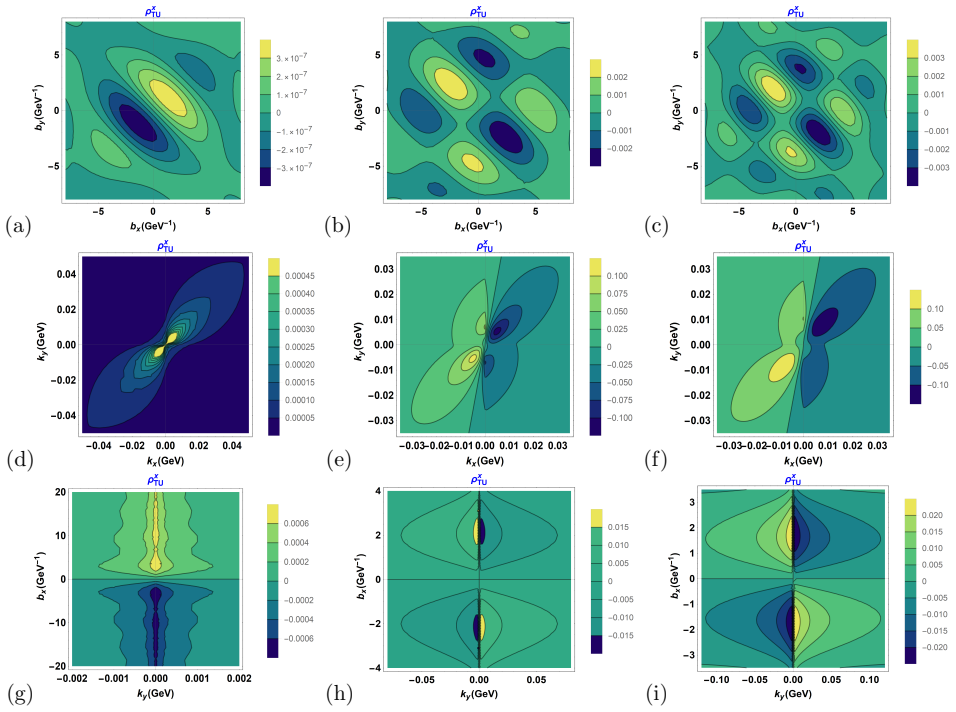
The central discovery is that turning on $\xi$ alters every quark Wigner distribution in the dressed quark model, not just the size of the phase-space support. The unpolarized $\rho_{UU}$, approximately circular at $\xi=0$, distorts and shifts as $\xi$ grows; $\rho_{UL}$ and $\rho^j_{UT}$ show persistent dipole structures in both impact-parameter and momentum space; $\rho_{LL}$ starts as a quadrupole and develops a dipole-like momentum asymmetry; and $\rho^i_{TU}$ and $\rho^i_{TL}$ acquire multipole interference patterns with sign-changing regions. These patterns are shown in transverse impact-parameter space, transverse momentum space, and mixed $(b_x,k_y)$ space. The paper attributes the multipoles to spin-orbit correlations and to interference between light-front wave function components whose orbital angular momentum differs by one or two units.
Load-bearing premise
The result stands on the convention, inherited from earlier off-forward studies, that the Fourier conjugate to the transverse impact parameter is $\mathbf{D}_\perp = \boldsymbol{\Delta}_\perp/(1-\xi^2)$ with a $(1-\xi^2)^{-3/2}$ prefactor; if that is not the correct $\xi$-generalization of the Wigner phase-space definition, every plotted pattern and localization trend changes.
Editorial extensions
If this is right
- At nonzero $\xi$, all nine leading-twist quark Wigner distributions lose the rotational symmetry of the forward limit, so any observable sensitive to off-forward phase space should see dipole or quadrupole lobes and negative regions.
- The transverse localization that grows with $\xi$ means large-skewness kinematics sharply reduce the overlap between initial and final state wave functions, redistributing the quark density into a narrower phase-space region.
- The dipole in $\rho_{UL}$ and the quadrupole in $\rho_{LL}$ provide model-level signatures of spin-orbit correlation and quark orbital angular momentum that can be compared with other hadron models.
- The momentum-space asymmetries, analogous to T-odd transverse-momentum-dependent effects, are enhanced by skewness, so off-forward kinematics amplify spin-momentum correlations.
- Because the GTMDs carry explicit $\xi$ factors such as $(1-\xi^2)$ and $(x^2-\xi^2)$, the model makes quantitative predictions for how each multipole moment of the Wigner distribution scales with skewness, testable in lattice QCD or in other light-front models.
Reading between the lines
- The paper does not compare its rescaled Fourier convention against the alternative of Fourier transforming directly in $\boldsymbol{\Delta}_\perp$; that comparison would show whether the reported multipoles survive under a different off-forward phase-space definition.
- A natural next step is to apply the same skewness-dependent machinery to gluon Wigner distributions in the same dressed quark model; if the gluon patterns mimic the quark ones, the multipole mechanism is generic rather than quark-specific.
- One could also test the paper's localization claim by computing the variance $\langle \mathbf{b}_\perp^2\rangle$ as a function of $\xi$ from the plotted distributions; a monotonic decrease would confirm the squeezing, while a plateau would call the interpretation into question.
Editorial analysis
A structured set of objections, weighed in public.
Referee Report
Summary. This manuscript studies the skewness (ξ) dependence of the nine leading-twist quark Wigner distributions in the light-front dressed quark model. Starting from published analytic GTMDs with nonzero ξ (Appendix A, taken from Ref. [39]) and from Wigner master formulas quoted from Refs. [39,40], it evaluates ρ for unpolarized, longitudinally, and transversely polarized quarks in targets of each polarization, plotting the distributions in transverse impact-parameter space, transverse momentum space, and a mixed (bx,ky) space for ξ=0, 0.25, 0.5, and for ρ_UU as a function of ξ from 0 to 0.5. The central claim is that increasing ξ distorts the forward-limit distributions, produces dipole and quadrupole patterns, breaks rotational/time-reversal symmetry, and localizes the phase-space support through reduced initial-final overlap and interference between light-front wave function components of different orbital angular momentum. The paper contains no data fitting; all results are numerical evaluations of closed-form model expressions.
Significance. The paper's qualitative claims—ξ-dependent localization, symmetry breaking, and multipole formation in every leading-twist channel—are, if correct, a useful model-level benchmark for off-forward phase-space tomography and could guide lattice QCD and exclusive-process phenomenology. The manuscript deserves credit for covering all nine polarization channels systematically, for working with analytic input, and for not introducing any fit parameters. In its present form, however, the contribution is essentially a numerical elaboration of self-cited analytic results [39,40], and the two load-bearing conventions it imports (the D⊥-space Wigner definition and the form of the GTMDs) are not derived or checked here. The significance is therefore conditional on resolving the technical issues below; the qualitative pattern claims are falsifiable and would be interesting if the definitions are confirmed.
major comments (4)
- [Sec. III, Eqs. (9), (10), (16)-(26)] The off-forward Wigner transform is not derived. With D⊥ = Δ⊥/(1−ξ²), the Jacobian is d²D⊥ = (1−ξ²)^{-2} d²Δ⊥, so Eq. (10) combined with the change of variables gives a prefactor (1−ξ²)^{-2}, not (1−ξ²)^{-3/2}, unless the spinor contraction in Eq. (13) supplies an additional (1−ξ²)^{1/2}. The paper simply cites [39,40] for Eqs. (16)–(26), but those equations are the paper's own central definitions and the extra factor is never exhibited. This matters because the overall (1−ξ²)-dependent prefactor rescales every ξ column in Figs. 1–7, so the claimed 'more pronounced' multipole patterns and localization with increasing ξ may be partly an artifact of the normalization convention. The authors should derive one representative Wigner formula from Eqs. (11)–(15), or state explicitly the convention used in [39,40] for the spinor factor.
- [Appendix A, Eqs. (A2), (A3), (A9)–(A16), and (A19)] The auxiliary function β in Eq. (A19) is α/[(1−x)(k2Δ1−k1Δ2)], and several GTMDs contain terms without a cross-product factor in the numerator. For example, F1,2 and the second square bracket in F1,3 are proportional to β times quantities such as 4m²ξ(1+x)k⊥·Δ⊥ or 8m²(1−x)²[2(1+x)ξk⊥−(1−x)xΔ⊥]·k⊥, which do not vanish when k∥Δ. As written, these GTMDs therefore have singularities along Δ⊥∥k⊥, and the subsequent 2D Fourier integrals over Δ⊥ would be at least logarithmically divergent unless regularized. This is a load-bearing issue for the numerical analysis because the Wigner plots of ρ_TU, ρ_TL, ρ_TT, and ρ_UL inherit such terms. Please verify these expressions against the original derivation, correct any transcription errors, and state how the numerical integration avoids the singular locus.
- [Sec. IV.A and Sec. V (Conclusion)] There is a direct contradiction about the ξ=0 baseline. Section IV A states that at ξ=0 in impact-parameter space ρ_UU has 'approximate rotational symmetry and a quadruple-like structure,' while the concluding paragraph says it 'shows circular symmetry at ξ = 0.' A quadrupole pattern is not circular, and with k⊥ fixed to 0.4 y-hat one would not expect exact circular symmetry at ξ=0. The authors should specify the precise zero-skewness baseline and then formulate the 'emergence' of multipoles with ξ relative to that baseline; as written, the central qualitative claim is internally inconsistent.
- [Sec. IV, Numerical Analysis] The numerical setup is under-specified in ways that affect reproducibility and interpretation. The text says 'x was integrated over the DGLAP region (ξ < x < 1),' but ρ in Eqs. (16)–(26) is a function of x and no x-integrated quantity is defined; if x was integrated, the plots should be labeled or the equations changed. In addition, the values of m=0.0033 GeV and Δ_max=1 GeV, the fixed transverse coordinates k⊥=0.4 y-hat and b⊥=0.4 y-hat GeV^-1, and the mixed-space integration ranges [0,0.4] are stated without justification, and no convergence check with respect to Δ_max or the grid is reported. Since the conclusions are purely qualitative statements about the shapes of the plots, a sensitivity check is needed to establish that the observed lobes and localizations are not numerical artifacts.
minor comments (5)
- [Sec. III, Eq. (10)] Eq. (10) writes W[Γ](x,ξ,Δ⊥,k⊥;S) but the integration variable is D⊥; after the substitution the argument should be written consistently as a function of D⊥ (or the relation should be stated).
- [Appendix A, Eq. (A18)] The quantities q⊥, y, q′⊥, and x′ entering D(q⊥,y) and D∗(q′⊥,x′) are never defined in the manuscript, so the appendix is not self-contained; define them in terms of x, ξ, k⊥, and Δ⊥ or state the mapping to Ref. [39] explicitly.
- [Appendix A, p. 24] The phrase 'The and auxiliary functions α, and D are defined as:' contains a typo and should read 'The auxiliary functions α and D are defined as:'.
- [Abstract and Sec. IV] In the abstract, 'using the analytical expression all leading-twist GTMDs' is missing 'of'; and in Sec. IV, 'The parton longitudinal momentum fraction x was integrated over' conflicts with the x-dependent definitions in Eqs. (16)–(26).
- [Fig. 1] Figure 1's caption uses 'left, middle, and right panels' but does not label the rows; given that the text refers to top/middle/bottom rows, adding row labels would aid readability.
Circularity Check
No significant circularity: the skewness-dependent Wigner distributions are Fourier transforms of previously published GTMDs, not fitted parameters or definitional identities.
full rationale
The paper's derivation chain is straightforward: it takes the analytic skewness-dependent GTMDs for the light-front dressed quark model (Appendix A, with the computation attributed to ref. [39]), inserts them into the defining Fourier transform of the off-forward Wigner distribution (Eqs. (9)-(10), with master formulas cited from refs. [39,40]), and numerically evaluates the resulting integrals. No parameter is fitted to a subset of data and then renamed as a prediction, and no uniqueness theorem is invoked to force the chosen Wigner convention. The observed dipole/quadrupole/localization features are literal Fourier transforms of the input GTMDs; they are consequences of the stated model input, not identities that presuppose the conclusions. The use of refs. [39,40] is indeed a self-citation chain, since the GTMD input and the Wigner master formulas are not rederived in this paper, but the cited GTMD computation is parameter-free within the stated dressed-quark assumptions and those assumptions do not include the Wigner-distribution phenomenology being reported. The cited result is therefore real prior evidence rather than a circular justification. Concerns about the (1-xi^2)^(-3/2) normalization factor in Eqs. (16)-(26) and about the wording 'quadruple-like' versus 'circular symmetry' at xi=0 are correctness or consistency issues, not instances of a derivation reducing to its own inputs.
Assumptions & free parameters
free parameters (5)
- quark mass m =
0.0033 GeV
- transverse momentum transfer cutoff Delta_max =
1 GeV
- fixed transverse momentum k_perp = 0.4 y-hat GeV =
0.4 y-hat GeV
- fixed impact parameter b_perp = 0.4 y-hat GeV^-1 =
0.4 y-hat GeV^-1
- mixed-space integration ranges kx, by in [0, 0.4] =
kx and by in [0, 0.4]
assumptions (5)
- domain assumption Dressed quark Fock-state truncation to the quark plus one gluon sector
- domain assumption Leading-twist GTMD parametrization of the quark-quark correlator in Eqs. (13)-(15)
- domain assumption Wigner distributions obtained by Fourier transform over D_perp = Delta_perp/(1-xi^2) with prefactor (1-xi^2)^(-3/2)
- domain assumption Quark longitudinal fraction x integrated only over the DGLAP region (xi < x < 1)
- standard math Light-front gauge A+ = 0 makes the Wilson line unity
Cite this review
Pith. "Pith review of Unveiling Skewness Dependence of Quark Wigner Distributions." pith.science (2026). https://pith.science/paper/T2TI4QBV
@misc{pith2026250718168,
  author       = {Pith},
  title        = {Pith review of: Unveiling Skewness Dependence of Quark Wigner Distributions},
  year         = {2026},
  howpublished = {\url{https://pith.science/paper/T2TI4QBV}},
  note         = {Machine review of arXiv:2507.18168}
}
abstract
We present a detailed investigation of the skewness dependence of quark Wigner distributions within the light-front dressed quark model. While previous studies have largely focused on the forward limit, we explore the impact of nonzero longitudinal momentum transfer (\(\xi \neq 0\)) on the full set of leading-twist quark Wigner distributions across various polarization configurations. We observe characteristic distortions in the spatial and momentum correlations with increasing skewness, including the emergence of dipole and quadrupole patterns, asymmetries, and localization effects. These features reflect spin-orbit correlations and quantum interference between light-front wave function components with differing orbital angular momentum.
Figures


Figures from the paper (4 more)



Reference graph
Works this paper leans on
-
[39]
Gluon generalized TMDs and Wigner dis- tributions in boost invariant longitudinal space
Sujit Jana, Vikash Kumar Ojha, and Tanmay Maji. Gluon generalized TMDs and Wigner dis- tributions in boost invariant longitudinal space. Nucl. Phys. A , 1053:122958, 2025
work page 2025
-
[1]
A. Accardi et al. Electron Ion Collider: The Next QCD Frontier: Understanding the glue that binds us all. Eur. Phys. J. A , 52(9):268, 2016. 25
work page 2016
-
[2]
and ¯ψ(−z 2). In the light-front gauge A+ = 0, this Wilson line becomes unity, simplifying the analysis within perturbative models. The choice of Γ ∈{ γ+,γ +γ5,iσ +jγ5} corresponds to the unpolarized, longitudinally polarized, and transversely polarized quark distributions, respectively. A. Unpolarized T arget Following the convention adopted in [28], the...
-
[3]
Daniele P. Anderle et al. Electron-ion collider in China. Front. Phys. (Beijing) , 16(6):64701, 2021
work page 2021
-
[4]
M Gl¨ uck, E Reya, and A Vogt. Dynamical parton distributions revisited.The European Physical Journal C-Particles and Fields , 5(3):461–470, 1998
work page 1998
-
[5]
Dynamical parton distributions of the proton and small-x physics
Moshe Gl¨ uck, Ewald Reya, and Andreas Vogt. Dynamical parton distributions of the proton and small-x physics. Zeitschrift f¨ ur Physik C Particles and Fields , 67(3):433–447, 1995
work page 1995
-
[6]
Parton distributions: A new global analysis
Alan D Martin, RG Roberts, WJames Stirling, and RS Thorne. Parton distributions: A new global analysis. The European Physical Journal C-Particles and Fields , 4(3):463–496, 1998
work page 1998
-
[7]
C´ edric Lorc´ e, A. Metz, B. Pasquini, and P. Schweitzer. Parton Distribution Functions and their Generalizations. 7 2025
work page 2025
Show all 61 references
-
[8]
The proton size
Jean-Philippe Karr, Dominique Marchand, and Eric Voutier. The proton size. Nature Rev. Phys., 2(11):601–614, 2020
2020
-
[9]
The Structure of the Proton in the LHC Precision Era
Jun Gao, Lucian Harland-Lang, and Juan Rojo. The Structure of the Proton in the LHC Precision Era. Phys. Rept., 742:1–121, 2018
2018
-
[10]
Experimental exploration of the 3D nucleon structure
Stefan Diehl. Experimental exploration of the 3D nucleon structure. Prog. Part. Nucl. Phys. , 133:104069, 2023
2023
-
[11]
The x-dependence of hadronic parton distributions: A review on the progress of lattice QCD
Martha Constantinou. The x-dependence of hadronic parton distributions: A review on the progress of lattice QCD. Eur. Phys. J. A , 57(2):77, 2021
2021
-
[12]
Unraveling hadron structure with generalized parton distributions
Andrei V Belitsky and AV Radyushkin. Unraveling hadron structure with generalized parton distributions. Physics reports, 418(1-6):1–387, 2005
2005
-
[13]
Generalized parton distributions
Markus Diehl. Generalized parton distributions. Physics Reports, 388(2-4):41–277, 2003
2003
-
[14]
Deeply virtual compton scattering
Xiangdong Ji. Deeply virtual compton scattering. Physical Review D , 55(11):7114, 1997
1997
-
[15]
Generalized Parton Distributions of the Photon with Helicity Flip
Asmita Mukherjee, Sreeraj Nair, and Vikash Kumar Ojha. Generalized Parton Distributions of the Photon with Helicity Flip. Phys. Lett. B , 721:284–289, 2013
2013
-
[16]
Final-state interactions and single-spin asymmetries in semi-inclusive deep inelastic scattering
Stanley J Brodsky, Dae Sung Hwang, and Ivan Schmidt. Final-state interactions and single-spin asymmetries in semi-inclusive deep inelastic scattering. Physics Letters B , 530(1-4):99–107, 2002
2002
-
[17]
Semi-inclusive deep inelastic scattering at small transverse momentum
Alessandro Bacchetta, Markus Diehl, Klaus Goeke, Andreas Metz, Piet J Mulders, and Marc Schlegel. Semi-inclusive deep inelastic scattering at small transverse momentum. Journal of High Energy Physics, 2007(02):093, 2007. 26
2007
-
[18]
Transverse polarisation of quarks in hadrons
Vincenzo Barone, Alessandro Drago, and Philip G Ratcliffe. Transverse polarisation of quarks in hadrons. Physics reports, 359(1-2):1–168, 2002
2002
-
[19]
The complete tree-level result up to order 1/q for polarized deep-inelastic leptoproduction
PJ Mulders and RD Tangerman. The complete tree-level result up to order 1/q for polarized deep-inelastic leptoproduction. Nuclear Physics B , 461(1-2):197–237, 1996
1996
-
[20]
TMD Handbook
Renaud Boussarie et al. TMD Handbook. 4 2023
2023
-
[21]
Echevarria, Ignazio Scimemi, and Alexey Vladimirov
Miguel G. Echevarria, Ignazio Scimemi, and Alexey Vladimirov. Unpolarized Transverse Mo- mentum Dependent Parton Distribution and Fragmentation Functions at next-to-next-to-leading order. JHEP, 09:004, 2016
2016
-
[22]
On the quantum correction for thermodynamic equilibrium
Eugene Wigner. On the quantum correction for thermodynamic equilibrium. Physical review, 40(5):749, 1932
1932
-
[23]
Viewing the proton through “color” filters
Xiangdong Ji. Viewing the proton through “color” filters. Physical review letters , 91(6):062001, 2003
2003
-
[24]
Belitsky, Xiang-dong Ji, and Feng Yuan
Andrei V. Belitsky, Xiang-dong Ji, and Feng Yuan. Quark imaging in the proton via quantum phase space distributions. Phys. Rev. D , 69:074014, 2004
2004
-
[25]
Wigner distribution of sine-gordon and kink solitons
Ramkumar Radhakrishnan and Vikash Kumar Ojha. Wigner distribution of sine-gordon and kink solitons. Modern Physics Letters A , 37(37n38):2250236, 2022
2022
-
[26]
Generalized parton correlation functions for a spin-1/2 hadron
Stephan Meißner, Andreas Metz, and Marc Schlegel. Generalized parton correlation functions for a spin-1/2 hadron. Journal of High Energy Physics , 2009(08):056, 2009
2009
-
[27]
Structure analysis of the generalized correlator of quark and gluon for a spin-1/2 target
C´ edric Lorce and Barbara Pasquini. Structure analysis of the generalized correlator of quark and gluon for a spin-1/2 target. Journal of High Energy Physics , 2013(9):1–30, 2013
2013
-
[28]
Unified framework for generalized and transverse-momentum dependent parton distributions within a 3Q light-cone picture of the nucleon
Cedric Lorce, Barbara Pasquini, and Marc Vanderhaeghen. Unified framework for generalized and transverse-momentum dependent parton distributions within a 3Q light-cone picture of the nucleon. JHEP, 05:041, 2011
2011
-
[29]
Quark orbital angular momentum from wigner distributions and light-cone wave functions
C´ edric Lorc´ e, Barbara Pasquini, Xiaonu Xiong, and Feng Yuan. Quark orbital angular momentum from wigner distributions and light-cone wave functions. Physical Review D, 85(11):114006, 2012
2012
-
[30]
Quark wigner distributions and orbital angular momentum
Cedric Lorce and Barbara Pasquini. Quark wigner distributions and orbital angular momentum. Physical Review D , 84(1):014015, 2011
2011
-
[31]
Wigner distributions for gluons in a light-front dressed quark model
Asmita Mukherjee, Sreeraj Nair, and Vikash Kumar Ojha. Wigner distributions for gluons in a light-front dressed quark model. Physical Review D , 91(5):054018, 2015. 27
2015
-
[32]
Quark wigner distributions and orbital angular momentum in light-front dressed quark model
Asmita Mukherjee, Sreeraj Nair, and Vikash Kumar Ojha. Quark wigner distributions and orbital angular momentum in light-front dressed quark model. Physical Review D , 90(1):014024, 2014
2014
-
[33]
Wigner distributions and gtmds in a proton using light-front quark–diquark model
Satvir Kaur and Harleen Dahiya. Wigner distributions and gtmds in a proton using light-front quark–diquark model. Nuclear Physics B , 937:272–302, 2018
2018
-
[34]
Quark wigner distributions in a light-cone spectator model
Tianbo Liu and Bo-Qiang Ma. Quark wigner distributions in a light-cone spectator model. Physical Review D , 91(3):034019, 2015
2015
-
[35]
Wigner distributions and orbital angular momentum of a proton
D Chakrabarti, T Maji, C Mondal, and A Mukherjee. Wigner distributions and orbital angular momentum of a proton. The European Physical Journal C , 76(7):1–16, 2016
2016
-
[36]
Quark wigner distributions and spin-spin correlations
D Chakrabarti, T Maji, C Mondal, and A Mukherjee. Quark wigner distributions and spin-spin correlations. Physical Review D , 95(7):074028, 2017
2017
-
[37]
Quark wigner distributions using light-front wave functions
Jai More, Asmita Mukherjee, and Sreeraj Nair. Quark wigner distributions using light-front wave functions. Physical Review D , 95(7):074039, 2017
2017
-
[38]
Wigner distributions for gluons
Jai More, Asmita Mukherjee, and Sreeraj Nair. Wigner distributions for gluons. The European Physical Journal C , 78:1–15, 2018
2018
-
[40]
Quark generalized tmds at skewness and wigner distributions in boost invariant longitudinal space
Vikash Kumar Ojha, Sujit Jana, and Tanmay Maji. Quark generalized tmds at skewness and wigner distributions in boost invariant longitudinal space. Physical Review D , 107(7):074040, 2023
2023
-
[41]
Leading twist gtmds at nonzero skew- ness and wigner distributions in boost-invariant longitudinal position space
Tanmay Maji, Chandan Mondal, and Daekyoung Kang. Leading twist gtmds at nonzero skew- ness and wigner distributions in boost-invariant longitudinal position space. Physical Review D , 105(7):074024, 2022
2022
-
[42]
Gabriel Santiago, Kyle Shiells, and Jinghong Yang
Yuxun Guo, Xiangdong Ji, M. Gabriel Santiago, Kyle Shiells, and Jinghong Yang. Generalized parton distributions through universal moment parameterization: non-zero skewness case. JHEP, 05:150, 2023
2023
-
[43]
Mamo and Ismail Zahed
Kiminad A. Mamo and Ismail Zahed. Quark and gluon GPDs at finite skewness from strings in holographic QCD: Evolved and compared with experiment. Phys. Rev. D , 108(8):086026, 2023
2023
-
[44]
GPDs at non-zero skewness in ADS/QCD model
Matteo Rinaldi. GPDs at non-zero skewness in ADS/QCD model. Phys. Lett. B , 771:563–567, 2017. 28
2017
-
[45]
Gluon generalized parton distributions of the proton at nonzero skewness
Dipankar Chakrabarti, Poonam Choudhary, Bheemsehan Gurjar, Tanmay Maji, Chandan Mon- dal, and Asmita Mukherjee. Gluon generalized parton distributions of the proton at nonzero skewness. Phys. Rev. D , 109(11):114040, 2024
2024
-
[46]
Pion generalized parton distribution from lattice QCD
Jiunn-Wei Chen, Huey-Wen Lin, and Jian-Hui Zhang. Pion generalized parton distribution from lattice QCD. Nucl. Phys. B , 952:114940, 2020
2020
-
[47]
Combining lattice QCD and phenomenological inputs on generalised parton distributions at moderate skewness
Michael Joseph Riberdy, Herv´ e Dutrieux, C´ edric Mezrag, and Pawe l Sznajder. Combining lattice QCD and phenomenological inputs on generalised parton distributions at moderate skewness. Eur. Phys. J. C , 84(2):201, 2024
2024
-
[48]
Mamo and Ismail Zahed
Kiminad A. Mamo and Ismail Zahed. String-based parametrization of nucleon GPDs at any skewness: A comparison to lattice QCD. Phys. Rev. D , 110(11):114016, 2024
2024
-
[49]
Ex- clusive double quarkonium production and generalized TMDs of gluons.Phys
Shohini Bhattacharya, Andreas Metz, Vikash Kumar Ojha, Jeng-Yuan Tsai, and Jian Zhou. Ex- clusive double quarkonium production and generalized TMDs of gluons.Phys. Lett. B, 833:137383, 2022
2022
-
[50]
Accessing the gluon GTMD F1,4 in exclusive π0 production in ep collisions
Shohini Bhattacharya, Duxin Zheng, and Jian Zhou. Accessing the gluon GTMD F1,4 in exclusive π0 production in ep collisions. Phys. Rev. D , 109(9):096029, 2024
2024
-
[51]
An introduction to light-front dynamics for pedestrians
Avaroth Harindranath. An introduction to light-front dynamics for pedestrians. arXiv preprint hep-ph/9612244, 1996
1996 arXiv
-
[52]
Light-front dynamics and light-front qcd
Wei-Min Zhang. Light-front dynamics and light-front qcd. arXiv preprint hep-ph/9412244 , 1994
1994 arXiv
-
[53]
Light-cone wavefunction representation of deeply virtual compton scattering
Stanley J Brodsky, Markus Diehl, and Dae Sung Hwang. Light-cone wavefunction representation of deeply virtual compton scattering. Nuclear Physics B , 596(1-2):99–124, 2001
2001
-
[54]
Single transverse spin asymmetries in semi-inclusive deep inelastic scattering in a spin-1 diquark model
Narinder Kumar and Harleen Dahiya. Single transverse spin asymmetries in semi-inclusive deep inelastic scattering in a spin-1 diquark model. The European Physical Journal A , 51(4):51, 2015
2015
-
[55]
Transverse-momentum distributions in a diquark spectator model
Alessandro Bacchetta, Francesco Conti, and Marco Radici. Transverse-momentum distributions in a diquark spectator model. Physical Review D , 78(7):074010, 2008
2008
-
[56]
Electron in three-dimensional momentum space
Alessandro Bacchetta, Luca Mantovani, and Barbara Pasquini. Electron in three-dimensional momentum space. Physical Review D , 93(1):013005, 2016
2016
-
[57]
Nonperturbative description of deep inelas- tic structure functions in light-front qcd
A Harindranath, Rajen Kundu, and Wei-Min Zhang. Nonperturbative description of deep inelas- tic structure functions in light-front qcd. Physical Review D , 59(9):094012, 1999
1999
-
[58]
Orbital angular momentum in deep inelastic scattering
A Harindranath and Rajen Kundu. Orbital angular momentum in deep inelastic scattering. 29 Physical Review D , 59(11):116013, 1999
1999
-
[59]
Light-front qcd
Wei-Min Zhang and Avaroth Harindranath. Light-front qcd. ii. two-component theory. Physical Review D, 48(10):4881, 1993
1993
-
[60]
Light front quark-diquark model for the nucleons
Tanmay Maji and Dipankar Chakrabarti. Light front quark-diquark model for the nucleons. Physical Review D , 94(9):094020, 2016
2016
-
[61]
Generalized parton distributions of the photon with helicity flip
Asmita Mukherjee, Sreeraj Nair, and Vikash Kumar Ojha. Generalized parton distributions of the photon with helicity flip. Physics Letters B , 721(4-5):284–289, 2013. 30
2013
Reviewed August 6, 2026 · model on record in the stance chip above.
Discussion (0). Continue with ORCID to comment.